
For as long as I can remember, I’ve always been fascinated by Citizen pilot watches. I think that has something to do with drooling over many of the earlier Blue Angels examples as a kid. Now well into my collecting journey, I’ve grown to more deeply appreciate the vast catalog of light-driven Citizen watches, especially the ones designed for flying. These light-driven movements are a big part of the draw. You set it, you wear it, you leave it in a drawer for a month, and it’s still keeping the correct time when you come back. That’s the thread connecting the two Citizens I want to talk about here: the Promaster Navihawk 40 and the blacked-out Nighthawk BJ7019-62E.
Both run on Eco-Drive, both carry the aviation-tool DNA Citizen has spent decades refining, and both land within a few dollars of each other. One is a chronograph. The other is a GMT. Between them, they cover most of what one person could reasonably ask a watch to do in a given week, which is the thing I kept circling while wearing them. If a set-and-forget Citizen can carry that much of your rotation on its own, how do you choose between the two that do it best? I’ve spent real time with each, so let’s get into where they line up and where they pull apart.
Overview and Identity

The Navihawk 40 is the one that stole my heart recently. Citizen sent it over as a loan, and I fully expected to admire it, write it up, and ship it back. Instead it spent the better part of a week talking me out of a plan I’d been sitting on for months. The short version is that I’d reserved a slot in my collection for an expensive Swiss mechanical chronograph, and while I reviewed it hands-on this 40mm Citizen made me wonder what I thought that slot was really for. It gives you a 1/5-second chronograph, a slide rule bezel, a 24-hour scale, and a date, all wrapped in a case that finally wears like something you’d put on without a second thought. I don’t own it yet. By the end of the loan I’d stopped asking whether I would and started asking when.
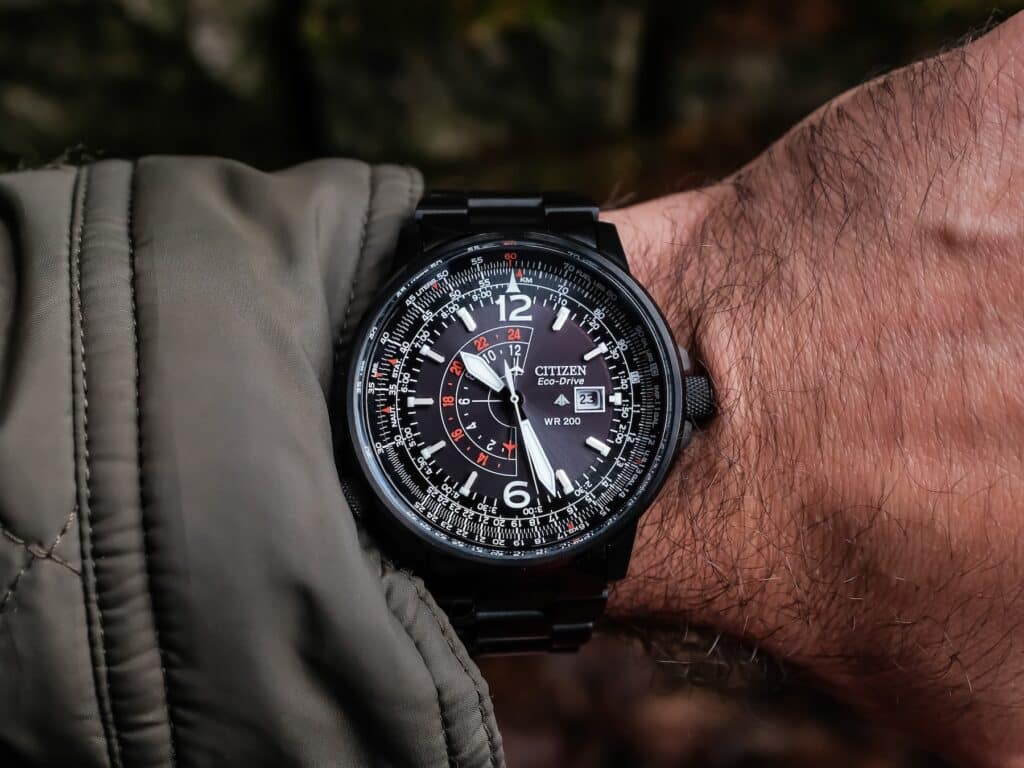
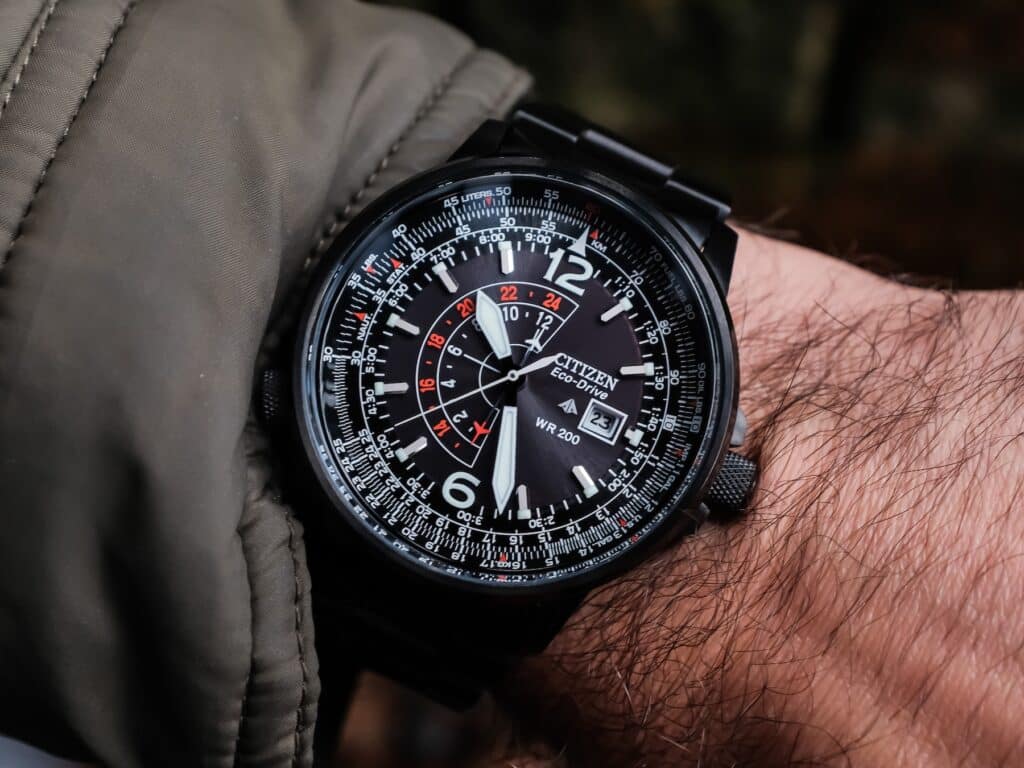
The Nighthawk is the one already in my box, and it got there the long way. I bought a standard steel version years ago, sold it, missed it, and eventually circled back to this blacked-out JDM variant (the whole arc is in my hands-on review). Citizen doesn’t officially use the Nighthawk name outside the U.S., so this Japanese-market piece is technically a different reference, though on the wrist the distinction is academic. What sets it apart is tone. The black ion plating pushes it away from straightforward pilot utility and into something with more edge. It runs a true GMT via the B877 Eco-Drive caliber, complete with a jumping local hour hand, which makes it one of the more affordable ways into real travel-GMT territory.
- The Navihawk 40 is the everyday chronograph that finally shrank to a size worth wearing daily, and it’s the one I’m planning to buy.
- The Nighthawk BJ7019-62E is the blacked-out true GMT already living in my collection, built for presence and second-time-zone duty more than for disappearing on the wrist.
Dial, Bracelet & Wearability: An Everyday Chronograph vs a Deliberate GMT
Given how much Citizen crammed onto the Navihawk’s dial, it has no business being as readable as it is. Three black subdials with a raised concentric texture sit against a silver-white sunburst base, and that contrast does most of the organizing for you. Red accents on the inner scale and the central chronograph hand steer your eye without shouting. At a glance you get the time. Lean in and there’s a slide rule, a 24-hour track, and enough detail to keep a watch nerd busy for a week. The date sits deeper under the dial than I’d like, which makes it harder to catch from an angle, but that’s a small tax on a layout this dense.

The bigger surprise was the bracelet. I usually swap Citizen tool watches onto rubber or nylon within a few days, and I tried both here. They looked right, and either would suit a pilot’s chronograph. I kept coming back to the three-link bracelet anyway. It gives the 40mm case enough weight to feel planted without turning into a boat anchor, and at 44.3mm lug-to-lug and 13.4mm thick, it slips under a cuff far more willingly than the older 48mm Navihawks ever did. The clasp snaps shut with real confidence. My one ask is an on-the-fly adjustment, which is getting common in this range and would make hot-day sizing easier.
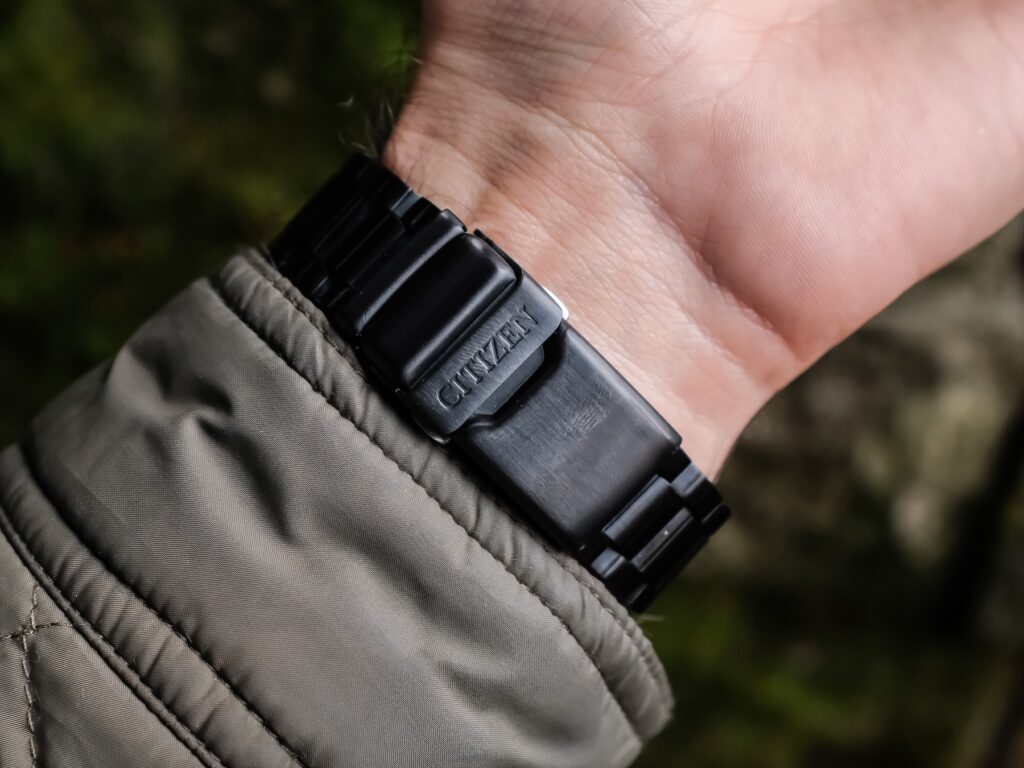
The Nighthawk takes the opposite stance on wearability, and it doesn’t pretend otherwise from the first minute. At 42.5mm across and 12.6mm thick in blacked-out steel, this is a watch you’re aware of all day. It has presence, and some days that’s exactly what I want out of the box. The dial is dense but disciplined, with applied markers, sword hands, and a GMT hand tipped with tiny red and white airplane motifs so you know which half of the scale you’re reading. The catch is that the second-time-zone track can hide behind the main hands at certain hours, so reading home time takes a beat longer than it would off a 24-hour bezel. The black ion-plated bracelet is solid with no rattle, though the whole package sits firmly in purposeful-heft territory rather than daily-driver comfort, at least for someone like me who gravitates toward smaller watches.
- The Navihawk 40 reads clean despite a busy dial and wears like a modern everyday chronograph, with only a slightly sunken date and a missing quick-adjust clasp to nitpick.
- The Nighthawk BJ7019-62E trades all-day ease for real wrist presence and blacked-out attitude, and its GMT track occasionally plays hide-and-seek behind the hands.
Build Quality & Technical Approach
The two watches share a silhouette family and a movement philosophy, but the closer you look, the more they separate. This is where a comparison stops being about first impressions and starts being about the decisions that only reveal themselves after a few weeks: the calibers, the case work, the crystals, and how each one handles water and low light.
Movements:

The Navihawk runs Citizen’s Eco-Drive caliber B620, and it’s the reason the watch reset my thinking on chronographs. It charges off any light source, holds roughly six months of runtime on a full charge, and rates to about ±15 seconds per month. Numbers aside, what mattered in daily use was that I never had to think about it. I’d leave it sitting, pick it up, and it was ready. That kind of dependability had an odd side effect. Instead of leaving the chronograph as a decoration I never touched, I used it constantly, timing coffee, workouts, and plenty of things that did not need timing at all.
The Nighthawk’s B877 Eco-Drive shares the same solar backbone and the same set-and-forget rhythm, with comparable ±15 seconds per month accuracy and a similar six-month reserve. Where it differs is function. This is a true GMT, and setting it is a pleasure, with crisp hand movement and a jumping local hour that snaps into place when you cross a time zone. You can run the GMT hand as a second time zone or as a 24-hour reference alongside the date. For a solar quartz piece at this price, that’s a lot of travel capability with none of the winding or accuracy anxiety a mechanical GMT brings.
Case Construction & Finishing:

The Navihawk’s case is where the 2025 redesign earns its keep. Broad brushed surfaces keep it grounded as a tool watch, while polished accents catch just enough light to keep it from going flat. Citizen kept the details longtime fans look for, including the exposed brushing between the lugs revealed by the end-link shape, and the pronounced coin-edge bezel that reads as Promaster before you even reach the dial. At 40mm it feels considered rather than shrunk, like Citizen kept the personality and simply found the right proportions for it.
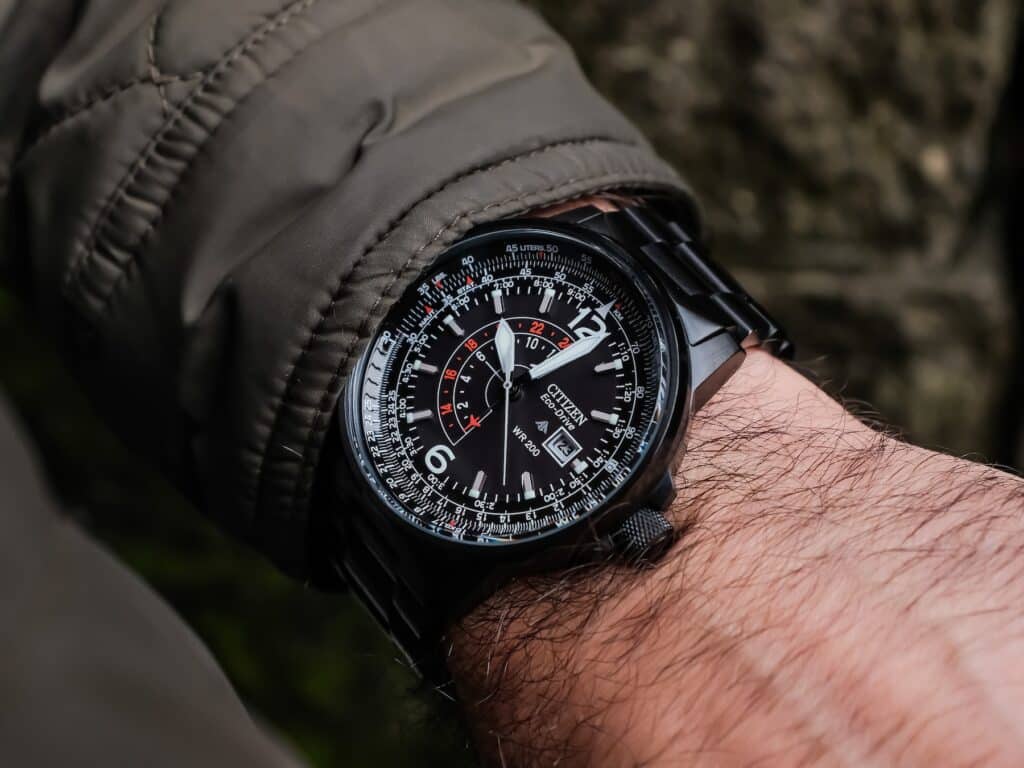
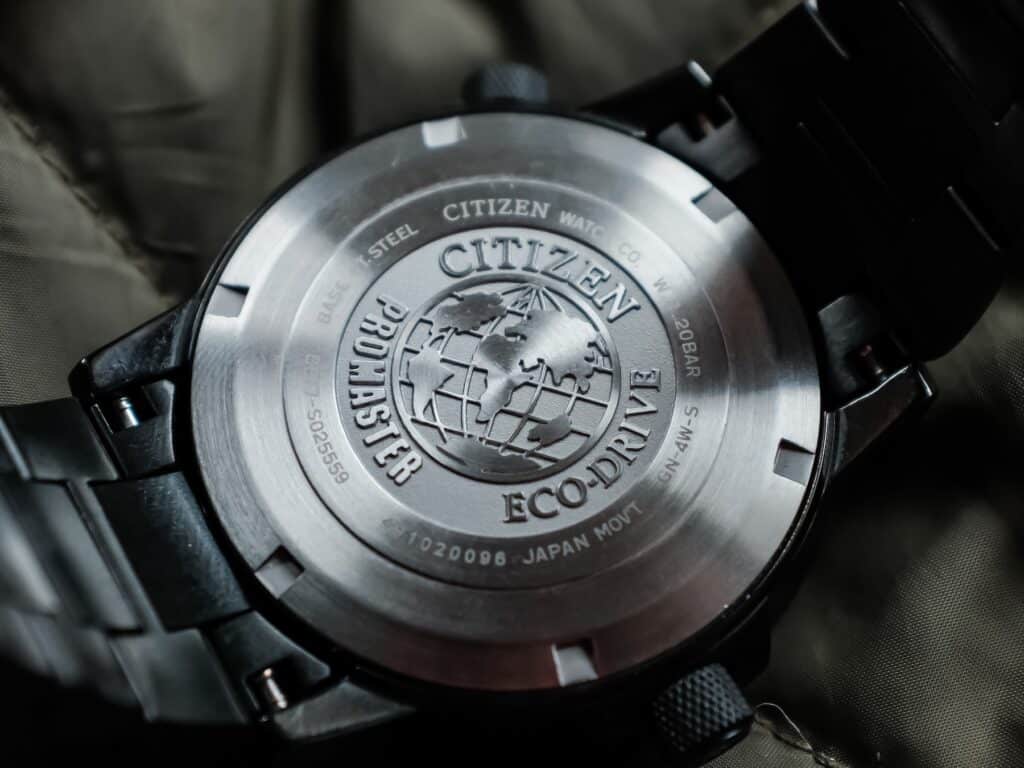
The Nighthawk’s case makes a different argument. The black ion-plated finish gives it a uniform, almost industrial look, with the usual caveat that a deep scratch will show steel underneath. It feels solid and built to shrug off regular wear. The E6B slide rule is integrated into the upper case and driven by a secondary crown at eight o’clock, so it never spins by accident and always feels deliberate. The engraved screw-down caseback is better finished than the price suggests, and noticeably nicer than the one on the steel Nighthawk I used to own.
Crystals & Bezels:

Here’s where the value question gets interesting, because the cheaper watch on paper carries the better crystal. The Navihawk gets a sapphire crystal, flat and clear, the kind of thing you stop thinking about because it does its job for years. The slide rule bezel here is a fixed reference scale rather than a click bezel you’ll fiddle with, so it contributes to the watch’s identity more than its daily function. I did notice a slight vertical play in the bezel on my loaner, but since it was a press sample I’m holding off on conclusions until I have my own to check.
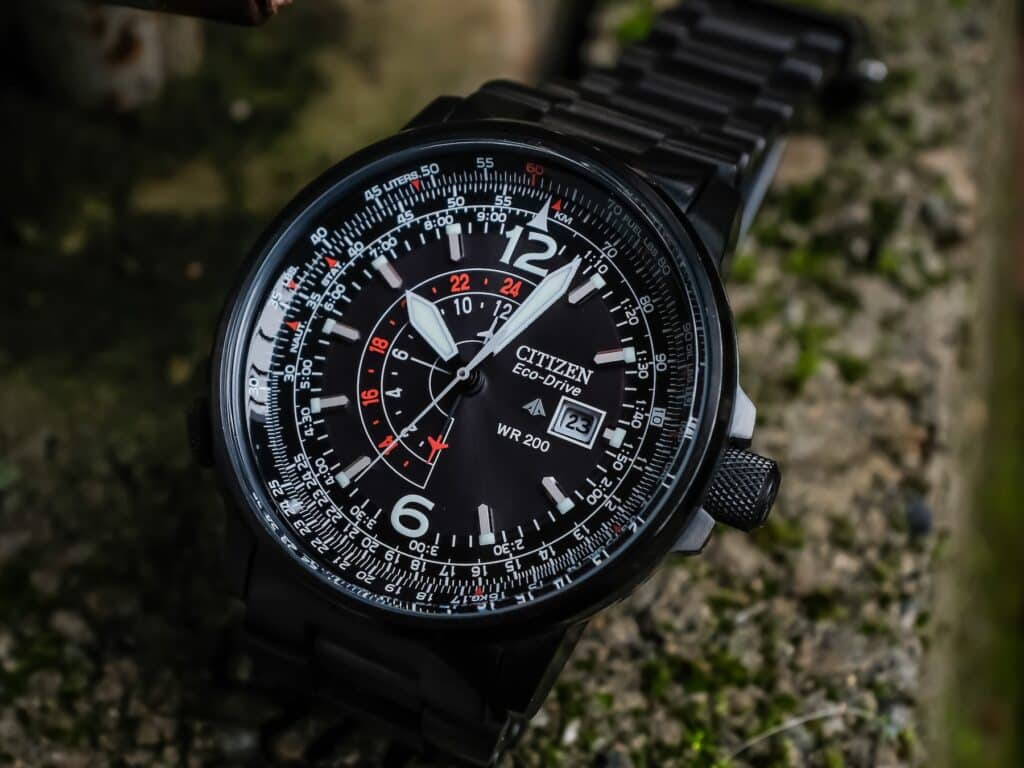
The Nighthawk flips that script. Its crystal is flat mineral glass with internal anti-reflective treatment, and it’s the clearest reminder that you’re in affordable territory. It sits fairly exposed above the case, so it wants a bit more awareness than a recessed sapphire would. Sapphire would have been welcome here, especially at the import price. The rotating E6B bezel, controlled by that eight o’clock crown, is the more involved of the two setups and the more satisfying to operate, even if most owners will use it a handful of times and move on.
Water Resistance & Lume:

The Navihawk carries 200 meters of water resistance and, interestingly, no screw-down crown. I’ll admit I’d prefer one, and if Citizen offered the choice I’d take it. In practice, paired with the sapphire crystal, I never treated the watch delicately or worried about a splash. Lume is the standard Citizen application, clean and legible after a quick charge, though a chronograph dial this busy was never going to be a lume showcase.

The Nighthawk matches the 200 meters and adds the screw-down crown the Navihawk lacks, which makes it feel like the more traditional tool watch of the pair despite the aviation styling. Its lume is a strength, that familiar Citizen blue that charges fast off brief daylight and glows evenly across the markers and numerals. If you’re weighing these two on pure go-anywhere ruggedness, the Nighthawk’s screw-down crown tips that particular scale.
- The Navihawk 40 pairs a sapphire crystal and a well-finished 40mm case with the convenient B620 Eco-Drive, giving up only a screw-down crown to keep things slim.
- The Nighthawk BJ7019-62E answers with a true-GMT B877 caliber, a screw-down crown, and stronger lume, though its mineral crystal is the compromise you notice first.
Cost Considerations
At Citizen’s current asking price of around $476, the Navihawk 40 is the easier one to recommend on paper, because it’s a watch you can walk up and buy at a set price with a sapphire crystal and a full chronograph. For what it does and how often I found myself reaching for it, that number felt low by the end of the loan. It’s the rare piece where the practicality and the price line up so neatly that the value case makes itself.

The Nighthawk is a little more complicated to price, because the figure I can give you is personal. I paid $488 all-in to import this JDM reference, which lands within a rounding error of the Navihawk despite being a fundamentally different proposition. A U.S.-market Nighthawk typically streets for less than my import total, so treat my number as the cost of chasing this specific blacked-out variant rather than the price of a Nighthawk in general. Even at that, a true GMT with this kind of build for under $500 is a hard thing to argue with.
Final Thoughts: Which Set-and-Forget Citizen Deserves the Slot?
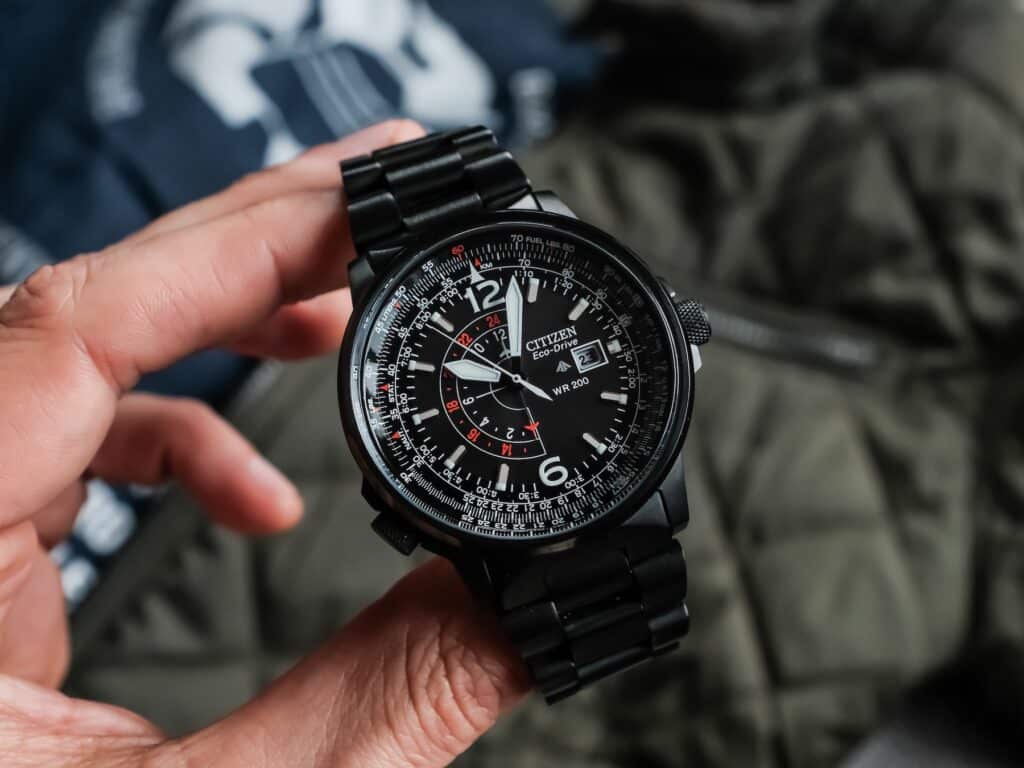
After living with both, the split comes down to something simpler than the specs. These are two solutions to the same underlying want, which is a capable aviation watch you never have to maintain, and the right one depends entirely on what you need that watch to do. The Navihawk is the everyday answer. The Nighthawk is the traveler with attitude. Neither is trying to be the other, and that’s what makes putting them side by side useful instead of unfair.

If I’m being straight about my own rotation, the Navihawk is the one that changed my plans, and it’s the one I’d point most people toward first. It does the everyday-watch job so well that it noticeably reduced the pull of a mechanical chronograph costing many times more. The Nighthawk earns its keep too, but it earns it as a specialist, the watch I reach for when I want size, contrast, and a real second time zone on the wrist.
So here’s my verdict:
- Choose the Citizen Navihawk 40 if you want the stronger everyday pick. The 40mm case, sapphire crystal, and set-and-forget chronograph make it the one I’d recommend to most people, and it’s the one I’m making room for.
- Choose the Citizen Nighthawk BJ7019-62E if you want a true GMT with presence and don’t mind the extra heft or the mineral crystal. It’s the better travel companion and the more assertive watch of the two.

Co-Founder & Senior Editor
Michael Peñate is an American writer, photographer, and podcaster based in Seattle, Washington. His work typically focuses on the passage of time and the tools we use to connect with that very journey. From aviation to music and travel, his interests span a multitude of disciplines that often intersect with the world of watches – and the obsessive culture behind collecting them.