Two G-Shocks, roughly the same money, and almost nothing else in common. One of them changed what people expected a G-Shock to look like and spent the better part of a year selling above retail because of it. The other has been sitting on shelves and hallway tables since the mid-2000s, doing the same job it has always done without asking anyone to notice. Putting them side by side sounds pointless until you realize they are both answers to the same question, which is what goes on your wrist when you have to be out the door in five minutes.
After a decade of reviews at TBWS, we have learned that hype tells you almost nothing about what a watch is like to live with. Some watches earn every bit of attention they get. Others are fun for a month and then go into a drawer while something plainer takes over the rotation. Wrist time is the only test that settles it. So this comparison is not about which G-Shock is objectively better. It is about which one still gets picked up after the novelty wears off, and what you are actually paying for when you choose the interesting one over the invisible one. Our reference points are the GAE-2100WE-3A camo Casioak and the GW6900-1, both of which we have spent real time with.
Overview and Identity
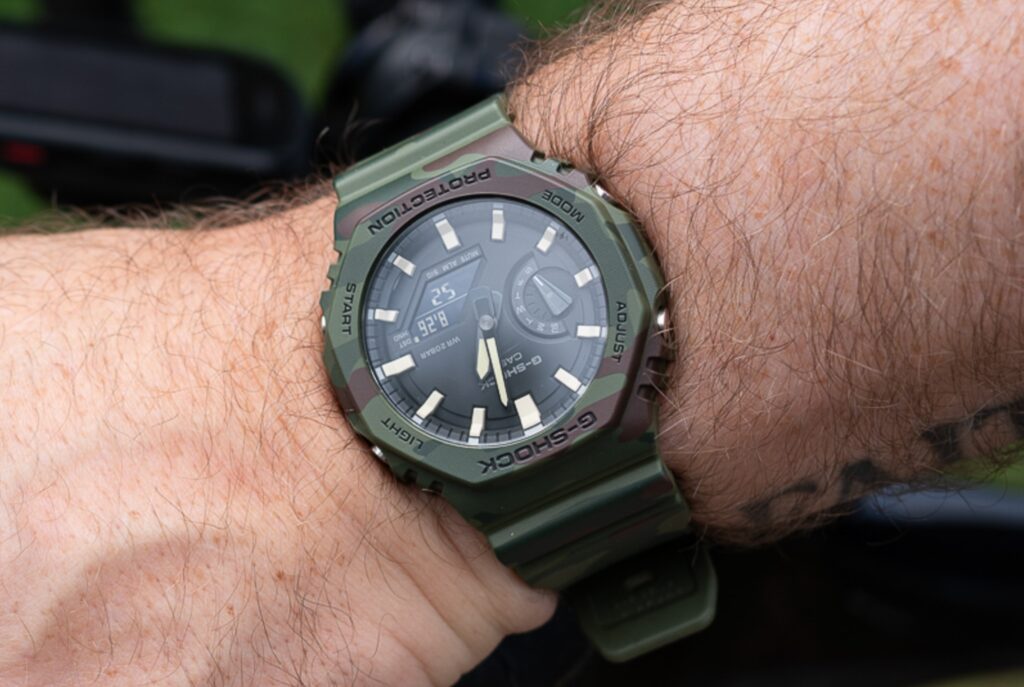
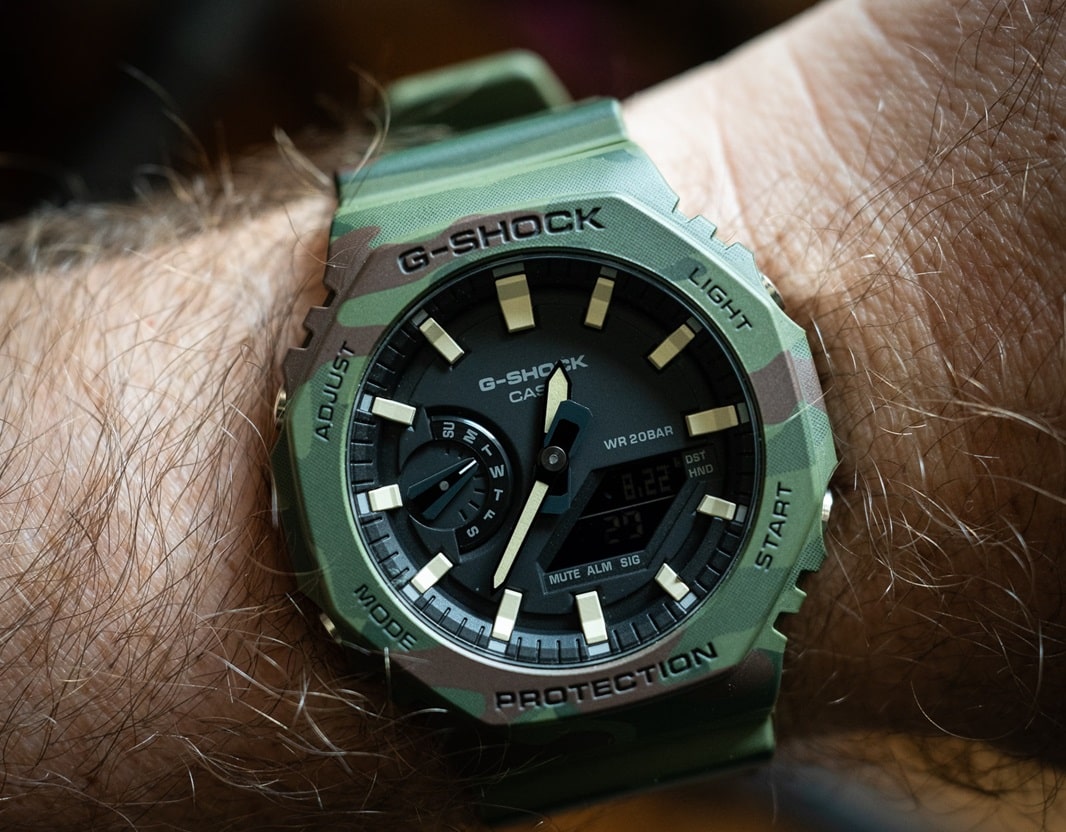
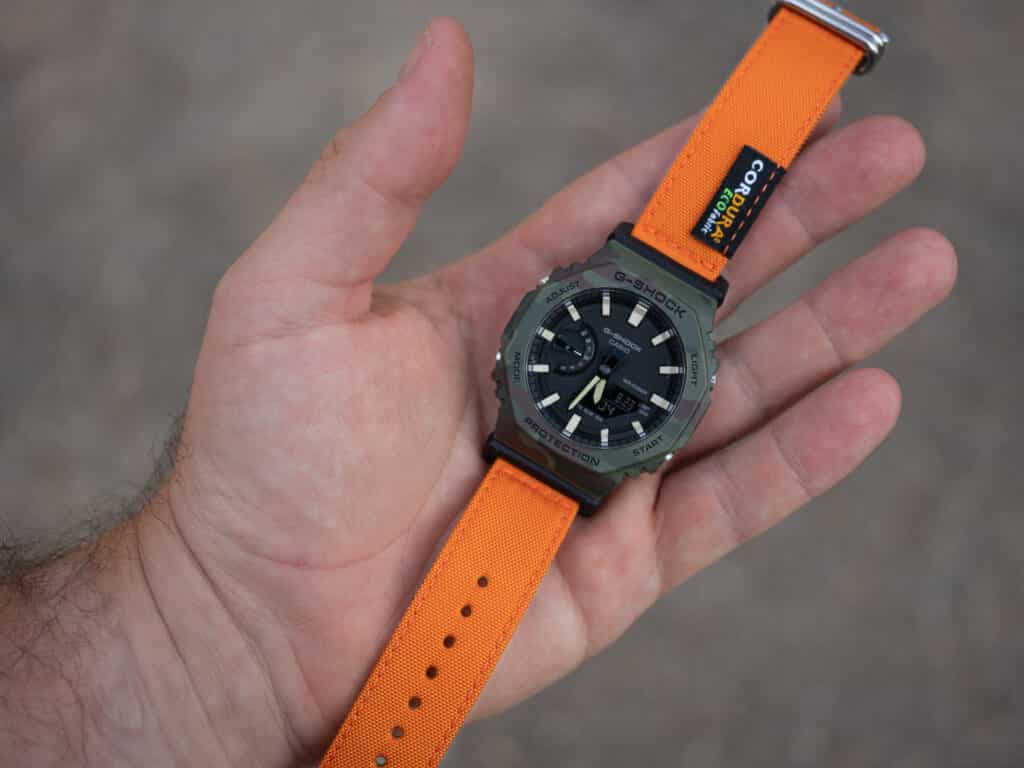
The Casioak arrived in 2019 with a case shape G-Shock had never used before, and the watch world reacted like something new had happened, because it had. It was the thinnest G-Shock the brand had produced at that point, and watch nerds go strange for thin. Popularity snowballed through social media until Macy’s displays were selling out of octagonal models and the things briefly traded above MSRP. That craze cooled as supply caught up, though the model stayed popular, and Casio has since built a version for nearly everyone: clear, white, neon yellow, full metal, camo. The one we reviewed is the GAE-2100WE-3A, a woodland camo box set with swappable bezels and straps. The nickname comes from the octagonal resin bezel and its vague resemblance to the Royal Oak, which is a silly association, but a visible one.
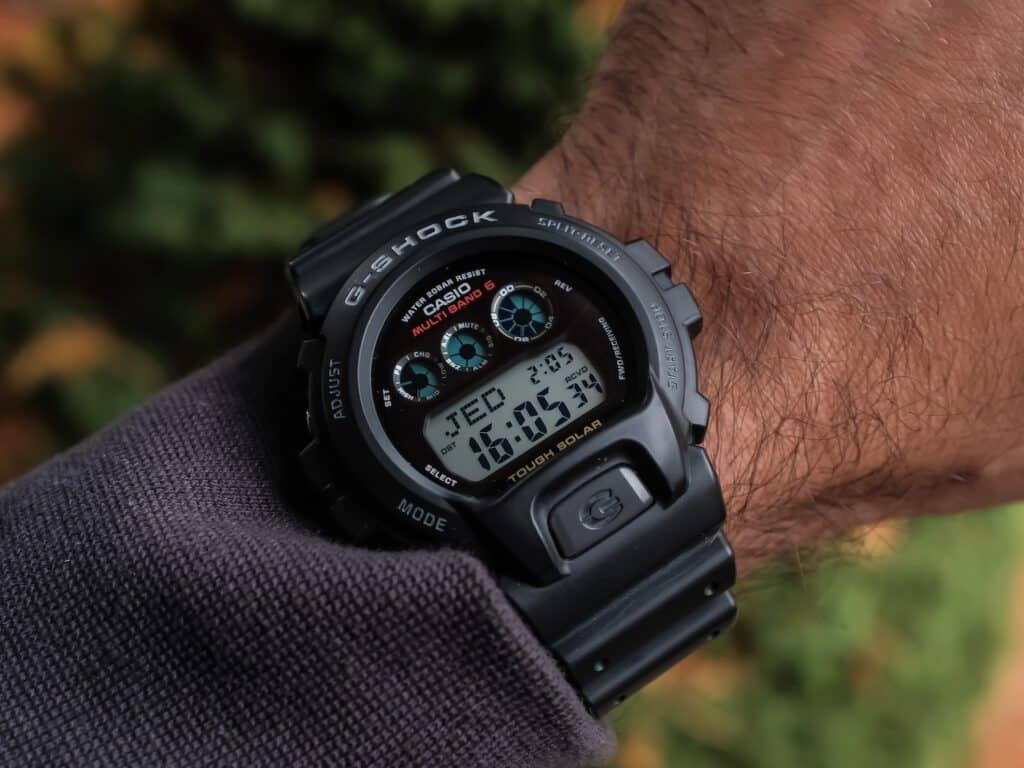
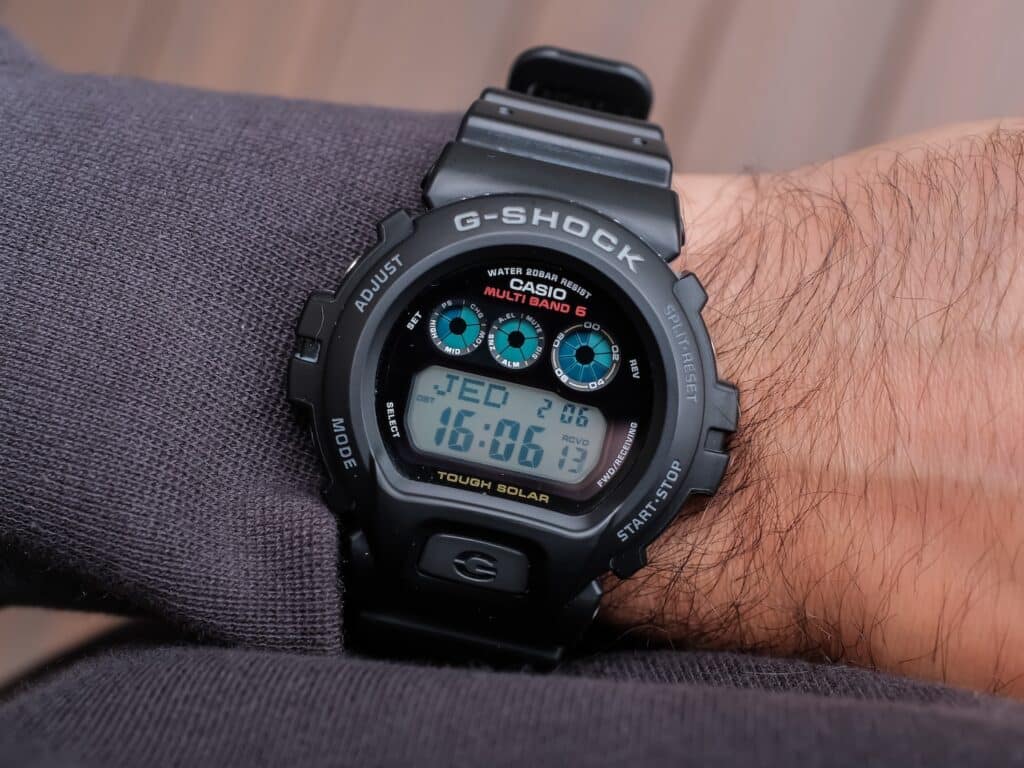
The GW6900-1 has the opposite biography. It uses the DW-6900 case, one of G-Shock’s best-selling shapes, with solar power and radio sync engineered in without disturbing the original design. Nobody queued for it. In our long-term review it lives on a hallway table wedged between a bowl of keys and a stack of unopened mail, which is where the watches people actually use tend to end up. In a collection that also holds a Doxa Sub 300 and a Halios Seaforth, watches that get rotated, stored, and occasionally babied, the G-Shock sits outside the rotation entirely. It is the default setting for days when deciding what to wear is more effort than it is worth. That makes it more useful than half the watches we have spent months hunting down on forums.
- The Casioak earned its following honestly, arriving as the first new G-Shock silhouette in years, and the hype has cooled into steady popularity the design deserves.
- The GW6900-1 never had a hype cycle. It has the DW-6900 case, solar power, atomic sync, and a habit of ending up on the wrist whenever nobody feels like making a decision.
Dial, Strap & Wearability: Visual Interest vs Everyday Invisibility
The Casioak’s dial is the whole reason the watch works. The matte black surface sits well down into the case, and Casio uses that depth to give the indices and chapter ring real presence. Those indices are big raised blocks of tan material that carry up into the chapter ring, and they catch light in a way that reads as designed rather than assembled. Between three and six o’clock there is an LCD panel handling the date, running seconds, or whatever function is active. Between eight and ten sits a small day-of-week indicator. The hands are simple swords with a modest amount of lume in their centers, and skipping lume on those tan indices still looks like a missed opportunity to us. In fairness, G-Shocks have never been lume watches, and every one of them carries a light for exactly this reason.
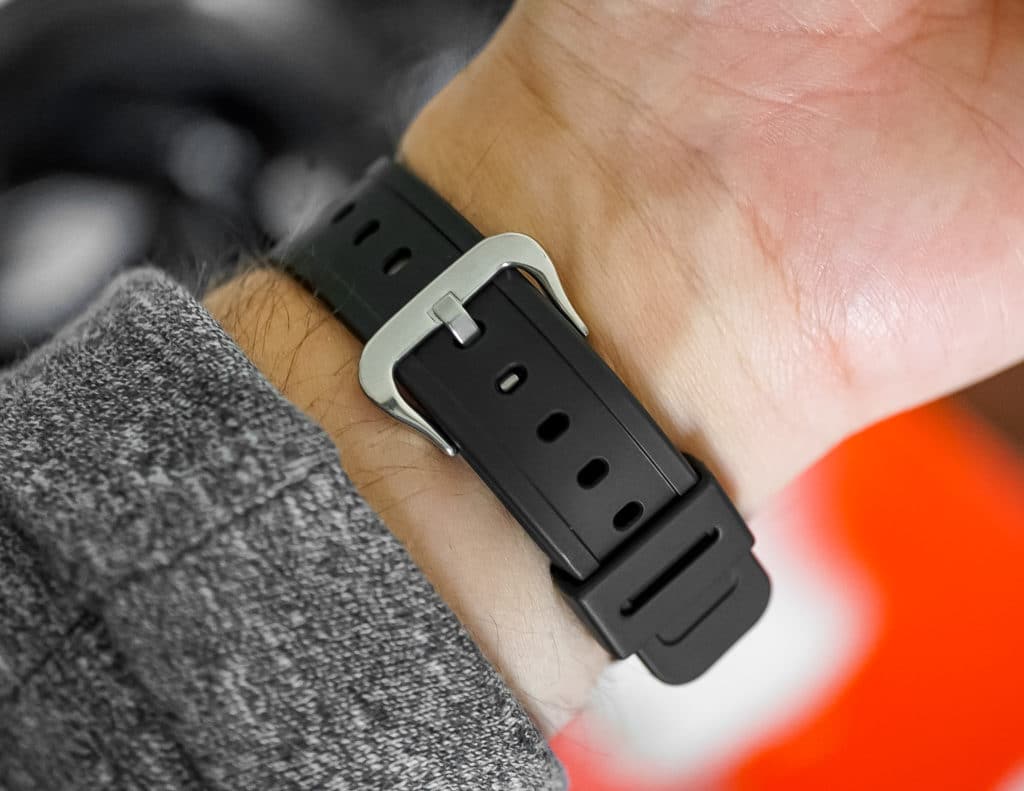
By the numbers the Casioak should not work at all. Measured by calipers it comes in at 45.4mm wide, 48mm lug to lug, and 11.9mm thick, and 45mm is territory most of us avoid on principle. On the wrist those numbers are deceptive. The case is square-adjacent, so it sits flat on the arm and stays balanced instead of rocking, and the points where the straps meet the case angle downward so the strap wraps rather than tents. On a 7.5-inch wrist the proportions land right, with a little room to spare. The GAE version we spent time with shipped with a camo rubber strap plus a two-piece orange Cordura nylon strap on Casio’s own adaptors, which works out to six combinations from one box. The rubber is the better everyday option. The nylon is comfortable, though the keepers are oversized and wander around all day, and under tension you can occasionally see a small gap where the strap meets the case.
The GW6900-1’s display looks like a sci-fi HUD at first glance and turns intuitive within a day. The large main readout carries primary time and date, three circles across the top handle stopwatch functions and radio reception status, and the top right corner holds a second time readout. That dual time display is the cleanest we have used on a digital watch. No subdial, no GMT hand, no bezel to align, just a small permanent window telling you what time it is somewhere else. Once you have lived with it for a while, most travel-oriented watches start to feel like they are working harder for a worse result.
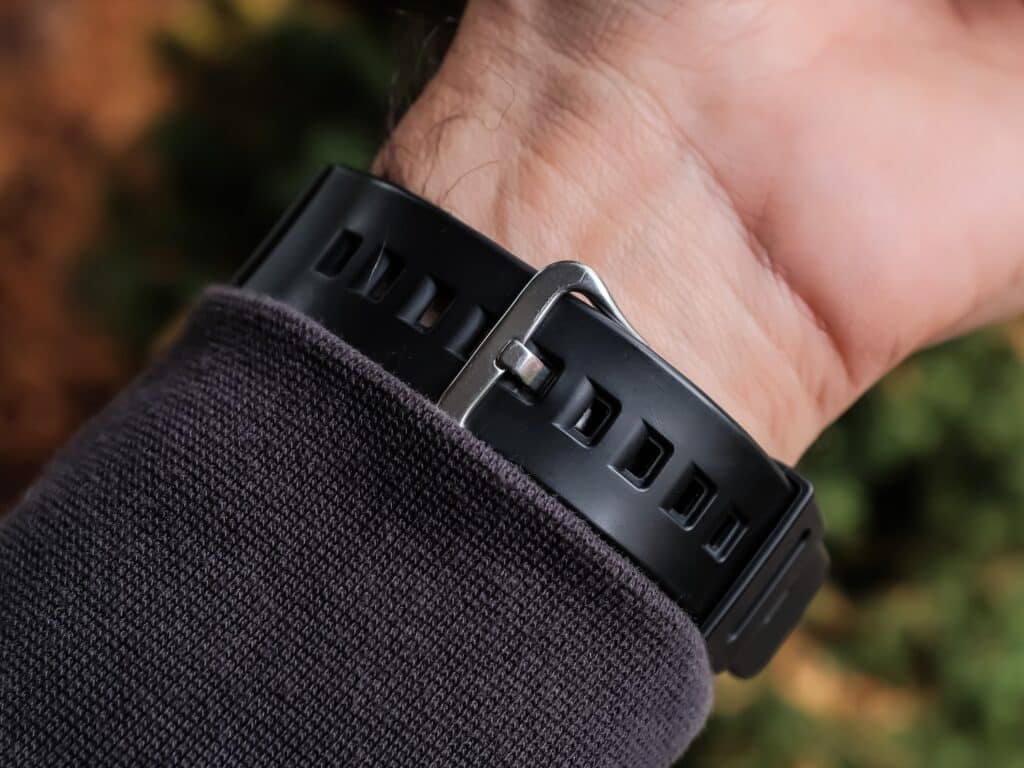
Wearability is where the GW6900-1 gets strange. It measures 53.2mm long, 50mm wide, and 17.7mm thick, which on paper sounds like a brick. It wears like a puff of resin. There is nothing dense in the construction apart from the steel caseback, so the watch disappears until you clip it on a doorframe, and even then it is the doorframe you feel bad about. The resin strap is functional and flexible, a little squeaky when new, and it hugs the wrist, stays put, and dries fast. Some owners fit straps from the square G-Shocks onto it. We have never felt the need.
- The Casioak trades darkness legibility for a dial with actual visual interest, and the recessed layout with raised tan indices is the single best argument for buying one.
- The GW6900-1 looks busier and reads faster, pairing the cleanest dual time display we have used with a case that measures large and vanishes on the wrist.
Build Quality & Technical Approach
Both watches are resin, both are rated to 200 meters, and both run quartz, so the interesting differences do not live in the category. They live in what Casio decided to spend the engineering on. One of these was built to be thin and to look like nothing else in the catalog. The other was built so you would never have to touch it. That split shows up in almost every component once you start comparing them directly.
Modules:
The Casioak we reviewed runs Casio’s 5611 module, and the function list is staggering for the money: world time across 31 time zones, a 1/100-second stopwatch, a countdown timer, an alarm, a light, and an auto calendar good through 2099. Four buttons run the whole thing. Bottom left cycles modes, top left drops the watch into set mode, top right fires the light, and bottom right starts functions like the stopwatch and timer. It is fiddly for the first week and second nature after that. When you get deep enough into G-Shock modules you run into the uncomfortable realization that this affordable watch is objectively all you need.
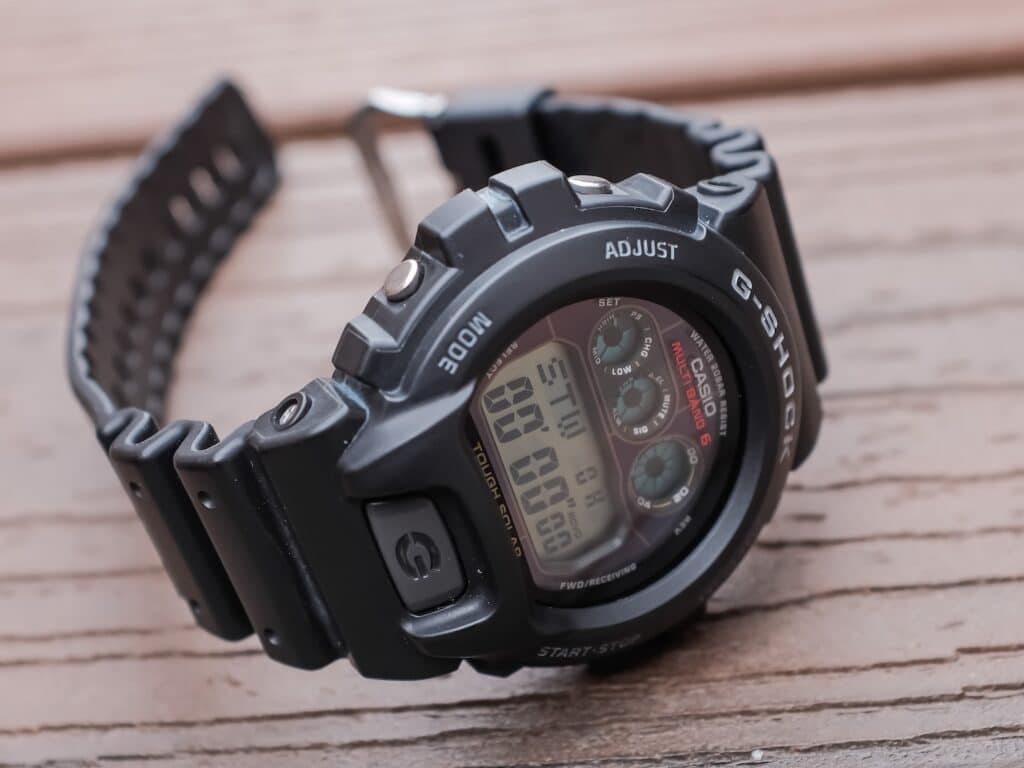
The GW6900-1’s punch list lands in nearly the same place. World time across 31 time zones, five daily alarms including a snooze, a countdown timer, a 1/100-second stopwatch, and the hourly chime that G-Shock owners either love or immediately disable. Navigation is easy and the function order never fights you. Casio has revised this module across production runs over the years, so the module number quoted for a GW6900-1 depends on when a given watch left the factory, which matters mainly if you are chasing the correct manual. Functionally, the two watches sit close enough that the module list is not where your decision gets made.
Case Construction & Finishing:

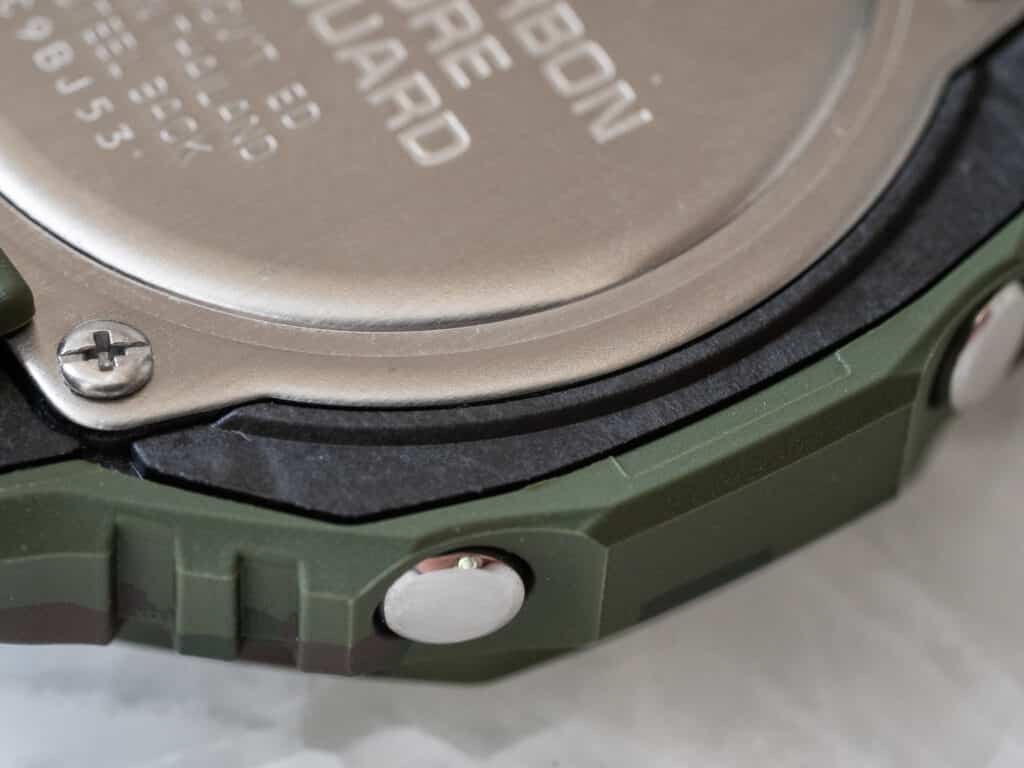
The Casioak’s case is where Carbon Core Guard earns its keep. Casio’s proprietary process integrates carbon fiber into the resin itself, and flipping the watch over shows some of that composite material wrapping the case. The practical result is a G-Shock that holds onto the brand’s durability reputation while coming in thinner and lighter than anything before it. The octagonal resin bezel carries printed button functions and the G-Shock Protection text across its faces, which sounds cluttered and reads as purposeful. Our GAE example uses a bezel that comes off with a supplied tool, so swapping the camo bezel for the black one takes a couple of minutes instead of a trip to a watchmaker.
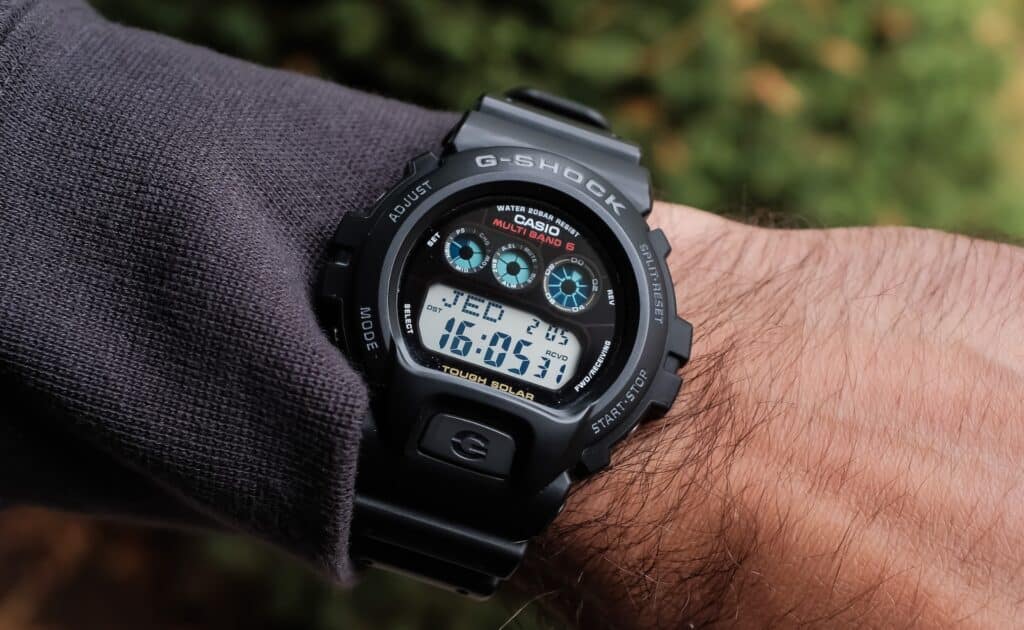
The GW6900-1 goes the other direction and barely bothers with finishing at all. Full resin, a steel caseback, and dimensions that make it larger than the Casioak in every direction. Nothing about it is refined and nothing about it is trying to be. What you get instead is the issued-kit look, the sense of something built for people who need a watch to survive a working day rather than complete an outfit. It reads as the roided-out companion to the Casio F-91W, a family resemblance you can spot from across the room. Both watches carry 200 meters of water resistance, and neither has given us a reason to think about it.
Displays & Lighting:
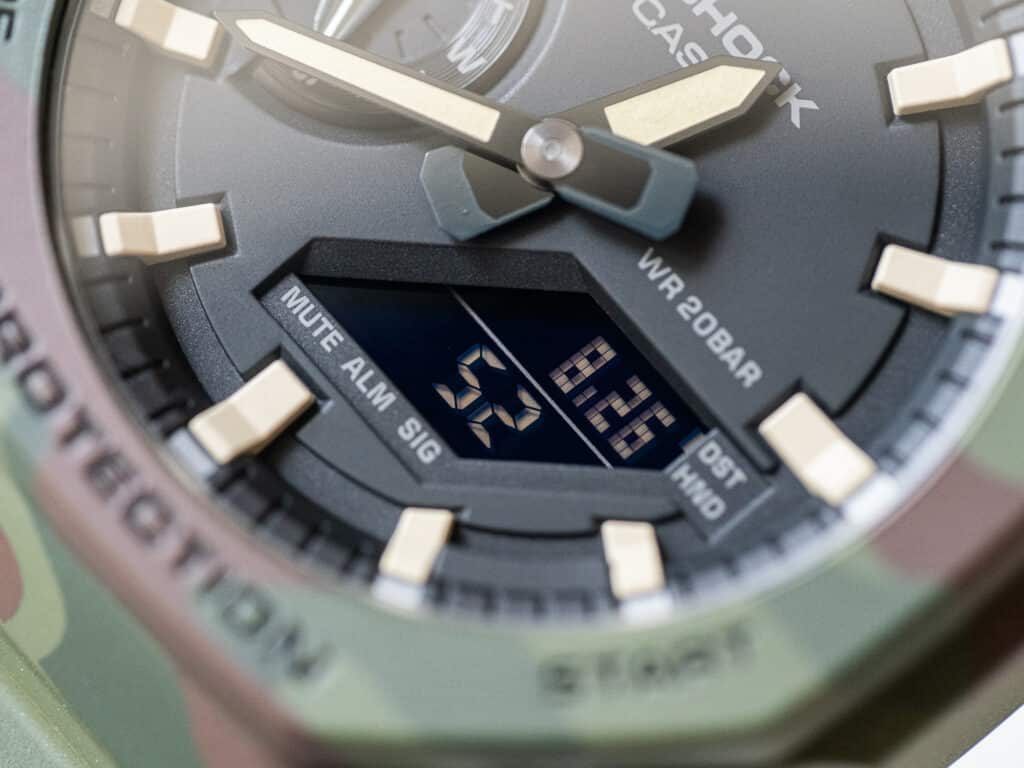
The Casioak splits its information between analog and digital, and the analog side wins. Hands against those raised tan indices are instantly readable in daylight. The LCD panel is small by necessity, since it shares dial real estate with a full set of hands, so it works better for glanceable data like the date than for anything you need to read in a hurry. In the dark the watch leans entirely on its light, because the lume lives only in the centers of the hands and the indices have none at all. That is a design choice rather than an oversight, though we would still take lumed indices if Casio ever offered them.
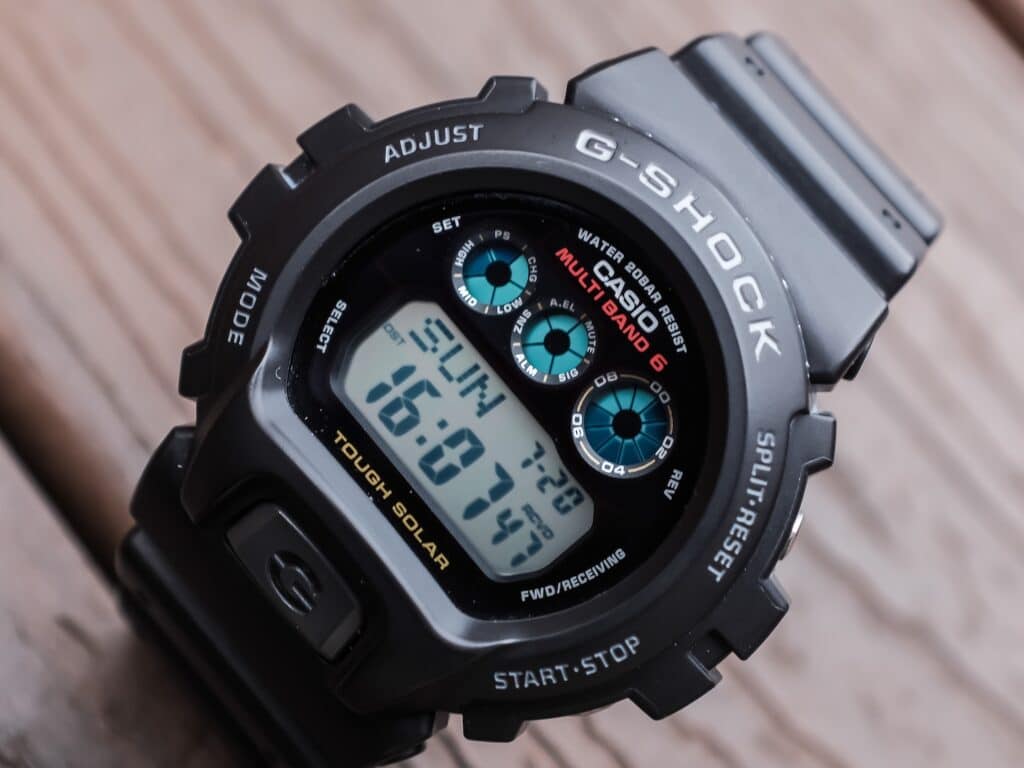
The GW6900-1 has no such split to manage. Everything sits on one LCD, which means the EL backlight solves the entire watch at once. Press the big front-facing button and the whole display glows green, bright, and legible with no hunting. Some owners want the newer LED backlight found elsewhere in the lineup, and that is a fair preference, though we have never had a visibility problem with this one. The stopwatch is fast to reach and accurate to a hundredth of a second, useful whether you are timing a run or a French press, and the countdown timer beeps with enough conviction that you will not forget it is running.
Power & Timekeeping:
Here is where the two watches stop being comparable. The GAE-2100WE-3A runs on a pair of coin cells rated for roughly three years. No solar, no radio sync, no Bluetooth. That is a real ownership cost on a watch you plan to keep for a decade, and it is the one place where the Casioak’s design-first priorities show their bill. Casio does sell a fix in the GA-B2100, which adds solar charging and phone-based time syncing through an app, and it typically costs less than the special editions. If maintenance-free ownership matters to you more than a camo bezel set, that is the Casioak to buy.
The GW6900-1 was built around exactly this problem. Tough Solar means the caseback never comes off, and even after weeks in a drawer a couple of hours in the sun brings the charge indicator back to high. Multi Band 6 handles the rest, pulling atomic time signals across Japan, China, the United States, the United Kingdom, and Germany, and syncing overnight without any input. The time is simply correct, whether you have crossed three time zones or ignored the watch for a month. It is the least exciting feature in this comparison and the one you notice most over five years.
- The Casioak spends its engineering budget on thinness and appearance, and Carbon Core Guard delivers both without giving up durability. The coin-cell power source is the bill that eventually comes due.
- The GW6900-1 spends its budget on never needing you, and Tough Solar paired with Multi Band 6 is why it stays accurate and sealed for years at a stretch.
Cost Considerations
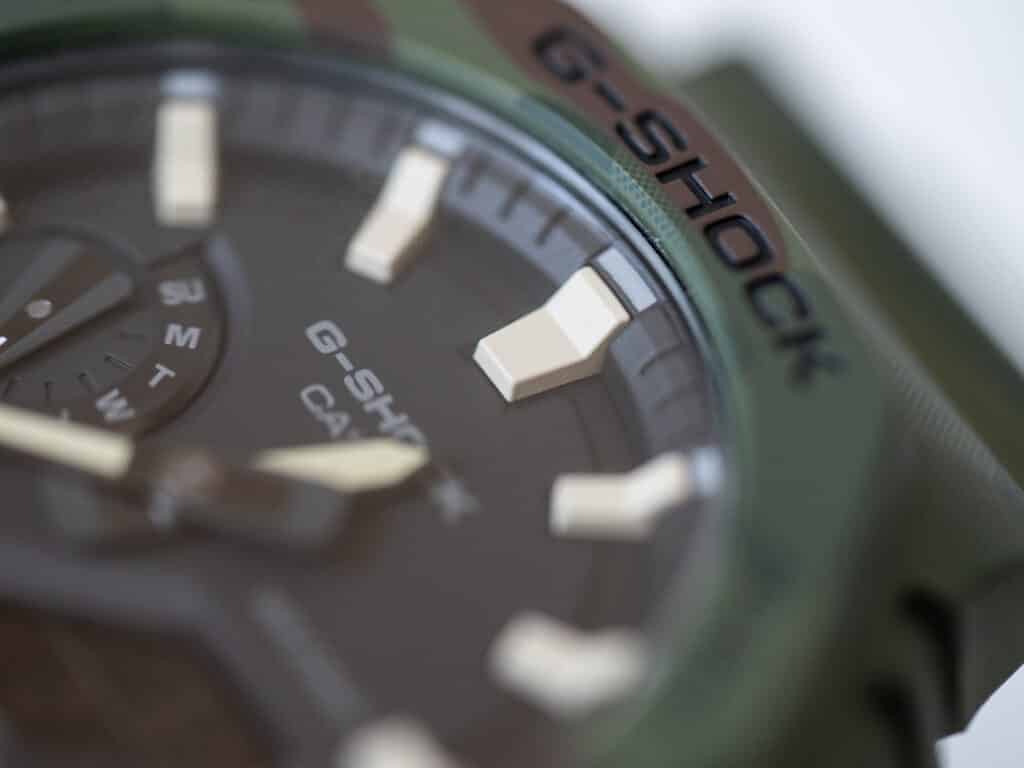
The standard GA-2100 generally sits somewhere between $100 and $130 depending on colorway, which is fair for what you get and roughly what a G-Shock has always cost. Special editions are a different conversation. The GAE-2100WE-3A box set we spent time with commonly turns up near $179 and above, and whether that premium is worth it comes down to how much you value the extra bezel, the extra strap, and the Cordura branding. For us the swap kit justified it, though we would understand anyone who looked at the standard model and decided the difference buys nothing functional. The better news is that the Casioak has been in production long enough that the above-retail nonsense of 2019 and 2020 is finished. You can walk into a store and buy one, which is the correct way to buy a $130 watch.
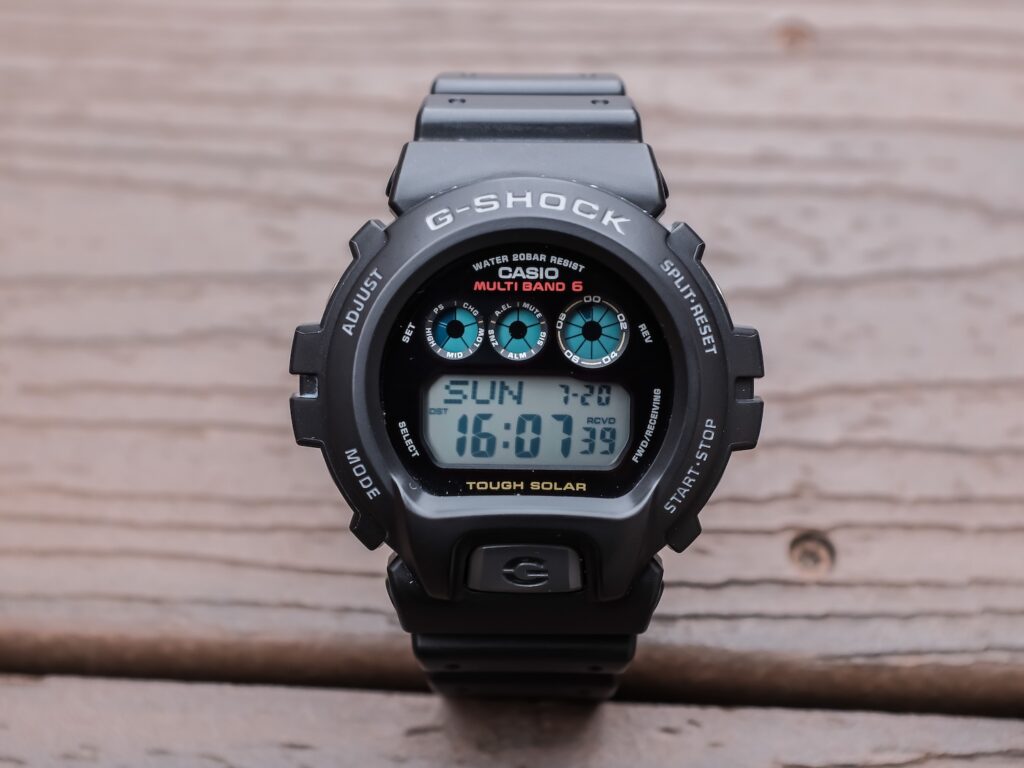
The GW6900-1 lists around $130 and routinely sells for under $100 at US retailers, which puts it in the odd position of costing less than the watch it beats on the power spec. For that money you are getting solar charging and atomic timekeeping, two features that usually push a watch further up the price list. Long-term ownership costs are close to nothing. No battery changes, no service intervals, and a strap that will outlast your interest in replacing it. If it disappears at an airport or dies under a lawnmower, you replace it and move on. That kind of low buy-in is easy to underrate right up until it becomes the watch you reach for most.
Final Thoughts: Which One Survives the Novelty?
Both of these are good watches, and neither one is trying to do the other’s job. The Casioak is a design object that happens to be indestructible. It is the G-Shock you buy because you want to look at it, and there is nothing embarrassing about that. Seven years on, the octagonal case still looks like nothing else in the catalog, and the thinness that made it a hit is still why it slides under a cuff. If you want a G-Shock that reads as a watch choice rather than a utility decision, this is the one.
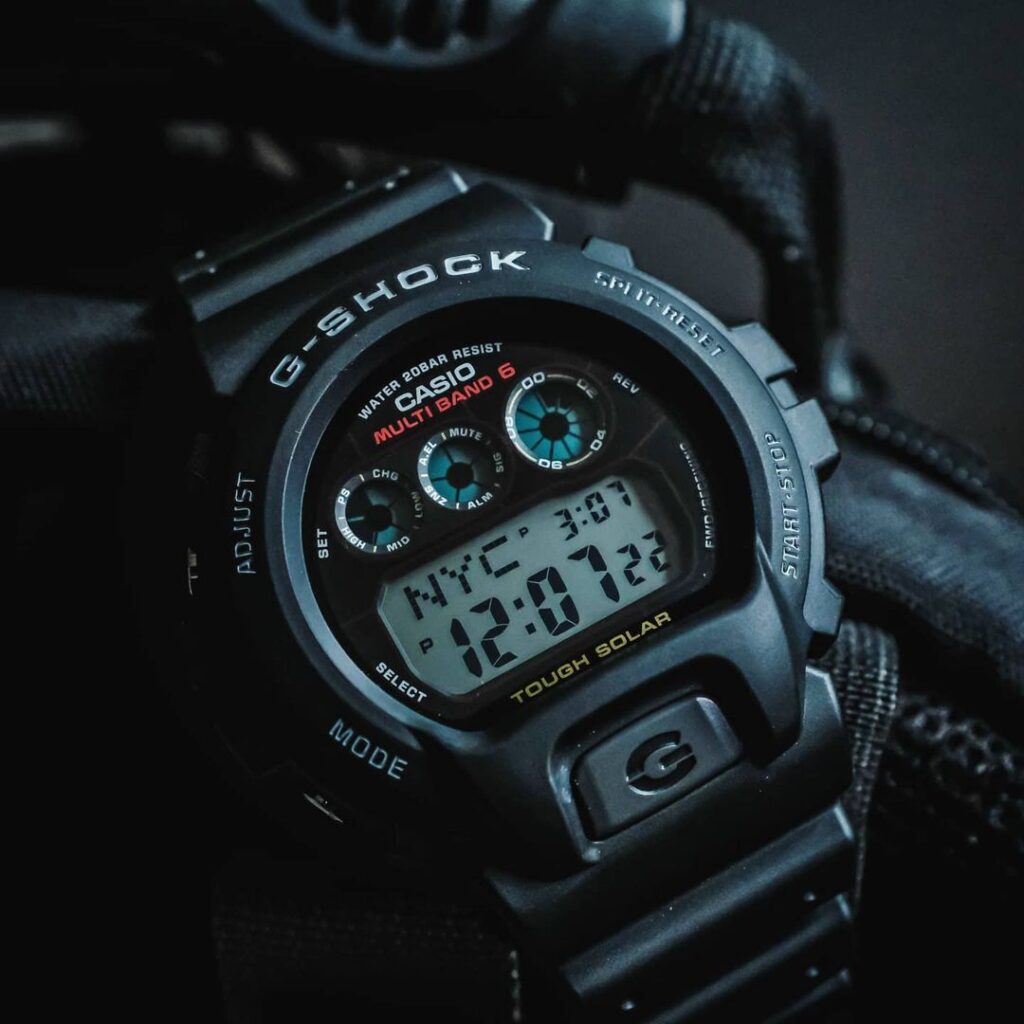
The GW6900-1 works the opposite way. It is the watch you stop noticing, and for a beater that is the entire point. It looks like a G-Shock from 2004 because it essentially is one, and that is precisely why it never asks anything of you. Solar power, atomic sync, a display readable in any light, and a price low enough that losing it is an inconvenience rather than a loss.
So here’s our verdict:
- Choose the Casioak if you want visual interest, a thinner case, and a G-Shock that works outside the yard. Go in knowing the standard GA-2100 delivers most of the experience, and the GA-B2100 adds solar for less than the special editions cost.
- Choose the GW6900-1 if you want the watch you never think about. Tough Solar, Multi Band 6, the cleanest dual time display at this price, and an ownership cost that rounds to zero.
The Casioak is the more interesting watch. The GW6900-1 is the one that gets worn. If your collection is already full of pieces that require some thought before they go on the wrist, the boring one tends to win, and it keeps on winning long after the interesting one has died in a drawer.

Co-Founder and Senior Editor
Kaz has been collecting watches since 2015, but he’s been fascinated by product design, the Collector’s psychology, and brand marketing his whole life. While sharing the same strong fondness for all things horologically-affordable as Mike (his TBWS partner in crime), Kaz’s collection niche is also focused on vintage Soviet watches as well as watches that feature a unique, but well-designed quirk or visual hook.