Not every watch that earns a place in our collection is the one everyone else keeps recommending. After a while, the obvious picks can start to feel like different versions of the same answer, especially when entire categories get crowded and familiar. That’s really the point of this list: for enthusiasts who prefer the less obvious choice, which watches are still worth chasing once the easy recommendations lose their pull? These hands-on reviewed picks come from the corners of the hobby that kept us curious, whether that meant a watch that lingered in our minds after a chaotic show, a design that felt fun precisely because it sat outside our usual lane, or a piece with more personality than the safer alternative.
And we believe our perspective matters because we’ve spent years changing our minds in public. Sometimes that means admitting the famous option wasn’t the home run we expected. Sometimes it means spotting something unexpected on someone else’s wrist and realizing our taste might need to widen a bit. Other times it’s a late-night impulse buy that only becomes worth writing about after real time on the wrist. That’s the kind of credibility behind this list of hidden gem watches: not borrowed prestige, but honest wrist time, direct comparisons, and enough self-awareness to know when the less obvious pick is the one that keeps earning a spot in the rotation.
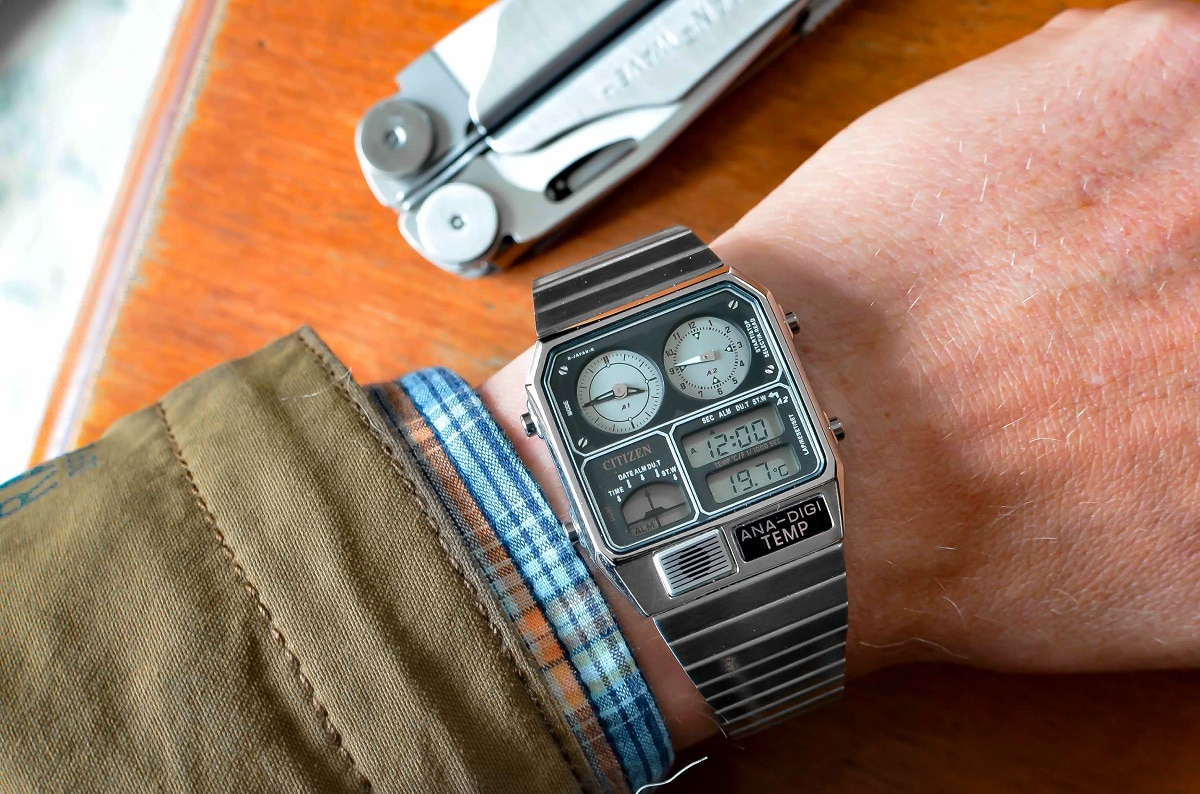
Citizen Ana-Digi Temp
| Price: | $250 – $500 |
| Water Resistance: | 30m |
| Case Dimensions: | 31.5mm (diameter) x 40mm (lug-to-lug) x 8.4mm (thickness) |
| Lug Width: | 18mm |
| Movement: | Citizen caliber 8980 |
The Citizen Ana-Digi Temp makes sense here because it’s the sort of watch that immediately tells us someone’s taste runs a little sideways from the usual path. It does not try to charm its way in with clean lines or a familiar sports-watch formula. Instead, it leans hard into its eighties, instrument-panel personality, with a squared-off stainless-steel case, crisp edges, and a display that looks built for input as much as for timekeeping. Even then, it wears more easily than the photos suggest. The case stays balanced on the wrist thanks to its short lug-to-lug span and relatively slim profile, so even smaller wrists can carry it without much drama. You notice it the whole time you wear it, but that feels intentional. This is not a watch designed to disappear.
What makes it work is that all of that visual density has real structure behind it. Citizen broke the dial into distinct zones, and in day-to-day use, that decision still pays off. The analog displays and LCD screens each occupy their own space, so the information feels layered rather than jumbled. The white markings stand out sharply against the black background, while the darker LCD elements recede enough to keep the whole thing from turning into visual clutter. There are also many small details worth lingering on: the polished bases on the hands, the exposed screws, the four luminous markers at the cardinal points, and the way the two analog sections each serve a different purpose. The thin black hands with narrow lume strips on the left stay very easy to read, while the heavier regulator-style hand on the right is even quicker to track at a glance.
Living with it is what makes the Ana-Digi Temp a less obvious pick. The dual-time setup turns out to be more useful than expected, with the analog display serving as a quick visual reference and the digital readout providing exact confirmation below. We found that genuinely helpful when bouncing between schedules in different time zones. The temperature readout is a little more conditional. It works, but only if you take the watch off your wrist first, which makes it less spontaneous than the rest of the package. Still, it does not come across like a throwaway gimmick. It feels in line with the watch’s whole reason for existing: a slightly odd, very deliberate tool built around interaction.
The integrated bracelet adds to that feeling because it is the right match for the case. It wears comfortably and completes the design in a way a strap swap probably never could. The catch is that the flared-end links have a reputation for bending under use, and that remains one of the more obvious compromises. That said, for collectors drawn to unconventional layouts, early multifunction tech, and watches with enough personality to resist blending into the rest of the box, the Ana-Digi Temp still offers something that many newer digital pieces do not.
Pros
- The unusual analog-digital display gives you useful dual-time functionality.
- Despite the busy design, the compact proportions keep it comfortable and well-balanced on the wrist.
- Contrast is strong enough that the most important information stands out quickly.
- Details like the varied hand shapes, lume placement, and exposed screws add depth the more time you spend with it.
Cons
- The temperature function is only accurate once the watch is off the wrist, which limits how casually you can use it.
- The layout takes a little time to learn, especially if you are coming from simpler digital or analog watches.
- The bracelet’s flared end links remain a known weak point and can bend over time.
- Anyone who prefers cleaner, more understated designs is probably going to bounce off this one fast.
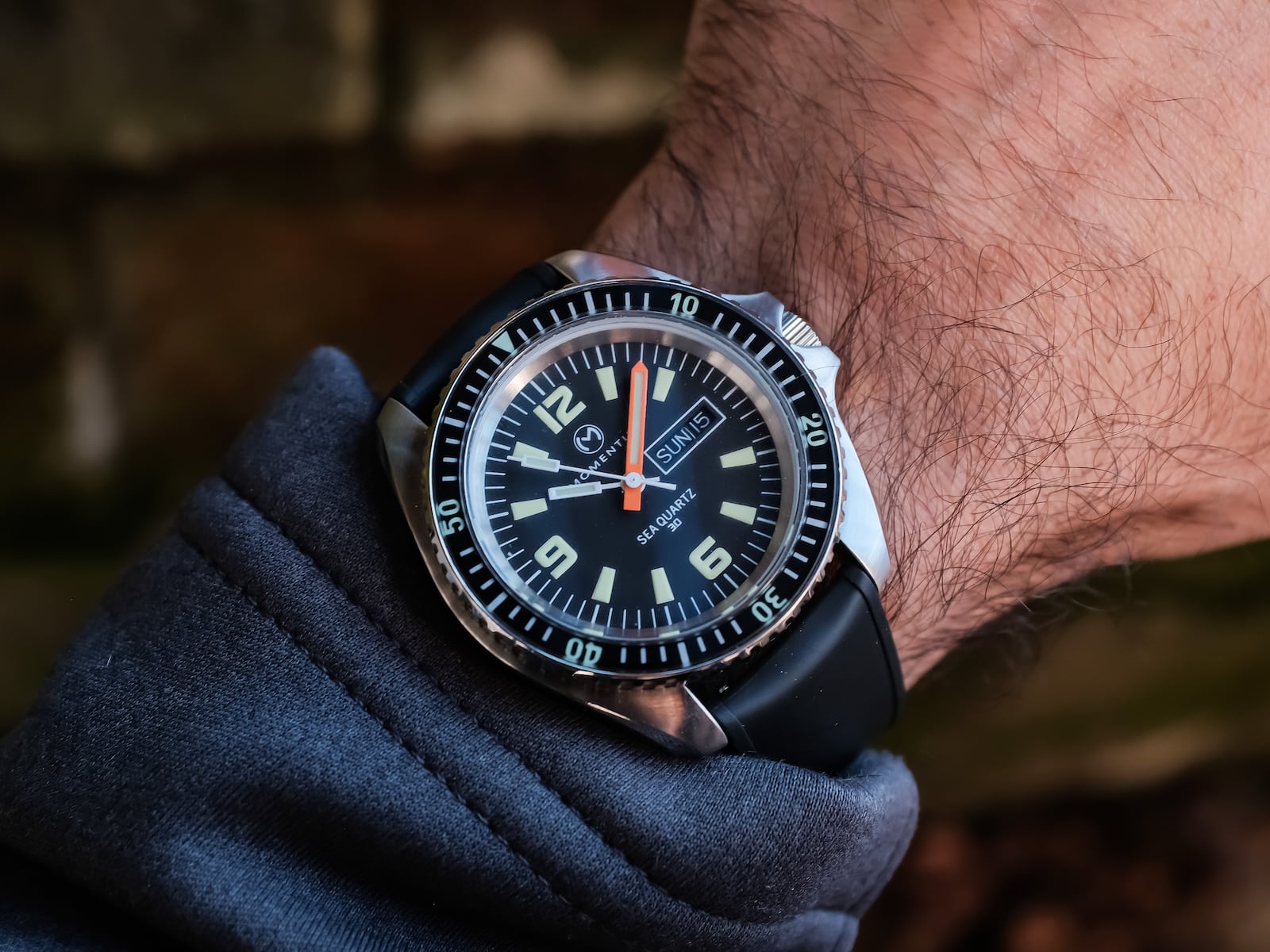
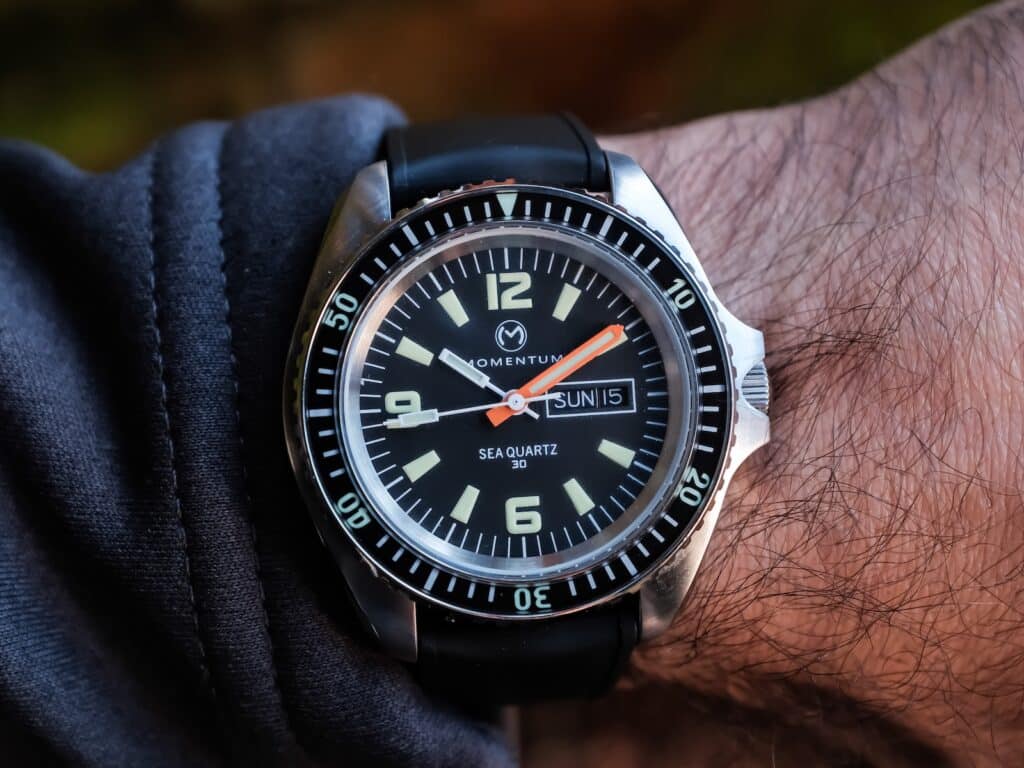
Momentum Sea Quartz 30
| Price: | $279 |
| Water Resistance: | 300m |
| Case Dimensions: | 42mm (diameter) x 47mm (lug-to-lug) x 11.3mm (thickness) |
| Lug Width: | 20mm |
| Movement: | Ronda R507 high-torque quartz |
The Momentum Sea Quartz 30 fits this list because it approaches the whole “serious dive watch” thing from a less obvious angle. It is not trying to overwhelm you with case size or brute-force wrist presence, yet it still has enough mass and shape to feel substantial once it’s on. At 42mm across with a 47mm lug-to-lug, it lands in a spot that feels more wearable than the numbers might suggest, though the case shape does give it a broader stance on the wrist than we first expected. That turns out to be part of the appeal. It fills space nicely, stays balanced, and avoids the kind of oversized awkwardness that can make bigger dive watches more work than fun. The flat caseback helps here too, keeping the watch planted and comfortable over longer stretches.
Momentum also did a good job of keeping the late-’70s influence intact without turning the watch into a vintage cosplay piece. The overall case design has the right throwback feel, but the practical updates matter most once you start living with it. The sapphire bezel insert is one of those choices that gives up a little old-school charm in exchange for better day-to-day durability, which feels like a fair trade. Brushing across the top surfaces gives the case some definition, while the polished sides stop it from feeling too flat or utilitarian. The downside is that the polished underside and lugs are a bit too eager to collect scratches, especially if you swap straps often. It is the sort of wear you notice pretty quickly.
Our review team found that the dial is restrained in a way that gets better the longer you wear it. Matte black, printed markers, and paddle-style hands keep everything easy to read without adding unnecessary noise. The orange minute hand is a smart touch because it gives elapsed-time reading a little more clarity when you are actually using the bezel. The watch is helped further by the quartz movement inside. The Ronda setup is accurate, low-maintenance, and makes this the kind of watch we can grab without thinking too hard about whether it has been sitting for a few days. Add 300 meters of water resistance, and it feels more capable than most of us will ever test.
That said, the bezel is the weak point in everyday use. It is stiffer than it should be, harder to grip, and never quite stops reminding you of itself when you try to time something. It is not a fatal flaw, but it keeps the watch from feeling fully effortless. Lume is similar. It starts well enough, though it fades earlier than some of the stronger performers we’ve worn. On the comfort side, the included tropic-style rubber strap turned out better than expected, and the watch also works nicely with a NATO or other rubber strap if you want to change things up. Momentum even offers a jubilee-style bracelet, which feels like a sensible, longer-term option. For enthusiasts who want something capable, wearable, and a little off the beaten path without turning the quirkiness up too far, the Sea Quartz 30 makes a convincing case.
Pros
- It wears with more presence than the dimensions suggest, but stays comfortable and well-balanced.
- The flat caseback and short lug-to-lug make it easy to wear for long periods.
- The quartz movement keeps ownership simple and dependable.
- The sapphire bezel insert makes a lot of sense for casual daily use.
- It works well across the included rubber strap, NATOs, and other aftermarket options.
Cons
- The bezel is too tight and more difficult to grip than it should be.
- Lume is serviceable, but it does not hang on as long as stronger alternatives.
- The polished portions of the case pick up scratches faster than we would like, especially during strap changes.
Baby Dreadnought PRS-52
| Price: | $470 |
| Water Resistance: | 300m |
| Case Dimensions: | 38mm (diameter) x 45mm (lug-to-lug) x 13mm (thickness) |
| Lug Width: | 18mm |
| Movement: | Miyota 9015 |
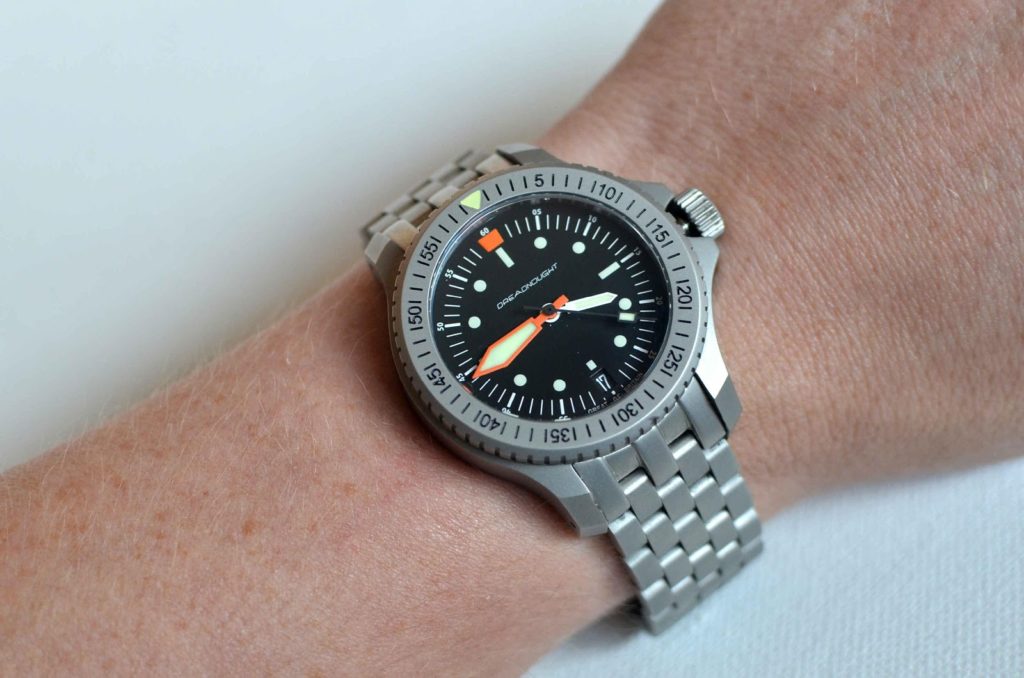
The “Baby” Dreadnought PRS-52 feels like the kind of watch you discover by accident after spending too many late nights in old forum threads. It was never built to be broadly charming, and that is a big part of why it works. Even the movement choice tells you what sort of watch this is. Inside, the Miyota 9015 keeps things straightforward and honest, with hacking seconds, manual winding, and a date. Ours ran at roughly +8 seconds per day, which felt perfectly respectable in real use. Skipping the Swiss route does not feel like a compromise here. It feels aligned with the whole point of the PRS-52: a hard-use watch built around function and attitude rather than pedigree.
That same attitude shows up in the case. It is milled from a single block of 316L steel and finished in bead blasting, which gives it a severe, stripped-down look in the hand. What stuck with us most during our review was the crisp edge along the side profile, a small detail that makes the whole watch feel more deliberate. The bezel turns with 120 firm left-handed clicks and forgoes a separate insert altogether, which only adds to the blunt, all-business personality. Despite the “Baby” name, this does not wear like a small watch. At 38mm wide and 45mm lug-to-lug, it lands in a very wearable mid-size territory, but it still has enough stance to feel substantial. The drilled, angular lugs also made strap changes quite easy during testing.
The dial does a nice job of carrying that identity without slipping into visual noise. There are obvious dive-watch cues if you know what you are looking at, but the overall layout feels coherent rather than borrowed. Circular lume plots alternate with striped markers, the date sits neatly at six, and text is sparse enough to feel considered. “Dreadnought” takes up the upper half of the dial, while “Great Britain” sits lower near the date in a way that feels earned instead of decorative. The oversized sword minute hand and orange block at twelve give the dial enough visual punch, while the black paddle seconds hand tends to stay out of the way in daily wear, which we appreciated more over time.
Once sized and on the wrist, the weight becomes a real part of the experience. At 165 grams on the bracelet, the PRS-52 feels dense and planted, and collectors who like a bit of heft will probably understand the appeal right away. The bracelet turned out to be better than expected. On paper, the 18mm lug width sounds narrow, but the solid end links fit the case tightly with no wobble, and the bead-blasted engineer-style design looks like it belongs there. Sizing, however, was another story. The screw pins were stubborn enough that handing the job to someone with proper tools felt like the smarter move. Once adjusted, the roughly 15mm of micro-adjustment in the clasp made it easier to fine-tune comfort. We were quick to throw it on NATOs because that seemed inevitable, but the bracelet earned more wrist time than we expected.
For enthusiasts who want something a little severe, a little obscure, and completely uninterested in playing nice, the PRS-52 makes a strong case for itself.
Pros
- The dial is readable and distinct without becoming cluttered.
- The Miyota 9015 delivered solid everyday performance and suits the watch’s no-nonsense character.
- The one-piece bead-blasted case feels rugged and intentionally overbuilt.
- Mid-size dimensions keep it wearable while still giving it a real presence.
Cons
- Bracelet sizing is not user-friendly without the right tools.
- The modern, utilitarian design limits how often it makes sense outside casual or tool-watch contexts.
- At 165 grams, it has real heft and will feel heavy to anyone used to lighter divers.
Citizen Promaster Aqualand Depth Meter
| Price: | $550 |
| Water Resistance: | 200m |
| Case Dimensions: | 50.7mm (diameter) x 51mm (lug-to-lug) x 14.8mm (thickness) |
| Lug Width: | 24mm |
| Movement: | Citizen C520 Quartz |
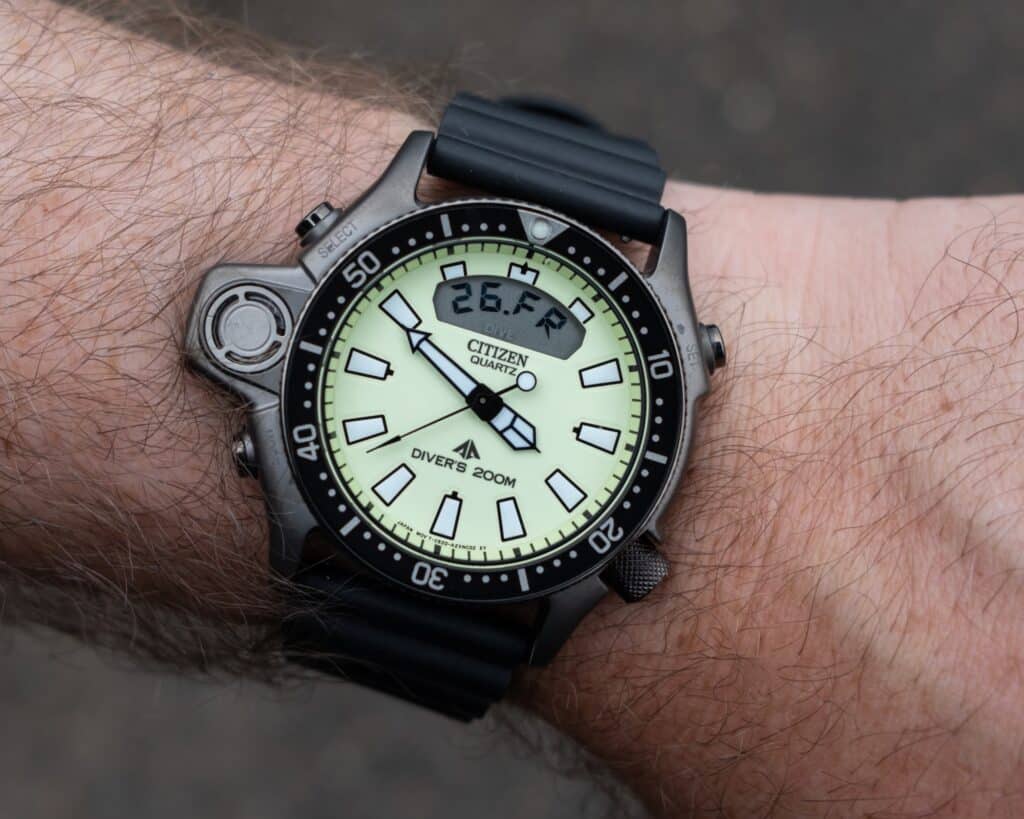
The Citizen Promaster Aqualand makes sense for enthusiasts who prefer the less-obvious choice because it wears more like purpose-built equipment than a conventional diver’s watch. It does not try to slim itself down or pass as a versatile everyday sports watch, and that is the point. The main case measures around 43mm, but the external depth sensor pushes the total spread closer to 50mm, and once you add the 24mm strap, the whole watch has a broad, deliberate stance on the wrist. In our time with it on wrist, the size never felt random or inflated just for effect. It felt tied directly to the watch’s function. For collectors who enjoy watches with real physical presence and a bit of unapologetic weirdness, that goes a long way.
And the functionality backs that up. This is not merely a dive watch with a few digital flourishes tacked on. It is a full dive computer, capable of tracking depth, logging dives, setting alerts, and warning you if you ascend too quickly. Realistically, most owners are not going to use every one of those features regularly, and we did not either, but knowing they are there changes the whole tone of the watch. It feels capable in a very different way from a standard desk-diver. Outside of actual dive use, the digital side still covers the practical basics well enough: alarm, chronograph, elapsed time, and calendar functions are all straightforward once the layout starts to make sense. The analog hands and digital display also operate independently while staying in sync once you have them set, which means very little ongoing fuss in daily wear.
The rest of the experience is shaped by usability more than charm. The bezel action is firm and positive, with proper alignment that is not always a given in this price range. The screw-down crown is oversized in a helpful way and easy to grip, while the pushers feel more intuitive the more time you spend with them. The rubber strap deserves some credit, too. It is soft, ventilated, secure on the wrist, and has enough length that it never feels cramped. Quartz accuracy quietly keeps everything running in the background, which suits a watch like this better than anything more romantic probably would.
Legibility is quite strong, with one caveat. The fully lumed dial glows brightly and stays on for hours, making low-light reading easy. The trade-off is that when the whole dial lights up at once, contrast drops a little compared to more selectively lumed designs. It never became a real problem for us, but it is something you notice. For anyone drawn to watches that feel gloriously overbuilt, function-led, and a little strange by modern standards, the Aqualand offers an ownership experience that most safer, more familiar divers do not.
Pros
- The case, external sensor, and strap give it a huge amount of wrist presence without feeling clumsy.
- Full dive-computer functionality gives it genuine capability beyond the usual diver formula.
- Quartz operation keeps it reliable and low-stress in everyday use.
- The rubber strap is comfortable, breathable, and long enough to wear securely without constant adjustment.
- Lume is strong and long-lasting, making the watch easy to read in the dark.
- Pre-owned pricing often makes it even more appealing.
Cons
- The overall footprint can feel excessive on smaller wrists.
- The fully lumed dial can soften contrast a bit in certain conditions.
- The 24mm lug width limits the number of alternative straps that make sense.
- Many of its diving functions will go unused by people who wear it mostly on land.
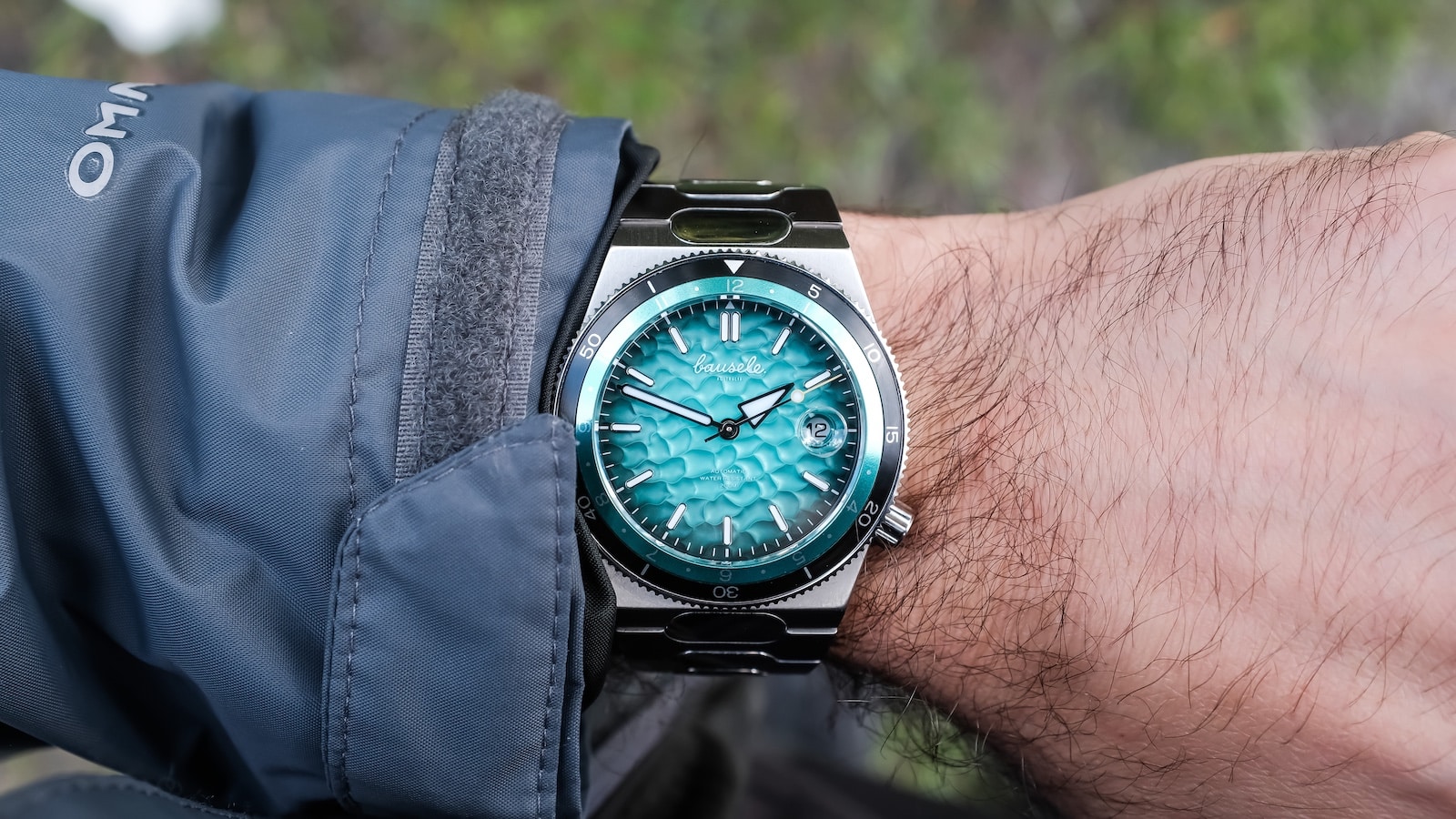
Bausele Elemental
| Price: | $750 |
| Water Resistance: | 200m |
| Case Dimensions: | 40mm (diameter) x 46mm (lug-to-lug) x 12.2mm (thickness) |
| Lug Width: | Integrated bracelet which tapers from 26mm down to 18mm |
| Movement: | Sellita SW200 |
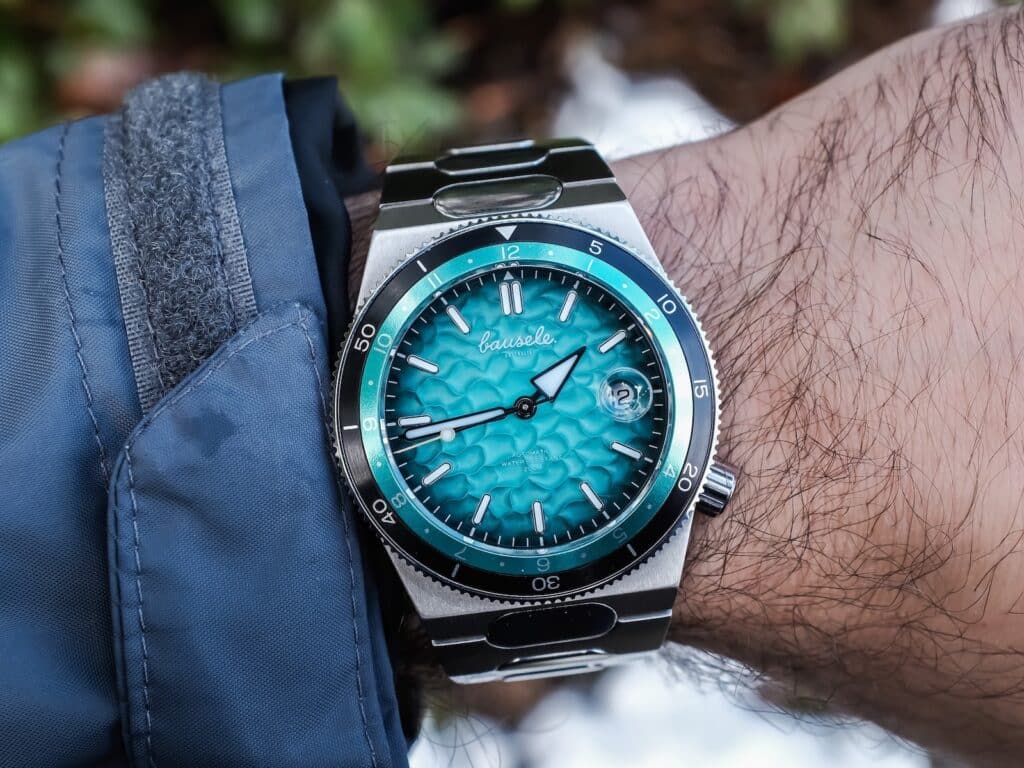
The Bausele Elemental earns its place here because it takes a familiar sports-watch formula and tilts it enough to feel personal. At 40mm, it does not sound too bold on paper, but the integrated bracelet gives it more wrist presence than that number suggests. It sits close, wears snugly, and feels intentional rather than flashy. We liked that balance. It has enough visual weight to feel like a real companion for long days on the move, but it never crossed into bulky or tiring territory. That said, the 46mm lug-to-lug and integrated layout can make it feel a bit larger on smaller wrists than the headline dimensions imply.
A lot of the appeal comes from how well it mixes practicality with details that could have easily gone sideways. The 316L steel case has a reassuring heft, but not so much that it becomes a burden, and the mix of brushed surfaces and polished chamfers adds some life without becoming decorative nonsense. The 200 meters of water resistance also matters here. It can handle the usual daily grind fine, and it does not feel out of place around water either.
The bezel and dial are where the watch starts to show more personality. The layered bezel adds visual depth, but it also lets you track a second time zone, which turned out more useful than expected for staying aligned with people elsewhere. The dial keeps things legible while still giving you something to look at. Its texture has a sandy, underwater quality to it that adds character without cluttering the display. Then there is the crown, which contains a bit of sand as a nod to Sydney’s Northern Beaches. That could have been an eye-roll detail in someone else’s hands, but here it feels more like a quiet signature than a gimmick.
Comfort is another area where the Elemental makes a strong case for itself. The bracelet tapers from 26mm down to 18mm, which helps keep the watch from feeling too blocky, and the micro-adjustable clasp made a real difference during extended wear. Being able to fine-tune the fit throughout the day, especially in warmer weather or after time in the water, made the watch easier to live with than many integrated-bracelet designs.
Inside, the Sellita SW200 is exactly the kind of movement we want in a watch like this: proven, straightforward, and easy to service. It is not exotic, but it ran at about +5 seconds per day in our time with it, and the 38-hour power reserve never caused any fuss. For enthusiasts who want something less expected without drifting into novelty for novelty’s sake, the Elemental has a pretty convincing argument.
Pros
- The integrated bracelet gives it real presence without making it awkward or overbearing.
- The layered bezel adds useful second-time-zone tracking without cluttering the dial.
- The textured dial brings character while staying easy to read.
- The micro-adjustable clasp noticeably improves day-to-day comfort.
- 200 meters of water resistance gives it genuine sports-watch credibility.
Cons
- The integrated design and 46mm lug-to-lug can make it wear a bit large on smaller wrists.
- Bezel alignment can drift slightly on certain examples.
- The sand-filled crown detail may land as a novelty for some people.
Certina DS PH200M

| Price: | $810 |
| Water Resistance: | 200m |
| Case Dimensions: | 43mm (diameter) x 52mm (lug-to-lug) x 14.5mm (thickness) |
| Lug Width: | 20mm |
| Movement: | Powermatic 80 |
The Certina DS PH200M is an easy watch to overlook if your attention usually gets pulled toward the louder names in the vintage-inspired dive category. That feels a little unfair once you spend real time with it. Yes, it is a modern take on a late-1960s Certina diver, but it does more than coast on old photos and familiar styling cues. The appeal is that it still feels like a usable dive watch first. Certina’s Double Security setup helps with that, pairing standard Incabloc protection with a rubber shock cushion around the movement. It is one of those details most people will never see, but it does change how the watch comes across in the hand. It feels like a tool with some actual engineering thought behind it, not another random retro reissue.
On the wrist, the DS PH200M has real presence. The case measures just under 43mm, stretches to roughly 52mm lug-to-lug, and sits around 14.5mm thick, with much of that thickness coming from the domed box-style crystal. Smaller wrists will notice all of that immediately, though the slightly downward-curving lugs help the watch settle better than the raw measurements suggest. On a larger wrist, it feels planted and substantial in a way that suits the design. The included leather strap is thick and sturdy, equipped with quick-release spring bars, though the nubuck finish may not be to everyone’s taste. During testing, we ended up liking the watch even more on a NATO or mesh bracelet, where the whole vintage diver character makes a bit more sense.
The dial and bezel do a nice job of carrying that old-school mood without turning the watch into a costume piece. The matte black dial stays clean and readable, and the red crosshair accents add enough personality to keep it from feeling flat. BGW9 lume performed well for us and stayed visible deep into the night, which matters more than many people admit. The aluminum bezel preserves the traditional feel, using a 60-click setup with a luminous marker at 12. Better still, the bezel lines up properly with the chapter ring, something that is not always guaranteed even from bigger names. The trade-off is in the feel. It turns with some resistance, and there is a little play between clicks, so it never feels quite as sharp as the category’s better examples.
Inside, the Powermatic 80 makes the whole package easier to live with. The roughly 80-hour power reserve means you can leave it off for a weekend and come back Monday without finding it dead, which is useful in a rotation. It is also a movement that has become common enough to keep servicing without feeling mysterious or complicated down the line. For enthusiasts who want a dive watch with vintage character but do not want the same predictable choices everyone else keeps making, the DS PH200M offers a more interesting path. It features enough practicality underneath the nostalgia to justify the detour.
Pros
- The Powermatic 80 gives you a very useful multi-day power reserve.
- Certina’s DS shock-protection system adds real everyday durability.
- BGW9 lume stays visible for hours in low light.
- The vintage-leaning design adapts well to leather, NATO, or mesh.
- Bezel alignment with the chapter ring is quite precise.
Cons
- The nearly 52mm lug-to-lug span can feel like a lot on smaller wrists.
- The nubuck-style leather strap will not suit everyone’s taste.
- The bezel action is a bit stiff and shows slight play between clicks.
Christopher Ward C63 Valour
| Price: | $945 |
| Water Resistance: | 150m |
| Case Dimensions: | 39mm (diameter) x 46mm (lug-to-lug) x 11.55mm (thickness) |
| Lug Width: | 20mm |
| Movement: | ETA G10.212 AD COSC quartz |
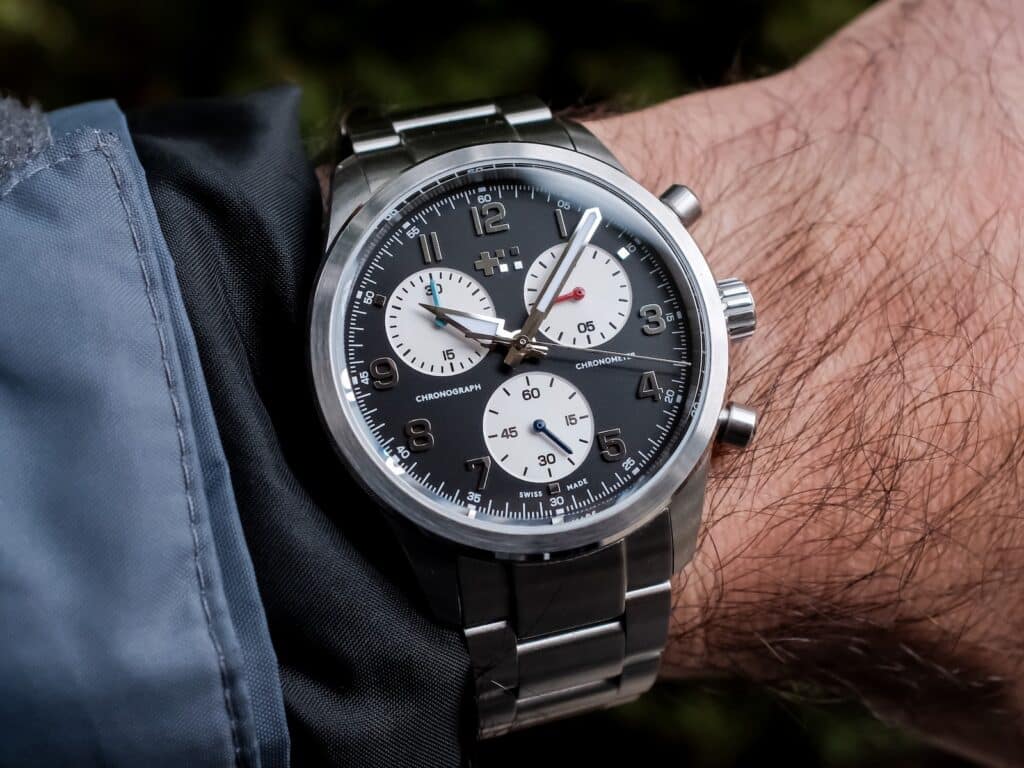
The C63 Valour works for this list because it takes a route that many enthusiasts overlook in principle. Instead of relying on a meca-quartz movement to sell the romance of a mechanical-adjacent chronograph, it uses a COSC-certified ETA quartz caliber rated to about ±10 seconds per year. In practice, that changes the whole ownership experience. While testing it hands-on, we set it up, wore it, and, more or less, forgot about it, which is a compliment here. Weeks later, it was still in the right place. The pushers feel crisp, the reset is clean, and the watch never tries too hard to imitate something it is not. It does the job with a level of consistency that is hard to argue with in daily wear.
On the wrist, the watch also lands in a sweet spot that is harder to find than it should be. At 39mm across and under 46mm lug-to-lug, it sounds compact, but it carries a little more substance than the dimensions suggest. It sits low and balanced, especially on the Bader bracelet, and avoids the top-heavy feel we often run into with thicker chronographs. There is some density to the case as well. It feels planted rather than hollow, which gives it a more reassuring presence throughout the day. Christopher Ward’s Light-catcher case name still reads a bit like marketing copy, but the alternating brushed and polished surfaces do give the watch a shifting character in different light. The result is a chronograph that feels slightly more refined than a strict tool-watch interpretation.
The dial follows that same approach. The reverse panda layout keeps contrast strong, while the applied Arabic numerals add depth and sharpen up nicely in brighter light. Indoors, they settle down without becoming hard to read. The colored sub-dial hands tied to different service branches could have been a little much, but they stay subtle enough not to interrupt the layout. Running seconds at six and the chronograph registers are easy to track, and the handset remains legible in low light thanks to generous lume. It is one of those dials that feels more thoughtful after a few days.
The bracelet helps seal the deal. Its taper from 20mm to roughly 16mm keeps the watch feeling tidy on the wrist, and the combination of link sizes makes dialing in the fit pretty straightforward. The simple on-the-fly extension also came in handy on warmer days when wrist size shifted a bit. Quick-release spring bars make strap changes easy, though we kept coming back to the bracelet because it suits the watch so well. The only real annoyance was a faint squeak early on, which did calm down with wear.
Pros
- The COSC-certified quartz movement delivers long-term accuracy with minimal deviation.
- Compact dimensions wear comfortably, but the case still has enough heft to feel substantial.
- The reverse panda dial stays very legible while adding a bit of depth through the applied numerals.
- The Light-catcher case gives the watch more visual range than a flatter, more utilitarian design.
- Bracelet taper and the quick-adjust extension make daily comfort easy to manage.
- Quick-release spring bars make strap swaps painless.
Cons
- The bracelet can develop a slight squeak during the early part of ownership.
- Collectors set on a fully mechanical chronograph may never warm to the quartz movement.
- The military-inspired cues are restrained enough that some buyers may want more of that character up front.
Mr. Jones Beam Me Up!
| Price: | $950 |
| Water Resistance: | 50m |
| Case Dimensions: | 40mm (diameter) x 50mm (lug-to-lug) x 11.6mm (thickness) |
| Lug Width: | 18mm |
| Movement: | Sellita SW200 automatic |
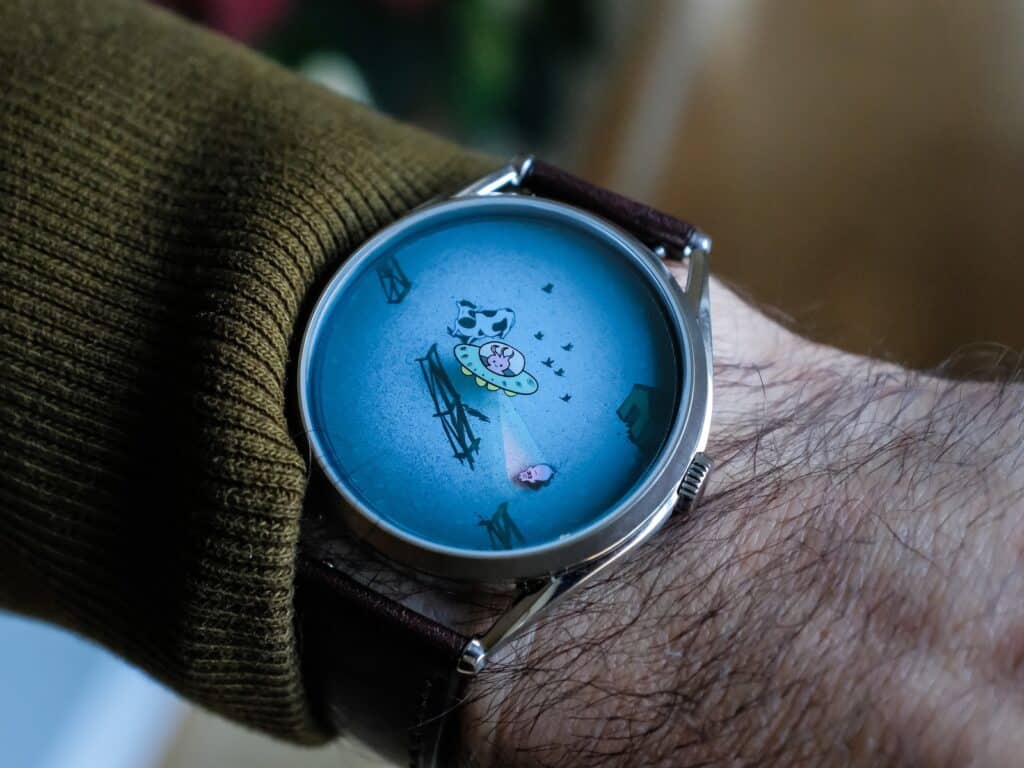
The Mr. Jones Beam Me Up! is the kind of watch that makes sense once you stop asking it to behave like a normal one. At 40mm wide, just under 50mm lug-to-lug, and about 11.6mm thick, it wears with a little more reach than the numbers suggest, mostly because the lugs are long and slender. Still, it settled on the wrist better than we expected. The gently curved case helps, and the polished 316L steel keeps the whole thing from feeling too cartoonish in person. That balance matters. For enthusiasts who are tired of every watch trying to justify itself through heritage, resale, or some tortured idea of “daily versatility,” this one offers a different kind of appeal. It feels like a conscious break from the usual script, but not a disposable joke.
Most of that comes from the dial, which was designed by French illustrator Xavier Broche and leans fully into the absurdity of a UFO lifting a pig off a farm. On paper, that sounds like a watch you admire once and never wear again. On the wrist, it is more engaging. The blues and turquoise tones have real depth, the pink beam stands out without overpowering the scene, and the hand-finished quality adds a little texture, keeping it from looking flat. Reading the time takes a short adjustment period. The beam tracks the minutes, and the pig marks the hours. Once that clicks, it becomes quite easy to use. More importantly, it changes the way you interact with the watch. You slow down for a second. You pay attention. That is part of the point. This is less about precision in the tool-watch sense and more about enjoying the act of wearing something weird, deliberate, and oddly charming.
The rest of the watch knows its role. Through the display case back, you get a look at the Sellita SW200, along with a small pig graphic that ties the whole concept together without pushing it too far. The movement is familiar, reliable, and easy to live with, which is what this watch needs. The included 18mm dark Havana leather strap ended up grounding the whole package better than we expected. It is soft right away, gets more comfortable with wear, and keeps the watch from tipping too far into novelty. We did wonder how it would feel on a NATO, especially if you wanted to lean harder into the casual side of things, but the leather gives it enough restraint to stay wearable.
In short, this is the watch we would recommend to the collector who wants one piece in the box that resets the mood and reminds them that this hobby can still be fun. Read through our full review for a deeper understanding.
Pros
- The illustrated dial feels playful in a way that still rewards repeated wear.
- Once learned, the UFO beam and pig time display is more intuitive than it first appears.
- The leather strap adds comfort and helps ground an otherwise unconventional design.
- The Sellita SW200 is dependable and easy to live with.
- The hand-finished dial and caseback details give the watch more character up close.
- The polished steel case keeps the watch wearable instead of tipping fully into novelty.
Cons
- Telling the time is not immediate, especially during the first few days.
- Water resistance is fine for daily wear, but this is not something we would treat like a tool watch.
Mido Ocean Star
| Price: | $1040 |
| Water Resistance: | 200m |
| Case Dimensions: | 42.5mm (diameter) x 42.5mm (lug-to-lug) x 11.75mm (thickness) |
| Lug Width: | 22mm |
| Movement: | Caliber 80 |
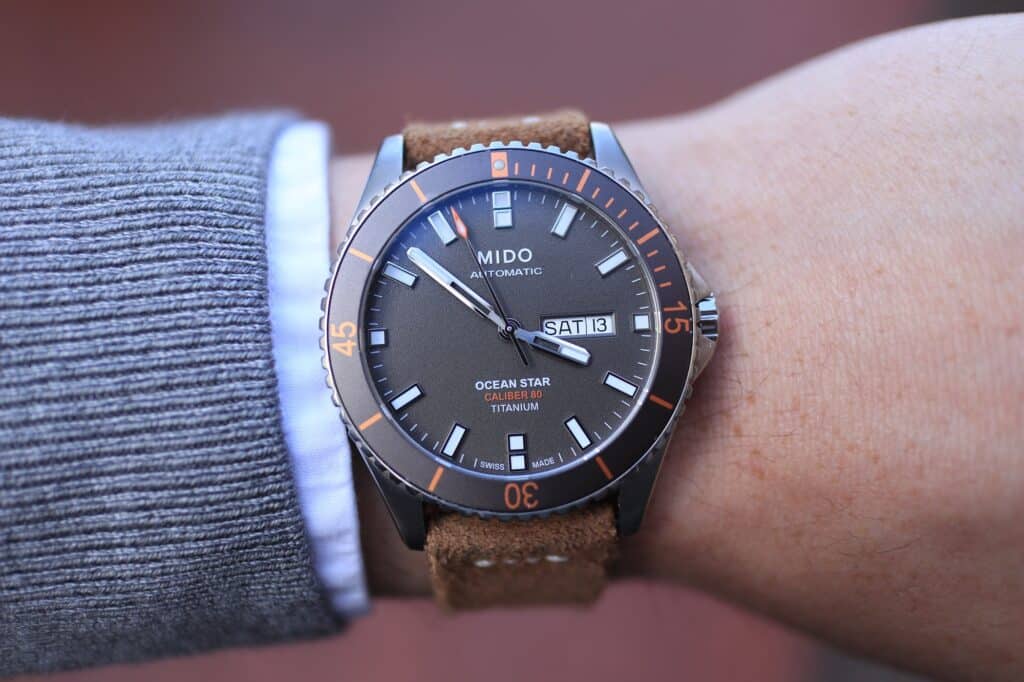
The Mido Ocean Star belongs in a piece like this because it is the watch that many collectors skip over too quickly. It does not arrive with much noise, and honestly, that is part of the charm. The more time we spent wearing it, the more the watch started to make sense. Its 42.5mm case sounds fairly standard for a modern diver, but the fully brushed titanium construction changes the experience. At roughly 11.75mm thick, it also stays slimmer than many similarly positioned dive watches. Over long days of commuting, desk time, and the usual errands, it never developed that top-heavy, slightly annoying feel.
A lot of that ease comes down to how thoughtfully the watch is put together. The case has gentle contours, and the sloped bezel follows those lines rather than cutting across them, so the whole thing feels cohesive on the wrist. A polished chamfer along the case edge adds enough contrast to keep the Ocean Star from looking flat, but it stops well short of feeling flashy. The bracelet helps, too. Titanium keeps it light, while the curved links and shaped underside let it wrap naturally around the wrist. The taper from 22mm to 19mm keeps things from feeling too blocky, and the ratcheting clasp makes small fit adjustments easy throughout the day.
The dial is where the watch starts to reward closer attention. The anthracite surface plays with light in a restrained way, sometimes catching it, sometimes going quiet, which gave the watch more character than we expected at first glance. That works well with the double anti-reflective coating on the sapphire crystal, which keeps glare under control whether you are outside or sitting under office lights. Legibility is strong overall. The shortened marker at nine balances the trimmed index at three near the day-date window, which is a small design decision but an important one because it keeps the dial from feeling visually off. The pencil hands, filled with BGW9 Super-LumiNova, charge quickly and glow with a cool blue-green tone after dark, while the orange-accented second hand with its luminous tip stays easy to follow right out to the edge of the dial.
Inside, Mido’s Caliber 80 does what we want a movement like this to do. It is based on the familiar ETA 2824 architecture, but the extended 80-hour power reserve makes the watch easier to wind and set without constantly resetting it. There are a few compromises, of course. The screw-down crown can be stubborn to get started and sometimes needs a fingernail to unscrew. The lugs could also drop a bit more sharply for smaller wrists. And because of the watch’s particular dial and case color combination, strap pairing is not as open-ended as it is with more neutral divers. Still, for enthusiasts who want something refined, capable, and a little less predictable than the usual spotlight divers, the Ocean Star makes a strong argument over time rather than all at once.
Pros
- The titanium case keeps the watch quite comfortable during extended wear.
- At around 11.75mm thick, it feels slimmer and more balanced than many modern divers.
- The Caliber 80’s extended power reserve makes everyday ownership easier.
- The dial texture, anti-reflective crystal, and BGW9 lume all help with real-world legibility.
- The titanium bracelet and ratcheting clasp make it easy to fit and comfortable to wear.
Cons
- The crown can be very tight when you first try to unscrew it.
- Smaller wrists may wish the lugs curved down more aggressively.
- The case and dial colors do not make this the easiest watch to pair with every strap option.
Archimede SportTaucher
| Price: | $1,230 |
| Water Resistance: | 300m |
| Case Dimensions: | 41.5mm (diameter) x 49.7mm (lug-to-lug) x 12mm (thickness) |
| Lug Width: | 20mm |
| Movement: | Sellita SW200-1 Swiss automatic |
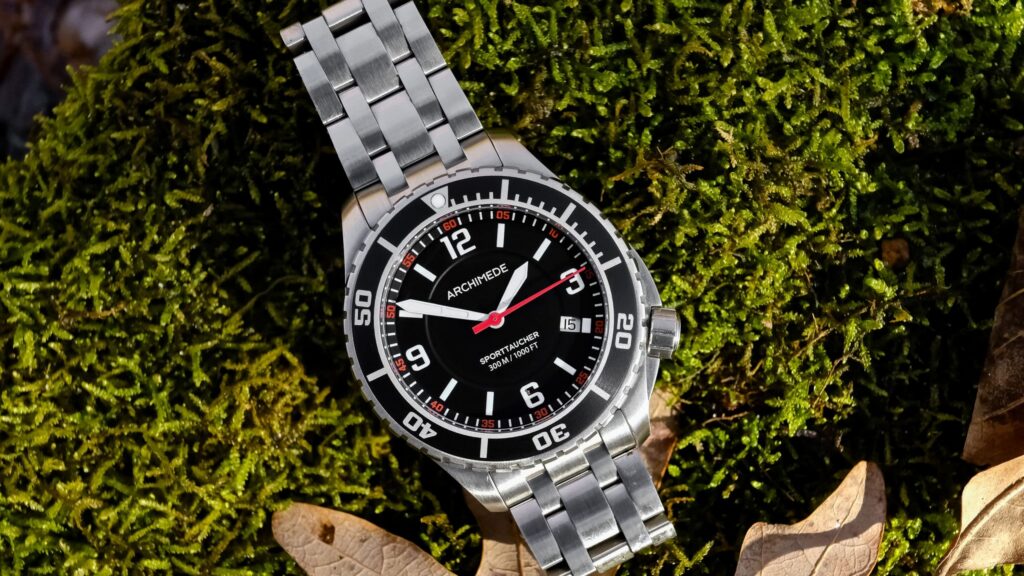
The Archimede SportTaucher is yet another watch that gets missed when collectors keep circling the same familiar names. That is strange, because once we spent time with it, the appeal was pretty immediate. The 41.5mm steel case, just under 50mm lug-to-lug, lands in a very usable middle ground, and the overall build feels more severe than styled-up. The CNC-milled case has a blocky, sharply machined character with no polished chamfers trying to soften the message. On the wrist, it feels robust without tipping into the clumsy, overbuilt territory some tool watches never escape.
A lot of that usability comes down to small decisions that matter in daily wear. The crown sits at four o’clock, which helps keep it from pressing into the wrist during desk work or more active use, and the crown itself is excellent: large, easy to grip, and smooth when threading back in. Inside is the Sellita SW200-1, with quickset date and a 38-hour power reserve. On wrist, that movement sat in the expected roughly +5 to +10 seconds per day range, which felt perfectly reasonable, though the shorter reserve does mean it may need resetting if it sits for a couple of days.
The dial is also practical, but in a more thoughtful way than the usual affordable diver formula. Archimede uses what appears to be a molded, integrated chapter ring rather than a separate printed one, and that helps avoid the alignment sloppiness we often notice elsewhere. The recessed center section also gives the dial a bit of shape, softening an otherwise very tough-looking watch. Sword hands keep things simple, the glossy red second hand adds enough contrast to track easily, and the lume on the hands, markers, and bezel pip is strong enough to stay visible until morning. Even the date at four feels well handled, replacing the marker cleanly and lining up with the crown rather than interrupting the dial more than necessary.
The bracelet turned out better than its looks first suggest. It is a thick five-link design, and we expected it to be a bit stiff or uncomfortable, but the articulation is better than that first impression implies. With four micro-adjust positions, getting a secure fit is straightforward, and the clasp feels solid and dependable. The bezel is the only area where the watch gives up a little ground. Its 120-click action is confident, and the markings line up properly, but there is a small amount of vertical play and some backplay if you look for it. Even with that, the SportTaucher still comes across as a serious, no-nonsense diver for enthusiasts who want something off the usual path and built with actual use in mind.
Pros
- The case feels rugged and purpose-built without becoming awkward on the wrist.
- The four o’clock crown placement and excellent threading make everyday handling better.
- The dial design intelligently addresses alignment issues and remains highly legible, day or night.
- The thick five-link bracelet is more comfortable than it looks and offers useful micro-adjustment.
Cons
- The bezel has slight vertical play and a bit of back-play, even though the clicks themselves feel positive.
- The watch still has enough case presence that smaller wrists may find it substantial.
- The SW200-1’s 38-hour reserve is shorter than that of many newer competitors.
Monta Skyquest GMT
| Price: | $2,435 |
| Water Resistance: | 300m |
| Case Dimensions: | 40.7mm (diameter) x 47.4mm (lug-to-lug) x 11.8mm (thickness) |
| Lug Width: | 20mm |
| Movement: | Monta Caliber M-23 (Sellita SW330-2 base) |
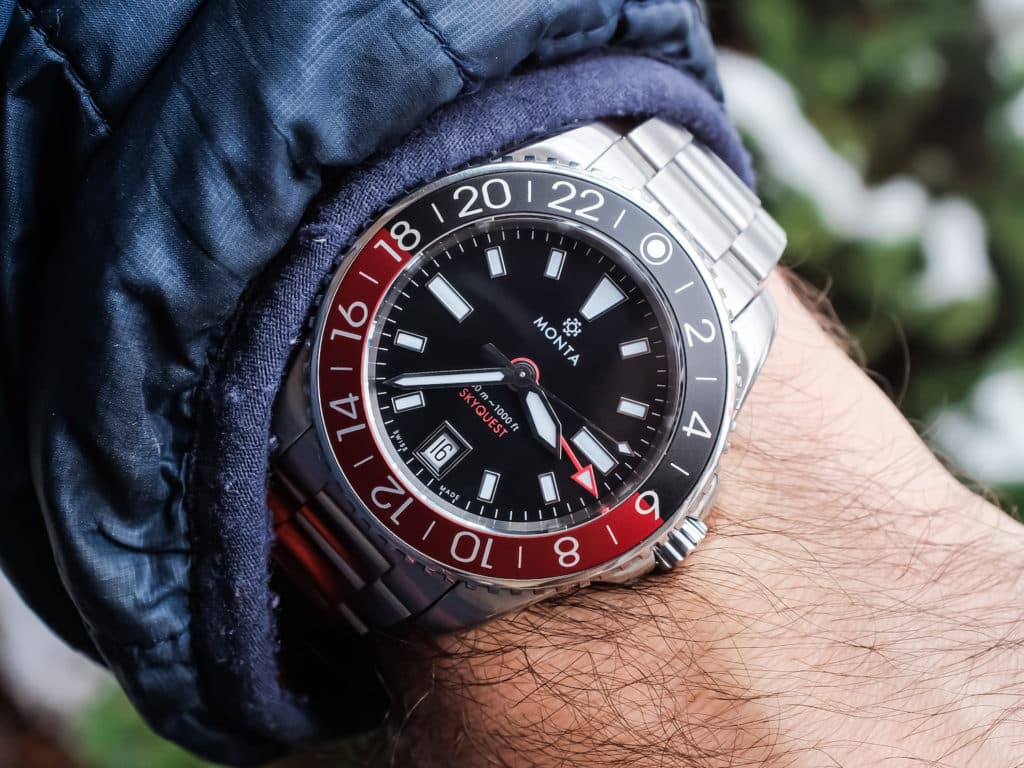
The Monta Skyquest GMT fits this topic because it doesn’t grab you with a loud gimmick the second it hits the wrist. What stuck with us during testing was how settled and composed the whole thing feels in use. At 40.7mm wide, 47.4mm lug-to-lug, and 11.8mm thick, it falls within a size range that works for many wrists, but it wears even calmer than those numbers suggest. Part of that comes from the way the larger 24-hour bezel markings draw your eye outward, making the dial feel less cramped, and the watch itself feel a bit smaller to the wearer. It is one of those designs that starts making more sense the longer you handle it.
That sense of restraint carries over into how the GMT function is executed. Monta uses its Caliber M-23, based on the Sellita SW330-2, and in our hands, it came across as reliable, easy to live with, and simple enough to service later on. It is a caller GMT, not a flyer, but the setup still feels practical because the bezel is so easy to use. The grip is solid, the bi-directional action is positive, and tracking another time zone never feels like work. We also liked the fact that Monta cleaned up the dial by removing the old internal 24-hour chapter ring. The result is a more readable layout with larger applied markers, broad sword hands, a clear date at six, and strong BGW9 lume that held up well after dark. The trade-off is that some of the older quirks, like the stepped GMT hand and third-time-zone party trick, are gone, and longtime fans may miss a little of that odd charm.
The bracelet is another big reason this watch keeps earning wrist time. Monta’s updated bracelet still feels like one of the more convincing examples in this space, with screw links, a solid milled clasp, and a tool-free quick-adjust system that proves more useful than it first sounds. Over long wear, that matters. Small changes in wrist size stop being an annoyance because you can deal with them on the fly. The taper also helps the watch stay comfortable and balanced, rather than feeling blocky.
What keeps the Skyquest in “less obvious choice” territory is that it is not trying to win people over with heritage shorthand or cheap nostalgia. It is a very considered GMT that prioritizes daily use. Still, it is not perfect. We would have liked the screw-down crown to be slightly larger, and the pricing puts it directly against more established names, which makes the decision less automatic than the quality alone might suggest. But for enthusiasts who want a GMT that feels refined, practical, and a little more self-assured than attention-seeking, this one makes a strong case.
Pros
- The proportions wear compact and balanced, with the bezel-to-dial relationship making the watch feel calmer on the wrist.
- The GMT setup is straightforward in real use, helped by a bezel that is easy to grip and operate.
- The cleaner dial layout, strong BGW9 lume, and anti-reflective crystal all help legibility in day and low light.
- The bracelet feels thoughtfully engineered, and the tool-free quick-adjust becomes useful over time.
- The Sellita-based movement is dependable and brings a useful 55-hour power reserve.
Cons
- The redesign improved function, but it also stripped away some of the earlier model’s character.
- The screw-down crown could stand to be a touch larger for easier handling.
- Pricing puts it in competition with bigger, more established brands, which some buyers will weigh heavily.
Omega Railmaster
| Price: | $6,400 |
| Water Resistance: | 150m |
| Case Dimensions: | 40mm (diameter) x 46.5mm (lug-to-lug) x 12.5mm (thickness) |
| Lug Width: | 20mm |
| Movement: | Omega 8806 Master Chronometer Co-Axial |
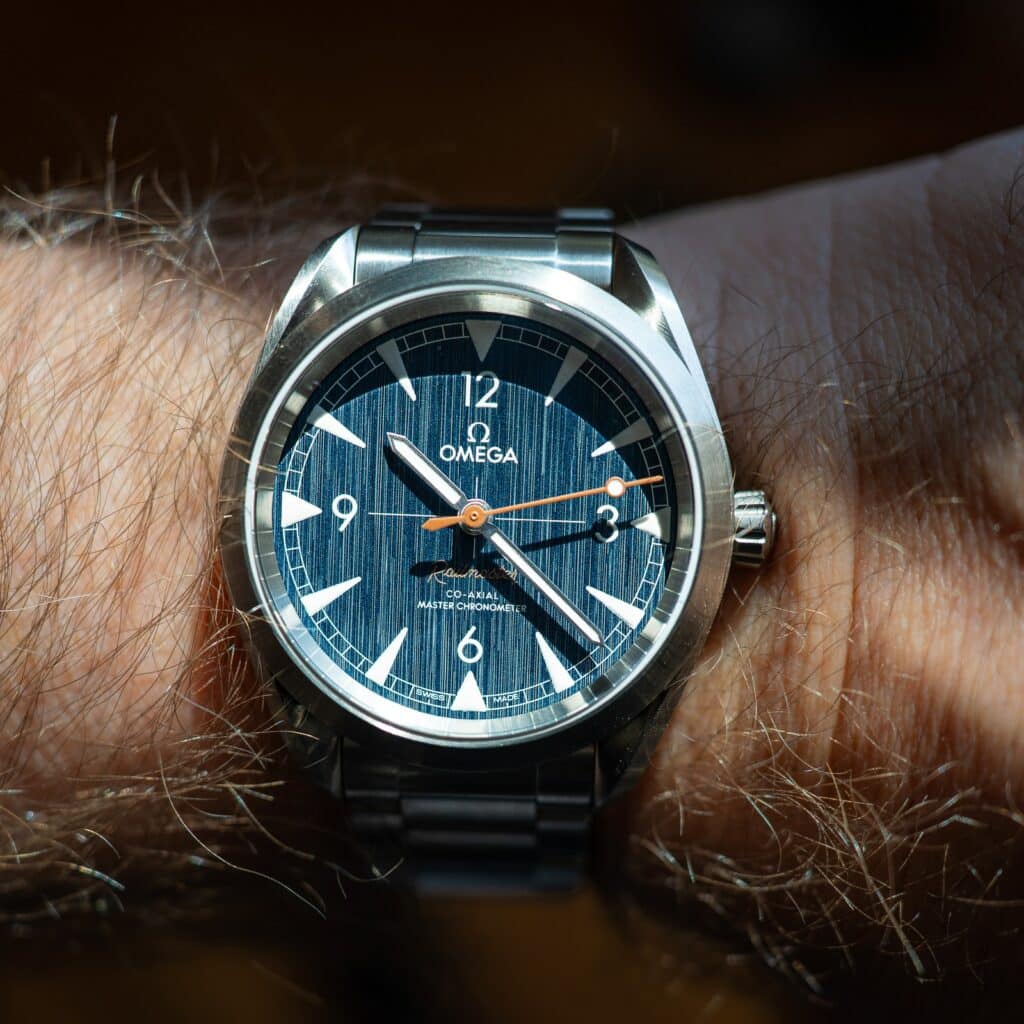
The Omega Railmaster belongs in this conversation because it takes the less-obvious route within its own brand. It is not trying to win you over with extra complications or a louder personality. What it does instead is narrow its focus, making the basics feel more satisfying than they should. The time-only layout keeps the dial open and easy to live with, and after a few days on the wrist, the vertically brushed surface does much of the heavy lifting. Light moves across it in a way that keeps the watch from ever feeling dull, shifting between darker and warmer tones depending on the angle. The bronze second hand helps too. It adds enough contrast to keep things from turning sterile, but never pushes the design into gimmick territory.
That quiet confidence carries over to the case. At 40mm wide, 46.5mm lug-to-lug, and about 12.5mm thick, the Railmaster wears with a steadiness that works across a wide range of wrist sizes. It sits low enough to behave under a cuff, but still has enough substance to avoid feeling slight. Most of the case is brushed, which suits the watch and makes everyday wear less stressful, while the polished chamfers along the edges stop it from becoming too plain. In practice, that balance is a big part of why the watch works. It can move between settings without asking you to think too much about it.
The movement is where the Railmaster starts justifying itself. Omega’s Co-Axial Master Chronometer caliber ran at roughly +1 second per day in our in-depth testing, and over a few weeks, that kind of consistency becomes easy to appreciate. The METAS certification and strong magnetic-field resistance matter equally. They sound like spec-sheet talking points until you remember how much daily life now revolves around electronics, travel, and random sources of interference. None of it makes the watch more exciting in a flashy sense, but it does make it easier to trust.
The bracelet follows the same logic. The three-link design feels solid, the mostly brushed finish does a decent job hiding the small marks that build up over time, and it suits the rest of the watch’s restrained character. The weak point is fit. The lack of micro-adjustment made dialing it in more annoying than it should have been, and that is the sort of issue you notice repeatedly, not just once. Price is the other hurdle. For a watch this visually restrained, the cost can feel ambitious at first, especially next to simpler alternatives. Then again, once you spend time with the finishing, movement performance, and overall coherence, it becomes easier to see where that money went. For enthusiasts who want something quieter than the usual headline Omega, the Railmaster makes a strong case by refusing to oversell itself.
Pros
- The Master Chronometer movement delivered excellent day-to-day accuracy in our testing.
- Predominantly brushed finishing helps the watch wear its scratches more gracefully over time.
- Strong magnetic resistance adds real peace of mind in normal modern environments.
- The brushed dial has more depth than a simple time-only watch gets away with.
Cons
- The bracelet could use a micro-adjustment to make fine-tuning easier.
- Buyers wanting extra functionality may find the time-only format too restrained.
- The price can feel steep when the visual design is this understated.
Glashütte Original SeaQ
| Price: | $10,200 |
| Water Resistance: | 200m |
| Case Dimensions: | 39.5mm (diameter) x 47.5mm (lug-to-lug) x 12.5mm (thickness) |
| Lug Width: | 20mm |
| Movement: | SeaQ Caliber 39-11 Automatic |
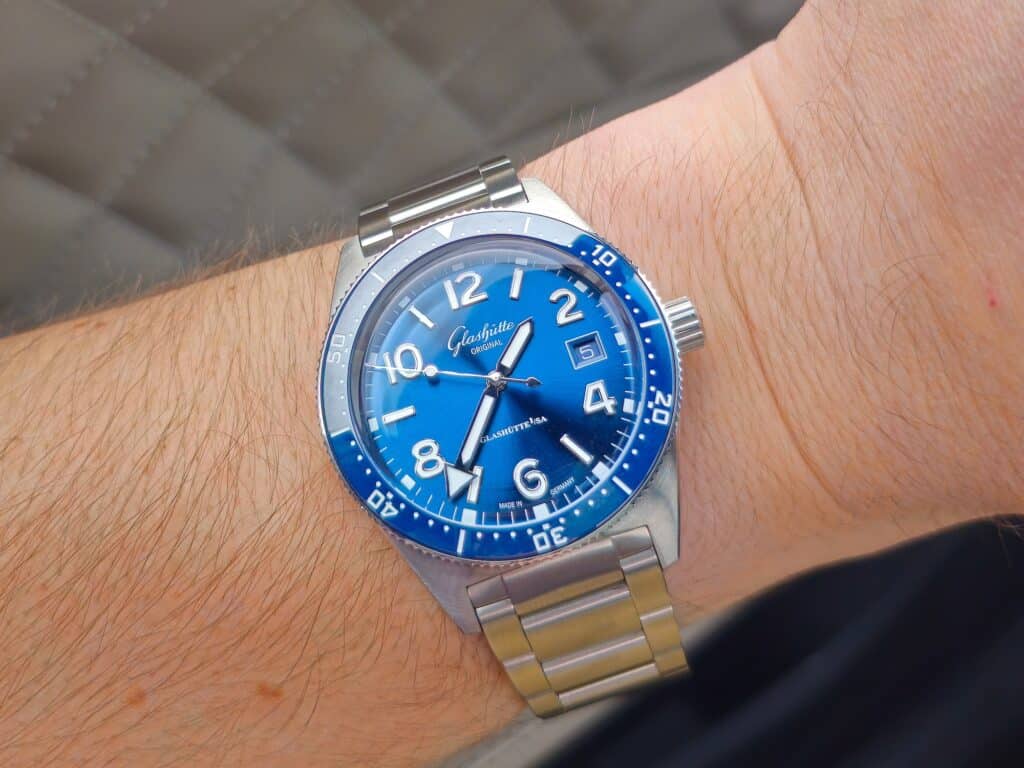
The SeaQ belongs on a list like this because it does not win us over through raw spec-sheet dominance. It starts making sense once there is actual wrist time involved. The bezel is a good example. Its unidirectional action feels firm, deliberate, and precise, with none of the looseness or hesitation that can quietly undermine confidence in a dive watch. The screw-down crown delivers the same reassuring resistance, and the case finishing backs it up. The surfaces most likely to take wear are brushed, while the polished accents around the edges remind you that this is not a purely utilitarian object, even if it behaves like one most of the time.
Then there is the dial, which is where the SeaQ kept pulling us back in during testing. Not because it shouts, but because it keeps changing. In brighter light, the sunburst surface wakes up and shows more energy. Indoors, it drops into darker, inkier tones, making the watch feel more restrained. The domed sapphire helps with that by adding a bit of curvature and movement rather than letting the dial sit there flat. Even with all of that going on, the layout stays open and readable thanks to the clean Arabic numerals and restrained text. It never feels overworked.
We found that the bracelet deserves real credit, too. The brushed 20mm links feel smooth and natural on the wrist, and the tool-free quick-adjust clasp is the kind of feature that quickly becomes part of daily use rather than a bullet point you forget. It is simple, compact, and easy to operate on the fly. The one place where the bracelet feels a little less convincing is where it meets the case, which does not look quite as cohesive as the rest of the watch.
Inside, the Caliber 39-11 ran consistently in our testing and offers more finishing than the closed caseback suggests, including beveled edges, polished screws, a swan-neck regulator, and a skeletonized rotor. The roughly 40-hour power reserve is not generous at this level, and the price definitely puts the SeaQ in serious company. Still, for enthusiasts who want a dive watch that feels more considered than obvious, the SeaQ earns its place through how complete the experience feels on the wrist.
Pros
- The dial has real tonal depth and remains visually engaging in different lighting conditions.
- The bezel and crown action both feel precise and confidence-inspiring.
- The bracelet is comfortable, and the compact, quick-adjust clasp is useful.
- Case finishing balances durability and refinement well.
Cons
- The power reserve feels a bit short for a watch in this tier.
- Pricing puts it in a very competitive part of the market.
- The bracelet-to-case transition is not quite as seamless as the rest of the execution.
That’s where we’ll leave this one, at least for now. Watches like these tend to stay interesting because they never took the easy route in the first place. They are the pieces that make sense a few weeks in, not always five minutes after opening the box, and that usually tells us more than any launch-day hype cycle ever could. If there’s a less obvious watch that has earned real wrist time in your collection and probably deserves a spot here, share it in the comments. We’ll see if it’s a watch we can coordinate a review for with the brand for future consideration in this piece.

Co-Founder and Senior Editor
Kaz has been collecting watches since 2015, but he’s been fascinated by product design, the Collector’s psychology, and brand marketing his whole life. While sharing the same strong fondness for all things horologically-affordable as Mike (his TBWS partner in crime), Kaz’s collection niche is also focused on vintage Soviet watches as well as watches that feature a unique, but well-designed quirk or visual hook.