Field watches have a funny way of exposing what we actually want from affordable watches. We say we want heritage, toughness, and military-adjacent seriousness. Still, most of us are wearing them to work, on errands, through bad weather, and during whatever domestic nonsense counts as “field duty” that week. This list exists to answer a simple question: which best field watches under $600 still feel useful, honest, and enjoyable after the initial new-watch buzz wears off? Some of the watches we’ve spent time with felt purpose-built, some were refreshingly cheap, and a few reminded us that convenience matters more than collector romance when you’re just trying to grab a watch and leave the house.
We’ve been reviewing watches for nearly a decade, but the better reason to trust us here is that we’ve lived with this category in all its awkward little corners. We’ve worn compact military-style pieces that felt more capable on the wrist than their measurements suggested, solar field watches that made mechanical fussing feel a little silly, budget oddballs that got close enough to real military DNA to be interesting, and affordable Timex models that showed both the charm and the compromises of this price range. This is a list shaped by wrist time, strap swaps, nitpicks, pleasant surprises, and the occasional reminder that a watch under $600 can still earn a real place in the rotation.
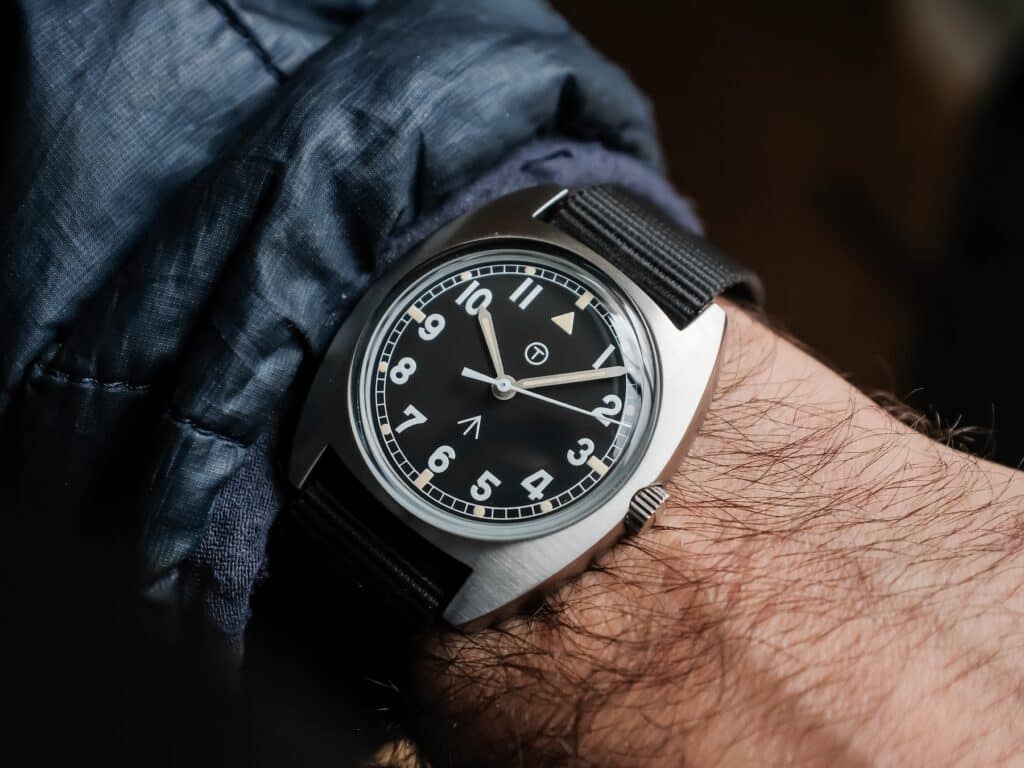
Rdunae RA02 Field Watch
| Price: | $45 |
| Water Resistance: | 50m |
| Case Dimensions: | 34.5mm (diameter) x 41.3mm (lug-to-lug) x 11mm (thickness) |
| Lug Width: | 19mm |
| Movement: | Miyota 2035 Quartz |
The Rdunae RA02 is the kind of pick that makes sense in a best field watches under $600 list, only if we’re being honest about value. This is not the watch you buy for brand cachet, finishing theater, or some romantic sales-page version of military heritage. It works because it commits to the old field-watch idea with almost stubborn restraint. The case comes in just under 35mm with a short lug-to-lug, and it wears as small as that suggests. That could be a dealbreaker if you’re used to modern field watches with more wrist presence, but on our wrist, the size felt close to older issued-style pieces. At roughly 35 grams on a strap, it nearly disappears during the day, making it quite easy to live with for commuting, desk work, and casual weekend wear.
The dial does most of the heavy lifting here. Rdunae keeps it matte black, sterile, and very readable, with crisp white Arabic numerals, a railroad minute track, and pencil-style hands that are sized well enough to avoid crowding the layout. The fully lumed triangle at 12, the small “T” marking, and the broad arrow at 6 all point toward the military-field inspiration without turning the watch into costume jewelry. What we appreciated most during testing was the absence of filler. No brand name, no water-resistance text, no awkward extra line trying to make the watch feel more important than it is. In normal use, that restraint paid off because the time was easy to read at a glance.
The case mostly follows the same practical mood. The sandblasted stainless steel finish keeps glare down and fits the utilitarian look, while the domed K1 mineral crystal adds more charm than we expected. Its dome is more pronounced than many vintage references, so you get a bit of warmth and edge distortion without the watch pretending it has sapphire or luxury-level materials. The push-pull crown is easy to use, though the polished finish feels slightly out of step with the otherwise muted case. The screw-down caseback is densely engraved and even includes the battery reference. That’s a small but useful detail for anyone who would rather not hunt later.
Inside, the Miyota 2035 quartz movement keeps the RA02 low-maintenance and accurate, which suits the watch better than a fussy mechanical movement would. The included nylon strap is usable, but we found it forgettable and preferred slimmer aftermarket options. The 19mm lug width is inconvenient on paper, though an 18mm strap looked fine enough in practice. Lume is another honest trade-off: it glows cleanly and remains usable when the lights drop, but it is not a powerhouse. That balance is why the RA02 works as the budget military-field wildcard here. It gives you the look, the lightness, the legibility, and the charm without asking you to care about prestige.
Pros
- The compact sub-35mm case wears comfortably and stays out of the way all day.
- The sterile matte dial is clean, legible, and free of unnecessary text.
- Roughly 35 grams on a strap, so it feels almost weightless in daily wear.
- Domed K1 mineral crystal adds vintage-style character and edge distortion without overreaching.
- Miyota 2035 quartz movement keeps ownership simple, accurate, and low-maintenance.
Cons
- The polished push-pull crown looks a bit out of place against the sandblasted case.
- Stock nylon strap works, but it is not especially memorable.
- The 19mm lug width makes strap shopping a bit annoying.
- Lume is usable, but not strong enough to be a major selling point.
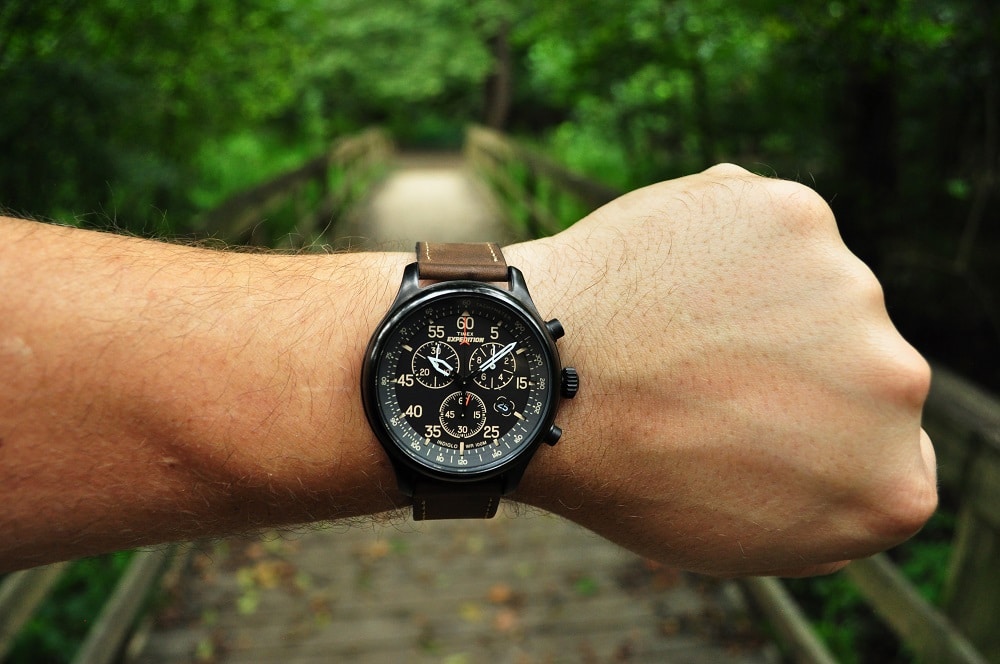
Timex Expedition Chronograph
| Price: | $100 |
| Water Resistance: | 100m |
| Case Dimensions: | 43mm (diameter) x 51mm (lug-to-lug) x 12mm (thickness) |
| Lug Width: | 20mm |
| Movement: | Timex Quartz Chronograph |
The Timex Expedition Chronograph earns its spot here as the field-style pick for someone who wants more function and visual energy than a simple three-hander. At 43mm across and 51mm lug-to-lug, it is a full-size watch, but the size makes sense once you look at the dial. A lot is happening, and making it smaller would likely hurt legibility. At 12mm thick, it still worked better under long sleeves than expected. The rounded bezel and black case also visually shrink the watch, so on the wrist it felt closer to 40 or 41mm before we checked the numbers.
The case shows the usual Timex mix of charm and compromise. It is black-coated brass, which keeps the watch light and affordable, but the coating can wear off over time. After a week or two, a mark near the reset pusher had already appeared. That is not the end of the world, but exposed brass can become an issue over time if corrosion or pitting starts. The brushing is basic, the edges are soft, and the lugs extend outward before curling down, which creates some wrist gap with the thick stainless steel caseback. Still, the crown is easy to grip and clicks cleanly through its positions. The chronograph pushers are less convincing, especially the start-stop pusher, which gave little feedback until the hand began moving.
The dial is where the watch makes its case. It leans more towards an aviation instrument than a traditional field watch, with large skeletonized altimeter-style hands, big minute markings, and three subdials at 10, 2, and 6. The black-and-sand color scheme is easy to read, while the orange-tipped running seconds and chronograph second hands add enough contrast. The 4 o’clock date window uses a black wheel with sand numerals, which helps it blend in rather than look like an afterthought. Lume is a little strange. The white hour, minute, and totalizer hands glow, but the orange-tipped seconds hands do not. In use, that mattered less because Indiglo is still one of Timex’s best tricks and remains excellent for quick nighttime checks.
The 20mm dark brown suede strap suits the watch better than expected. It is flexible out of the box, needs no real break-in, and the contrast stitching fits the black case well. It does not taper, but that works here because the watch has a rugged, field-chronograph feel that benefits from a more substantial strap. The quartz chronograph movement is old-school in operation: the chrono seconds tick once per second, the 1/20 subdial only moves when the chronograph is stopped, and the minute counter clearly tracks up to 30 minutes.
The clever hidden feature is the jumping hour hand. It moves forward or backward in one-hour jumps without stopping the time. That makes travel adjustments easy, though setting the date is annoying because you have to jump the hour hand through 24 hours. Add 100 meters of water resistance, and this becomes a useful under-$600 field chronograph for someone who wants rugged looks, practical timing, and a little Timex weirdness baked in. For a deeper look at the watch, read our full hands-on review.
Pros
- The 43mm case wears smaller than expected due to the rounded bezel and black coating.
- 12mm thickness keeps it more sleeve-friendly than the diameter suggests.
- Black-and-sand dial, orange-tipped hands, and large minute markings improve quick legibility.
- Indiglo is excellent for fast nighttime readability.
- The jumping hour hand is genuinely useful for travel and time-zone changes.
- The 20mm suede strap is comfortable immediately and fits the rugged look.
Cons
- Black-coated brass can show wear quickly, and exposed brass may corrode or pit over time.
- Straight lugs and a thick caseback can create a wrist gap.
- Chronograph pushers lack satisfying tactile feedback.
- Chronograph timing is clearest only up to 30 minutes unless you remember the start time.
Timex Expedition Field Post Solar
| Price: | $199 |
| Water Resistance: | 100m |
| Case Dimensions: | 36mm (diameter) x 44mm (lug-to-lug) x 12mm (thickness) |
| Lug Width: | 18mm |
| Movement: | Solar Quartz |
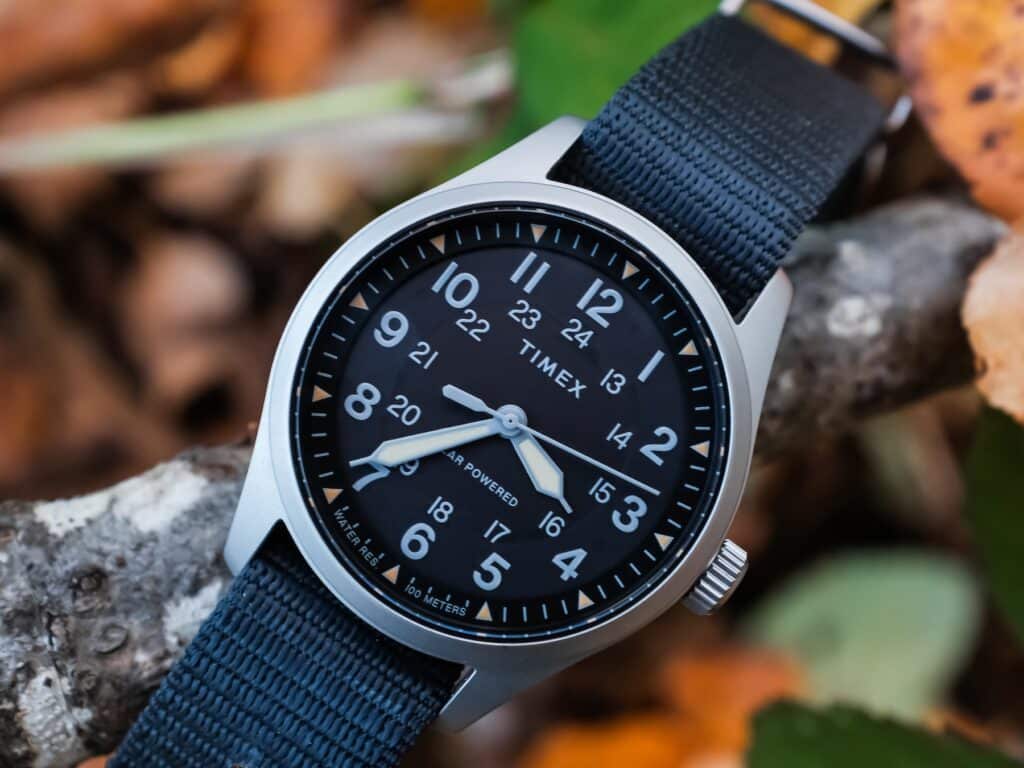
The Timex Expedition Field Post Solar belongs to this list because it gets the everyday part of the formula right without making ownership feel precious. The field-watch layout is familiar, clean, and easy to read, but the solar quartz movement is what makes the watch settle into daily life so easily. Once charged, Timex claims a power reserve of around four months, and during our in-depth review, the accuracy stayed steady enough that we barely had to touch the crown. That matters for a watch like this. You put it on, get through the day, and don’t end up babysitting it because the movement needs attention.
The 36mm stainless steel case is a big part of why the watch works. It wears flat and centered, and through commuting, errands, and a stretch of lousy weather, it didn’t need that annoying mid-day wrist adjustment some taller or heavier watches demand. The bead-blasted finish gives the case a worn-in, practical feel right away, so the first scratch does not carry the emotional weight of ruining a shiny new toy. The screw-down crown fits the watch’s personality, too. It feels dependable and functional, though not especially smooth or refined in action.
Timex keeps the dial close to the old military field template with full numerals and straightforward legibility. The slightly domed sapphire crystal helps it avoid feeling too sterile, adding a bit of warmth and edge distortion while still giving you a more durable crystal than expected at this price. The anti-reflective coating also did better outdoors than we expected, cutting glare enough to make quick time checks easy in bright conditions. The lume is the weak link. Even after a good charge, the hands glow briefly, the dial barely gets moving, and the whole thing fades faster than we’d like.
We’d make the first change to the stock leather strap. It is soft and clearly not an afterthought, but the thickness feels mismatched against the compact case. On a MIL-style strap, the Expedition Field Post Solar feels more balanced and more in line with its no-frills field-watch personality. That is the appeal here: it gives you field-watch legibility, solar convenience, a wearable 36mm case, and enough durability for normal life without asking much in return.
Pros
- Solar quartz movement makes it easy to grab and wear without regular adjustment.
- 36mm case wears low, centered, and comfortable through long days.
- Full-numeral field dial stays clear and easy to read at a glance.
- Bead-blasted case finish gives it a practical, already-worn-in feel.
- Domed sapphire crystal and AR coating add usability and a more considered feel than the price suggests.
Cons
- Lume fades quickly, with the dial barely lighting up even after a full charge.
- The stock leather strap is soft but too thick for the compact case.
- Screw-down crown works reliably, but the action is not very smooth.
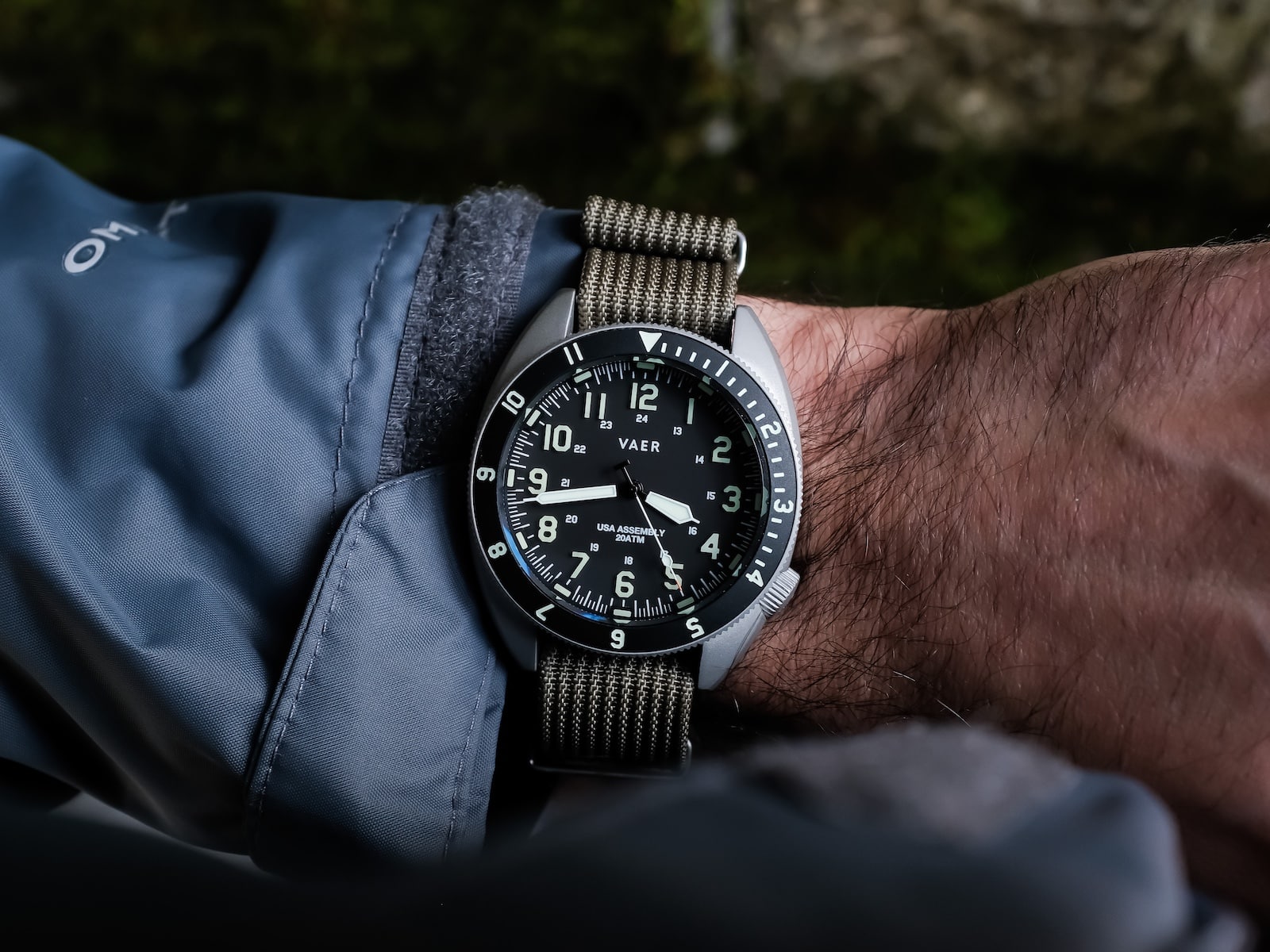
Vaer C4 Tactical Field Solar
| Price: | $479 |
| Water Resistance: | 200m |
| Case Dimensions: | 41.5mm (diameter) x 48mm (lug-to-lug) x 12.8mm (thickness) |
| Lug Width: | 20mm |
| Movement: | Epson VS-42 solar |
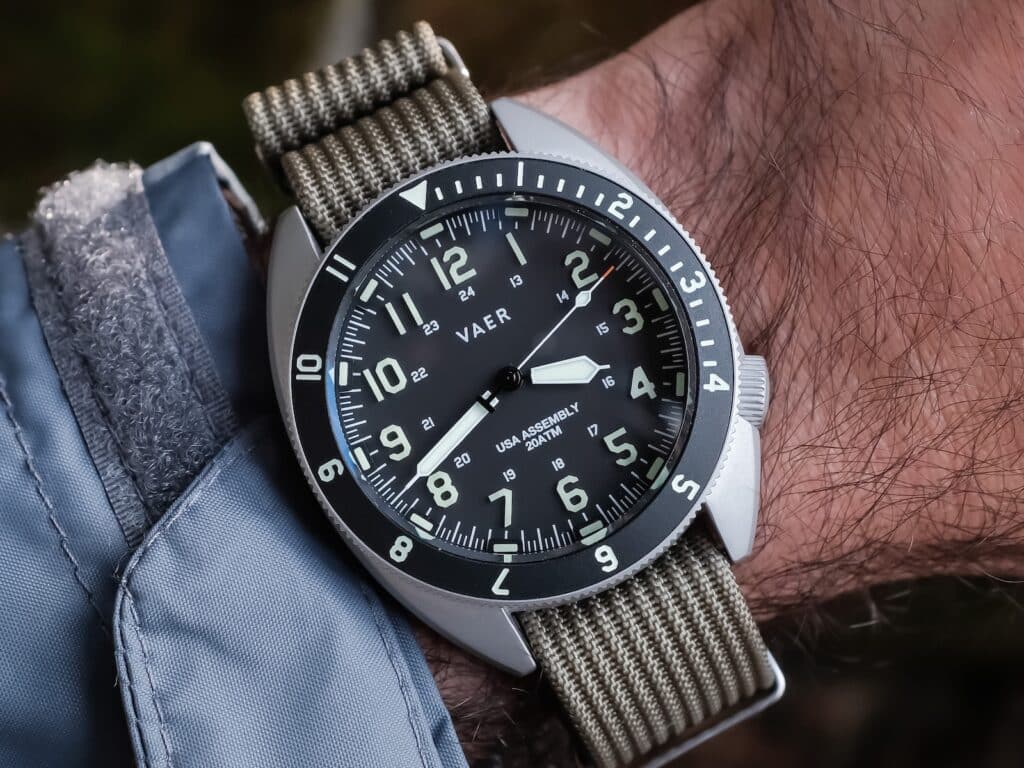
The Vaer C4 Tactical Field Solar is one of the more practical picks here because it doesn’t treat the field-watch formula like a costume. It keeps the familiar military-style readability, then adds the things that make sense for real daily wear: solar quartz for grab-and-go utility, serious water resistance, a usable bezel, and a case that can take a little abuse without looking like it wandered into the wrong category. There’s a bit of old Seiko softness in the case shape, and a faint Benrus Type II mood in the overall attitude, but the watch still feels like its own thing.
The case is larger than many classic field watches at 41.5mm, but it wears better than that number suggests. At 12.8mm thick, including the bezel, it sat flatter than expected, and the compact lug-to-lug kept it from hanging over a 6.75-inch wrist. The mid-case does a lot of quiet work here, keeping the watch from feeling blocky or overbuilt. In bead-blasted stainless steel, the finish has a dry, purposeful look that fits the military tone well, while the full DLC version pushes the watch further into tactical territory. This is not the subtle choice in the group, but that assertiveness feels intentional rather than forced.
The hardware is what separates the C4 from simpler field watches. You get 200 meters of water resistance, along with a screw-down caseback and a screw-down crown at 4 o’clock, which gives the watch a more secure, field-diver personality without feeling confusing. The crown action was reassuring during our time with it: easy to unscrew, simple to set, and clean when threading back down, without that gritty feeling that can make cheaper tool watches feel sketchy. The 120-click unidirectional bezel also proved useful, with a coin-edge grip that stayed easy to operate even with damp fingers. Vaer uses a DLC-treated steel insert instead of aluminum, which gives the bezel a tougher feel. It is marked to 20 minutes, but because Vaer also frames it as a 12-hour bezel, it can handle short timing jobs or serve as a casual second-time-zone tracker.
The dial stays focused on function. The matte-black surface, oversized Arabic numerals, large syringe hands, and smaller 24-hour track make the C4 easy to read, while the three-dimensional lume blocks give the hour markers more presence than flat printing would. The rectangular minute markers get the same raised treatment, so the depth feels practical rather than decorative. The beveled sapphire crystal adds a small touch of refinement without softening the tool-watch character. Lume was one of the watch’s strongest features in our review. It charged quickly, glowed hard, and stayed readable several hours into the night. Inside, the Epson VS-42 solar movement fits the brief well, needing around six hours of light for up to six months of charge, which makes it easy to keep in a rotation.
The one nitpick that stood out was secondhand alignment, which missed some markers and will bother collectors who notice such things immediately. As for straps, the black waffle-textured FKM felt substantial without being stiff and suited the case better than a standard tropic-style strap. The olive single-pass nylon worked, too, but the FKM was the one we kept reaching for. On an admiralty grey CWC strap, the C4 leans fully into its military lineage.
Pros
- Solar quartz movement makes it convenient, low-maintenance, and easy to keep in rotation.
- 41.5mm case wears flatter and more balanced than the dimensions suggest.
- Bead-blasted stainless steel and optional DLC case finishes give it a convincing tactical character.
- Three-dimensional lume markers and strong nighttime performance make the dial genuinely useful after dark.
- Black waffle-textured FKM strap feels substantial without being stiff.
Cons
- Second-hand alignment is not perfect across every marker.
- The 41.5mm case may still feel large for collectors who prefer compact military proportions.
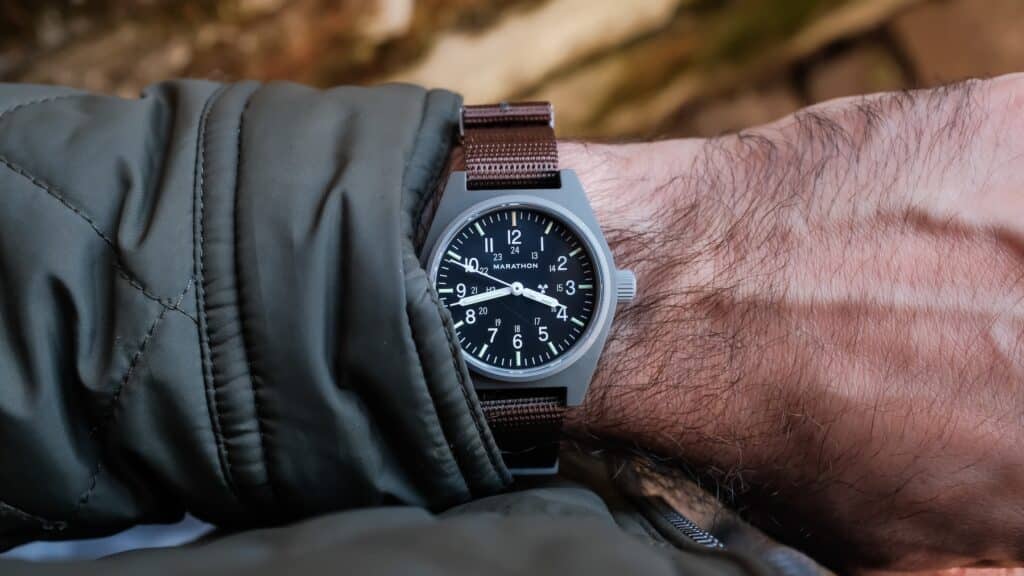
Marathon General Purpose Mechanical 34mm
| Price: | $525 – $575 |
| Water Resistance: | 30m |
| Case Dimensions: | 34mm (diameter) x 41mm (lug-to-lug) x 12.5mm (thickness) |
| Lug Width: | 16mm |
| Movement: | Seiko NH35A Automatic |
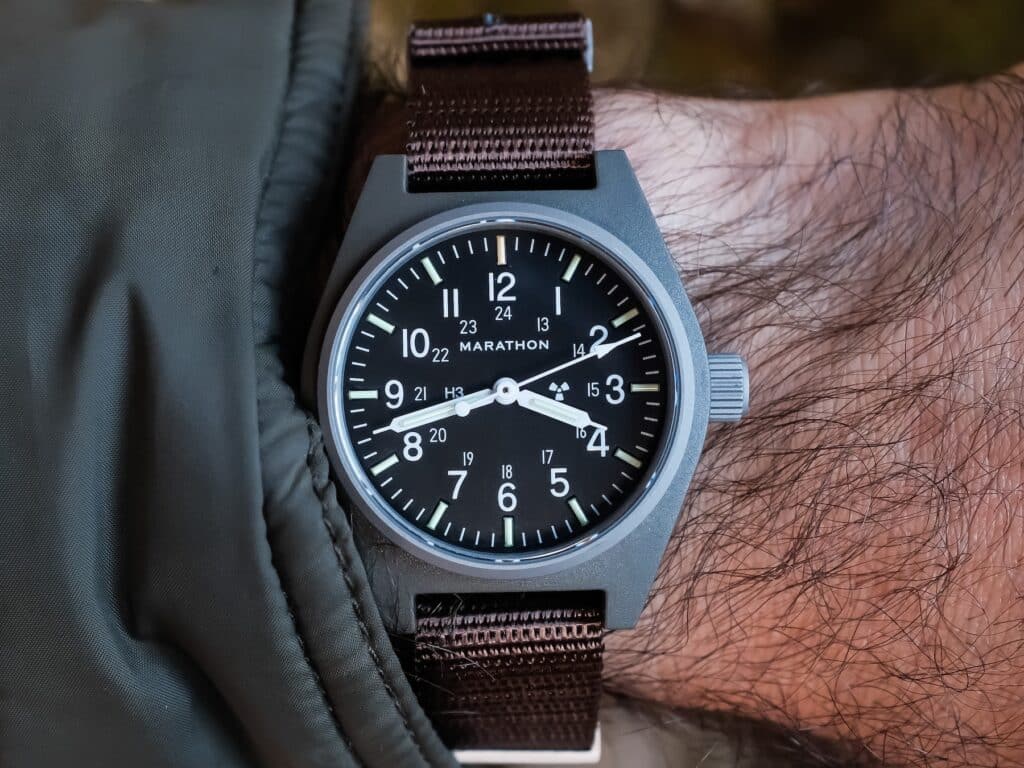
The Marathon General Purpose Mechanical is the rugged outlier in this conversation, mostly because it feels less like a field-watch homage and more like actual issued gear that ended up being wearable enough for normal life. It does sit slightly above the $600 mark, depending on where and when you buy it. Still, it earns the mention because the character is hard to fake. This is not a polished civilian field watch borrowing military cues for flavor. The sage green resin case, spec-heavy caseback, NSN markings, and plainspoken build give it a utility-first personality that feels purposeful rather than styled.
The 34mm case sounds tiny if you’ve spent years around oversized tool watches, but the Marathon wears with more presence than the number suggests. The 12.5mm thickness, 41mm lug-to-lug, and stock NATO strap give it enough stance that it never feels fragile or toy-like. Compared with a steel field watch, the resin case feels warmer, lighter, and more practical during a long day. It can feel odd at first if you’re used to metal cases, but after errands, walking around, or sitting at a desk for hours, that low weight starts to make sense. The watch does not disappear in the same way an ultra-thin quartz field watch might, but it avoids the heavy-case fatigue that creeps in with some “rugged” watches.
The dial is where the Marathon’s field-watch usefulness comes through most clearly. The classic layout with an inner 24-hour scale is quick to read, and the syringe-style hands work well with the hour markers without making the dial feel crowded. The tritium tubes are the bigger practical advantage. Instead of needing to charge the lume under a lamp or hoping it lasts through the night, the low-light visibility is always there. That fits the watch’s low-maintenance personality better than traditional lume would. The bezel stays simple and functional, avoiding any attempt to turn the watch into a diver or something more complicated than it needs to be.
Inside, the Seiko NH35A movement matches the watch’s practical attitude. It is not fancy, but it is dependable, familiar, and easy to live with, with a 41-hour power reserve that works fine for normal rotation use. More importantly, it should not make owners nervous about long-term servicing or replacement. Marathon’s move to an all-steel crown was also a smart one. The crown looks small, but the grip is strong enough that winding and setting the movement never feels fussy.
The trade-offs are real, though. The 30 meters of water resistance feels light for something this rugged, and we’d prefer 50 meters for everyday confidence. The included ballistic nylon strap looks right and reinforces the field-kit feel, but it starts stiff, and the tight spring-bar clearance makes strap changes more annoying than they should be. While testing, we liked it more on a single-pass olive-drab strap, which helped the case sit lower and feel more natural. The 16mm lug width is another enthusiast’s headache because it narrows strap options more than most of us would like.
Pros
- True military-issued feel, helped by the caseback spec text and NSN markings.
- Lightweight sage green resin case stays comfortable through long daily wear.
- All-steel crown is small, grippy, and easy to operate.
- Compact 34mm case wears with more wrist presence than expected.
- Tritium tubes provide constant low-light legibility without needing a charge.
Cons
- 30 meters of water resistance feels limited for a rugged field watch.
- 16mm lug width limits aftermarket strap options.
- Tight spring-bar clearance makes strap changes more frustrating than they need to be.
- Stock ballistic nylon strap looks the part, but starts stiff.
Think we left out one of the best field watches under $600? We probably did, because this category is full of strange little winners hiding on nylon straps, in microbrand catalogs, and at the bottom of very opinionated forum threads. We only include watches we’ve spent real wrist time with, though, so if there’s a piece you think deserves a spot, let us know in the comments.

Co-Founder and Senior Editor
Kaz has been collecting watches since 2015, but he’s been fascinated by product design, the Collector’s psychology, and brand marketing his whole life. While sharing the same strong fondness for all things horologically-affordable as Mike (his TBWS partner in crime), Kaz’s collection niche is also focused on vintage Soviet watches as well as watches that feature a unique, but well-designed quirk or visual hook.
I’d toss in the ALBA AQPJ402, found this on one of the forums and IMO it’s criminally overlooked. A stealth brand from Seiko but offering great specs for the $$$:
Quartz VJ53 movement, 38mm titanium case (with matching 18mm bracelet), under 11mm thick, Hardlex crystal (of course), 100m WR and day/date dail with Lumibrite.
I put it on a perlon NATO strap and it pretty much disappears on my wrist. If this was a Seiko catalogue item it would certainly not be priced like this.
While it’s a JDM offering you can easily find them on eBay under 70USD with S&H
Hi, Garry:
This is actually a brand I’m not familiar with, but after some initial research it certainly looks interesting (especially at that price point)! I’ll see if we can potentially get one in for review on the site. Thank you for reading the piece and writing in.
Best,
-Kaz
The ALBA brand is pretty much non-existent here in the West but has a strong following in Asia.
Only bad thing I can say about this ALBA is the bracelet didn’t vibe with me.
That’s down to me preferring a heavier bracelet in my watches. Had the same experience/feeling with other titanium bracelets.
no citizen tough? it’s a classic fielder 🙂
I reeeeaally need to review one of those. The titanium with the dark green dial? droool
The Boldr Venture deserves a spot on a list like this!
38 mm titanium case, 200 m water resistance, NH38A movement and AR-coated saphire for 299 USD.
Looks pretty sweet, too.
Titanium and sapphire at that price is hard to come by. We’ll keep the Venture on our radar. Thanks for the tip.