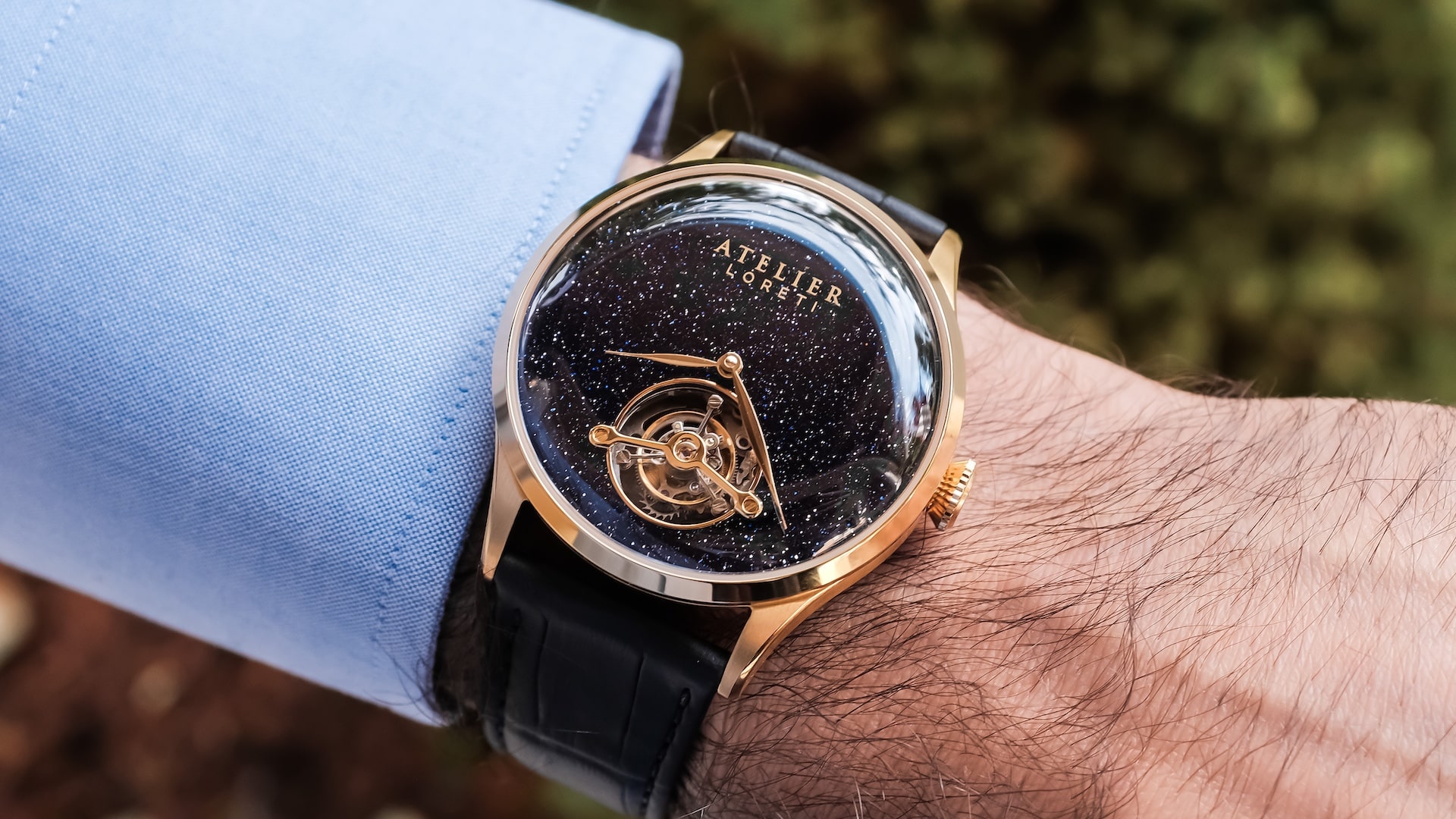
Here’s something I never expected to see on TBWS: a tourbillon. And certainly not one in the form of a dressy watch that looks nothing like what I’d normally wear, complete with a gold-tone case and leather strap. But that’s been part of my collecting journey this year. I’ve been trying to experience watches that would probably never make it into my personal watch box, and there’s something weirdly interesting about this one.
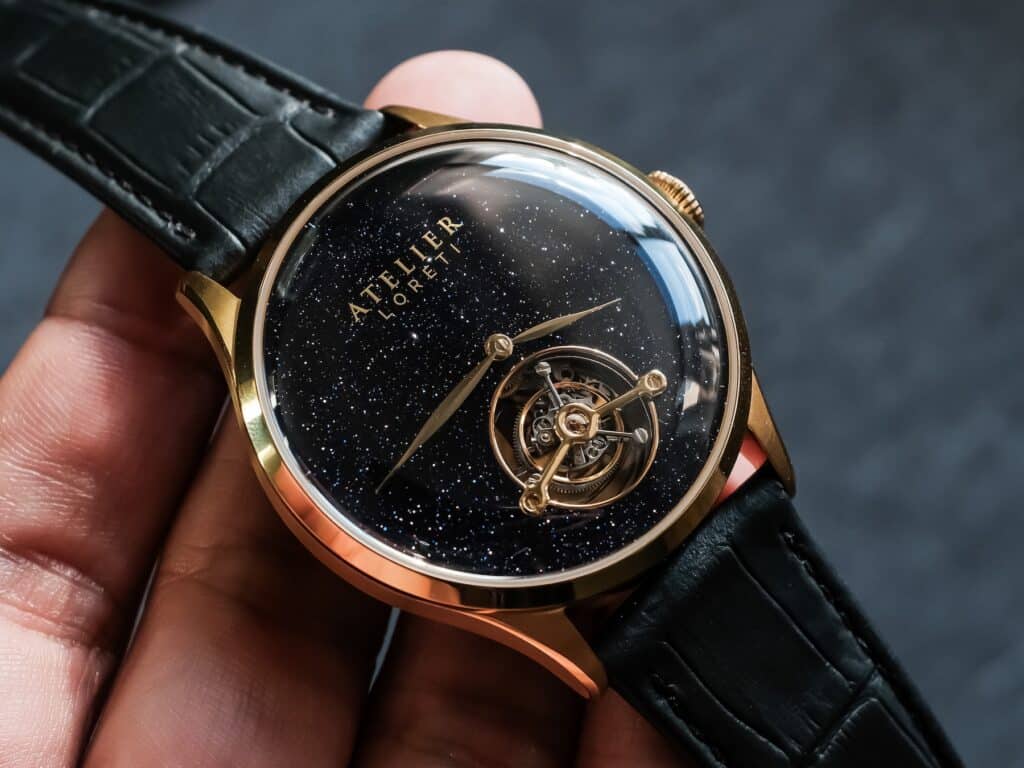
Not long ago, an “affordable tourbillon” could still mean spending somewhere around $15,000. We’ve watched that number come down over the years, but seeing one at $850 is still pretty wild. I also came into this knowing very little about Filippo Loreti or Atelier Loreti. So here we are, with a chance for me to spend some time with their limited-edition Celestial Tourbillon Blue Aventurine and figure out exactly what an $850 tourbillon looks like in practice.
A Different Direction for Filippo Loreti
Atelier Loreti is apparently a new name under Filippo Loreti, and the Celestial Tourbillon is an early collection to carry it. The separation makes sense to me. An $850 tourbillon sits pretty far outside the territory Filippo Loreti has traditionally occupied, and the Atelier name gives the brand somewhere to put these more expensive projects without confusing them with its lower-priced watches.
There are four versions of the Celestial Tourbillon, each built around a natural-material dial. There’s blue aventurine, black onyx, turquoise, and meteorite, with the first three priced at $850. The meteorite version comes in at $1,050.
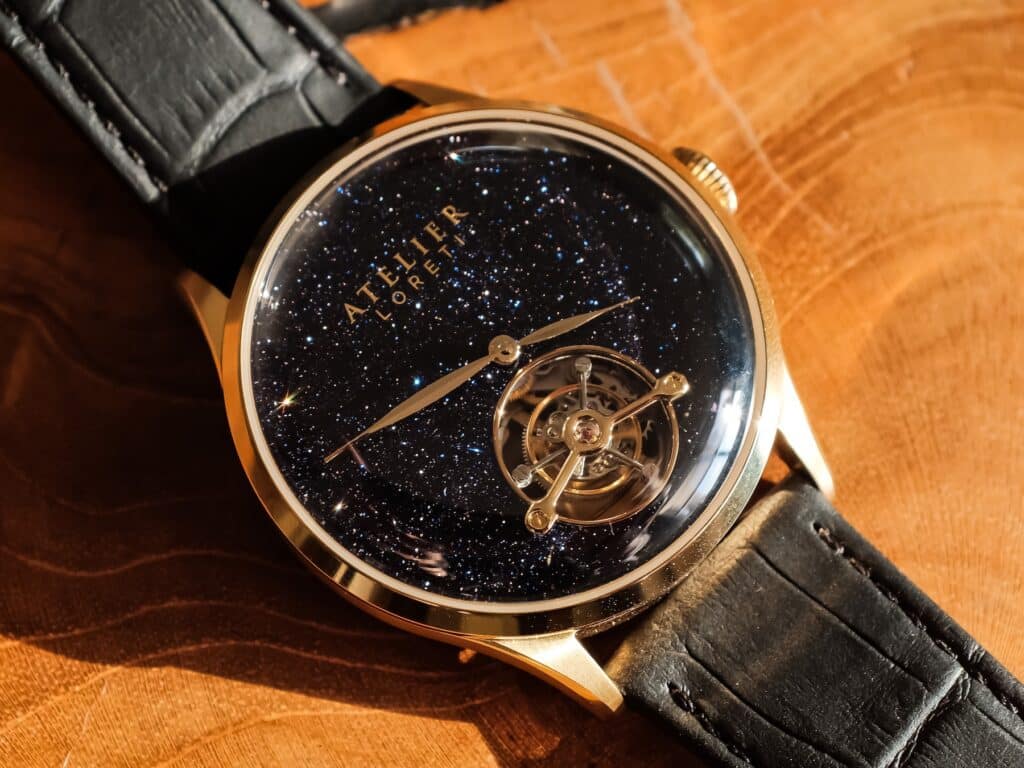
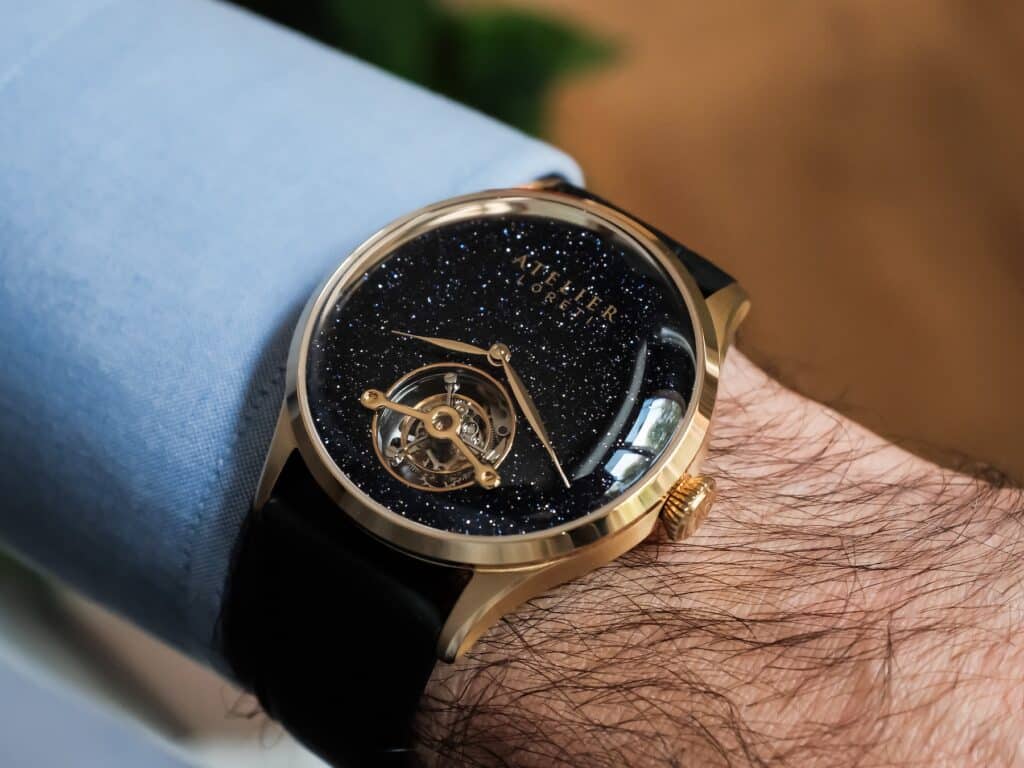
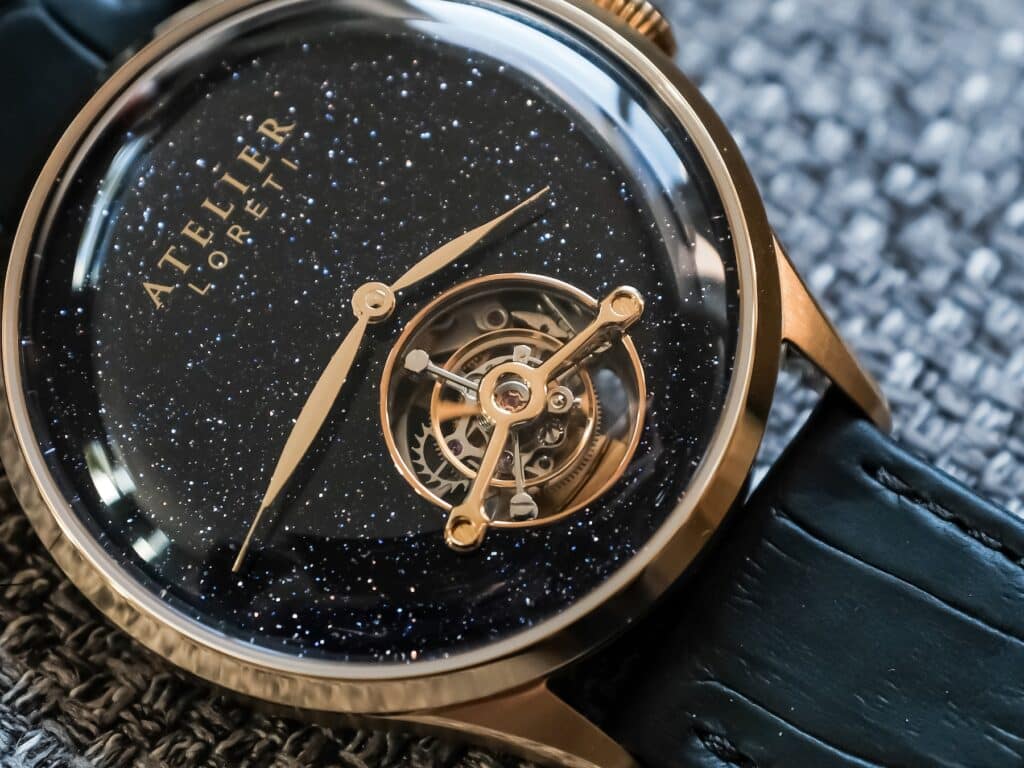
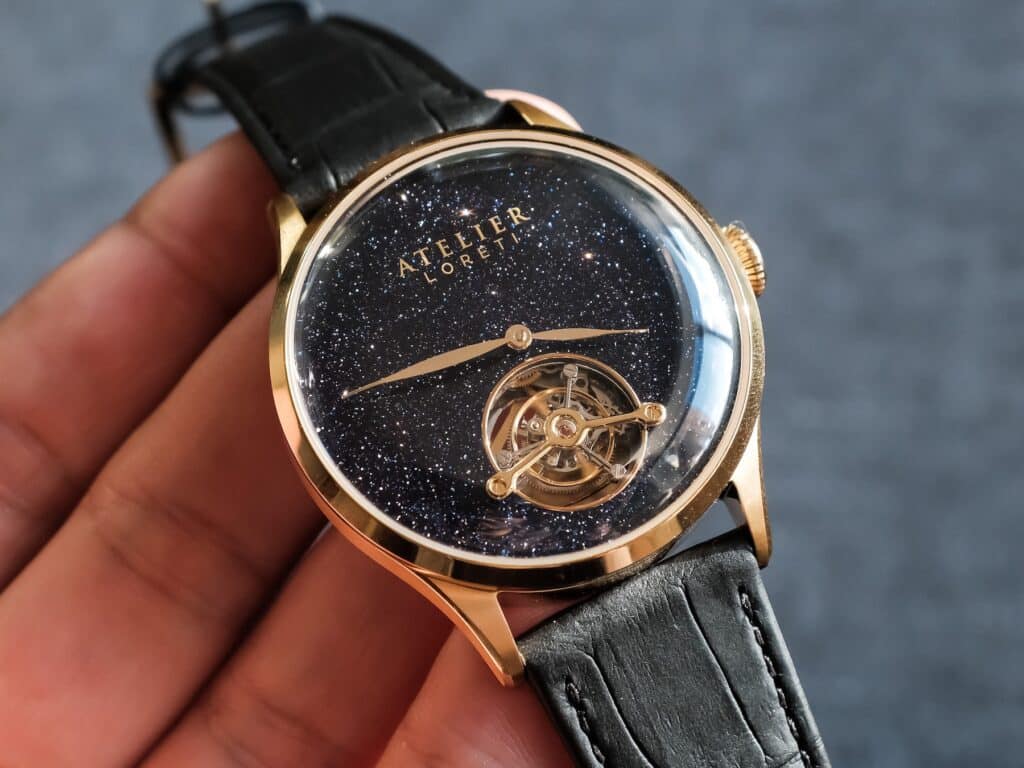
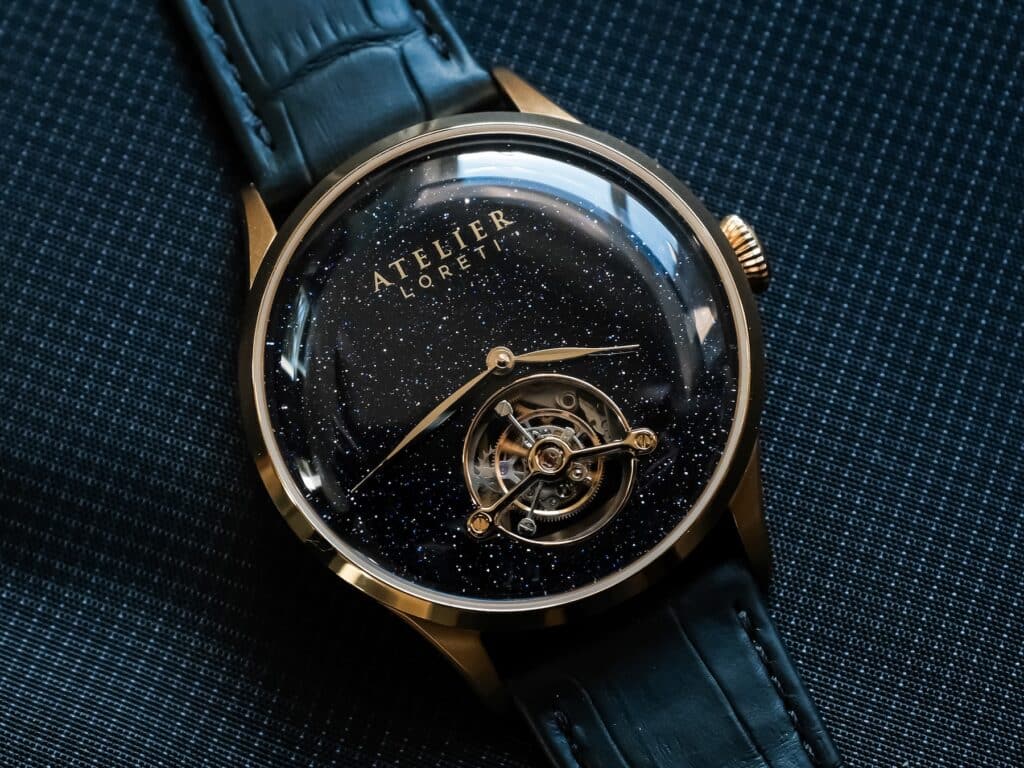
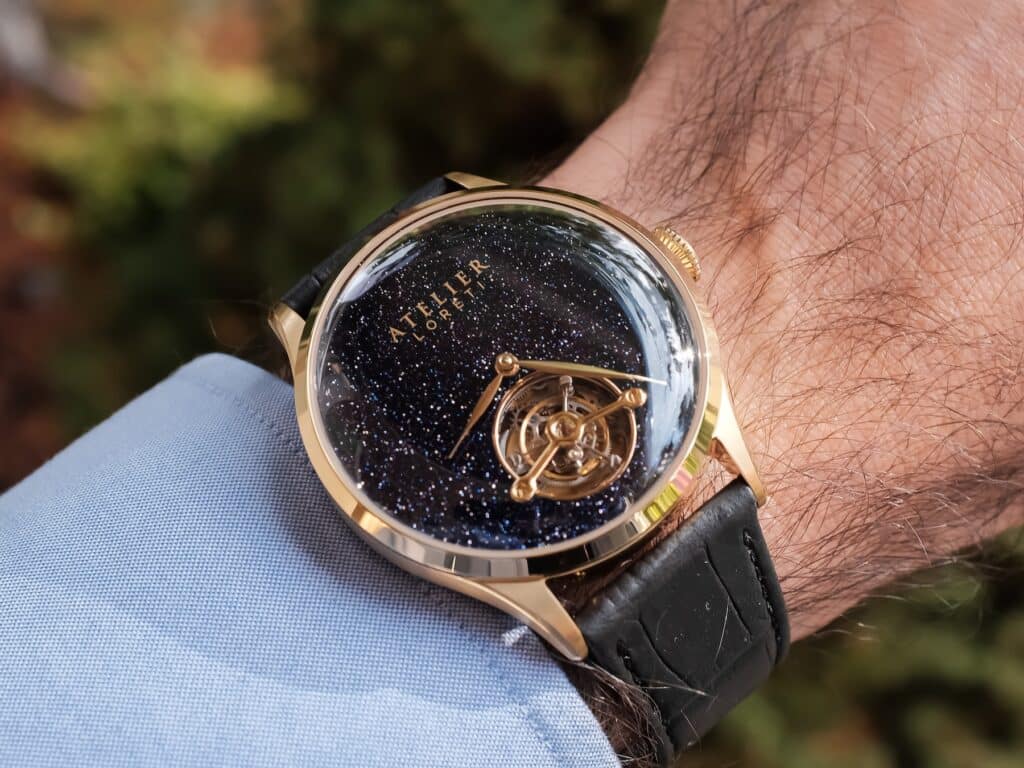
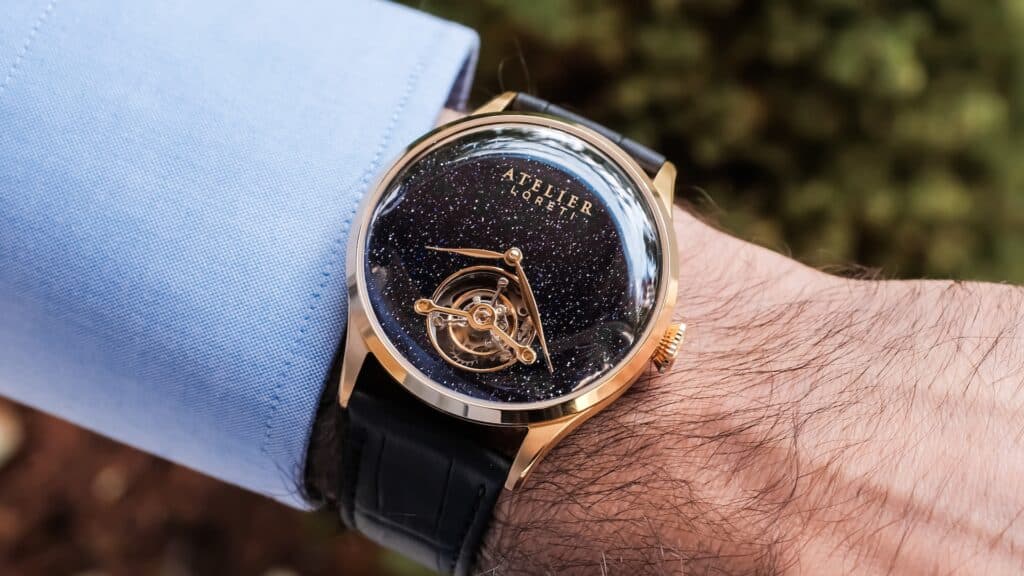
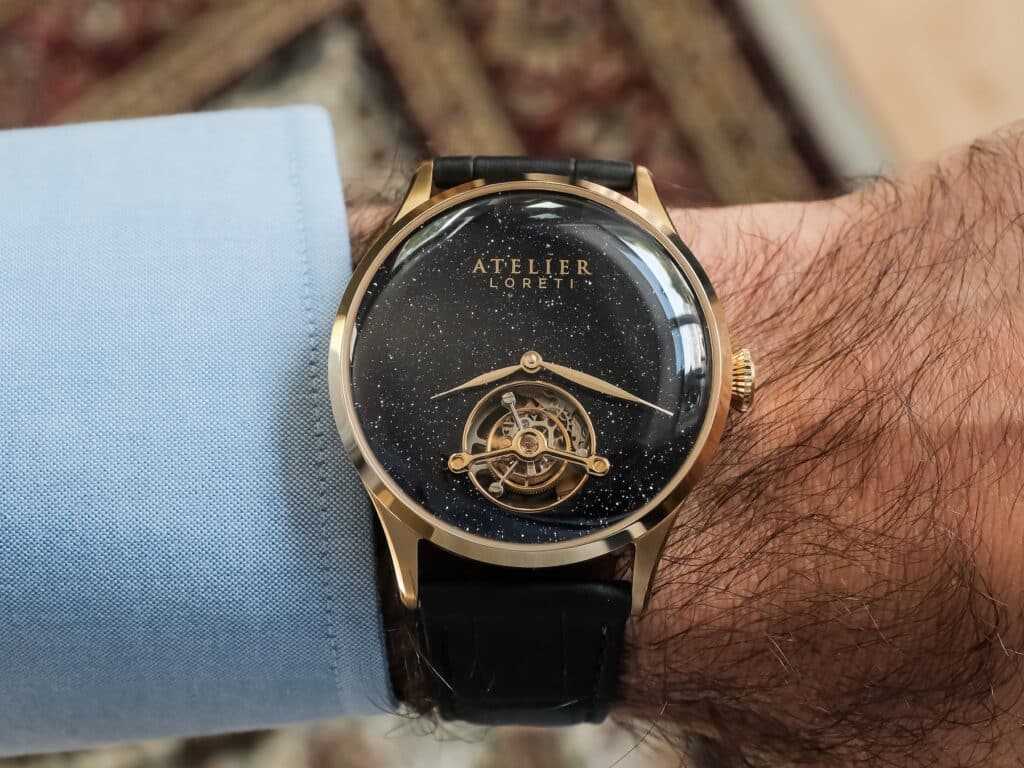
The aventurine dial is easily one of my favorite parts of the watch. It has enough variation to change quite a bit depending on the light, and there’s a nice amount of depth without much else competing for attention. That matters when there’s already a tourbillon spinning around at six o’clock.
I’ll admit that the combination sounded like a bit much when I first looked at the watch. Blue aventurine, a tourbillon, a gold-tone case, and a dressy leather strap can pile up pretty quickly. In person, it’s more cohesive than I expected. It’s still far outside my normal taste, and I’d personally choose one of the steel versions. But the gold-tone treatment at least makes sense with what Atelier Loreti was going for here.
On the Wrist
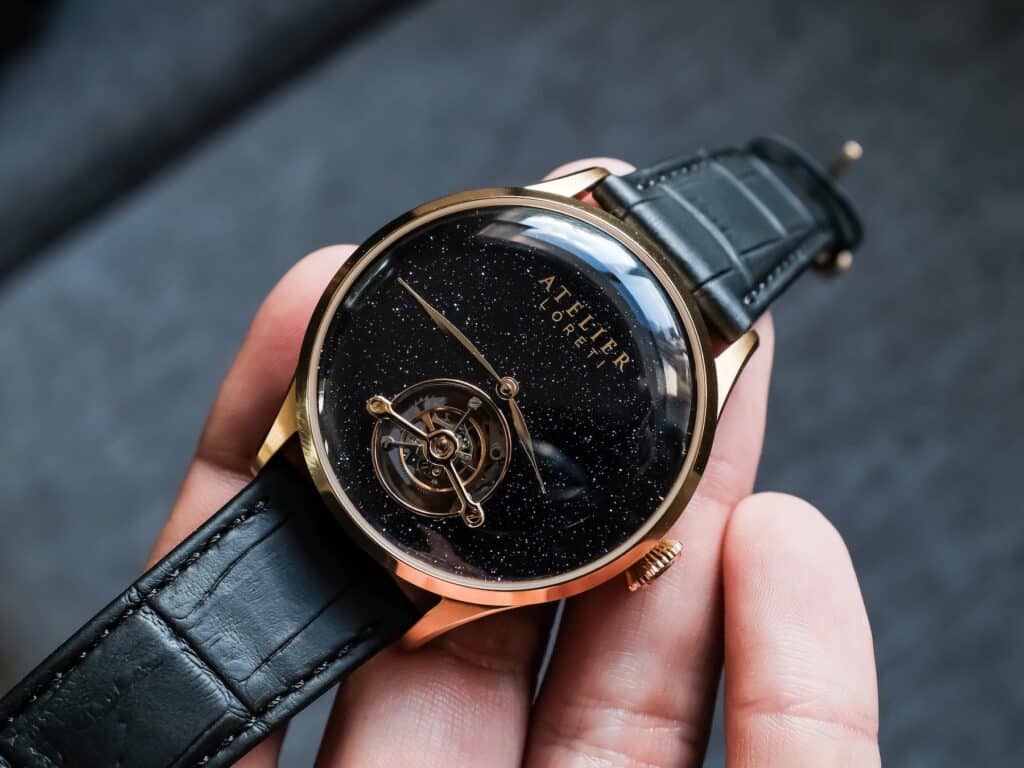
The Celestial is a big dress watch. The case measures 42mm across with a roughly 49mm lug-to-lug, and I think the diameter works better here than I expected. There’s a lot happening on this dial, and the extra surface area gives the aventurine and tourbillon some room.
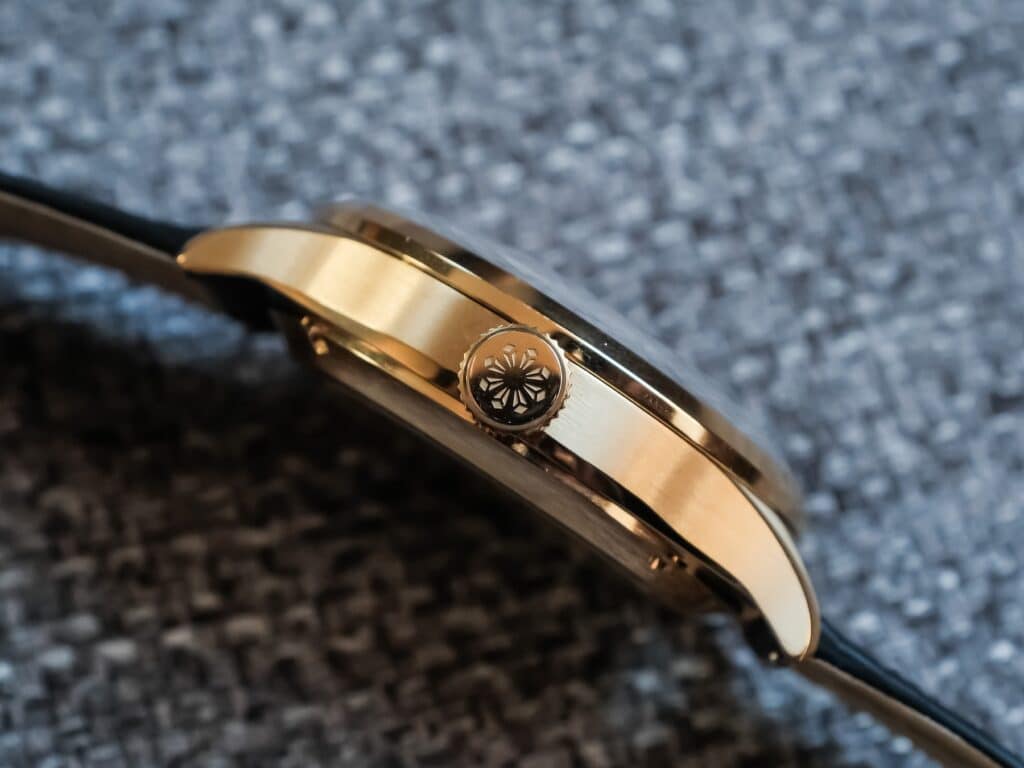
Atelier Loreti lists the case at 10.85mm thick, which sounds pretty slim. Once I account for the tall box-style sapphire crystal, I get closer to 14mm overall. That’s a much more representative number for how the watch actually feels.
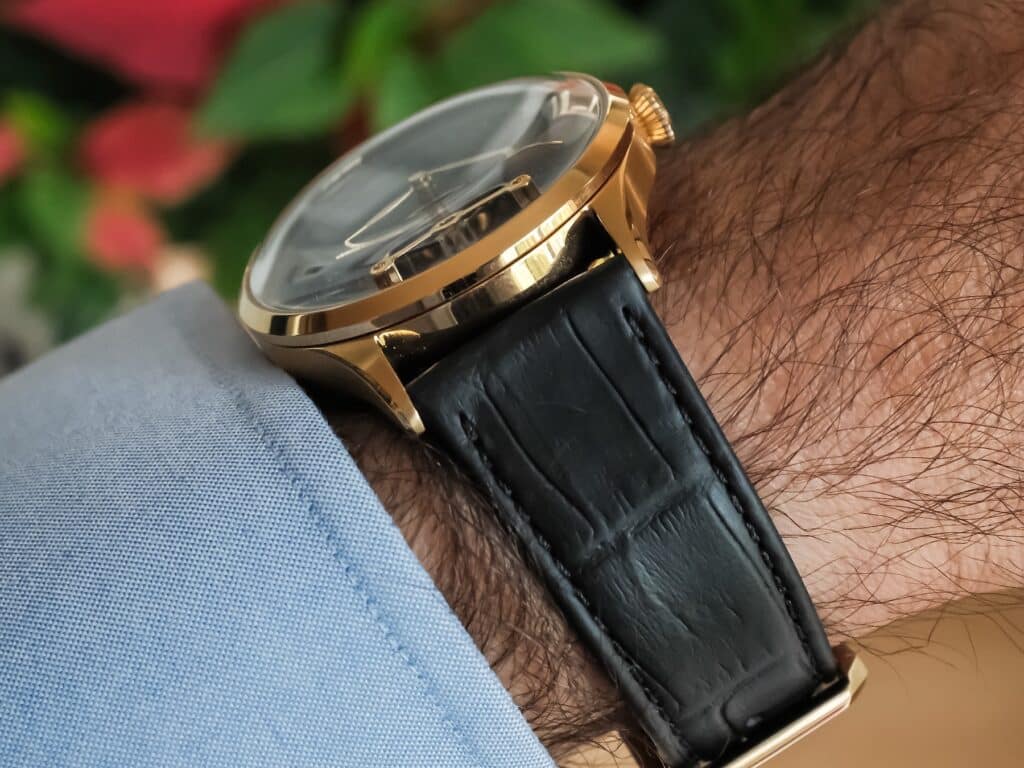
Even then, I found it surprisingly comfortable. The thickness is noticeable, but it never bothered me much during normal wear. I also like the crystal enough that I’m willing to accept some of that extra height. Viewed from an angle, the crystal gives the dial a much more interesting presentation than a flat sapphire would.
The case itself is stainless steel with a gold-tone PVD coating, and this is one of the first areas where I can see some of the budget constraints. The finishing is fine. I wouldn’t call it especially crisp or elaborate, and there’s very little about the case construction that I found myself examining for its own sake. I’m okay with that here. Most of my attention went straight through the crystal anyway.
The 100 meters of water resistance was a nice surprise. I’m probably never going near a pool with a gold-tone tourbillon on leather, but that rating means I wouldn’t have to treat the watch as particularly delicate during normal wear.
Legibility is a bigger compromise. There are no conventional hour markers or minute track, and the thin hands can get lost against the aventurine. I could read it well enough once I got used to the layout, though precise timekeeping clearly takes a back seat here.
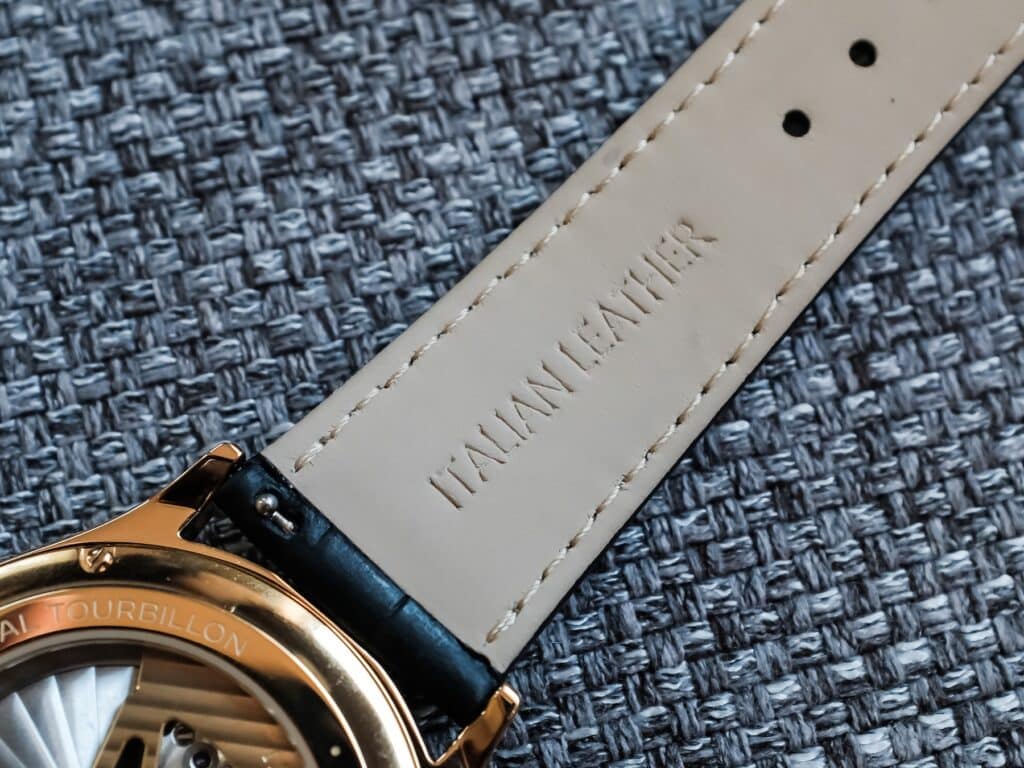
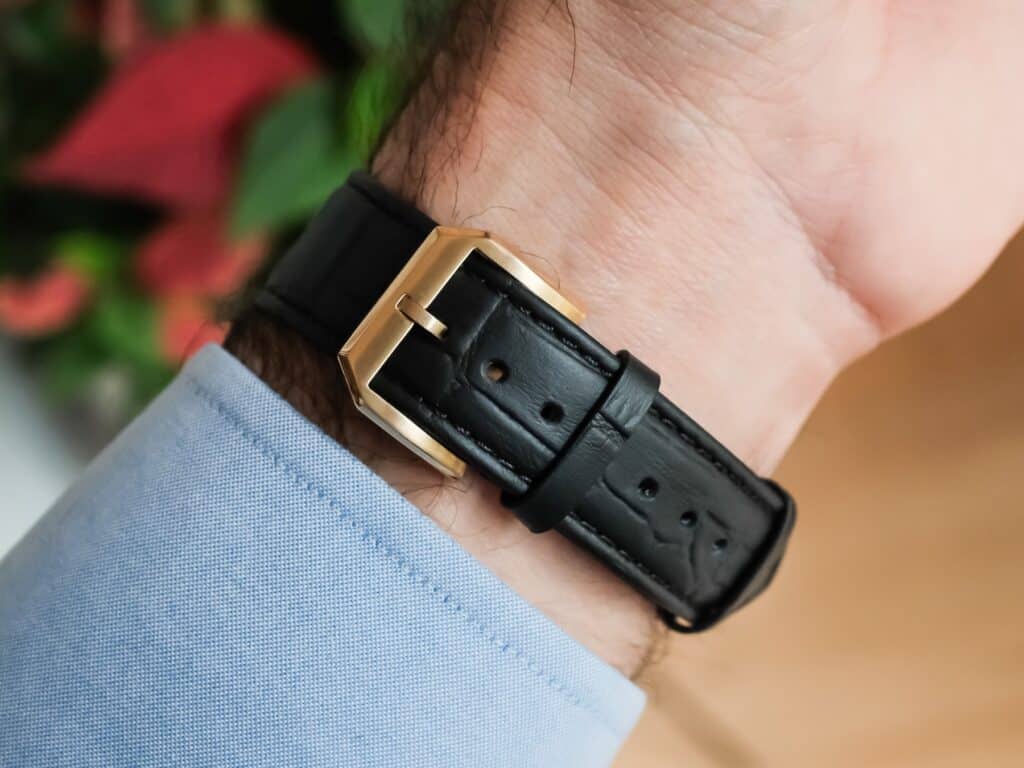
The supplied leather strap feels like another place where the budget caught up with the watch. It’s comfortable enough and perfectly usable, but I’d replace it. With this much happening on the dial, a nicer strap would probably be the easiest way to make the whole package feel a little more complete.
The L.1T Tourbillon
The L.1T is an automatic one-minute tourbillon running at 28,800 vph, or 4Hz. Seeing that mechanism running at six o’clock was obviously what grabbed me during my first few days with the watch. I’d find myself staring at the tourbillon for a while, realize I hadn’t actually checked the time, and then try to find the hands against the aventurine. I suspect that tells you plenty about the experience. There is one part of the L.1T story that I think deserves some clarification, and that’s its connection to Miyota.
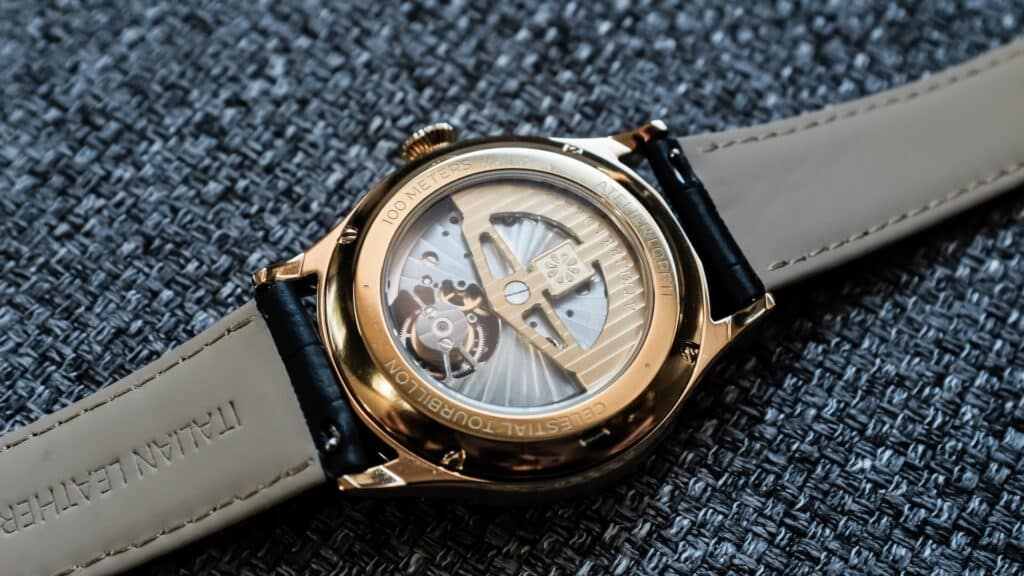
Filippo Loreti references the Miyota 8215 architecture when discussing the development of the L.1T. I don’t think that should be interpreted to mean Miyota manufactures this movement or that an 8215 has simply been modified to accept a tourbillon. There are substantial differences between the two, including the 4Hz frequency of the L.1T and its non-hacking behavior.
I understand the basic idea of using an existing movement architecture as a developmental reference. My problem is mostly with how easily the Miyota connection can create the wrong impression. Miyota has a well-established reputation for inexpensive, dependable movements, and mentioning the 8215 naturally brings some of that reputation into the conversation. I’d prefer to see the relationship explained more clearly. Oddly enough, once I put that issue aside, I became more interested in the L.1T itself.
There’s no fancy hand finishing here, nor would I expect any. The movement has still been given enough decoration that the view through the caseback feels considered. The visible bridges have decorative finishing, and the gold-tone automatic rotor fits the rest of the watch.
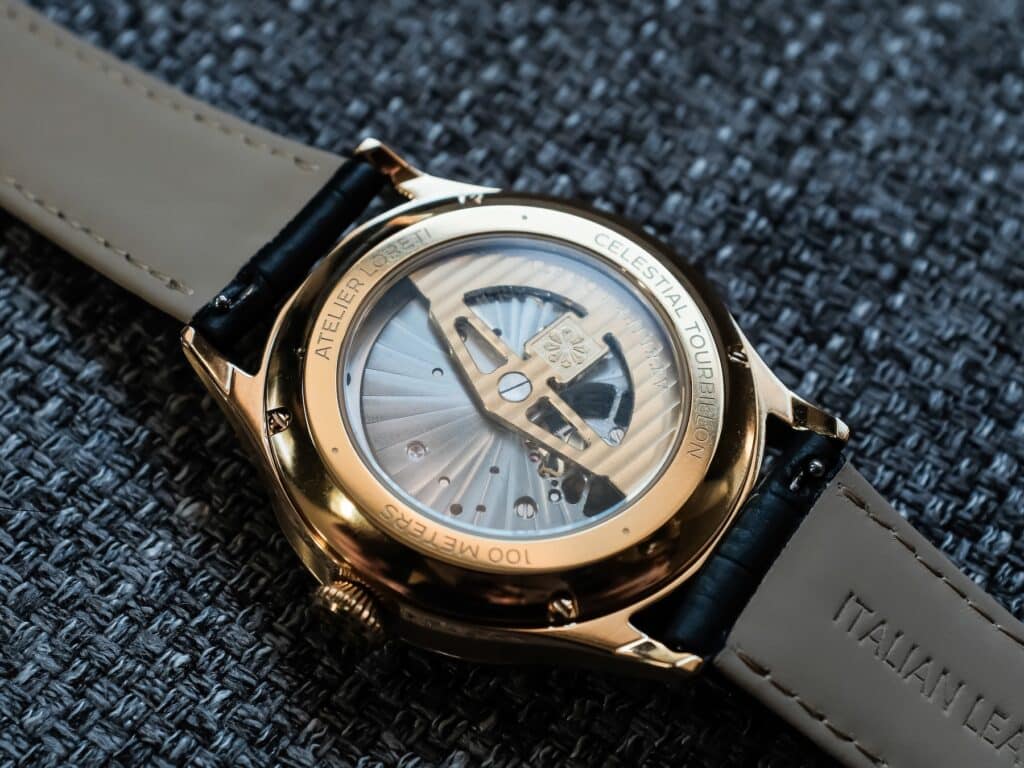
That rotor also has a tendency to make itself known. I could occasionally feel and hear it spinning on the wrist, though it never became annoying enough to affect how I felt about wearing the watch.
The stated power reserve is around 35 hours. For someone like me who rotates through watches constantly, that means I’d expect to reset this thing pretty regularly. Between the tourbillon and the 4Hz frequency, there’s also a lot being asked of the movement, so I can understand why there isn’t a huge reserve available. I’m more concerned about what happens years from now.
Filippo Loreti provides a two-year warranty and has suggested a service interval somewhere around seven to ten years. The L.1T is still a proprietary tourbillon movement without the service history or parts availability I’d associate with something like a standard Miyota caliber. That would be my biggest practical concern if I owned one.
I actually don’t care very much where the movement was manufactured. If it works, it works. What matters more to me is whether someone can repair it when it eventually stops working. A tourbillon has a lot going on mechanically, and I wouldn’t assume my local watchmaker would be thrilled to see an unfamiliar L.1T land on the bench several years from now.
Filippo Loreti says it intends to support the movement, and for now that’s what owners have to go on. I’d simply keep that uncertainty in mind as part of what comes with buying a tourbillon at this price.
Where the Money Went
After wearing the Celestial, I started thinking about the $850 less as a shocking tourbillon price and more in terms of where that money actually went. The answer seems pretty obvious once I have the watch in front of me.
The case finishing is basic. The strap is something I’d replace. Legibility isn’t great. The 35-hour power reserve isn’t particularly convenient for a larger rotation, and the long-term service picture has some unanswered questions. Then I look at the dial.
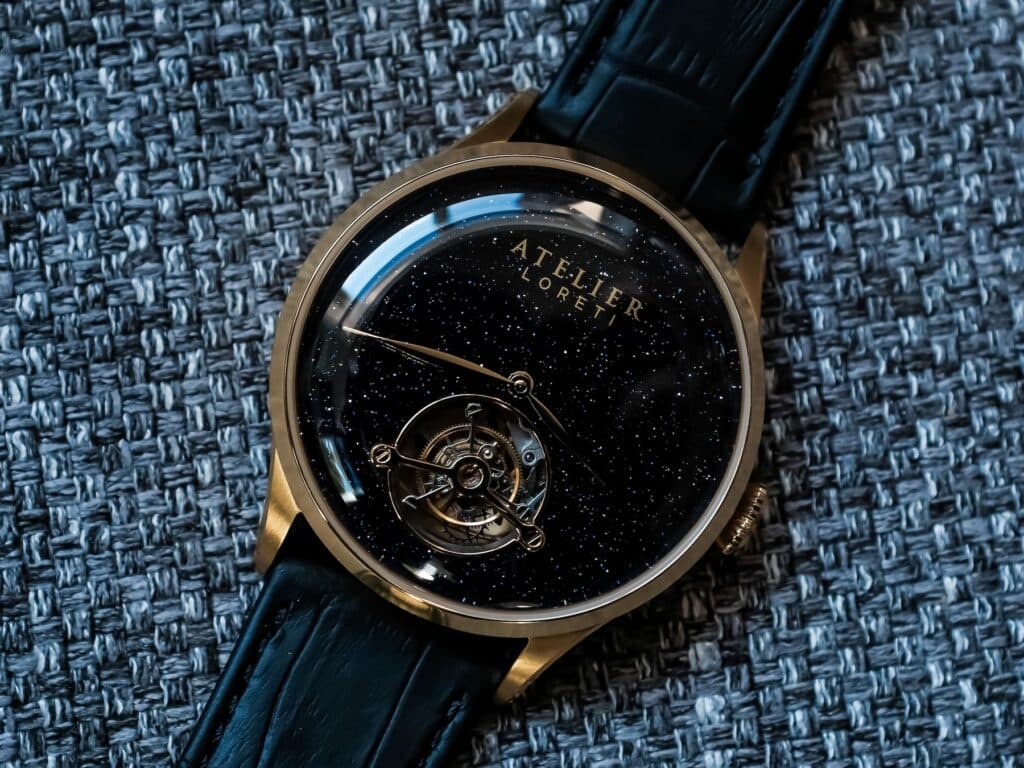
The aventurine is good. I like how much it changes with the light, and I think Atelier Loreti made the right decision by keeping the rest of the dial relatively sparse. The tourbillon gets the space it needs at six, and there isn’t a pile of text competing with it.
And yes, this is a real tourbillon. The escapement and balance are contained within a rotating cage, and watching that entire assembly make its rotation has a very different effect from looking through an open-heart aperture at a conventional balance wheel. I spent a lot of time watching it during the first few days. Less so after a few weeks.
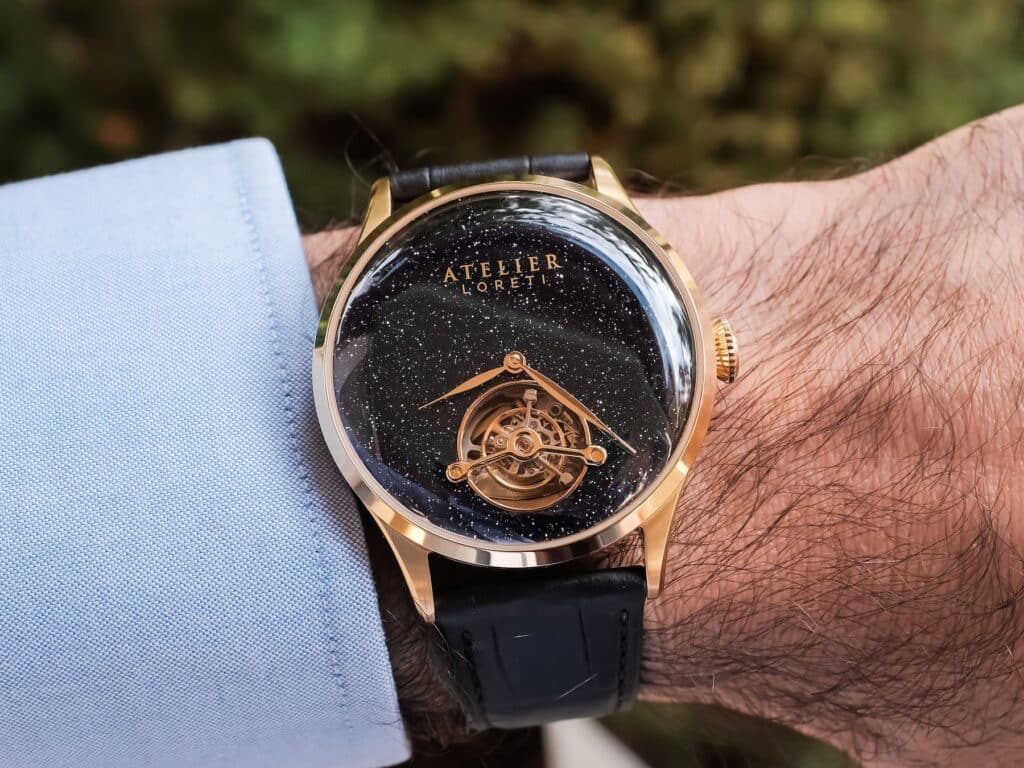
That drop-off was interesting because it helped me separate the initial fascination with the mechanism from how I actually felt about the watch. Once I stopped checking out the tourbillon every few minutes, I was left with the rest of the Celestial. That meant the aventurine dial, the large gold-tone case, the leather strap, compromised legibility, and a style that still sits pretty far outside what I normally wear.
The tourbillon is also only part of the price conversation. Affordable Chinese tourbillons have existed for years, so $850 doesn’t suddenly make mechanical history. What Atelier Loreti has done is package one with an aventurine dial, sapphire crystal, automatic winding, 100 meters of water resistance, and a design that I think presents the complication pretty well. I can also see exactly where some compromises were made to get there.
For me, that’s a much more useful way to understand this watch than getting hung up on how inexpensive the tourbillon is.
Understanding the Appeal
Spending time with the Celestial hasn’t turned me into a tourbillon guy. I still appreciate the complication more from a mechanical standpoint than as something I want in my own collection. The movement is fascinating to watch, and having one on my wrist for an extended period gave me a better understanding of why people get so absorbed by them. I get it a little more now. My own tastes just haven’t moved very far.
If this loaner suddenly became mine, I’d probably enjoy keeping it around for a while. Eventually, I think I’d move it along. A 42mm gold-tone dress watch on leather still doesn’t have much of a place in my watch box, regardless of what’s spinning around at six o’clock. And that takes me back to why I wanted to spend time with watches like this in the first place.
I’ve been trying to get outside my normal collecting habits this year, and the Celestial took me farther outside them than most. I got to live with a complication I’d previously appreciated mostly from a distance. I found an aventurine dial I enjoyed. I also came away with concerns about servicing and some frustration with how the Miyota relationship is communicated. None of that made me want to own a tourbillon. But I understand the people who do a little better now.

Co-Founder & Senior Editor
Michael Peñate is an American writer, photographer, and podcaster based in Seattle, Washington. His work typically focuses on the passage of time and the tools we use to connect with that very journey. From aviation to music and travel, his interests span a multitude of disciplines that often intersect with the world of watches – and the obsessive culture behind collecting them.