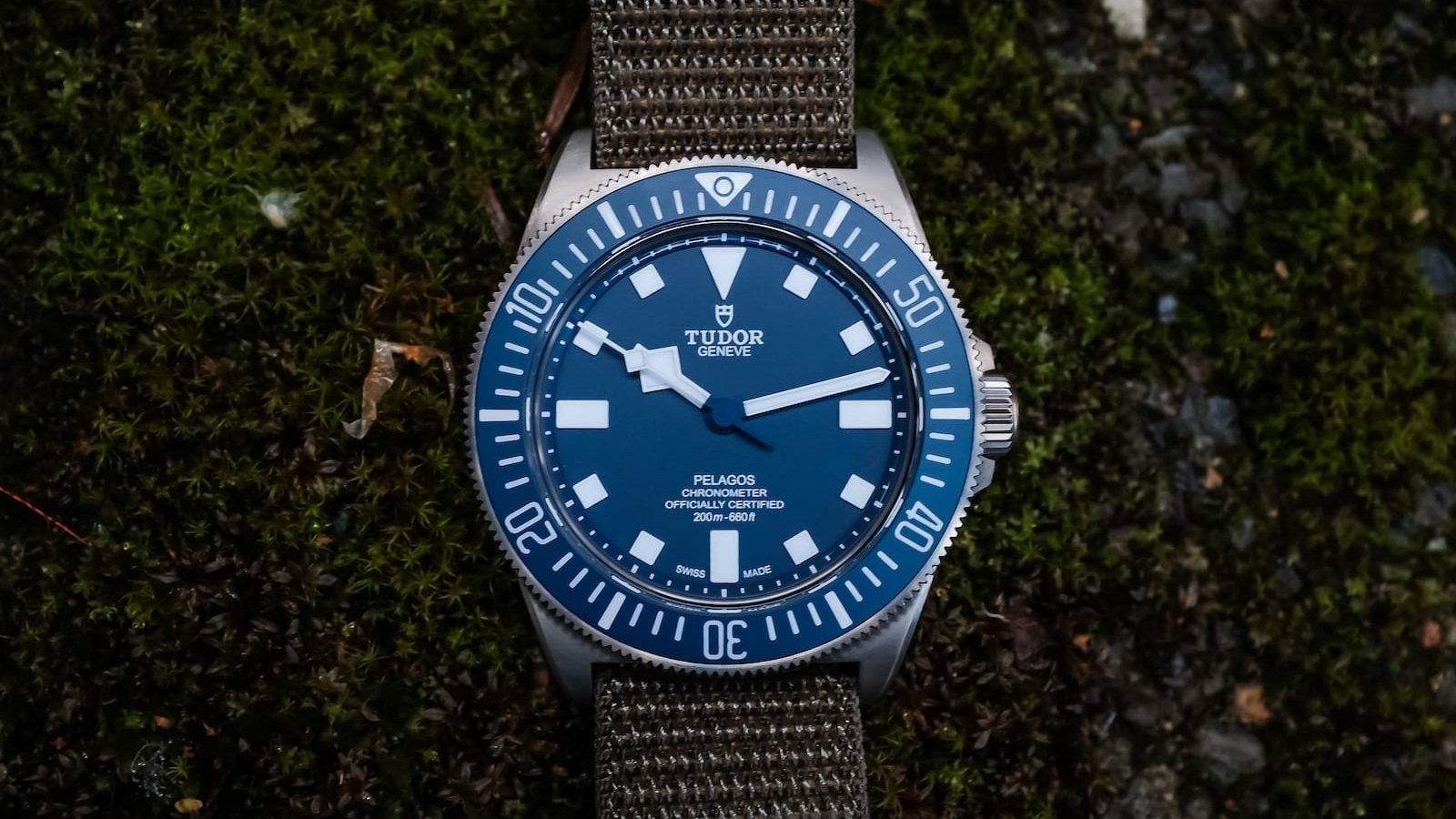
Titanium tool watches are often purchased for the adventures we imagine having rather than the ones we actually take. There’s nothing necessarily wrong with that, but the Tudor Pelagos FXD and Sinn T50 are interesting because both were designed with genuine utility in mind. Tudor draws on its history with French military divers, while Sinn approaches the category with an almost obsessive commitment to practical engineering. Both offer lightweight titanium construction, serious diving credentials, and enough specialized features to make an ordinary stainless steel diver seem almost underprepared. Yet despite their similar intentions, these watches couldn’t be more different in how they approach the job.
We’ve had both watches on hand at TBWS, and the differences became particularly interesting once we moved beyond their specifications. Our Tudor Pelagos FXD review explored the original blue Marine Nationale version, revealing a watch that felt remarkably comfortable despite its substantial dimensions and military-inspired construction. The Sinn T50 review followed the German diver through two weeks of travel, where its compact proportions and specialized engineering made a lasting impression. Tudor offers stronger movement specifications and a distinctive connection to military diving history, while Sinn counters with greater water resistance and an unusually technical approach to durability. With both competing for the attention of serious tool-watch enthusiasts, we’re interested in something more meaningful than which one looks better on paper: which titanium dive watch actually delivers the better combination of diving capability, everyday wearability, and value?
Overview and Identity
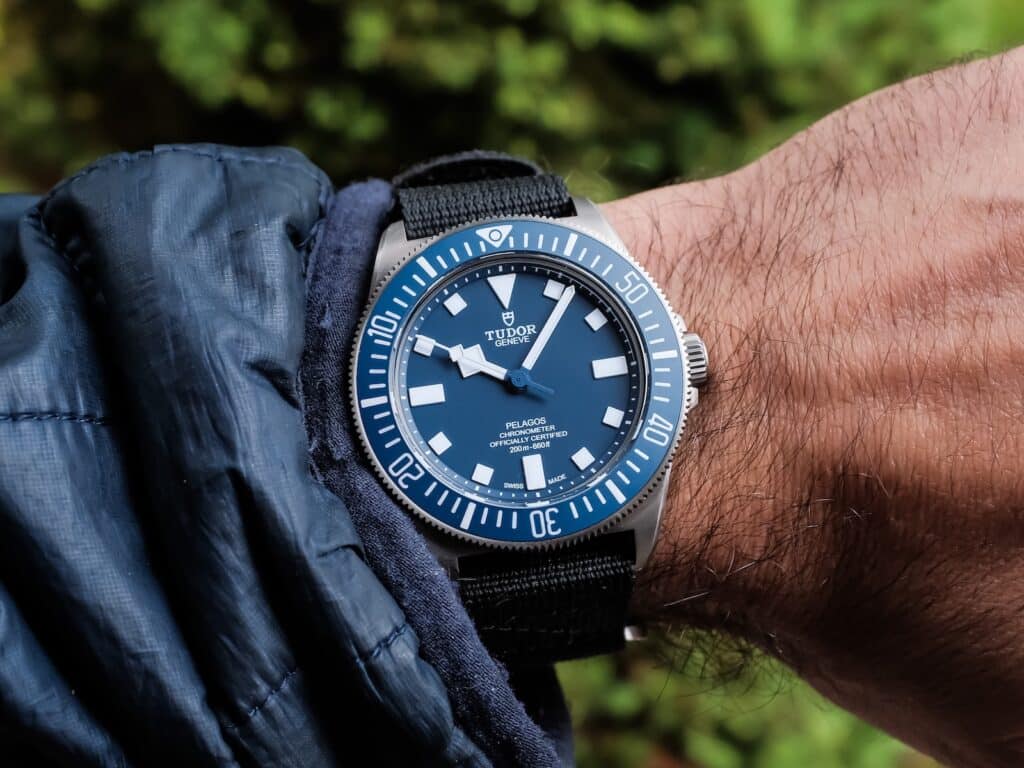
Tudor’s Pelagos FXD is one of those watches that becomes easier to understand once we stop looking at it through the usual luxury-watch expectations. Introduced in 2021, the original blue version draws on Tudor’s historical relationship with the French Marine Nationale, incorporating fixed strap bars, a specialized countdown bezel, and a restrained design that feels closer to military equipment than an expensive lifestyle accessory. There are certainly collectors who will purchase the FXD because of its historical associations, but that’s not what impressed us most. The watch succeeds because those details have a practical purpose. Our original review approached the FXD with some skepticism about the enthusiasm surrounding it, only to discover that the watch was considerably more understated and wearable than its reputation suggested. It’s an unusual combination of specialized design and everyday usability, and Tudor deserves credit for not sanding away all the interesting features to make it more commercially conventional.
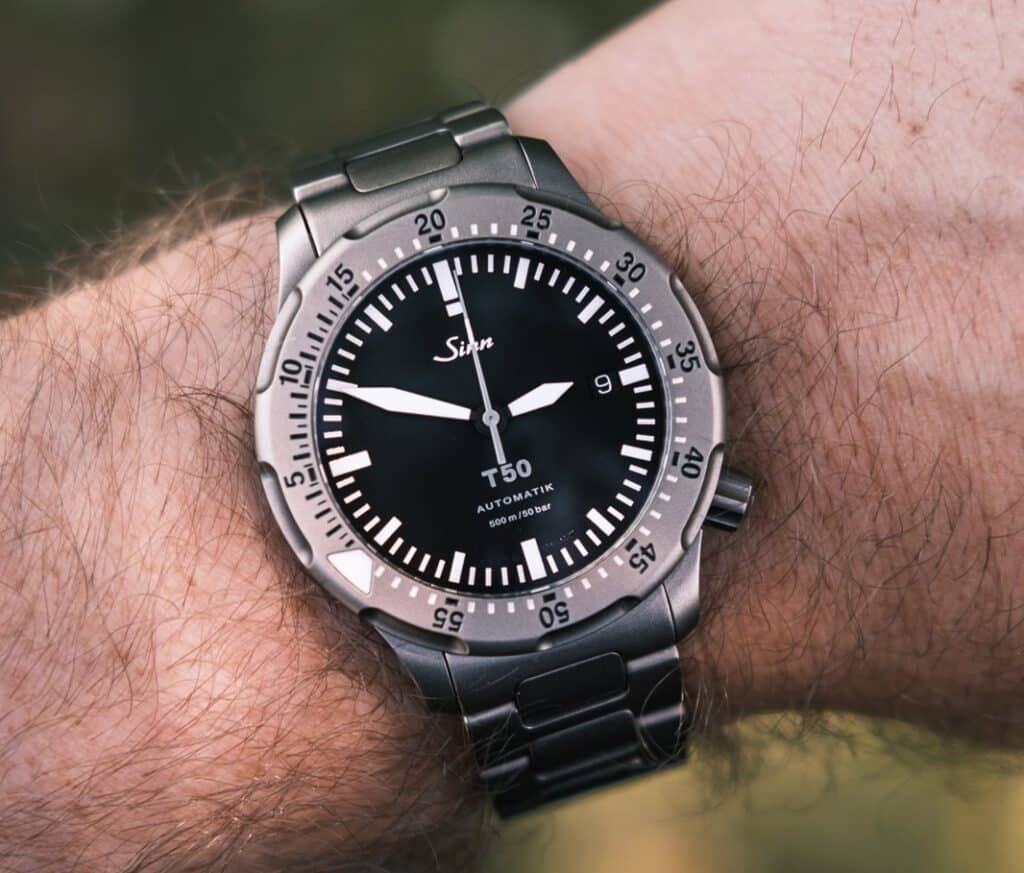
Sinn’s T50 reaches a similar destination through an entirely different philosophy. The German manufacturer has built much of its reputation around aggressively functional watches, often incorporating specialized technologies that most other brands simply don’t offer. The T50 follows that tradition but packages it in a considerably more manageable form than some of Sinn’s earlier divers. Its titanium case, hardened bezel, captive bezel mechanism, and Ar-Dehumidifying technology create a watch that seems almost comically committed to preventing things from going wrong. Yet our experience suggested that the engineering doesn’t overwhelm the wearing experience. There’s no excessive decoration, no polished surface demanding attention, and very little effort to make the watch look prestigious. Sinn seems far more interested in building something that works than convincing strangers that it costs several thousand dollars. For collectors who value technical individuality, that approach has a considerable appeal of its own.
Dial and Straps/Bracelets
The blue dial on the Tudor Pelagos FXD is one of its most successful design decisions. Rather than using the brighter blue associated with some other Pelagos models, Tudor chose a darker navy shade that works particularly well against the matte titanium case. The result is a watch that feels almost subdued despite its substantial dimensions and unmistakable military styling. We also appreciate how much cleaner the dial has become compared with earlier Pelagos designs. Removing the date and reducing unnecessary text allows the large snowflake hands and luminous hour markers to do most of the visual work. The matte surface helps control reflections, while the overall layout remains exceptionally easy to read. There’s nothing especially decorative about the composition, which is exactly why it succeeds. Tudor has managed to produce a genuinely attractive dial without compromising the utilitarian personality that makes the FXD interesting.
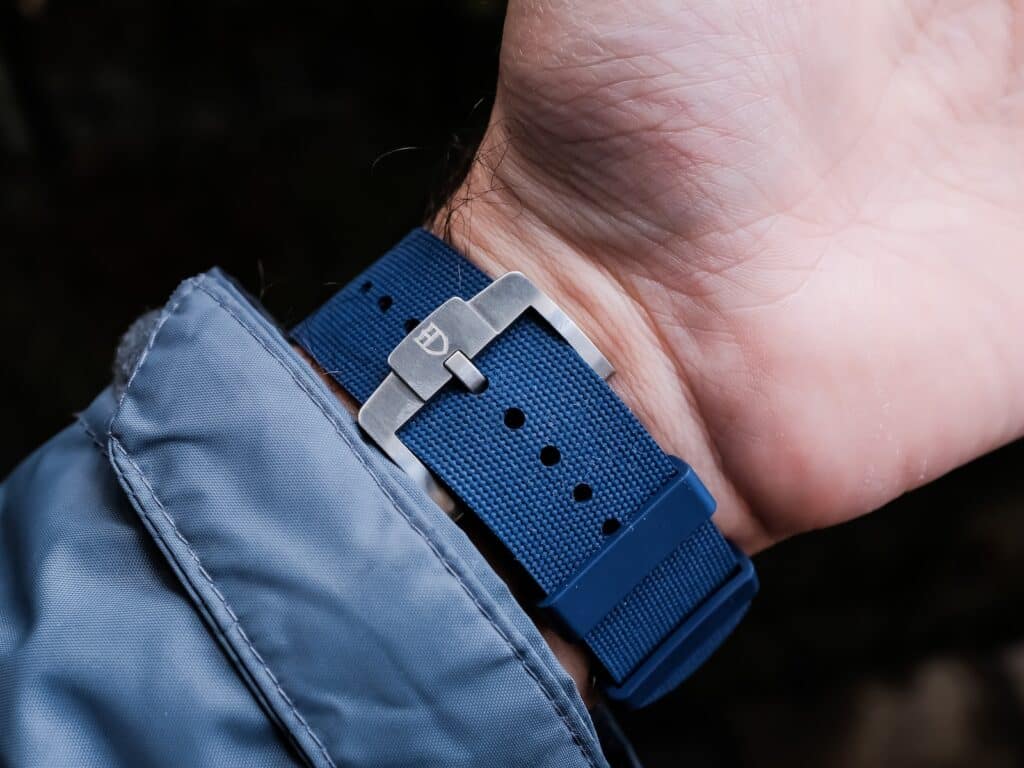
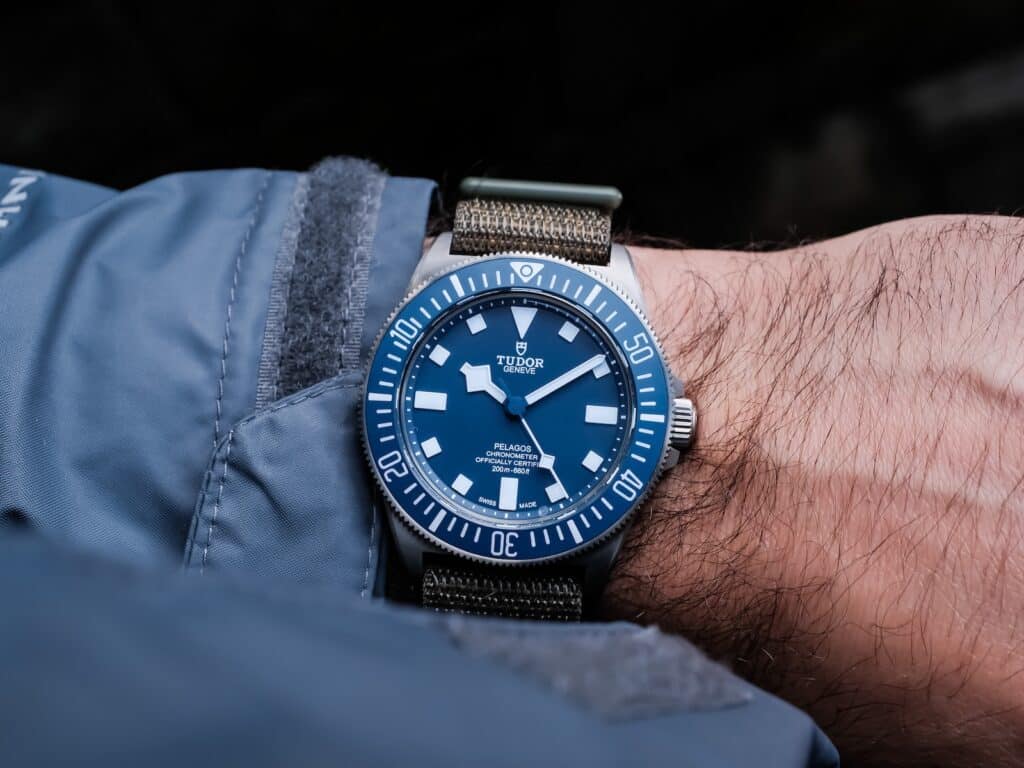
Strap compatibility is both the FXD’s most distinctive feature and one of its more obvious limitations. Instead of conventional spring bars, Tudor machines fixed bars directly into the titanium case, creating a secure arrangement inspired by historical military-issued dive watches. The construction feels purposeful rather than nostalgic, particularly once we notice the small chamfers designed to reduce wear on fabric straps. Our original review explored several aftermarket options, including straps from Prometheus Design Werx and Watches of Espionage, and the FXD proved remarkably adaptable within that category. Even inexpensive elastic straps worked surprisingly well. But the limitation is unavoidable: we’re largely committed to pass-through straps, and there’s no straightforward way to fit a conventional bracelet. Some collectors will consider that unacceptable on a watch at this price. Others will appreciate that Tudor was willing to make a design decision that prioritizes security and historical authenticity over universal versatility.
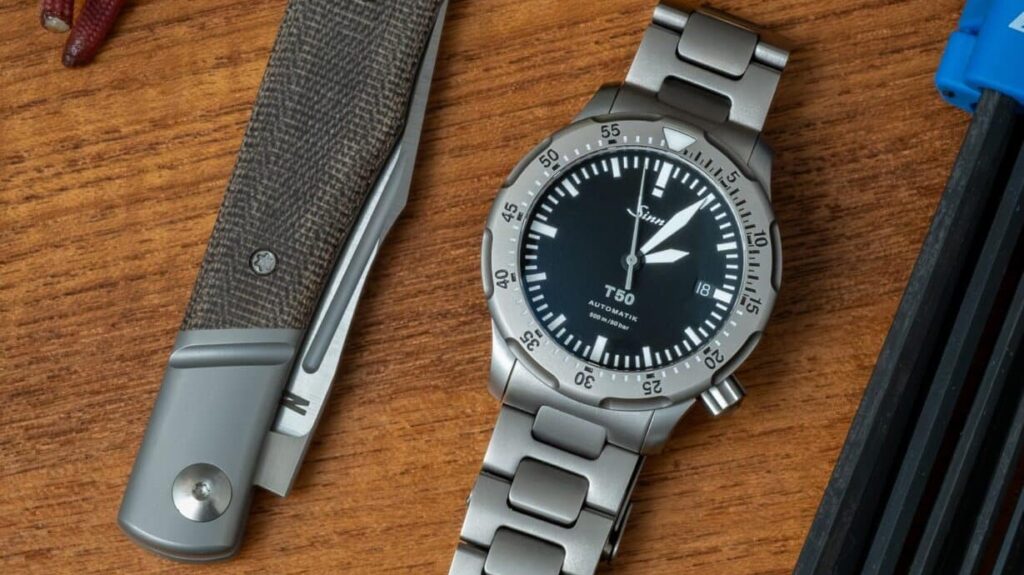
The Sinn T50 takes an even more restrained approach to its dial. White sword-shaped hands and bold hour markers sit against a black background, with matching minute markings creating an exceptionally clear display. The gray seconds hand and understated text near six o’clock introduce just enough variation to prevent the watch from feeling completely sterile. We particularly appreciate the date implementation. Rather than surrounding the aperture with a contrasting frame or using a bright white date wheel, Sinn blends the complication into the dial with a dark background and white numerals. It’s present when we need it and nearly invisible when we don’t. The result is wonderfully practical, especially for a watch whose identity depends on functional clarity. Compared with Tudor’s navy dial and distinctive snowflake handset, the T50 feels more industrial and less concerned with visual tradition. Neither approach sacrifices legibility, but each communicates a very different personality.
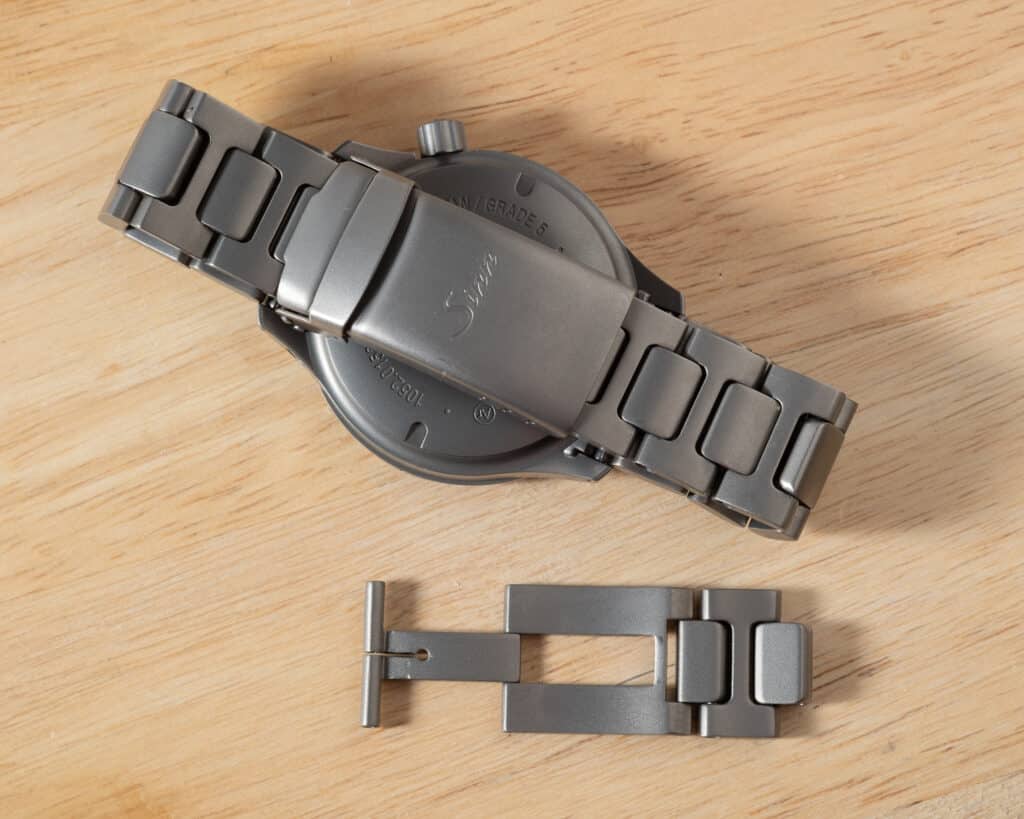
Where Tudor deliberately limits bracelet compatibility, Sinn provides considerably more flexibility. The T50 is available on a titanium H-link bracelet, and the example we reviewed felt impressively light thanks to its construction. The bracelet includes three conventional micro-adjustment positions and a diver’s extension, although the latter became one of our biggest frustrations with the watch. The extension could release with surprisingly little force, creating an unpleasant moment of uncertainty whenever the clasp was handled. Our reviewer eventually removed the extension and secured the bracelet directly, which significantly improved the experience. That’s not something we’d expect to have to do on a watch at this price. Fortunately, drilled lug holes make the T50 easy to wear on rubber, NATO, or canvas straps, and its restrained case works naturally with all three. Sinn wins on configuration options, but Tudor’s intentionally simpler strap system avoids the particular clasp irritation we encountered.
The contrast is interesting because neither manufacturer delivers the conventional titanium-bracelet experience without qualification. Tudor eliminates the bracelet entirely in pursuit of a more secure military-style attachment system, while Sinn provides one but compromises the experience with an unnecessarily troublesome extension. Neither decision makes the underlying watch less capable, but both influence how we interact with it every day. We’d rather have a manufacturer commit fully to an unusual design choice than include a supposedly useful feature that becomes irritating during ordinary wear. At the same time, the ability to install a conventional bracelet remains a meaningful advantage for the Sinn. The better solution depends on whether we’re looking for a dedicated fabric-strap tool watch or a more versatile diver that can move between different configurations.
Build Quality & Technical Approach
Both manufacturers use titanium to make substantial diving watches more manageable, but that shared material is where the similarities begin to disappear. Tudor concentrates on refined construction and a relatively conventional movement inside an unconventional military-inspired case. Sinn devotes much of its attention to preventing damage, moisture intrusion, and accidental operation. The differences become particularly apparent once we move beyond the material itself and consider how these watches behave.
Movements
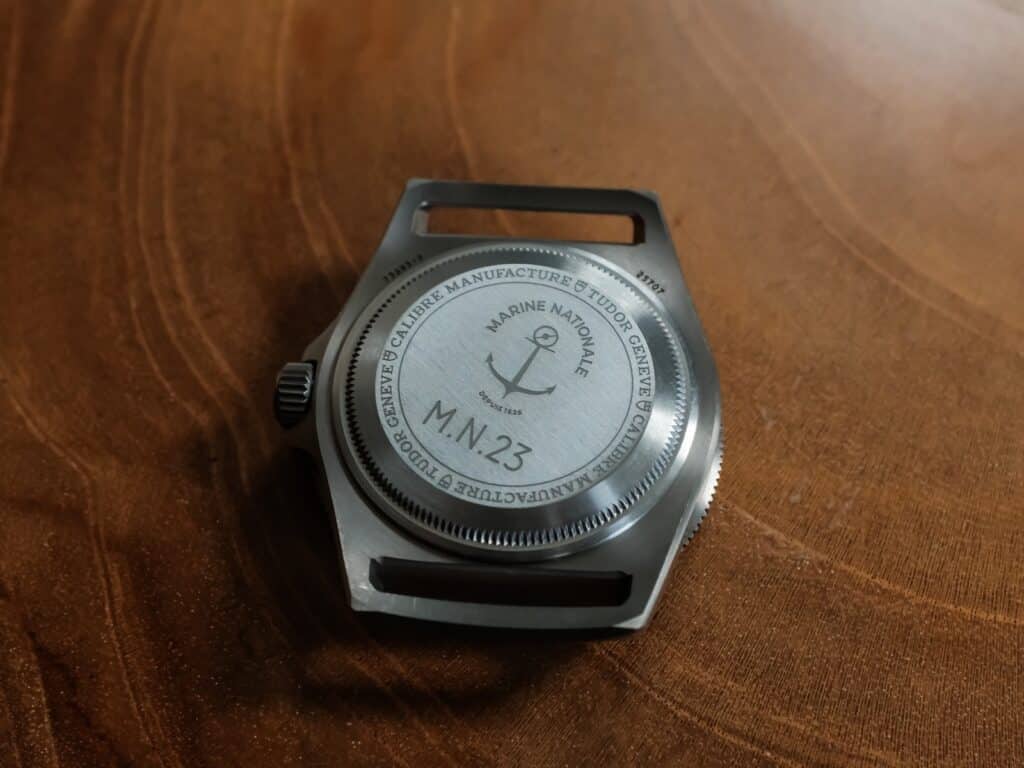
Inside the Tudor Pelagos FXD is the manufacture caliber MT5602, an automatic movement with a 70-hour power reserve and COSC chronometer certification. Those specifications give Tudor an immediate advantage for collectors who rotate watches throughout the week, since the FXD can spend several days off the wrist without requiring another setting. The movement also operates at 28,800 vibrations per hour and provides the familiar hacking and hand-winding functionality we’d expect at this price. Our experience with the FXD was particularly reassuring because previous interactions with Tudor’s in-house movements hadn’t always been entirely positive. This example performed well, maintaining strong accuracy without introducing any distracting behavior during regular use. It’s exactly the sort of movement that becomes more appealing when we stop thinking about it. The longer power reserve provides genuine convenience, and the absence of a date complication keeps the operation straightforward.

Sinn uses the Sellita SW300-1, a movement with a long track record across the Swiss watch industry. Our review example delivered excellent observed accuracy, running around two or three seconds per day in either direction depending on whether it was being worn. That’s impressive performance, particularly considering that Sinn isn’t relying on a proprietary movement to achieve it. The caliber also includes a date complication and a relatively slim architecture that helps keep the T50’s overall dimensions manageable. The original review identified a 42-hour power reserve as a disadvantage compared with modern three-day movements, although SW300-1 specifications have changed across production generations, so the exact reserve should be checked against the version being considered. Regardless, the broader point remains that Sinn has chosen a widely established movement rather than developing something unique simply for the sake of exclusivity.
The two movements reflect a familiar disagreement among watch enthusiasts. Tudor gives us a longer reserve and a manufacturer-specific caliber that supports the brand’s premium positioning, while Sinn relies on an established movement whose underlying design is widely understood by watchmakers. There’s a reasonable argument that the Sellita is the more practical choice for long-term servicing, particularly when we consider how expensive proprietary movements can become to maintain. Sinn complicates that advantage somewhat through its specialized case technologies, which may require manufacturer involvement to preserve the original moisture-control system. We prefer the Tudor’s power reserve for everyday convenience, but the Sinn performed so well during our review that dismissing it for using a third-party movement would be difficult to justify. Mechanical sophistication matters, but reliable execution matters just as much.
Case Construction, Finishing & Wearability
The Pelagos FXD measures 42mm in diameter, approximately 52mm from lug to lug, and 12.75mm thick. Those dimensions initially made us question whether the watch would feel unnecessarily aggressive, particularly because fixed bars extend the effective footprint of the case. On the wrist, however, the experience was surprisingly manageable. The relatively thin profile and consistent matte finishing reduce much of the visual bulk, while the case sits more naturally than the numbers suggest. Our original review even compared the wearing experience with a Seiko Turtle, which is hardly a small watch but has a reputation for being more comfortable than its dimensions imply. Tudor’s brushed titanium surfaces also feel exceptionally consistent, with crisp transitions and a finish that communicates quality without drawing attention through polished decoration. The result is a watch that looks purpose-built without feeling cumbersome.
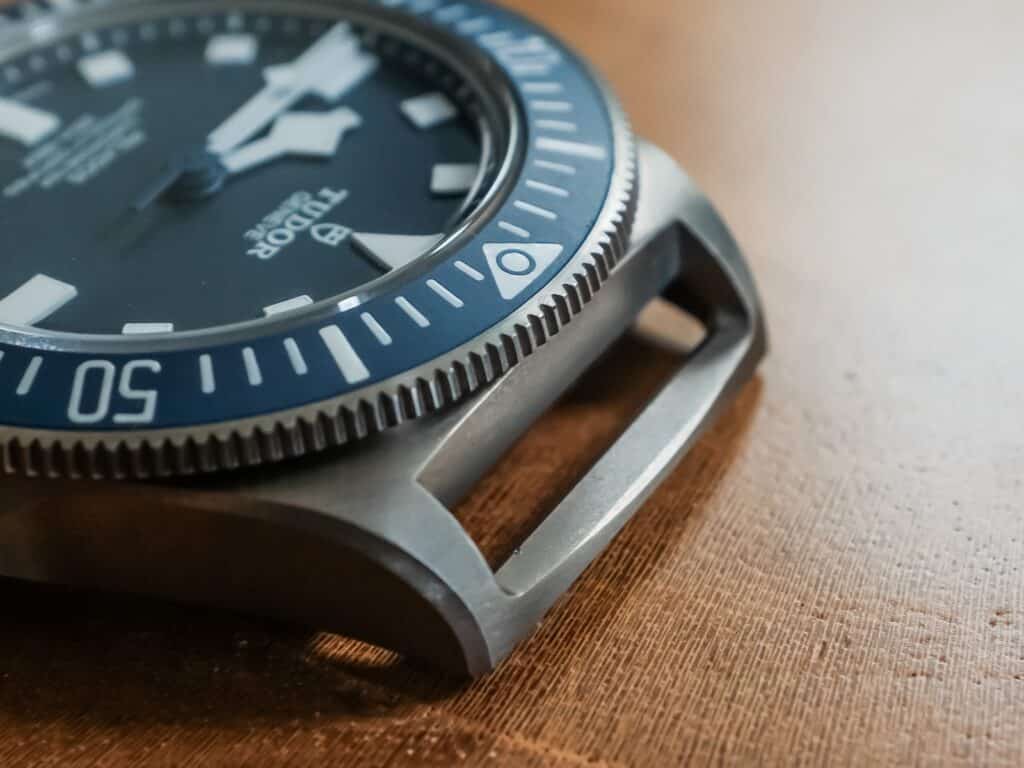
What makes the FXD particularly convincing is how deliberately Tudor has simplified the standard Pelagos formula. The helium escape valve is gone, and water resistance has been reduced from the standard Pelagos’s 500 meters to 200 meters. On paper, those changes might seem like compromises, but they also allow the FXD to maintain a slimmer, more focused case. The fixed bars become the centerpiece of the construction, eliminating the possibility of a conventional spring bar failing under demanding conditions. We also appreciate the attention paid to the bar edges, which have been subtly chamfered to reduce unnecessary abrasion on straps. None of these details is particularly glamorous. That’s precisely why they work. Tudor has created a watch whose unusual design choices become more understandable through use rather than simply providing features that look impressive in promotional photographs.
Sinn’s T50 is more compact, measuring approximately 41mm across, 47mm from lug to lug, and 12mm thick. The titanium construction keeps the weight remarkably low, with our review example measuring just over 95 grams on a fitted bracelet for a seven-inch wrist. That’s an impressive achievement for a 500-meter diver, especially considering the additional technology built into the case. We found the dimensions particularly comfortable during extended travel, and the restrained matte finish helped the watch remain relatively inconspicuous. Unlike the Tudor, which draws attention through the distinctive Pelagos design language, the Sinn almost disappears visually once it’s on the wrist. There’s nothing polished to catch the light, and the simple case geometry communicates durability without unnecessary aggression. For someone who wants a capable watch that doesn’t feel oversized or decorative, the T50 is exceptionally convincing.

Sinn’s Ar-Dehumidifying technology introduces another distinction that goes beyond ordinary case construction. The system combines specialized seals, protective gas filling, and a copper sulfate drying capsule designed to help control moisture inside the watch. That capsule is visible through a small window near the lower left lug, changing color as it absorbs moisture and providing an indication of when servicing may be appropriate. It’s clever engineering, and we appreciate that Sinn has considered the potential long-term effects of moisture on movement lubricants. But the practical benefits are difficult to quantify from a relatively brief wearing experience, particularly when conventional dive watches have demonstrated decades of reliable service without comparable systems. There’s also the complication of maintaining the technology during future servicing. The system adds genuine technical interest, although whether it materially improves the ownership experience will depend on how the watch is used and maintained.
If we’re judging the cases primarily through comfort, Sinn has the advantage. The shorter lug-to-lug distance, slimmer profile, and exceptionally low weight make the T50 easy to wear without much adjustment. Tudor is more impressive than its 52mm measurement suggests, and we wouldn’t discourage someone from trying it simply because of the dimensions. But Sinn delivers much of the same titanium tool-watch appeal in a more compact package while maintaining a substantially higher water-resistance rating. Tudor counters with exceptional finishing and a design whose unusual construction feels entirely intentional. Neither watch seems inadequately engineered for its price, but Sinn’s ability to package so much capability into such manageable dimensions deserves particular recognition.
Crystals and Bezels
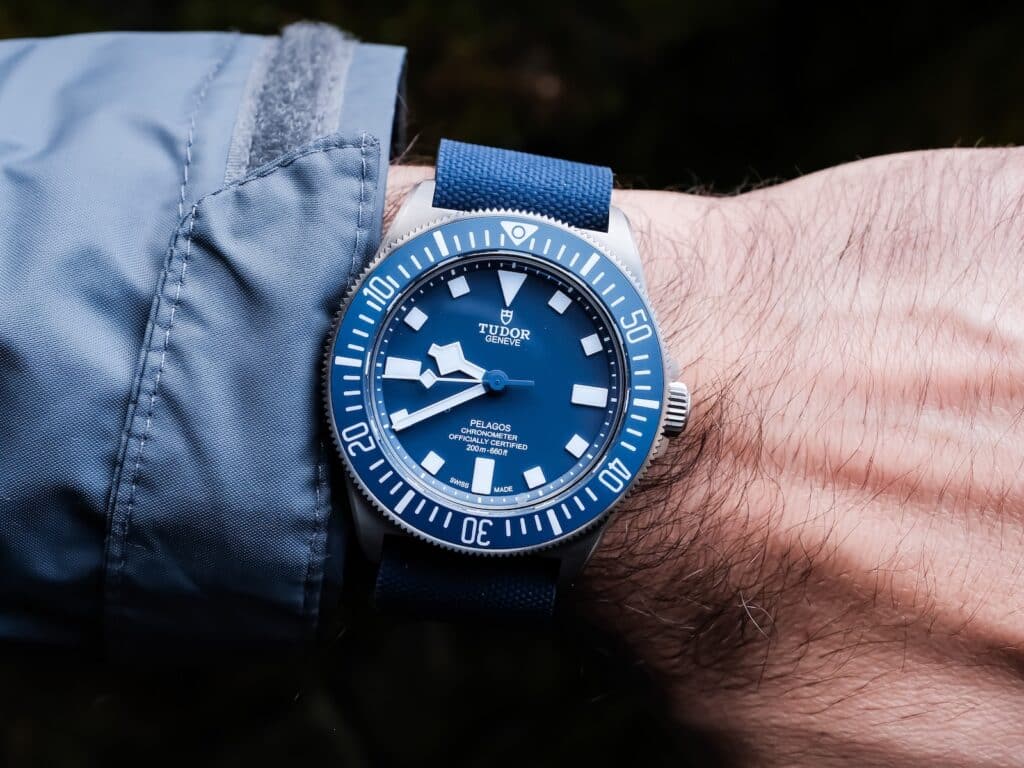
Tudor’s Pelagos FXD uses a sapphire crystal and a fully luminous ceramic bezel insert, creating a combination that looks particularly effective in low light. The 120-click mechanism feels precise and deliberate, while the pronounced external grip makes the bezel easier to operate than many other Tudor divers we’ve handled. Its specialized countdown markings distinguish the FXD from conventional elapsed-time dive bezels, reflecting the watch’s military navigation and timing influences. That distinction is important because the bezel isn’t simply another styling detail. It changes how we interact with the watch and reinforces the FXD’s specific purpose. We particularly appreciate how the larger bezel feels integrated with the broader case rather than appearing oversized for effect. It’s an exceptionally satisfying component, and one of the clearest examples of Tudor’s attention to everyday tactile quality.

Sinn’s T50 also uses a sapphire crystal, but its bezel illustrates a very different approach to durability and operation. The titanium bezel is treated with Sinn’s Tegiment technology, which increases surface hardness and helps resist the scratches and marks that untreated titanium can accumulate. Its engraved diving scale is straightforward and legible, with black-and-white markings that match the monochromatic dial. More distinctive is the captive bezel mechanism, which requires downward pressure before the bezel will rotate. That reduces the likelihood of accidental adjustments, although it introduces an extra step whenever we want to use it. Our original review found the system well executed, even if the benefit felt somewhat excessive for ordinary wear. We can appreciate the logic without pretending it’s essential. Sinn clearly designed the bezel around preventing mistakes and minimizing damage, while Tudor prioritizes easy manipulation and the specific timing requirements associated with the FXD.
Water Resistance & Lume
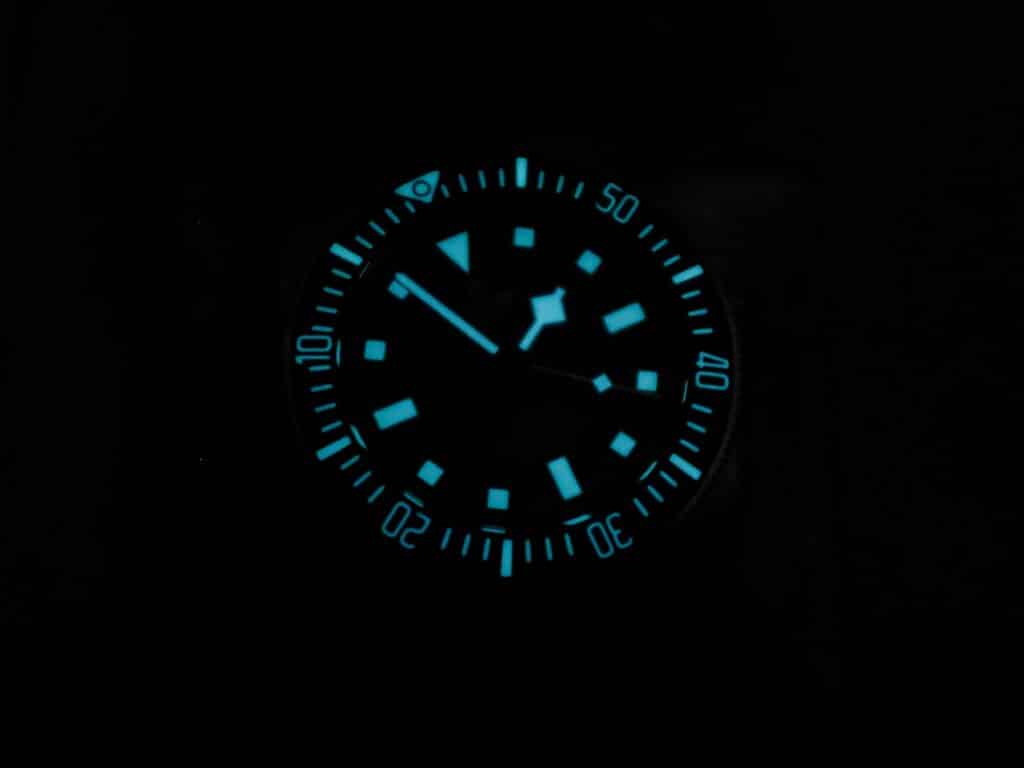
Two hundred meters of water resistance is entirely appropriate for the Pelagos FXD’s intended military diving identity, even if it looks modest beside the 500-meter rating of the standard Pelagos. We wouldn’t consider that a serious limitation for most buyers, particularly because the FXD isn’t pretending to be an extreme-depth saturation diver. Its luminous performance is also excellent, thanks to the large snowflake hands, bold markers, and fully luminous ceramic bezel insert. We found the dial exceptionally easy to read in poor lighting, with the navy background providing enough contrast to keep the display clear without excessive visual clutter. Tudor has achieved the kind of functional legibility that often gets lost when manufacturers become too interested in decorative finishing. It’s a genuine strength, and one that supports the watch’s military-inspired identity.

Sinn provides 500 meters of water resistance in the T50, a remarkable specification considering the case’s relatively compact dimensions. The screw-down crown, specialized seals, and moisture-control system reinforce the impression of a watch designed for demanding environments. Its black-and-white dial is similarly purposeful, with large luminous elements and a small illuminated section on the seconds hand to help indicate that the movement is operating. We found the presentation extremely legible, although the watch doesn’t rely on the same fully luminous bezel treatment that gives the Tudor such a distinctive appearance after dark. For most owners, the difference between 200 and 500 meters will be largely theoretical. But Sinn deserves credit for achieving the higher rating without turning the watch into an oversized titanium cylinder. It’s an impressive combination of engineering and practical wearability.
Cost Considerations
Our original Pelagos FXD review placed the watch at $5,025, reflecting its position within Tudor’s premium tool-watch collection. At that price, buyers are paying for more than a titanium case and a capable automatic movement. The Marine Nationale association, proprietary caliber, carefully executed finishing, and recognizable Tudor identity all contribute to the experience. Some collectors will consider that combination compelling enough to justify the cost, particularly if the FXD represents a connection to historical military divers that they already appreciate. Others may struggle with the fixed bars and comparatively modest water-resistance rating when less expensive watches offer more conventional versatility. We understand both reactions. The FXD makes sense when considered as a complete design rather than an attempt to maximize the number of impressive specifications.
Sinn’s T50 was listed at $3,870 on its titanium bracelet in our original review, although that historical figure shouldn’t be confused with a guaranteed current retail price. Even at that level, the engineering package was unusually substantial. Titanium construction, 500 meters of water resistance, a hardened captive bezel, and the Ar-Dehumidifying system create a watch that offers genuine technical differentiation. We’re not paying for precious metals, elaborate decoration, or an unusually recognizable logo. The value proposition is centered almost entirely on functional design. That approach will appeal to collectors who enjoy understanding how their watches work and appreciate details that most people would never notice. The frustration is that Sinn’s bracelet extension undermines an otherwise thoughtful package, demonstrating that considerable technical sophistication doesn’t automatically produce a flawless ownership experience.
The movement comparison also influences how we evaluate the price difference. Tudor’s 70-hour reserve and COSC certification are meaningful advantages, particularly for collectors who regularly rotate watches. There’s convenience in leaving the FXD unworn for a couple of days and returning to find it still running accurately. Sinn’s Sellita movement offers a more conventional approach, but our review example delivered excellent accuracy and demonstrated why a proven third-party caliber can remain appealing in a high-end tool watch. We wouldn’t automatically consider an in-house movement more valuable simply because a manufacturer developed it independently. The benefits need to appear in actual use, and Tudor’s extended reserve provides a tangible improvement. Still, Sinn’s movement performs its essential job convincingly, and that leaves more room for the brand to concentrate on other aspects of the watch.
Where Sinn makes its strongest financial argument is through the sheer amount of specialized engineering contained in a relatively compact case. The additional water resistance, Tegiment-treated bezel, protective seals, and moisture-control capsule all demonstrate a willingness to approach watchmaking from a practical problem-solving perspective. We can question how often those technologies will matter to an ordinary owner, but they’re not superficial decorations. Tudor takes a more restrained approach, prioritizing historical authenticity, an excellent movement, and consistent finishing over technical features that might have limited practical applications. There’s something admirable about both philosophies. Sinn wants to eliminate as many potential problems as possible, while Tudor seems more interested in producing a narrowly focused watch that performs its intended role exceptionally well.
Ultimately, the question becomes how much we value refinement versus technical experimentation. Tudor’s strongest qualities are immediately apparent through its dial, bezel, straps, and movement performance. Sinn’s appeal emerges through the compact case, low weight, specialized bezel construction, and the layers of engineering intended to protect the movement over time. Both watches deliver credible titanium tool-watch experiences, but the T50 makes it harder to justify paying more solely for a recognizable name. The FXD offers its own practical advantages and an unmistakable identity, yet Sinn manages to provide considerably more water resistance and specialized case technology without sacrificing comfort. For buyers who prioritize diving capability, practical engineering, and everyday comfort over military provenance or brand recognition, that represents a compelling proposition.
Final Thoughts: Tudor Pelagos FXD vs Sinn T50
The Tudor Pelagos FXD earned much of the enthusiasm surrounding it once we experienced the watch firsthand. Its matte titanium case is beautifully executed, the navy dial is unusually restrained, and the combination of fixed bars and a specialized countdown bezel feels genuinely purposeful. We particularly appreciate that Tudor hasn’t attempted to transform the FXD into another universally appealing everyday diver. It retains the quirks that make it interesting, even when those decisions limit conventional bracelet compatibility. The MT5602 movement is another meaningful strength, delivering a long power reserve and reassuring accuracy without demanding much attention. What initially appeared to be an aggressive, oversized military watch became surprisingly comfortable and approachable during our review. That’s a significant achievement, and it explains why the FXD continues to appeal to enthusiasts beyond the historical associations surrounding it.
Sinn’s T50 is less romantic about its identity, and we find that equally appealing. The compact titanium case, exceptionally low weight, and deliberate approach to functional design make it one of the more convincing modern tool watches we’ve experienced. Its additional water resistance is impressive, but the real satisfaction comes from how naturally the watch wears despite the substantial engineering inside it. We appreciate the hardened bezel, the moisture-control technology, and the restrained dial, even if some of those innovations are more interesting in theory than they are essential for daily use. The bracelet extension remains a frustrating oversight, particularly on a watch that otherwise feels so carefully considered. Yet that flaw doesn’t erase what Sinn has accomplished. Few titanium divers offer this combination of technical individuality, comfortable proportions, and understated appearance.
Choosing between them comes down to which aspects of tool-watch ownership we actually enjoy. Tudor provides a stronger connection to military diving history, a longer-lasting movement, and an unusually cohesive design that becomes more satisfying the longer we examine it. Sinn counters with a smaller case, greater water resistance, specialized materials, and an engineering philosophy that feels genuinely different from most of the Swiss watch industry. We wouldn’t suggest that everyone should pay more for Tudor’s name, nor would we automatically reward Sinn for having more impressive specifications. The FXD’s fixed bars and countdown bezel are part of its appeal rather than universally beneficial features, just as Sinn’s captive bezel and moisture-control system won’t matter equally to every owner. Both watches ask us to appreciate the purpose behind their design rather than simply the numbers associated with them.
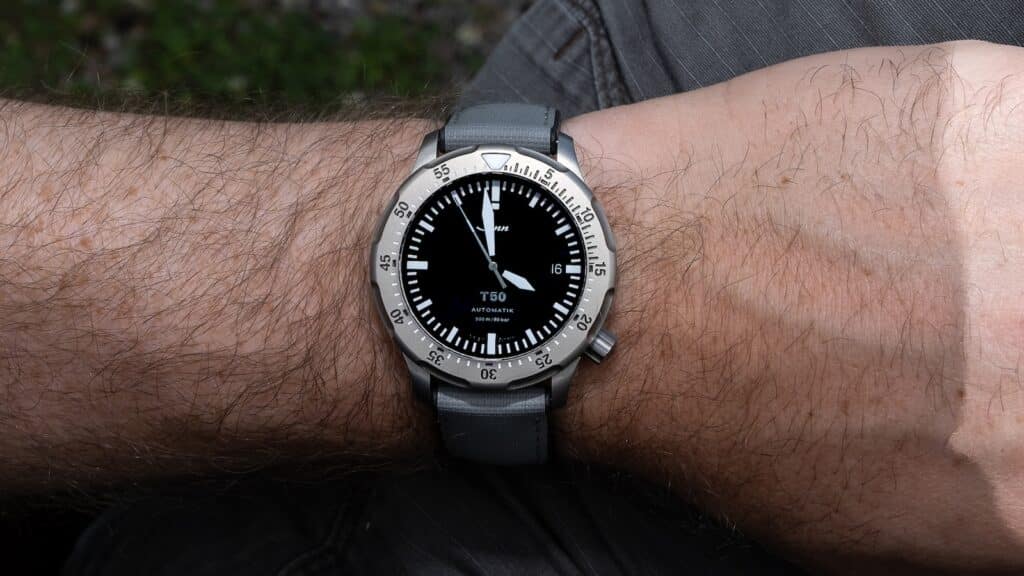
Our choice for overall value is the Sinn T50. Although the Tudor Pelagos FXD remains the more compelling expression of a modern military dive watch. Sinn delivers an extraordinary amount of practical engineering in a compact titanium package, and its understated personality makes it especially attractive for collectors who want something different from the familiar luxury-tool-watch formula. We’d still understand someone choosing the FXD without hesitation. Its finishing, movement, and distinctive military-inspired construction create an experience that Sinn doesn’t attempt to reproduce. But when the question is which titanium tool watch makes the stronger argument for the money, the T50 has our vote. It demonstrates that thoughtful engineering and genuine wearing comfort can be every bit as satisfying as heritage, reputation, and a famous name on the dial.

Co-Founder and Senior Editor
Kaz has been collecting watches since 2015, but he’s been fascinated by product design, the Collector’s psychology, and brand marketing his whole life. While sharing the same strong fondness for all things horologically-affordable as Mike (his TBWS partner in crime), Kaz’s collection niche is also focused on vintage Soviet watches as well as watches that feature a unique, but well-designed quirk or visual hook.