
An everyday tool watch doesn’t have to impress us every time we look at it; it has to keep making sense once the new-watch buzz wears off. That sounds simple, until two watches built around clear dials and time-only practicality offer very different ideas of what makes an everyday watch worth owning. The Hamilton Khaki Field Mechanical 250 sticks close to the uncomplicated pleasures of a field watch, while the Omega Railmaster brings a more polished, technically ambitious take on the same no-nonsense idea. So here’s the question worth settling: does the Railmaster’s extra refinement change the experience enough to matter through ordinary days, or is the Hamilton already delivering what we actually want from an everyday tool watch?
At TBWS, we’ve spent a decade looking beyond spec sheets and paying attention to what earns real wrist time. We’ve written about how we searched for years before finding a Khaki Field configuration that finally felt right, with its legibility and satisfying daily winding making it a watch we kept reaching for. We also drew on roughly three months of owning our Railmaster, describing a comfortable case and a blue dial that changes character as it catches the light. These are separate ownership experiences, not a side-by-side test, and we won’t pretend otherwise. But they give us a grounded starting point for examining which differences we’ll notice and appreciate in daily wear, which compromises might become frustrating, and whether the Railmaster’s added refinement translates into an experience that feels meaningfully different on the wrist.
Overview and Identity

The Hamilton Khaki Field Mechanical 250 is what happens when Hamilton digs a little deeper into its military-watch playbook instead of handing us another greatest-hits compilation. Rather than revisiting a familiar military-inspired design, Hamilton recreated the relatively obscure FAPD 5101 Type 1, a watch issued to U.S. Air Force Navigators. That’s a more interesting starting point than slapping some khaki paint on a field watch and calling it a day. As mentioned in our dedicated review, the Mechanical 250 finally brought the design and proportions together in a way that clicked. Its appeal lies in that focused execution and the uncomplicated pleasure of a hand-wound field watch. No complicated origin story required, no need to dress it up as a rugged lifestyle accessory. It knows what it is, and it doesn’t seem to have an identity crisis.

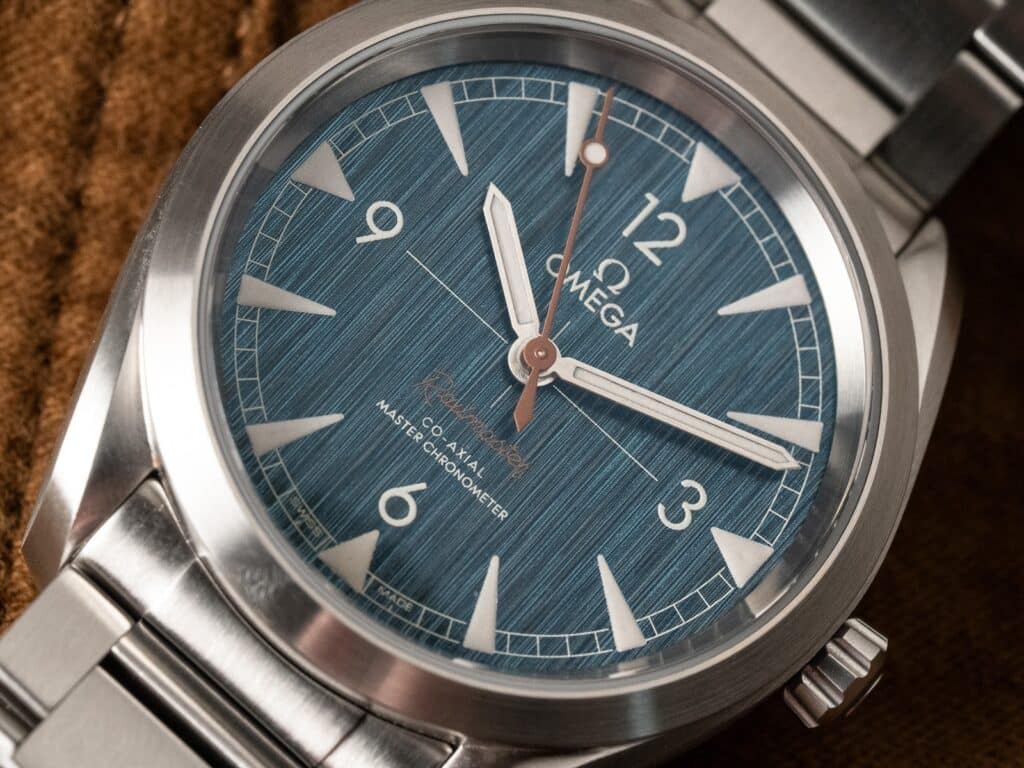
The Omega Railmaster has a different kind of functional pedigree. Dating back to the late 1950s, the original CK2914 was designed for railway workers and others regularly exposed to magnetic fields. Omega’s answer to the Rolex Milgauss came from a practical problem, not a focus group trying to invent another luxury-sports-watch personality. Fast-forward to 2017, and Omega revisited its 1957 collection with a trilogy of modern watches before introducing the Railmaster Co-Axial Master Chronometer as a separate production model. Our focus is the reference 220.10.40.20.03.001, better known as the denim-dial version. We found during our hands-on review that it retains the Railmaster’s understated, functional character while adding contemporary movement technology and a more refined execution. The blue dial gives it more visual personality than its restrained design might suggest, without turning the watch into a peacock in a room full of tool watches.
Dial and Straps/Bracelets: Field-Watch Utility vs Railmaster Refinement
The Hamilton Khaki Field Mechanical 250 keeps its dial focused on one job: telling the time without making us work for it. The matte black background gives the large hour numerals plenty of contrast. At the same time, the inner military time track and white minute markings add information without turning the dial into a miniature cockpit. The old-school hands and period-appropriate typography complete the military-inspired look, and even the Hamilton logo beneath 12 o’clock knows when to keep quiet. We appreciate that restraint. The dial feels cohesive rather than cluttered, and the legibility holds up as expected from a watch inspired by military navigation. No decorative nonsense, no unnecessary visual gymnastics. Just a layout that gets us to the time at a glance.

Hamilton also kept the fixed strap bars, which make strap changes less straightforward than on a conventional watch. That might sound like a design decision made by someone who hates fun, but there’s a good argument for keeping them: they preserve the original design’s character and encourage a little creativity. We’ve found that an olive drab Maratac single-pass strap and a grey ADPT NATO both suit the watch without trying too hard. Each gives it a different personality while keeping the military aesthetic intact. The catch is that fixed bars limit your strap options and make swapping less convenient. Still, if you enjoy experimenting with NATO straps, the Hamilton gives you room to play. Just don’t expect every strap change to be a five-second job.
The Omega Railmaster brings more visual depth to an equally restrained layout. Its vertically brushed denim-blue dial changes character with the light, moving between shades of blue with hints of grey and bronze appearing between the brushing. According to our review team’s insights, the bronze second hand and matching Railmaster script add a welcome touch of color against the otherwise silver-and-white details. It’s a clever way to give a simple dial some personality without filling it with extra markings. We like that the texture does most of the work; the dial can look different from one glance to the next without becoming difficult to read. The denim dial is also available alongside black and light grey versions, so the Railmaster’s understated yet stunning design isn’t tied to one color.
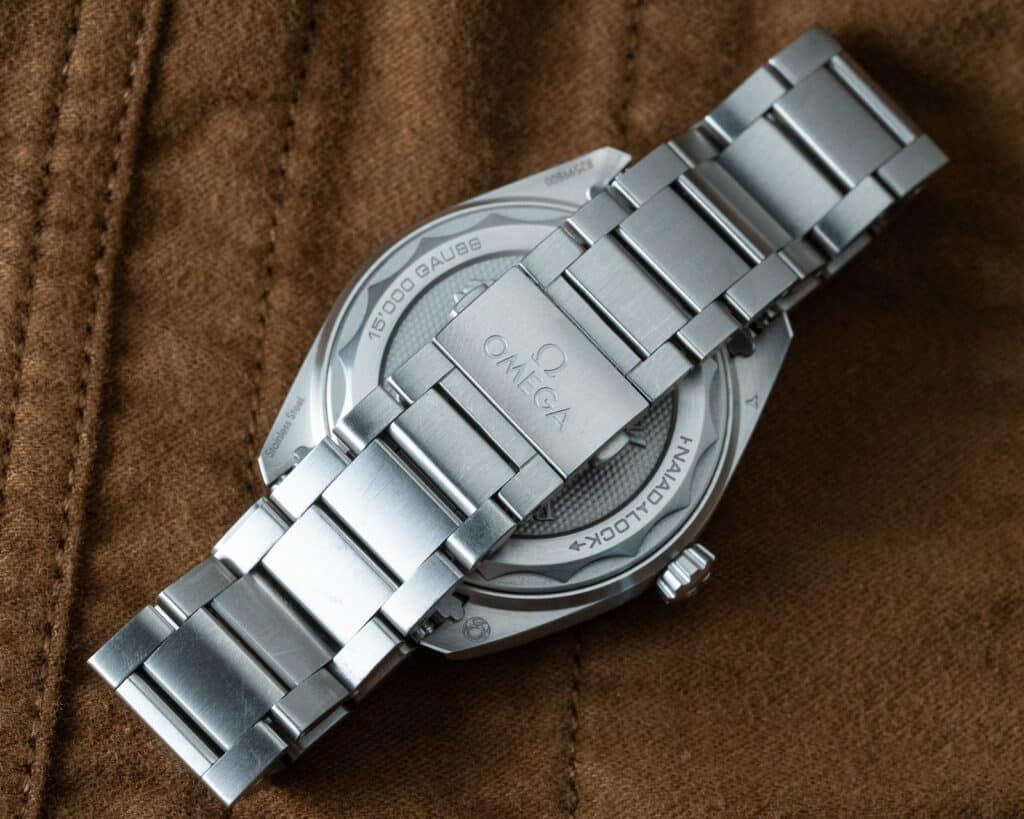
The steel bracelet continues that restrained approach. Its three-link construction and fully brushed finish look suitably understated, while the slightly matte surface helps disguise everyday wear. The butterfly clasp closes with a reassuring click and opens easily, but there’s no micro-adjustment. Getting the fit right means experimenting with the full and half links, and the small rods and cap screws used to secure the links aren’t as convenient as a simpler screw arrangement. Once sized correctly, though, the bracelet can be comfortable enough for all-day wear. We’d still rather see easier sizing on a watch in this category, because a good bracelet shouldn’t require a minor engineering project to fit properly. Omega also offers fabric and NATO options, and the standard 20mm lugs leave plenty of room for aftermarket straps. Leather, nylon, or steel can each change the Railmaster’s character without fighting its design. In other words, the bracelet is a strong starting point, not a life sentence.
Build Quality & Technical Approach
Good dials get us through the door, but the real test starts when we look beyond the face and see where the engineering earns its keep. Case construction, movement performance, finishing, and the small details easy to miss in product photos all shape the ownership experience. Specs can make any watch look impressive on paper; the more interesting question is what we’ll notice after months on the wrist (because nobody needs another expensive set of numbers to memorize).
Movements:
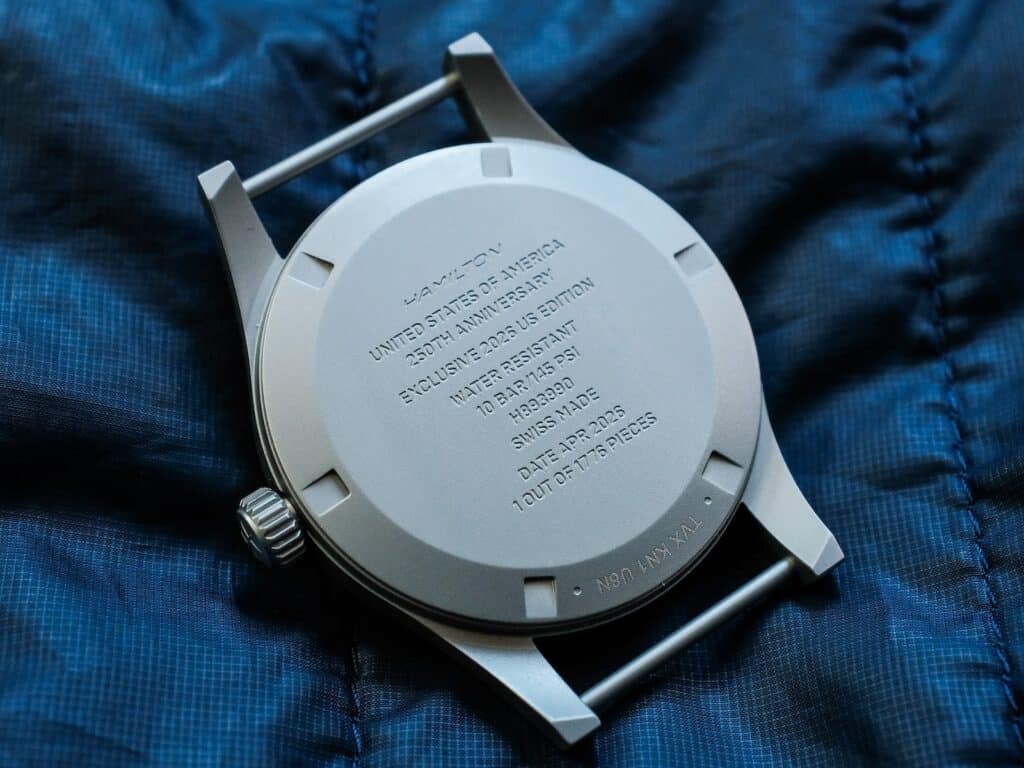
The Hamilton Khaki Field Mechanical 250 runs on Hamilton’s H-50 hand-wound movement, with an 80-hour power reserve that lets us go a couple of days without winding before we need to reset it. But the more enjoyable part is the winding itself. The crown action feels smooth and consistent, turning a daily ritual into something we look forward to rather than another mechanical chore. Underneath the military-inspired exterior, the H-50 brings modern touches, including a Nivachron balance spring and hacking seconds for precise time-setting. Hamilton even includes a movement dust cover as a nod to the military watch that inspired this model. That’s the kind of detail we appreciate: someone cared about more than getting the vintage look right. In use, the H-50 has kept good time and stayed out of the way, which is what we want from a field-watch movement. It doesn’t need a gold rotor or a complicated party trick to keep us interested. Give us a satisfying wind, dependable performance, and enough power reserve to survive a lazy weekend, and we’re happy.
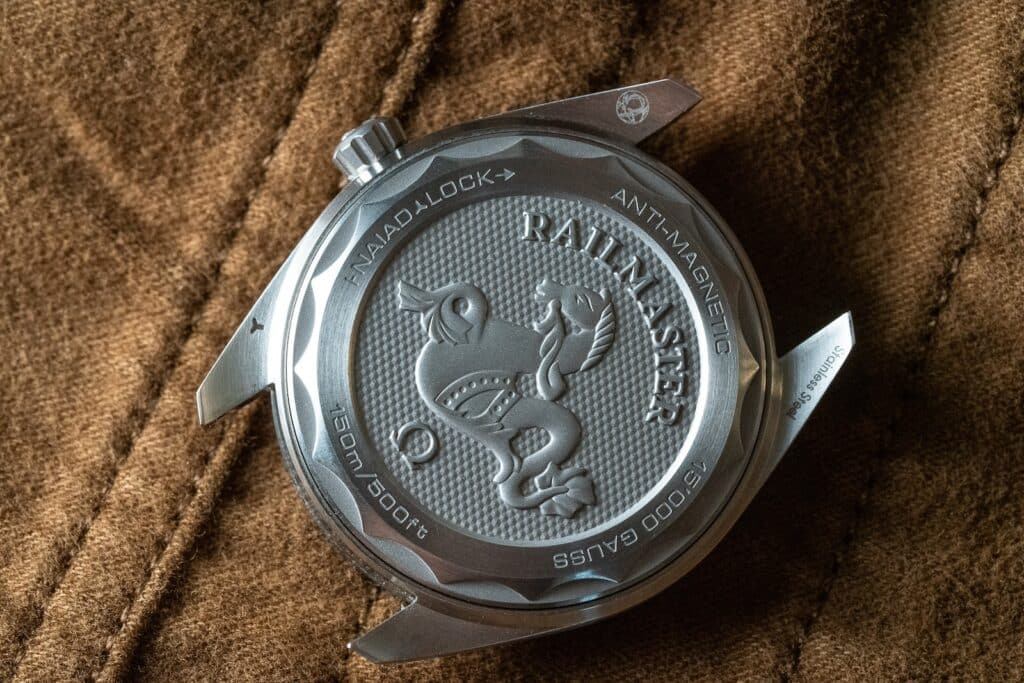
The Omega Railmaster steps things up with its caliber 8806 Co-Axial Master Chronometer movement, a 35-jewel caliber beating at 25,200 vibrations per hour and certified through METAS. The certification sounds impressive on paper, but we appreciate it more when the timekeeping backs up the reputation. In our overnight storage position, with the crown facing up, we’ve observed roughly one second of gain per day. That’s an encouraging real-world result, though your mileage may vary depending on your wearing habits and storage position. The 8806 also keeps the Railmaster strictly time-only. No date window, no extra complication squeezed in to make the dial look busy—just hours, minutes, and seconds, backed by sophisticated movement engineering.
Case Construction, Finishing & Wearability:

The Hamilton Khaki Field Mechanical 250 makes a solid case for not treating wrist size like a competitive sport. At 36mm across and just over 10mm thick, it’s compact by modern standards, but the 46mm lug-to-lug measurement gives it enough presence without feeling undersized. On a 6.75-inch wrist, the proportions came together particularly well. We’d previously struggled to connect with the 38mm Khaki Field Mechanical, but this version finally got the balance right. It sits comfortably for long stretches without demanding attention, which is precisely what we want from an everyday field watch. Hamilton didn’t need to supersize the case to make it work, and our wrists can stop complaining that every watch is bigger than the last.
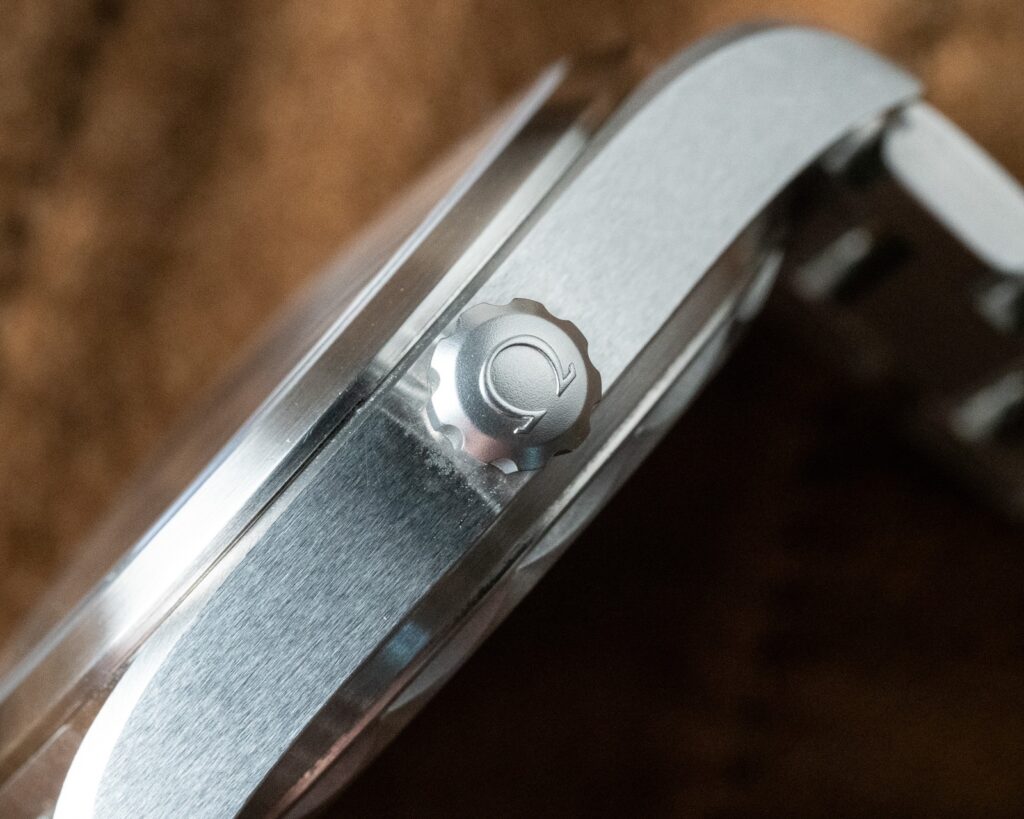
The Omega Railmaster takes up a little more room, measuring 40mm across, 46.5mm lug-to-lug, and 12.5mm thick. On a 7-inch wrist, those dimensions hit the Goldilocks zone: substantial without feeling bulky, and slim enough to avoid turning a shirt cuff into an obstacle course. The all-over brushed finish suits the utilitarian brief, but Omega’s twisted lugs keep the case from looking like a generic block of steel. Their different surfaces catch the light as the wrist moves, adding some visual interest without resorting to polished accents that announce themselves from across the room. Flip the watch over, and you’ll find Omega’s NIAD Lock caseback system, which works more like a camera-lens bayonet mount than a conventional screw-down caseback. It also lets Omega align the Hippocampus engraving and surrounding text upright relative to the case. Does that make the watch keep better time? No. Is it the kind of fussy construction detail watch nerds enjoy noticing? Absolutely. The Railmaster’s refinement isn’t loud, but it’s there if you pay attention.
Crystals and Bezels:

The Hamilton Khaki Field Mechanical 250 uses an acrylic crystal, and we’re glad Hamilton didn’t automatically reach for sapphire just because it’s the modern default. The boxed profile becomes particularly noticeable from the side, giving the watch warmth and a touch of distortion that suits its vintage-inspired design. Acrylic scratches more easily than sapphire, but Polywatch can polish out light marks. That’s a small maintenance tax we’re willing to accept for the character it brings (provided you don’t expect your watch crystal to live a completely sheltered life). Hamilton also appears to have addressed some of the glare issues associated with earlier Khaki Field models. The raised bezel frames the dial, giving this America 250 edition a more distinctive profile than the flatter-cased versions.
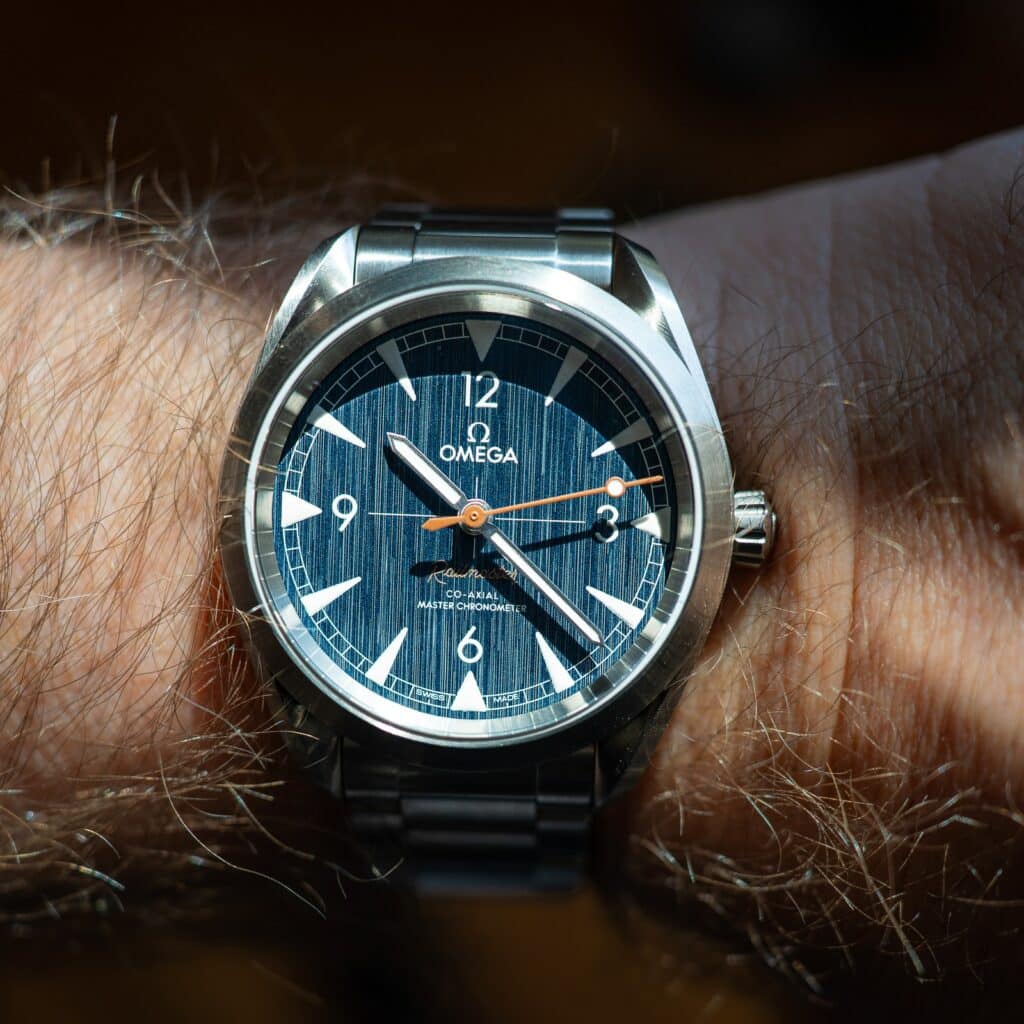
The Omega Railmaster takes the more modern route with a domed, scratch-resistant sapphire crystal and anti-reflective treatment on both sides. It’s a practical combination: the dome adds shape to the otherwise understated watch, while the coatings help keep reflections from getting between us and the dial. The fixed stainless steel bezel keeps things simple. There’s no rotating timing scale or dive-watch cosplay here; the Railmaster sticks to its utilitarian, anti-magnetic roots rather than borrowing features it doesn’t need.
Water Resistance & Lume:
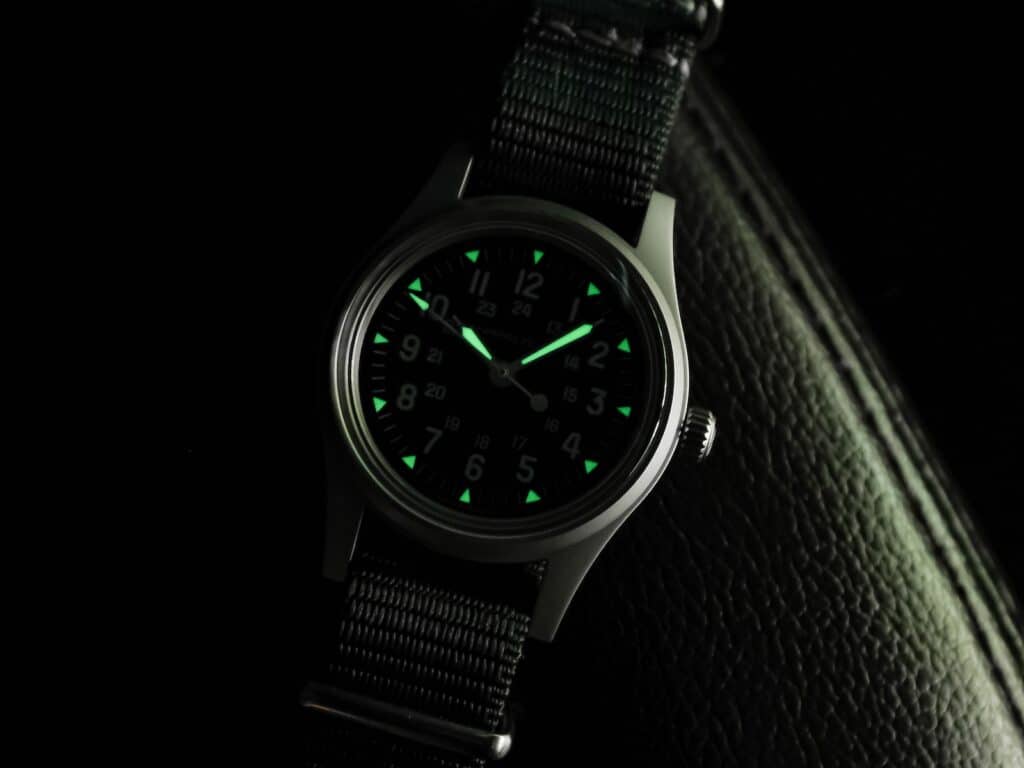
The Khaki has 100 meters of water resistance, enough to keep everyday wear uncomplicated. Plenty of watches offer the same rating, but the point is that we don’t have to treat this one like a delicate museum exhibit whenever water enters the picture. That confidence suits a field watch far better than another paragraph of ruggedness claims. The lume follows the same no-nonsense approach. Warm-toned Super-LumiNova complements the vintage-inspired design, while the aged treatment on the triangular markers and second hand softens the stark black-and-white dial without making it look like Hamilton dragged it through a prop department. More importantly, legibility remains excellent, even during those awkward driving glances when turning your wrist into a sundial isn’t an option.
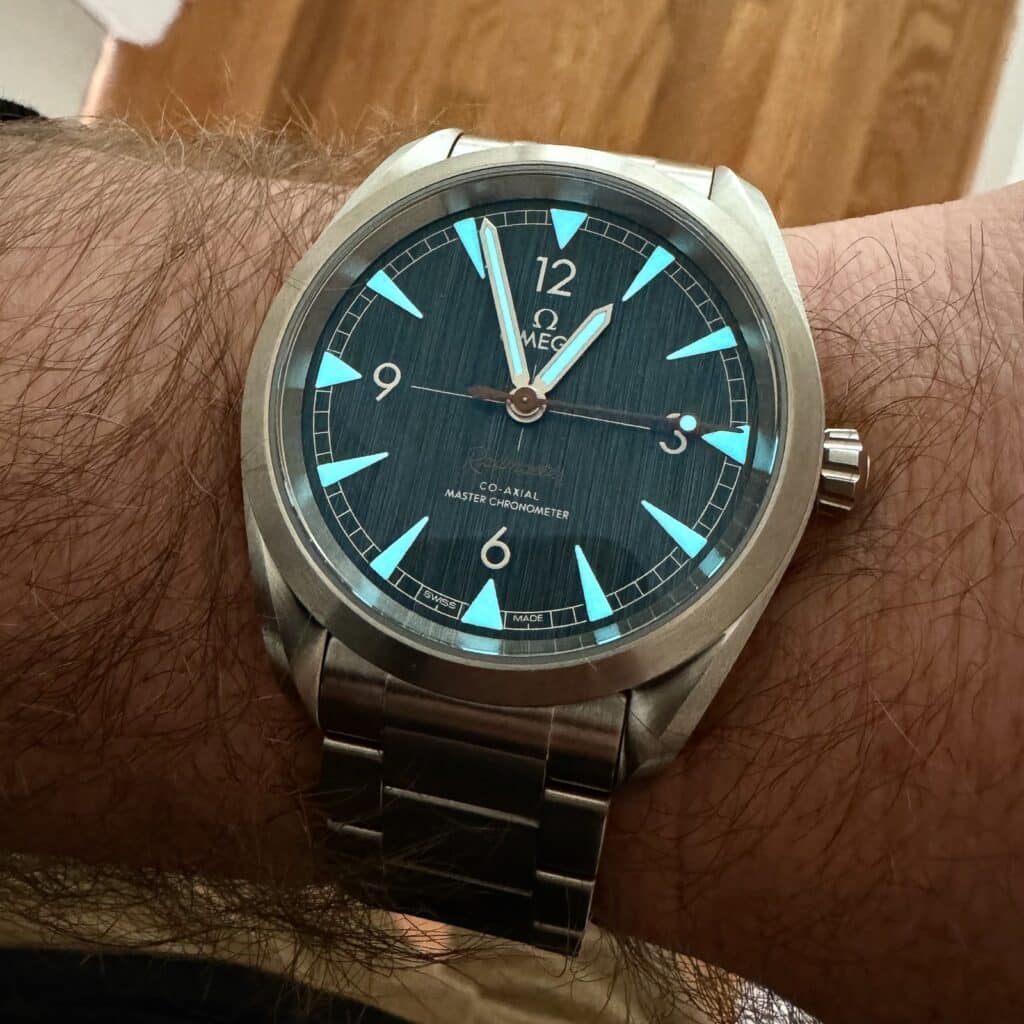
The Omega Railmaster bumps water resistance up to 150 meters and uses a screw-down crown measuring approximately 5.7mm across. Its tapered shape narrows toward the case, giving it a distinctive profile while making it easy to grip when setting the time. So far, so practical. The lume is less interested in winning any after-dark competitions. White Super-LumiNova fills recessed areas in the indices rather than being painted onto the dial, keeping the layout clean and consistent with the Railmaster’s utilitarian design. It glows blue at night and remains perfectly usable, but it isn’t very powerful. If your ideal watch turns the bedroom into a glow-in-the-dark aquarium, this isn’t your contestant. The Railmaster puts visual restraint ahead of lume theatrics, and we can respect that, even if we’d happily accept a little extra glow. Its higher water-resistance rating adds reassurance, but neither watch needs to pretend it’s a professional diving instrument.
Cost Considerations
The Hamilton Khaki Field Mechanical 250 comes in at $725, which makes it a relatively accessible way to get a thoughtfully executed mechanical field watch. That price means more when we consider how quickly it earned regular wrist time. We also stopped wondering whether another field watch might do the job better. That’s meaningful value: not just spending less, but finding something that scratches the itch without sending us back to the shopping tabs. At this price, the acrylic crystal and fixed strap bars are compromises worth understanding, but neither undermines what makes the watch appealing. Our wallet gets a break, and our watch box doesn’t need another candidate for a job that’s already covered.
The Omega Railmaster is a different financial conversation. Our denim-dial reference originally retailed for roughly $5,700–$6,400, but it’s now discontinued and can be found on the secondary market for considerably less, with examples around $3,300 depending on condition. That’s a substantial spread, and it changes the value argument considerably. At its original retail price, buyers paid a serious premium for Omega’s Master Chronometer movement, refined casework, and the satisfaction of owning a modern Omega that still behaves like a tool watch. On the used market, the Railmaster becomes a more compelling proposition, especially for buyers who want that combination of technical capability and everyday versatility without swallowing the full new-watch bill. We wouldn’t pretend it suddenly becomes cheap, but the right pre-owned example makes the leap less painful.
Final Thoughts: Is the Omega Railmaster Worth the Premium Over the Hamilton Khaki Field?
For us, the Hamilton Khaki Field Mechanical 250 is the better everyday tool watch. The Railmaster has the more technically sophisticated movement, but impressive specifications don’t automatically make it the better everyday watch. We’re interested in what those differences mean when the watch leaves the display case and becomes part of our daily routine.

Moreover, this Hamilton stands out for a personal reason. Our review traces a years-long search for the right Khaki Field, with the America 250 finally bringing the design and proportions together. Finding that fit made it feel like a complete choice in its own right, not a placeholder for something more expensive. We appreciate watches that give us a reason to keep wearing them, not another reason to keep shopping.
The Railmaster makes a compelling case for enthusiasts drawn to its Master Chronometer movement, refined casework, and understated Omega identity. We’d seriously consider a well-priced pre-owned example, especially if those qualities are what attracted us to the watch in the first place. At full retail, though, we’d only leap if Omega’s engineering and ownership appeal were priorities in their own right.

Our verdict: choose the Hamilton Khaki Field Mechanical 250 for everyday wear. Its compact proportions, clear dial, and satisfying hand-winding make it the more compelling daily companion.

Co-Founder and Senior Editor
Kaz has been collecting watches since 2015, but he’s been fascinated by product design, the Collector’s psychology, and brand marketing his whole life. While sharing the same strong fondness for all things horologically-affordable as Mike (his TBWS partner in crime), Kaz’s collection niche is also focused on vintage Soviet watches as well as watches that feature a unique, but well-designed quirk or visual hook.