Titanium dive watches have a way of messing with our expectations. We tend to think of divers as sturdy little wrist bricks, the kind of watches that feel reassuring because they have some heft. Then titanium shows up, drops the weight, changes the wrist feel, and makes us wonder why more everyday divers aren’t built this way. We’ve reviewed enough of them now to see the trade-offs clearly: titanium can make a watch more comfortable, more practical, and easier to wear for long stretches, but it can also bring quirks around scratching, finishing, bracelet feel, and price. So the goal here is simple: out of the titanium dive watches we’ve reviewed, which ones make the most sense from affordable watches territory into the more luxury-tool-watch end of the pool?
That said, we’re not building this from product pages or pretending that every lightweight titanium diver is automatically one of the best-value watches out there. These are based on our own reviews, where the watches were worn, adjusted, compared, praised, complained about, and occasionally side-eyed for the little things that only show up after the new-watch buzz wears off. None of them is 100% perfect. That’s what makes the list useful.
Halios Seaforth IV Titanium
| Price: | $965 |
| Water Resistance: | 200m |
| Case Dimensions: | 41mm (diameter) x 46.5mm (lug-to-lug) x 12.4mm (thickness) |
| Lug Width: | 20mm |
| Movement: | Sellita SW200-1 |
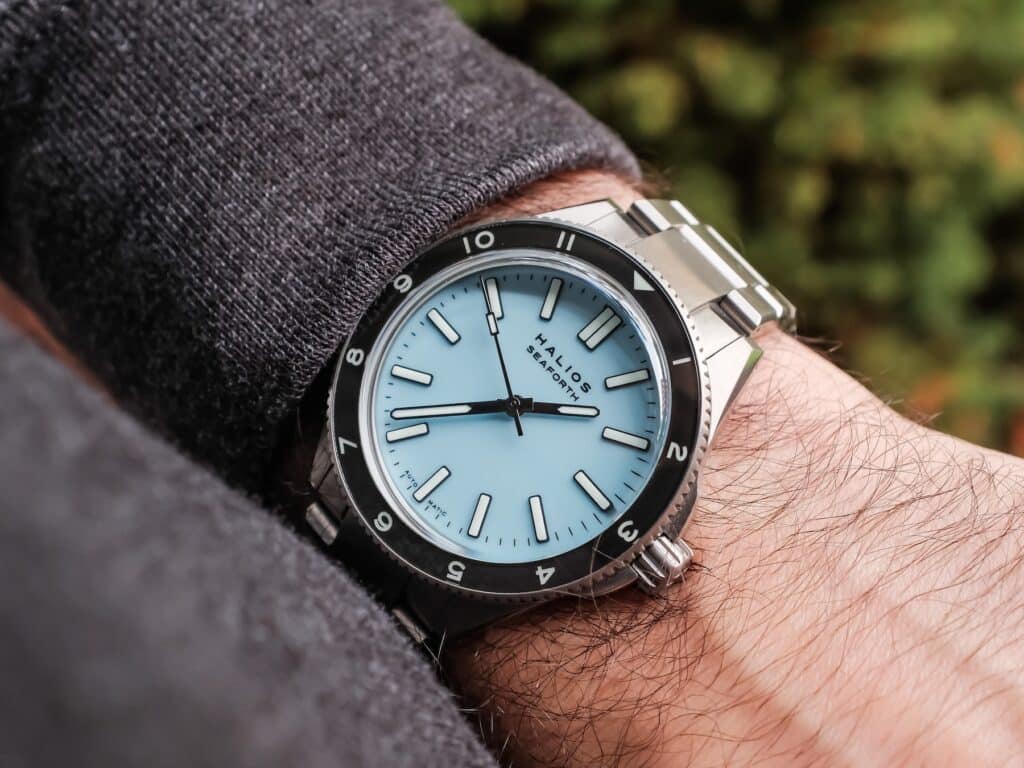
The Halios Seaforth IV Titanium sits in the enthusiast sweet spot of this list. It is not trying to out-muscle the bigger luxury tool divers, and it is not leaning on novelty either. The appeal comes from how the familiar Seaforth platform changes once titanium is introduced. We put it into rotation, expecting it to share wrist time, and it slowly became the watch that stayed on longer than planned. Pick it up, and it feels almost weightless. Wear it for a full day, and the case taper makes it feel slimmer than the dimensions suggest, while the double-domed sapphire gives the watch some visual lift without making it feel tall or clumsy.
The case finishing also helps it avoid that flat, overly plain titanium look. The brushing is clean and consistent, while the polished chamfers on the lugs give the case enough shape and definition without making it feel dressed up. It still works as a practical sports diver, too, with a screw-down crown, screw-down caseback, and 20 ATM water resistance. The titanium bracelet completes the whole thing better than expected. It flows naturally from the case, wraps comfortably around the wrist, and uses screw links, which makes sizing less annoying than it could have been. The stainless steel clasp added a little grounding weight, and the tool-free micro-adjustment became one of those features we used more than we expected during long days when wrist size changed.
The dial has more personality in real life than its soft blue tone suggests. It shifts subtly as the light changes, avoiding looking washed out or flat. The raised ceramic hour markers add crispness, and the Super-LumiNova C3 X1 across the hands, markers, and bezel fades evenly in low light. That matters because uneven lume can make a watch feel cheaper than it is once the lights go down. The no-date layout also proved part of the charm. There was less to set, less to think about, and less clutter on the dial. The 120-click unidirectional bezel had a smooth, confident action with enough grip to be useful without feeling sharp. We used the 12-hour bezel, which became an easy way to track another time zone for work or family without the extra visual baggage of a dedicated GMT layout.
Inside, the Sellita SW200-1 did what we wanted it to: it set easily, behaved predictably, and maintained steady accuracy with a practical 40-hour power reserve. The trade-off, unsurprisingly, is that titanium shows wear. The case and bracelet picked up scratches through regular use, though they felt more like honest marks from wrist time than some catastrophic flaw. The bigger frustration is availability. Halios watches are often harder to buy than to recommend, which can make the Seaforth IV Titanium annoying for anyone who just wants to pick one up and move on with life. Still, as the microbrand enthusiast pick in this titanium dive watch lineup, it earns its place by making lightness feel useful rather than gimmicky.
Pros
- Case taper helps it wear slimmer than the measurements suggest.
- Clean brushing and polished lug chamfers define the case.
- Integrated titanium bracelet, screw links, and tool-free micro-adjustment make daily wear easy.
- 120-click bezel action feels smooth, confident, and easy to grip.
- Raised ceramic markers and even Super-LumiNova C3 X1 fade help low-light legibility.
Cons
- The titanium case and bracelet pick up scratches with regular wear.
- Limited availability can make buying one frustrating.
Mido Ocean Star Titanium
| Price: | $1040 |
| Water Resistance: | 200m |
| Case Dimensions: | 42.5mm (diameter) x 42.5mm (lug-to-lug) x 11.75mm (thickness) |
| Lug Width: | 22mm |
| Movement: | Caliber 80 |
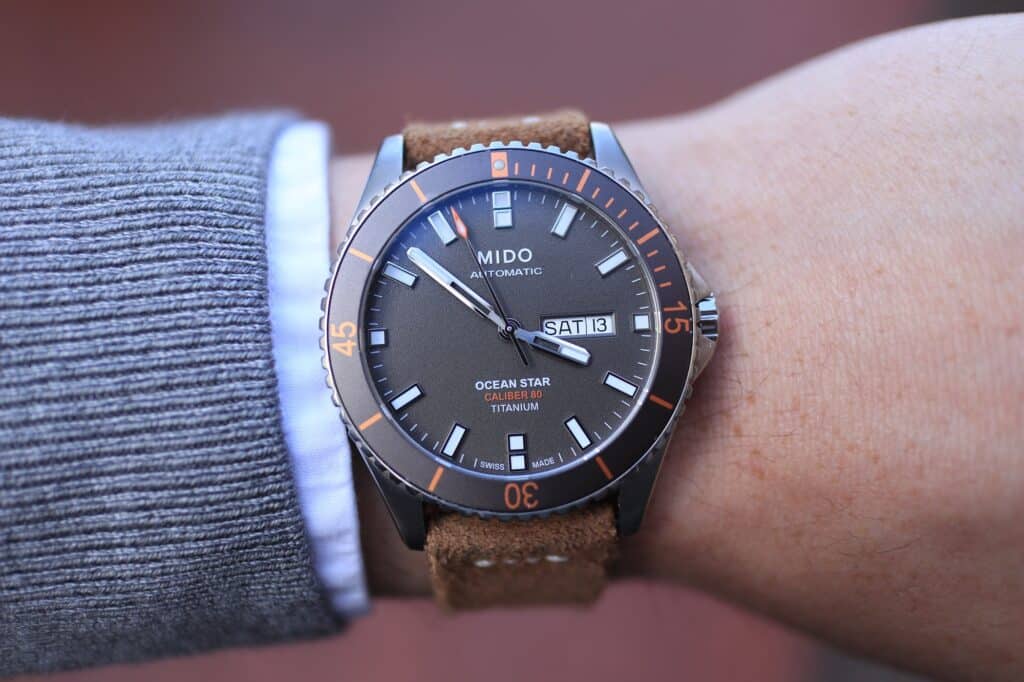
The Mido Ocean Star Titanium fills the clean and affordable Swiss-diver slot in this lineup because it feels like the least fussy way into a proper titanium dive watch from an established brand. It does not try to win you over with loud colors or oversized case drama. The watch measures 42.5mm across and comes in around 11.75mm thick, which is slim for a modern diver, and the fully brushed titanium case makes that size much easier to live with. During hands-on testing, we wore it through ordinary routines like commuting, desk work, and errands, and it never had that top-heavy feeling some steel divers can develop by mid-afternoon. The case is subtly contoured, and the sloped bezel follows that shape instead of sitting on top like an afterthought. A polished chamfer along the case edge adds some contrast, but it stays well within Mido’s quiet, practical lane.
The dial is where the Ocean Star starts to feel more thoughtful than it first appears. The anthracite texture shifts depending on the light, sometimes catching reflections and sometimes absorbing them, while the double AR-coated sapphire crystal keeps glare under control. That makes the watch easy to read outdoors and under office lighting, which is the kind of boring-sounding detail that matters once you are wearing it all day. The layout also avoids feeling uneven. The shortened nine o’clock marker mirrors the shortened three o’clock marker around the day-date window, so the dial still feels balanced. The pencil hands are filled with BGW9 Super-LumiNova, which charges quickly and gives off a cool blue-green glow at night. The orange accent on the second hand, along with its luminous tip reaching toward the dial edge, also makes it easy to track at a glance.
Mido’s Caliber 80 gives the Ocean Star one of its most practical advantages. It is based on the ETA 2824 architecture but has been adjusted to deliver an 80-hour power reserve, which makes a real difference if this is not the only watch in your rotation. You can take it off for a couple of days and not immediately return to a stopped watch. The titanium bracelet also fits the overall brief well. It stays light, uses curved links, and has shaping on the underside that helps it wrap around the wrist rather than fight it. The taper from 22mm down to 19mm keeps it from feeling slabby, and the ratcheting clasp makes quick wrist-size adjustments easy during the day.
The quirks are not dealbreakers, but they are worth knowing. The screw-down crown can be stubborn to loosen and sometimes needs a fingernail to get it started, which is not ideal on a watch you may be setting or adjusting regularly. The lugs could also curve down more aggressively, especially for smaller wrists, where a slightly more pronounced downward slope would help the case hug the wrist better. Strap pairing is another limitation, since the specific dial and case color combination does not play nicely with everything. Even so, the Ocean Star Titanium earns its spot here because it delivers the core titanium diver experience with real Swiss credibility, strong daily comfort, and enough refinement. It makes sense for someone who wants a lightweight dive watch without chasing boutique microbrand hype or Sinn-level tool-watch intensity.
Pros
- Lightweight brushed titanium case stays comfortable through long wear.
- Anthracite textured dial and double AR coating keep legibility strong in changing light.
- Curved titanium bracelet, 22mm-to-19mm taper, and ratcheting clasp make daily wear easy.
- BGW9 Super-LumiNova charges quickly and glows with a cool blue-green tone.
- Caliber 80 movement offers an excellent 80-hour power reserve.
Cons
- Lugs could be angled more to improve fit on smaller wrists.
- Strap options feel limited because of the specific dial and case color combination.
- The screw-down crown can be stubborn to unscrew at first.
Jack Mason Strat-o-Timer GMT Titanium Diver
| Price: | $1,399 |
| Water Resistance: | 200m |
| Case Dimensions: | 40mm (diameter) x 47mm (lug-to-lug) x 13mm (thickness) |
| Lug Width: | 20mm |
| Movement: | Miyota 9075 |
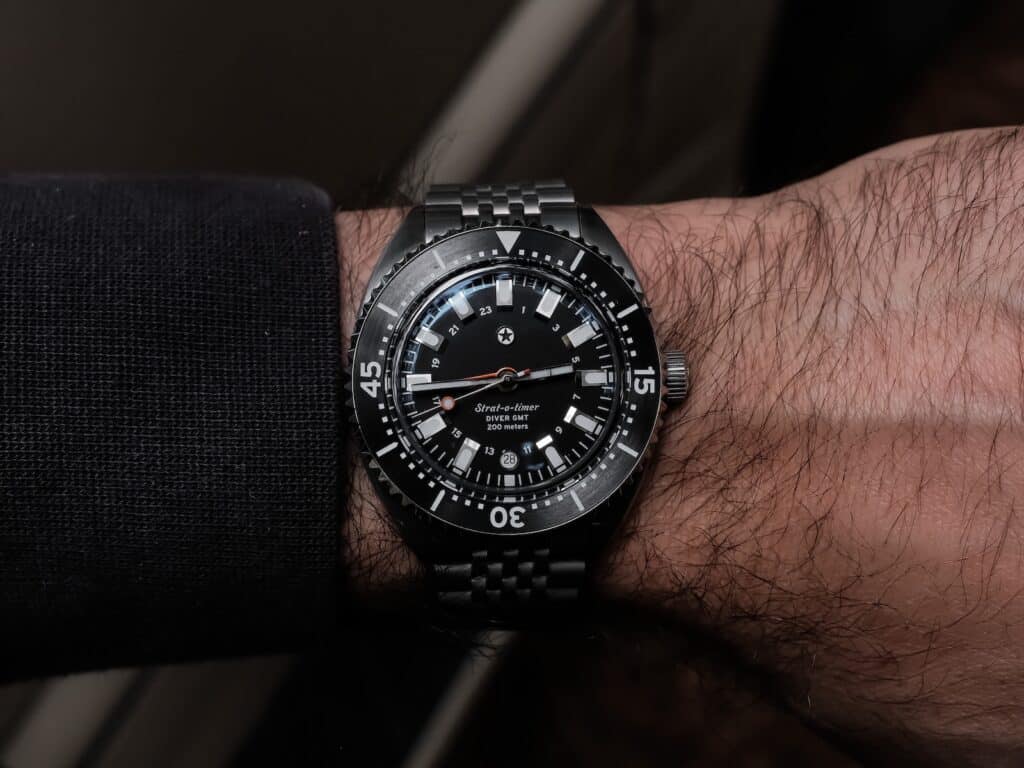
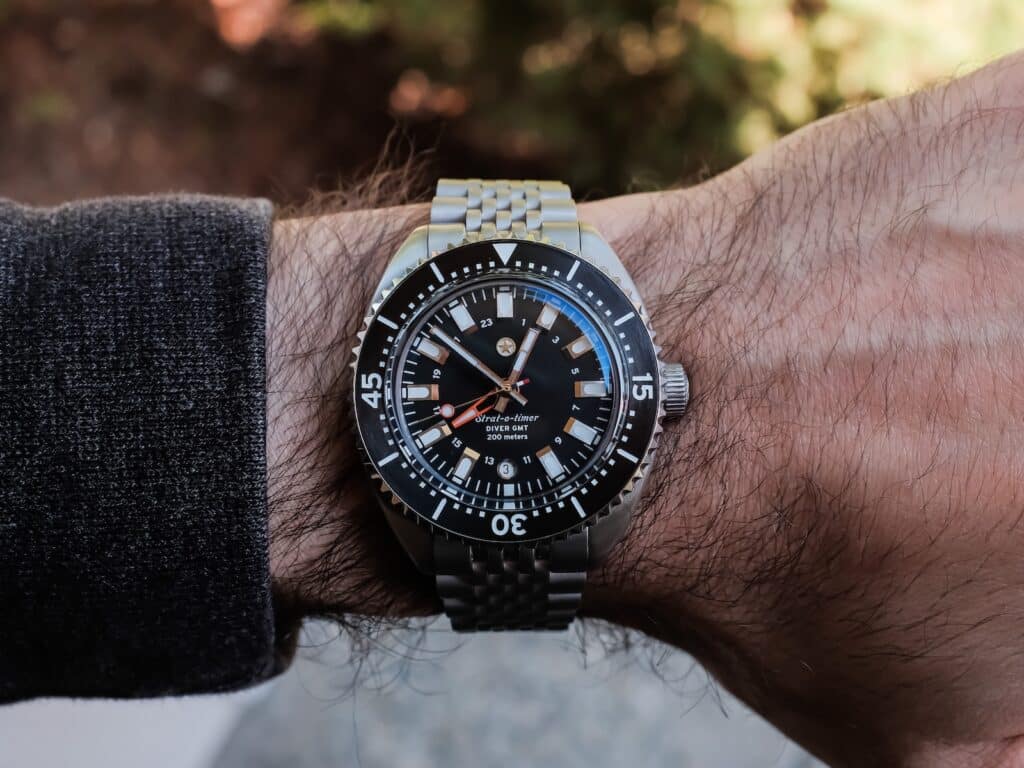
The Jack Mason Strat-o-Timer GMT Titanium Diver earns its spot near the affordable-to-mid-tier end of this titanium dive watch lineup because it brings together a few things that usually do not sit this comfortably in one package: titanium construction, a proper dive bezel, GMT functionality, and a modern American microbrand point of view. What stood out most during our hands-on review was not the spec stack, even though plenty is going on here. It was the weight. Dropping roughly 40 grams changes the way the watch settles on the wrist. It lands in familiar sports-watch territory, but the Grade 2 titanium keeps it from feeling dense or top-heavy. The curved mid-case and downward-arching lugs help the watch sit close, rather than hover.
The case and bezel feel visually consistent. The fully brushed titanium case has no polished surfaces to break things up, so the whole thing leans toward muted, practical, and tool-forward. It does not chase shine, which fits the watch better. The 200 meters of water resistance, screw-down feel, ceramic bezel insert, and lumed dive markings all support the idea that this is still a diver first, even with the GMT complication layered in. The bezel uses a 120-click action that felt even and deliberate, with enough resistance to keep adjustments from feeling loose. We did notice that the bezel markings were not perfectly aligned on the sample, though that may have been due to it being an earlier press piece that had already seen some handling. It is not something that ruined the experience, but it is still worth mentioning.
The dial is where Jack Mason made the decision that keeps the watch usable. Instead of turning the bezel into a 24-hour scale, the GMT track sits on the dial, leaving the bezel free for timing. You can time something with the bezel and still read a second time zone without making the layout feel like homework. Yes, there is a lot of information in a compact space, and we understand why some people may call the dial busy. But the restrained black dial and bezel keep the visual noise down, and the applied markers do enough heavy lifting that the layout becomes intuitive after some wrist time. The BGW9 lume was stronger than expected, especially when moving between indoor and outdoor lights. The stick hands stay simple, the lollipop second hand adds a small design lift, and the orange skeletonized GMT hand is easy to find when needed. Having lume on the hands, markers, GMT hand, and bezel markings also makes the watch more useful in low light, not just prettier in a lume shot.
The bracelet reinforces the same lightweight, practical personality. It is a fully brushed seven-link titanium bracelet in 20mm, and the smaller links help it drape naturally rather than feel stiff. Sizing was simple thanks to screws, and once fitted, it worked well with the reduced case weight. The clasp adds a toolless micro-adjustment system, which we appreciated, though it took a few tries to lock it in properly. Inside, the Miyota 9075 gives the watch its flyback GMT behavior, allowing the local hour to jump independently in one-hour increments. Even when we were not using it as a true travel watch, that direct adjustment felt satisfying and easy to live with. With a 28,800 bph beat rate, around 42 hours of power reserve, and in-house regulation, it stayed accurate enough during our time with it that we stopped thinking about it.
For this list, the Strat-o-Timer GMT Titanium Diver matters because it shows how much value microbrands can pack into a titanium diver without making the watch feel like a spec-sheet dare. It is busier than the standard GMT version because it combines dive timing with a full GMT display, and there is a small amount of bezel play if you look closely. But the crown is easy to grip, the operation feels predictable, and the lighter titanium build makes the watch easier to wear than the feature list suggests.
Pros
- Grade 2 titanium case and bracelet cut roughly 40 grams, making the watch feel much lighter in daily wear.
- Curved mid-case and downward lugs help the watch avoid feeling blocky or top-heavy.
- 200 meters of water resistance and a ceramic lumed dive bezel keep the dive-watch side credible.
- BGW9 lume on the markers, hands, GMT hand, and bezel markings improves low-light usability.
- Seven-link titanium bracelet drapes well and uses screws for easier sizing.
Cons
- Dial can feel busy because it combines dive timing and GMT information in a compact layout.
- Bezel markings on the review sample did not align perfectly.
- Toolless micro-adjust clasp takes some getting used to and needs to be clicked in precisely.
- 42-hour power reserve is fine, but not generous if you rotate through several watches.
Sinn T50
| Price: | $4,400 |
| Water Resistance: | 500m |
| Case Dimensions: | 41mm (diameter) x 47mm (lug-to-lug) x 12mm (thickness) |
| Lug Width: | 20mm |
| Movement: | Sellita SW 300-1 |
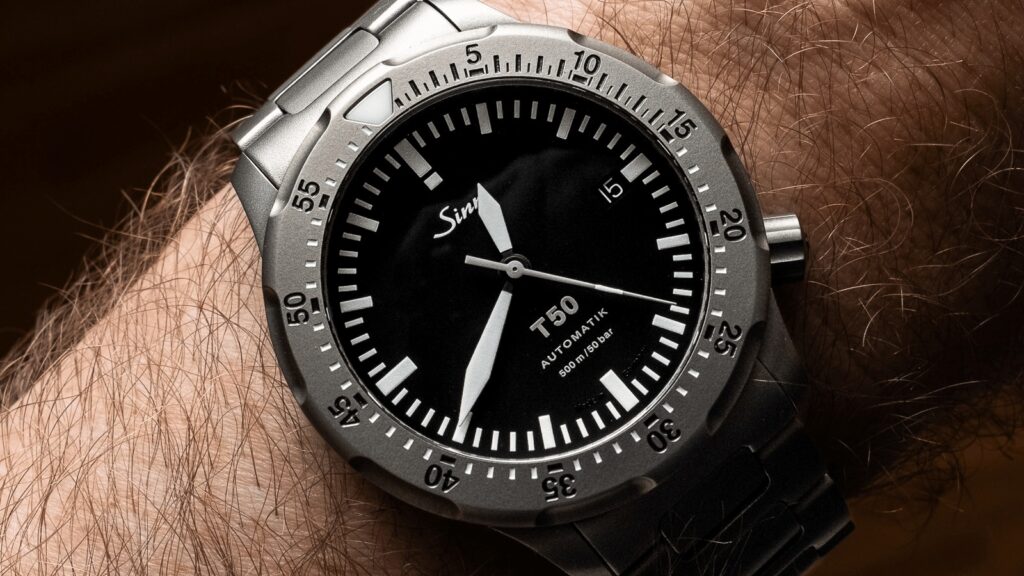
The Sinn T50 sits at the top end of this list because it treats titanium like a practical tool-watch material, not a luxury flex. On the wrist, the first surprise is how little effort it takes to wear. At roughly 95 grams and sized well for a 7-inch wrist, it feels almost quite light at first, especially if your brain still associates serious dive watches with steel-case heft. That lightness settles into one of the T50’s biggest strengths. It stays planted, sits low, and does not need constant mid-day fiddling, whether you are typing at a desk, riding a bike, or running errands in the least glamorous possible way.
The case does a lot of the quiet work here. Sinn’s matte titanium keeps reflections down and gives the watch the kind of utilitarian presence that fits the brand better than polished surfaces ever would. The 4 o’clock crown is also worth calling out because it is easy to operate without becoming a pressure point when your wrist bends. Then there is the captive bezel system, which requires a press before turning. On paper, that can sound like Sinn being Sinn for the sake of it, but in use, it makes sense. Knock the watch into something, and the bezel stays where you left it, which is the kind of overengineering that earns its place on a proper tool diver.
The dial keeps the same restraint. The black-and-white layout, sword hands, clean markers, and low-key date window all make the T50 quick to read without turning the dial into a dashboard. The lume on the second hand is useful because it confirms the watch is running in the dark, though the patch is small enough that it takes an extra beat to spot compared with larger lume plots. Durability is also handled with some thought. During our in-depth testing, the tegimented bezel held up better against scratches than untreated titanium would, which matters because titanium comfort often comes with the worry that every scrape will show up before lunch.
Inside, the SW300 performed very well during our testing, running up to +2 to -3 seconds per day, which is stronger than plenty of watches in this space. The trade-off is the 42-hour power reserve. If you rotate through a few watches, leave it off for a day or so, and come back to it, there is a decent chance it has stopped. The H-link bracelet wears comfortably and matches the case visually, but the diver extension did not inspire the same confidence as the rest of the watch since it could release with a light pull. We ended up removing it and switching to a standard spring bar setup, which was made easier by the drilled lugs. Those lugs also make it easy to move the T50 onto rubber or NATO, where it still feels completely at home.
Servicing is less casual, since it means going through Sinn directly. Still, as the German luxury/tool-watch anchor in this titanium dive-watch lineup, the T50 earns its place by feeling engineered with restraint rather than bulk.
Pros
- The titanium case keeps the watch very light and comfortable for all-day wear.
- The tegimented bezel improves scratch resistance over standard titanium.
- The captive bezel system prevents accidental movement and works well in practice.
- Drilled lugs make strap changes simple; the watch wears well on rubber or NATO straps.
- Matte titanium finish reduces reflections and gives a utilitarian, purposeful feel.
- The 4 o’clock crown stays easy to operate without digging into the wrist.
Cons
- Servicing is less straightforward since it must go through Sinn directly.
- The 42-hour power reserve can be limiting if you rotate watches frequently.
- The lume patch on the second hand is small and takes a moment to notice in the dark.
- The diver extension on the bracelet can release too easily, reducing confidence.
Tudor Pelagos FXD
| Price: | $5,025 |
| Water Resistance: | 200m |
| Case Dimensions: | 42mm (diameter) x 52mm (lug-to-lug) x 12.75mm (thickness) |
| Lug Width: | 22mm |
| Movement: | Tudor MT5602 |
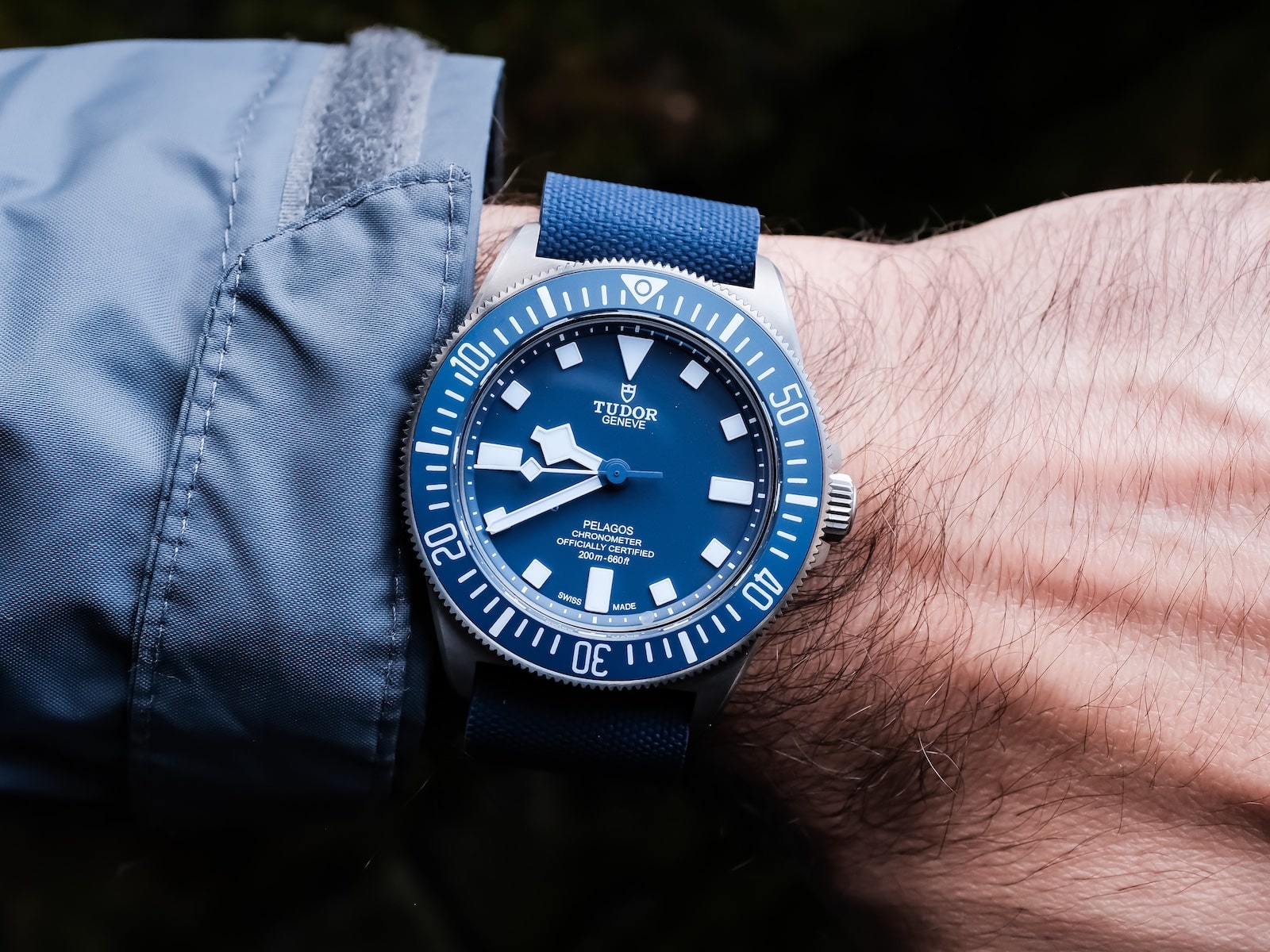
The Tudor Pelagos FXD sits in the modern military-tool-watch slot of this titanium dive watch lineup because it takes the Pelagos formula and strips it down in a way that actually makes the watch easier to understand. On paper, the 42mm case, 52mm lug-to-lug, fixed strap bars, countdown bezel, Marine Nationale ties, and matte titanium case all sound like they should add up to something large and overly specialized. After a week hands-on reviewing the original blue Marine Nationale version, though, the FXD felt much easier to wear than the internet discourse suggests. The 12.75mm thickness helps it avoid the slab-sided feel of the standard Pelagos, while the lightweight titanium case keeps the watch from feeling top-heavy or overbuilt.
The case finishing is exactly where the FXD earns a lot of its appeal. The brushing is crisp, the fully matte surfaces keep reflections down, and the whole watch has a utilitarian look without feeling unfinished. Tudor also made the FXD feel more honest by removing the helium escape valve and dropping water resistance from 500 meters to 200 meters. That may sound like a downgrade on paper, but in practice, it keeps the watch from feeling like it was designed around spec-sheet competition. The larger bezel knurling is also genuinely useful, and the crisp 120-click action makes the countdown bezel feel deliberate and easy to operate.
The fixed bars are the defining feature, and they are probably the clearest reason someone will either love or avoid the FXD. Tudor machined them directly into the case rather than using spring bars or removable tubes, and there is even a slight chamfer along the edges to reduce wear on fabric straps. The included rubber strap feels solid, but the watch really comes alive on fabric and elastic straps. A Prometheus Design Werx Ti-Ring strap worked especially well, as did a Watches of Espionage Glomar Explorer strap, and even inexpensive elastic Garmin-style straps made the FXD feel casual and easy to wear. The trade-off is obvious: no bracelet, less traditional versatility, and a much more specific personality than a standard Pelagos or Black Bay.
The dial and bezel are where the FXD feels more refined than the standard Pelagos. The darker navy tone is more restrained than the brighter blue Pelagos, the no-date layout keeps everything balanced, and Tudor cleaned up the dial text enough that the whole watch feels built around legibility first. Between the snowflake handset, matte dial texture, strong contrast, and excellent lume, the FXD is extremely easy to read in almost every lighting condition. Inside, the MT5602 adds a practical 70-hour power reserve, and during our time with the watch, accuracy was solid enough that the movement mostly stayed out of the way.
For this list, it earns its place because it makes titanium feel connected to the entire design rather than just the case material. The lightness, fixed bars, matte finishing, clean dial, and simplified case all point in the same direction. It is not the most versatile titanium diver here, and the countdown bezel plus fixed bars make it more niche than many buyers will want. But after real wrist time, the FXD feels less like a hyped collector object and more like a modern Tudor tool watch that actually knows what it is.
Pros
- Matte titanium case feels light, restrained, and purpose-built.
- Thinner 12.75mm profile helps it wear smaller than the 42mm case and 52mm lug-to-lug suggest.
- Fixed bars are machined directly into the case and give the watch a more authentic military-tool feel.
- Excellent legibility thanks to the clean no-date dial, snowflake handset, strong contrast, and lume.
- Wider bezel with crisp 120-click action is easy to grip and use.
- MT5602 movement offers a practical 70-hour power reserve.
Cons
- Fixed bars limit strap choices and rule out bracelet use.
- Countdown bezel makes the watch feel more specialized than a traditional dive bezel.
- The 52mm lug-to-lug measurement may still be intimidating for smaller wrists.
- Price puts it firmly in luxury-tool-watch territory.
- Tudor in-house movement history may give some buyers pause, even though this sample performed well.
Got a titanium dive watch you think deserves a spot here? Let us know in the comments. We’re always interested in lightweight divers that earn their wrist time the hard way, especially the ones that balance comfort, utility, and character without turning titanium into a pricing excuse.

Co-Founder and Senior Editor
Kaz has been collecting watches since 2015, but he’s been fascinated by product design, the Collector’s psychology, and brand marketing his whole life. While sharing the same strong fondness for all things horologically-affordable as Mike (his TBWS partner in crime), Kaz’s collection niche is also focused on vintage Soviet watches as well as watches that feature a unique, but well-designed quirk or visual hook.
You missed the best of the bunch….the 39mm Titanium Certina DS Action Diver with an 80hr power reserve, 300m of water resistance (Certified!), and shock resistance protection for the movement,
True. That’s a serious spec sheet at that price.
I have an FXD and endorse everything you said, save for the “limited strap options” – I own about 20 straps for this watch, and changing is extremely easy.
My other Ti diver is Ulysse Nardin Great White, which is a fantastic watch, but as 1 of 300 produced, not easy to find. 🙂
I’ll take the L on the strap point – very true. And a Ulysse Nardin Great White is a serious piece.
The Mido, the one with the orange bits. They produce an equally, if not more attractive, and similarly equipped titanium (but with the extra bonus of a ceramic bezel insert) trad’ dive watch in the M042.430.44.051.00 — Ocean Star 200C Titanium.
I think its aesthetics are more balanced, making the watch appear smaller than its spec might suggest. The finish is close to luxury.
My initial impression of the orange one was….”Orange? Why?”. Its not even Doxa orange, which might have made it pop a bit more. My first impression of the ocean star was to fill in my credit card details.
Hi, Nickhl:
Thank you for reading our piece! That Ocean Star 200C Titanium is a great call. The ceramic bezel and more balanced design give it a cleaner, more versatile look, while the finishing seems impressive for the price. It’s definitely one we should spend more time with so I’ll see about getting it added to our review list for the upcoming year.
Best,
-Kaz
Hey Kaz,..And thanks to you for taking my comment seriously.
I believe that mainstream and independent, “affordable” watches, though a matter of personal opinion; I suggest between $750-2000 US, should not be represented as beaters, everyday watches that tend to be less cared for. Some brands out there, such as Mido and Certina, and quite few others, though producing some run-of-the-mill lines, offer some incredible value pieces that defy the hype of more “luxury” brands which perpetuate the myth that in-house movements and a bit more time spent on finish and packing can be permitted to charge ridiculously non-linear price curve prices. I’m talking about the likes of Tag, Omega, Tudor and other base luxury brands. When technological innovation might be quoted as another reason for price exaggerations, look no further than silicon based nonmagnetic main springs and ceramic inserts among others as proof of how innovation and modern tech’ can be included in more modestly priced offerings. Of course, choice of precious metals comes into play and the addition of gem stones and rare face materials, meteorite etc, are a factor in calculating pricing, but that brings us into the world of jewelry, which I consider watches are not (hah! That would be another discussion).
There, I’ve had my rant….at least one of many waiting in the sidelines…don’t get me started on PP or RM, or the value of pedigree!
Love your blogs, grounding and practical.