A lot of us come to Citizen after spending too much time wondering whether affordable watches need to apologize for being practical. Then a Promaster Diver becomes the thing we grab for hikes, lake days, jogging, and office wear; a Nighthawk makes us reconsider a watch we already bought once and somehow missed; and an NY0040 quietly proves it doesn’t need to be treated like a Seiko understudy to earn a spot. So, are Citizen watches any good? Yes, especially if you want solar-powered convenience, rugged tool-watch design, affordable divers, and watches that can be worn hard without turning ownership into a little maintenance hobby. They’re not usually where we go for luxury finishing or misty-eyed mechanical romance, but Citizen is very good at building watches that work.
From our testing experience, we’ve learnt that Citizen keeps showing up in ways that are harder to dismiss once the watches spend real time in rotation. The models we’ll look at here give us a useful spread of what the brand does well, where it gets weird in a good way, and where the compromises start to show. That’s what will help answer whether Citizen watches are genuinely good or just easy to recommend because they’re affordable and familiar. This isn’t brand loyalty, spec-sheet worship, or a campaign to make every collector buy a Citizen. It’s a practical look at whether Citizen makes watches worth the money for real people building useful, enjoyable collections.
Citizen Avion AW1361-10H
| Price: | $200 |
| Water Resistance: | 100m |
| Case Dimensions: | 45mm (diameter) x 52mm (lug-to-lug) x 12mm (thickness) |
| Lug Width: | 22mm, tapers down to 20mm |
| Movement: | J810 Citizen Eco-Drive quartz |
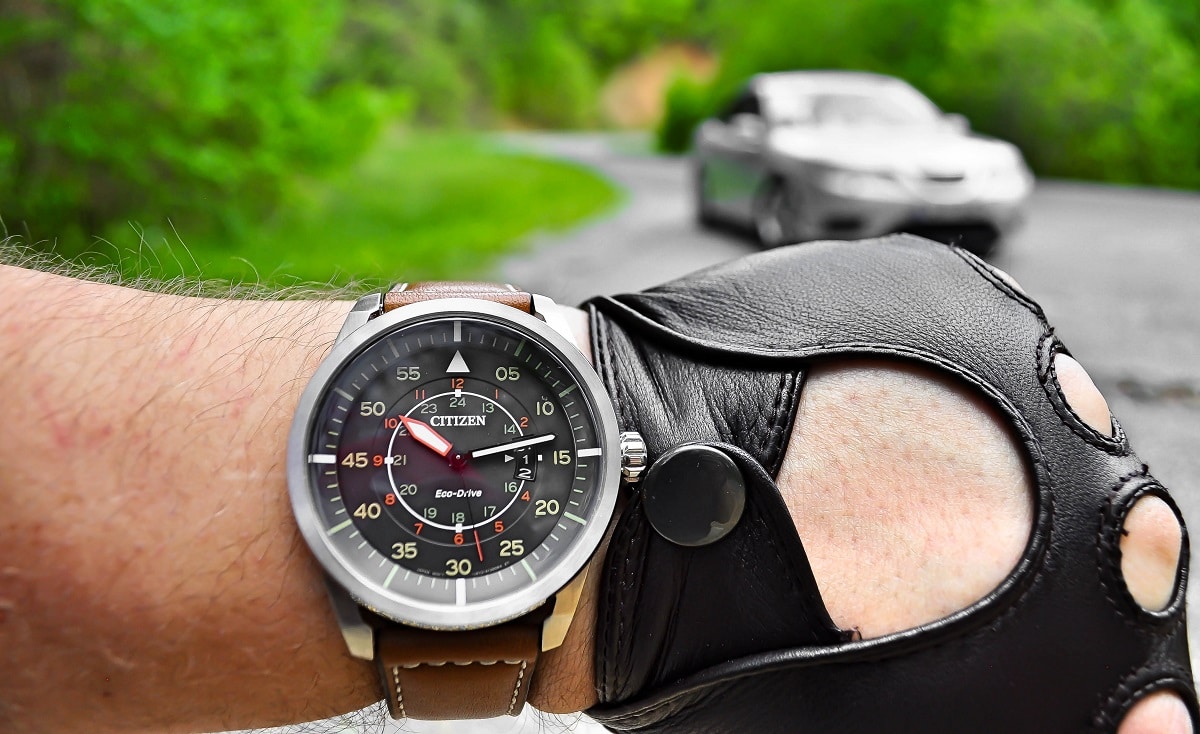
The Citizen Eco-Drive Avion is a good answer to the “Are Citizen watches any good?” question because it shows the brand doing something affordable without making it feel disposable. This is still a budget-friendly, solar-powered pilot-style watch, but it has enough personality to avoid that sad department-store quartz energy. The Eco-Drive J810 movement is the practical center of the whole thing, running at roughly ±15 seconds per month and requiring occasional light exposure to keep running. For someone who wants a grab-and-go watch without battery changes or mechanical upkeep, that matters more than a decorated movement you’ll never see.
The dial is where the Avion earns most of its charm. The Type B layout has a lot going on, but Citizen uses color to make the information easier to process rather than turning the dial into soup. The minutes are marked in mustard yellow, the hours in orange, and the inner 24-hour scale in white. On the wrist, that gives the watch a fun, high-contrast look while still keeping it readable during normal daytime use. The raised chapter ring adds some welcome depth, and the sword hands match the dial colors in a way that feels deliberate rather than randomly “vintage-inspired.” Even the orange-tipped second hand adds a little extra motion and character, which is useful because you’ll probably find yourself looking at it more than necessary.
The case is where the Avion becomes more specific about who it’s for. At 45mm wide with a 52mm lug-to-lug, it is a large watch by any normal standard. Citizen doesn’t hide that. But the 12mm thickness and slight inward taper toward the caseback help it sit more securely than those numbers suggest. Once the leather strap starts to loosen, the watch settles in better and becomes easier to wear as an everyday piece, especially if you already prefer larger watches. The strap itself is thick and has a worn-in vintage character that picks up marks quickly, which suits the watch’s tool-ish personality. That said, the same thickness may feel stiff at first, especially if your wrist shape doesn’t agree with it. The oversized crown is one of the most useful design choices here. It’s easy to grip while walking around, sitting in the car, or adjusting the time with gloves on, which fits the pilot-watch idea better than a tiny polished crown would. The case finishing is more functional than refined, though. The brushing does the job, but it doesn’t have the smoothness or detail you’d expect from something trying to feel fancy. That’s fine for the role this watch plays, but it is worth saying out.
The biggest compromise is the lume. Only the hands are lumed, which means the dial loses most of its usefulness once the light drops. For a watch with such a bold, instrument-style dial, it feels like a missed opportunity. It’s better thought of as a daytime pilot-style watch than something built for low-light legibility. Still, as an affordable Citizen, the Avion makes a solid case for the brand: it’s big, practical, distinctive, low-maintenance, and more engaging than a generic cheap quartz watch. Feel free to check out our in-depth review for deeper on-the-wrist insights.
Pros
- Solar-powered Eco-Drive J810 movement keeps ownership simple and low-maintenance.
- Color-coded Type B dial adds personality while helping with legibility.
- Oversized crown is easy to operate, including with gloves.
- The thick leather strap develops a visible character with wear.
- Large case wears better than expected thanks to the 12mm thickness and tapered caseback.
Cons
- Only the hands are lumed, so nighttime readability is limited.
- The 45mm case and 52mm lug-to-lug will be too large for some wrists.
Citizen Promaster Diver BN0151
| Price: | $250 – $300 |
| Water Resistance: | 200m |
| Case Dimensions: | 43mm (diameter) x 48mm (lug-to-lug) x 11.5mm (thickness) |
| Lug Width: | 20mm |
| Movement: | Citizen Eco-Drive E168 (solar quartz) |
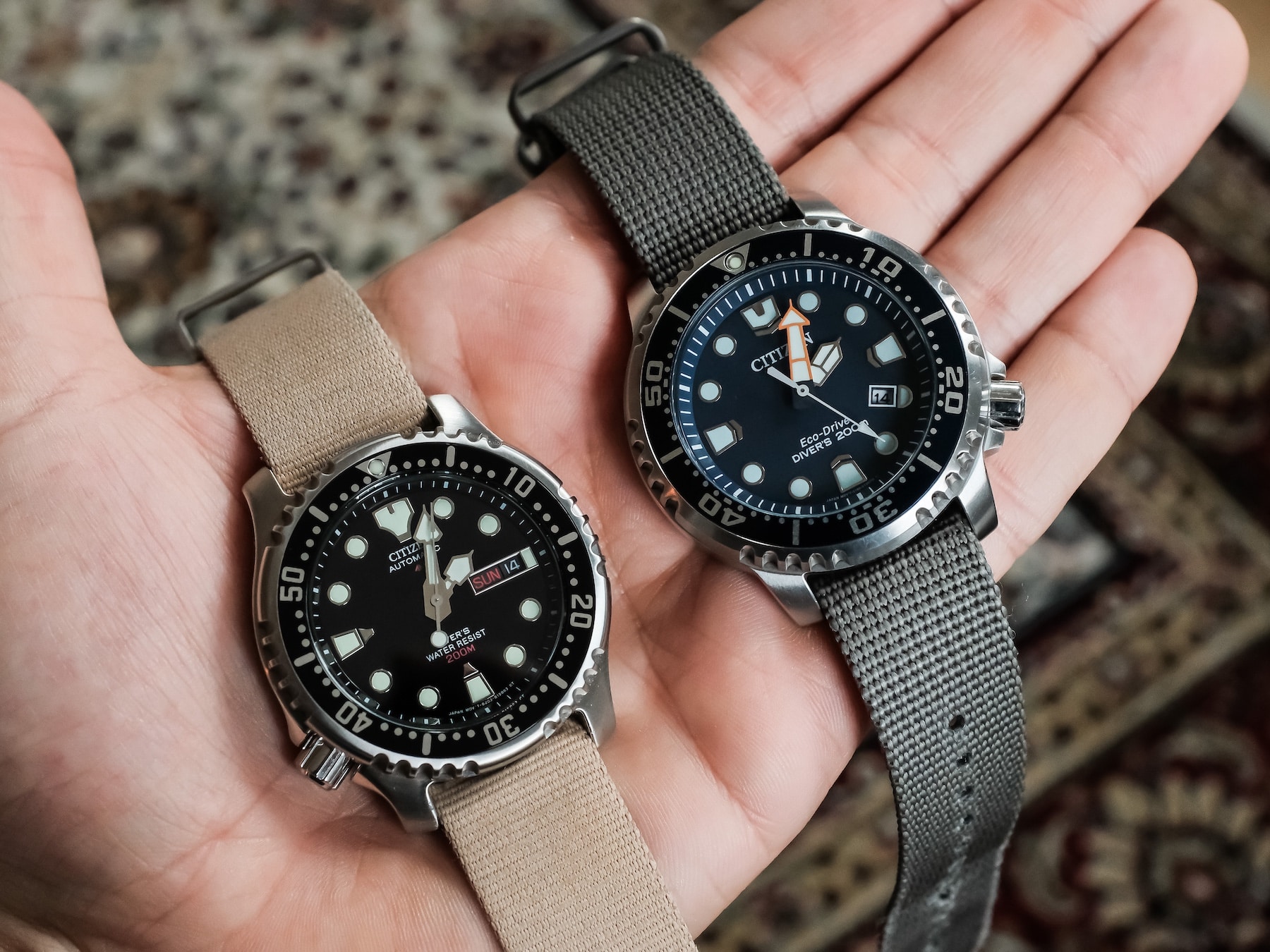
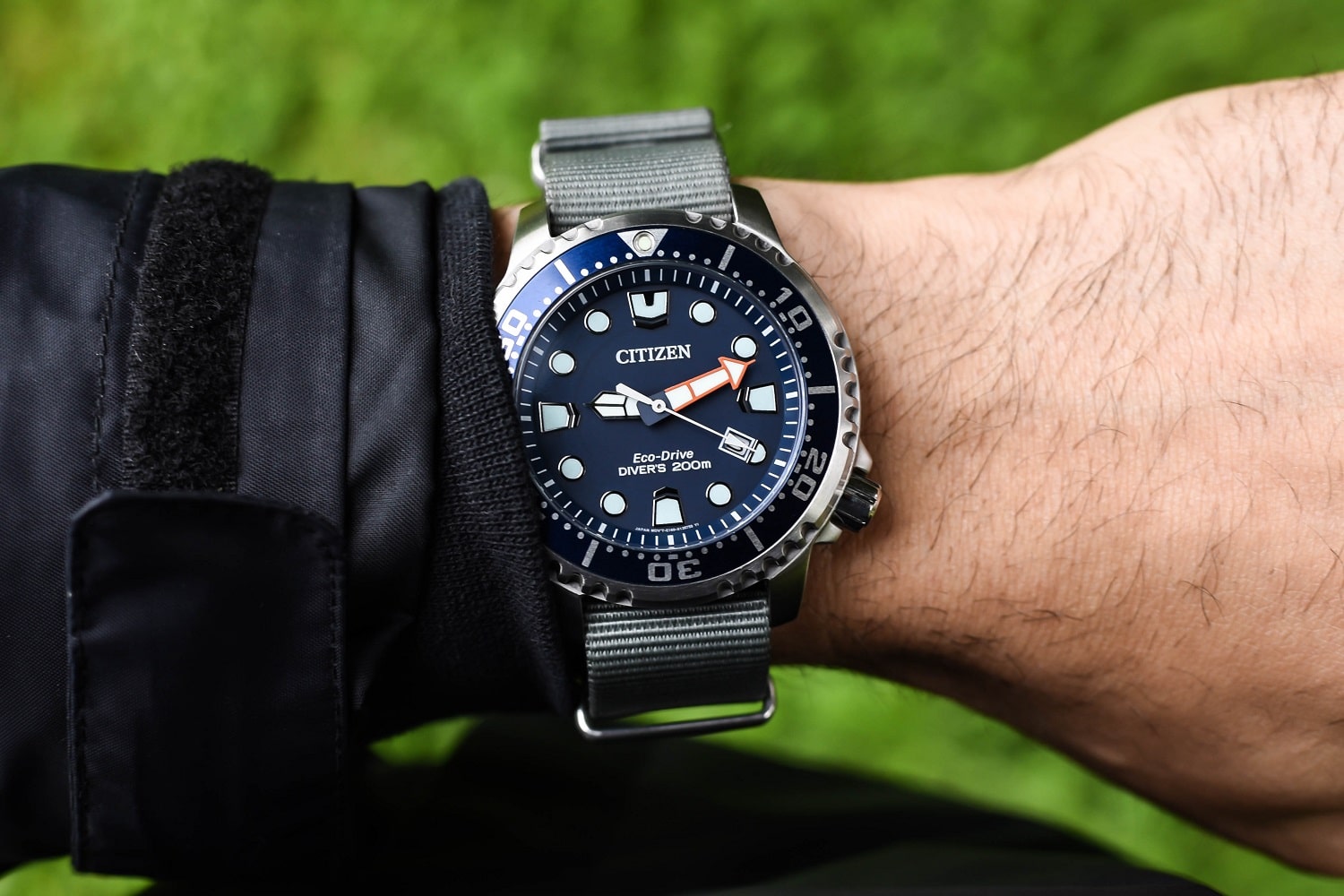
The Citizen Promaster Diver BN0151 is probably the easiest watch to point to when someone asks whether Citizen watches are any good. Not because it feels luxurious or because it gives collectors something obscure to argue about at 1 a.m., but because it solves the boring ownership stuff so well. The Eco-Drive movement is the heart of that. During our extended time with it, accuracy stayed around ±15 seconds per month, and once fully charged, the watch had about six months of runtime. We only triggered the low-power indicator once, and after a short stretch in the light, it was back to normal. That is Citizen doing Citizen things: no winding, no regular battery swaps, no “why did this stop running in the drawer?” nonsense. That convenience would not matter much if the rest of the watch felt flimsy, but the Promaster carries itself like a proper tool diver. The 200m water resistance makes it easy to wear around pools, lakes, rain, and whatever else a normal person calls “diving” without worrying about the watch. It still feels affordable, but it removes the hesitation. You are not babying it. You put it on and let it do the job.
The case helps more than the 43mm size might suggest. On paper, that sounds like a fairly big diver, but the short lug-to-lug and downward curve of the case keep it planted on the wrist. It also wears lighter than expected, almost with a titanium-like absence during the day, even though this is not some featherweight luxury thing. The 4 o’clock crown adds to that comfort by staying out of the way, especially during longer wear, when a traditional crown might start poking at the back of your hand. For an everyday dive watch, those small ergonomic choices matter more than another line of polished bevel marketing copy.
The dial does a lot of the practical heavy lifting, too. The hands and markers are bold enough to read quickly in daylight, and the blue dial has a subtle purple shift at certain angles that gives the watch a little personality without becoming a distraction. In low light, the aqua-toned lume stayed visible for hours, and the lumed pip on the second hand added a useful running indicator. That detail sounds small until you are checking the watch in dim light and want instant confirmation that it is still alive and ticking along.
There are compromises, and they are worth calling out because this is still an affordable Citizen. The mineral crystal does not bring the same scratch resistance as sapphire, even though ours held up better than expected during extended wear and avoided obvious scratches. The 60-click bezel stayed aligned and felt intentional in use, but the grip could get slick with wet hands, which is exactly when you want more traction. The stock polyurethane strap fits the tool-watch personality, but it starts stiff and takes time to relax. We preferred the watch on a NATO strap, as it felt more balanced, more casual, and easier to keep on for a full day.
That is the real value of the Promaster Diver BN0151. For anyone wondering if Citizen watches are good, this is the brand’s case study: durable enough to trust, legible enough to use, comfortable enough to keep wearing, and low-maintenance enough to make a lot of mechanical divers feel needier than they should.
Pros
- Eco-Drive movement keeps ownership simple, with long runtime and reliable, tested accuracy.
- 200m water resistance makes the watch easy to trust in water and during rough daily use.
- The case wears better than its 43mm size suggests, thanks to the short lug-to-lug and downward curve.
- Aqua-toned lume stays visible for hours, with a lumed seconds-hand pip for quick running checks.
- The 4 o’clock crown improves comfort during longer wear.
Cons
- The bezel grip can feel slippery when your hands are wet.
- The stock polyurethane strap starts stiff and needs time to break in.
Citizen NY0040
| Price: | $250 – $350 |
| Water Resistance: | 200m |
| Case Size: | 42mm (diameter) x 47.3mm (lug-to-lug) x 12.6mm (thickness) |
| Lug Width: | 20mm |
| Movement: | Miyota automatic Caliber 8204 |
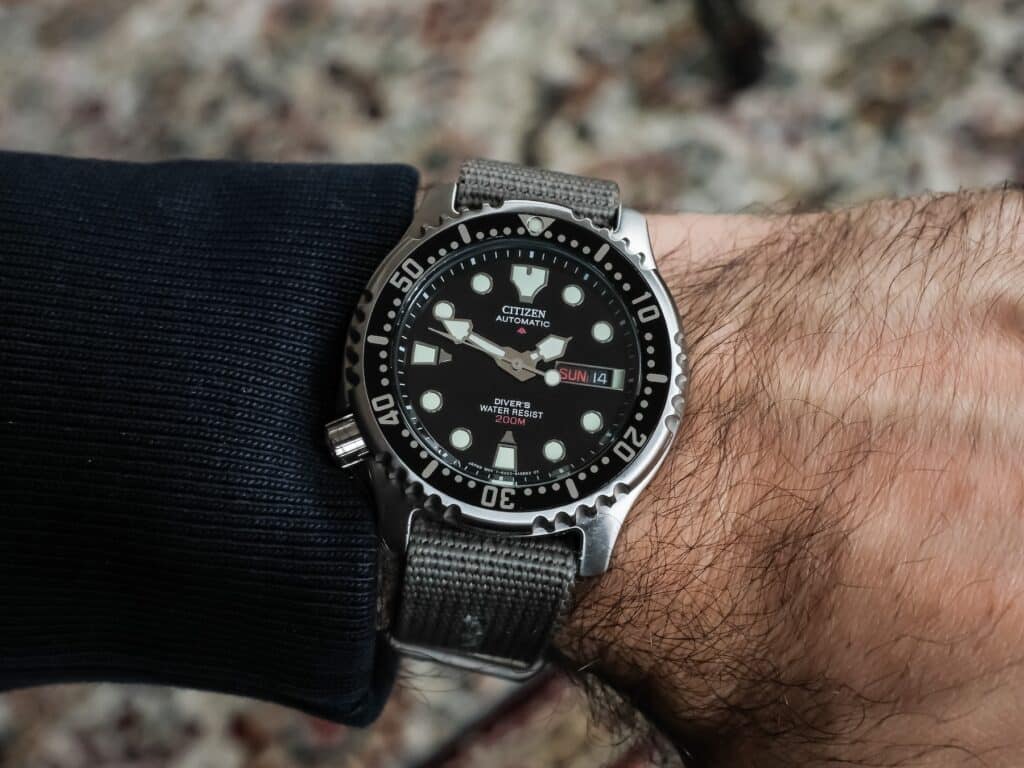
The Citizen NY0040 is a useful watch for this article because it pushes back against the lazy habit of treating every affordable automatic diver as an SKX comparison. We get why that happens, especially now that older Seiko divers have become weird little secondary-market trophies, but the NY0040 makes a stronger point when judged on its own merit. This is not Citizen trying to chase collector mythology. It feels more like Citizen doing what Citizen often does best: building a serious, ISO-rated tool watch, letting professional use prove the point, and not bothering to turn the whole thing into a grand brand story. Its connection to professional divers, including the Italian Navy’s COMSUBIN unit, adds credibility, but the appeal is simpler than that. It feels like a diver built by people more interested in function than applause.
The case layout is where the NY0040 starts feeling different in daily wear. The left-side crown looks odd at first if your muscle memory comes from traditional divers, but on the wrist, the benefit is obvious. Nothing is digging into the back of your hand, even when the watch sits a little lower. That makes a real difference during long days, especially if you type, drive, or move around enough to notice crown pressure. It also makes sense for left-handed wearers or anyone who wears a watch on the right wrist. For right-handed users, winding and setting take a few days to feel natural, but the awkwardness fades quickly. The size helps, too. Nearly 42mm sounds fairly standard for a diver. Still, the lug-to-lug of just over 47mm, restrained thickness, compact dial opening, inward-sloping bezel, and shorter visual footprint make it wear smaller than expected, even on a 6.75-inch wrist.
In hand, the NY0040 has a density that reads as reassuring rather than bulky. The upper surfaces are brushed, the flanks are polished, and the whole case feels solid enough to sit comfortably beside Seiko and Orient options in the same general price range. The broad, tooth-like shoulders soften the silhouette and keep it from looking like another straight-lug diver template. There is even a little old-school skin-diver warmth hiding inside the otherwise utilitarian shape. That said, the bezel is one of the watch’s better arguments. The coin-edge grip is easy to use with wet fingers; alignment on our example was dead-on, and there was no wobble or slack between clicks. The 60-click action and aluminum insert fit the tool-first personality, and the rotation felt smooth, confident, and a bit more satisfying than the bezel on our Eco-Drive Promaster Diver.
The dial keeps the same practical energy. The black background, clear hands, and readable hour markers make the NY0040 easy to use in daylight, while the day-date window at three o’clock blends in better than expected thanks to the darker background and lighter text. “Citizen Automatic” under twelve keeps the branding plain, and the small red arrow adds enough character without making the dial busy. Near six, the 200m water resistance text reinforces the watch’s purpose. This is a watch we would be comfortable swimming with, snorkeling with, or accidentally subjecting to saltwater because sometimes hobbies and judgment do not always travel together. The flat mineral crystal is the obvious compromise compared to sapphire, but in normal wear, it is less tragic than spec-sheet arguments make it out to be. Lume is dependable rather than explosive. It does not punch as hard as some Seiko divers at first glow, but the hands and markers hold enough light to stay useful once your eyes adjust.
Inside, the Miyota 8204 automatic movement gives the NY0040 the enthusiast hook that Citizen does not always get credit for. Hacking and hand-winding make it easier to live with than older entry-level automatics, and the accuracy expectations feel realistic for the price. The rotor is loud. Long-time Miyota wearers will know the sound immediately. Some people will call it character, others will find it annoying, and both groups are probably right. The stock thick rubber strap is serviceable but not the most charming part of the watch, so the easy strap changes matter. On NATO straps, the NY0040 feels honest, balanced, and more relaxed. The aftermarket support also helps, with dedicated bracelet options. For anyone asking whether Citizen watches are good, the NY0040 answers from a different angle than the Eco-Drive models. It proves Citizen can build an affordable automatic diver with real tool-watch credibility, daily comfort, and enough personality to stand on its own without borrowing anyone else’s legend. Read our dedicated, hands-on review for a deeper dive.
Pros
- Compact lug-to-lug, inward-sloping bezel, and tight dial opening make the case wear smaller than the nearly 42mm size suggests.
- Coin-edge bezel has a strong grip, clean alignment, smooth 60-click action, and no noticeable play.
- Miyota 8204 adds hacking and hand-winding, giving the watch better everyday usability.
- Clear black dial, practical lume, and 200m water resistance make it feel like a proper tool diver.
- Easy strap changes and strong aftermarket bracelet support make it simple to personalize.
Cons
- Mineral crystal lacks the scratch resistance of sapphire.
- Miyota rotor noise will bother some wearers.
- Right-handed users may need a short adjustment period with the left-side crown.
Citizen Ana-Digi Temp
| Price: | $250 – $500 |
| Water Resistance: | 30m |
| Case Dimensions: | 31.5mm (diameter) x 40mm (lug-to-lug) x 8.4mm (thickness) |
| Lug Width: | 18mm |
| Movement: | Citizen caliber 8980 |
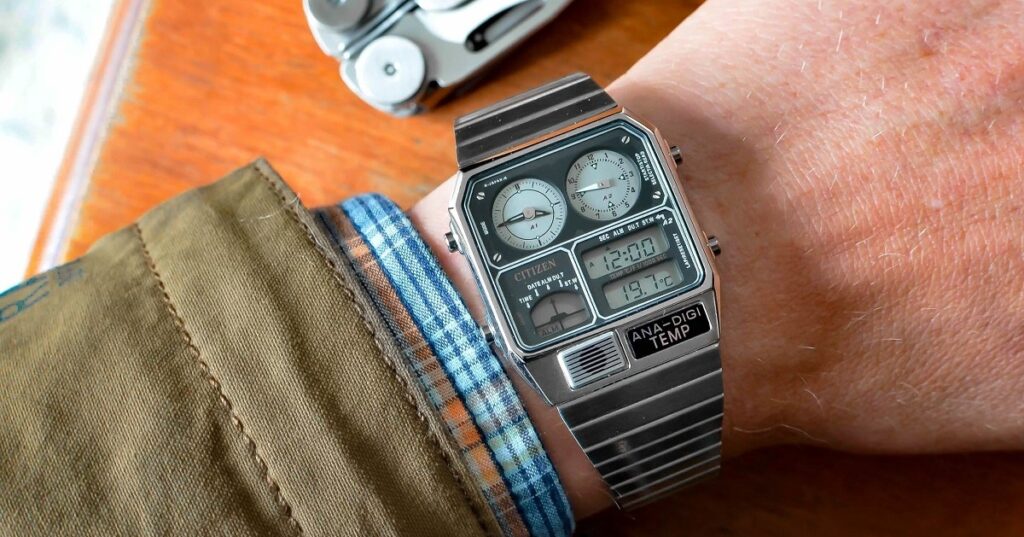
The Citizen Ana-Digi Temp is useful in this conversation because it pushes against the idea that Citizen only makes safe, practical watches for people who never want to think about what’s on their wrist. This one is practical, sure, but it is also strange in a way that feels deliberate. The dual-time layout, temperature display, analog sub-dials, digital readouts, exposed screws, and squared-off stainless-steel case all come together like someone shrank an eighties control panel and decided it should live on a bracelet. That will lose some people immediately. Fair. But for collectors who like watches with a little awkward charm, this is the kind of thing that makes Citizen more interesting than its reputation sometimes suggests.
That said, the actual user experience is more organized than the first glance lets on. Citizen divides the display into separate zones, so the analog and LCD elements do not collapse into one unreadable mess. The white markings cut clearly against the black backdrop, while the darker LCD sections sit back visually enough to keep the dial from feeling overloaded. The left-side analog display uses thin black hands with narrow lume strips, which remain quite easy to track. The right-side regulator-style hand is heavier and even quicker to read at a glance. Add in the four luminous markers at the cardinal points, polished hand bases, and those visible screws, and the watch rewards the staring that often happens during a meeting you were already mentally checked out of. The Ana-Digi Temp also wears better than its photos might suggest. The case has crisp edges and a squared-off shape, so it still has presence, but the short lug-to-lug span and slim profile keep it balanced on the wrist. Even smaller wrists can usually handle it without the watch feeling like a metal tile strapped to the arm. You do notice it during the day, but that is part of the appeal. This is not an everyday watch because it disappears. It gives you something to interact with.
That interaction is where the watch earns its collector-friendly personality. The dual-time setup is more useful than it looks on paper, with the analog display giving a quick visual reference and the digital readout underneath confirming the exact time. When moving between schedules or time zones, that setup feels handy rather than decorative. The temperature function is more conditional. It works, but only after taking the watch off the wrist. That makes it less casual to use than the dual-time feature, but it still fits the watch’s larger personality. It does not feel like a random party trick as much as another odd little instrument in an already odd little package.
Our review team found that the integrated bracelet is the right visual match. A normal strap would probably break the overall design language, while the bracelet carries over the case shape and helps the watch feel complete. It is comfortable to wear, but there is a known compromise: the flared end links can bend over time. The layout also takes a little getting used to, especially if your usual watches are simple analog pieces or cleaner digital ones. Still, as evidence that Citizen watches are good, the Ana-Digi Temp makes a different argument than the Promaster Diver or Avion. It proves Citizen can build something useful, memorable, and properly weird without sanding away the oddball character.
Pros
- The dual-time setup is useful, combining a quick analog reference with exact digital confirmation.
- The integrated bracelet suits the case and completes the design better than a strap swap likely would.
- Details like exposed screws, varied hand shapes, polished hand bases, and cardinal-point lume give the watch more depth over time.
- Compact proportions, short lug-to-lug span, and slim case profile keep the busy design wearable.
- Strong contrast helps the key information stand out despite the dense layout.
Cons
- The temperature reading is only accurate when the watch is off the wrist.
- Flared bracelet end links are a known weak point and can bend with use.
- The display takes time to get used to if you are used to simpler analog or digital watches.
Citizen Nighthawk
| Price: | $500 |
| Water Resistance: | 200m |
| Case Size: | 42.5mm (diameter) x 47mm (lug-to-lug) x 12.6mm (thickness) |
| Lug Width: | 22mm |
| Movement: | Citizen B877 Eco-Drive caliber (solar-powered quartz) |
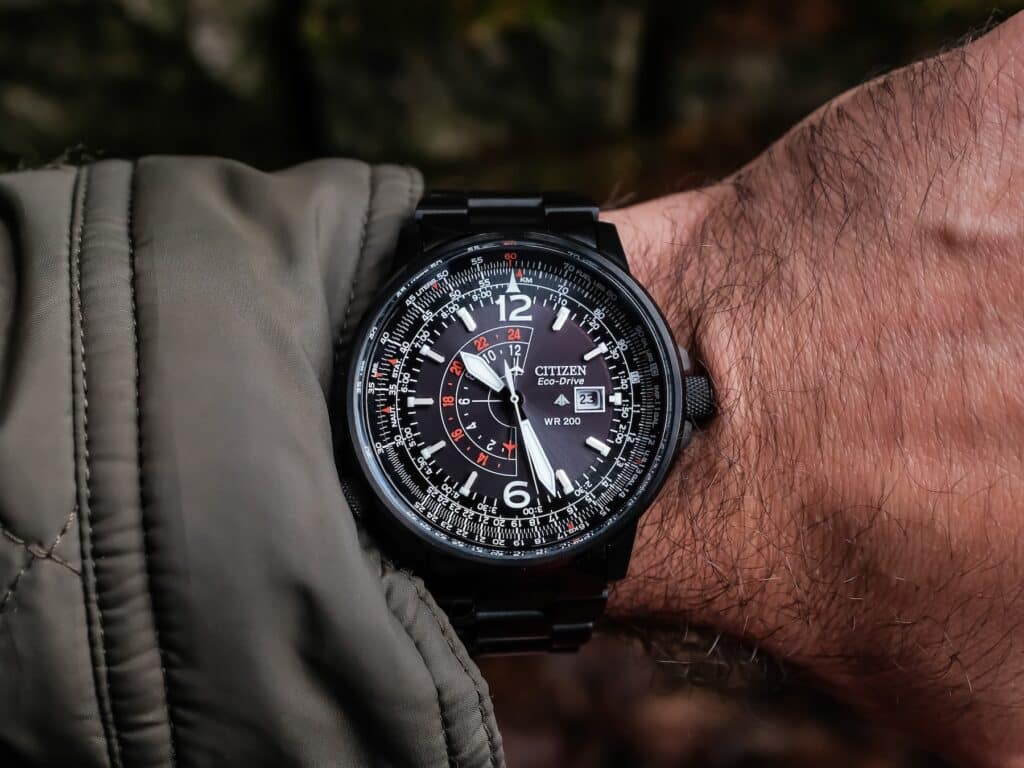
The Citizen Nighthawk is one of the better examples of why Citizen watches are good when the brief is practical, affordable, and more interesting than another watch that only tells time. The B877 Eco-Drive caliber gives you solar-powered quartz convenience, second-time-zone functionality, a date, and a jumping local-hour feature that makes time-zone changes less annoying when traveling or bouncing between schedules. Accuracy is rated to within 15 seconds per month, and once fully charged, it can run for roughly six months without light. The setting action feels crisp, with minimal hand play, which matters because this watch asks for more interaction than a simple three-hander.
The dial is busy, but Citizen manages the clutter better than expected. The internal E6B slide rule scale is there when you want to use it, and the secondary crown at 8 o’clock controls it securely enough that it does not feel like a gimmick or something you’ll knock out of place by accident. During normal time checks, the finer markings fade back while the bold indices and sword hands take over. The applied markers sit slightly proud of the dial, with polished edges and lume-filled outer sections. The GMT hand adds personality through small red-and-white airplane motifs that indicate which side of the scale you’re reading. The trade-off is that the main hands can block the secondary time zone scale at certain points, so reading it takes more patience than a straightforward 24-hour bezel.
On the wrist, this Japanese- and European-market version may not officially carry the Nighthawk name outside the U.S., but that feels more like a naming footnote than a meaningful difference. The black ion-plated case and bracelet shift the personality toward something more industrial and assertive than the standard aviation-tool version, without falling into full cockpit cosplay. At 42.5mm wide, 12.6mm thick, and built in stainless steel, it has real weight and presence. That can feel reassuring during travel days or long commutes, but it is not the watch we would choose for someone who wants a small daily piece that disappears. The case feels solid, and the screw-down crown, engraved screw-down caseback, and 200m water resistance give it more durability than the price suggests. The warning is the usual one with black ion plating: deeper scratches can expose the steel underneath.
As also mentioned in our dedicated review, the bracelet suits the watch visually and physically. It is black ion-plated to match the case, feels secure, and avoids the loose rattle that can ruin an otherwise capable watch. The push-button deployant clasp with fold-over safety is straightforward, and the micro-adjustment gives enough room to tune the fit. Still, the Nighthawk becomes easier to live with on rubber or nylon if the bracelet’s weight starts to wear on you. The lume is solid, charging quickly and giving off Citizen’s familiar blue glow across the markers and numerals after brief daylight exposure. The flat mineral crystal is the clearest compromise: the internal anti-reflective treatment keeps it readable, but because the crystal sits exposed, sapphire would have been more reassuring.
That is the Nighthawk’s value argument in the larger Citizen conversation. It gives you tool-watch functionality, aviation styling, solar-powered convenience, second-time-zone usefulness, real water resistance, and a level of durability that feels more serious than the price suggests. It is not small, subtle, or mechanically romantic, and it will not suit everyone. But as a capable travel watch for someone who would rather have something useful than something precious, it makes Citizen look very good.
Pros
- Eco-Drive B877 movement delivers second-time-zone use without battery changes or mechanical GMT servicing.
- Rated accuracy of within 15 seconds per month beats most mechanical GMTs in daily use.
- A six-month power reserve on a full charge makes it easy to rotate without worrying about it stopping.
- Secure internal E6B slide rule crown, solid bracelet, fold-over safety clasp, and micro-adjustment all support daily use.
Cons
- Black ion plating may show steel underneath if deeply scratched.
- The flat mineral crystal feels like the obvious cost-saving choice.
- Main hands can cover the secondary time zone scale at certain times.
- The 42.5mm stainless steel case has noticeable size and weight.
Citizen Promaster Aqualand Depth Meter JP2007-17W
| Price: | $550 |
| Water Resistance: | 200m |
| Case Dimensions: | 50.7mm (diameter) x 51mm (lug-to-lug) x 14.8mm (thickness) |
| Lug Width: | 24mm |
| Movement: | Citizen C520 Quartz |
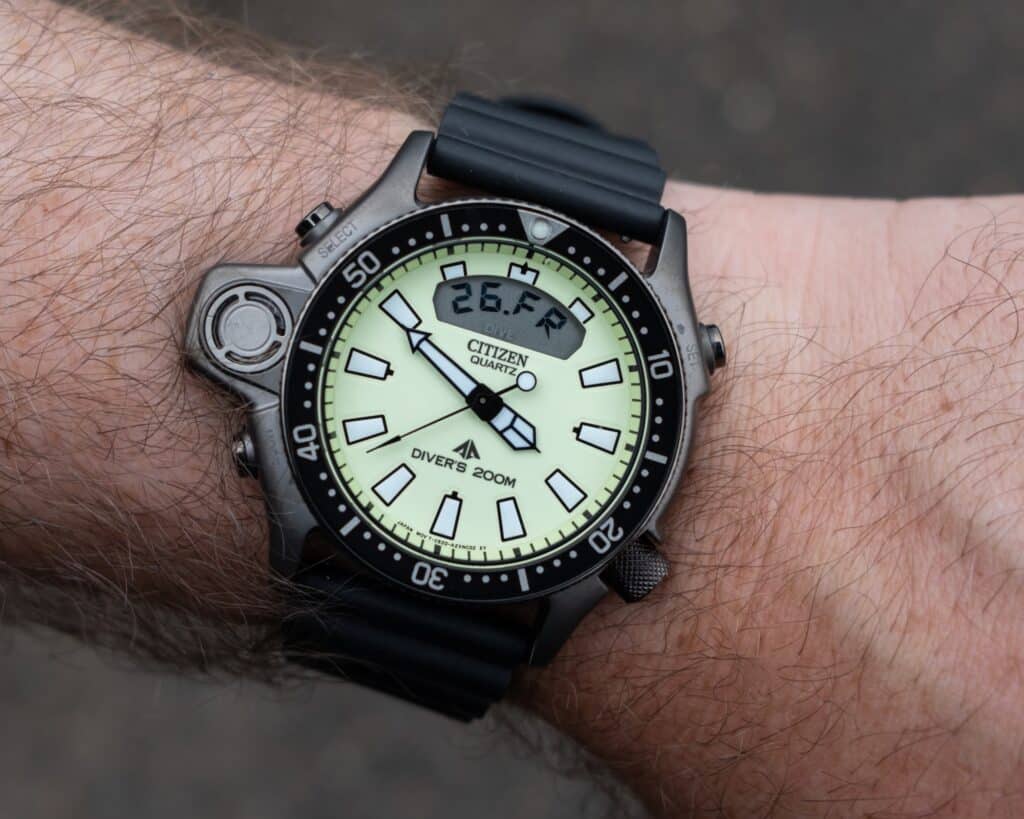
The Citizen Promaster Aqualand is one of the clearest examples of Citizen being good in a way that does not feel safe or boring. This is not a diver trying to slim itself down so it can pass as a polite everyday sports watch. It wears more like equipment, and the size supports that. The main case is around 43mm, but the external depth sensor stretches the total footprint closer to 50mm, and the 24mm strap gives the whole thing a wide, planted stance. On the wrist, that size never made it feel like Citizen was making it huge for its own sake. It felt tied to the job the watch was built to do. Smaller wrists may find it excessive, but collectors who like function-first watches with physical presence will understand the appeal fast.
The reason Aqualand matters on this list is that its functionality is not decorative. This is a full dive-computer-style watch that can track depth, log dives, set alerts, and warn you if you ascend too quickly. Most owners will not use every one of those features regularly, and we did not either, but their presence changes how the watch feels. It feels like a slightly strange instrument that happens to tell time. Away from the water, the digital side still handles useful basics like alarms, chronographs, elapsed time, and calendar functions. The layout takes a little time to learn, but once it clicks, the analog hands and digital display operate independently while staying synced after setup. That keeps daily ownership low-fuss.
The rest of the watch follows that same usability-first logic. The bezel action is firm, positive, and properly aligned, which is not something we take for granted in this price range. The oversized screw-down crown is easy to grip, and the pushers become more intuitive once you spend time with the watch instead of poking at it like a confused raccoon. Quartz accuracy works quietly in the background, and that suits the Aqualand better than a more romantic mechanical movement would. The rubber strap also does its part: it is soft, ventilated, secure, and long enough to sit comfortably without constant adjustment. The downside is that the 24mm lug width limits which alternative straps make sense, so this is not the easiest watch to remix casually.
Legibility is strong, though not perfect. The fully lumed dial glows brightly and remains visible for hours, making low-light reading easy. The trade-off is that when the entire dial lights up, contrast softens compared to a design that only luminesces the hands and markers. It never became a major issue for us during testing, but it is noticeable. Pre-owned pricing often makes the Aqualand more appealing, especially if you want a Citizen that feels memorable rather than merely sensible. It again proves the brand can build something functional, weird, overbuilt, and collector-friendly.
Pros
- Full dive-computer functionality gives it real capability beyond normal diver styling.
- The case, external sensor, and strap create a strong wrist presence without feeling random.
- The firm bezel, oversized screw-down crown, and tool-watch feel support the tool-watch feel.
- Soft, ventilated rubber strap is secure and comfortable.
- Fully lumed dial stays bright for hours.
Cons
- The overall footprint can feel too large on smaller wrists.
- Many diving functions may go unused if it mostly stays on land.
- The fully lumed dial can reduce contrast in some low-light situations.
- 24mm lug width limits practical strap options.
Let us know what you think about this list in the comments below. If there’s a Citizen we missed, or one you think makes a case for the brand, tell us, and we’ll try to get it in for a hands-on review. Bonus points if it’s weird, affordable, or somehow both, because Citizen does tend to get more interesting when it wanders off the sensible path.

Co-Founder and Senior Editor
Kaz has been collecting watches since 2015, but he’s been fascinated by product design, the Collector’s psychology, and brand marketing his whole life. While sharing the same strong fondness for all things horologically-affordable as Mike (his TBWS partner in crime), Kaz’s collection niche is also focused on vintage Soviet watches as well as watches that feature a unique, but well-designed quirk or visual hook.
I enjoy your reviews! I am considering a Citizen Navihawk but the frugal side of me urges me to keep looking 🤔 Thanks for your information! Anything I might be overlooking in the $250 to$350 range? I am hard on my watches so they need to be sturdy.
Thanks Francis! In that range, the Casio G-Shock lineup is tough to beat if durability is the priority. The Citizen Promaster BN0151 is another solid option if you want something that can take a beating and runs on Eco-Drive. And if you’re open to quartz, the Casio Duro is absurdly tough for a fraction of your budget, which leaves room for a second watch down the road. The frugal side usually wins for a reason.
I enjoy your work very much and have learned a great deal. But please allow me to offer an important clarification about a term used in the review of the ProMaster Aqualand. While the headline uses the correct term of “depth meter,” the body of the review incorrectly refers to the watch as a dive computer. This is important because a depth meter is NOT a dive computer. A dive computer is a device that monitors depth and time and calculates a dive profile that enables a diver to manage risk of decompression sickness. This watch is a depth meter and a dive timer but it does not contain a dive computer that is generating a dive profile. [LINK REMOVED PER EDITORIAL POLICY] –learning Watch Snob and SCUBA Instructor
David – that’s an important distinction and you’re absolutely right. A depth meter and a dive computer are not the same thing, and we should be precise about that. Appreciate the correction, especially coming from someone who actually teaches this stuff.
Obviously they are good.
I think so too
Been rocking a SS nighthawk since 2005. Still one of my favorites.
I’ve still got one too! Never selling it.
You forgot radio controled Citizen watches, especially H145 and H800 caliber.
Fair. The radio-controlled lineup deserves more attention than it gets. Thanks for flagging those calibers.
The Aqualand is a great watch & the presence it gave marked the wearer as a legit diver. While I loved it, I didn’t like how it’s power hungry. This watch has 3 batteries & goes through a set at least twice a year. That plus the cost of the batteries plus the service is an annoyance that I finally stopped using the watch for something more friendly. A shame since I was really fond of it.
Louie – three batteries twice a year is a real ownership cost. Great tool, but I can see why the maintenance eventually wore you down.
Hi Kaz,
Thanks for TBWS articles on affordable watches and general watch collecting.
Admittedly I’m biased toward Citizen but may add further testimony relative to some Citizen attributes that other may question:
– Eco-drive: My first Citizen field watch that has run reliably for 13 yrs. I even lost it in a drawer for more than a year; then placed it by a window several years ago and it keeps running.
– Mineral crystal: Extremely durable for casual use; and it holds up well when abused. My 5 yr old Promaster get banged hard during my weekend offshore fishing excursions, yet it shows only 1 un-noticeable scratch despite abuse (I must closely examine to find it); and it still wears clean to social events and casual dinners.
– Polyurethane strap: Comfortable and ideal in and around water.
– Rotating Bezel: Rotates easily and clicks securely after routine saltwater use.
– Black finish: Probably Ok for light use. My 13 yr old field watch shows some wear. While I really like the finish, I’d consider stainless or titanium for more than routine daily use.
Super Titanium: Awesome ad durable. I wear my 3 yr old Super Titanium as my daily office driver and for most sales calls.
I gifted my wife a Promaster ladies 3 years ago thinking that she would only wear it on the boat. While she still wears her dress watches to for more formal occasions, the Promaster has moved to her daily driver and she wears it more and more.
Different watches will fit different lifestyles. I rely more on 3 Citizen watches (over my Tag, Bulova, and G-shock) for my daily job as a regional account manager covering 12 southern states, domestic and international travel, and my active weekends saltwater fishing, hiking, and motorcycle riding. ‘Your mileage may vary.’
BM8475-26E – Field – 13 yrs
BN0151-09L – Promaster- 5 yrs
BM7570-80L – Super Titanium 3 yrs
Keep up the articles.
Eric, thirteen years on a field watch and five on a Promaster across saltwater, travel, and daily wear is a serious endorsement. And the fact that your wife’s Promaster migrated from boat watch to daily driver tells its own story. Appreciate you taking the time to share all of this.
I liked Citizen watches and myself have the model C 300, with already 30 years old and still it works perfect and looks good, it on batteries I used to change myself.
Jakob – thirty years and still going strong. That says everything you need to know. Thanks for sharing.
This post was right up my street. I have the NY0040 and like it a lot. The only thing is that, the way I use it, the reserve often gets depleted and I need to reset it. I’m in the market for a solar dive watch but most or all of the Citizen ones have either 1) hands of different colours (like the BN0151 shown here) or 2) a bezel which doesn’t have markers for all the minutes (only up to 15 or 20 minutes, like the BN0260).
Hey Neal – those are oddly specific frustrations that are totally valid once you notice them. Matching hand colors and a full-minute bezel shouldn’t be a lot to ask for, but it narrows the options fast. Hopefully Citizen addresses that in future Promaster runs.
The citizen field watches in eco drive are perfect. No bezel no buttons just.set.the time.and.occasionally adjust the day and.or.date.
Hey Bob, sometimes the best feature set is the shortest one. Set it and forget it. That’s the appeal.
I got myself the BN0260-54L Promaster Diver recently. Unecessary purchase really given my collection but, hey, that’s the hobby…
What I’ll say is that it’s a fantastic thing – has become ultimate grab and go for me. Love the solar tech, looks great, fit and balance superb, bracelet great. I get compliments on the looks. This is a watch that does not demand from me but is a real giver – I love it. And it has turned my attention towards quartz and the higher end quartz offerings out there. What a watch.
Hey Nick – the solar convenience factor is hard to go back from once you’ve lived with it. Glad it’s opening up the quartz world for you.