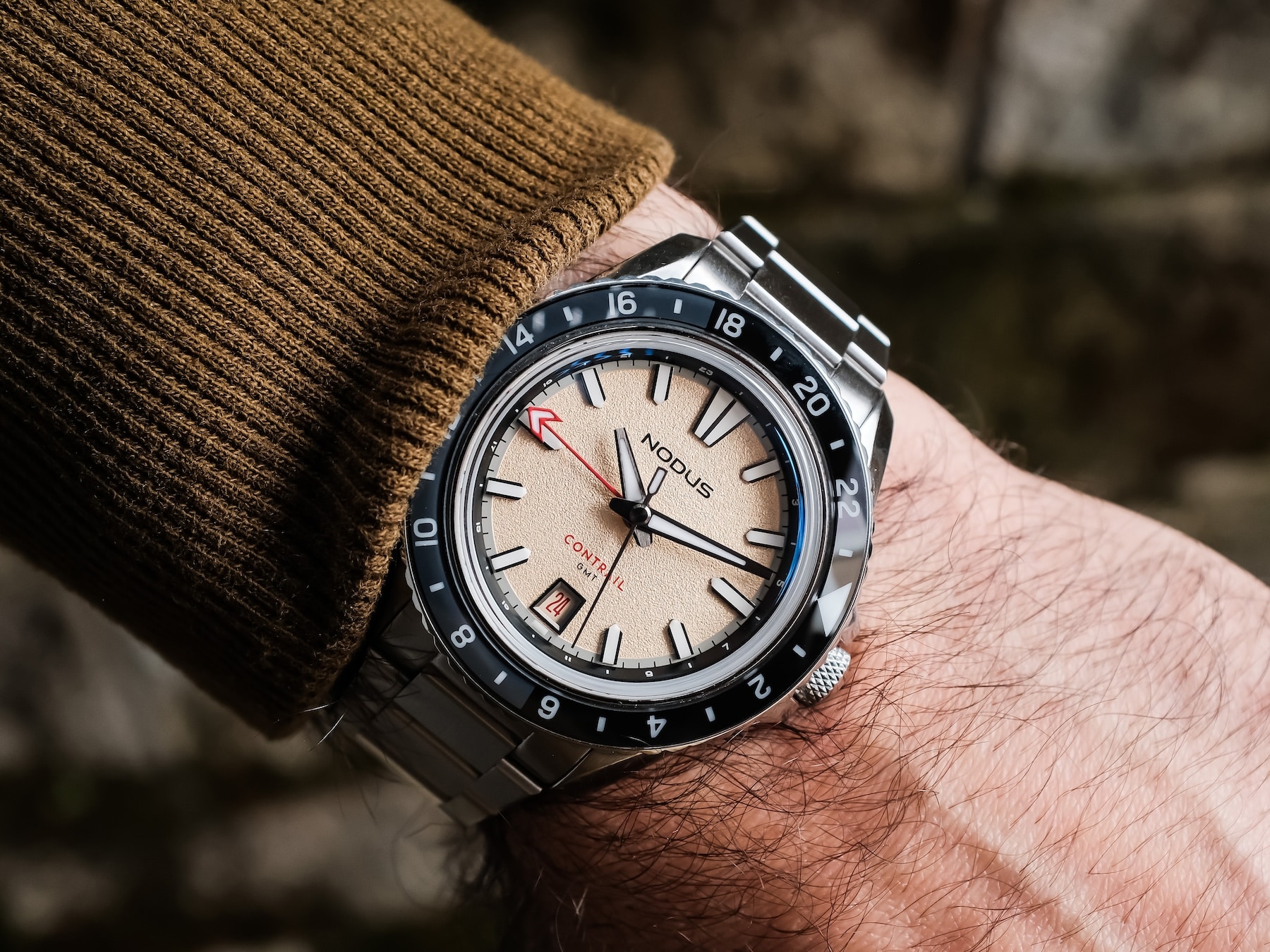
A funny thing happens once the Seiko 5 GMT has been in the rotation for a while: it stops feeling like the destination and starts feeling like the reference point. This list of Seiko 5 GMT alternatives is for that stage of collecting, when an affordable GMT watch has already shown you its appeal, and you now want to know what spending more would actually change. In our experience, that next step is not about buying the same function with a nicer logo on the dial. It’s more about finding out whether the extra money brings better day-to-day wear, stronger finishing, more thoughtful design, or simply a watch that keeps pulling you back in after the honeymoon period ends. Each watch here makes a different case for why moving on from the Seiko 5 GMT might be worth it.
Imperial Oceanguard GMT
| Price: | $600 |
| Water Resistance: | 200m |
| Case Dimensions: | 38mm (diameter) x 47mm (lug-to-lug) x 14mm (thickness) |
| Lug Width: | 20mm |
| Movement: | Seiko NH34 |
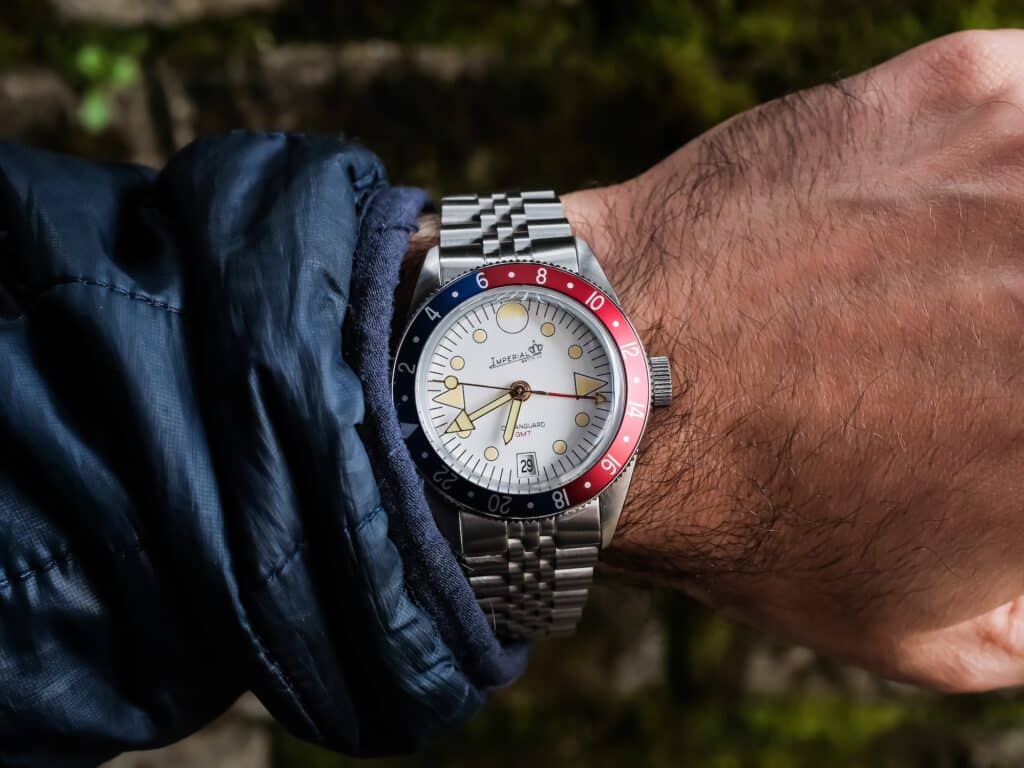
What sold us on the Oceanguard GMT was not some grand reinvention. It was how sorted it felt in daily wear. The jubilee-style bracelet draped nicely around the wrist, the tool-less microadjustment made small fit changes painless, and the whole package came across as more considered than its price might suggest. Yes, the clasp is thicker than we would prefer, but comfort remained high throughout full days of wear, which is what matters when a GMT is meant to travel with you rather than sit in the box.
The case size plays a big role in that. At 38mm, the Oceanguard GMT lands in a sweet spot that many modern GMTs miss entirely. It wears compact, stays manageable on smaller wrists, and gives off more of a skin-diver attitude than the broad-shouldered feel we have come to expect from many contemporary travel watches. On paper, the thickness may give pause, though it never felt lopsided or top-heavy once it was on. That matters for collectors moving up from a Seiko 5 GMT and hoping the extra money buys better proportions, not merely a different dial layout.
We also came around to the physical design faster than expected. The oversized crown looks a little dramatic at first, though it makes perfect sense the moment you start using it. It is easy to grip, easy to operate, and works well with the bi-color bezel when you are tracking another time zone on the fly. In day-to-day use, we leaned on the bezel more than the caller-style GMT hand anyway, which made the usual flyer-versus-caller debate feel less pressing.
The dial took a minute to click in photos, but on the wrist, the mix of dots, triangles, and the circular marker at twelve made orientation easy at a glance. Legibility stayed strong in bright light and indoors, while the lightly aged lume played nicely with the white dial rather than trying too hard to look faux-vintage. Powered by the Seiko NH34, it delivered the kind of dependable performance we want in a watch like this. For someone stepping beyond the Seiko 5 GMT territory, this feels like a thoughtful next move: familiar in spirit, cleaner in execution, and a bit more complete where it counts.
Pros
- The 38mm case wears smaller and more comfortably than many modern GMTs, especially on slimmer wrists.
- The bracelet has good articulation, and the on-the-fly microadjustment makes everyday fit changes easy.
- The large crown and bezel are easy to operate, which makes the GMT function feel useful rather than ornamental.
- The NH34 movement keeps things straightforward and dependable without adding unnecessary fuss.
Cons
- The case still reads a little thick if you are chasing strict vintage proportions.
- The clasp is chunkier than the rest of the watch deserves.
- Collectors holding out for flyer GMT functionality may find the caller setup limiting.
Nodus Contrail GMT Laguna
| Price: | $825 |
| Water Resistance: | 200m |
| Case Dimensions: | 40.5mm (diameter) x 46.6mm (lug-to-lug) x 11.8mm (thickness) |
| Lug Width: | 20mm |
| Movement: | Miyota 9075 |
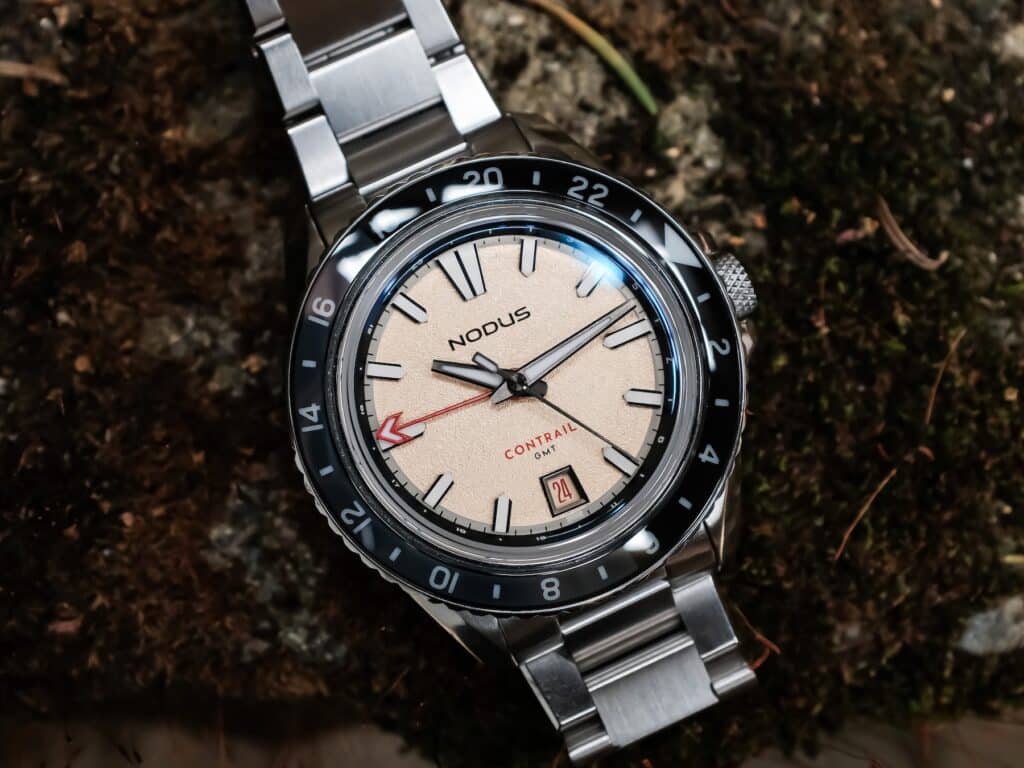
The Nodus Contrail GMT feels like the watch you notice more once you start using it, which is usually a good sign. For collectors moving on from a Seiko 5 GMT, that matters. This is not a watch that relies on a single flashy detail to justify the higher price. It makes the case through a bunch of smaller decisions that add up over time. The screw-down crown is a good example. It is large, nicely textured, and easy to handle, so setting the watch or jumping the local hour hand feels controlled instead of fiddly. The flyer-style Miyota 9075 helps here, too. During our hands-on review, the local hour jump felt precise, accuracy stayed steady, and the roughly 42-hour power reserve made sense in a normal rotation without asking for much babysitting.
The case is another key reason this works so well. At 40.5mm, it sounds standard, but the 11.8mm thickness is what stands out once it is on the wrist. Compared to many GMTs using the same movement, it wears slimmer and closer to the arm, with the 46.6mm lug-to-lug and twisted lugs helping keep the footprint tidy. There is still some heft here, but never the kind that turns into bulk halfway through the day. The finishing helps as well. Brushed and polished surfaces break things up nicely, while the box sapphire crystal and sapphire bezel insert catch light in a way that gives the watch a bit more presence than the raw dimensions would suggest. Add 200 meters of water resistance, and this becomes the kind of GMT we would wear without overthinking where the day might go.
What kept bringing us back, though, was how intuitive the whole thing felt in use. The bi-directional 24-hour bezel has a smooth 48-click action that makes quick adjustments easy without coming across loose or vague. Between the bezel, the internal 24-hour scale, and the main handset, tracking multiple time zones became second nature after a short learning curve. The handset itself is bold, easy to separate at a glance, and backed up by strong BGW9 lume across the markers, bezel numerals, and GMT hand. Low-light legibility was excellent, given that you don’t have to hunt for angles.
The Laguna dial adds some warmth, too, with its soft, sandy tone that shifts depending on the light, while the roulette date wheel gives the design a bit of personality without making it feel busy. The dial text stays restrained, though we still would not have minded slightly larger internal 24-hour numerals for quicker reading. The H-link bracelet keeps the everyday-wear story going. It feels solid and straightforward, tapering from 20mm to 16mm, even if some of us would have liked a more aggressive taper. That said, sizing is easy thanks to screw links, and while the NodeX clasp adds a bit of chunk, the convenience of quick on-the-fly adjustment more than makes up for it.
As a step up from the Seiko 5 GMT, this feels less like a dramatic departure and more like a sharper, more resolved version of the idea.
Pros
- The slim case profile makes it wear closer and cleaner than many GMTs in this lane.
- The bezel action is smooth, and tracking multiple time zones becomes quite easy once you get used to it.
- The NodeX clasp makes quick fit changes simple throughout the day.
- Lume is strong and practical across the dial, bezel, and GMT hand.
- The flyer GMT setup feels precise in actual use, especially when paired with the well-executed crown.
Cons
- Bracelet taper is a little conservative if you prefer a more dramatic narrowing toward the clasp.
- The internal 24-hour numerals could be larger to improve readability.
- The clasp itself wears chunkier than the rest of the watch suggests.
Farer World Timer Roché II
| Price: | $1,695 (leather strap); $1,865 (stainless steel bracelet) |
| Water Resistance: | 100m |
| Case Dimensions: | 39mm (diameter) x 45mm (lug-to-lug) x 11mm (thickness) |
| Lug Width: | 20mm |
| Movement: | Sellita SW330-1 Elaboré |
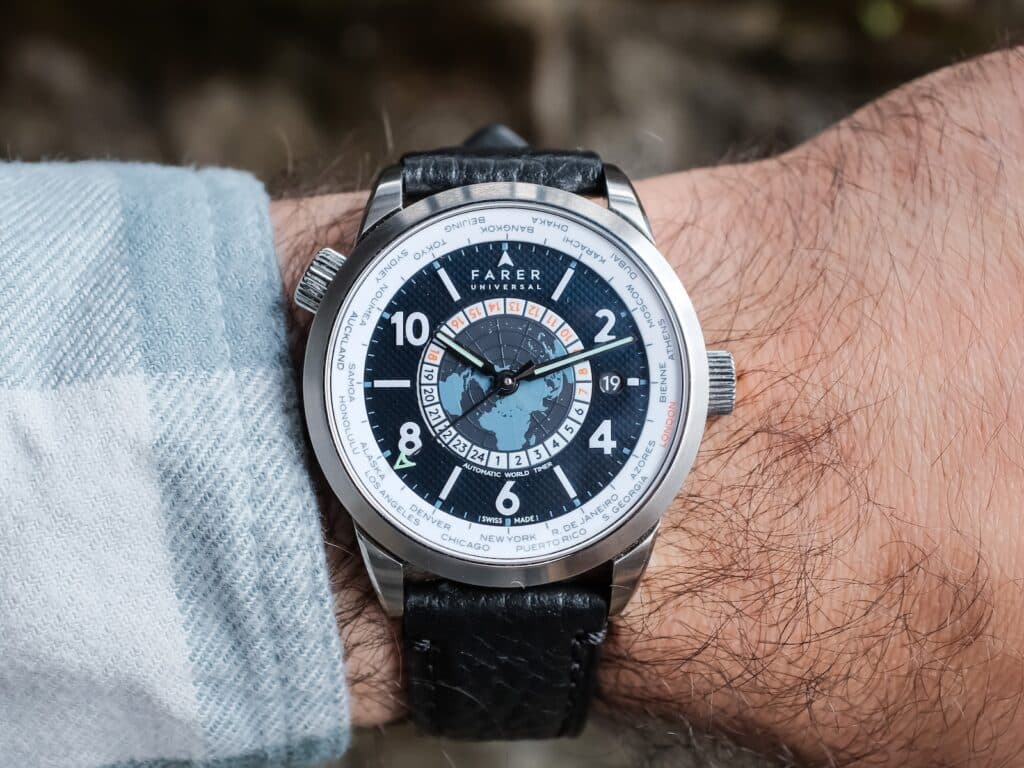
The Roché II makes sense for collectors who have outgrown the Seiko 5 GMT but do not necessarily want the next watch to feel more serious, heavier, or more complicated in a bad way. What we liked here was how normal it felt in daily wear despite doing more than a standard GMT. The 39mm case lands in an easy middle ground, and on the wrist, it stayed flat and balanced whether we were sitting at a desk, running errands, or dragging ourselves through an airport. It also slides under a sleeve without much fuss, which is not always a given once travel complications start piling up. The 100 meters of water resistance helps too. We never got the sense that this was a watch demanding careful treatment. It felt like something you could wear as a regular daily watch and let the world-time function come along for the ride.
A lot of that ease comes from how Farer handled the dial. Plenty is going on, but it never felt like a complication trying to show off. The midnight-blue textured surface gives the rotating 24-city ring enough separation to stay useful, and the raised markers add depth without turning the whole thing cluttered. During our in-depth testing, the updated alpha hands were easy to follow, and the lume across the hands, markers, and inner bezel felt a little excessive at first, until late nights and early-morning travel made the point for Farer. Even the rotating 24-hour disc proved more intuitive than we expected, so checking a second time zone did not require the usual pause to decode the dial. That said, this is still a busier layout than a straightforward GMT, and the inner bezel does take a little time to get comfortable with.
The rest of the watch keeps reinforcing that same theme. The modified Sellita SW330 ran steadily in our testing, and the extended 50-hour power reserve made rotation easier during the week. The St. Venere leather strap was comfortable right away and stayed secure even on smaller wrists, which isn’t something we take for granted with leather straps out of the box. The quick-release setup also made it easy to swap over to the bracelet if we wanted something with a bit more weight.
For someone stepping up from a Seiko 5 GMT, the Roché II is not the obvious next move, and that is part of the appeal. It offers a different kind of travel watch experience: more layered, a little more expressive, and still grounded enough to live with every day.
Pros
- The 39mm case wears comfortably across a wide range of wrist sizes and stays balanced through long days.
- The textured blue dial and raised markers add depth without wrecking legibility.
- Lume is strong across the hands, markers, and inner bezel, which helps more than expected in low light.
- The modified SW330 performed consistently, and the 50-hour reserve gives the watch more flexibility in a weekly rotation.
- The leather strap feels broken-in quickly, and the quick-release setup makes strap or bracelet changes painless.
Cons
- The inner bezel layout takes a little time to learn before it feels second nature.
- The dial may read too busy for anyone who prefers a cleaner, more minimal travel watch.
- Pricing sits above many comparable microbrand options, so the appeal depends on whether the design clicks with you.
Monta Skyquest GMT
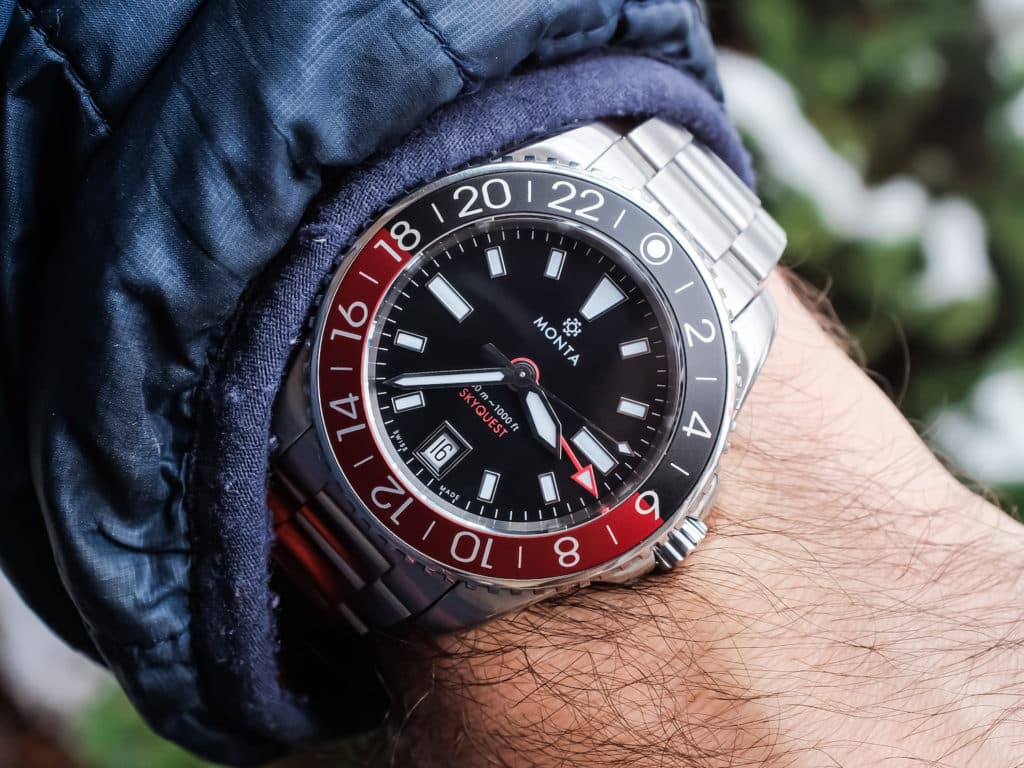
| Price: | $2,435 |
| Water Resistance: | 300m |
| Case Dimensions: | 40.7mm (diameter) x 47.4mm (lug-to-lug) x 11.8mm (thickness) |
| Lug Width: | 20mm |
| Movement: | Monta Caliber M-23 (Sellita SW330-2 base) |
Some watches win you over by doing less, only doing it better. That is the Skyquest GMT in a nutshell. For collectors moving on from a Seiko 5 GMT, this is the kind of step up that feels immediately noticeable in wear rather than in marketing language. The case proportions are a big part of that. On paper, it does not sound too small, though on the wrist, it wears more compact and better balanced than expected. Much of that comes down to how Monta handles the relationship between the dial and bezel. The larger 24-hour bezel markings draw your eye outward, keeping the watch from feeling cramped and giving the whole thing a calmer, more settled look in daily wear.
That same sense of control carries over into the GMT function itself. Nothing feels bolted on. Tracking a second time zone is simple because the bezel is easy to read and the dial stays clean. We found during our review that the bezel had the kind of grip and firm, predictable action that made quick adjustments easy, even with cold hands or while wearing gloves. The dial leans hard into legibility, with applied markers and well-proportioned hands that make quick time checks feel effortless. BGW9 Swiss Super-LumiNova held up nicely into the evening in our hands-on time, staying readable without falling off too quickly. Monta has also cleaned up some of the quirks from earlier versions, which gives the watch a more refined appearance overall, even if longtime fans may miss a little of the original personality.
The bracelet is where the Skyquest starts to separate itself from more affordable GMTs. Screw links make sizing straightforward; the milled clasp shuts with a precise, reassuring snap; and the tool-free micro-adjustment proved more useful than we expected on longer days when wrist size shifted. It is the kind of feature that quietly becomes part of how you wear the watch. Comfort stayed consistently high throughout extended wear.
Inside, Monta’s Caliber M-23, based on the Sellita SW330, kept things steady in our experience. Accuracy was consistent, the roughly 55-hour power reserve gave us some breathing room in a rotation, and the familiar movement base should make future servicing less of a headache. It is not doing anything radical, and that is part of the appeal. As a Seiko 5 GMT alternative for collectors ready to spend more, the Skyquest makes its case through better execution, cleaner usability, and a more complete overall feel.
Pros
- Bracelet quality is excellent, and the tool-free micro-adjustment is genuinely useful.
- Dial layout stays clear and easy to read in everyday use.
- The bezel is easy to grip and has a firm, confidence-inspiring action.
- The case wears smaller and more proportionate than the specs suggest.
- The movement proved dependable, with a practical 55-hour reserve and straightforward serviceability.
Cons
- The screw-down crown could be larger to make handling easier.
- The updated design loses a bit of the charm that gave earlier versions more character.
- Its price places it in direct competition with more established names, which some buyers may care about.
Tudor Black Bay GMT
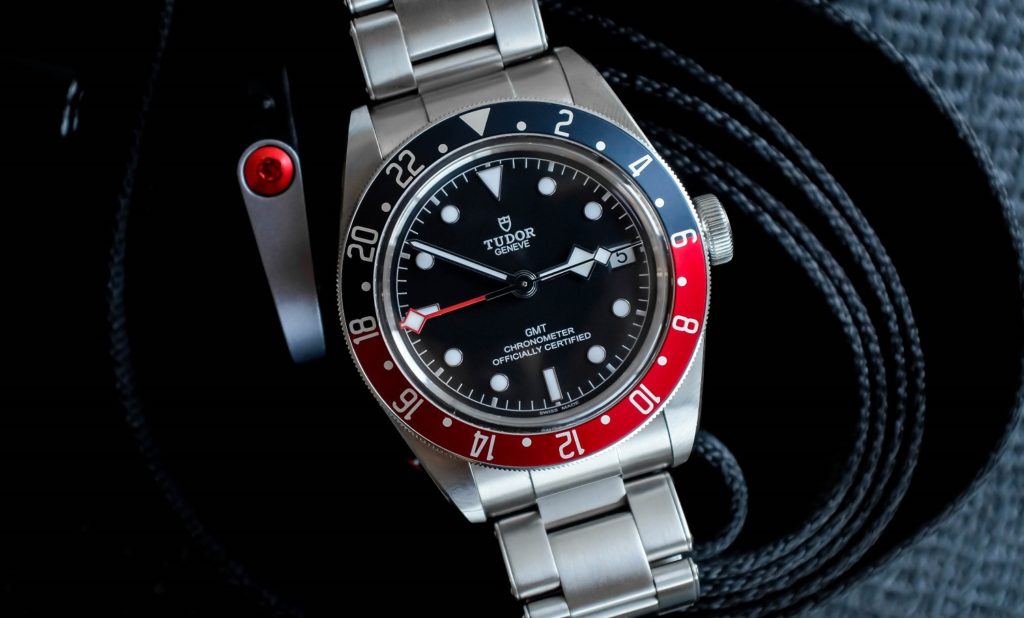
| Price: | $4,300 |
| Water Resistance: | 200m |
| Case Dimensions: | 41mm (diameter) x 50mm (lug-to-lug) x 14.7mm (thickness) |
| Lug Width: | 22mm |
| Movement: | Tudor Caliber MT5652 Automatic Movement (COSC) |
The Tudor Black Bay GMT makes sense when the Seiko 5 GMT has already done its job, and now you want to see what spending more gets you in day-to-day use. What stood out to us was not that it felt flashy or overbuilt, but that it felt sorted. The bracelet has that dense, confident Tudor feel, and the watch itself comes across as a proper travel tool rather than a dress-up version. We also kept coming back to the fact that it wears well on steel or fabric. On the bracelet, it feels substantial and planted. On a nylon strap, it leans further into its tool-watch side, even if that setup adds a bit more height. It is also one of those watches that becomes easier to justify if you are open to pre-owned examples, where the value story becomes much more convincing.
The case is still the main thing to think through before buying. At 41mm wide, 50mm lug-to-lug, and 14.7mm thick, including the domed sapphire crystal, this is not a small GMT by any reasonable standard. On a 7.5-inch wrist, though, it settled in comfortably during review, and the sharply downturned lugs did a lot to keep it wearable through full days. That subtle bevel along the case side helped too, giving the watch a little visual softness as the wrist moved. The thickness is noticeable, especially under sleeves, and anyone with a wrist under 7 inches will probably want to be realistic about the fit. Still, the brushed top surfaces, polished slab sides, and aluminum bezel keep it from feeling like a block of steel strapped to your arm.
Where it starts to separate itself from more affordable GMTs is in the actual travel experience. The MT5652 gives you true flyer GMT functionality, so jumping the local hour hand is quick and intuitive once the watch is set up. That matters more in real travel than most people realize until they have used it. For more information on the order of operations for time settings, refer to our dedicated review.
The matte black dial stays clean and easy to trust at a glance, the lume on the markers and snowflake hands is generous, and the red GMT hand reaches far enough to make the 24-hour bezel simple to read. The burgundy-and-blue bezel provides clear day-and-night separation, while the domed crystal adds some warmth and vintage character, even as it contributes to the overall height. During wear, accuracy hovered around +4 seconds per day, which was easy enough to forget about once the watch was on.
For collectors ready to move beyond the Seiko 5 GMT, this is the kind of upgrade that feels more complete, more robust, and more purpose-built without losing sight of what makes a GMT fun in the first place.
Pros
- Flyer GMT functionality makes local time changes much easier in real-world travel.
- The dial is highly legible, with strong lume and a GMT hand that is easy to track against the bezel.
- Bracelet quality is excellent, and the watch works well on alternative straps, too.
- It becomes appealing if you are willing to shop the secondary market.
Cons
- The domed crystal adds to an already tall case.
- Lug-to-lug length may still be a problem on smaller wrists.
- No factory half links means dialing in the bracelet fit can take extra effort.
Nomos Zürich World Time Midnight Blue
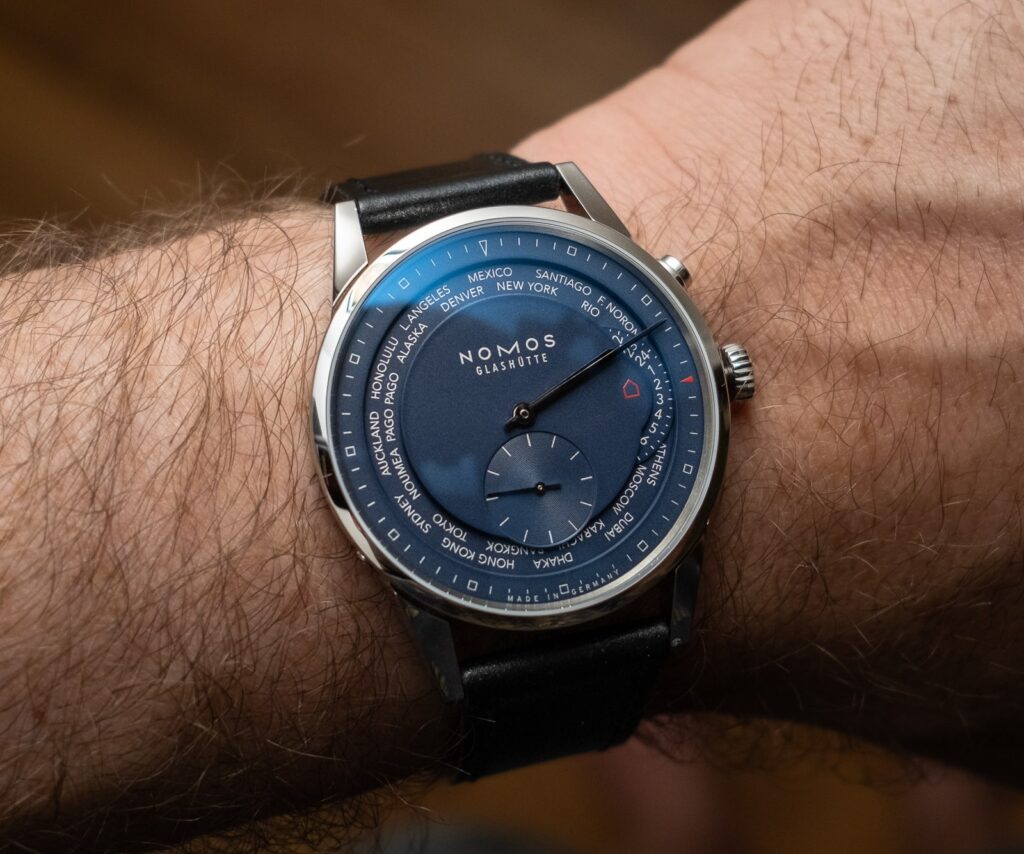
| Price: | $6,100 |
| Water Resistance: | 30m |
| Case Dimensions: | 40mm (diameter) x 50mm (lug-to-lug) x 11mm (thickness) |
| Lug Width: | 20mm |
| Movement: | Nomos DUW 5201 Automatic |
The Nomos Zürich World Time is an interesting move for someone coming from a Seiko 5 GMT because it does not try to win on ruggedness or sheer feature count. It wins on restraint. After nearly ten months in rotation, what stood out in our review was how distinctive it felt without ever turning loud. The blue dial plays a big role in that. It stays matte and calm, shifting subtly between navy and steel depending on the light, without dominating the layout. That restraint keeps the city ring and rhodium hands easy to follow, while the small red home-time indicator adds enough contrast to stay visible indoors and in the harsher light of an airport terminal. It is a thoughtful layout for people who want functional travel features without feeling like they are wearing a dashboard on the wrist.
The travel function is also handled in a quite direct way. A push of the button advances local time without messing with the crown, and that GMT-style setup is really the key to understanding this watch. Nomos calls it a world timer, but in practice, it behaves more like a GMT with extra personality, which is worth being honest about up front.
Inside, the in-house DUW 5201 delivers a 42-hour power reserve and, in our hands-on review, reinforced the sense that this was a complication-first design made usable rather than fussy. The shell cordovan strap helps, too. It keeps the watch comfortable and gives the whole thing a more relaxed feel than the polished case alone might suggest.
That said, the Zürich is not trying to be an everything watch. At 40mm wide, 50mm lug-to-lug, and 11mm thick, it stays slim, but those long lugs will still push the fit too far for some wrists. The fully polished case also wears more quickly than a brushed tool watch, and the 30 meters of water resistance make it clear this is not the one to treat like a sports watch. Still, for collectors ready to spend more after a Seiko 5 GMT, this feels like a thoughtful turn: more refined, more unusual, and more about living with a clever complication than chasing a tougher-looking bezel.
Pros
- The push-button local-time adjustment makes travel use simple and very intuitive.
- The dial setup adds depth and character without making the watch feel busy.
- It wears with more versatility than most travel watches and can be dressed up or down.
- The DUW 5201 and shell cordovan strap help the watch feel considered in everyday use.
Cons
- The long lug-to-lug measurement will rule it out for some wrists.
- The polished case is quick to show wear if you are not careful.
- It behaves more like a GMT than a true world timer, so expectations matter.
If you’ve moved on from the Seiko 5 GMT, landed on one of these, and feel the extra spend is justified, we’d like to hear about your thoughts. And if there’s a GMT we missed that deserves a spot here, share it in the comments and we can see about working to get one in for a hands-on review.

Co-Founder and Senior Editor
Kaz has been collecting watches since 2015, but he’s been fascinated by product design, the Collector’s psychology, and brand marketing his whole life. While sharing the same strong fondness for all things horologically-affordable as Mike (his TBWS partner in crime), Kaz’s collection niche is also focused on vintage Soviet watches as well as watches that feature a unique, but well-designed quirk or visual hook.
Nice work calling out the lug to lug measurement, It is super important. The Monta still has a pretty good spot in this lineup though I feel like most are simply an homage to the GMT Master.
Hey Mike – you’re not wrong about the GMT Master influence. The question is whether a brand brings enough of its own identity to the format. Some do, some don’t. I think Monta does.