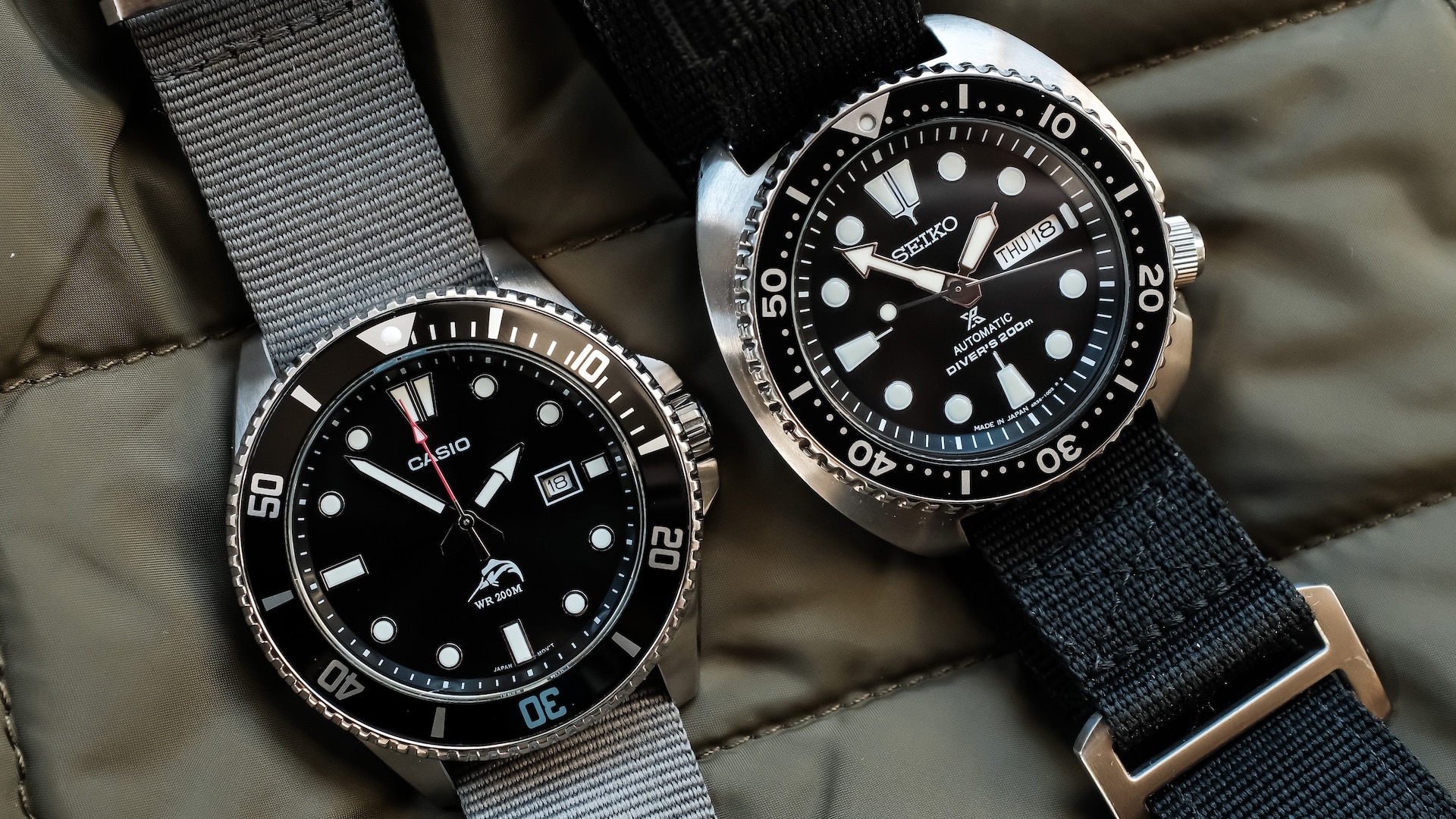
Finding a dive watch when you’ve got a larger wrist sounds easy on paper: just go bigger, right? That’s what we thought, too, until we started actually living with these pieces. Over time, we realized that “big” doesn’t always mean wearable. Some watches look elegant but sit awkwardly, others wear smaller than their specs suggest, and a few nail that balance where the case, lug span, and weight all make sense together. We kept coming back to pieces like the Seiko Turtle and Seiko Sumo because they feel right after a full day on the wrist (or a long weekend where you forget to take them off entirely).
We’ve been reviewing watches for close to a decade, but more importantly, we’ve worn them in rotation to notice what truly works for larger wrists, and what just looks good in photos. We’ve timed movements, dealt with awkward crown placement, and adjusted more dive bracelets than we care to admit. Watches like the Citizen Promaster Aqualand, Sinn T50, and Panerai Luminor Marina have taught us that size alone doesn’t guarantee comfort or presence. This list comes from those experiences: large dive watches we’ve handled, compared side-by-side long enough to understand how they behave outside of a spec sheet.
Casio Duro
| Price: | $85 |
| Water Resistance: | 200m |
| Case Dimensions: | 44.2mm (diameter) x 48.5mm (lug-to-lug) x 12.1mm (thickness) |
| Lug Width: | 22mm |
| Movement: | Casio 2784 Quartz |
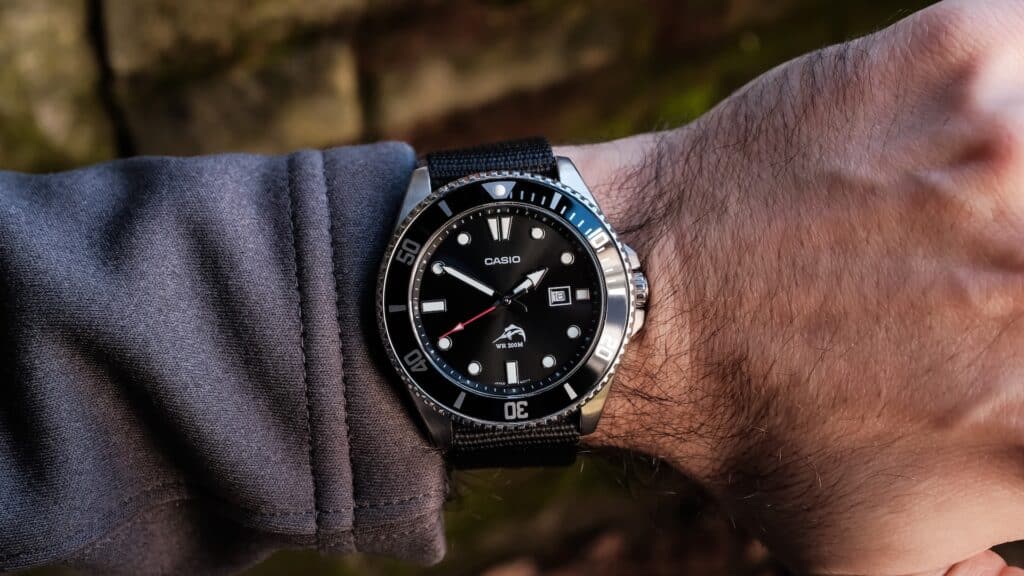
A 44mm dive watch normally raises some eyebrows, but the Casio Duro lands differently once it’s on the wrist. The case has a shorter-than-expected lug-to-lug and enough downward curvature to avoid sprawl, while still carrying that larger presence. If you’ve spent time with something like the Seiko Turtle, the way the Duro sits will feel familiar: substantial, but not clumsy. For larger wrists, that balance matters more than the raw diameter.
What makes the Duro easy to live with, though, isn’t only size; it’s how little it asks from you. The quartz movement hacks and includes a quick-set date, and, in our hands-on experience, stayed within about ±20 seconds per month. That kind of consistency changes your relationship with the watch. You can leave it sitting for a few days, come back, and it’s still ready without needing a reset. It’s the kind of low-maintenance setup that fits naturally into everyday wear, especially if you rotate between watches.
The dial keeps things simple in a way that works. Under a flat mineral crystal, the arrow-shaped hands reflect light clearly, and the applied indices give the dial enough depth to avoid feeling flat. Casio kept the text restrained: brand at twelve, 200m water resistance at six, and the framed date at three is clean and easy to glance at. Lume is usable and easy to charge up, though during longer stretches in the dark, it fades earlier than we’d prefer.
From a functional standpoint, it behaves like a proper dive watch. The screw-down crown and solid caseback inspire confidence in water, and the aluminum bezel rotates with a controlled, deliberate feel. It never developed that loose, rattly action we’ve seen on other watches in this price range. The 22mm lug width also makes strap swaps painless: we’ve run it on rubber, nylon, and bracelets without any fuss.
Pros
- The 44mm case wears more comfortably than expected, especially for larger wrists.
- Quartz movement stays accurate and doesn’t require constant attention.
- The bezel action feels tight and controlled, not cheap or loose.
- Clean, legible dial with thoughtful details like applied indices and a framed date
- 22mm lugs make it easy to experiment with different straps.
Cons
- Mineral crystal will pick up scratches faster than sapphire over time.
- Lume is functional, but doesn’t last through extended low-light periods.
- Still wears large: great for bigger wrists, but overwhelming on smaller ones
Momentum Sea Quartz 30
| Price: | $279 |
| Water Resistance: | 300m |
| Case Dimensions: | 42mm (diameter) x 47mm (lug-to-lug) x 11.3mm (thickness) |
| Lug Width: | 20mm |
| Movement: | Ronda R507 high-torque quartz |
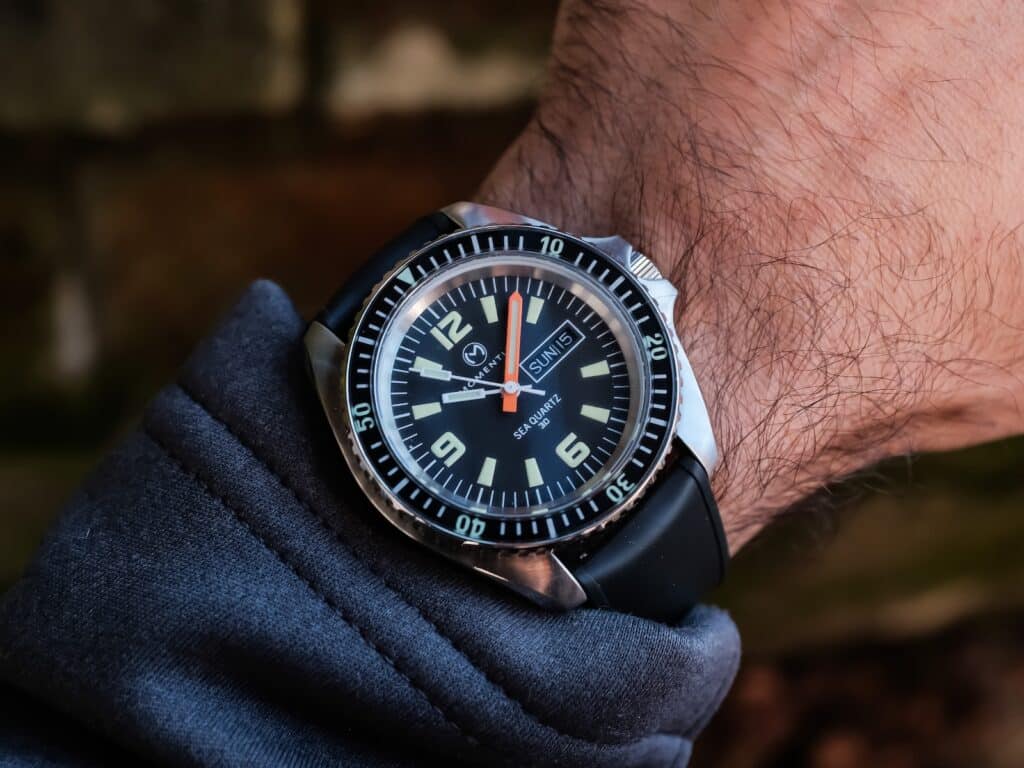
The Sea Quartz 30 doesn’t rely on raw size to make sense on a larger wrist, which is part of its appeal. At 42mm with a relatively short 47mm lug-to-lug, it lands in that middle ground, filling out the wrist without overreaching. On paper, it sounds modest compared to some of the heavier hitters on this list, but the flat caseback and balanced proportions help it sit evenly and stay comfortable through long stretches of wear. During our review, we found it wears a bit broader than expected because of the case shape, which gives it more presence than the numbers suggest. For anyone who wants a larger feel without jumping into oversized territory, this one hits a nice middle point.
Momentum kept the case design close to its late 70s inspiration, but the execution feels modern where it counts. The sapphire bezel insert trades some vintage charm for durability, and that decision makes sense once you start using the watch casually. The brushing on top, with polished sides, gives it some structure without feeling decorative, though the polished underside does pick up scratches more quickly than we’d like during strap changes. Crown action feels smooth and reliable, but the bezel is where things get a bit frustrating. It’s tight, harder to grip than it should be, and never quite disappears during use. Not a dealbreaker, but something you notice every time you try to time something.
The dial keeps things restrained in a way that works over time. Matte black, simple printed markers, and paddle-style hands make it easy to read without trying too hard. The orange minute hand adds enough contrast to be useful when you need to track elapsed time. Lume is decent at first charge but fades earlier than some of the better performers we’ve worn. It gets the job done, just don’t expect it to carry through the entire night.
What makes this watch easy to live with is the quartz setup. The Ronda movement is accurate, low-maintenance, and gives the watch that grab-and-go quality we tend to appreciate more over time. Add in 300 meters of water resistance, and it feels more capable than most of us will ever push it. The included tropic-style rubber strap surprised us with how comfortable it was, and the case design works as well on NATO or aftermarket rubber if you feel like switching things up. Momentum also offers a jubilee-style bracelet for this model, which you can consider as a long-term replacement.
Pros
- The 42mm case wears larger than expected without becoming awkward.
- Flat caseback and short lug-to-lug improve long-term comfort.
- The sapphire bezel adds durability for everyday use.
- Quartz movement keeps things simple and reliable.
- Strap versatility works well across rubber and NATO options.
Cons
- The bezel is stiff and difficult to grip during use.
- Lume fades quicker than some alternatives.
- Polished caseback and lugs pick up scratches easily.
Seiko Turtle
| Price: | $370 – $525 |
| Water Resistance: | 200m |
| Case Dimensions: | 44.3mm (diameter) x 48mm (lug-to-lug) x 14mm (thickness) |
| Lug Width: | 22mm |
| Movement: | Seiko 4R36 |
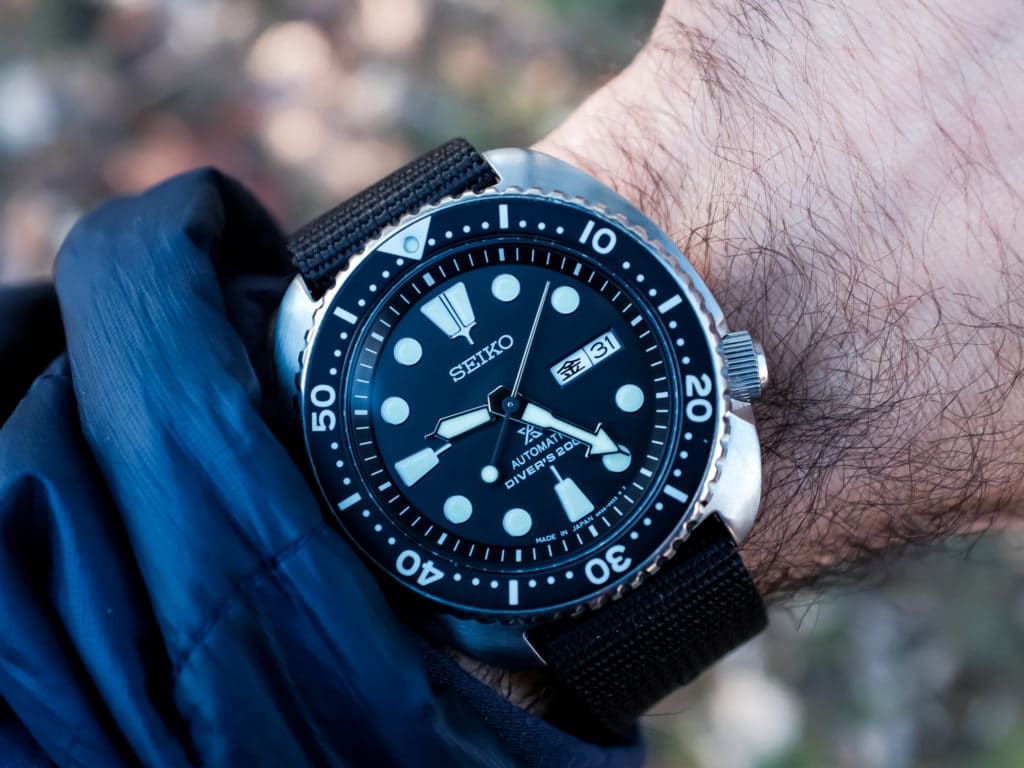
The Turtle is one of those watches that looks oversized on paper but makes a lot of sense once it’s on a larger wrist. It sits north of 44mm, but the cushion-shaped case spreads that size across the wrist instead of stacking it upward. That shape, combined with the curved profile, keeps it from feeling top-heavy or awkward. It’s a watch we’ve worn on long travel days and beach trips where comfort matters, and the way it distributes weight is a big part of why it keeps coming back into rotation. Another detail that helps over time is the crown placement. Seiko shifts it slightly off to the side, and that small change makes a noticeable difference. It stays out of the way instead of digging into the back of your hand, especially if you’re moving around a lot during the day. For a larger watch, that kind of ergonomics goes a long way.
The dial leans heavily into legibility, which fits the tool-watch mindset. The matte black surface cuts down glare outdoors, and the oversized Lumibrite markers are easy to read at a glance, even in low light. It’s the kind of watch where you don’t have to second-guess the time. Seiko uses Hardlex instead of sapphire here, which might sound like a compromise, but in our personal experience, it holds up well enough and keeps the overall cost reasonable. The Prospex “X” logo gets its share of criticism online, though on the wrist it tends to fade into the background.
Under the hood, the 4R36 automatic movement does what it needs to do without trying to be anything more. Our example ran within roughly +35 to +45 seconds per day, which is typical for this movement. It’s not precise in a technical sense, but the hacking and hand-winding features make small adjustments quick and painless if you care to dial it in.
The bezel action feels reassuring during use, though alignment can still be hit or miss depending on the piece. That’s a known Seiko quirk at this point. The watch also comes in variations such as the “Made in Japan” version and models with a Kanji day wheel. The Kanji adds personality, but can slow a quick day check once the novelty wears off. The stock silicone strap is softer than older versions and comfortable enough out of the box, but the Turtle really opens up once you start swapping straps. It works as well with NATO or other casual options, adding to its everyday flexibility.
Pros
- The large cushion case wears comfortably and evenly on bigger wrists.
- The offset crown improves comfort during extended wear.
- Strong lume and matte dial make it very legible in most conditions.
- Strap versatility makes it easy to adapt to different styles.
- Solid water resistance with a screw-down crown adds everyday durability.
Cons
- Bezel alignment isn’t always perfectly centered.
- Movement accuracy can vary between individual watches.
Citizen Promaster Aqualand
| Price: | $550 |
| Water Resistance: | 200m |
| Case Dimensions: | 50.7mm (diameter) x 51mm (lug-to-lug) x 14.8mm (thickness) |
| Lug Width: | 24mm |
| Movement: | Citizen C520 Quartz |
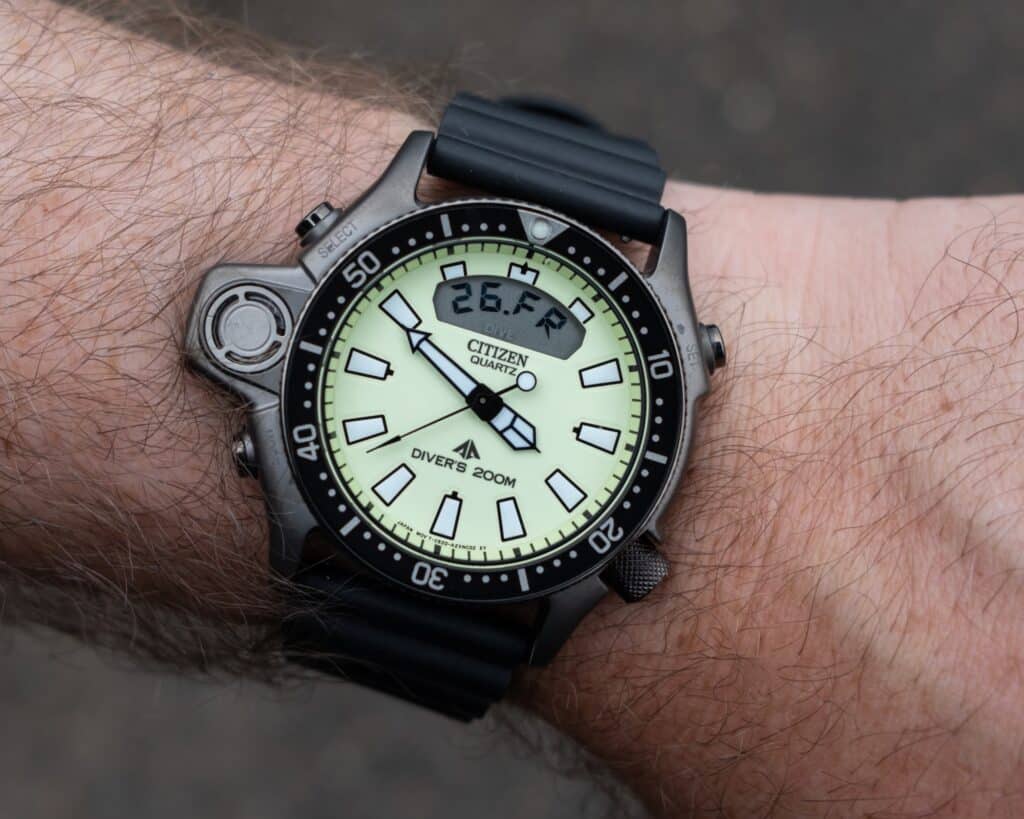
The Aqualand doesn’t try to blend in, and that’s why its great for larger wrists. The main case measures around 43mm, but once you factor in the external depth sensor, you’re looking at something closer to 50mm across. Add the 24mm strap, and the whole thing spreads out like a proper wrist presence. During our in-depth review, we determined that it wears more like equipment than a watch. It’s wide, yes, but it never felt clumsy. If anything, the size feels intentional. For bigger wrists, that extra surface area fills things out in a way smaller divers simply can’t.
Functionality also plays into that experience. This isn’t just styled like a dive watch. It’s a full dive computer. You can track depth, log dives, set alerts, and even get warnings if you ascend too quickly. Most of us won’t use all of that regularly, and we didn’t either, but having those features there changes how you think about the watch. It feels capable. Outside of diving, the digital functions cover the basics. Alarm, chronograph, elapsed time, and calendar functions are easy to navigate once you get used to the layout. The analog hands and digital display run independently but stay in sync once set, which we didn’t have to fuss with after initial setup.
The rest of the watch leans heavily into usability. The bezel has a firm, deliberate action and lines up properly, which isn’t always a given at this price. The screw-down crown is large and easy to grip, and the pushers make more sense the longer you use them. The rubber strap is soft, well-ventilated, and long enough to accommodate larger wrists without feeling tight. It wears securely without needing constant adjustment.
Legibility is a bit of a mixed bag depending on the situation. The fully lumed dial is very bright and lasts for hours, which makes it great in low light. At the same time, when everything is glowing at once, contrast can drop slightly. In practice, it never stopped us from reading the time, but you notice it. Quartz accuracy keeps everything running reliably in the background, and the fact that these often show up well below retail on the pre-owned market adds to the appeal.
Pros
- The large case and external depth sensor create a strong wrist presence for bigger wrists.
- Full dive computer functionality with depth tracking and safety alerts
- Bright, long-lasting lume makes it easy to read in the dark.
- Comfortable rubber strap with plenty of length and ventilation
- Reliable quartz performance with strong value on the secondary market
Cons
- The wide case and 24mm strap can feel excessive on smaller wrists.
- Limited strap options due to the larger lug width
- Many dive features may go unused for everyday wear.
- The fully lumed dial can reduce contrast in certain conditions.
Seiko Sumo
| Price: | $600 – $800 |
| Water Resistance: | 200m |
| Case Dimensions: | 45mm (diameter) x 52.6mm (lug-to-lug) x 13.5mm (thickness) |
| Lug Width: | 20mm |
| Movement: | 6R35 (Automatic Movement) |
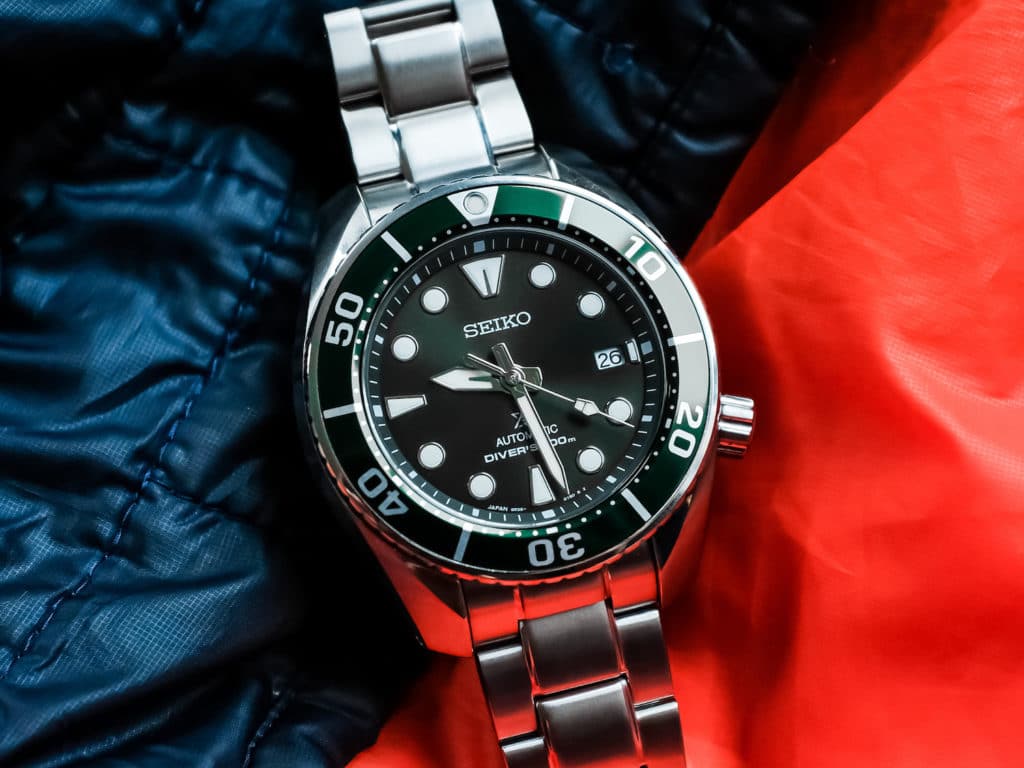
The Seiko Sumo is one of those watches that often gets overlooked, which is strange once you spend time wearing it. On paper, a 45mm case sounds like a commitment. In reality, it wears far more comfortably than most people expect. The long, sweeping curves from lug to lug help the case sit naturally, and the way the mid-case wraps around the wrist keeps it from feeling bulky. For larger wrists, this is where the Sumo stands out. It has real presence, but the soft case profile keeps it from turning into a block of steel on your arm.
What makes the Sumo interesting is how it balances two identities. It has the build of a proper dive watch, featuring 200 meters of water resistance, a screw-down crown, and a solid caseback. At the same time, the mix of brushed and polished surfaces gives it a slightly dressier feel than something like the Turtle. Our review team noticed this especially in changing light. The polished edges catch reflections, while the brushed surfaces keep things grounded. It ends up working in more situations than you’d expect for a watch this size.
The dial plays into that versatility. The blue tone on the “Blumo” variant shifts depending on lighting, sometimes appearing deep and muted, other times brighter and more vibrant. Applied round markers and polished surrounds add depth, and the contrast between the hands and dial makes it easy to read at a glance. The beveled chapter ring draws your eye inward and adds a bit more structure to the dial without feeling busy.
On the wrist, the bracelet feels solid with its brushed tops and polished sides, though the lug width is a bit of a sticking point. It’s narrower than you might expect for a watch this large, which can make the proportions feel a bit off to some. Strap options can also be tricky. The spacing between the case and lugs means not every strap fills the gap cleanly. NATOs tend to work best if you want to switch things up, though the stock bracelet remains the easiest option. The 6R35 automatic movement inside is straightforward and dependable. It offers around a 70-hour power reserve, along with hand-winding and hacking, which makes daily use simple. More than precision, it’s about consistency and ease of use over time.
Pros
- The large case wears well thanks to curved lugs and balanced proportions.
- A nice combination of brushed and polished finishes adds versatility beyond a typical diver.
- Strong dial legibility with applied markers and good contrast
- Solid build with reliable water resistance and screw-down components
Cons
- Strap pairing can be tricky due to the spacing between lugs and the case.
- Price sits in an awkward middle ground compared to other Seiko divers.
Luminox Pacific Diver
| Price: | $875 |
| Water Resistance: | 200m |
| Case Dimensions: | 44mm (diameter) x 12mm (thickness) |
| Lug Width: | 24mm |
| Movement: | Ronda 515 quartz |
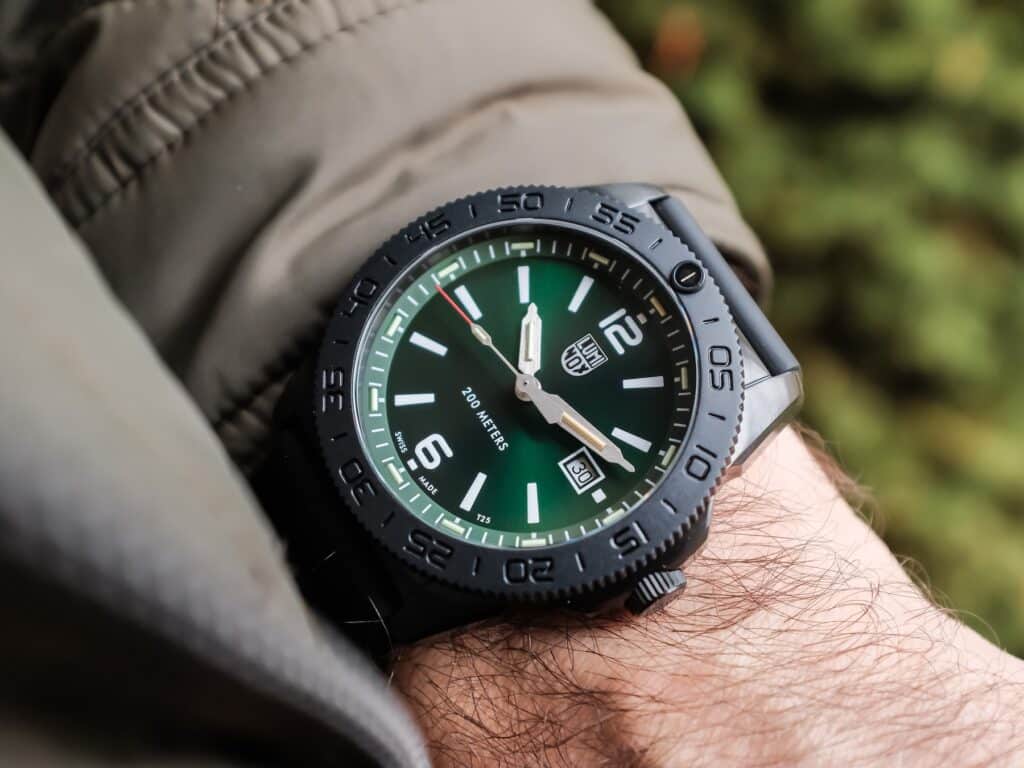
The Luminox Pacific Diver is one of those watches that looks like it should feel heavy the second you see its 44mm case. Once it’s on the wrist, that assumption falls apart pretty quickly. At over 100 grams on the rubber strap, it wears lighter than most steel divers in this range. The relatively slim 12mm thickness also helps. It sits closer to the wrist instead of stacking upward, which makes a difference during longer wear. For larger wrists, that combination of size and low weight creates an easy presence. It fills out the wrist without reminding you it’s there.
The dark IP-coated steel case also plays a role in how it wears. Black finishes tend to shrink things a bit visually, and that effect shows up here. Even with crown guards and the matching case detail on the opposite side, the watch feels more contained than the numbers suggest. The 24mm lug width adds to the overall stance, though it still leans wide depending on your preference. From a durability standpoint, it’s a straightforward setup. You get 200 meters of water resistance along with a screw-down crown. It also has a sapphire crystal with an anti-reflective coating. It’s the kind of watch you can throw on without thinking too much about where you’re going.
The dial keeps things relatively restrained. The emerald green tone shifts subtly with light, adding depth without becoming a distraction. Printed markers keep things clean and readable, and the minimal text avoids clutter. Where things get more interesting is the tritium tube setup. Instead of traditional lume that fades over time, these tubes stay consistently visible throughout the night. It’s not a good, glowing effect. It’s more of a steady, always-there visibility that you start to appreciate the longer you wear it. You don’t have to think about charging the lume or checking if it’s faded. The bezel action is solid, with tight rotation and very little play. The trade-off is legibility. The fully blacked-out insert looks cohesive, but it can be harder to read quickly, especially in low-contrast situations. In casual use, it wasn’t a major issue for us, but it’s worth noting if you rely on bezel timing regularly.
As also mentioned in our dedicated review, the rubber strap is comfortable and wears well once sized, though getting it to fit requires cutting it. That process can feel a bit stressful, especially at this price point, since there’s no going back once it’s trimmed. Once done, though, it sits cleanly on the wrist and avoids excess strap bulk. The quartz movement inside keeps things simple. It’s reliable, low-maintenance, and helps keep the overall case thickness in check.
Pros
- The large 44mm case wears lighter and slimmer than expected.
- Dark case finish reduces visual bulk on the wrist.
- Tritium tubes provide constant, no-maintenance nighttime visibility.
- Strong build with a sapphire crystal and solid water resistance
- Comfortable rubber strap once properly sized
Cons
- Cut-to-size strap requires commitment and can be nerve-wracking.
- The blacked-out bezel is harder to read at a glance.
- 24mm lug width limits strap options.
Longines HydroConquest 41mm Automatic
| Price: | $1,600 |
| Water Resistance: | 300m |
| Case Dimensions: | 41mm (diameter) x 50mm (lug-to-lug) x 11.9mm (thickness) |
| Lug Width: | 21mm |
| Movement: | Longines L888 |
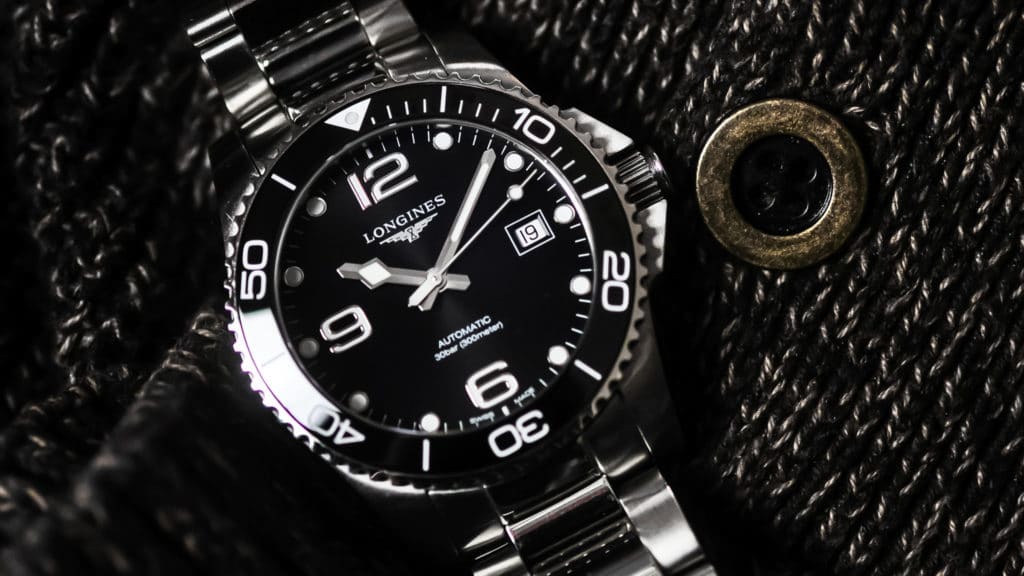
The Longines HydroConquest doesn’t rely on extreme sizing, but it still works well on larger wrists thanks to its broad case. At 41mm with a 50mm lug-to-lug, it has more reach than the diameter suggests. Those longer lugs give it a wider stance across the wrist, which helps it feel more substantial without pushing into oversized territory. What stood out to us over time was how stable it feels. The caseback sits close to the case, keeping the center of gravity low. That means it stays planted instead of sliding around, even during longer days or when moving between desk work and being outdoors.
The case design also solves a few things we didn’t expect. The crown guards look sharp and aggressive at first glance, but they sit high enough that they never dug into the wrist during wear. We were able to adjust and wind the crown without taking the watch off, which is something we always appreciate in daily use. Around the case, the finishing feels more refined than most dive watches in this range. The ceramic bezel insert replaces the older aluminum style and holds up better to scratches, especially if you wear it regularly rather than save it for occasional use.
The dial leans toward clarity with a bit of polish. The black sunburst finish catches light without becoming distracting, and the simplified minute track makes the layout easier to read compared to earlier versions. Large numerals stand out clearly, and the diamond-shaped hour hand becomes quite noticeable in low light. Lume is strong at first charge but settles into a softer glow as the night goes on. Even then, the markers’ contrast keeps things readable without much effort.
Inside, the L888 automatic movement brings a longer 72-hour power reserve, which makes a difference if you rotate watches during the week. In our use, it stayed within about -5 to +15 seconds per day and ran quietly in the background. It’s not something you think about often, which is exactly the point. Add 300 meters of water resistance and a solid screw-down caseback, and it feels ready for more than casual wear. The oyster-style bracelet feels a bit more straightforward. It’s comfortable and gets the job done, but the design is quite simple compared to the rest of the watch. The 21mm lug width also limits strap options slightly, which is something to keep in mind if you like to swap straps often.
Pros
- Long lug-to-lug gives the watch a strong wrist presence without oversized bulk.
- Low center of gravity keeps it stable and comfortable throughout the day.
- The ceramic bezel resists scratches and feels more durable in daily use.
- 72-hour power reserve makes it easy to rotate with other watches.
- Clean, legible dial with thoughtful updates to layout and markers
Cons
- The bracelet design feels basic compared to the case finishing.
- 21mm lug width limits aftermarket strap options.
- Lume fades faster than some competing dive watches.
Seiko Marinemaster
| Price: | $3,100 |
| Water Resistance: | 300m |
| Case Dimensions: | 44mm (diameter) x 50.5mm (lug-to-lug) x 15.4mm (thickness) |
| Lug Width: | 20mm |
| Movement: | Seiko 8L35 (Automatic Movement) |
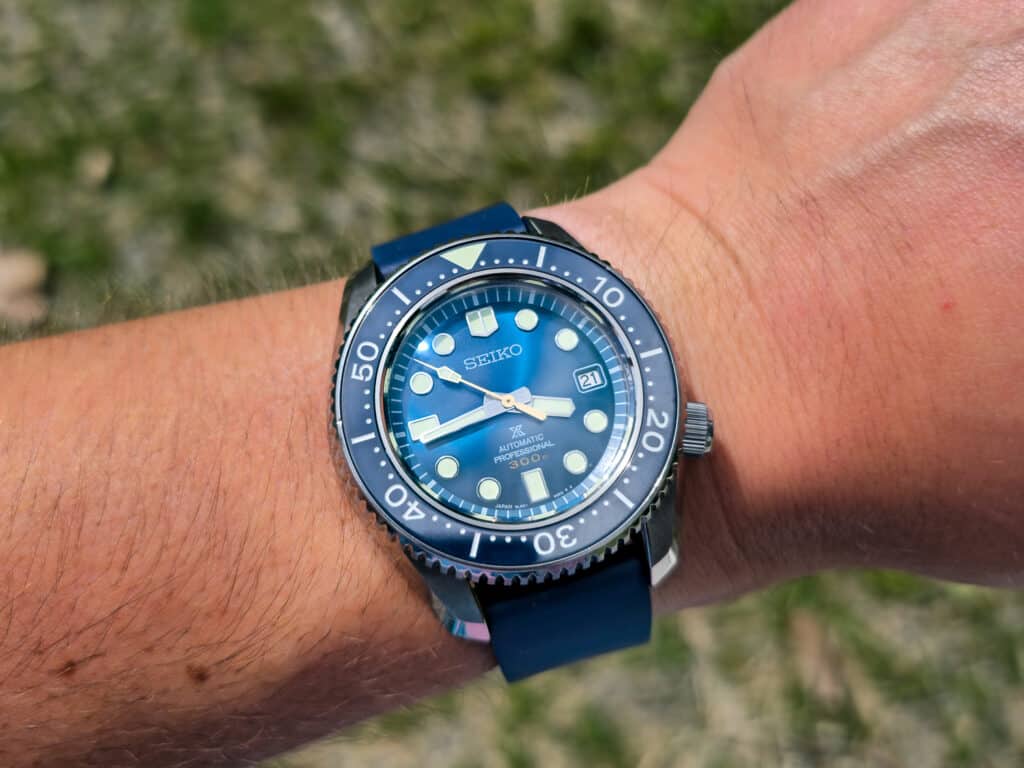
The Marinemaster 300 is one of those watches that fully commits to being large. At around 44mm with serious weight behind it, this is not something you casually forget you’re wearing. On the bracelet, it pushes close to 200 grams, and that’s something you feel immediately. For larger wrists, though, that heft can work in its favor. It fills out the wrist in a way that lighter watches sometimes don’t, but it also requires a bit of adjustment before it feels natural.
What surprised us more during testing was how the case wears compared to what the specs suggest. The monocoque construction gives it a solid, single-piece feel, and the sculpted sides help reduce its apparent width. The polished flanks reflect light, visually slimming the case, while the relatively compact dial keeps things from feeling oversized. It ends up wearing closer to something like a modern Submariner than you’d expect, at least in terms of footprint. The smooth caseback also helps it sit evenly on the wrist, though servicing requires going through the front of the case, which is something to keep in mind long term.
The bezel is one of those elements you notice every time you use it. It sits tall and is easy to grip, even with gloves, and the action feels firm and consistent. It’s not sharp or clicky in the typical Swiss sense. Instead, it has a smoother, almost fluid resistance that feels deliberate and controlled. It’s different, but in a way that grows on you. The dial is what pulls you in. The blue variant shifts nicely in different lighting and holds its tone better than most sunburst dials we’ve seen. Details like the framed date and subtle gold accents add character without making it feel flashy. Lume is easily one of the strongest we’ve experienced. It charges quickly and stays visible throughout the night, which makes a real difference if you rely on it in low-light situations.
Inside, the 8L35 movement brings a noticeable step up from Seiko’s mid-tier calibers. In our experience, it stayed within +/- 4 seconds per day, even though Seiko officially rates it more loosely. It feels stable and dependable, and that consistency shows over time. Where things fall apart a bit is the bracelet. It’s heavy, the links are long, and articulation is limited. The male end links also extend the lug-to-lug length, which can make the watch feel larger than it needs to be. We ended up quickly moving it to rubber or NATO, where it became much more wearable. On a good strap, the whole experience shifts from something cumbersome to something you want to keep on.
Pros
- Large case with sculpted sides wears smaller than expected for its size.
- Exceptional lume that remains visible throughout the night
- High-grade 8L35 movement delivers strong real-world accuracy.
- Monocoque case construction adds durability and a solid feel.
- The bezel action feels smooth, firm, and easy to use.
Cons
- Very heavy on the stock bracelet
- The bracelet design and articulation fall below expectations for the price.
- Male end links increase the overall wrist footprint.
- Servicing requires front-loading the movement.
Sinn T50
| Price: | $4,400 |
| Water Resistance: | 500m |
| Case Dimensions: | 41mm (diameter) x 47mm (lug-to-lug) x 12mm (thickness) |
| Lug Width: | 20mm |
| Movement: | Sellita SW 300-1 |
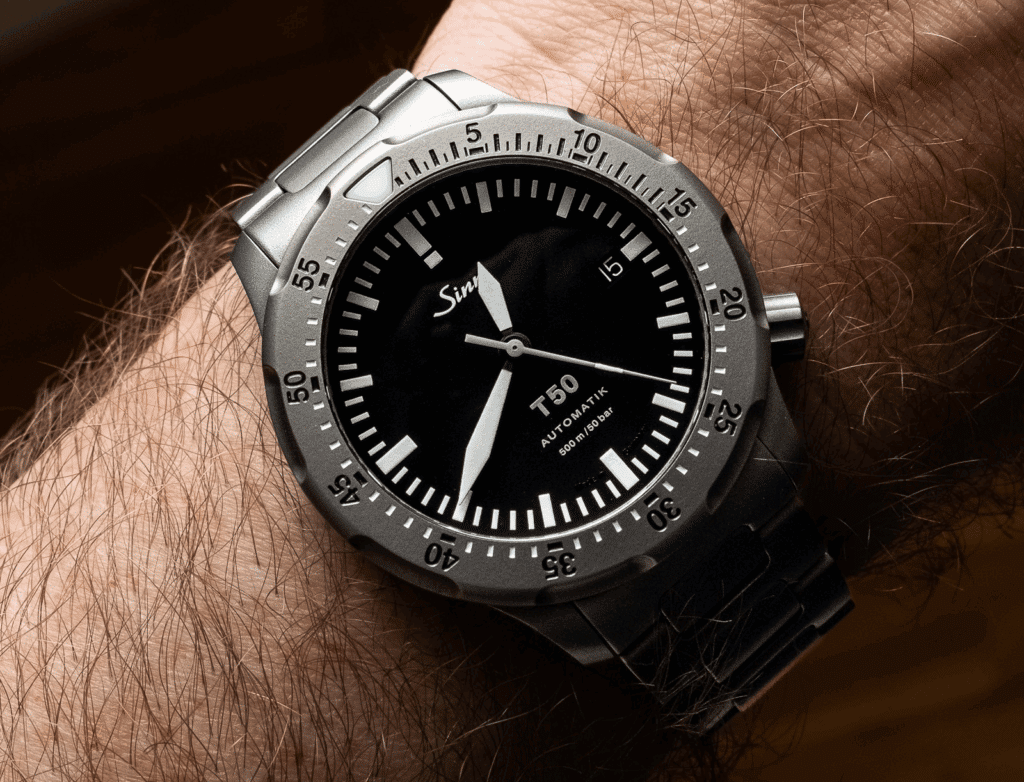
The Sinn T50 takes a different approach to sizing for larger wrists. It doesn’t rely on bulk or thickness to feel substantial. Instead, it spreads its presence across the wrist while keeping the overall weight quite low. At around 95 grams in size for a 7-inch wrist, it feels almost out of place compared to heavier steel divers. That lightness changes how you wear it. It sits low, stays balanced, and never becomes something you’re constantly aware of throughout the day. Whether we were at a desk, out on a bike, or running errands, it stayed comfortable without needing adjustment.
The matte titanium case plays a big role in that experience. It avoids reflections and keeps everything looking understated, which helps the watch feel more like a tool than an accessory. The 4 o’clock crown is easy to access and never digs into the wrist during movement, which matters more on a watch you plan to wear all day. The captive bezel system adds another layer of practicality. You have to press down before rotating it, which keeps it from shifting accidentally if you bump it against something. It’s one of those features you don’t think about until you notice it working.
Durability is handled thoughtfully as well. The tegimented bezel resists scratches better than standard titanium, which we saw firsthand during regular wear. The dial sticks to a simple black-and-white layout with sword hands and clean markers. It’s easy to read in most conditions, and the date window blends in without pulling attention. The lume on the second hand is useful for confirming the watch is running in the dark, though the small size means it takes an extra second to spot compared to larger lume plots.
Inside, the SW300 movement kept things steady during our time with it, running within about +2 to -3 seconds per day. The trade-off is the 42-hour power reserve. If you rotate watches and skip a day, there’s a chance you’ll come back to it stopped. It’s not a major issue, but it’s something to factor into how you use it. The bracelet is where things get a bit more mixed. The H-link design is comfortable and fits the overall look, but the diver extension felt unreliable. It could release with a light pull, which isn’t something you want to worry about. We ended up removing it and running a standard spring bar setup instead. The drilled lugs make strap swaps easy, and the watch works well on rubber or NATO if you prefer a simpler setup.
Pros
- Lightweight titanium case keeps long-term wear comfortable on larger wrists.
- Tegimented bezel resists scratches during daily use.
- The clean dial layout makes time easy to read at a glance.
- The captive bezel system prevents accidental movement.
Cons
- The diver extension can release too easily, making it feel insecure.
- Shorter power reserve limits flexibility for rotation.
- The small lume patch on the second hand is harder to spot quickly.
- Servicing requires going through Sinn directly.
Panerai Luminor Marina
| Price: | $4,600 – $5,500 |
| Water Resistance: | 100m |
| Case Dimensions: | 44mm (diameter) x 15mm (thickness) |
| Lug Width: | 24mm |
| Movement: | In-house, manual-winding P.6000 |
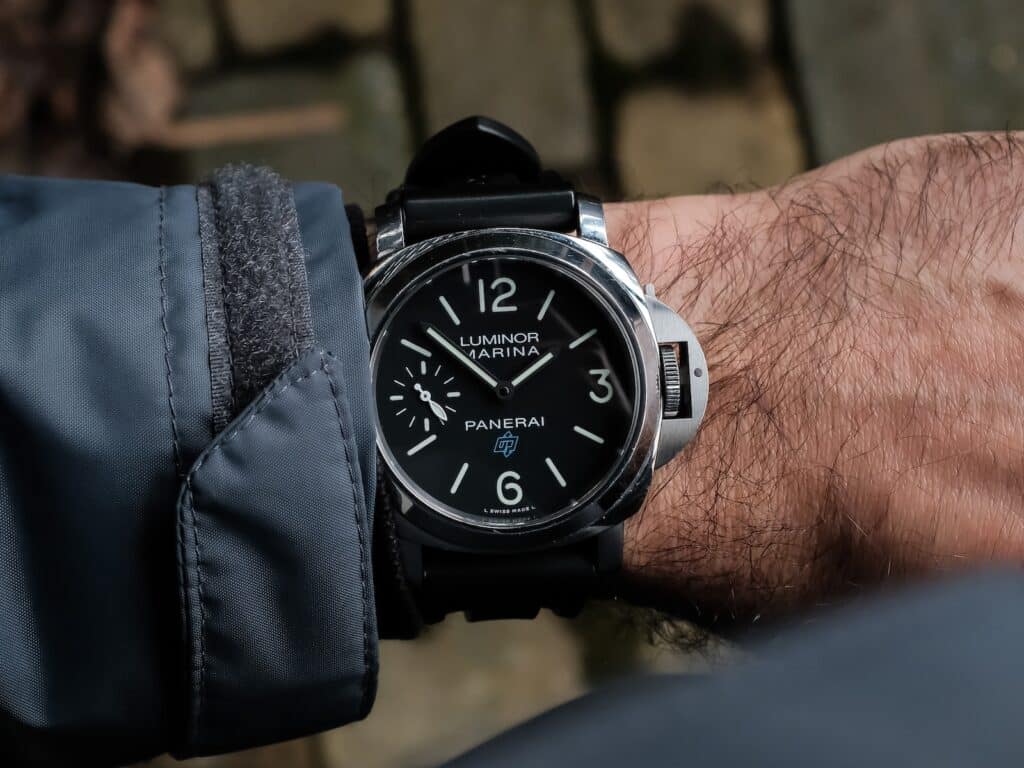
The Luminor Marina is one of those watches that does not attempt to hide its size. At 44mm, it wears large, and unlike some other divers, it doesn’t try to shrink itself visually. You feel it on the wrist, and that’s part of the experience. After spending hands-on time with it, we stopped thinking about whether it was “too big” and started accepting that this is how it’s meant to be worn. For larger wrists, that presence works. It fills the space confidently without feeling like it’s trying too hard. A lot of that comes down to how the case is built and how the signature crown guard functions. The lever mechanism feels precise every time you use it, and flipping it open to wind or set the watch becomes part of the daily routine. It’s one of those small interactions that make the watch feel more engaging over time. The case itself is highly polished, which gives it a strong visual impact but also means it will show scratches easily. We never felt the need to baby it, but you notice it as the watch picks up marks from regular wear.
The dial keeps things simple in a way that works well day to day. Large numerals and indices are printed directly onto the dial, and the layout stays clean with a small running seconds at 9 o’clock. It’s easy to read in most conditions without thinking about it. The small details stand out more the longer you wear it. The blue logo at 6 o’clock adds enough contrast to break up the otherwise minimal design. It’s subtle, but it gives the dial a bit of personality without overcomplicating things.
Inside, the manual-winding P.6000 movement keeps things straightforward. It offers a 3-day power reserve, which makes it practical if you rotate watches during the week. Winding it becomes part of the ownership experience, and the hacking seconds let you set it precisely if you care about that level of detail. In our time with it, the movement has been reliable and easy to live with, which matters more than decorative finishing you never see behind the solid caseback.
The standard Panerai rubber strap is 24mm wide and matches the watch’s scale. It takes a little getting used to, but once it settles in, it becomes one of the more comfortable setups for a watch this size. The quality is noticeable right away, and it holds up well over time. Strap changes are less of a ritual here than in older Panerai models, but we found ourselves sticking with the rubber strap anyway since it fits the watch so naturally.
Pros
- Large 44mm case delivers a strong wrist presence for bigger wrists.
- The crown guard mechanism adds a satisfying and practical interaction.
- Clean, highly legible dial with subtle design details
- Reliable in-house movement with a useful 3-day power reserve
- High-quality rubber strap that suits the watch’s size and feel
Cons
- Polished case shows scratches easily over time.
- 24mm strap width limits variety and feels substantial.
- Water resistance is lower than that of some traditional dive watches.
That’s our take on a handful of dive watches that make sense if you’ve got a larger wrist to fill. None of these are flawless. A few are awkward on certain straps, some carry more weight than expected, and others make small trade-offs along the way. But when the proportions are right, that stuff tends to matter a lot less. Please let us know your thoughts on our picks in the comments below. Also, if you think we are missing any watches from this breakdown, let us know and we’ll see if we can conduct a hands-on review of it.

Co-Founder and Senior Editor
Kaz has been collecting watches since 2015, but he’s been fascinated by product design, the Collector’s psychology, and brand marketing his whole life. While sharing the same strong fondness for all things horologically-affordable as Mike (his TBWS partner in crime), Kaz’s collection niche is also focused on vintage Soviet watches as well as watches that feature a unique, but well-designed quirk or visual hook.
Nothing from Orient is a crime
That just means we need to go hands on with the M-FORCE!
Strange that there is no love for omega. The ultra deep and planet ocean come to mind.
Both are great watches. We tend to stick to pieces we’ve had hands-on time with for these roundups, and neither made it onto the wrist this time around. Doesn’t mean they don’t belong in the conversation.
I’m surprised to see so many watches with a lug to lug <50mm on this list. Wouldn't that be a more relevant number than the case diameter, for large wrists? Like 51mm+ etc. I'm in search for a 43mm+/51mm+ lug to lug diver (gmt a bonus). Panerai qualifies by default, but tough to find a clear list of other options for large wrists.
Hi, PC:
Totally fair callout. Lug-to-lug is often the more useful measurement for larger wrists, but we included some variety because watches like the Turtle can still wear substantial without needing to clear 51mm+ to feel right. As we continue to review watches we’ll certainly seek out watches with a larger lug to lug measurement in order to create a more varied offering on this round up.
Best,
-Kaz