At some point, most of us realize that the watches we actually wear aren’t always the ones that cost the least, or the most. They’re the ones that quietly prove themselves over time. After years of bouncing between affordable watches, microbrands, and the occasional higher-end piece, we kept coming back to the same handful because they simply made sense to live with. In practice, some watches under a few hundred dollars have more personality and usefulness than pieces costing three times as much, while others, despite a low price tag, don’t earn the wrist space they request.
These are the watches we’ve tested long enough to notice what matters: whether a digital Casio continues to be something you reach for, how a rugged G-Shock survives daily abuse, or whether a microbrand’s premium fit makes you forget you didn’t pay luxury prices. And this list pulls insights from that long-term perspective, covering everything from no-nonsense quartz to thoughtfully designed mechanical watches, across familiar brands and underrated names alike. If you’re trying to figure out which ones are genuinely worth the money, this is the stuff we wish someone had told us earlier.
Casio F-91W
| Price: | $15 – $20 |
| Water Resistance: | 30m |
| Case Dimensions: | 34mm (diameter) x 38mm (lug-to-lug) x 8.5mm (thickness) |
| Lug Width: | 18mm |
| Movement: | Casio Quartz Module 593 |
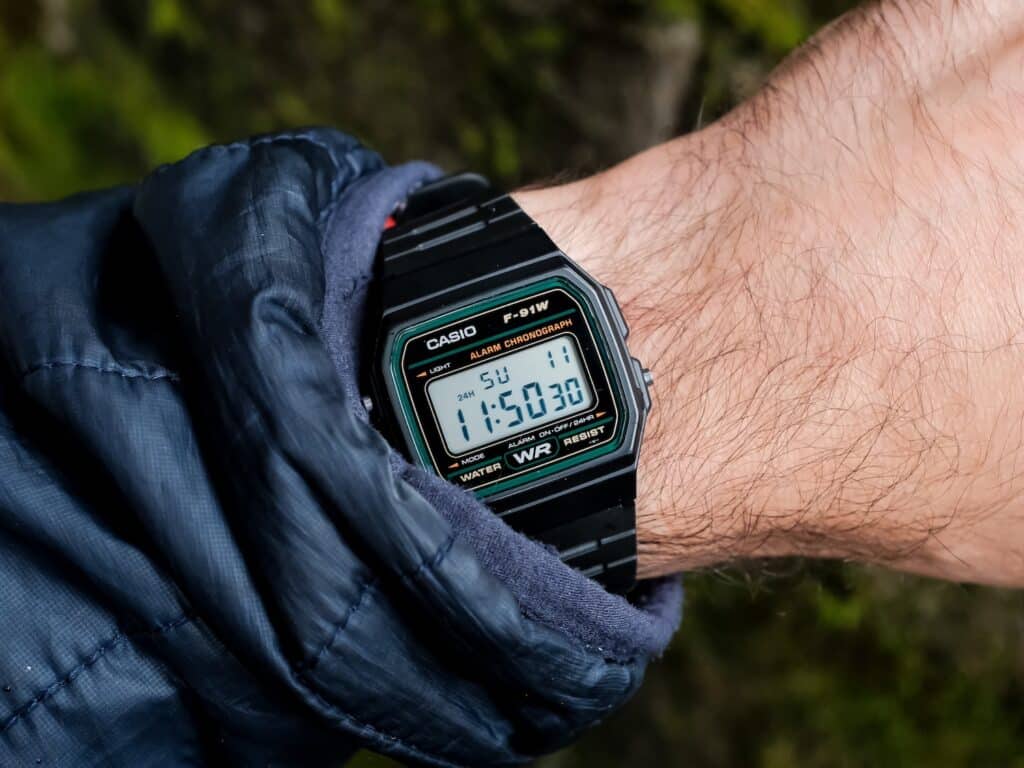
The Casio F-91W earns its spot here not because it’s inexpensive, but because it keeps proving how much utility you can get with almost nothing on your wrist. Once it’s on, it all but vanishes. The case is feather-light, the profile is slim, and it never competes for attention during the day. In practice, it handles daily abuse better than many watches that lean heavily on toughness as a marketing angle. During our time wearing it, the resin case and strap felt purpose-built rather than disposable: there’s no sense of fragility, and no reason to baby it.
Turning the watch over reinforces that same straightforward approach. The stainless steel caseback is basic, secured with four screws, and engraved only with what’s necessary. It’s not trying to impress, and that’s part of why it works. This watch fits into workouts, travel days, yard work, or running errands because you’re never conscious of it being there. While the dimensions look modest on paper, the case wears with more presence than expected. The subtle corner guards give it a bit of structure and make the buttons easier to locate, which matters when you’re using the chronograph or alarm without looking down for long.
Within the display layout, Casio managed to pack in a calendar, alarm, stopwatch, and 12- or 24-hour time without ever feeling cluttered. Everything is legible at a glance. The green LED backlight is intentionally minimal. It’s more of a quick flash than a full illumination, but it does the job when checking the time in low light. Navigating the module is intuitive, something that can’t be taken for granted on smaller digital watches. Comfort is another quiet win here. The resin strap is soft and flexible, offering plenty of adjustment, though the integrated design makes swapping straps difficult. During testing, accuracy hovered around ±30 seconds per month, in line with expectations. Finally, the long battery life from a single CR2016 cell remains one of its most substantial practical advantages.
Pros
- Very lightweight and easy to wear for long stretches
- Reliable quartz accuracy and multi-year battery life
- Simple, legible display with logical mode navigation
- Durable enough for everyday use and inexpensive to replace
Cons
- The LED backlight is weaker than modern full-panel lights.
- Water resistance is minimal and not intended for swimming or sustained exposure to water.
- Integrated strap limits customization.
Casio G-Shock DW9052-1V
| Price: | $45 |
| Water Resistance: | 200m |
| Case Dimensions: | 47mm (diameter) x 48mm (lug-to-lug) x 15mm (thickness) |
| Lug Width: | 24mm; tapers to 20mm at the buckle |
| Movement: | Casio 3232 digital module |
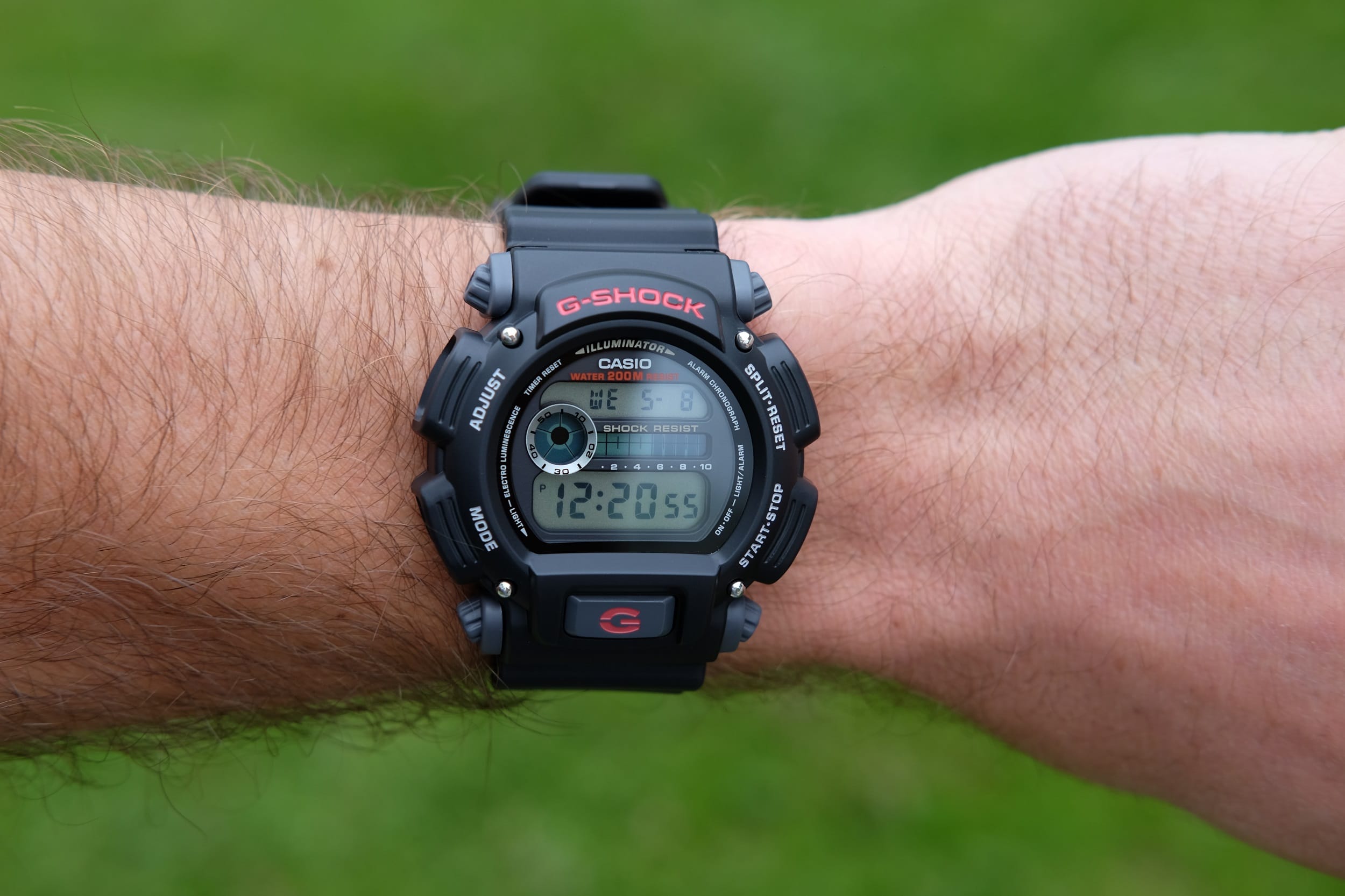
The G-Shock DW9052 earns its spot here the same way it earns wrist time: by surviving situations that would end the day for most watches without making a big deal about it. This is the watch we reach for when the environment is likely to be unkind. The oversized urethane resin bumper dominates the case, extending above the crystal and wrapping around the buttons. In practice, that design choice matters. After regular exposure to yard work, workouts, and more than a few accidental collisions with door frames, ours picked up only superficial marks, with nothing affecting function or legibility.
There’s no pretending this is a subtle watch. The case is thick, the profile is tall, and it announces itself the moment you put it on. That size can feel like a drawback until you spend time wearing it. The extra mass translates directly into impact protection, and the watch absorbs punishment quietly in the background. The display initially looks dense, with four separate windows competing for attention, but it doesn’t take long for the layout to become second nature. During our hands-on testing, the electro-luminescent backlight stood out for evenly lighting the entire display, making quick nighttime checks effortless. Even though the buttons sit recessed, they’re easy to operate with wet hands or gloves.
Comfort was better than expected for something this bulky. The free-moving lugs allow the case to sit closer to the wrist, avoiding the stiff, top-heavy feel familiar with large watches. The vented strap manages sweat well over longer sessions, and the stainless steel buckle feels capable of taking long-term abuse without bending or loosening. One minor annoyance is the decorative metal pins set into the bumper. They can work loose over time and, if they fall out, tend to trap dirt, which feels unnecessary in an otherwise purpose-driven design.
Beyond that, reliability has been what we expect. The quartz module stayed within roughly ±15 seconds per month, the auto calendar functioned without issue, and battery life remained solid in the multi-year range. As a watch that prioritizes durability, usability, and consistency over refinement, the DW9052 continues to justify its value well beyond its price.
Pros
- The even electro-luminescent backlight makes the display easy to read in the dark.
- The free-moving lugs improve how the large case sits on the wrist.
- The vented strap reduces sweat buildup during extended wear.
- Quartz module delivers consistent accuracy and long battery life.
- The protective resin bumper shields the crystal and buttons from impacts.
Cons
- Case height and bulk make it difficult to wear under sleeves.
- The display layout can feel cluttered during the first few days of use.
- The decorative bumper pins may loosen and trap dirt over time.
Orient Mako II
| Price Range: | $160 – $220 |
| Water Resistance: | 200m |
| Case Dimensions: | 41.5mm (diameter) x 47mm (lug-to-lug) x 13mm (thickness) |
| Lug Width: | 22mm |
| Movement: | Orient Caliber F6922 (Mechanical Movement) |
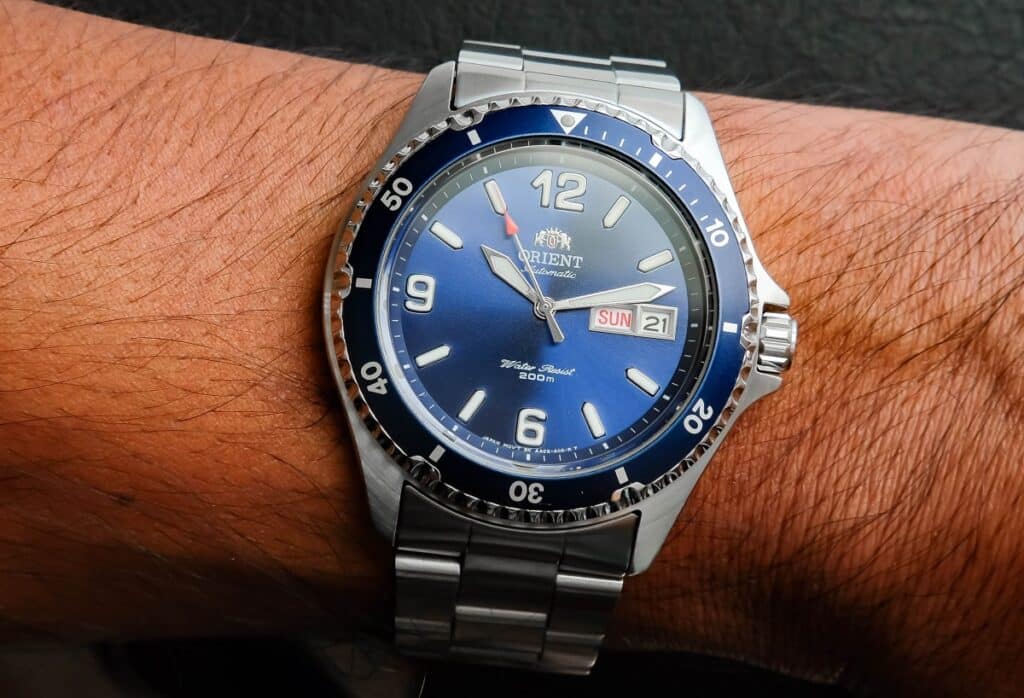
The Orient Mako II makes sense on this list because it feels complete and “valuable” in a way many similarly priced watches don’t. On the wrist, it comes across as purposeful without being intimidating, striking a balance between familiarity and personality. At 41.5mm across with a reasonable lug-to-lug, it sits comfortably even on smaller wrists, and never feels oversized or top-heavy in daily wear. What stood out during extended use was how well the case works as a whole. The brushed surfaces on the lugs transition cleanly into polished case sides, and that contrast feels deliberate rather than decorative. Even the bracelet integration feels thought-through, with end links that follow the case lines naturally.
Living with the watch day to day reinforces that impression. The dial’s sunburst finish adds depth without compromising readability, and the applied markers stand out clearly against the blue background. There’s a quiet consistency in the details: thin metal framing around the day-date window mirrors the polished accents found on the hands, tying the design together. The handset itself keeps things grounded—sword-style hour and minute hands paired with a red-tipped seconds hand that adds the right amount of contrast without drawing attention away from the dial. Lume performance won’t impress lume obsessives, but it’s dependable enough for quick checks in the dark.
The bezel is another area where the Mako II meets expectations, though with a few caveats. The move to a 120-click action improves overall usability, and once engaged, the rotation feels firm and reassuring. The sloped bezel edge makes gripping it a bit awkward at times, especially compared to more aggressively knurled designs, but you quickly adapt to it. Inside, the in-house F6922 movement does much of the heavy lifting for the ownership experience. Hacking seconds and manual winding make it easier to interact with and understand, especially after the watch has been sitting for a few days.
The bracelet also punches above its weight, with solid-feeling links and a clasp that feels secure, even if the hollow end links are a reminder of where costs were saved. Taken together, the Mako II delivers a well-rounded experience that feels thoughtfully executed rather than budget-driven.
Pros
- The sunburst dial and applied markers add depth without hurting legibility.
- The bracelet feels solid on the wrist with a well-executed clasp.
- In-house F6922 movement with hacking and hand-winding improves day-to-day usability.
- The bezel action is firm and confidence-inspiring once engaged.
Cons
- Mineral crystal, instead of sapphire, reminds you of the price tier.
- The bezel edge can be tricky to grip due to its sloped design.
- Lume is functional but falls short of higher-performing competitors.
- Hollow end links are noticeable when handling the watch off the wrist.
Timex Expedition Field Post Solar
| Price: | $199 |
| Water Resistance: | 100m |
| Case Dimensions: | 36mm (diameter) x 44mm (lug-to-lug) x 12mm (thickness) |
| Lug Width: | 18mm |
| Movement: | Solar Quartz |
The Timex Expedition Field Post Solar stands out here because it fades into daily life in the best possible way. After a few days of wear, it becomes something you stop adjusting, checking, or worrying about. The solar-powered quartz movement plays a significant role in that. With four months of reserve once charged, it simply keeps running, and during our testing, it stayed accurate enough that we never felt the need to touch the crown. That hands-off reliability goes a long way toward making the watch feel like a good value rather than a mere affordable option.
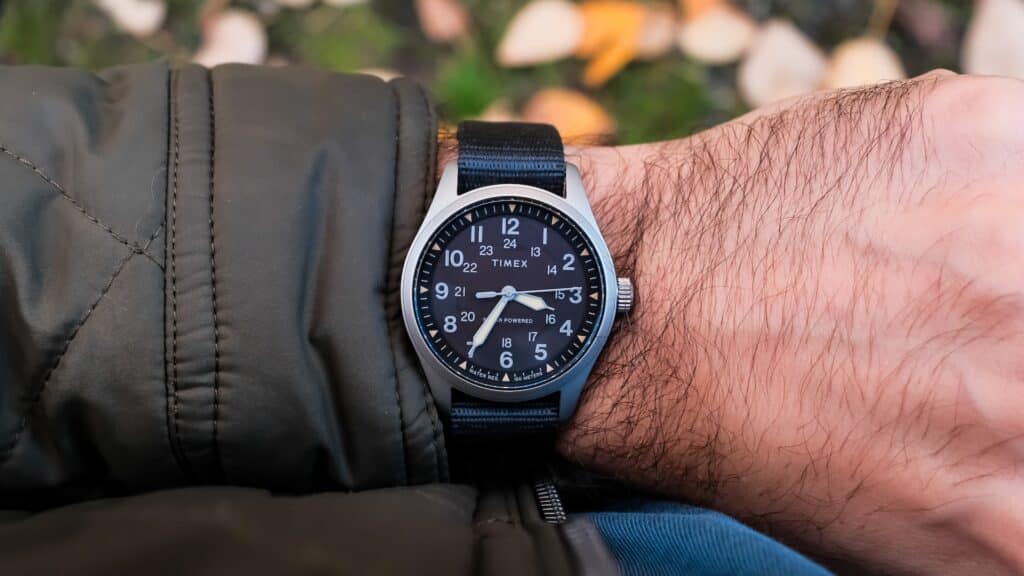
On the wrist, the 36mm stainless steel case wears flat and stays centered, even through long days that included commuting, errands, and bad weather. The bead-blasted finish looks utilitarian and already feels broken in, which removes any hesitation about picking up scratches along the way. The screw-down crown matches that tone: nothing polished or refined, but dependable and easy to operate. It’s the kind of setup that works quietly in the background rather than demanding attention.
The dial sticks closely to traditional field-watch layouts, with full numerals and a straightforward design rooted in military-issued templates. Legibility is strong, and the slightly domed sapphire crystal adds a touch of visual warmth, introducing mild edge distortion without interfering with readability. That sapphire also does a good job managing reflections thanks to its anti-reflective coating. Where the watch clearly compromises is in low-light performance. Even with a solid charge, the lume fades quickly. The hands glow briefly, the dial barely registers, and within moments it’s gone. It’s noticeable because so much else about the watch feels well considered.
The included leather strap is soft and environmentally conscious, but its thickness feels mismatched to the smaller case size. We found ourselves swapping it out for a U.S.-made MIL-style strap, which better suited the watch’s no-frills personality and improved comfort. Over time, what stuck with us wasn’t any single feature, but how naturally the Field Post Solar fit into everyday routines.
Pros
- The solar quartz movement offers long reserve and worry-free accuracy.
- The compact case sits flat and remains comfortable throughout the day.
- The clean, military-inspired dial layout is easy to read at a glance.
- The sapphire crystal with anti-reflective coating reduces glare.
Cons
- Lume performance is weak and fades almost immediately.
- The crown action is not very refined.
- The stock leather strap feels too thick for the case size.
Scurfa Diver One
| Price: | $250 – $399 |
| Water Resistance: | 500m |
| Case Dimensions: | 40mm (diameter) x 47mm (lug-to-lug) x 14mm (thickness) |
| Lug Width: | 20mm |
| Movement: | ETA.F06 (Quartz Movement) |
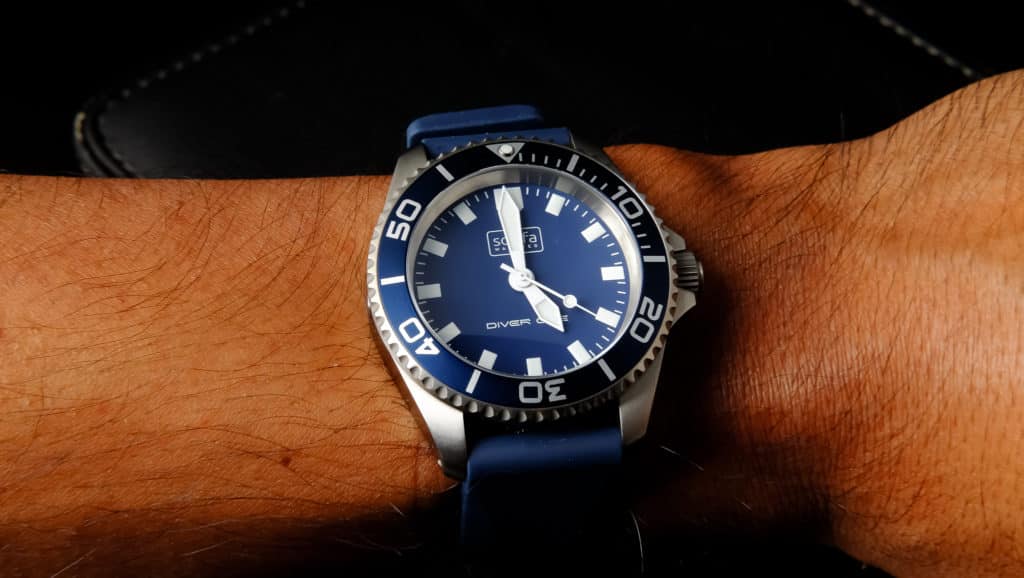
The Scurfa Diver One feels like a watch designed from the inside out, where comfort and function were figured out before anyone worried about how it would look in a product photo. Despite measuring 40mm across and roughly 14mm thick, the watch sits lower than expected thanks to a contoured mid-case that spreads weight evenly and avoids pressure points. The titanium construction plays a significant role in that experience. It’s pretty light but never feels hollow or insubstantial, and the finishing holds up well under close inspection, reinforcing the impression that nothing here is decorative without reason.
Functionality drives nearly every design decision. The dial prioritizes clarity above all else, with broad sword hands and oversized hour markers that make reading the time immediate, even in far-from-ideal lighting. The matte blue surface subtly shifts in daylight without becoming flashy, and the domed sapphire crystal adds enough edge distortion to lend the watch some character without interfering with legibility. Lume performance was powerful during testing. The BGW9 Super-LumiNova glows clean and bright, and it charges so readily that the markers often appear active even after brief exposure to ambient light. Timing tasks are handled by a bezel that feels deliberate and controlled, clicking firmly with no play and providing consistent feedback whether you’re underwater or not.
Under the hood, the ETA.F06 quartz movement reinforces the watch’s no-fuss approach. It stayed accurate throughout our testing phase, is easy to service, and offers an estimated five-year battery life, which suits the set-it-and-forget-it nature of the design. The watch’s serious water resistance, rated to 500 meters, is supported by practical details like a helium escape valve and a screw-down crown, adding credibility rather than only numbers on a spec sheet. The rubber strap deserves its own mention. It’s soft, secure, and well-matched to the watch’s utilitarian tone, with titanium hardware and drilled lugs making strap changes straightforward. After weeks of wear, the Diver One felt less like something to admire and more like something to rely on, which is where its value really shows.
Pros
- Lightweight titanium case that feels solid and well finished
- Strong legibility from bold hands, oversized markers, and BGW9 lume
- Firm, precise bezel action with no noticeable play
- 500m water resistance supported by functional design choices
- Comfortable rubber strap with titanium hardware
Cons
- Quartz movement won’t appeal to those who prefer mechanical watches only.
- The case thickness can feel tall on smaller wrists.
Nodus Sector Deep
| Price: | $599 |
| Water Resistance: | 500m |
| Case Dimensions: | 38mm (diameter) x 47mm (lug-to-lug) x 13.6mm (thickness) |
| Lug Width: | 20mm |
| Movement: | Seiko NH35 (Mechanical Movement) |
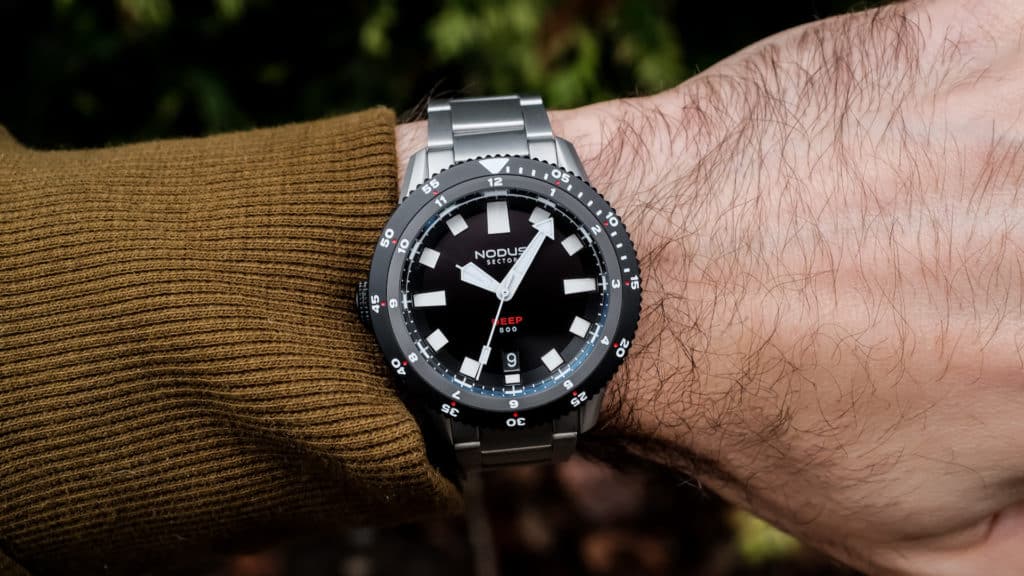
The Nodus Sector Deep feels like a turning point for the brand: less about refinement for refinement’s sake and more about what works on the wrist. One of the first things we noticed during wear was how composed it felt despite its serious depth rating. At 38mm, the case stays compact and wears low, avoiding the top-heavy balance that often comes with watches built for extreme conditions. That comfort is enhanced by the left-side crown, which gives the watch a distinctive look and helps prevent it from digging into the wrist on long days.
Usability drives much of the design here. The matte DLC bezel provides a confident grip, and the dual-scale layout proved helpful in tracking elapsed time alongside a second time zone. The move away from perfect symmetry allows the bezel and dial to communicate information more clearly, even if it won’t appeal to everyone visually. On the dial, white PVD-framed markers with lume-filled centers taper outward at the cardinal points, creating a subtle domed effect when viewed head-on. The BGW9 Super-LumiNova performed well in testing, making the transition into low-light conditions easy without needing to hunt for the right angle.
Inside, the familiar Seiko NH35 keeps things straightforward and serviceable. Nodus’ in-house regulation made a noticeable difference, with accuracy landing around ±10 seconds per day out of the box. That’s better than what we typically see from a stock movement. The 41-hour power reserve felt well matched to a watch that’s likely to rotate in and out of daily wear rather than live permanently on the wrist. The bracelet and clasp system held up well over time. Screw-secured links made sizing painless, and the taper from 20mm to 18mm helped maintain balance. The NodeX clasp allowed for quick micro-adjustments, though the fully extended setting left some hardware exposed, a small but visible compromise. For more comprehensive insights, check out our dedicated hands-on review.
Pros
- The compact case wears low and balanced despite the high depth rating.
- Grippy DLC bezel with dual timing scales adds real-world utility.
- The regulated NH35 offers better-than-average out-of-the-box accuracy.
- Left-side crown improves comfort during extended wear.
- NodeX clasp enables quick and easy fine adjustments.
Cons
- The extended clasp setting exposes some hardware.
- Utility-driven layout sacrifices symmetry, which won’t suit all tastes.
Baltic MR01
| Price: | $635 |
| Water Resistance: | 30m |
| Case Dimensions: | 36mm (diameter) x 44mm (lug-to-lug) x 9.9mm (thickness) |
| Lug Width: | 20mm |
| Movement: | Hangzhou 5000a automatic |
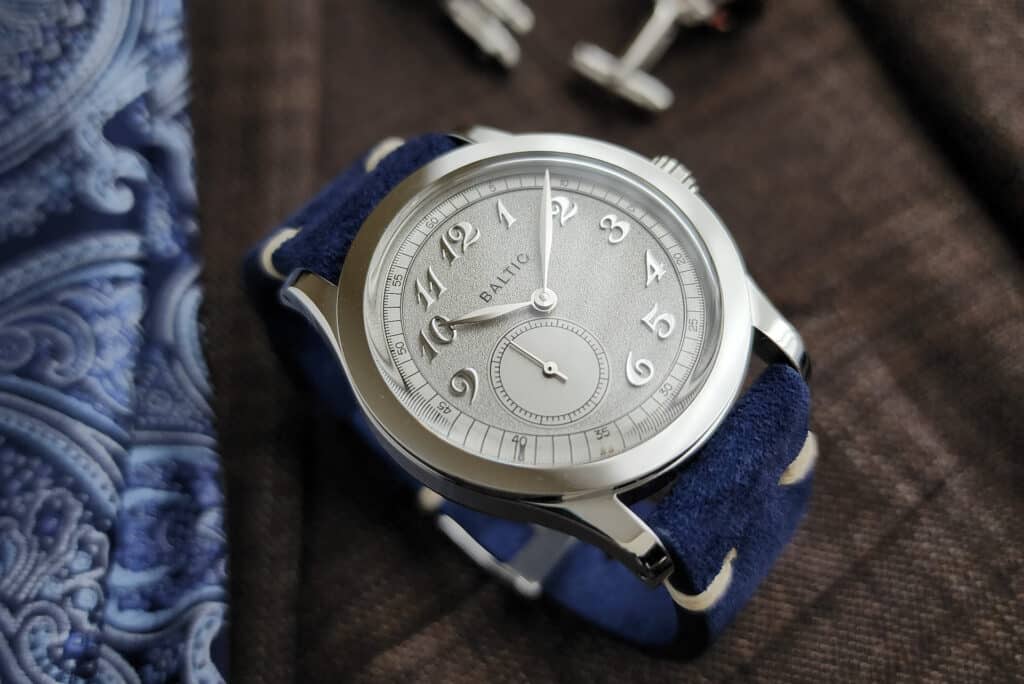
The Baltic MR01 makes its case quietly, which is why it works in a value-focused conversation like this one. What becomes apparent first is how comfortably it fits into daily wear. The 36mm case feels intentional rather than nostalgic, and the sub-10mm thickness allows it to slide under a cuff without effort. On the wrist, the contrast between the fully polished surfaces and the brushed mid-case creates a soft interplay with light. That’s noticeable if you’re paying attention. And that balance keeps the watch feeling appropriate in relaxed settings while still holding its own when things lean more formal.
Spend a little more time with it, and the dial starts doing the heavy lifting. As also mentioned in our full review, the silver surface uses a fine sand texture that adds depth without visual noise. At the same time, the offset guilloché small seconds breaks up the layout in a way that feels deliberate rather than decorative. The polished Breguet numerals are the detail that keeps drawing your eye back. In softer light, they appear to glow instead of reflect, giving the dial a warmth that’s easy to miss in photos. Leaf-shaped hands and a brushed railroad minute track tie everything together, reinforcing a tactile, almost handmade feel. The domed Hesalite crystal plays a significant role here, introducing gentle edge distortion that softens the dial and leans into the watch’s emphasis on feel over flash.
Turning the watch over adds another dimension. The Hangzhou 500a automatic movement, visible through the display caseback, tends to divide opinion, but the execution exceeds expectations. Polished bridges, perlage, and gold-toned engraving feel generous for the price. In daily use, the 42-hour power reserve was easy to live with, and performance stayed consistent enough that it never became a distraction. Water resistance is limited to 3 ATM, which sets clear boundaries around where this watch belongs. Whether worn on leather or the optional beads-of-rice bracelet, the MR01 sits comfortably between modern microbrand ambition and old-school design restraint, rewarding those who pay attention to texture, proportion, and detail.
Pros
- Slim case proportions wear comfortably across casual and dress-leaning settings.
- The sand-textured dial and Breguet numerals create depth without clutter.
- The domed Hesalite crystal adds warmth and character to the overall presentation.
- The display caseback reveals a well-finished automatic movement for the price.
Cons
- Hesalite crystal is more susceptible to scratches than sapphire.
- Limited 3 ATM water resistance restricts water exposure.
- The Chinese-made movement may give some collectors pause.
Baltic Aquascaphe
| Price: | $650 – $750 |
| Water Resistance: | 200m |
| Case Dimensions: | 39mm (diameter) x 47mm (lug-to-lug) x 12mm (thickness) |
| Lug Width: | 20mm |
| Movement: | Miyota 9039 (Mechanical Movement) |
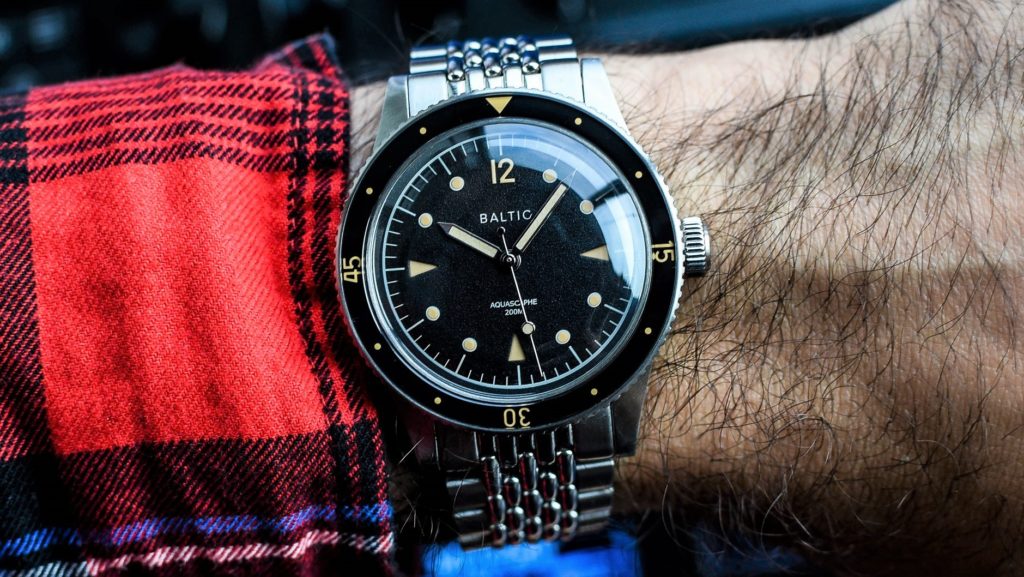
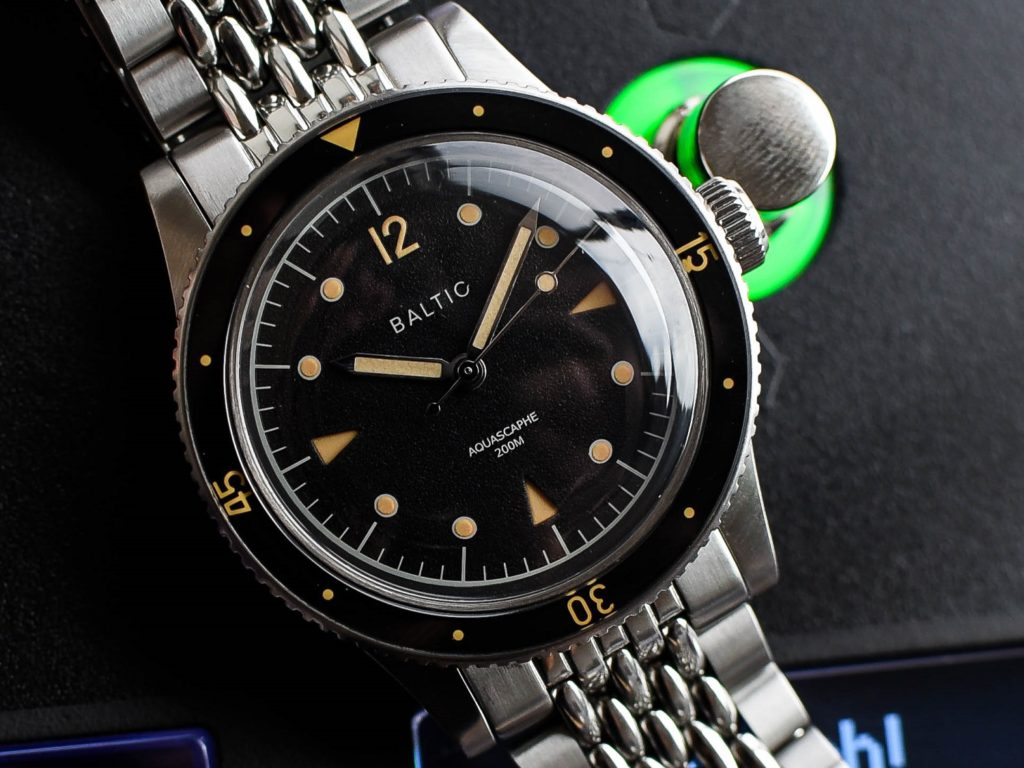
The Baltic Aquascaphe starts to make sense once you spend real time wearing it. What stood out early on while spending time with it was how balanced it felt on the wrist for full days. The case isn’t large, but the weight and finishing give it a reassuring presence that feels more refined than the measurements suggest. At a little over 12mm thick, it slid under sleeves easily, and the 47mm lug-to-lug kept it stable without any awkward overhang. The mostly brushed surfaces proved practical, masking everyday scuffs well, and the textured crown was easier to grip than expected when adjusting or unscrewing it. With a double-domed sapphire crystal, screw-down crown, and 200 meters of water resistance, it’s a watch we never hesitated to wear, whether on or off the water.
The dial is where the watch separates itself. The hybrid sandwich construction adds depth while keeping the layout clean, exposing a fully lumed layer beneath the cut-out indices. In low light, that design paid off with an even, legible glow that felt practical rather than theatrical. The matte surface subtly shifts with lighting, keeping the dial interesting over time. Gilt-toned accents are used sparingly and feel warm without drifting into artificial aging, tying in naturally with the sapphire bezel insert. The handset is well judged: pencil-style hour and minute hands are crisp and easy to read, while the lollipop seconds hand reaches the chapter ring cleanly. Minimal dial text keeps everything feeling intentional rather than crowded. Inside, the Miyota 9039 was a sensible match for a time-only layout. The two-position crown avoids unnecessary steps, and during testing, the movement ran smoothly at 28,800 vph with a reliable 42-hour power reserve.
The beads-of-rice bracelet conforms naturally to the wrist and tapers in a way that keeps the watch from feeling top-heavy. Polished beads paired with brushed outer links strike a subtle visual balance, and the clasp remains simple yet offers enough micro-adjustment to dial in the fit. Quick-release spring bars made strap changes painless, and the optional Tropic rubber strap leaned into the watch’s vintage-leaning personality without feeling forced. Worn either way, the Aquascaphe stayed comfortable through long stretches without developing hot spots.
Pros
- The hybrid sandwich dial delivers depth and strong low-light legibility.
- Warm gilt accents feel balanced rather than exaggerated.
- The slim case profile wears well and fits easily under sleeves.
- Straightforward time-only movement without unnecessary complexity
- Comfortable beads-of-rice bracelet with easy strap swapping
Cons
- Predominantly brushed case may feel too restrained for those who prefer high-polish contrast
- The absence of a date function won’t suit every daily wearer.
Formex Field Automatic

| Price: | $795 (nylon strap) $945 (leather strap and deployant clasp) |
| Water Resistance: | 150m |
| Case Dimensions: | 41mm (diameter) x 47mm (lug-to-lug) x 10.6mm (thickness) |
| Lug Width: | 20mm |
| Movement: | Sellita SW200-1 Automatic |
The Formex Field Automatic settles into daily wear quickly, which is often the first sign a watch is doing something right. What our review team noticed early on was how little attention it demanded. The Grade 2 titanium case keeps weight to a minimum, and over long stretches it stayed flat on the wrist, slipping under sleeves and avoiding the snags that tend to show up during active days. Between the sapphire crystal and 150 meters of water resistance, it felt comfortable to treat it as a faithful everyday companion. The hardened surface on the titanium also proved its worth, resisting the light scuffs and fingerprints that generally show up fast on bead-blasted cases.
Once the comfort fades into the background, the dial starts to stand out. Formex leans into a more distinctive design here, using stamped numerals that look unconventional up close but snap into focus when viewed as a whole. That detail gives the watch personality without compromising legibility. The stepped outer edge creates a subtle three-dimensional effect that adds visual depth without cluttering the layout. Lume coverage is generous across the hands and markers, using Old Radium Super-LumiNova. It isn’t the brightest we’ve tested, but it stayed readable well into the evening. We spent time with the charcoal dial, though the broader lineup offers a range of colors depending on how restrained or expressive you want the watch to feel. The syringe-style hands generally work well, though the sage green version may fall short of contrast for some eyes.
Powering the watch is the Sellita SW200-1, which behaved as expected. Accuracy remained consistent, and nothing about its operation stood out. Where Formex really adds value is in the strap system. The one-piece nylon strap felt secure and breathable when worn outdoors, and the tool-free spring bars made swapping straps quick and painless. The optional leather strap takes things further, pairing soft leather with Formex’s carbon composite clasp. The lightweight feel and fine adjustment made it more comfortable, and it ended up being the configuration we reached for most often. After a few weeks of use, the Field Automatic landed in that rare category of watches you glance at because you enjoy wearing it, not because you need the time.
Pros
- The carbon composite clasp offers excellent adjustment and comfort.
- The distinctive stamped dial adds depth while remaining easy to read.
- The lightweight titanium case stays comfortable during long days.
- The strap system is flexible and executed well.
- SW200-1 movement delivers dependable, drama-free performance.
Cons
- The sage green dial option may lack enough contrast for some wearers.
- Lume performs well but doesn’t lead the segment in brightness.
Halios Seaforth
| Price: | $965 |
| Water Resistance: | 200m |
| Case Dimensions: | 41mm (diameter) x 46.5mm (lug-to-lug) x 12.4mm (thickness) |
| Lug Width: | 20mm |
| Movement: | Sellita SW200-1 |
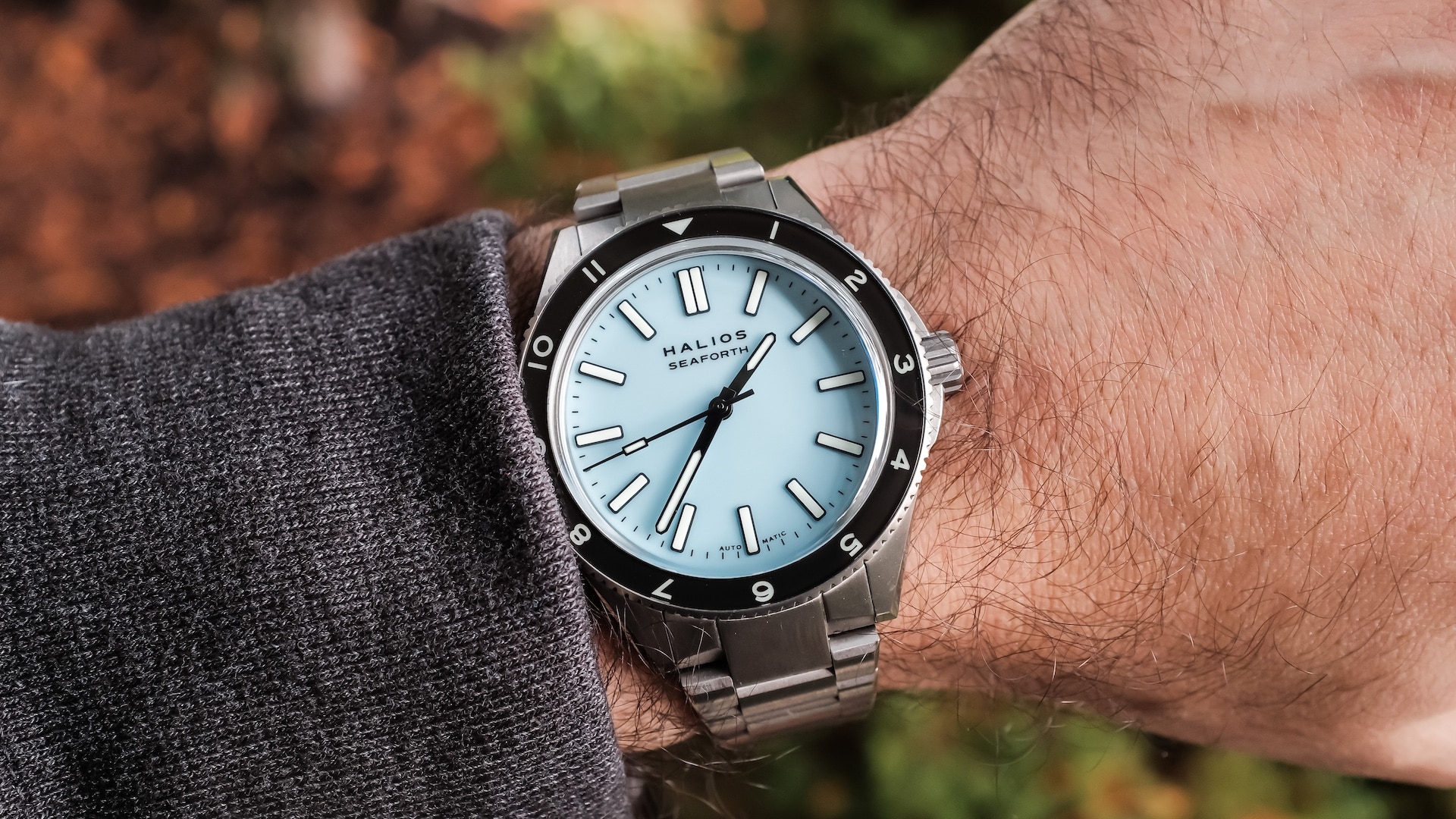
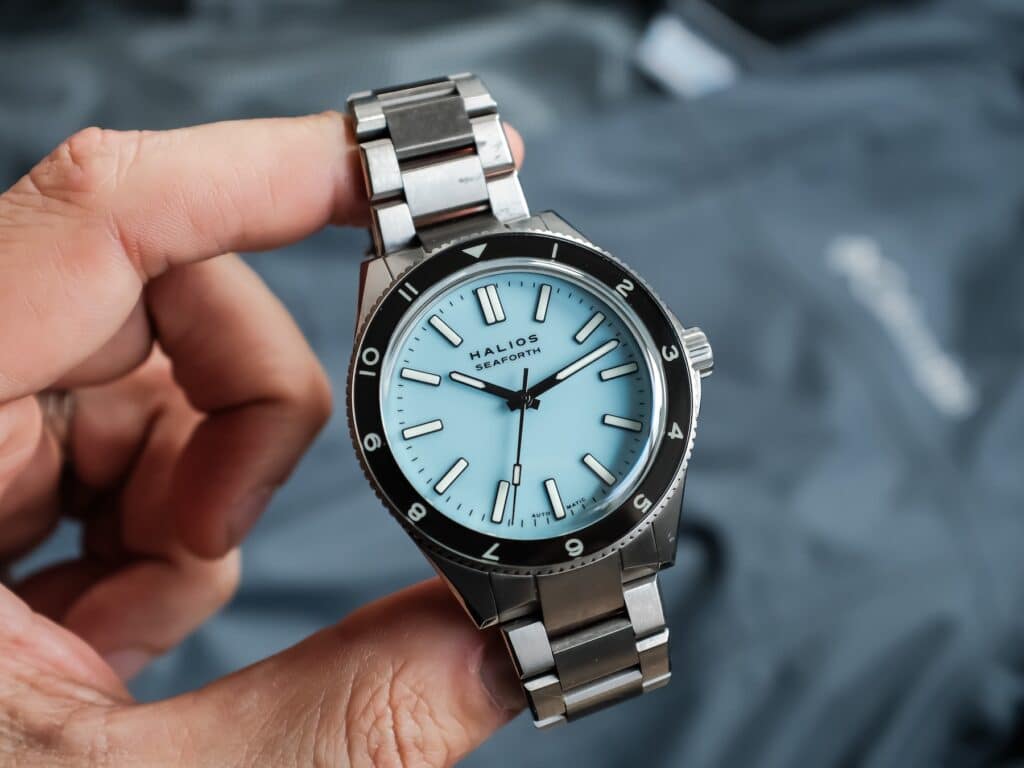
The value of the titanium Seaforth doesn’t show up on paper so much as it does after a few weeks of regular wear. What stood out first wasn’t the design or specs, but how often it ended up back on the wrist. Titanium changes the experience here. The watch feels almost weightless in the hand, and once worn, that sensation only becomes more pronounced. The familiar Seaforth case benefits from the material shift, wearing slimmer than the numbers suggest, thanks to its gentle taper. The double-domed sapphire adds visual depth without making the watch feel tall. The overall finishing: uniform brushing paired with restrained polished chamfers adds definition without drawing unnecessary attention.
Daily wear reinforced that impression. The absence of a date keeps interaction simple, which we came to appreciate more than expected. Set it, strap it on, and move on with the day. The unidirectional bezel rotates through its 120 clicks with a smooth, confident feel and enough grip to use easily without sharp edges. We opted for the 12-hour bezel, and it quickly became part of our routine, offering an intuitive way to track a second time zone without the clutter or compromises of a dedicated GMT design. Despite its lighter feel, the watch never came across as delicate. With a screw-down crown and caseback and a 20 ATM water-resistance rating, it still felt ready for real-world use, just without the heft of steel.
The dial brings more presence than its soft blue tone initially suggests. The surface shifts subtly with changing light, avoiding a flat appearance, while the ceramic hour markers rise cleanly from the dial with crisp edges. Lume performance was another understated strength. The Super-LumiNova C3 X1 charged evenly and faded consistently across the hands, markers, and bezel, making nighttime glances feel balanced.
The titanium bracelet completes the package. It integrates smoothly with the case, flows comfortably around the wrist, and uses screw links that make sizing straightforward. The stainless steel clasp adds a reassuring bit of weight, and the tool-free micro-adjustment proved invaluable on long days when wrist size fluctuated. Inside, the Sellita SW200-1 behaved exactly as expected, setting easily and maintaining steady accuracy with a practical 40-hour power reserve. Over time, the titanium case and bracelet did pick up scratches, but they read as honest wear rather than a shortcoming. For a deeper dive into our personal insights, read our in-depth review.
Pros
- Well-integrated bracelet with tool-free micro-adjustment
- Consistent lume performance across dial and bezel
- The titanium case and bracelet keep weight low and comfort high.
- Case taper and proportions make it feel slimmer than expected.
- The 12-hour bezel offers a clean, practical way to track a second time zone.
Cons
- Titanium surfaces show wear marks quite quickly.
- Limited production runs can make availability frustrating.
Monta Atlas
| Price: | $1950 |
| Water Resistance: | 150m |
| Case Dimensions: | 38.5mm (diameter) x 47mm (lug-to-lug) x 10.2mm (thickness) |
| Lug Width: | 20mm |
| Movement: | MONTA Caliber M-23 (Mechanical) |
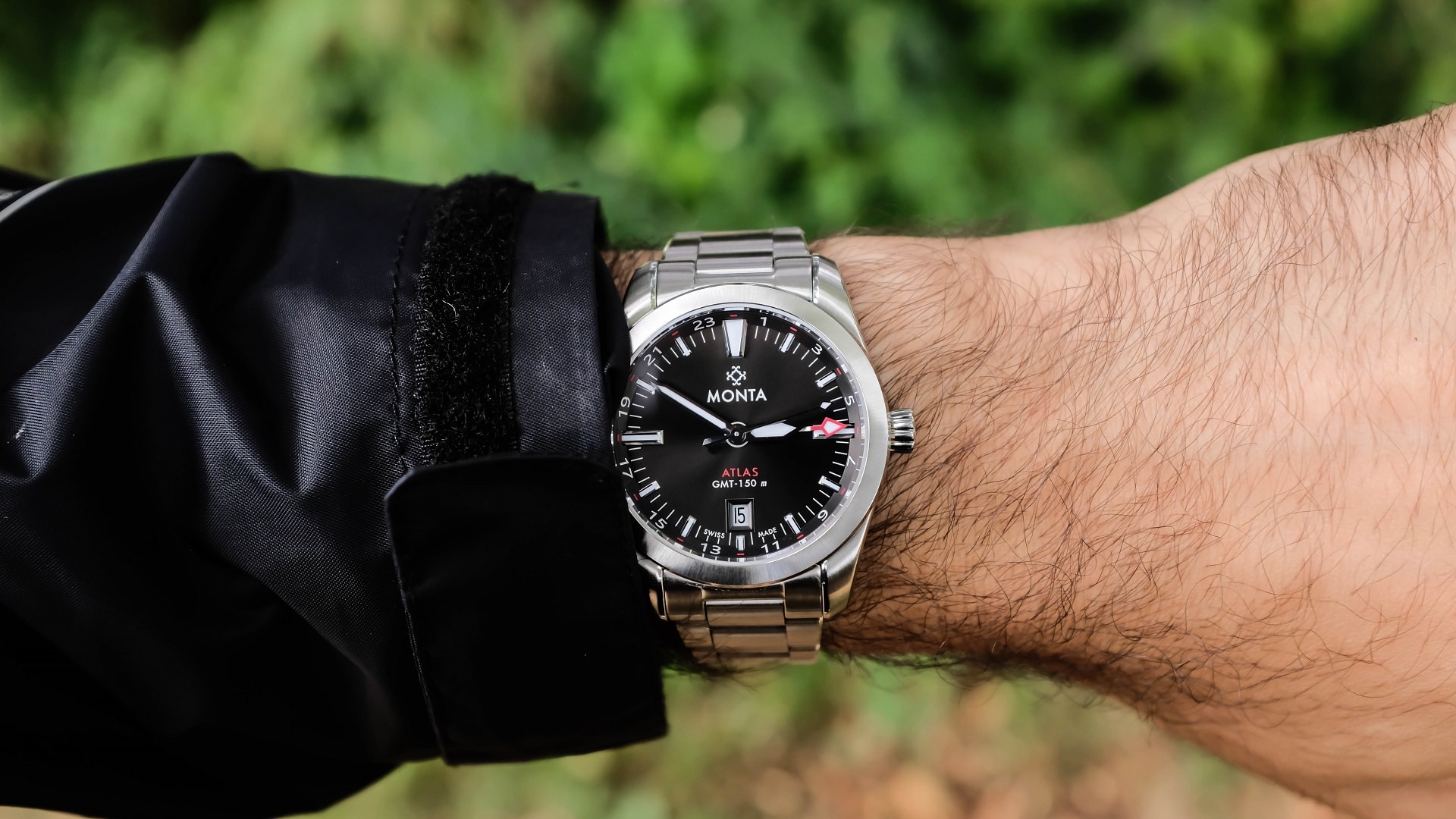
The Monta Atlas justifies its price the moment you start interacting with it, especially in places where most watches quietly cut corners. On the wrist, it feels closer to a well-built everyday field watch that happens to travel well. The 38.5mm case sits comfortably on a wide range of wrists, including ours, which usually avoid anything creeping toward 40mm. At just over 10mm thick, it stays low and balanced, which matters if you are wearing it through long workdays, flights, or back-to-back errands. Nothing about the proportions feels inflated to justify the complication. Instead, the Atlas wears calm and composed, which is why it ends up feeling versatile rather than niche.
While testing, we found that the restraint carries over to the dial and functionality. The layout stays symmetrical and easy to read, showing local time and a second time zone without clutter or visual noise. It never felt like we were wearing a pilot costume on our wrist. The second time zone came in handy for keeping tabs on family or work across regions, but it never demanded attention when we did not need it. Water resistance is a reassuring 150 meters, paired with a screw-down crown and a case and bracelet that feel solid without being overbuilt. This is the kind of watch you can wear on a trip and not think twice about swimming, walking all day, or getting caught in bad weather.
Where Monta separates itself is in the finishing and hardware. The bracelet and clasp are standout elements. The clasp in particular feels over-engineered in the best way, with a confident snap and tight tolerances that reminded us of watches that cost far more. It is one of those details you appreciate every single time you put the watch on. Inside, the MONTA Caliber M-23 (essentially the Sellita SW330) is regulated to a level that showed care during testing, running consistently within a narrow window (-5/+5 seconds a day). The exhibition caseback, however, feels unnecessary. The movement works well, but it adds little visually. Still, taken as a whole, the Atlas delivers value through execution, comfort, and thoughtful design rather than leaning on branding or gimmicks.
Pros
- The clean, symmetrical dial keeps the second time zone easy to use without clutter.
- Excellent bracelet and clasp with standout fit and secure action
- 150m water resistance and solid case construction support real daily use.
- Well-regulated movement with consistent performance
Cons
- The exhibition caseback adds little, given the movement’s unfinished look.
- The second time zone function may feel unnecessary for strictly local wearers.
Omega Railmaster
| Price: | $6,400 |
| Water Resistance: | 150m |
| Case Dimensions: | 40mm (diameter) x 46.5mm (lug-to-lug) x 12.5mm (thickness) |
| Lug Width: | 20mm |
| Movement: | Omega 8806 Master Chronometer Co-Axial |
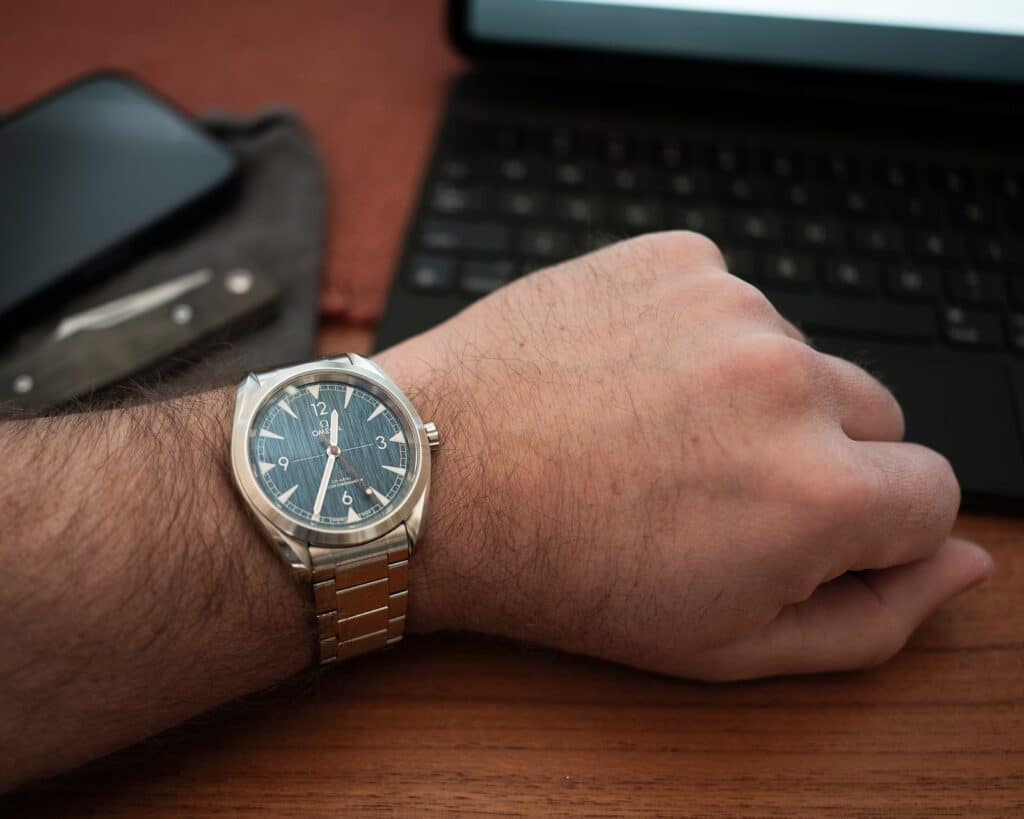
If your idea of value includes restraint, consistency, and a watch that doesn’t ask for attention, the Railmaster starts to make a lot of sense. Nothing about it is designed to shout for attention. The 40mm steel case relies on proportion rather than presence, and the mostly brushed finishing keeps reflections to a minimum. After a few days of wear, the dial becomes the focal point. The vertically brushed surface reacts constantly to changing light, shifting between darker, warmer tones at different angles. It stays legible at all times, but it never feels static. The bronze second hand adds a quiet contrast that breaks the monotony enough to remind you there was intention behind every choice.
That restraint carries into daily wear. The case proportions do most of the heavy lifting here. A 46.5mm lug-to-lug keeps the watch stable on the wrist, while the 12.5mm thickness stays manageable under a cuff. The brushed case leans firmly toward a utilitarian feel, but the polished chamfers along the edges add refinement, keeping it from feeling austere. It is the kind of watch that works as well during a long workday as it does running errands or traveling, never feeling out of place.
Inside, the Co-Axial Master Chronometer movement is where the long-term value becomes clear. During testing, it consistently ran about +1 second per day, and that kind of stability shows up over weeks of wear, keeping the watch on time without intervention. The METAS certification and resistance to magnetic fields add peace of mind rather than bragging rights. The thoroughly brushed three-link bracelet feels solid and well-constructed, though the lack of micro-adjustment made dialing in a perfect fit less convenient than we would have liked. Pricing can feel ambitious when compared to simpler alternatives. Still, once you factor in the movement performance, finishing quality, and overall coherence, it becomes easier to understand where that money is going.
Pros
- Consistent real-world accuracy backed by METAS certification and strong anti-magnetic performance
- Vertically brushed dial adds visual depth while staying clear and is easy to read.
- Case dimensions strike a comfortable balance for daily wear across a range of wrist sizes.
- Predominantly brushed finishing helps the watch hold up well to regular use.
Cons
- The bracelet offers no micro-adjustment, making a precise fit harder to dial in.
- No additional complications beyond a time-only display
- Price can feel steep when compared to simpler, less technically advanced options.
Glashütte Original SeaQ
| Price: | $10,200 |
| Water Resistance: | 200m |
| Case Dimensions: | 39.5mm (diameter) x 47.5mm (lug-to-lug) x 12.5mm (thickness) |
| Lug Width: | 20mm |
| Movement: | SeaQ Caliber 39-11 Automatic |
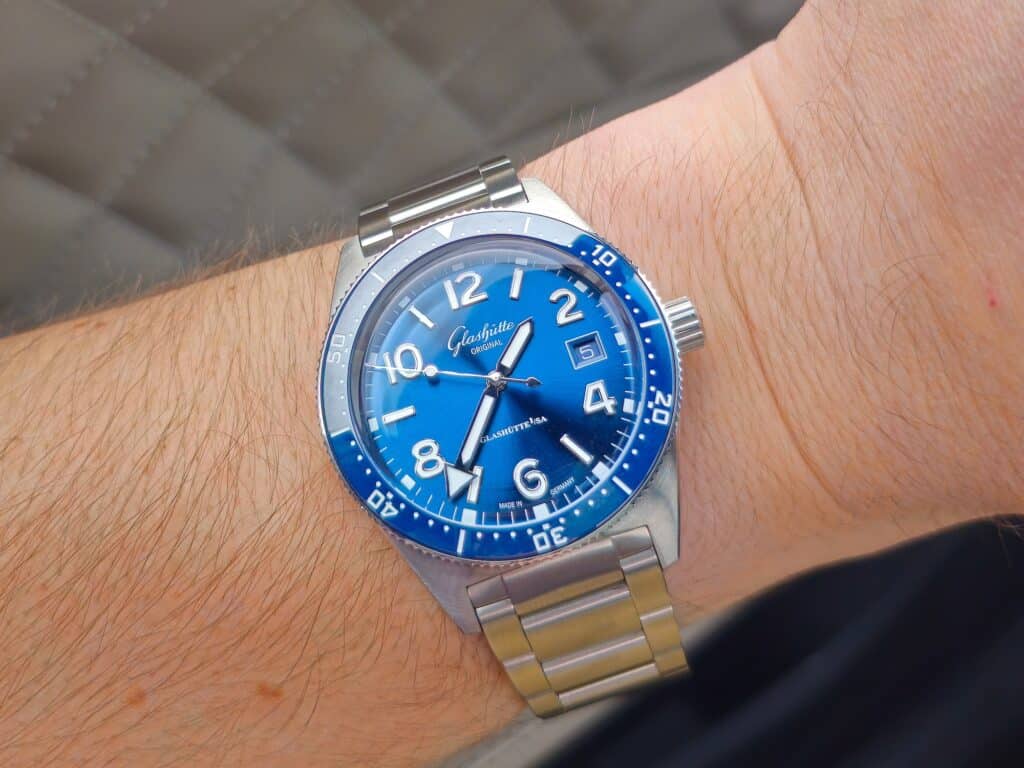
The SeaQ starts to make sense once you stop viewing it as a checklist of dive-watch credentials and start wearing it. The first thing that stood out to us was the dial, not because it was flashy, but because it kept changing. Outdoors, it picked up brighter, more energetic tones. Indoors, it settled into deeper, almost inky shades. The domed sapphire adds subtle curvature, giving the sunburst surface a sense of movement rather than a flat sheen. Combined with clean Arabic numerals and restrained text, the dial remains open and readable, even as the characters shift with the light.
That attention to detail carries through once you start using the watch. The unidirectional bezel rotates with a firm, deliberate action, clicking precisely with no slack or hesitation. Timing tasks felt confident and repeatable, which is what you want from a diver at this level. The screw-down crown delivered the same reassuring resistance we expect from well-executed dive watches, and the case finishing reinforced that impression. Brushed surfaces dominate the areas most likely to see wear, while polished accents along the edges remind you that this is not a purely utilitarian piece.
Living with the SeaQ day-to-day highlighted where the value shows up. Inside, the Calibre 39-11 runs at 28,800 beats per hour and behaves consistently throughout testing. You do not get a display caseback, but the finishing is there nonetheless, including beveled edges, polished screws, a swan-neck regulator, and a skeletonized rotor. The roughly 40-hour power reserve is not generous by modern standards, but it never made the watch feel demanding.
The bracelet is another strong point. The brushed 20mm links feel smooth in the hand and disappear on the wrist, matching the watch’s tool-forward personality. The tool-less quick-adjust clasp stands out for its simplicity, allowing on-the-fly extension with a discreet button while keeping the clasp compact. The only place the execution feels slightly behind the rest of the watch is at the bracelet’s meeting with the case, which lacks the same level of cohesion. Pricing is undeniably high, and competition here is intense, but the SeaQ justifies itself by how well its elements work together rather than by trying to dominate on specs alone.
Pros
- The dial shows rich tonal variation that comes alive in different lighting.
- Precise bezel action with firm, confidence-inspiring clicks
- Comfortable case proportions that wear naturally on the wrist
- Smooth bracelet with an excellent tool-free, quick-adjust clasp
Cons
- Price sits near the top of the luxury dive watch segment.
- Power reserve feels modest for a watch at this level.
- The bracelet-to-case transition is less seamless than the rest of the execution.
That wraps up our take on watches that earn their keep, not just their price tag. Still, lists like this are never truly finished. If there’s a watch you’ve owned that punched well above its cost, quietly became a regular part of your rotation, but didn’t show up here, let us know in the comments. We pay close attention to the watches people genuinely live with, and we’re always willing to put another “good on paper” claim to the test on the wrist.

Co-Founder and Senior Editor
Kaz has been collecting watches since 2015, but he’s been fascinated by product design, the Collector’s psychology, and brand marketing his whole life. While sharing the same strong fondness for all things horologically-affordable as Mike (his TBWS partner in crime), Kaz’s collection niche is also focused on vintage Soviet watches as well as watches that feature a unique, but well-designed quirk or visual hook.
I picked up a Dievas Vortex from Gnomon late last year. Even with import duties (Singapore) it came in around $1,300 total while on sale.
Kinda like a blend between the Nodus and the Halios, you get a lift side crown and full titanium case and bracelet, but this one has a hard coating and no scratches so far. The bracelet is really nice, actually.
Very tuetonic (sp?) styling which not everyone likes, but I do. The gate window is silly though.
I won’t embarrass myself with more watch writing, but thought I’d throw that one in. I’ve worn daily and I like it.
I think the Timex Expedition is the winner for me for several reasons, first and foremost is cost, over $400 for a field/daily is just not me. Second is size, I am done with the alarm clock size wrist watches above 40mm, and I don’t need the size and weight of a diver type any longer. My last 4 new watch purchases were under 40mm and I prefer old school 36mm. Third is solar, it is simple, efficient and unlike our multitude of quartz watches when I change batteries and gaskets (I do both at the same time) very often. I now prefer our automatic/solar/kinetic types, just tied of changing batteries. Love this article and all of the watches. I have other Timex Expedition models but no solar, now you throw this one out there just when I had a new Timex Snoopy watch in my sites
No Tissot SeaStar 2000 or Christopher Ward? Also, no Seiko Orange Monster? There are a LOT of great watches out there. Fun and expensive to collect!
Pretty weak article and far better options available
Hey Darien – appreciate the honesty. If you’ve got specific picks you think should’ve been included, I’m always open to hearing them.