There’s a point in every watch collection where you realize you don’t always want to wind, set, or emotionally commit to what’s on your wrist. And that’s usually when a retro digital watch sneaks back into rotation. These are the watches we reach for when the day already has enough going on: grab-and-go pieces that tell the time, keep track of it reasonably well, and don’t care what you’re wearing or where you’re headed. Watches like the Casio F-91W, A168, and a few gloriously awkward digital throwbacks from Citizen and Bulova aren’t just nostalgia doing the heavy lifting. It’s the quiet relief of wearing something simple, familiar, and unintimidating.
Our take on retro digital watches is built on years of actual ownership, not novelty or quick-hit impressions. We’ve been reviewing watches for nearly a decade, and many of the digital models in this list have lived with us far longer than a review cycle. They’ve been reset after daylight savings, forgotten in drawers, rediscovered, and worn again because they still made sense. Some aged gracefully, others showed their limits, and a few surprised us by sticking around while more complicated watches quietly fell out of favor. This list reflects that kind of long-term relationship.
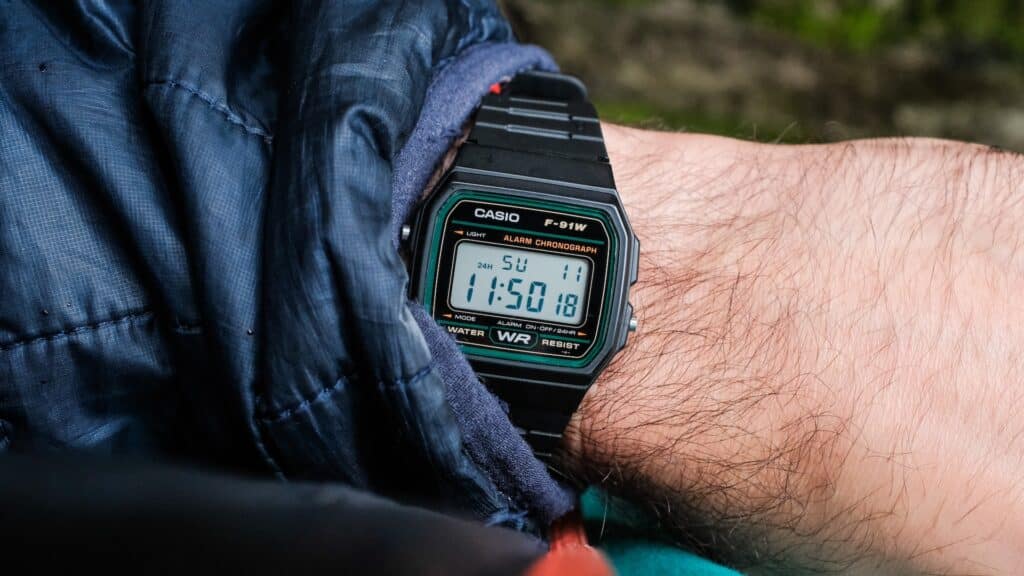
Casio F-91W
| Price: | $15 – $20 |
| Water Resistance: | 30m |
| Case Dimensions: | 34mm (diameter) x 38mm (lug-to-lug) x 8.5mm (thickness) |
| Lug Width: | 18mm |
| Movement: | Casio Quartz Module 593 |
The Casio F-91W earns its place on any retro-focused list by quietly reminding you how little you actually need on your wrist. It weighs next to nothing, disappears once it’s on, and somehow handles everyday chaos better than plenty of watches built around a “tough” narrative. During our hands-on time, the resin case and strap reinforced that old-school, tool-first feeling: it never feels precious or distracting.
Flip it over, and you get a simple stainless steel caseback with basic engravings and four screws. There’s nothing fancy, it’s just honest and functional. It’s the kind of watch you can wear for workouts, travel days, yard work, or a long stretch of errands without ever being aware of it. Despite the modest dimensions on paper, it wears better than expected. Those subtle corner bumpers give the case a bit more visual presence and, more importantly, make the buttons more straightforward to find and press when you’re using the stopwatch or alarm on the fly.
The display is pure F-91W and very much rooted in its era: clear, uncluttered, and efficient. Casio managed to fit a surprising amount into that compact screen: the calendar, alarm, 12- or 24-hour format, and chronograph are all presented in a way that feels natural rather than cramped. The green LED backlight is distinctly old-school. It’s not a modern, full-panel glow, but more of a quick flash that’s enough for checking the time in the dark.
The module itself is easy to navigate, which isn’t always guaranteed with smaller retro pieces. The strap is soft and comfortable, and it offers plenty of adjustment, though the integrated design limits straightforward strap swaps. Accuracy during our testing stayed around ±30 seconds per month, exactly what we expect from this quartz setup, and battery life is one of its quiet strengths. A single CR2016 cell can last for years. As a retro digital watch that still holds up through real use, the F-91W continues to make sense on the wrist, not just in memory.
Pros
- Ultra-lightweight and genuinely comfortable for all-day wear
- A clear, functional display with intuitive modes and layout
- Long battery life and consistent accuracy from the quartz module
- Affordable, durable, and easy to replace or rebuy
Cons
- The LED light is weaker than that of modern full-backlights.
- The integrated strap design limits simple strap swaps.
- Basic water resistance means it’s not suited for swimming or heavy water use.
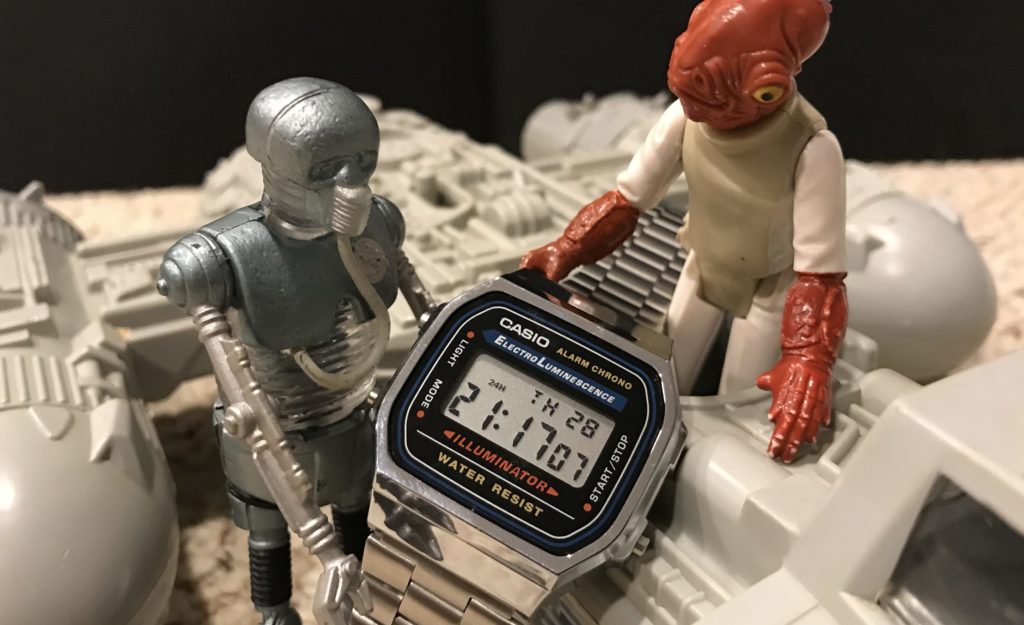
Casio A168WA
| Price: | $20 – $30 |
| Water Resistance: | 30m |
| Case Dimensions: | 37.5mm (diameter) x 33.5mm (lug-to-lug) x 9.6mm (thickness) |
| Lug Width: | 18mm |
| Movement: | Quartz Module 3298 |
Lightweight, straightforward, and completely comfortable leaning into its era, the Casio A168WA earns its spot here by embracing its retro roots without apology. The design pulls straight from the ’80s playbook, right down to the colorful digital lettering and compact proportions. At roughly 37.5mm by 33.5mm, it is easy to wear across a range of wrist sizes, especially if you prefer low-profile, unobtrusive watches. The case is plastic (there’s no hiding that), but it’s finished to resemble stainless steel well enough that you don’t really think about it once it’s on. It’s not a watch we’d reach for in dressier situations, but for errands, casual days, or committing fully to a vintage look, it works without getting in the way.
Functionally, the A168WA sticks to what retro digital watches were meant to do and nothing more. You get the basics: time, alarm, stopwatch, and an electro-luminescent blue backlight. There’s also an hourly chime, which feels very on-brand for a watch that hasn’t tried to modernize itself beyond recognition. In our testing, everything worked exactly as expected: no glitches, no odd behavior. The backlight is fun and period-correct, but it’s brief. It lights up more like a quick pulse than a sustained glow, which is satisfactory for checking the time but not ideal for reading it in complete darkness. The display itself is on the smaller side and can be harder to read at extreme angles or in tricky lighting, though under normal conditions, it held up well enough for everyday use.
The stainless steel bracelet completes the retro look, but it comes with some compromises. On smaller wrists, it felt snug, and after more extended wear, it tended to sit a bit high rather than fully settling in. Overall build quality reflects the price point: a mix of plastic and lightweight metal that won’t convince anyone it’s a luxury piece. But that’s also part of the appeal. For well under $30, you’re getting dependable quartz performance and a design that leans fully into nostalgia without pretending to be something else. It’s the kind of watch you don’t worry about losing or beating up. For deeper impressions from extended wear, we’ve covered more of that experience in our insightful community review.
Pros
- Inexpensive and easy to own without worrying about damage or loss
- Extremely lightweight and comfortable for daily wear
- Strong ’80s-inspired design that delivers genuine retro appeal
Cons
- The plastic case lacks the solid feel of metal alternatives.
- The backlight is very brief and easy to miss if you’re not quick.
- The stainless steel bracelet can feel uncomfortable during prolonged wear.
- The small display can be harder to read at a glance.
Timex Expedition Atlantis T5K463
| Price: | $35 – $60 |
| Water Resistance: | 100m |
| Case Dimensions: | 40mm (diameter) x 45mm (lug-to-lug) x 10.5mm (thickness) |
| Lug Width: | 19mm |
| Movement: | Timex Quartz |
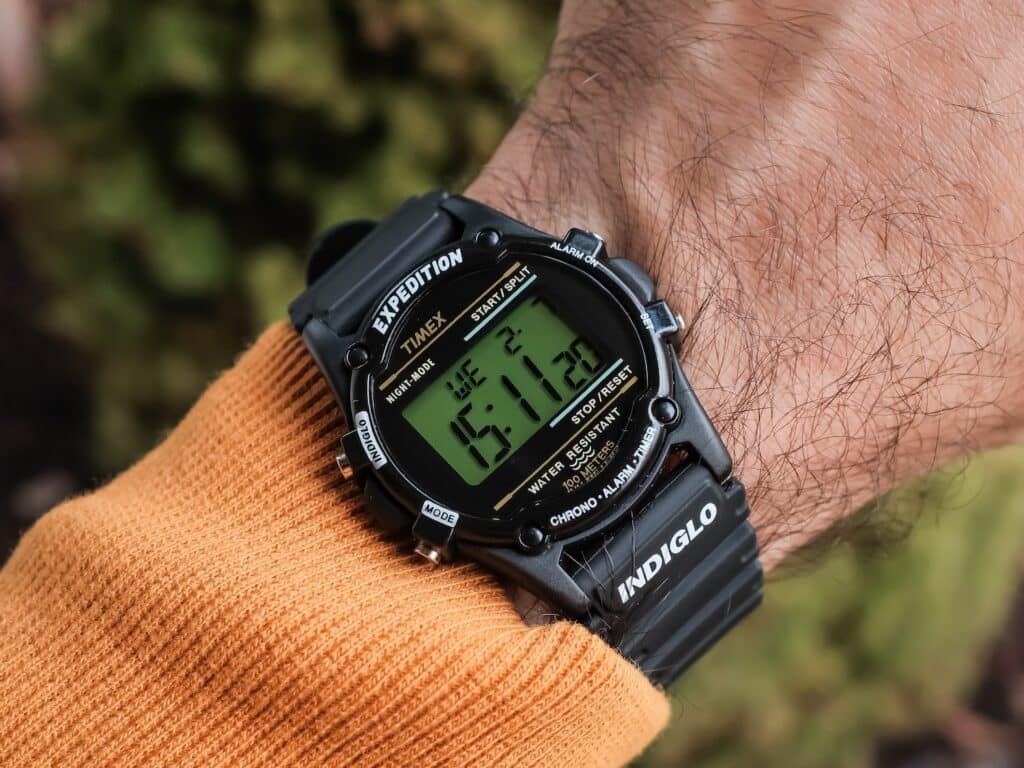
The Timex Expedition Atlantis T5K463 lands in this list because it carries forward an older, no-nonsense idea of what a digital watch should be: light, readable, and ready to be worn without much thought. On the wrist, it barely announces itself. At around 40mm wide and roughly 10mm thick, it feels closer to the utilitarian digital watches many of us grew up with than anything modern or tech-forward. The weight (or lack of it) is immediately noticeable, especially during long days. We wore it through workouts, errands, and packed schedules, and it never felt like something we needed to adjust or take off. As mentioned in our dedicated review, the resin case and silicone strap feel better than their price suggests, and the 100 meters of water resistance adds that old-school confidence where rain, sweat, or splashes in the sink don’t even register as concerns.
The button layout sticks to a familiar four-corner format, which feels right for a retro-inspired digital. That said, the buttons are on the smaller side and require a deliberate press. That became more obvious when we activated Indiglo or used the chronograph, particularly when our hands were tired or sweaty.
The dial leans fully into its digital character. Inside the glossy round bezel, the layout is busy but intentionally so, echoing older expedition-style digitals. The green-tinted display paired with oversized numerals uses the available space well, and once your eyes adjust, it’s easy to read straight on. At sharper viewing angles, legibility drops off quickly, sometimes almost entirely, which was one of the more noticeable quirks during daily wear. Indiglo, however, remains a standout. In low light, it delivers a clean, evenly lit display that feels very much in line with Timex’s long-standing reputation for usable illumination.
The strap is better than expected for a watch in this category. The soft silicone is comfortable, doesn’t attract much dust, and the vented design helps during extended activity. The 19mm lug width is unusual and limits easy strap swaps, but it does suit the case proportions if left as-is. Internally, the quartz movement kept solid time during our testing, drifting only a few seconds over months of wear. You also get a complete digital toolset: a stopwatch with a lap function, a countdown timer, a second time zone, alarms, and a full calendar, without the interface feeling overwhelming. Availability can be hit-or-miss, but when you find one, the Expedition T5K463 delivers a relaxed, retro-leaning digital experience that works well for workouts, weekends, and everyday wear.
Pros
- Extremely lightweight and comfortable over long periods
- Clear digital layout with excellent Indiglo performance at night
- 100m water resistance adds everyday durability
- The soft, vented strap wears better than expected.
Cons
- Small buttons require firm presses.
- The display loses legibility at sharper angles.
- The uncommon 19mm lug width limits strap options.
- Inconsistent availability depending on stock
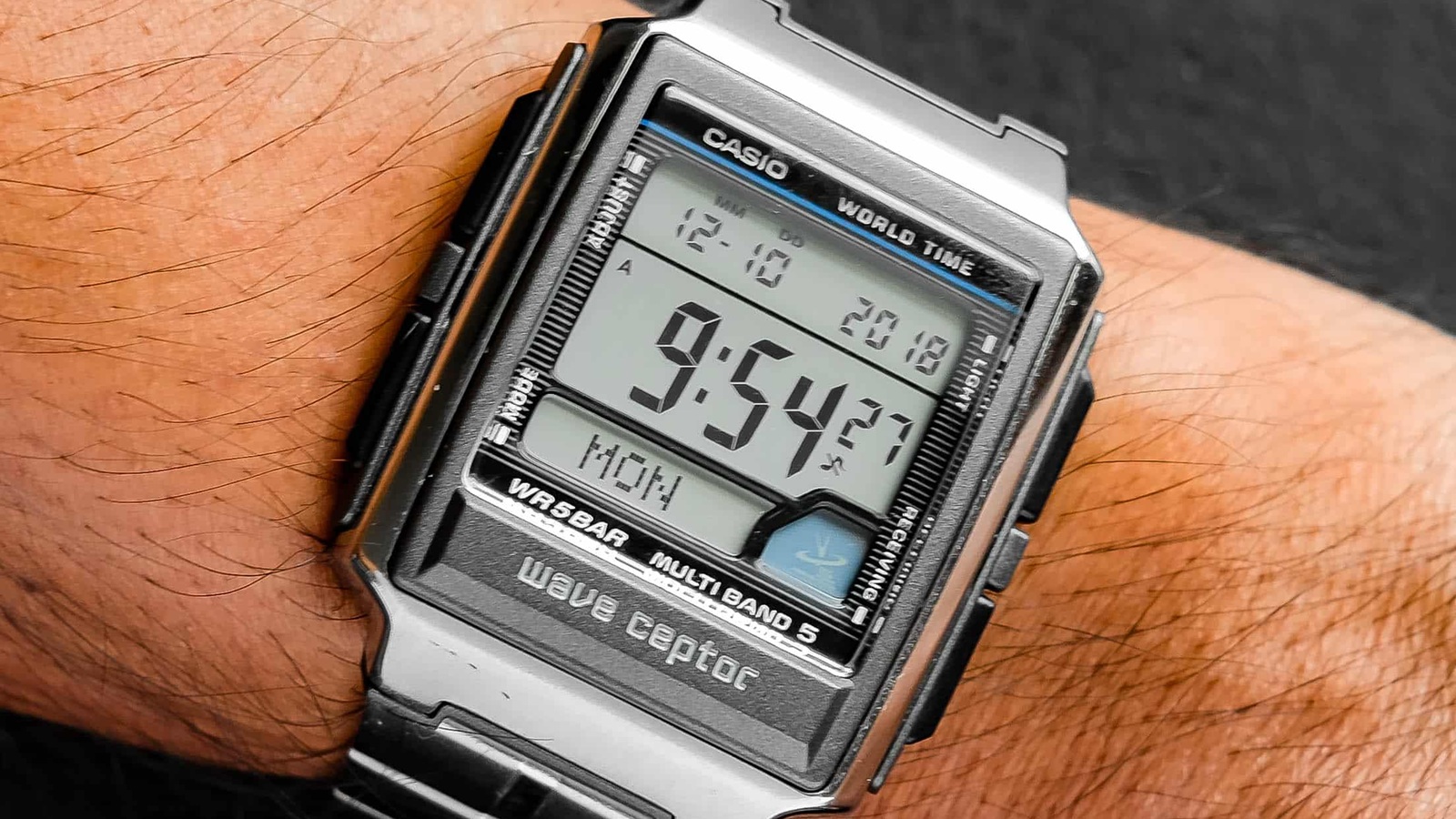
Casio Wave Ceptor

| Price: | $55 – $60 |
| Water Resistance: | 50m |
| Case Dimensions: | 39mm (diameter) x 48mm (lug-to-lug) x 12.75mm (thickness) |
| Lug Width: | 20mm, tapers down to 18mm at the clasp |
| Movement: | Quartz Module 3054 |
The Casio Wave Ceptor earns its place here by blending a familiar retro digital shape with the kind of practicality that becomes obvious the moment it’s on the wrist. The dimensions look a little awkward at first glance, but in practice, they come together nicely. On a sub-7-inch wrist, the rectangular case sat comfortably and felt balanced almost immediately. The narrower case paired with a longer lug-to-lug gives it that classic digital presence without drifting into toy-like territory. Button placement is another quiet win. They’re easy to find and press, even when you’re moving. It also feels incredibly light, especially compared to steel sports watches. At first, that can feel strange, but over time, the lack of heft becomes part of the appeal.
In day-to-day wear, the dial layout stood out as one of the Wave Ceptor’s strongest retro traits. Everything is arranged logically, so your eye lands where it needs to without hesitation. The primary time display is clear, the day and date are easy to glance at, and the small signal indicator quietly reassures you that the watch is keeping itself accurate. The LCD does lose some contrast at sharper angles, but straight on, it remains readable in most lighting conditions. Casio packs a lot into this module, and while the complete feature set can feel overwhelming at first, the core functions are intuitive once you spend a little time with it.
The bracelet plays a significant role in how the Wave Ceptor comes across on the wrist. It leans fully into classic Casio digital territory with its folded metal construction and light, hollow feel. That won’t be for everyone, but after spending enough time with it, we found it encouraged a more relaxed, throw-it-on-and-go relationship with the watch. It sits naturally on the wrist and matches the case better than any aftermarket option likely would. Sizing the bracelet takes some patience, but it’s manageable even without special tools. The integrated design means you’re committed to the stock bracelet, and that limitation feels intentional here. Overall, the Wave Ceptor focuses on reliable, accurate digital timekeeping, wrapped in a retro design that fits easily into everyday life.
Pros
- Clear, logically arranged digital display that’s easy to learn
- Atomic timekeeping and a strong feature set at an accessible price
- Well-placed buttons that are easy to use during daily wear
- The rectangular case wears comfortably despite unconventional proportions.
Cons
- The plastic components can feel cheap if you expect more heft.
- The LCD loses contrast at certain viewing angles.
- The integrated bracelet limits strap changes, and its sizing requires patience the first time.
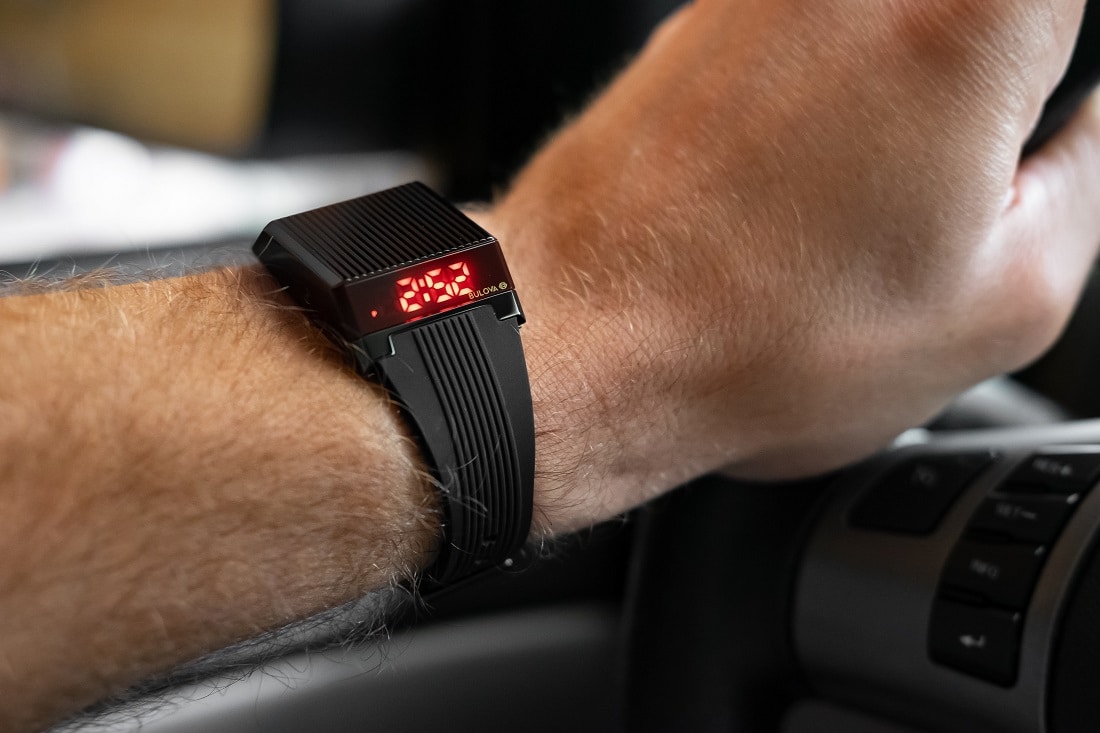
Bulova Computron
| Price: | $450 |
| Water Resistance: | 30m |
| Case Dimensions: | 31mm (diameter) x 40mm (lug-to-lug) x 13.8mm (thickness) |
| Lug Width: | Integrated strap that tapers from 25mm at the case to 16mm at the ends |
| Movement: | Quartz |
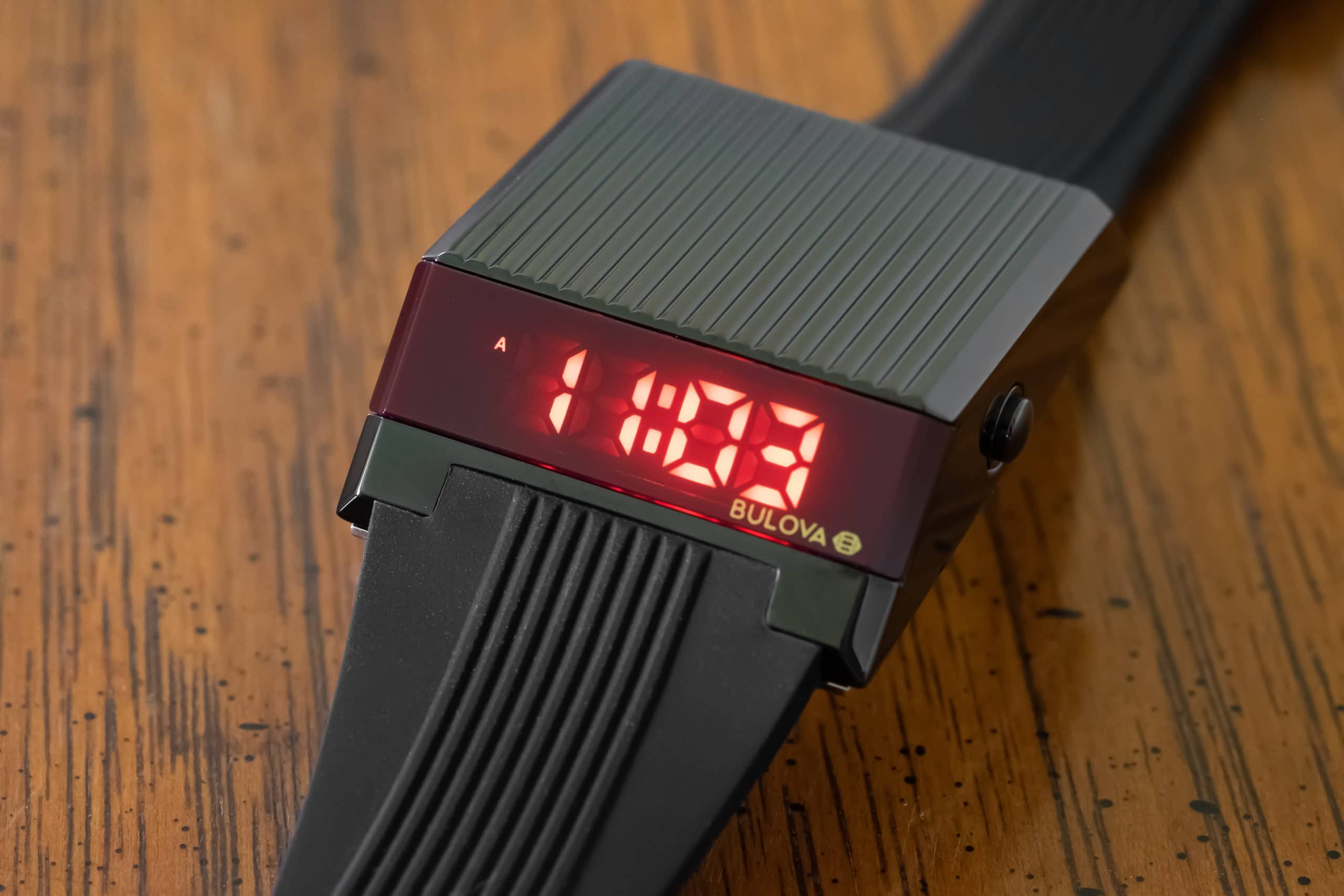
The Bulova Computron earns its spot here by fully committing to its retro identity, even when that choice makes it less convenient. It’s strange, and that’s precisely why it works. The trapezoidal case feels pulled straight from the late ’70s, and Bulova deserves credit for not softening the shape or sanding down the edges to make it more modern. The shallow grooves across the top add a bit of texture to what would otherwise be a very plain slab of metal. On the wrist, the angled case wears more comfortably than photos suggest. Our review team found that it sat securely, remained balanced, and felt lighter than its size would suggest. And for anyone tired of safe, round cases, the Computron feels different the moment it’s on.
Living with the Computron day to day highlights both its charm and its limits. The on-demand LED display stays true to the original concept, and we respect Bulova for keeping it that way, even though it’s less practical. Having to press the side button to check the time forces you to slow down, which can feel inconvenient if you’re used to glances throughout the day. At the same time, that interaction is a big part of the experience. It’s a reminder of an era when digital timekeeping was still experimental rather than optimized. The red LED lights up clearly when activated, and cycling through the time, date, and a second time zone works as intended. It’s a watch that asks for intention, which makes it better suited to casual wear than constant, all-day time checks.
The strap and finishing help anchor the overall experience. The integrated rubber strap is soft and comfortable, and it tapers aggressively enough to keep the case from feeling top-heavy. We noticed fingerprints appearing quickly on the black IP finish, especially since reading the time requires touching the case itself. That’s either something you accept as part of ownership or avoid by choosing a different finish. In the end, the Computron feels less like a daily background watch and more like a wearable piece of retro design history.
Pros
- Faithful case design that captures true 1970s digital character
- Comfortable and balanced fit despite the unconventional shape
- Strong finishing and solid build quality for the price
Cons
- The glossy black finish shows fingerprints easily.
- The on-demand display is slower and less intuitive for frequent checks.
Citizen Ana-Digi Temp
| Price: | $450 – $500 |
| Water Resistance: | 30m |
| Case Dimensions: | 31.5mm (diameter) x 40mm (lug-to-lug) x 8.4mm (thickness) |
| Lug Width: | 18mm |
| Movement: | Citizen caliber 8980 |
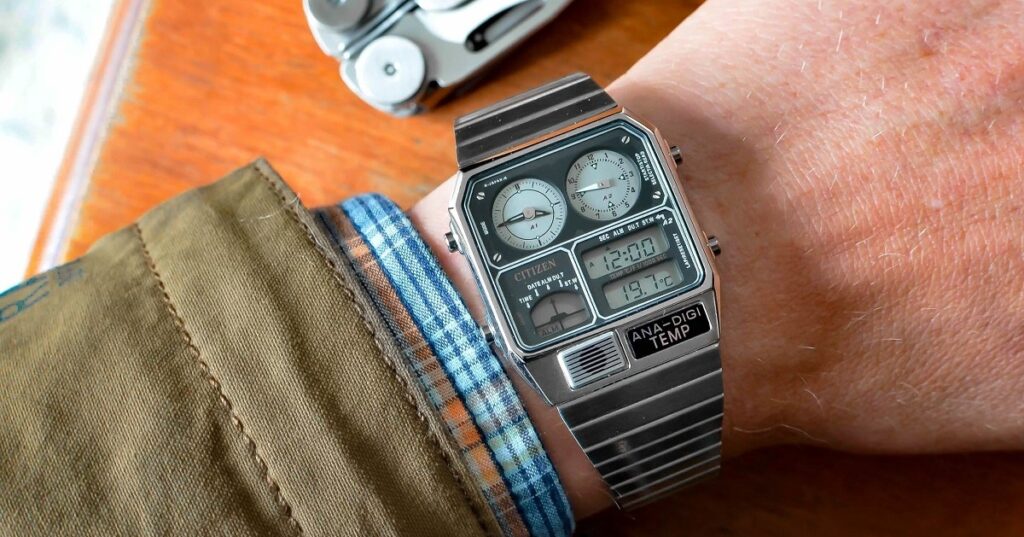
The Citizen Ana-Digi Temp belongs on a list like this because it doesn’t try to simplify or modernize its personality. From the moment it hits the wrist, it feels unmistakably rooted in the ’80s. The boxy stainless steel case and dense layout come across more like a miniature control panel than a conventional dial. Despite how busy it looks, it wears smaller than you might expect. The short lug-to-lug and relatively slim profile keep it balanced, even on smaller wrists. In daily wear, it never really fades into the background. It feels less like a background accessory and more like a functional artifact.
Citizen divided the functions into clearly defined zones, and that structure holds up well in daily use. Analog registers and LCD screens coexist without feeling chaotic. High-priority information appears in sharp white text against a black background, while secondary labels fade into darker tones and stay visually quiet. Branding is intentionally restrained. The analog hands contribute real utility rather than decoration. On the left, slim matte-black hands with narrow lume strips still manage to glow reliably. On the right, a heavier regulator-style hand is easy to follow at a glance. Four luminous markers at the cardinal points help keep everything oriented, and small details, such as polished hand bases and exposed screws, add contrast without pulling attention away from function.
Where the Ana-Digi Temp really shows its character is in how it presents and manages information. The dual-time setup functions like a practical GMT, pairing an analog reference with precise digital confirmation underneath, which we found genuinely useful when dealing with multiple time zones. The temperature feature is more situational. For accurate readings, the watch needs to be off the wrist, which limits quick checks but still makes it a fun and occasionally useful tool.
The integrated bracelet wears comfortably and feels purpose-built for the case, though the flared end links are a known vulnerability. For collectors drawn to unconventional layouts, early multi-function features, and designs that stand apart rather than blend in, the Ana-Digi Temp continues to deliver a distinctly retro experience. For more insights on this model, check out our in-depth hands-on review.
Pros
- Compact, wearable case despite the visually dense design
- Strong contrast makes key information easy to read.
- The distinct analog-digital layout delivers practical dual time functionality.
- Temperature measurement and data storage features add meaningful utility.
Cons
- The busy dial can feel overwhelming at first.
- Accurate temperature readings require taking the watch off the wrist.
- The bracelet end links are prone to bending.
That’s where we’ll leave our list of retro digital watches that have actually held up over time. If there’s a retro digital you think deserves to be here, or one that’s been quietly earning time on your wrist, drop it in the comments. We’re always interested in revisiting overlooked favorites and tracking down the next hidden gem.

Co-Founder and Senior Editor
Kaz has been collecting watches since 2015, but he’s been fascinated by product design, the Collector’s psychology, and brand marketing his whole life. While sharing the same strong fondness for all things horologically-affordable as Mike (his TBWS partner in crime), Kaz’s collection niche is also focused on vintage Soviet watches as well as watches that feature a unique, but well-designed quirk or visual hook.