Most watches still want us to pick a lane. Field, diver, pilot, dress—each category comes with a familiar set of cues, and collectors get pretty good at spotting them at a glance. But some watches get interesting precisely because they refuse to stay put. After enough time on the wrist, we’ve found that a watch can borrow the legibility of a field watch, the robustness of a diver, the clean functionality of a pilot watch, or the restraint of a dress watch without fully becoming any of them. That overlap can make for some of the most wearable watches in a collection, but it can also expose compromises that aren’t obvious in a product photo. We’ve spent enough time with these designs to know the difference matters. This article looks at the watches we’ve handled that genuinely blur those category lines, and where each one lands on the wrist.
More than a decade of wearing, testing, and comparing watches has changed how we judge that kind of versatility. We pay attention to whether a case settles naturally after several hours, whether the bracelet helps or hurts that flexibility, whether a dial stays easy to read when the light gets awkward, and whether a watch’s practical details keep making sense once the novelty wears off. We’ve also learned that the same design choice can be a strength in one setting and a limitation in another. Those experiences shape the recommendations here. We’re looking at where these watches successfully cross the field-diver-pilot-dress divide, where they don’t, and which compromises are worth living with.
Marathon General Purpose Mechanical
| Price: | $525 – $575 (Check Current Price) |
| Water Resistance: | 30m |
| Case Dimensions: | 34mm (diameter) x 41mm (lug-to-lug) x 12.5mm (thickness) |
| Lug Width: | 16mm |
| Movement: | Seiko NH35A Automatic |
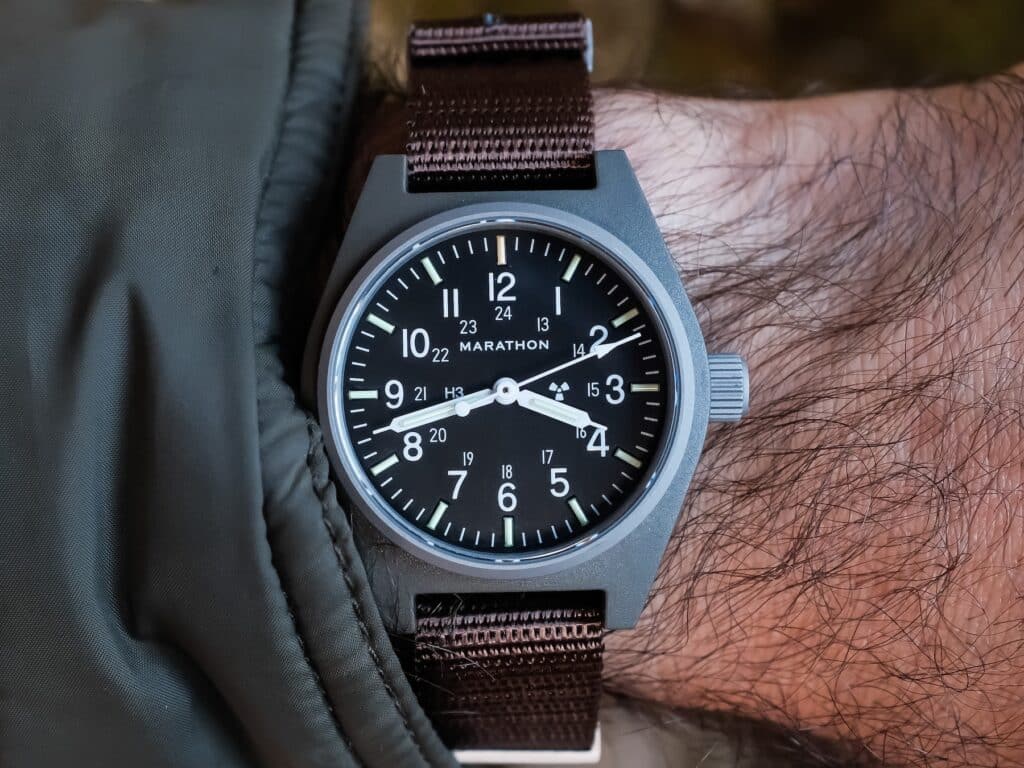
The Marathon General Purpose Mechanical earns its place here by sitting comfortably between a field watch and a pilot watch without trying too hard to borrow from either. The sage-green resin 34mm case, NSN markings, and specification-packed caseback make it feel like equipment rather than a civilian watch wearing a costume (and we’ve seen plenty of those). The inner 24-hour scale and syringe hands reinforce that impression while keeping the dial remarkably easy to scan. Then there’s the case itself. At 12.5mm thick with a 41mm lug-to-lug, the little Marathon has more wrist presence than its diameter indicates, but the resin keeps it warm, light, and comfortable through a full day. After several hours of desk work and running around, we’d take that low weight over unnecessary steel heft without much hesitation.
The tritium tubes are another reason the watch works so well as a practical field/pilot hybrid. They keep the dial visible in low light without asking us to wave the watch under a lamp first, which fits the Marathon’s low-fuss personality. The bezel is deliberately uninteresting, too, and that’s a compliment here. It doesn’t try to dress it up as a diver with functionality it doesn’t need. The all-steel crown is small but has enough grip to make winding and setting straightforward, while the Seiko NH35A keeps mechanical ownership familiar with its roughly 41-hour power reserve and serviceable design. The catch is the 30-meter water resistance. The watch looks prepared for considerably more abuse than that rating suggests, so we’d keep the adventure on land rather than let the case’s military attitude talk us into something stupid.
The Marathon loses a few points on the strap setup. The ballistic nylon looks perfectly at home but starts stiff, and we preferred a single-pass olive-drab strap because it helped the case sit lower and feel more natural. That leads to one of the watch’s more annoying little contradictions: the 16mm lugs restrict strap choices, while tight spring-bar clearance makes changing the few options available more fiddly than it should be. It also won’t sneak under a cuff and pass for a dress watch, nor should we expect it to.
Its versatility is more convincing in the field/pilot end of the spectrum, where compact proportions, constant low-light legibility, light weight, and genuine tool-watch details give it a distinct role. For collectors who like watches with an actual job to do, that honesty goes a long way. Our hands-on review gets deeper into the details that make this field/pilot hybrid work.
Pros
- Tritium illumination provides constant low-light visibility without needing to charge the lume.
- Lightweight sage-green resin makes the 34mm case comfortable for long wear.
- Inner 24-hour scale and clear syringe hands add pilot-watch practicality without sacrificing field-watch clarity.
- The familiar NH35A keeps mechanical ownership straightforward, serviceable, and low-stress.
- The small all-steel crown has enough grip for easy winding and setting.
- NSN markings and the spec-heavy caseback reinforce the genuine tool-watch character rather than merely styling it that way.
Cons
- 30 meters of water resistance is hard to reconcile with the watch’s rugged appearance.
- The 16mm lug width significantly limits strap experimentation.
- Tight spring-bar clearance makes strap swaps more awkward than normal.
- The stock ballistic nylon strap feels stiff initially.
Praesidus A-11 Type 44 Patina
| Price: | $555 (Check Current Price) |
| Water Resistance: | 100m |
| Case Dimensions: | 32mm (diameter) x 39mm (lug-to-lug) x 13mm (thickness) |
| Lug Width: | 20mm |
| Movement: | Swiss-made, manual-wind Landeron L21 movement |
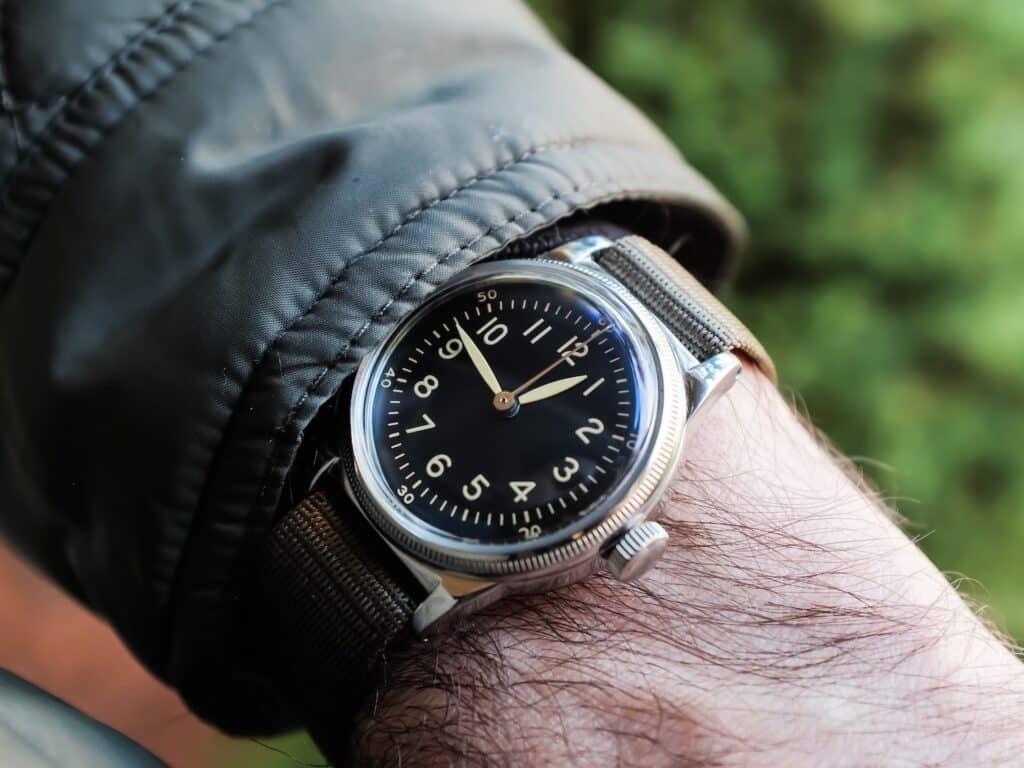
The Praesidus A-11 Type 44 Patina makes a good case for why some watches are more interesting when they refuse to stay in their assigned category. At 32mm, with a logo-free dial and military-style layout, it is unmistakably a field watch. Still, the clean numerals and crisp handset give it the kind of instant legibility we tend to associate with pilot watches. More importantly for this list, it doesn’t need oversized dimensions or a pile of extra functions to pull off that overlap. The compact case, curved lugs, and 39mm lug-to-lug settle neatly against the wrist, while the 13mm thickness and domed acrylic crystal keep the watch from feeling flat or flimsy. We know 32mm can sound comically small to anyone used to modern 40mm-plus watches, but after several hours, the reduced footprint starts to feel liberating rather than limiting.
A lot of that appeal comes from the dial. The Arabic numerals and railroad minute track make reading the time almost automatic. At the same time, the faux-patina hands and markers add enough age to the presentation without turning it into a caricature of a vintage watch. The polished second hand adds nice contrast, and the absence of a logo keeps the dial calm. That helps it move toward dressier territory more naturally than most military field watches, although we wouldn’t mistake it for a dress watch. Even the textured bezel knows when to stay out of the conversation. Moreover, the Swiss Super-LumiNova is useful rather than spectacular, so we got functional low-light visibility without expecting the dial to stage a light show after dark.
The mechanical side keeps that same uncomplicated character. The Swiss-made manual-winding Landeron L21 makes winding and setting easy enough, although there is noticeable resistance through the crown. It lacks the smoother feel we’ve experienced from the Sellita SW210. Accuracy during our hands-on testing was solid, and we encountered no reliability problems. The 10-ATM water resistance is arguably the bigger surprise here. This watch looks like something we should be treating gingerly, yet the rating gives it more everyday freedom than its vintage styling implies. It still isn’t a substitute for a diver, and the relatively modest lume reinforces that distinction, but it doesn’t need to be wrapped in bubble wrap whenever the forecast changes.
Our biggest gripe was the supplied canvas strap, which felt thicker than the small case needed. Moving to a 16mm olive single-pass nylon strap brought the watch closer to the wrist and made the whole setup feel more natural. Black nylon also works when you want to dial back the military character. The standard lugs also make strap experimentation easy. Praesidus offers larger configurations, but the 32mm version on olive canvas feels closest to the compact original idea while remaining versatile. That said, the trade-offs are clear: lume could be stronger, winding could be smoother, and 32mm will remain a mental hurdle for many collectors. But for a watch that lives primarily in field territory while borrowing pilot clarity, vintage dress-watch restraint, and useful everyday water resistance, those compromises make sense rather than feeling like mistakes.
Pros
- The 10-ATM rating gives the vintage-styled case useful everyday water resistance.
- Clean Arabic numerals and the railroad track make time checks quick and effortless.
- The logo-free dial keeps the presentation restrained.
- Standard 16mm lugs make changing straps easy and broaden its stylistic range.
- Manual-winding Landeron L21 delivers an approachable mechanical experience with solid accuracy in testing.
- Curved lugs and the 39mm lug-to-lug help the compact case sit securely without feeling fragile.
Cons
- The supplied canvas strap feels too thick for the 32mm case.
- Crown winding has noticeable resistance.
- Super-LumiNova is functional but hardly a nighttime show-off.
CWC Mellor 72
| Price: | $600 (Check Current Price) |
| Water Resistance: | 50m |
| Case Dimensions: | 35mm (diameter) x 42mm (lug-to-lug) x 11mm (thickness) |
| Lug Width: | 18.5mm |
| Movement: | Sellita SW210 hand-wound movement |
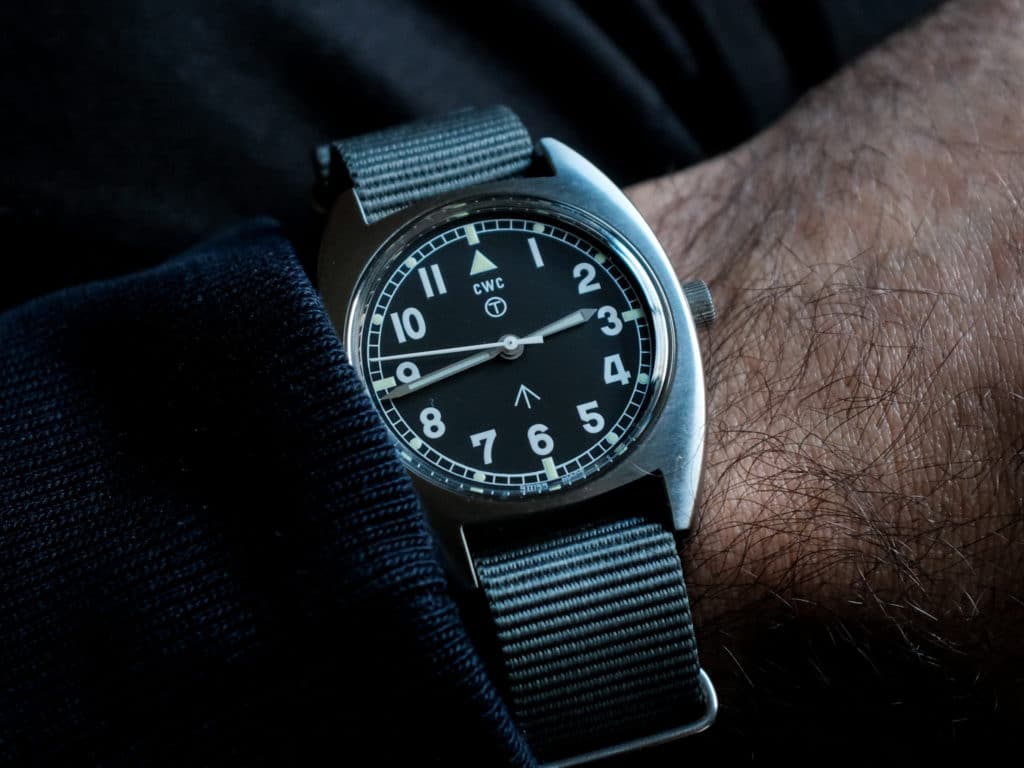
The CWC Mellor 72 doesn’t need much help deciding what it wants to be, which is part of why it works so well in a list about blurred categories. The 35mm case, fixed bars, fully brushed finish, and restrained military dial keep it firmly in field-watch territory, but its compact tonneau shape gives it more presence than the dimensions indicate.
On the wrist, it feels closer to a 38mm watch than a tiny vintage piece, helped by the case shape and crown placement. That makes it easier to imagine wearing beyond strictly utilitarian situations without sanding away the character that makes it interesting. The trade-off is the fixed-bar setup. It feels secure and appropriate here, but it removes the easy strap-swapping that makes many modern watches so adaptable. And while 50 meters of water resistance handles everyday splashes without complaint, we wouldn’t confuse that with diver capability.
The dial is probably where the Mellor comes closest to borrowing from the pilot-watch playbook. Bold Arabic numerals, a high-contrast layout, and the railroad-style seconds track make reading the time almost instantaneous, while the minute hand reaching properly to that outer track adds a degree of precision that you notice during actual use. CWC’s vintage typography and circled T marker bring in the military flavor without making the watch look like a reenactment prop. Modern Super-LumiNova keeps low-light checks practical, and the Hesalite crystal softens the whole presentation in a way sapphire simply doesn’t. It also scratches more readily, though, so this is one of those watches where living with a few marks is preferable to spending every other week worrying about them.
The Sellita SW210 underneath gives the watch another reason to feel distinct from a purely decorative vintage throwback. Winding is smooth, satisfying, and tactile, and our detailed testing showed steady performance without any reliability drama. That daily ritual makes the mechanical side feel approachable rather than intimidating, while the snap-back case should make future servicing more practical. What we like most is that the Mellor can edge toward pilot-style legibility and even a slightly dressier restraint without losing its field-watch identity.
Pros
- The 35mm tonneau case has more wrist presence than expected and wears closer to a 38mm watch.
- Bold numerals and the high-contrast dial make quick time checks effortless.
- The minute hand reaching the railroad track gives the dial a more precise, instrument-like feel.
- Smooth SW210 winding makes the mechanical interaction satisfying.
Cons
- Fixed bars sharply limit strap experimentation and make it harder to change the watch’s character.
- 50-meter WR covers ordinary daily wear but leaves it well short of diver territory.
- Hesalite adds welcome warmth but scratches more easily than sapphire.
Nodus Sector II Field Titanium
| Price: | $625 (Check Current Price) |
| Water Resistance: | 100m |
| Case Dimensions: | 38mm (diameter) x 47mm (lug-to-lug) x 11.7mm (thickness) |
| Lug Width: | 20mm |
| Movement: | Seiko/TMI NH38 automatic |
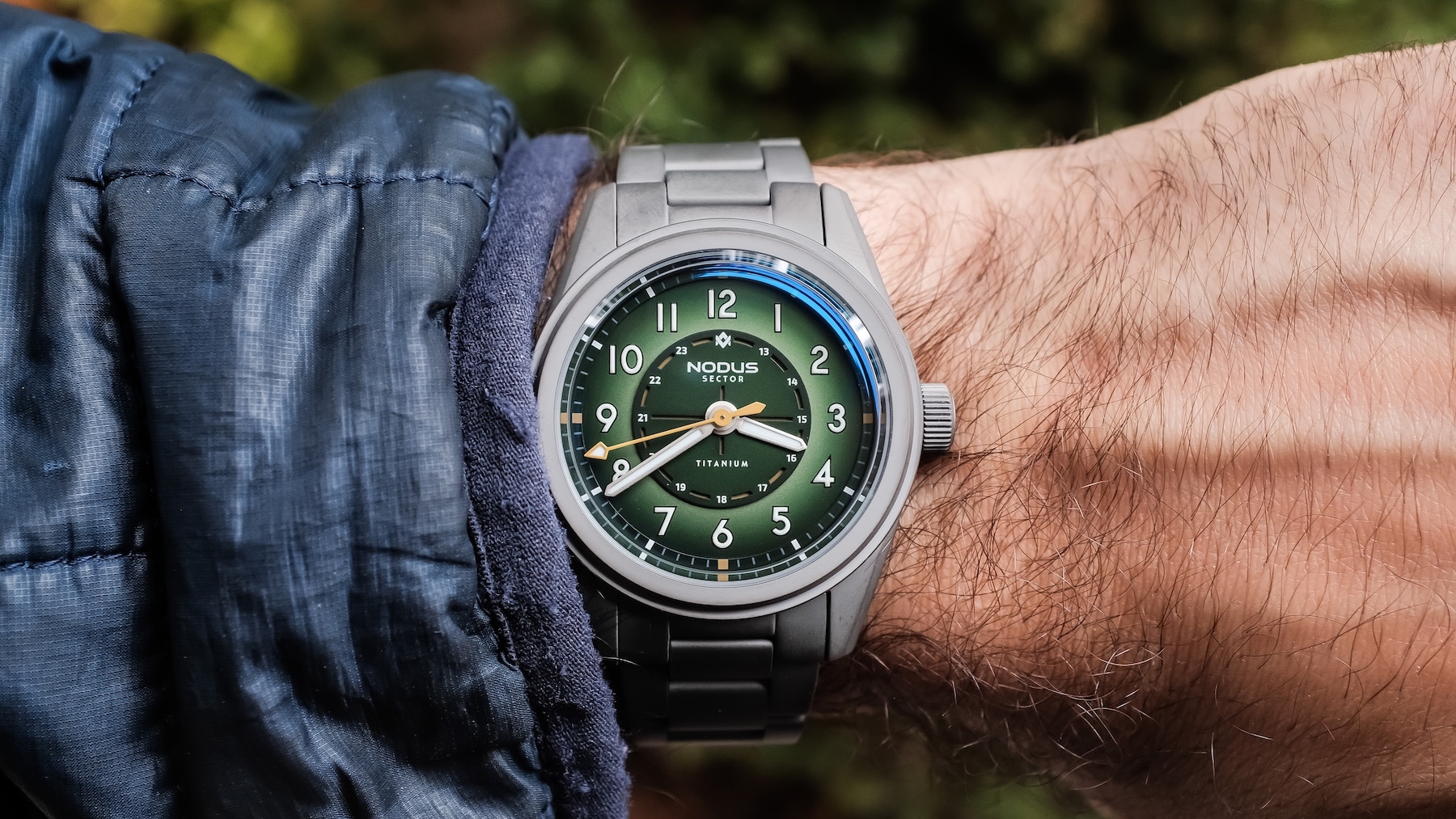
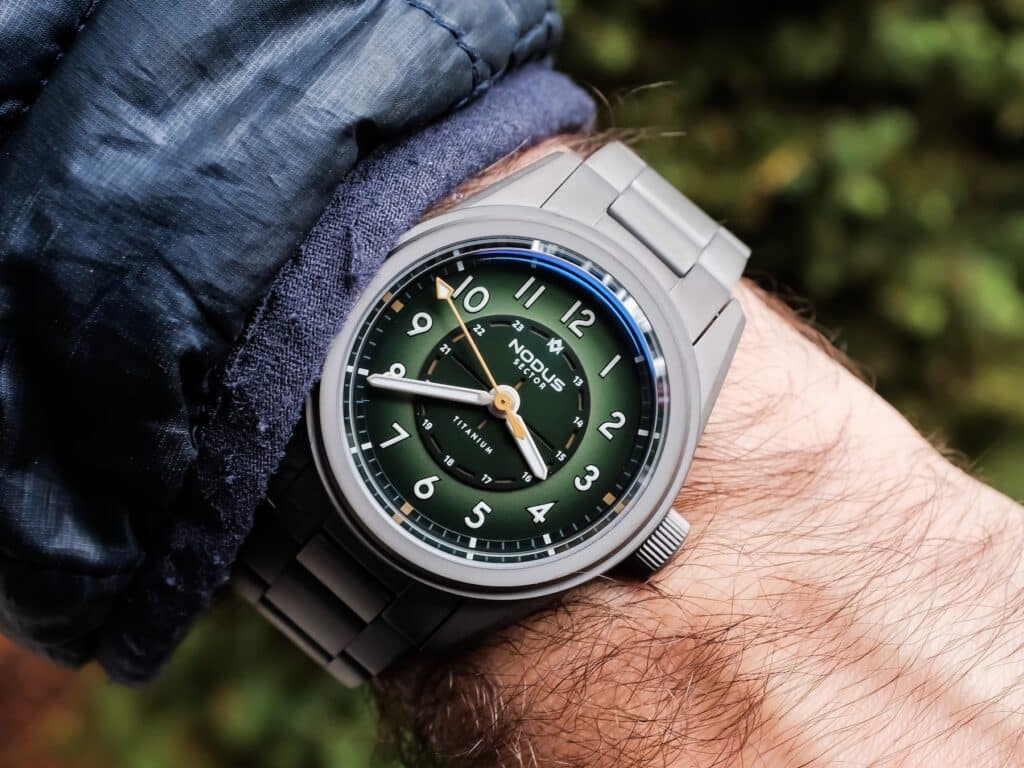
The Nodus Sector II Field Titanium is what happens when a field watch stops looking backward for design inspiration. After spending significant time with it, we liked how much of its appeal comes from how naturally it sits on the wrist. The 38mm case, 47mm lug-to-lug, and 11.7mm thickness give it enough presence without turning it into another oversized “rugged” watch. The squared-off lug tips add some visual reach, while the downward curve keeps the case planted comfortably, even on a 6.75-inch wrist.
Titanium changes the experience more than the spec sheet suggests, too. At roughly 100 grams on its bracelet before sizing, it feels almost suspiciously light for a mechanical watch with this much visual presence. The matte media-blasted Grade 2 titanium case keeps things properly tool-ish, although collectors who like their watches a little shinier may find it almost aggressively restrained.
The Sequoia green dial is where Nodus adds personality. Instead of another flat military dial, we get a raised center, recessed numeral ring, elevated chapter ring, and sandwich-style openings that create real depth. The metallic gradient around the numerals shifts subtly with the light, so the dial never feels quite the same throughout the day. It remains highly legible, though, which is where the field and pilot sides of the watch meet nicely. The BGW9 lume is particularly good, charging fast and giving us plenty of low-light visibility. The box-shaped sapphire, stepped bezel, and underside blue AR coating also keep the dial readable when reflections could otherwise get annoying. Add the screw-down crown, titanium caseback, and 100 meters of water resistance, and it handles ordinary wet-weather life with far less fuss than a traditional field watch.
The NH38 automatic keeps things straightforward with a 41-hour power reserve, 21,600vph beat rate, and no date position to accidentally hunt for. Nodus also regulates it in-house to a claimed ±10 seconds per day, which is the sort of ownership detail we appreciate far more than movement name-dropping.
The bracelet is similarly well resolved. Solid links, no noticeable rattle, a 20mm-to-16mm taper, and the latest NEM (Nodus Extension Mechanism) clasp make it comfortable all day, with enough adjustment to accommodate a wrist that decides to swell after lunch. Drilled lugs and quick-release spring bars leave the door open for NATO, canvas, or leather, though we rarely wanted to open it because the bracelet suits the watch so well.
That combination makes the Sector II a particularly convincing field/pilot crossover with enough water resistance for everyday use. It isn’t a diver, and it doesn’t need to cosplay as one. At its price, it makes more sense for someone who wants a modern field watch with its own design language rather than another military throwback. Our review gets into the finer details.
Pros
- At around 100 grams on the bracelet, it stays comfortable for extended wear.
- The layered Sequoia dial adds character without compromising readability.
- Fast-charging BGW9 lume gives useful low-light visibility.
- 100 meters of water resistance broadens everyday use beyond the usual field-watch boundaries.
- NEM clasp and 20mm-to-16mm taper make the bracelet comfortable and easy to fine-tune.
- Drilled lugs and quick-release spring bars make strap changes painless.
Cons
- 41-hour power reserve is merely adequate.
- Fully blasted titanium may feel too visually subdued for anyone who prefers polished or contrasting finishing.
Mido Commander M8429.3.22.13
| Price: | $960 (Check Current Price) |
| Water Resistance: | 50m |
| Case Dimensions: | 37mm (lentgh) x 37mm (width) x 10.5mm (thickness) |
| Strap Width: | 19mm, tapers down to 16mm |
| Movement: | Mido Caliber 80 |
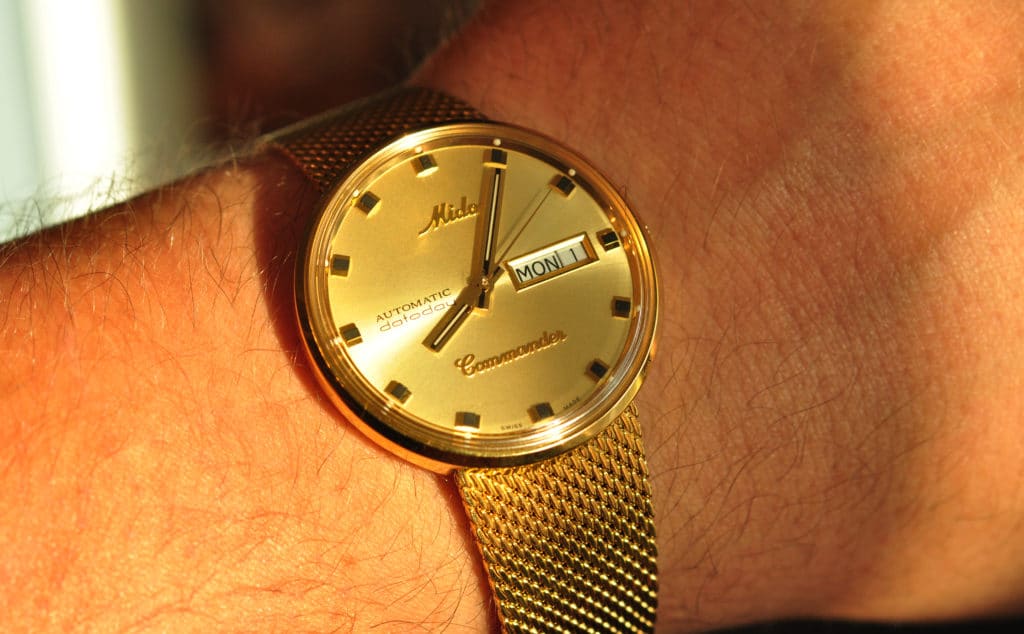
The Mido Commander M8429.3.22.13 is the odd one out here in the best possible way. It takes the dress-watch recipe—37mm case, 10.8mm thickness (including the crystal), gold, and a bracelet that looks more jewelry than tool—and gives it enough personality to avoid disappearing under a cuff. The lugless, round case wears slim, while the Milanese bracelet flows directly into the case and tapers from about 19mm to 16mm. The monocoque construction also gives the back of the watch a smooth feel against the wrist, with small side recesses keeping the case visually thin. It’s dressy, but not precious. The catch is that Mido has rather firmly decided how you should wear it: the pinned bracelet and lugless construction make strap swapping a non-event.
Most of the Commander’s overlap appeal comes from the dial. The gold sunburst surface, cursive Mido logo, applied details, framed day-date, and black-topped five-minute markers create an old-school look that has more character than the average minimalist dress watch. The broad gold-and-black baton hands are easy to pick out, although their lume is more decorative insurance than something we’d trust for a late-night time check.
Setting the watch precisely is another vintage-flavored annoyance. With no markers between the five-minute intervals, getting the minute hand exactly where you want it takes some squinting and patience. The domed Hesalite crystal adds a softer, warmer quality to reflections, but it sits proud enough to collect scratches with regular wear. In other words, the Commander gives you plenty of charm and charges a small ownership tax for it.
The Caliber 80 underneath offers a practical advantage: an 80-hour power reserve from its ETA 2836-2-derived architecture, running at 21,600 bph. That helps because the tiny signed crown is fiddly to wind and set, while the Milanese bracelet’s flip clasp and adjustable buckle offer good security but have an adjustment lever that is far stiffer than it needs to be. The result is a watch that doesn’t literally cover all four categories, but demonstrates how far a dress watch can move toward everyday versatility without losing its identity. We get into the ownership details in our in-depth review.
Pros
- The 37mm lugless case and 10.8mm thickness give it a slim, dress-friendly profile.
- The framed day-date adds useful everyday functionality without disrupting the vintage dial.
- Gold finishing, applied details, and the sunburst dial give it a personality most dress watches at this size lack.
- The Milanese bracelet integrates neatly and tapers from about 19mm to 16mm.
- Caliber 80’s 80-hour reserve reduces how often the awkward crown needs attention.
Cons
- The tiny signed crown makes winding and setting needlessly frustrating.
- Five-minute markers without intermediate minute marks make precise setting harder.
- Lugless construction and the pinned bracelet effectively rule out strap swapping.
- The Milanese clasp’s adjustment lever is excessively stiff.
- The lume is too weak to treat as a serious low-light feature.
Archimede Outdoor Protect
| Price: | $1100 – $1300 (Check Current Price) |
| Water Resistance: | 200m |
| Case Dimensions: | 38.5mm (diameter) x 43.5mm (lug-to-lug) x 11.5mm (thickness) |
| Lug Width: | 18mm |
| Movement: | Sellita SW200-1 automatic |
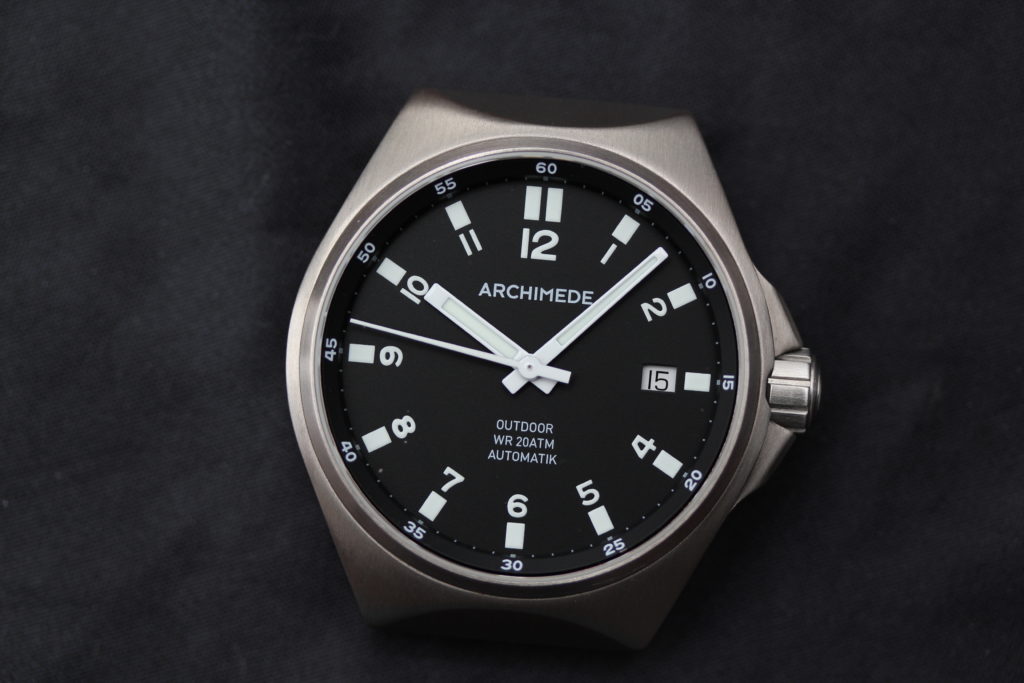
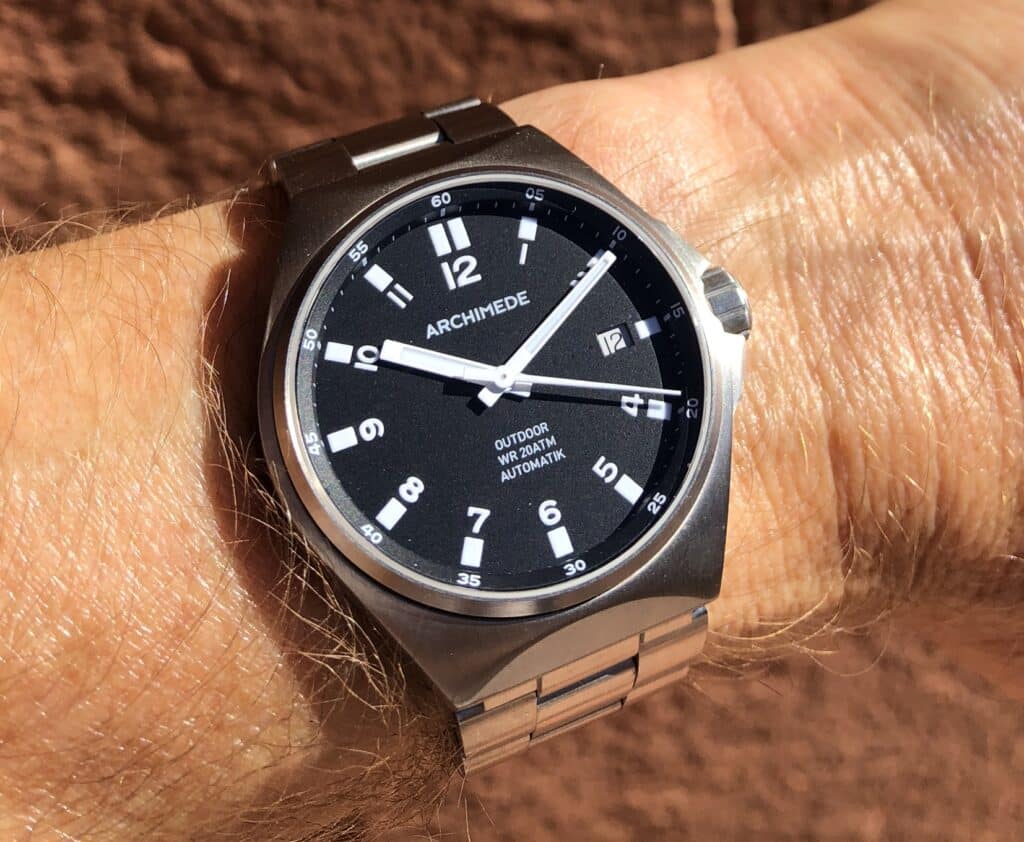
The Archimede Outdoor Protect is a useful reminder that a watch doesn’t need vintage military styling to live in field-watch territory. There’s no faux patina or historical cosplay here. Instead, it takes the practical side of a field watch and pushes it toward diver-level toughness. The barrel-shaped, lugless case is made from hardened stainless steel, and after extended hands-on wear, it shrugged off surface marks noticeably better than ordinary steel. That matters because this is the kind of watch we can wear without negotiating with ourselves every time it gets near a doorway.
The case stays compact and secure on the wrist, while the lengthwise brushing keeps the appearance firmly tool-oriented. Even the crown guards are machined into the midcase, protecting the crown without making it a tiny hostage during winding and setting. With a screw-down crown, sealed caseback, and 200 meters of water resistance, it’s much more comfortable around rain, chores, travel, and general abuse than the typical field watch.
The dial takes the same no-nonsense approach. Its flat black surface, white numerals, and cleanly aligned markers make quick time checks almost automatic, whether we’re outdoors or simply trying to read the watch without ceremony. It lacks the warmth of some vintage-inspired pieces here, but that is part of the point. The Outdoor Protect is designed to be used rather than admired from a safe distance. The Sellita SW200-1 backs that up with reassuring performance, averaging +6 seconds per day across three positions over a week of testing. In short, the watch doesn’t ask us to choose between mechanical charm and practical reliability quite as much as some category-pure pieces do.
The obvious compromise is the same feature that makes the case so clean on the wrist: it’s lugless. You get the supplied bracelet and rubber option, both of which suit the watch properly, but there’s no easy route into the usual strap-swapping rabbit hole. For collectors who treat every watch as an excuse to order another pile of straps, that will sting. For everyone else, it’s a small price for a watch that genuinely crosses the field/diver divide while keeping the legibility associated with pilot-style tool watches. What it does particularly well is give us a modern mechanical watch with field-watch clarity, diver-level water resistance, and enough hardened steel to make everyday scratches feel less like a personal betrayal.
Pros
- 200m of water resistance, a screw-down crown, and a sealed caseback give it genuine water-ready versatility.
- Hardened stainless steel resisted surface marks better than standard steel during extended wear.
- The flat black dial and white printing make time checks quick.
- Brushed barrel-shaped case wears compactly and securely without becoming cumbersome.
- The integrated crown guards protect the crown while keeping it usable.
Cons
- Aftermarket strap experimentation is essentially off the table.
- Lugless construction limits the watch to the supplied bracelet and rubber strap.
Mido Commander Datoday
| Price: | $1,260 (Check Current Price) |
| Water Resistance: | 50m |
| Case Dimensions: | 40mm (diameter) x 10.7mm (thickness) |
| Lug Width: | 21mm |
| Movement: | Mido Caliber 80 automatic |
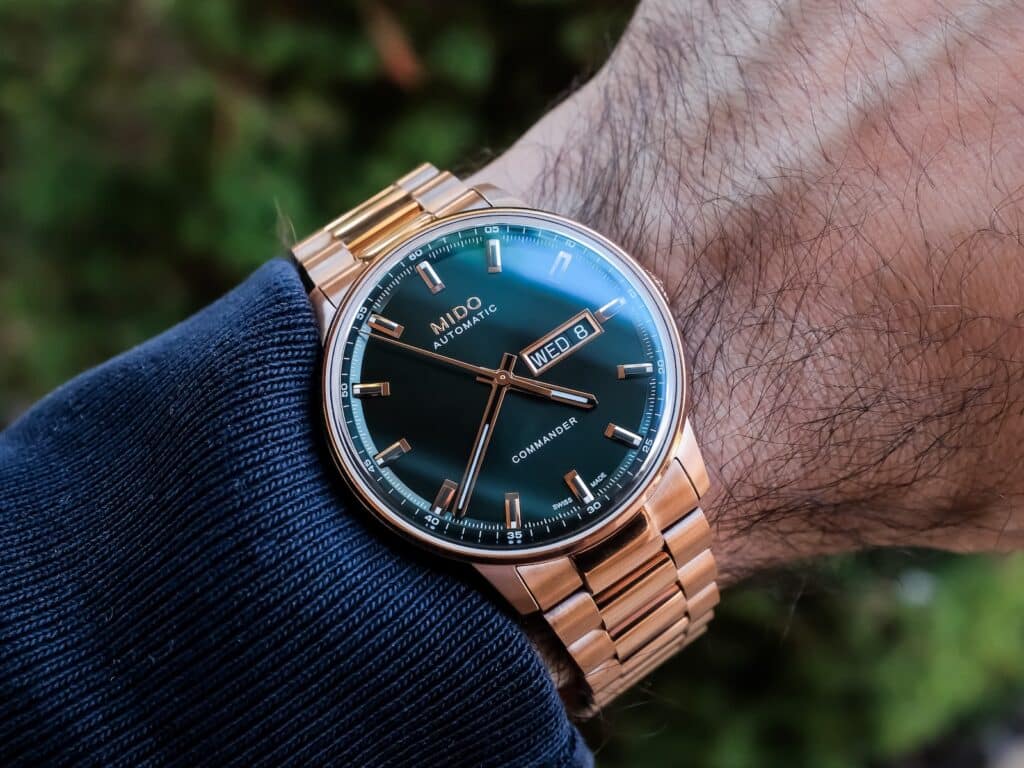
The Mido Commander Datoday earns its spot here by showing how far a dress-leaning watch can move toward everyday territory without losing its polish. The green dial changes character with the light, shifting from blue-green to a deeper forest shade, and that variation keeps the rose-gold-tone PVD from feeling overly formal. We liked that because it gives the watch some life without piling on visual noise.
At 40mm wide and just 10.7mm thick, the case has enough presence to feel substantial while remaining slim enough to avoid becoming a cuff-management exercise. The three-link bracelet follows the case closely, making the whole thing feel like a single object rather than a dress watch fitted with metal. Brushed and polished surfaces add some texture, while the tidy butterfly clasp keeps the package appropriately clean.
The practical side is better thought through than the dressy presentation might suggest. The stepped outer dial, white markings, rose-gold-tone applied indexes, baton hands, and framed day-date window keep the display easy to read without disturbing the balance. Flip the watch over, and the Caliber 80 adds an 80-hour power reserve, so leaving it off the wrist for a couple of days doesn’t automatically mean you have to reset everything. The Nivachron balance spring also offers useful protection against magnetism and everyday shocks, which we appreciate more once a watch stops living exclusively on the nice side of the desk. The quick-release spring bars are another welcome touch because they make it easy to ditch the PVD bracelet when the watch starts feeling a little too formal and switch to leather. That flexibility helps the Commander stretch beyond straight dress-watch use.
There are limits, though, and they show up most around the strap and water side of the equation. The 21mm lug width narrows replacement strap options, and we’d prefer a stronger taper near the clasp and screw links than the current setup. The crown is also smaller than ideal, which makes setting more fiddly than it needs to be. More importantly, the push-pull crown and 50-meter water resistance mean we’re not treating it like an aquatic watch just because the bracelet makes it feel versatile. The Datoday works better as a dress/everyday crossover, borrowing enough practical design to handle normal life while keeping its polished personality intact. For a closer look at those features and how they play out on the wrist, check out our full review.
Pros
- The green dial shifts from blue-green to forest tones as the light changes, giving the rose-gold-tone PVD more restraint.
- Three-link bracelet follows the case closely for a cohesive, integrated feel.
- 40mm case and 10.7mm thickness give it presence without excessive bulk.
- Framed day-date adds useful everyday functionality while keeping the dial balanced.
- Caliber 80 provides an 80-hour power reserve and Nivachron protection against magnetism and everyday shocks.
- Switching to a different bracelet isn’t complicated, thanks to the quick-release spring bars.
Cons
- The 21mm lug width limits replacement strap options.
- Small crown makes winding and setting more fiddly than it should be.
- Push-pull crown and 50 meters of water resistance mean it isn’t the watch we’d pick for carefree water use.
- The pin construction isn’t as convenient as screw links for sizing the bracelet.
Jack Mason Strat-o-Timer GMT
| Price: | $1,399 (Check Current Price) |
| Water Resistance: | 200m |
| Case Dimensions: | 40mm (diameter) x 47mm (lug-to-lug) x 13mm (thickness) |
| Lug Width: | 20mm |
| Movement: | Miyota 9075 |
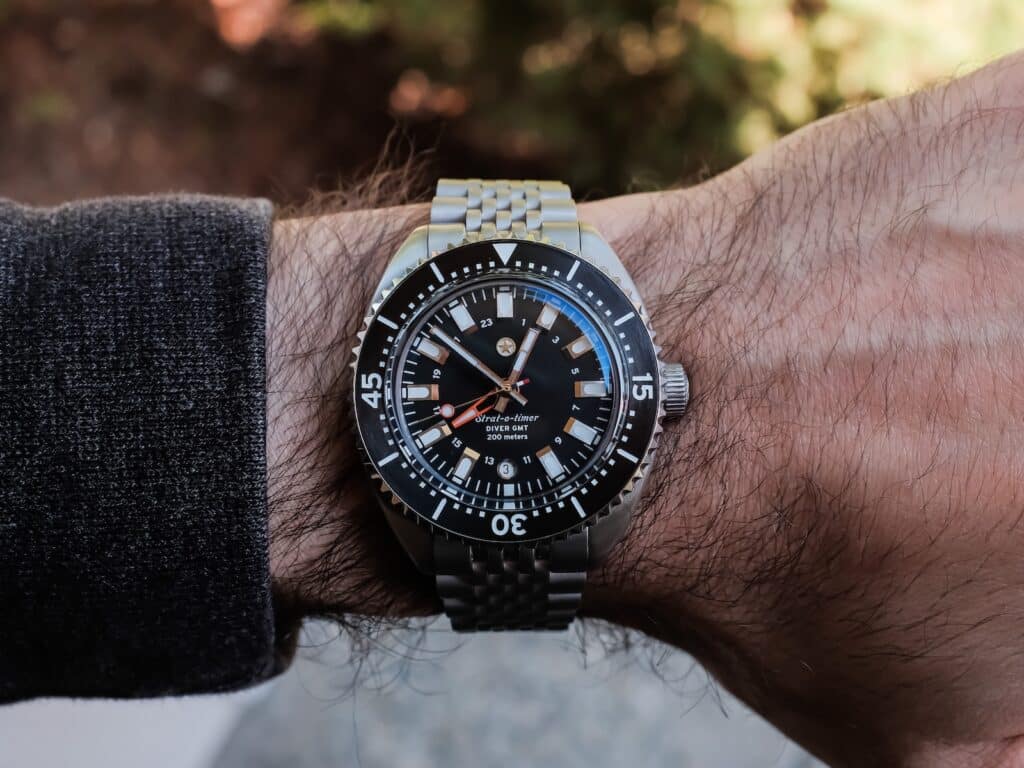
The Jack Mason Strat-o-Timer GMT is a convincing case of an American diver borrowing from the pilot and travel-watch playbook without becoming a feature pileup. At 40mm wide, 47mm lug-to-lug, and just over 13mm thick, the titanium version could have worn hefty, but shedding roughly 40 grams versus steel makes a noticeable difference after a full day. The curved mid-case, downward-arching lugs, and fully brushed Grade 2 titanium keep it close and tool-like, while 200 meters of water resistance, a sapphire crystal, and a screw-down crown give it legitimate diver credentials.
The clever bit is the layout. The full 24-hour GMT scale lives on the dial, leaving the ceramic bezel as a proper 120-click timing tool. The black or blue palette keeps the applied BGW9 markers, stick hands, lollipop second hand, and orange GMT hand from turning the dial into visual soup. Lume on the hands, markers, GMT hand, and bezel markings stayed useful during our weekend in the woods, although our sample’s bezel had some play and its markings weren’t perfectly aligned. Those are small details, but they’re the sort of things you notice when a watch asks you to interact with it.
The seven-link titanium bracelet helps sell the comfort story. Its smaller links drape nicely, screwed links make sizing easy, and the tool-free micro-adjust is useful once you get the hang of engaging it. Inside, the Miyota 9075 with in-house regulation gives us a proper flyer GMT, with an independently jumping local-hour hand, 28,800 bph, and around 42 hours of reserve. Setting is straightforward, and the local-hour jump is satisfying to use. That gives the Strat-o-Timer a genuine pilot/travel-watch side without weakening its diver credentials.
As noted in our dedicated review, the watch isn’t trying to be dressy, and that’s fine. Its appeal is the way diver toughness, pilot-style functionality, and lightweight everyday wear coexist without making the watch feel confused. The busy dial, imperfect bezel execution, and initially awkward clasp are fair compromises for that versatility.
Pros
- Flyer GMT functionality from the Miyota 9075.
- Lightweight titanium makes all-day wear noticeably easier.
- GMT scale leaves the 120-click dive bezel free for timing.
- Strong, useful lume across the dial and bezel.
- The seven-link bracelet wears comfortably and sizes easily.
Cons
- Dial takes some adjustment to read quickly.
- Bezel has some play and imperfect alignment on our sample.
- The micro-adjust clasp takes a little practice.
Longines Heritage Classic Sector
| Price: | $2750 (Check Current Price) |
| Water Resistance: | 30m |
| Case Dimensions: | 38.5mm (diameter) x 47mm (lug-to-lug) x 12mm (thickness) |
| Lug Width: | 19mm |
| Movement: | Longines Caliber L893.5 |
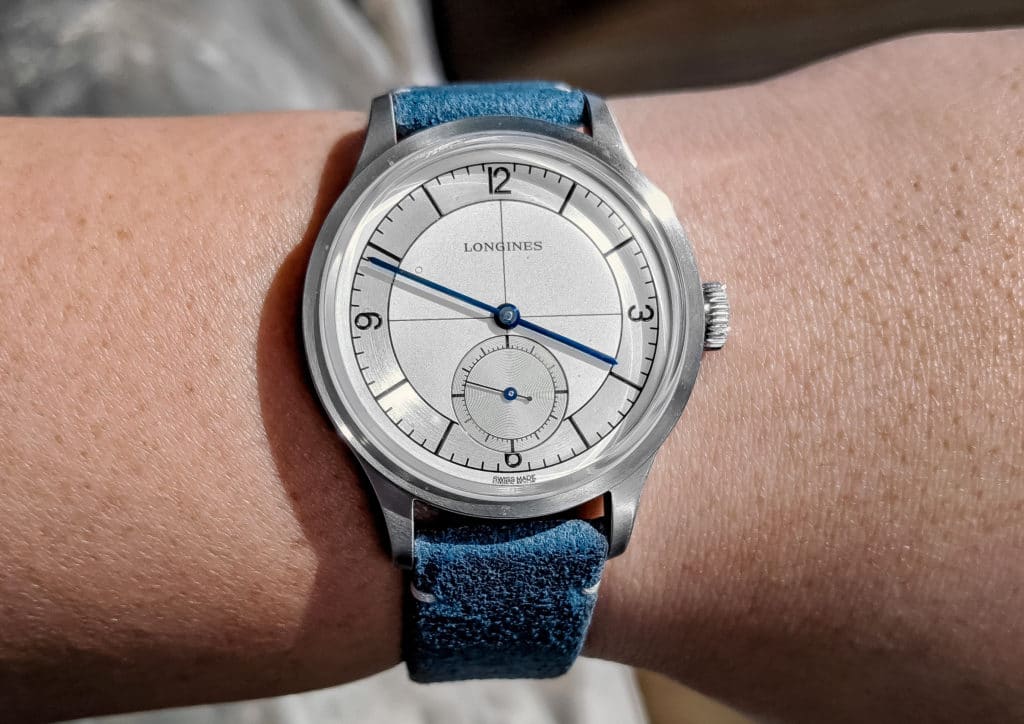
The Longines Heritage Classic Sector shows that a dress watch can borrow some field-watch practicality without suddenly needing a NATO strap and a heroic backstory. Its 38.5mm case and short lugs make it quite easy to wear, while the 12mm thickness never became cumbersome during commutes, dinners, or lazy weekends. That everyday comfort matters because the watch feels less confined to the dress-watch end of the collection than its styling suggests. It’s refined, certainly, but not so much that we felt the need to keep it home whenever life got slightly untidy.
The 1930s sector dial design is where the fusion gets more interesting. Its matte off-white center, polished chapter ring, black-painted numerals, and small-seconds register create clear layers that make the watch easy to read, not just interesting to photograph. We initially found the angled 3 and 9 and slightly off-center 6 a little odd, but after a few days, they started looking deliberate. That’s the kind of detail hands-on time tends to settle on. The blue suede strap also loosens the formality, feels comfortable immediately, and becomes our usual choice over the included NATO. It gives the watch a more relaxed personality without turning it into a pretend field watch.
Longines keeps the mechanical side thoroughly modern with the L893.5, based on the ETA 2892-A2. Its 64-hour power reserve means it can spend a weekend off the wrist without immediately demanding attention, while the silicon balance spring adds useful resistance to magnetism. We initially thought a hand-wound movement might have suited the vintage character better, but regular wear changed our minds somewhat. An automatic makes more sense when the idea is to keep this in rotation rather than treat it like Sunday-best wrist furniture.
The limitations are easier to forgive once we understand what this watch is trying to do. 30 meters of water resistance keeps it well away from carefree pool duty, while the lack of drilled lugs and quick-release spring bars makes strap changes more involved than they ought to be. Still, this is one of the more convincing dress/field intersections here: it has the restrained proportions and polish of a dress watch, but enough dial clarity and everyday comfort to avoid feeling trapped under a cuff. For the finer details, see our full review.
Pros
- The 38.5mm case and short lugs make it comfortable well beyond formal wear.
- Layered sector dial delivers excellent readability without losing character.
- Blue suede strap immediately makes the dressy design feel more relaxed.
- L893.5 combines a 64-hour reserve with a silicon balance spring.
- Vintage styling feels intentional rather than costume-like.
Cons
- 30 meters of water resistance severely limits water-oriented use.
- No drilled lugs or quick-release bars make strap changes fiddly.
- The unusual numeral placement takes some time to appreciate.
Category lines are useful until a watch comes along and ignores them. We’ve only included watches we’ve spent meaningful time wearing and testing, so these picks are based on what happened on the wrist. Some lean harder toward field and pilot territory, others bring diver toughness or dress-watch restraint into the mix, and none of them get every part of the formula right. That’s part of the fun. If we’ve overlooked another watch that genuinely blurs these categories without losing its own identity, let us know in the comments.

Co-Founder and Senior Editor
Kaz has been collecting watches since 2015, but he’s been fascinated by product design, the Collector’s psychology, and brand marketing his whole life. While sharing the same strong fondness for all things horologically-affordable as Mike (his TBWS partner in crime), Kaz’s collection niche is also focused on vintage Soviet watches as well as watches that feature a unique, but well-designed quirk or visual hook.
For my money 🤑 will go with the Nodus then Mido,and wind down to a once American made watch ⌚ the big L period…