Vintage-style chronographs have a way of pulling us in that most modern designs don’t. Maybe it’s the slightly awkward case proportions, the busier dials, or the fact that these watches were originally built with a purpose beyond sitting in a display case. Whatever it is, we keep coming back to them. Over the years, we’ve worn many chronographs that tried to tap into vintage design. Some stuck around longer than others, but all taught us the same thing: vintage-inspired chronographs live or die by how they feel on the wrist, not by how faithfully they copy the past.
This list exists because we’ve gone beyond merely trying these watches on for a week. We’ve lived with them through daily wear, swapped straps more times than we’d like to admit, and paid attention to the small things that don’t show up on spec sheets. For instance, how a domed crystal catches light at odd angles or how a chronograph pusher feels after the hundredth click. After nearly a decade of reviewing and wearing everything from accessible microbrands to pieces like the TAG Heuer Carrera Glassbox and Nivada Grenchen Chronomaster Broad Arrow, we’ve developed a pretty clear sense of what actually holds up over time. If you’re trying to figure out which vintage-style chronograph is worth adding to your rotation (and which ones just look good in photos), this is where we’d start.
Dan Henry 1964 Gran Turismo
| Price: | $250 |
| Water Resistance: | 50m |
| Case Dimensions: | 39mm (diameter) x 44.7mm (lug-to-lug) x 12.9mm (thickness) |
| Lug Width: | 19mm |
| Movement: | Seiko VK63 mechanical-quartz |
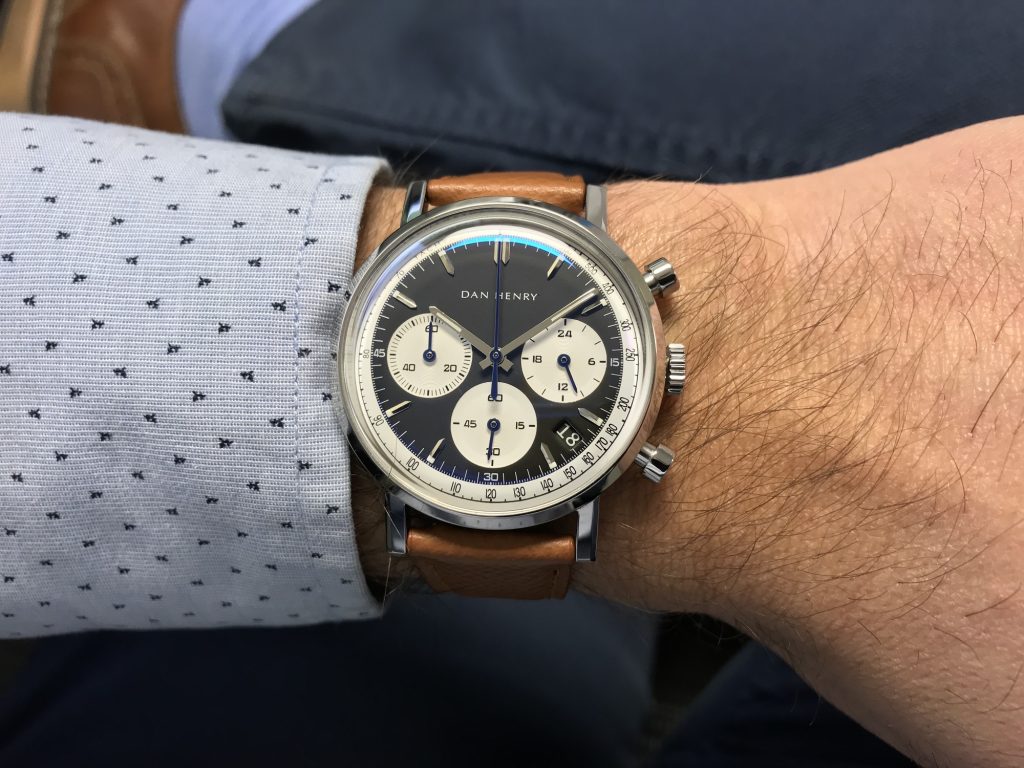
What makes the Dan Henry 1964 stand out among the best vintage-style chronograph watches is its restraint. Instead of pushing a tachymeter onto the bezel, as in most racing-inspired pieces, the scale is printed on the dial. That one decision keeps the watch visually calmer and helps the 39mm case wear smaller than expected. On the wrist, it doesn’t feel crowded or top-heavy, and the downward curve of the long lugs helps it settle nicely, especially for wrists in the five-and-a-half to seven-inch range.
The dial execution is what quietly wins people over. You get four color options and the choice of date or no date, which is rare at this price point. The evil panda version we spent time with uses a 3-6-9 layout that keeps things balanced, and the color-matched date wheel doesn’t interrupt the flow when you’re not actively looking for it. The blue hands add contrast without overpowering the rest of the dial. It’s one of those designs that feels intentional rather than busy.
On the wrist, the experience is helped by the meca-quartz VK63 movement. The pushers have that mechanical snap when you start and reset the chronograph, which makes everyday timing tasks more engaging than you’d expect. The beads-of-rice bracelet adds a slightly dressier texture compared to the usual sporty options, and it wears comfortably over long periods. If you switch to the included leather strap, the watch leans more refined, though swapping straps isn’t as smooth as it could be.
There are a few compromises to keep in mind. The chemically blued hands don’t have the same depth as traditional heat bluing, and the smooth bezel can make the watch feel a bit smaller if you’re used to chunkier chronographs. Still, for anyone getting into the retro watches for men category while staying accessible, the 1964 offers a well-balanced entry.
Pros
- Cleaner dial layout thanks to internal tachymeter scale
- Strong variety of dial and date configurations
- Comfortable beads-of-rice bracelet with vintage character
- The Meca-quartz movement gives a satisfying pusher feel with low maintenance.
Cons
- The bracelet lacks a quick-release, making swaps less convenient.
- Wears slightly smaller due to the smooth bezel design.
- Chemically blued hands don’t offer the same visual depth as heat-blued ones.
Vaer R1 Racing Chronograph
| Price: | $495 |
| Water Resistance: | 100m |
| Case Dimensions: | 38mm (diameter) x 46mm (lug-to-lug) x 12.6mm (thickness) |
| Lug Width: | 20mm |
| Movement: | Seiko VK-63 meca-quartz |
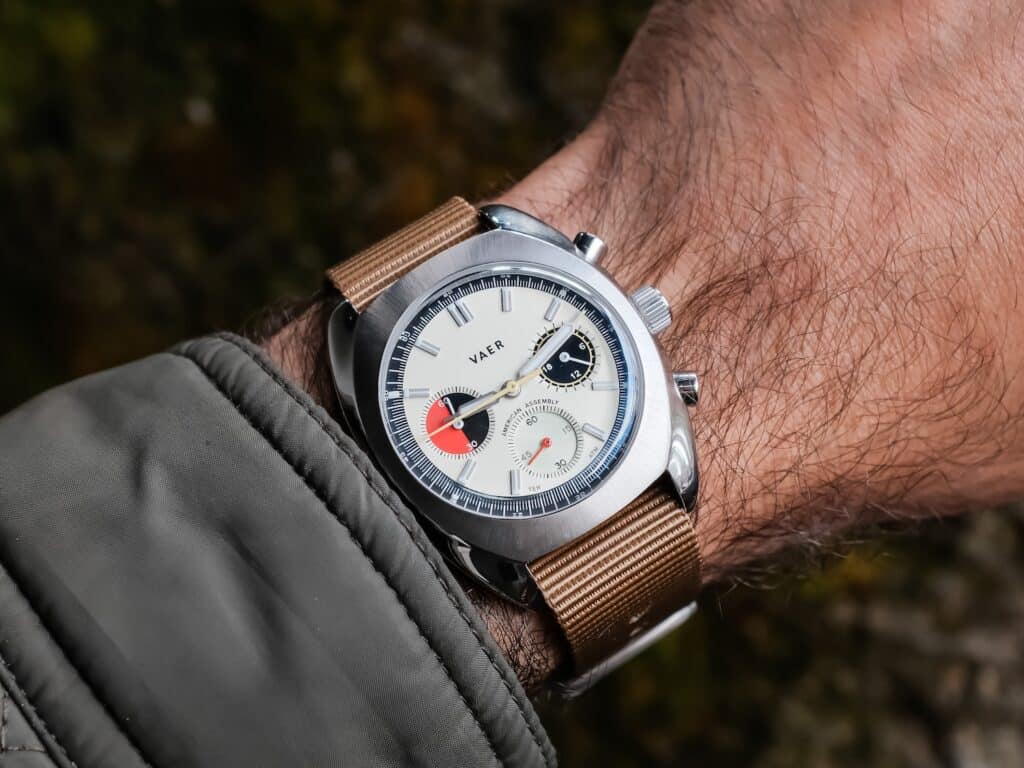
The Vaer R1 ended up being one of those vintage watches we kept reaching for without planning to. It stands out because it doesn’t just lean on retro design; it actually feels built for daily use. At 38mm with a 46mm lug-to-lug, it lands in that sweet spot where you get vintage proportions without the watch disappearing on your wrist. The case mixes brushed and polished surfaces in a way that feels more solid than expected, and that impression carries through the moment you start using the pushers.
What surprised us most during testing was how much attention Vaer gave to durability. You’re getting a screw-down crown, 100 meters of water resistance, and a domed sapphire crystal. These are features that aren’t always guaranteed in this category. In practice, that means you don’t have to think twice about wearing it through a full day, whether that includes rain, desk work, or something more active. The meca-quartz movement keeps things accurate and low-effort, while still giving you that satisfying mechanical-style snap when engaging the chronograph.
The dial leans into vintage cues with a cream base and colorful accents, but it avoids feeling gimmicky. The orange and yellow hands bring some energy without going overboard, though we did notice that the polished edges can blend into the dial under certain lighting. Legibility is still solid overall, but you only notice it after extended wear. The NATO strap keeps the watch secure and wears flatter than expected, even with the added height. The included rubber strap didn’t quite match the rest of the watch in terms of feel, though there is a bracelet option if you want something more substantial. The overall experience is consistent: this is a chronograph you can wear without overthinking it. If you’re looking for vintage-inspired chronograph watches that balance old-school design with everyday practicality, the R1 fits naturally into that rotation.
Pros
- Case construction feels more robust than most watches in this category.
- The Meca-quartz movement keeps accuracy high with minimal upkeep.
- Pushers offer a firm, satisfying click during use.
- Screw-down crown and 100m water resistance add real-world usability.
- The 38mm sizing works well across small to mid-sized wrists.
Cons
- Polished hand edges can reduce visibility in certain lighting conditions.
- Lume is functional but fades more quickly than expected.
- The rubber strap feels less refined than the NATO or bracelet options.
Christopher Ward C63 Valour
| Price: | $945 |
| Water Resistance: | 150m |
| Case Dimensions: | 39mm (diameter) x 46mm (lug-to-lug) x 11.55mm (thickness) |
| Lug Width: | 20mm |
| Movement: | ETA G10.212 AD COSC quartz |
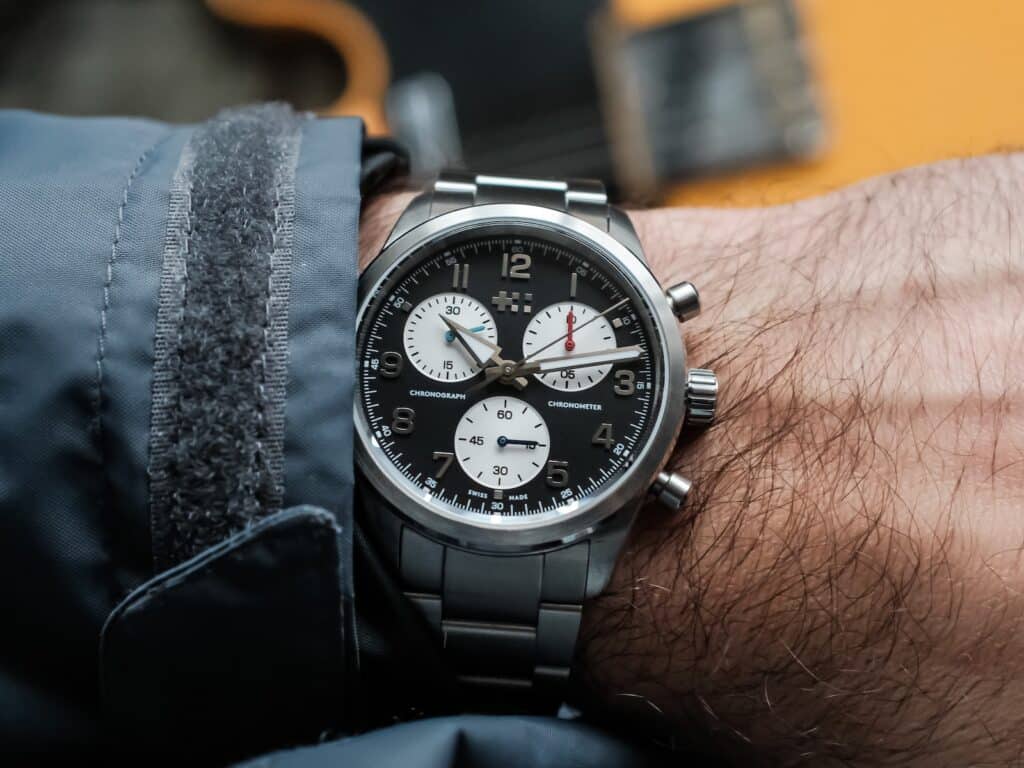
The C63 Valour doesn’t follow the usual script for vintage-style chronograph watches. At 39mm across and under 46mm lug-to-lug, it lands in that comfortable vintage-inspired size range, but the way it wears feels more substantial than expected. On the wrist, it sits low and balanced, especially on the Bader bracelet, without that top-heavy feel we often run into with thicker chronographs. The case has a noticeable density. It feels planted, not hollow, which changes how you perceive it over a full day of wear. The Light-catcher case design sounds like marketing at first, but the mix of brushed and polished surfaces gives it a shifting character as light hits it. It doesn’t feel like a strict military tool watch. It leans slightly dressier, making it easier to wear outside purely casual settings.
The dial brings in familiar vintage cues but adds its own twist. The reverse panda layout keeps contrast high, and the applied Arabic numerals catch light, adding depth without hurting legibility. In brighter conditions, those numerals are more sharply defined. Indoors, they are easy to read and settle down. The colored sub-dial hands tied to different service branches could have felt gimmicky, but in practice, they don’t distract. The layout remains clear, with running seconds at six and the chronograph counters easy to track at a glance. The handset does its job well, with generous lume that holds up in low light. It’s one of those dials that feels more considered the longer you wear it.
What separates this watch from many other options in its category is the movement. Instead of going with a typical meca-quartz setup, it uses a COSC-certified ETA quartz chronograph rated to around ±10 seconds per year. That level of consistency changes the ownership experience. During hands-on testing, we set it once and stopped thinking about it. Weeks later, it was still spot on. The pushers have a crisp, defined action, and the reset snaps back cleanly every time. It doesn’t try to mimic a mechanical chronograph for the sake of it. It focuses on reliability, which is more useful day-to-day.
The bracelet supports that same approach. The taper from 20mm down to around 16mm helps the watch feel more refined on the wrist, and getting a good fit is straightforward thanks to the mix of link sizes. The on-the-fly extension is simple but practical, especially during warmer days when your wrist expands slightly. Quick-release spring bars make strap changes easy if you want to switch things up. The only small annoyance we noticed was a faint squeak from the bracelet during movement, though it tends to settle over time. Overall, this is a chronograph that blends vintage inspiration with modern execution in a way that feels intentional rather than nostalgic for its own sake.
Pros
- Compact case dimensions are balanced and comfortable across a wide range of wrist sizes.
- COSC-certified quartz movement delivers exceptional long-term accuracy.
- Light-catcher case adds visual depth without feeling overdesigned.
- Applied numerals improve legibility while adding a more refined look.
- Bracelet taper and quick-adjust extension enhance daily comfort.
Cons
- The bracelet can produce a slight squeak during early wear.
- Quartz movement may not appeal to those seeking a fully mechanical experience.
- Military-inspired details may feel subtle rather than overt for some buyers.
Nivada Grenchen Chronomaster Broad Arrow
| Price: | $1,975 |
| Water Resistance: | 100m |
| Case Dimensions: | 38mm (diameter) x 46.5mm (lug-to-lug) x 14.5mm (thickness) |
| Lug Width: | 20mm |
| Movement: | Landeron 70 |
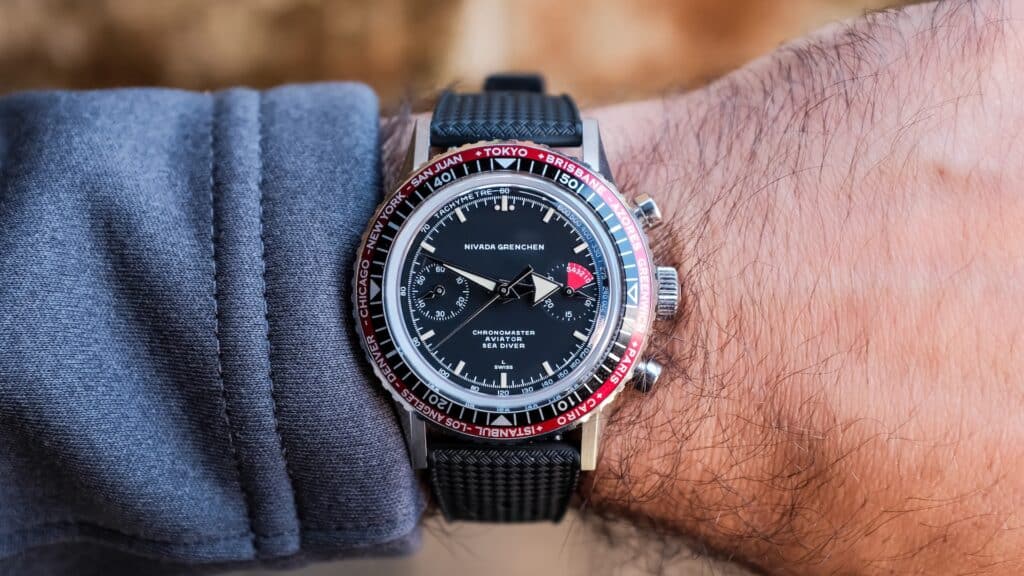
The Nivada Grenchen Chronomaster Broad Arrow is one of those vintage-style chronograph watches that feels overwhelming at first glance. There’s a lot going on. Pilot cues, dive watch elements, chronograph scales, and even interchangeable bezels are all packed into a 38mm case. On paper, that size sounds modest, but on the wrist, it carries more presence than expected. The 46.5mm lug-to-lug and thicker profile give it weight, and the case finishing holds up well against watches that sit higher in price. It feels solid and deliberate, not like a novelty piece trying to do too much.
The bezel system ultimately defines the experience. It’s a friction-fit, fully tool-free design, which means you can swap inserts by hand in seconds. We didn’t expect to use this feature much, but it quickly became part of the routine. A faded blue insert gave it that worn-in vintage feel, while the red and green options shifted the tone depending on the day. There’s even a world-time version that adds another layer of functionality. It sounds gimmicky until you live with it. Once you do, it feels like having multiple watches in one case.
The dial is dense but quite manageable. A matte black base carries a tachymeter scale, two sub-dials, and layered text, yet it doesn’t fall apart visually. The broad-arrow handset anchors the design, and legibility remains consistent even as your eyes adjust to the layout. The domed sapphire adds a bit of distortion at angles, which enhances that vintage feel rather than getting in the way. Some details take time to appreciate. The red five-minute markings on the chronograph counter felt unnecessary at first, but proved useful for quick timing without overthinking it.
Underneath, the hand-wound Landeron 70 movement brings a different kind of engagement compared to quartz options in this space. Ours ran about minus five seconds per day, which felt reasonable given the circumstances. The oversized crown makes daily winding easy, and it becomes part of the routine rather than a chore. The pushers are crisp and satisfying, encouraging you to use the chronograph more often than you planned. The included tropic strap was another surprise. It’s soft, wearable, and doesn’t fight the wrist like most rubber straps we’ve tried. Still, we would have liked standard spring bars included to expand strap options.
Overall, this is one of those pieces that offers depth, versatility, and a bit of personality without the uncertainty of going fully vintage. For more detailed insights, refer to our in-depth review.
Pros
- Interchangeable bezel system adds real versatility without tools.
- Case finishing and build feel more premium than expected.
- Hand-wound movement adds daily interaction and character.
- Domed crystal and layered dial enhance vintage appeal.
- The tropic strap is softer and more wearable than most others in this range.
Cons
- The busy dial can take time to understand fully.
- Polished sub-dial hands can reduce visibility in certain light.
- No standard spring bars included for easy strap swaps
Yema Yachtingraf
| Price: | $2,250 |
| Water Resistance: | 100m |
| Case Dimensions: | 39mm (diameter) x 45.5mm (lug-to-lug) x 15.35mm (thickness) |
| Lug Width: | 19mm |
| Movement: | ETA Valjoux 7753 |
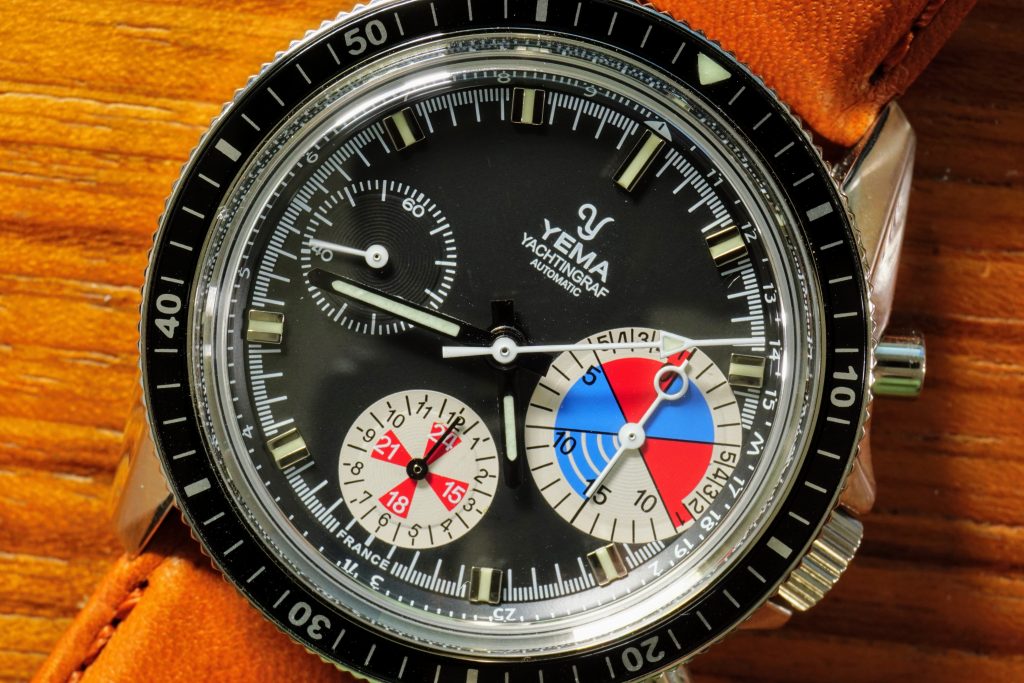
The Yema Yachtingraf is one of those vintage-inspired chronograph watches that doesn’t try to simplify anything. The moment we handled it, the proportions stood out. At 39mm wide but over 15mm thick, it has a tall, stacked profile that feels unusual at first. On smaller wrists, it can look top-heavy, and even on larger wrists, it takes some getting used to. That said, once it settles on the wrist, the top-down view makes more sense. The short lugs keep the footprint compact, and visually, it stays true to that 1960s-inspired design language that draws people in.
As mentioned in our dedicated review, the dial is where most of the personality lives and where the adjustment period comes in. It’s busy. There’s no way around that. Multiple subdials, colorful accents, and dense markings all compete for attention at first glance. After a couple of days, though, it starts to click. The large minute counter at three o’clock gives the watch its identity, and the mix of blue, red, and white details creates a strong nautical feel. Legibility is decent overall, but not perfect. The black hands can blend into the dial in low light, and we did find ourselves straining at times, especially when they overlapped lighter subdials. The domed crystal and thin bezel pull your focus inward, which helps once your eyes adjust.
The bezel itself is another vintage throwback, though not in the way most people expect. It’s bi-directional and friction-based, meaning there’s no clicking when you turn it. That initially feels odd if you’re used to modern dive bezels, but it stays tight enough in normal use. For everyday tasks like timing something in the kitchen, it works fine. For anything more demanding, we’d hesitate. The inner bezel markings add visual complexity, but they don’t serve a real functional purpose, which feels out of step with the otherwise heritage-driven approach.
Under the hood, the Valjoux 7753 brings a familiar, proven experience. It hacks, runs reliably, and gives you that mechanical chronograph feel. Ours ran consistently, though the chronograph’s seconds hand didn’t always land perfectly at zero. The rotor noise is noticeable when the watch is off the wrist, which can catch you off guard. On the wrist, it disappears. The pushers feel solid and satisfying, which encourages actual use. The crown, on the other hand, is harder to work with than it should be due to tight guards. Even off the wrist, adjusting it can feel awkward. The included leather straps are a strong point. Both options feel well-made and lean into the vintage aesthetic without needing an immediate swap.
Pros
- Strong vintage styling that closely reflects original designs
- Unique, colorful dial with a clear nautical identity
- Solid chronograph pushers with satisfying feedback
- High-quality leather straps included
Cons
- The case thickness feels excessive for the diameter.
- The crown is difficult to operate due to the tight guards.
- Inner bezel markings serve no real function.
- The friction bezel lacks the precision of a clicking mechanism.
- Rotor noise is noticeable when the watch is off the wrist.
Tag Heuer Carrera Glassbox Chronograph
| Price: | $6,450 |
| Water Resistance: | 100m |
| Case Dimensions: | 39mm (diameter) x 46mm (lug-to-lug) x 13.9mm (thickness) |
| Lug Width: | 20mm |
| Movement: | TH20-00 Automatic In-House Caliber |
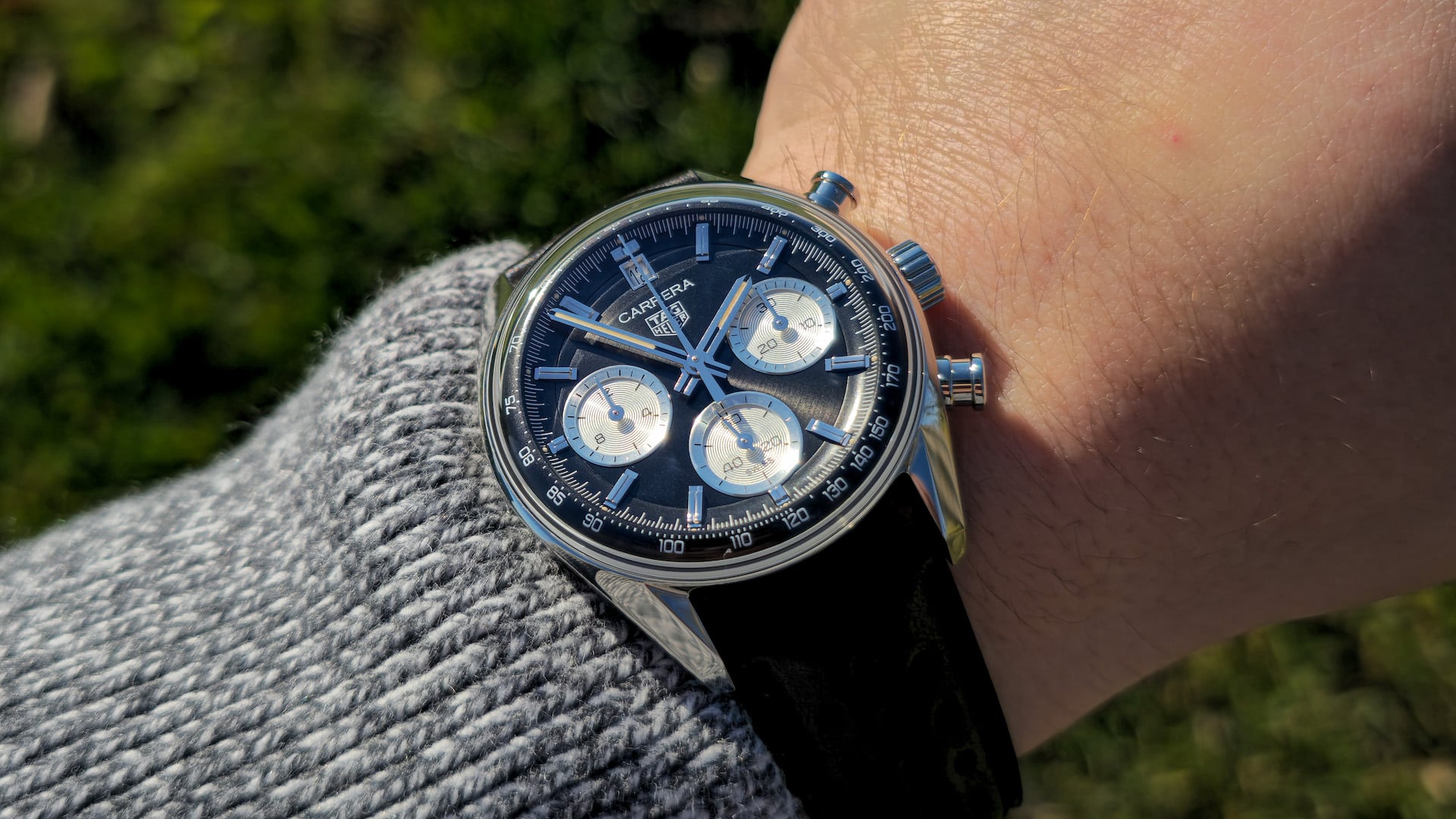
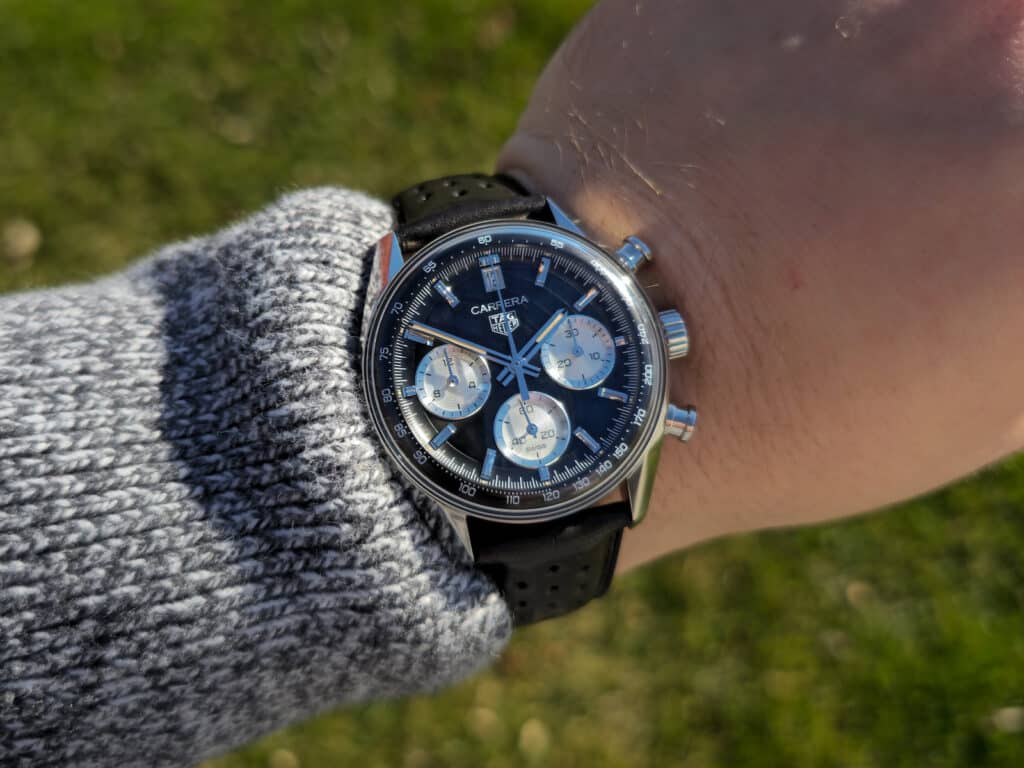
The Carrera Glassbox is one of those vintage-style chronograph watches that gets a lot right before you even look at the dial. The 39mm case sits in that ideal range for everyday wear, and despite a listed thickness under 14mm, it doesn’t feel bulky. On the wrist, it settles in naturally, helped by the way the lugs curve and reflect light. The mix of brushed and polished surfaces gives it a sense of depth that shifts throughout the day. It feels closer to vintage proportions than most modern chronographs, which tend to wear heavier and flatter.
What defines the experience is the domed “Glassbox” sapphire crystal. It stretches across the entire top of the watch and wraps over the inner tachymeter scale, removing the need for an external bezel. That design changes how the watch wears and how you interact with it. The crystal adds height on paper, but visually it feels thinner and more integrated. Glancing at the dial from an angle brings a bit of distortion that enhances the vintage feel without hurting legibility. It’s one of those details that kept catching our attention during daily wear, especially outdoors, where the light plays across the surface.
The TH20 automatic chronograph uses a column wheel and vertical clutch setup, with an 80-hour power reserve. In practice, that translates to reliability and ease of use. The pushers feel precise and consistent, and winding the watch has a more defined, mechanical feel than the grainier experience you get with many standard chronographs. It’s not a showpiece movement, but it performs exactly how you want it to. Set it, wear it, and trust it.
The dial is where things get more complicated. On paper, it checks all the right boxes. Reverse panda layout, applied indices, and a color that shifts between black and brown depending on lighting. In person, though, the execution doesn’t fully match the rest of the watch. The polished indices and hands lack the refinement you’d expect at this level, and some details feel less crisp than they should. The sub-dial hands sit higher than ideal, which becomes noticeable once you start paying attention. The strap, on the other hand, is a strong point. The perforated leather is soft right out of the box and comfortable for long wear, though the polished clasp tends to pick up scratches quickly.
There’s a clear split in how this watch comes together. The case, crystal, and movement feel thoughtfully executed and enjoyable to live with. The dial feels like a missed opportunity. If your focus is on how a vintage-inspired chronograph wears and feels day to day, the Glassbox delivers in a way few modern chronographs do. If you’re sensitive to dial finishing, you’ll notice it early. For a more insightful entry into the dial execution and more, read our in-depth review.
Pros
- Well-balanced 39mm case that wears comfortably across most wrists
- Unique domed “Glassbox” crystal enhances vintage feel and legibility.
- The TH20 movement offers strong performance with satisfying pusher action.
- High-quality leather strap that is comfortable from day one
Cons
- Dial finishing does not match the quality of the case and movement.
- Sub-dial hands sit higher than expected, affecting visual refinement.
- The polished clasp is prone to scratches with regular wear.
Omega Speedmaster
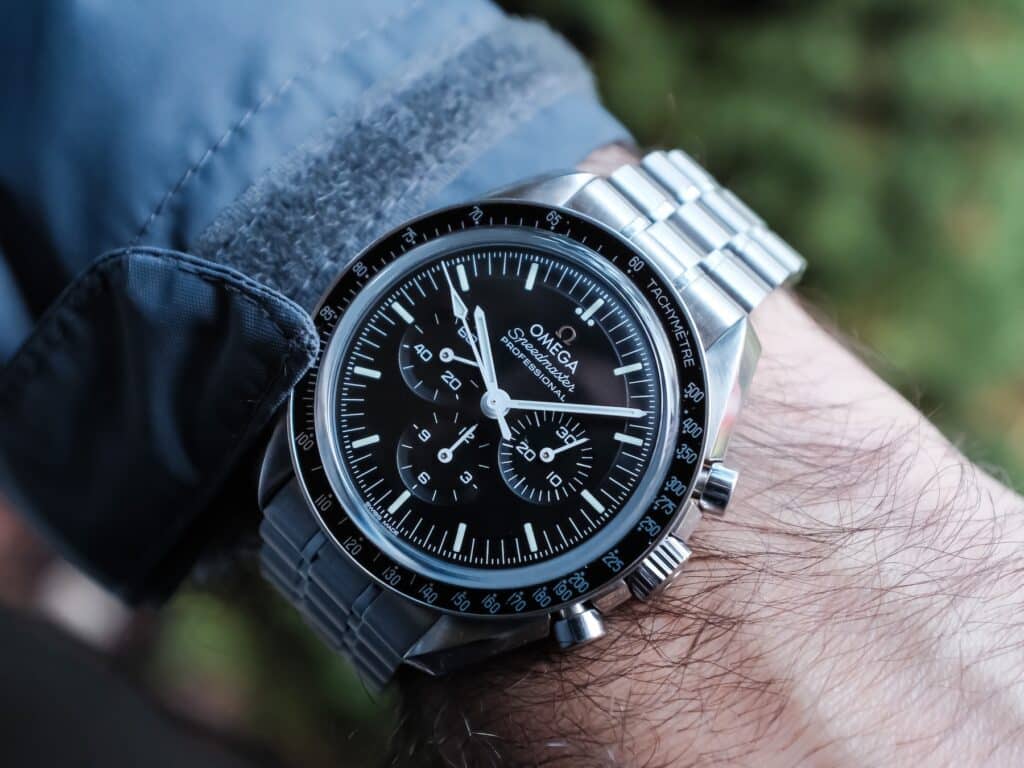
| Price: | $9,000 |
| Water Resistance: | 50m |
| Case Dimensions: | 42mm (diameter) x 47.5mm (lug-to-lug) x 13.2mm (thickness) |
| Lug Width: | 20mm |
| Movement: | Omega 3861 |
The Speedmaster sits in a different place compared to most vintage-style chronograph watches, but after living with the 3861, it makes sense why it keeps showing up in conversations. On paper, the 42mm case doesn’t sound too vintage-friendly, but small adjustments in the case shape make a noticeable difference. It wears more compact and planted than expected, thanks to subtle trimming and better overall balance. The stepped dial also returns here, adding depth without complicating the layout. It’s one of those details you don’t fully appreciate until you catch it in changing light throughout the day.
Legibility is where the Speedmaster still feels effortless. The black dial and white markers follow a familiar formula, but it works because nothing feels forced. The lume is consistent and reliable. Not too bright, but it lasts through the night, which matters more in real use than initial brightness. Whether you’re checking the time in the dark or glancing down during the day, everything stays easy to read. The applied logo on the sapphire version adds a bit of visual lift without pushing the watch into dress territory, which keeps it versatile.
The interaction with the watch is what keeps us coming back. This is a hand-wound chronograph, and that daily winding becomes part of the experience. The crown feels smooth and deliberate, and the pushers have a firm, satisfying action that makes timing even simple things feel more engaging. The 3861 movement improves on the older architecture with better accuracy and anti-magnetic performance, but what stands out most is how it feels. While testing it hands-on, accuracy stayed around +3 seconds per week, but more importantly, it stayed consistent. It’s the watch you trust without thinking about it.
The updated bracelet deserves mention because it changes how the watch wears day to day. The taper is more pronounced, and the links articulate sooner, which helps the watch wrap around the wrist rather than sit on top of it. The end links also reduce the visual length, making the case feel more compact. It’s comfortable enough that we didn’t feel the need to swap straps, which is saying something for a watch known for versatility. Sizing it, however, can be frustrating at home. It’s doable, just not enjoyable.
Pros
- Case proportions wear smaller and more balanced than expected.
- The stepped dial and classic layout improve depth and legibility.
- The 3861 movement offers strong accuracy and a satisfying manual-wind experience.
- Updated bracelet significantly improves comfort and fit.
Cons
- Bracelet sizing can be frustrating without proper tools.
- Still relatively large compared to stricter vintage proportions
Zenith El Primero A384
| Price: | $9,000 |
| Water Resistance: | 50m |
| Case Dimensions: | 37mm (diameter) x 47mm (lug-to-lug) x 12.6mm (thickness) |
| Lug Width: | 19mm |
| Movement: | El Primero 400 |
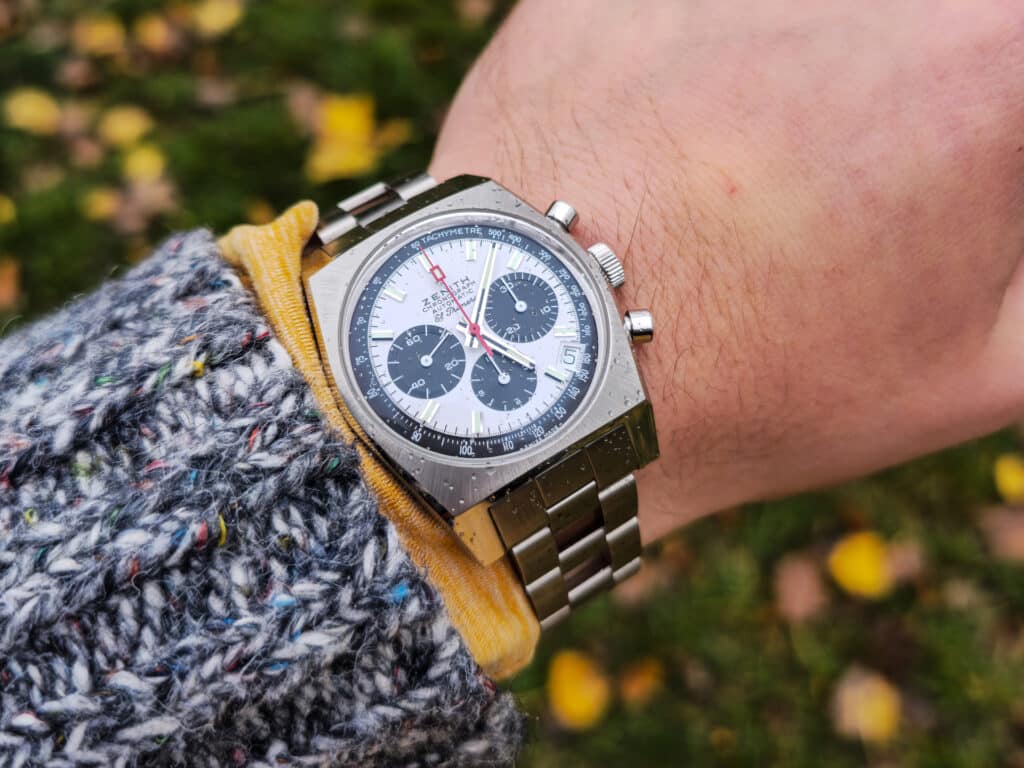
The A384 is one of those vintage-oriented chronograph watches that doesn’t need much reinterpretation. It feels like it was pulled straight out of another era and cleaned up enough for modern wear. The 37mm case sounds small on paper, but the cushion shape gives it more presence than expected. On the wrist, it wears closer to a 38- or even 39-mm watch, especially with the flat case sides and sharp transitions in the finishing. It feels balanced, not delicate. What surprised us more was the weight. It’s lighter than you’d expect at this price point, which ends up making it one of the easiest chronographs to wear all day without noticing.
The case finishing adds a lot to that experience. There’s a clear separation between brushed and polished surfaces, with bevels that catch light in a way that feels intentional. Over time, we expect those polished areas to pick up scratches, but that almost feels appropriate here. This is the kind of watch that looks better once it shows some wear. The domed sapphire crystal also plays a role. It rises noticeably above the case and introduces slight distortion at angles, adding to the vintage feel without compromising clarity. It’s one of those crystals you notice every time you check the time.
The dial keeps you coming back. The panda layout is clean but not sterile, with faceted indices and polished hands that reflect light throughout the day. Even with multiple subdials and a tachymeter scale, reading the time feels natural. The red chronograph second hand adds enough contrast to keep things interesting. Lume is present but not very strong, which feels consistent with the vintage approach. This isn’t a watch built for night use. It’s built for daytime interaction and visual appeal.
The El Primero 400 movement is where things get more engaging. The high-beat frequency gives the chronograph a smooth sweep, and the pushers feel crisp and mechanical, encouraging you to use them. Winding the watch is just as satisfying, with a smooth resistance that becomes part of your daily routine. Accuracy held steady during our time with it, and the overall experience feels refined without being overly delicate. The rotor stays quiet on the wrist, which is something you notice if you’ve spent time with louder chronographs.
The bracelet is where things get complicated. On paper, it feels underwhelming. The clasp is simple, stamped, and doesn’t inspire confidence at first. The finishing on the end links doesn’t match the case either. But once it’s on the wrist, the story changes. The light, flexible ladder design makes the watch feel balanced and comfortable, and it matches the vintage character better than a heavier, modern bracelet would. It’s not perfect, but it fits the watch’s personality. Overall, the A384 stands out because it doesn’t try to modernize the experience too much. It leans into what made these watches appealing in the first place.
Pros
- The cushion case measures over 37mm while staying balanced.
- Lightweight build makes it very comfortable for all-day wear.
- The El Primero movement offers smooth operation and strong reliability.
- The domed sapphire crystal enhances vintage character.
- The panda dial remains legible and visually engaging.
Cons
- The bracelet clasp feels basic for the price.
- End link finishing does not match the case quality.
- Lume performance is minimal in low light.
Let us know your thoughts in the comments below on our picks and if you think there are some other options we should evaluate for future hands-on review and inclusion.

Co-Founder and Senior Editor
Kaz has been collecting watches since 2015, but he’s been fascinated by product design, the Collector’s psychology, and brand marketing his whole life. While sharing the same strong fondness for all things horologically-affordable as Mike (his TBWS partner in crime), Kaz’s collection niche is also focused on vintage Soviet watches as well as watches that feature a unique, but well-designed quirk or visual hook.