
Dive watches tend to follow a predictable path in most collections. We start with the obvious ones: the Seikos everyone recommends, the big-name Swiss divers that dominate Instagram, or maybe the occasional microbrand that’s making noise on forums. But after spending years rotating through different pieces, we kept noticing something odd: some of the most satisfying divers we’ve worn rarely get mentioned when collectors start making their “best dive watches” lists. Not because they’re bad watches. In many cases, it’s the opposite. Watches like the Longines HydroConquest or the Mido Ocean Star do their job without demanding attention, offering solid wearability and dependable performance that only becomes obvious once you’ve lived with them.

That said, we’ve worn many of these pieces side by side in everyday life. For instance, swapping straps, timing movements, and figuring out which designs actually hold up after the excitement of a new purchase wears off. Some of the watches on this list surprised us during that process. And after years of hands-on testing and comparison, these are the dive watches we kept coming back to, even while the broader watch world seemed to forget about them.
Glycine Combat Sub

| Price: | $400 – $600 |
| Water Resistance: | 200m |
| Case Dimensions: | 42.2mm (diameter) x 50mm (lug-to-lug) x 10.5mm (thickness) |
| Lug Width: | 22mm |
| Movement: | GL224 |
One reason the Glycine Combat Sub tends to get overlooked is its restraint. In a category where many dive watches lean into chunkier cases and loud design cues, this one quietly trims things down. The case measures 42mm across but only about 10.5mm thick, which is slim for a 200-meter automatic diver. In daily wear, it slides under a shirt cuff without fuss and doesn’t snag on jackets or sleeves. The lugs sweep downward pretty sharply, which helps the watch settle naturally on the wrist. The straight-sided case profile keeps things clean, and the drilled lugs make swapping straps simple when you feel like changing things up.
We found that the dial leans into that same low-key approach. Glycine went with a matte gray surface that keeps reflections down and makes the layout easy to read at a glance. The flat sapphire crystal helps here too; it almost disappears from certain angles, which keeps the dial looking sharp outdoors. A subtle 24-hour scale sits inside the main markers, and the date window blends in nicely thanks to a color-matched background. At night, the lume holds up well through the evening without overwhelming the dial during the day. The bezel feels deliberate when turning, with tight tolerances and no backplay. There’s even a small raised nub at the 12 o’clock marker that makes it easier to locate by touch. The coin-edge grip is narrow but quite effective, though the bezel itself is on the stiff side, which can make adjustments a bit tricky if your hands are wet or gloved.
Inside the watch is Glycine’s GL224 automatic movement, essentially a reworked Sellita SW200 that has built a long reputation for reliability (older models are built off of the ETA 2824). During our review, it’s accuracy held steady at around +6 seconds per day after a quick regulation. The bracelet feels sturdy overall, with solid end links and a milled clasp that inspires confidence during daily wear. It tapers from 22mm to 20mm, which works well enough, though we would have preferred a slightly sharper taper to give it a bit more elegance on the wrist. Sizing can also take some patience thanks to the pin-and-collar system. Even so, the Combat Sub ends up being a capable dive watch that keeps things comfortable and versatile without constantly reminding everyone it’s a dive watch.
Pros
- The slim 10.5mm profile makes it very comfortable for a 200m automatic diver.
- Reliable GL224 (ETA-based) movement delivering consistent accuracy
- Strong nighttime lume and a flat sapphire crystal that keeps the dial easy to read
Cons
- The bezel action is quite stiff for wet or gloved hands.
- The bracelet uses a pin-and-collar system that can make sizing frustrating.
- Bracelet taper is modest, which limits how refined it feels on the wrist.
Certina DS PH200M
| Price: | $810 |
| Water Resistance: | 200m |
| Case Dimensions: | 43mm (diameter) x 52mm (lug-to-lug) x 14.5mm (thickness) |
| Lug Width: | 20mm |
| Movement: | Powermatic 80 |
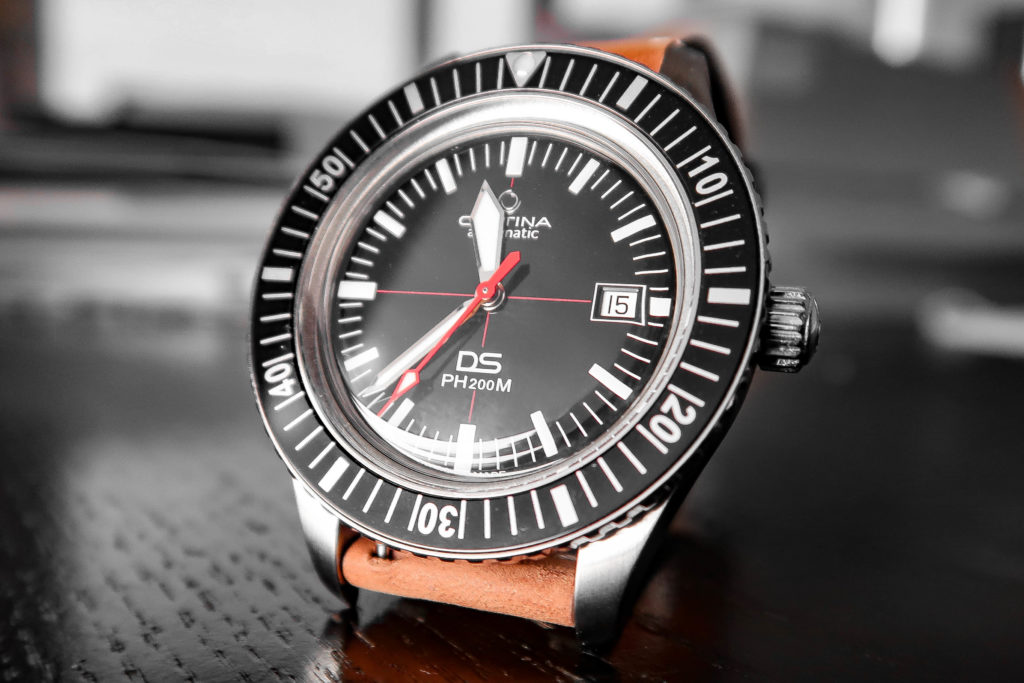
Vintage-inspired dive watches are everywhere right now, but the Certina DS PH200M tends to slip under the radar for many collectors. That’s surprising once you spend a little time with it. The watch is a modern reissue of a late-1960s Certina diver, but it doesn’t lean on nostalgia alone. The case measures just under 43mm across, with a lug-to-lug stretch of around 52mm, giving it a noticeable wrist presence. On larger wrists, it feels purposeful and solid. Smaller wrists will definitely notice the size, though the slightly downward-curving lugs help it settle better than those numbers suggest. Case height sits around 14.5 mm, and a big part of that comes from the domed box-style crystal.
Our review team observed that the design leans heavily into that old-school diver personality. You get a matte black dial with simple white markers and red crosshair accents that add a little visual interest without turning the watch into a novelty. The lume uses BGW9 and stays visible well into the night, which we appreciated when checking the time in darker conditions. The aluminum dive bezel is a traditional 60-click design with a luminous marker at 12. Alignment between the bezel and the chapter ring is precise, something we don’t always see even on popular Seiko divers. That said, the bezel is not perfect. It has a bit of resistance when turning and a slight wiggle between clicks. It still works well enough for timing tasks, but it does not feel quite as crisp as some competitors.
Inside the watch is the Powermatic 80 automatic movement, a familiar Swatch Group workhorse that beats at 21,600 bph and offers a power reserve of roughly 80 hours. In everyday use, that means you can take the watch off Friday evening and still find it running Monday morning. Servicing should also remain straightforward since the movement has become widely used across the industry. Certina’s “DS” or Double Security system adds another layer of durability by surrounding the movement with a rubber shock cushion in addition to standard Incabloc protection. It’s a subtle engineering detail, but it reinforces the idea that this watch was built as a proper tool rather than just a vintage tribute.
On the wrist, the DS PH200M feels like a vacation watch in the best sense of the word. It can handle water and sand and travels without feeling fragile, yet it adapts easily depending on the strap you use. As mentioned in our dedicated review, the included leather strap is thick and sturdy with quick-release bars, though the nubuck finish might not be everyone’s favorite. We found it works very well on a NATO or mesh bracelet, which leans into the vintage diver aesthetic even more. That versatility is a big reason this watch deserves more attention.
Pros
- The Powermatic 80 movement provides an impressive 80-hour power reserve.
- The DS shock protection system adds meaningful durability for everyday use.
- Strong BGW9 lume remains visible deep into the night.
- The vintage design works well across multiple strap options.
Cons
- The case size and 52mm lug-to-lug span may feel large on smaller wrists.
- Bezel action is somewhat stiff and shows minor play between clicks.
- The nubuck-style leather strap may not suit everyone’s taste.
Mido Ocean Star (Titanium)
| Price: | $1040 |
| Water Resistance: | 200m |
| Case Dimensions: | 42.5mm (diameter) x 42.5mm (lug-to-lug) x 11.75mm (thickness) |
| Lug Width: | 22mm |
| Movement: | Caliber 80 |
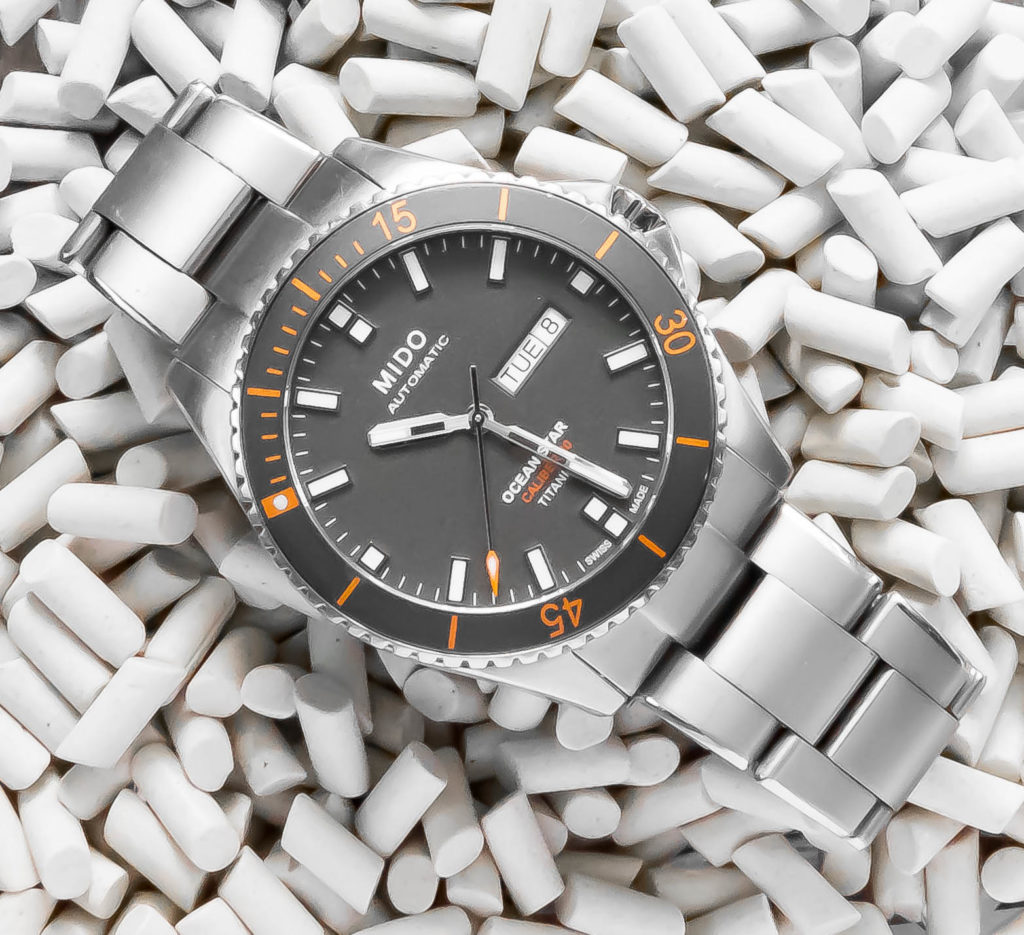
The Mido Ocean Star is one of those dive watches that does not scream for attention the moment you open the box. Instead, the details start revealing themselves the more you wear it. The fully brushed titanium case measures 42.5 mm across and sits around 11.75 mm thick, which is quite slim for a modern diver. On the wrist, the lighter titanium construction makes a noticeable difference during long days. We wore it through normal routines such as commuting, working at a desk, and running errands, and the watch never felt top-heavy. The case design is subtly contoured, and the sloped bezel follows those curves rather than interrupting them. A polished chamfer along the case edge adds enough contrast to keep things visually interesting without turning the watch flashy.
Living with the watch day to day also highlights some thoughtful design decisions. The anthracite dial has a textured surface that interacts with light in subtle ways, sometimes reflecting it and sometimes soaking it up entirely. Combined with the double anti-reflective coating on the sapphire crystal, glare is kept to a minimum. That makes the dial easy to read outdoors or under office lighting. The layout feels balanced as well. The shortened index at nine mirrors the shortened marker at three, which was trimmed to accommodate the day-date window. It is a small detail, but it keeps the dial from looking lopsided. The pencil hands feature BGW9 Super-LumiNova, which charges quickly and glows with a cool blue-green tone at night. We also found the second hand easy to track, thanks to its orange accent and luminous tip reaching toward the edge of the dial.
Under the surface, the Ocean Star runs on Mido’s Caliber 80. This movement is based on the ETA 2824 architecture but has been adjusted to deliver an impressive 80-hour power reserve. The bracelet deserves attention as well. Titanium keeps it light, but the curved links and thoughtful shaping on the underside help the bracelet wrap naturally around the wrist. It tapers from 22mm down to 19 mm and uses a ratcheting clasp that makes quick adjustments easy during the day.
There are a few quirks, though. The screw-down crown can be stubborn to loosen, sometimes requiring a fingernail to get it started. The lugs could also slope a little more aggressively to hug smaller wrists. Still, after spending real time with the Ocean Star, it becomes clear why it belongs on a list like this. It is a refined, durable diver that many collectors overlook because it is not chasing the spotlight.
Pros
- The lightweight titanium case keeps the watch comfortable during long wear.
- The Caliber 80 movement delivers an impressive 80-hour power reserve.
- The textured dial and strong BGW9 lume improve legibility across different lighting conditions.
- The curved titanium bracelet with a ratcheting clasp offers excellent everyday comfort.
Cons
- The screw-down crown can be stubborn to unscrew at first.
- Lugs could curve more to improve fit on smaller wrists.
- Limited strap pairing options due to the specific dial and case color combination
Archimede SportTaucher

| Price: | $1,230 |
| Water Resistance: | 300m |
| Case Dimensions: | 41.5mm (diameter) x 49.7mm (lug-to-lug) x 12mm (thickness) |
| Lug Width: | 20mm |
| Movement: | Sellita SW200-1 Swiss automatic |
The Archimede SportTaucher rarely shows up in conversations about underrated divers, which is odd once you spend some time wearing it. The watch feels built in a way that many modern divers try to imitate but rarely achieve. The case is sharply machined with a very blocky, CNC-milled look. No polished chamfers or decorative flourishes are trying to dress it up. The measurements may look large on paper, yet on the wrist, they settle into a comfortable middle ground. You always know it is there, but it never tips into that clumsy territory that some tool pieces fall into.
One of the smartest choices here is the placement of the crown. It sits at four o’clock, which keeps it from digging into the wrist during everyday tasks. We noticed this most during long stretches at a keyboard and during more active weekends outside. The crown itself is worth mentioning as well. It is large, easy to grip, and threads smoothly when you screw it down. Setting the Sellita SW200 movement feels straightforward, and during our time reviewing the watch, it stayed within the expected range of about five to ten seconds per day. The movement does have a shorter 38-hour power reserve than newer alternatives, so it may need resetting if it sits unworn for a couple of days.
The dial keeps the same practical approach. Instead of relying on a standard printed chapter ring, Archimede uses a molded one that sits slightly above the dial surface. That design helps avoid the alignment problems we often notice on affordable divers. The recessed center section creates a gentle slope toward the markers, which softens the otherwise rugged design. Simple sword hands carry enough lume to stay visible deep into the night, and the red seconds hand adds a small splash of contrast that makes it easy to track time at a glance.
The bracelet initially looks like it might be uncomfortable thanks to its chunky five-link design, but that assumption disappears once you wear it. The links articulate more than expected, which helps the bracelet wrap naturally around the wrist. The clasp provides enough micro-adjustment to dial in a secure fit without feeling too bulky. The bezel is the one area where the watch shows a small compromise. It lines up correctly and clicks with confidence, though there is a slight hint of vertical play if you go looking for it. After a few weeks of regular wear, the SportTaucher came across as a diver built for people who actually use their watches.
Pros
- The large crown with smooth threading makes time adjustments easy.
- Strong lume on the hands helps with nighttime legibility.
- The rugged CNC-machined case gives the watch a durable, tool-ready feel.
- The five-link bracelet articulates well and remains comfortable during long wear.
Cons
- The bezel shows slight vertical play despite positive clicks.
- Case presence may feel substantial on smaller wrists.
- Sellita SW200 offers a shorter 38-hour power reserve than newer movements.
Longines Hydroconquest

| Price: | $1,600 |
| Water Resistance: | 300m |
| Case Dimensions: | 41mm (diameter) x 50mm (lug-to-lug) x 11.9mm (thickness) |
| Lug Width: | 21mm |
| Movement: | Longines L888 |
The Longines HydroConquest has been around for years, yet it doesn’t come up too often when collectors talk about dive watches. The version we tested measures 41mm across with a 50mm lug-to-lug span and sits about 11.9 mm thick. On paper, those numbers sound substantial, especially the long lugs that Longines tends to favor. In practice, the watch balances itself nicely. The caseback barely extends past the case body, which lowers the center of gravity and keeps the watch planted in the middle of the wrist. During daily wear, it never felt chunky or prone to sliding around. The shape also allows it to slip under a cuff more easily than many divers with similar specifications.
The crown guards are another detail that initially raised some concerns for our review team. Their triangular shape looks aggressive at first glance, almost like they would press into the wrist. That didn’t happen in our testing. The crown and guards sit elevated above the case flank, which keeps them from digging in during long hours at a desk or while wearing the watch on hikes. The crown itself is easy to operate. We were able to unscrew and wind it without removing the watch from the wrist. Around the case, you also notice Longines paying attention to finishing. The ceramic bezel insert replaced the older aluminum style and gives the watch a more modern feel while resisting scratches from everyday knocks.
The dial keeps things familiar but refined. A black sunburst surface catches light in subtle ways while remaining easy to read. Longines simplified the minute markers compared to earlier versions, making the dial feel less crowded and letting the large numerals stand out more clearly. The hands are well-shaped and easy to track. The diamond-shaped hour hand is especially noticeable once the lights go down, where its luminous center appears almost like a small blue marker floating across the dial. The lume itself is decent rather than spectacular. It glows brightly after exposure to light but settles into a softer glow later in the night. Fortunately, the large white markers remain easy to read even when the lume fades.
Inside the watch is the Longines L888 automatic movement. It is based on ETA architecture but modified to deliver about 72 hours of power reserve. That extra runtime makes it practical for anyone who rotates between multiple watches during the week. The movement runs quietly with an accuracy of -5 to +15 seconds a day. During our testing, the rotor was almost silent, and the winding action felt smooth with very little resistance. The watch is backed by serious dive credentials too, including 300 meters of water resistance and a solid screw-down caseback engraved with the classic Longines winged hourglass.
The bracelet is where the watch’s most obvious compromise is evident. It uses a basic oyster-style design with minimal taper and a fairly simple clasp. It works and remains comfortable, but it feels a little plain compared to the nicely finished case. Even so, the HydroConquest ends up being one of those divers that handles outdoor use, office wear, and travel without much fuss.
Pros
- Comfortable case proportions with a low center of gravity that keep the watch stable on the wrist
- Scratch-resistant ceramic bezel with clear markings and smooth 120-click action
- The Longines L888 movement offers about 72 hours of power reserve.
- Excellent case finishing and a detailed engraved caseback
Cons
- The bracelet feels basic compared to the well-finished case.
- The 21mm lug width limits strap options slightly.
- Lume brightness fades more quickly than some competing dive watches.
That’s our take on the dive watches collectors tend to forget. All of them kept earning wrist time the old-fashioned way by being comfortable, durable, and dependable. If you own or have owned any of these watches, share your thoughts in the comments below. Or if you’ve got a diver that quietly refuses to leave your rotation, let us know. We’re always curious which overlooked watches are doing the real work out there.

Co-Founder and Senior Editor
Kaz has been collecting watches since 2015, but he’s been fascinated by product design, the Collector’s psychology, and brand marketing his whole life. While sharing the same strong fondness for all things horologically-affordable as Mike (his TBWS partner in crime), Kaz’s collection niche is also focused on vintage Soviet watches as well as watches that feature a unique, but well-designed quirk or visual hook.
I don’t understand how you can get information so wrong at times. For instance, the Glycene Combat dive watch’s GL224 movement is not an eta 2824, it’s a Sellita sw200. It may not seem much to you, but it is. It’s a fundamental thing to get right. If a watch brand would tell us it put in a movement that wasn’t correct, we’d be up in arms! And this information is readily available on their website. It doesn’t take much to check. Laziness is not a good look for your blog. It destroys your credibility.
Hi, J:
I appreciate your enthusiasm and directness in helping us to ensure the information we present is accurate. I would like to clarify the statement about the GL224. The specific Combat Sub we did our hands-on review with is an older model which featured the GL224 based on the ETA. The modern version of the GL224 however is based on the SW200. The onus is on us to have ensured that we clarified that detail between the older models and the newer models. I’ve made that edit now to the piece. While mistakes will happen, we will always do our best to ensure that incorrect information is addressed promptly.
Thank you so much,
-Kaz
“Inside the watch is Glycine’s GL224 automatic movement, essentially a reworked Sellita SW200 that has built a long reputation for reliability (older models are built off of the ETA 2824).”
Did you not read the article?!?
Excellent list! I’d personally have the Helm Vanuatu in there, but some great choices.
Thanks! The Vanuatu is a solid pick. Helm consistently flies under the radar and deserves more attention than it gets.