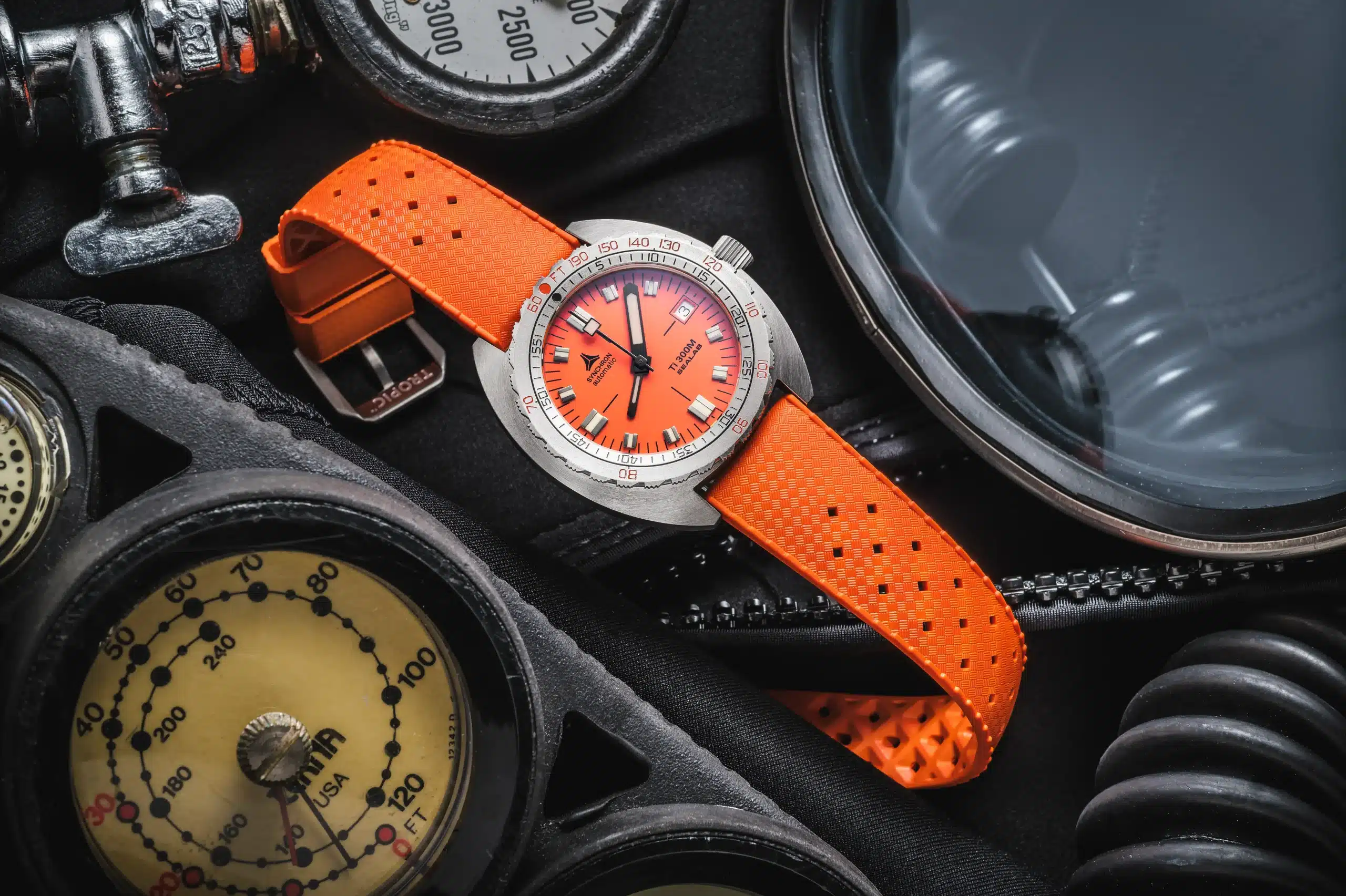
Synchron has announced the SEALAB Ti300M, a new professional dive watch that introduces a Grade 5 titanium case and 300 meters of water resistance as the foundation of its newly launched SEALAB line. Titanium dive watches are nothing new, but this release is notable for where it’s positioned. The SEALAB Ti300M is aimed directly at the same functional, heritage-driven space occupied by brands like Doxa and Synchron itself, rather than the broader lifestyle-oriented titanium diver market.

That focus is consistent with how Synchron has operated over the last few years. The revivals of Aquadive and Aquastar, paired with Synchron’s stewardship of Tropic and ISOfrane, have leaned heavily toward practical design and real historical reference points. The SEALAB doesn’t deviate from that formula. Instead, it applies it to a modern titanium platform.
On a personal level, this is exactly the kind of release that gets my attention. I’ve been following what Synchron has been doing closely, and I’ve liked more of it than not. I also happen to own a Marei-era limited edition Sub 300 from Doxa, and there are some very familiar design cues here. The proportions, the overall restraint, the sense that this is a tool first and a talking point second. I’ve even spent time with a Synchron Poseidon Ice Diver in the past, so I already have a good feel for how the brand approaches case design and wearability.

Those proportions are one of the strongest arguments in the SEALAB’s favor. The case measures 41mm in diameter, 45mm lug to lug, and 11.9mm thick. The dial and bezel diameter are shared with the Synchron Military, which is a smart move. That case profile has already proven to sit comfortably on a wide range of wrists, mine included. In titanium, those dimensions feel especially well judged. Grade 5 titanium is noticeably lighter than steel, and over a full day it likely makes the watch feel present without ever feeling burdensome.
This is still a full-spec tool watch. Water resistance is rated to 300 meters, supported by a screw-down crown and caseback. The sapphire crystal features anti-reflective coating, and the unidirectional bezel offers a firm 120-click action. Lume is handled by X1 Super-LumiNova on the hands and markers, which keeps the emphasis on clarity and nighttime legibility rather than stylistic flourishes.
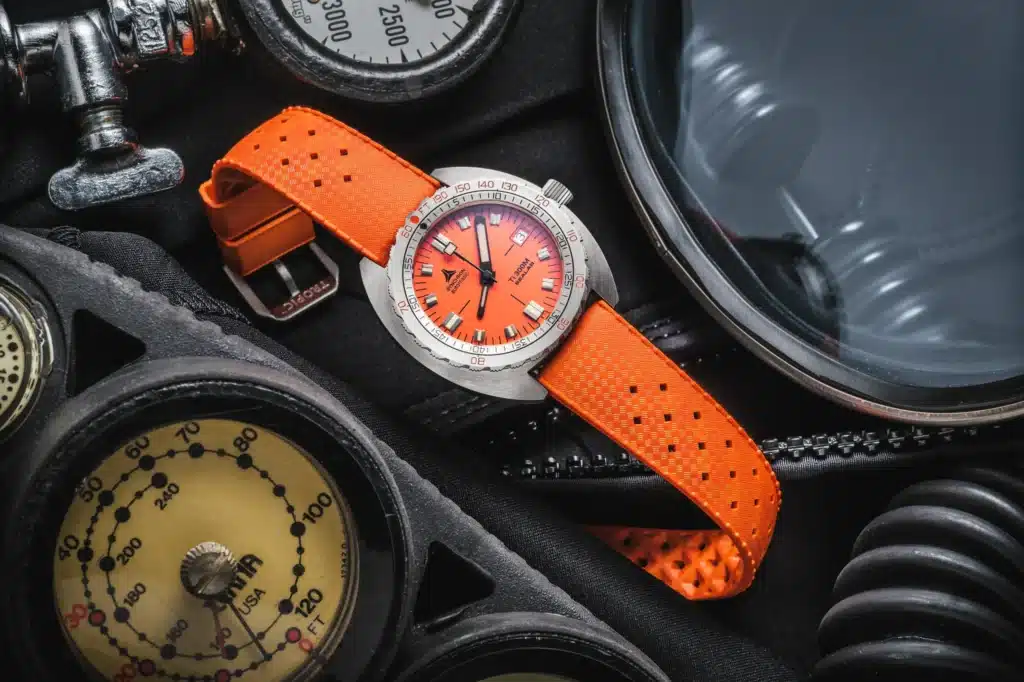
Inside the case is the La Joux-Perret G100, a Swiss automatic movement with a 60-hour power reserve. That number matters more than it sounds like. In real-world use, it means the watch will still be running Monday morning even if it spent the weekend off your wrist. Compared to the more common Sellita SW200, it’s a meaningful upgrade in everyday convenience. The G100 shares the same dimensions as the ETA 2824-2 and SW200-1, making it a true drop-in replacement, but it isn’t simply a copy.
La Joux-Perret has been open about the G100’s development starting with the Miyota 9-series architecture, followed by substantial re-engineering. The rotor is made from a single piece of tungsten for improved winding efficiency, and the balance uses a KIF anti-shock system, a supplier trusted by many high-end Swiss brands. The result is a modern, robust movement designed to be worn hard and relied on.

The SEALAB Ti300M comes on a Tropic rubber strap, with ISOfrane and seatbelt NATO options available. Given the titanium case and overall weight savings, rubber feels like the natural pairing. It should keep the watch comfortable, secure, and firmly in tool-watch territory.
Pricing is where this gets genuinely difficult for me. The $990 USD pre-order price, before it moves to a $1,390 USD MSRP, places the SEALAB Ti300M right in a zone where the value proposition becomes very hard to ignore. For a Swiss-made Grade 5 titanium diver with these proportions and this movement, it’s compelling. Deliveries are expected to begin at the end of February 2026, which at least gives me some time to sit with the decision.

Viewed as a whole, the SEALAB Ti300M doesn’t try to redefine what a dive watch is. It doesn’t need to. For someone like me, who appreciates what Synchron has been building and already gravitates toward this end of the dive watch spectrum, this feels like a very intentional release. And at that pre-order price, it’s the kind of temptation that lingers longer than I’d like to admit.

Co-Founder & Senior Editor
Michael Peñate is an American writer, photographer, and podcaster based in Seattle, Washington. His work typically focuses on the passage of time and the tools we use to connect with that very journey. From aviation to music and travel, his interests span a multitude of disciplines that often intersect with the world of watches – and the obsessive culture behind collecting them.
No lume pip?
It’s a Doxa knock off..
Exactly.
It’s a total AliExpress homage for triple price.
Thought it was a DOXA for a second…
While the Sealab is not a exact clone of a Doxa Sub300 it is really really close. I would imagine even watch nerds would have a hard time telling the difference at a few feet. That said, from reading the specs and comparing images, there is a lot to enjoy in Synchron’s Sealab offering. For starters, the Sealab’s case is titanium, it is both smaller in diameter and thickness. The markers are applied not printed, and the orange is toned down a bit from the Doxa, which, depending on your taste, that may be a good thing. The bezel markings are close enough that I can only detect minor font and size variation. the La Joux movement offering 68 hours of power reserve is a welcome plus to me.
I truly appreciate what they have done here at a grand less than the Doxa. Doxa is way over priced for a parts bin cobbled together watch – and I can say that because I own one. But I truly understand if you prefer ponying up for the Doxa cachet.