
Putting the Seiko 5KX vs. Orient Mako II side by side seems straightforward at first. They almost live in the same price range, appear in the same “best affordable dive watches” conversations, and are often treated as interchangeable recommendations. But after spending real time with both, the question we kept asking wasn’t whether one was better on paper. It was whether one actually earns its place on the wrist more often than the other, once the excitement fades.

And after nearly a decade of reviewing affordable watches like these, we’ve learned that two watches that look similar on paper can deliver different experiences. If you’re stuck choosing between the Seiko 5KX and the Orient Mako II and want to avoid buyer’s remorse, this breakdown is meant to help you figure out which one fits your habits, expectations, and tolerance for compromise.
Overview & Identity

The Seiko 5KX positions itself as a modern, everyday-friendly reinterpretation of Seiko’s long-running dive watch language rather than a strict tool watch revival. During our hands-on time, it consistently felt like a watch designed to live comfortably both outside the water and near it. It’s casual, approachable, and intentionally softened compared to Seiko’s more purpose-built divers. It carries the visual DNA people expect from Seiko, but the overall experience leans toward versatility and ease rather than hard-edged utility. Over weeks of wear, it came to feel like a “grab-and-go” mechanical watch.

The Orient Mako II, by contrast, stays closer to the traditional dive watch formula that made it popular in the first place. From our long-term wear, the Mako II feels more earnest about being a no-nonsense diver: less adaptable stylistically, but more confident in its role. It wears like a watch that expects to be knocked around a bit, with an identity rooted in practicality rather than reinterpretation. And that consistency gives the Mako II its appeal for buyers who want a straightforward, purpose-driven, affordable diver.
- The Seiko 5KX is an everyday mechanical sports watch borrowing dive-watch aesthetics for versatility and comfort.
- The Orient Mako II is a traditional, budget-focused diver that stays true to its tool-watch roots, with fewer stylistic concessions.
Design & Wearability: Casual Sports Vibe vs Classic Dive Watch Form

The Seiko 5KX was clearly designed to be worn in as many situations as possible. With the SRPD51, the sunburst blue dial constantly shifts depending on lighting, going from vibrant in direct light to surprisingly muted indoors. The matte aluminum bezel keeps reflections to a minimum. It avoids looking flashy, but the applied markers and updated dial text give it a more modern, less tool-like feel than the SKX it visually replaces. On the wrist, it’s comfortable and well-balanced, though the flat 22mm lug width makes the bracelet feel wide and a bit slab-like. The three-link bracelet itself is the weak point: polished sides highlight the cheaply made folded clasp, and pin-and-collar sizing feels dated.

The Orient Mako II takes a more traditional and deliberate approach. As also mentioned in our in-depth review, the deep blue sunburst dial has a softer, more fluid sheen that reveals itself slowly, with applied markers outlined in polished metal that catch light without overpowering the dial. The raised chapter ring adds depth and structure, while the sword-style hour and minute hands feel purposeful, with the red-tipped second hand providing a subtle but welcome point of contrast. On the wrist, the Mako II feels solid and composed, leaning into its dive-watch identity rather than versatility. The bracelet, while using hollow-end links, wears better than expected; it feels cohesive once on the wrist, and the double-locking, push-button clasp is quite well-executed for the price, complete with micro-adjustments and thoughtful finishing. A noteworthy feature of the clasp is the choice to sandblast the inner folding joint, which demonstrates attention to detail.
- The Seiko prioritizes visual variety and comfort over strict tool-watch discipline, rewarding owners who enjoy experimenting with straps but revealing clear cost-cutting once you spend time with the stock bracelet.
- The Mako II delivers a more cohesive and confidence-inspiring wearing experience straight out of the box, even if it lacks the stylistic flexibility of the Seiko.
Build Quality & Technical Approach
Both the Seiko 5KX and Orient Mako II are built to withstand the kind of daily abuse that affordable dive watches often see: desk knocks, door frames, and the occasional ill-advised swim. That said, they approach build quality from noticeably different angles.
Movements:
The Seiko 5KX relies on Seiko’s in-house 4R36, a movement most enthusiasts know just as well by its other name: the NH36. In daily use, it feels built for tolerance rather than precision, with a wide accuracy range of +45/ -35 seconds per day that rarely matters once it’s on the wrist and moving. Hacking is technically there, though it feels unnecessary given how loosely the movement is regulated. What Seiko did get right is presentation: seeing the movement through the display caseback adds a layer of mechanical engagement that makes the watch feel more alive. Our team found that winding it up and watching the parts move gives the 5KX an entry-level charm that’s hard to ignore.

The Orient Mako II takes a more deliberate mechanical approach with its in-house F6922 caliber. Compared to earlier Orient movements, this one feels like a direct response to long-standing enthusiast complaints. Hacking is smooth and positive, making it easy to track accuracy over time, and manual winding is helpful if the watch sits off-wrist for a few days. The winding action has a slight mechanical resistance: not buttery, but satisfying. It reinforces the sense you’re interacting with something purposeful. Accuracy expectations are tighter than Seiko’s, and in real wear, it feels easier to live with if you care about setting and maintaining time precisely.
Case Construction & Finishing:

The Seiko 5KX feels familiar the moment it hits the wrist, especially if you’ve spent time with an SKX. The case proportions are close enough that it feels like muscle memory. The signature crown, with a few milled rings at four o’clock, stays out of the way and never digs into the wrist. At around 13.5 mm thick, it sits taller than it looks on paper, giving it presence but also making it feel a bit top-heavy on the bracelet. The finishing is straightforward and utilitarian, without sharp transitions or decorative flair. Practical touches like drilled lugs make strap changes painless.
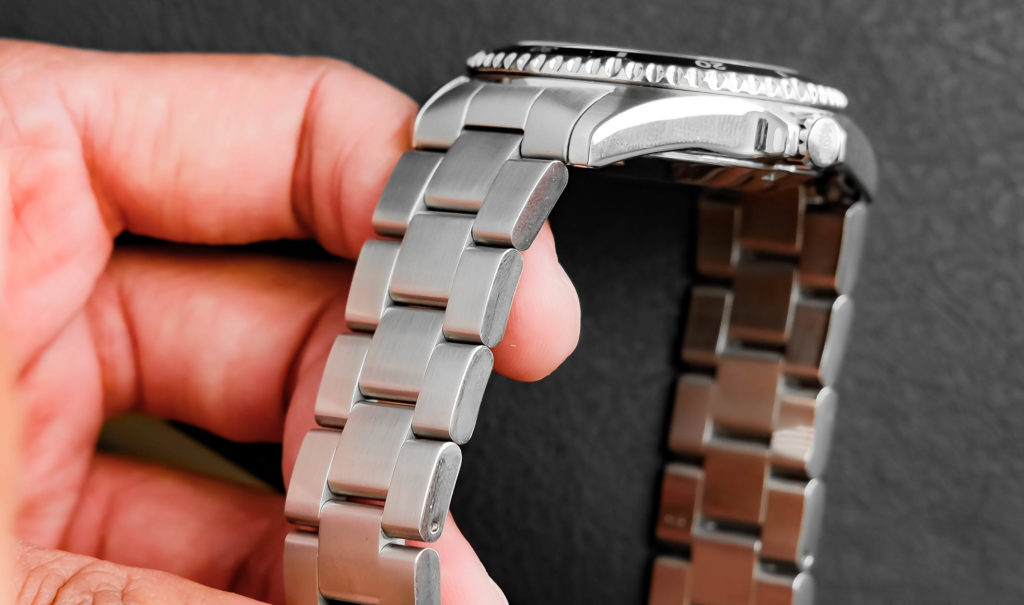
The Orient Mako II presents a more traditionally refined case shape, balancing classic proportions with thoughtful surface work. At 41.5mm wide and 13mm thick, it wears comfortably on a wide range of wrists, feeling solid without being bulky. The mix of brushed tops and polished case sides is handled very well, with smooth transitions that don’t call attention to themselves. The bezel insert looks cohesive with the case, though the sloping profile can make it tricky to grip in daily use. Once it moves, the action feels deliberate and reassuring. Also, the way the bracelet integrates into the case reinforces the sense that this was designed as a complete package.
Crystals:

The Seiko 5KX sticks with Seiko’s familiar Hardlex crystal, which has always felt like a pragmatic choice rather than a cost-cutting one. In day-to-day wear, it held up well to desk knocks and the incidental contact that comes from forgetting a watch is on your wrist. Reflections are present but manageable. Hardlex may not win spec-sheet arguments, but it fits the 5KX’s “wear it and don’t worry” personality and feels appropriate for a watch meant to see real use.

The Orient Mako II uses a mineral crystal, and while that might raise eyebrows for some, it never felt like a deal breaker during our time with the watch. Keeping mineral here clearly helps Orient hold the price where it is, and in everyday wear, it performed as expected.
Water Resistance & Lume:

The Seiko 5KX doesn’t pretend to be a serious dive tool, and in practice, that honesty works in its favor. With 100 meters of water resistance, it handled pool time and hot tub duty without complaint during our wear, even if we kept glancing down at the push-down crown out of habit. It’s very much a “desk diver.” Seiko’s Lumibrite remains a strong point. The glow was bright and lasted well into the night, easily readable long after the lights went out. It’s one of the areas where Seiko continues to punch above its price.
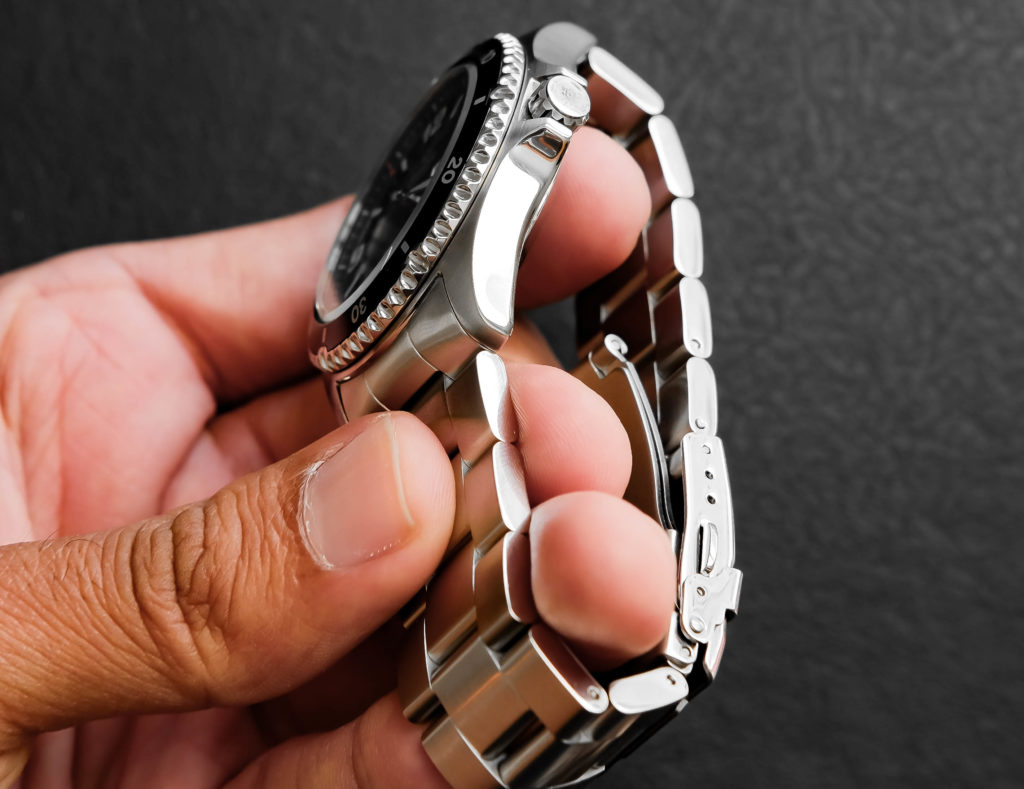
The Orient Mako II raises the bar, staying closer to diver expectations, with a 200-meter rating, backed by a screw-down crown and caseback that inspire greater confidence in the water. It feels like a watch that’s actually prepared for more than casual splashes, even if most owners never push it that far. The lume is solid but less aggressive, filling the applied markers well enough to remain readable in low light without dominating the dial. Compared to Seiko, it’s more reserved, but appropriate for the price and the Mako’s straightforward tool-watch positioning.
- Seiko 5KX: Tuned for tolerance rather than precision, the 4R36, Hardlex crystal, push-down crown, and 100m rating make it a watch you stop worrying about once it’s on your wrist. The strong Lumibrite and familiar SKX-adjacent case ergonomics carry the experience.
- Orient Mako II: The F6922’s hacking and tighter accuracy, paired with a more refined case, mineral crystal, and true 200m screw-down construction, give it a more cohesive, purpose-built feel.
Cost Considerations
The Seiko 5KX lives in a price bracket that feels almost unreal when you catch it at the right moment. We picked up the SRPD51 through Macy’s for roughly $200 after discounts, with fulfillment handled directly by Seiko USA. That’s a reminder of how aggressively this model can be priced when retailers cut out the middle layer. At its usual $200–$295 range, the value depends a lot on your tolerance for swapping the bracelet and accepting a softened tool-watch identity. When discounted, though, it’s hard to argue against the amount of mechanical watch you’re getting for the money.
The Orient Mako II sits in the $200–$300 range with different dial or bezel variants. In our experience, it feels priced for people who want a reliable mechanical diver without second-guessing the purchase or hunting for promo codes. The out-of-the-box experience feels complete, which makes the cost easier to justify even without deep discounts. It’s one of those rare watches where the value proposition is clear once it’s on the wrist.
Final Thoughts: Which One Gets More Wrist Time Once the Honeymoon Ends?
After living with both, it’s clear that the difference between the Seiko 5KX and the Orient Mako II is about which one keeps landing up on your wrist months (and years) after the novelty wears off.

The Seiko 5KX is the more flexible, low-pressure companion. It’s easy to wear, easy to live with, and priced so accessibly that it feels almost disposable in the best way. It shines as a daily watch for someone who wants something nicer than a beater without falling down the hobby rabbit hole. What it’s not for is anyone chasing true dive-watch credibility or a finished, out-of-the-box experience. It asks you to meet it halfway with straps (and expectations).
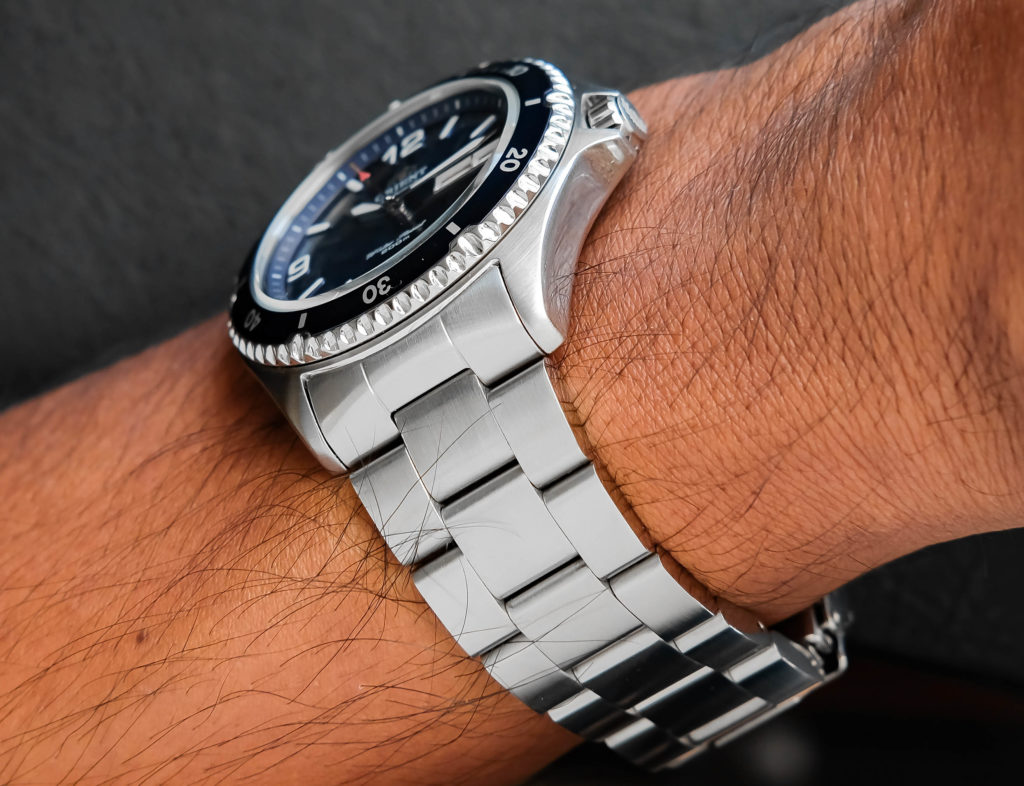
The Orient Mako II, on the other hand, is the watch that quietly sticks around. Its congruent design, tighter mechanical feel, and more serious tool-watch construction create a wearing experience that feels greater than the sum of its parts. It’s not flashy, and it doesn’t try to be everything, but it feels resolved in a way the Seiko doesn’t. For us, that cohesion is what matters long-term.
Overall, the Orient Mako II earns the win. It’s the watch we found ourselves choosing more often, not because it’s perfect, but because it feels honest, complete, and purpose-built in a way that holds up over time.

Co-Founder and Senior Editor
Kaz has been collecting watches since 2015, but he’s been fascinated by product design, the Collector’s psychology, and brand marketing his whole life. While sharing the same strong fondness for all things horologically-affordable as Mike (his TBWS partner in crime), Kaz’s collection niche is also focused on vintage Soviet watches as well as watches that feature a unique, but well-designed quirk or visual hook.