
Lining up the Orient Mako II against the Omega Seamaster 300M may look ridiculous on paper: a sub-$300 diver versus a $6,000 luxury icon. However, the real question we kept coming back to was simple: “Can the Mako actually compete with the Seamaster where it matters?” After wearing both for a long time, knocking the Mako into doorframes and taking the Seamaster into situations it probably didn’t deserve, we started to notice patterns.

And after nearly a decade of testing everything from budget beaters to high-end divers, we’ve learned that price brackets tell only part of the story. That’s why this comparison isn’t about luxury vs. value as abstract ideas; it’s about what these two watches feel like day-to-day. So if you’re torn between spending responsibly or stretching for the big-name diver, this breakdown will help you figure out whether the Mako delivers enough real-world value to stand in the same conversation as the Seamaster.
Overview & Identity

The Orient Mako II sits firmly in the “everyday diver” lane. It’s the kind you buy because you want something honest, capable, and not afraid of a few scrapes. In our dedicated Mako II review, its identity emerged through lived-in details: the no-nonsense, familiar case profile, the straightforward dial layout, and the sense that nothing here is chasing prestige. It wears with the same ease as a well-used tool, the kind you trust because it never feels precious. Even after rotating it through straps and daily wear, it stayed firmly rooted in that “reliable budget diver” space.

The Omega Seamaster 300M, by contrast, leans confidently into luxury-tool territory. Our hands-on testing experience highlighted the 42 mm case with its sharply executed lyre lugs, the ceramic wave-pattern dial, and the refined mix of brushed and polished surfaces. All of these signal a level of finish that goes beyond pure utility. The METAS-certified movement and overall crisp execution reinforce Omega’s modern engineering ambitions. Yet, as we noted in testing, the Seamaster carries a dress-diver polish beneath its technical specs, giving it a sleeker, more elevated identity than a straightforward tool diver.
- The Orient Mako II is a grounded, utilitarian diver defined by simplicity, comfort, and everyday reliability.
- The Omega Seamaster 300M is a refined, high-spec luxury diver that blends technical precision with dress-diver sophistication.
Design & Wearability: Functional Simplicity vs Modern Luxury Polish
The Orient Mako II is built around a straightforward, familiar diver design, but our review team found that the details give it more character than the price suggests. The blue sunburst dial shifts dramatically in changing light, letting the applied markers and thin polished surrounds catch highlights without ever feeling ornamental. The raised chapter ring keeps the layout tidy, while the sword-style hour and minute hands, and the red-tipped seconds hand, add just enough personality.

On the wrist, the case stays low and friendly, never fighting shirt cuffs or feeling oversized. The oyster-style bracelet, with brushed tops and polished sides, wears well, though the hollow end links reveal where costs were trimmed once you handle them off the watch. Day-to-day, we found it comfortable, balanced, and forgiving of scuffs thanks to its more muted finish.
The Omega Seamaster 300M leans hard into visual precision and luxury detailing. In our hands-on impressions, the laser-engraved ceramic wave dial immediately set the tone: glossy and layered. The skeleton hands and crisp markers reinforce the dress-diver vibe, even if legibility gives up a little ground in certain angles.

On the wrist, the watch offers an odd but compelling contrast: the horizontal wave pattern visually broadens the dial, while the watch head stays thin, creating a genuine wear-and-forget feel during long days. Paired with the rubber strap, the watch becomes genuinely comfortable, while the steel bracelet feels like the weak link, heavy and refusing to taper from the 20 mm lugs. Despite the hole spacing and keeper design not being perfect, the embossed branding and finely finished tang buckle still showcase Omega’s attention to detail. It also helps that the Seamaster can pivot into full strap-monster mode, working well on NATOs and even certain leathers.
- Orient Mako II: A clean, approachable diver with a dynamic sunburst dial, friendly proportions, color-matched date window, and easy day-long comfort. It involves modest finishing that prioritizes wearability over flash.
- Omega Seamaster 300M: A high-gloss, design-forward diver defined by its ceramic wave dial, sculpted case, and luxury finishing. It’s more refined than utilitarian, especially when paired with the rubber strap.
Build Quality & Technical Approach
Both the Orient Mako II and Omega Seamaster 300M can handle far more than casual, everyday wear. But the way they’re built, from case finishing to movement philosophy, highlights two very different interpretations of what “quality” should feel like on the wrist.
Movements:
The Orient Mako II keeps its mechanics grounded in practicality. Its in-house F6922 movement is a meaningful upgrade from earlier Orient calibers, adding hacking, hand-winding, and a far more accurate day/date quickset. The movement’s 21,600 bph beat rate and roughly 40-hour reserve are modest on paper, but what stands out is how easy it is to live with. While testing, we found that the winding has a tactile, slightly gritty bite that feels purposeful, and being able to top it up after a few days off the wrist is far better than the old “shake it” routine we complained about in earlier models. The crown interaction is less refined. It’s a bit small and not the smoothest to screw down, but the overall reliability and simplicity make the F6922 the kind of movement you don’t think about until you need it.

The Omega Seamaster 300M goes in a different direction with its Caliber 8800. METAS certification puts it in elite company, guaranteeing 0/+5 seconds per day and 15,000 gauss of resistance. These specs were observed in real-world use, with our test piece hovering around 1 second per day. The Co-Axial escapement, George Daniels’ friction-reducing design, stretches service intervals. Through the caseback, the spiral Geneva waves and meticulous finishing reinforce that the 8800 is built for both accuracy and admiration. Even the winding experience feels luxurious, with a smooth, mousse-like glide that contrasts sharply with the more utilitarian feedback of the Mako.
Case Construction & Finishing:
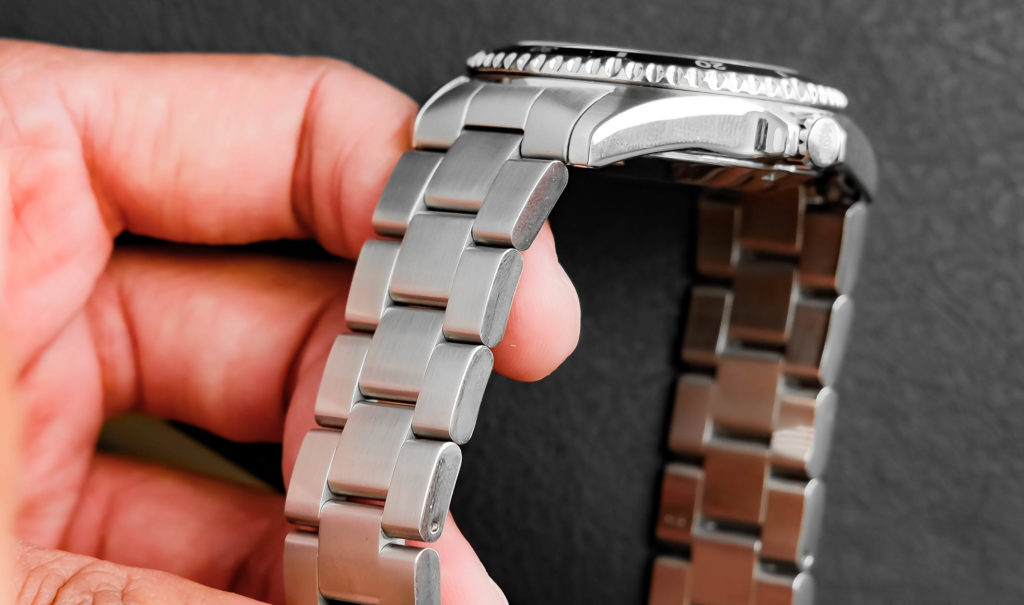
The Orient Mako II keeps its case design familiar but far better executed than its price suggests. At 41.5 mm wide, 47 mm lug-to-lug, and 13 mm thick, it wears like a classic mid-sized diver. What surprised us most in our review was how the polished case flanks melt into the brushed lug tops without a harsh line, giving the watch a cohesion you don’t see at this level. The bracelet connects to the case organically, reinforcing that sense of dependable build quality. The 120-click bezel looks great with its polished coin edge, but the sloped grip makes it harder to turn; once engaged, though, the clicks are confident and satisfying.

The Omega Seamaster 300M takes case construction into sculpted, architectural territory. The twisted lyre lugs, executed with razor-sharp polished bevels and deep brushing, give the watch its recognizable profile, and they make some of the visual width disappear when viewed from the wrist. Although its listed thickness is closer to 14 mm, it wears more like 12 mm. The brushing on the inner lug portions and flanks adds real depth, and an art deco, gear-toothed-styled caseback frames the movement like a gallery piece. The scalloped ceramic bezel looks fantastic, with alternating brushed facets that match the dial tones. Still, its grip and lack of personality remain weak points: crisp in action but awkward to turn, especially with wet hands.
Crystals:
The Orient Mako II keeps costs sensible with a mineral crystal, and in our testing, it performed as expected: clear, functional, and easy to live with. It won’t resist scratches like sapphire, but that trade-off is part of how Orient keeps the watch in its ultra-affordable price bracket. On the wrist, the crystal doesn’t distort the dial or add glare in any distracting way, and the sunburst finish beneath it still comes through cleanly.

The Omega Seamaster 300M uses one of the most impressive sapphire crystals we’ve encountered. During our testing, it almost vanished entirely thanks to multiple layers of anti-reflective coating on both sides. Glare was practically nonexistent, even outdoors, making the ceramic wave pattern and polished markers easy to read. The trade-off is that the outer layer can pick up faint micro-scratches at certain angles. Ours looked flawless and new, but it’s something you should keep in mind.
Water Resistance & Lume
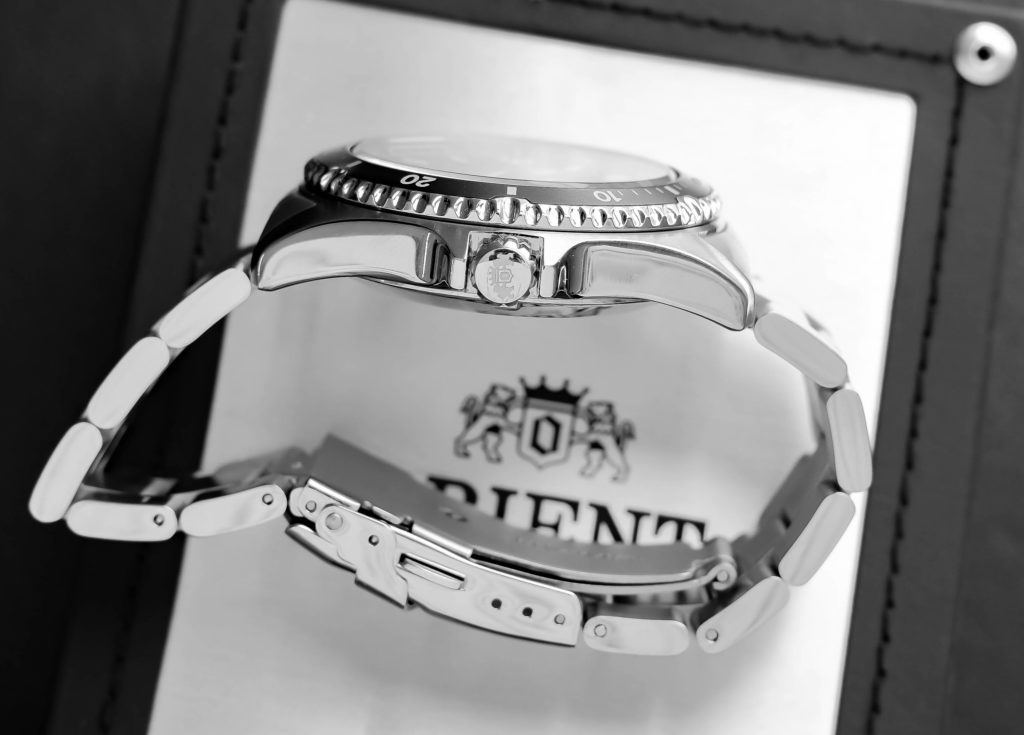
The Mako keeps things practical with 200 meters of water resistance, supported by a screw-down crown and caseback. That’s more than enough for swimming, snorkeling, and the kind of everyday abuse most of us will put it through. The applied markers are filled with lume that’s serviceable for the price. It’s bright enough to read at a glance in dim rooms, though it won’t outshine the Seiko heavy-hitters in this range.

The Omega Seamaster 300M pushes water resistance up to 300 meters and carries the brand’s signature helium escape valve at 10 o’clock. Whether or not you’ll ever need it, the valve adds a bit of old-school tool-watch charm to what is otherwise a polished, dress-leaning diver. In the dark, the lume is one of the watch’s most striking features: blue glow on the indices, hour hand, and seconds hand, with green reserved for the minute hand and bezel pip. This color separation makes orientation instant, even if the overall brightness and longevity fall short of those of the Seiko SKX.
- The Mako delivers practical toughness through its F6922 movement, clean case finishing, mineral crystal, 200 m resistance, and functional lume and bezel.
- The Omega Seamaster 300M leans into high-spec technical refinement with the METAS-certified 8800, near-invisible AR sapphire, 300 m resistance, and two-tone lume. It portrays luxury-focused engineering with a few quirks.
Cost Considerations

The Orient Mako II sits at the ultra-accessible end of the dive-watch spectrum, priced at $140–$240, depending on colorway and retailer. Even the Pepsi and black-dial variants stay in that same bracket, making the Mako II one of those rare watches where the value proposition is obvious the moment you put it on. It’s priced for people who want a dependable diver without thinking about financing plans or resale value.

The Omega Seamaster 300M operates in an altogether different financial universe, coming in at $5,600 on rubber or $5,900 on the bracelet. It’s a serious price jump that reflects the movement tech, ceramic components, and finishing execution rather than purely functional needs. In our experience, buying it on the bracelet offers more long-term flexibility for resale and strap swaps, but you’re paying for refinement and brand engineering rather than raw utility.
Final Thoughts: Can the Orient Mako II Really Compete With the Omega Seamaster 300M?
After spending real wrist time with both watches, the biggest takeaway is that “compete” depends entirely on what you value. In that regard, the Mako II and the Seamaster 300M aren’t trying to solve the same problem.

The Orient Mako II thrives because all of its small choices come together into something more compelling than the sum of its affordable parts. Its classic proportions, upgraded F6922 movement, and cohesive finishing create that “Mako magic” we talked about in our review. It’s for the wearer who wants a dependable diver that won’t demand much in return. It’s not for someone chasing prestige, pinpoint accuracy, or a luxury-level tactile experience.

The Omega Seamaster operates differently. The sculpted lyre-lug case, laser-engraved ceramic dial, and METAS-certified Calibre 8800 all push it into a realm where refinement and engineering sit front and center. As we noted, it’s more dress-diver than hardcore tool. It’s for the enthusiast who values precision, finishing, and modern luxury execution over raw practicality. It’s not for someone who worries about scratching AR coatings or ceramic bezels.
So, the Orient Mako II cannot directly “compete” with the Omega Seamaster 300M. The Seamaster is objectively superior in movement tech, finishing, and overall refinement. However, the Mako holds its own within its intended lane. It succeeds by being a cohesive, wearable diver whose charm comes from how naturally it fits into real life at an incredibly affordable price. And based on that alone is that reason why we would (and do) recommend the Orient over the Omega for those who are just looking for a reliable dive watch.

Co-Founder and Senior Editor
Kaz has been collecting watches since 2015, but he’s been fascinated by product design, the Collector’s psychology, and brand marketing his whole life. While sharing the same strong fondness for all things horologically-affordable as Mike (his TBWS partner in crime), Kaz’s collection niche is also focused on vintage Soviet watches as well as watches that feature a unique, but well-designed quirk or visual hook.
Just a note/question on the crystals. My understanding is that, being more brittle than mineral crystal, sapphire is more prone to breaking if dropped? If so, that, to me, means the Mako is a better bet as a genuine tool watch.
Oh, and can unscrewing the crown act as a “helium release valve”? If that’s true, what’s the point of a dedicated release valve?
A helium release valve is a spring-loaded one-way valve, that only lets.pressure escape from within the watch. Unscrewing the crown will let helium escape, but can also let water in…
Interesting juxtaposition of two watches that, though by design are dive watches, but reflect different cost strata. I’d incline that the use of the Mako III might make a better argument with it’s more refined crown and the use of sapphire in the crystal. With that watch, your argument might be more compelling…
Orient are hard to beat as a solid value watch. I own many more expensive brands, but always enjoy wearing an Orient.
Kamasu has sapphire.