
I still think back to that stretch in 2017 when I convinced myself I’d crossed some imaginary threshold in collecting. My family and I had just settled into Seattle, I had a cool new job, and I felt this pull to mark the moment with something meaningful. The Speedmaster had always lived somewhere in the back of my mind. It was just one of those designs that felt honest. And back then, if you were patient enough to dig through the secondhand listings, you could grab a hesalite 1861 for a song. So that’s what I did. I wore it constantly. I babied the crystal. I tolerated the bracelet the same way you tolerate a noisy roommate. And for a while, I thought that was the Omega Speedmaster experience. Imperfections and all.
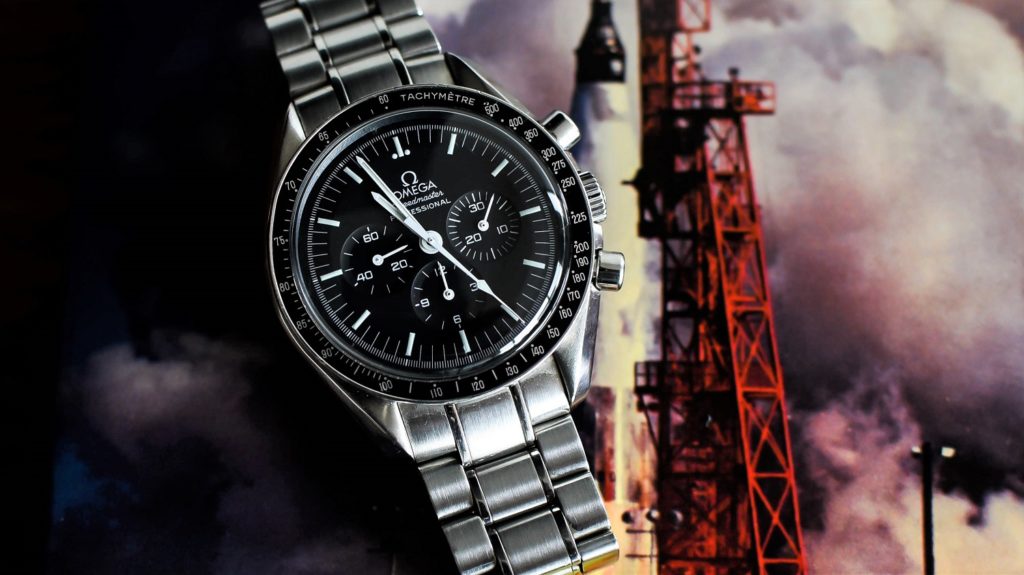
But years pass. You get tired of buffing out scratches. You start recognizing the difference between “heritage” and “stuff I just put up with.” You can even see some shots and impressions of this watch in one of our earlier Omega reviews here. But when Omega announced the 3861 Moonwatch with a Master coaxial movement and a handful of refinements, I felt that old curiosity again. Just curiosity… “yeah sure.” What would a Speedmaster feel like if Omega finally let itself evolve the thing?

Turns out, it feels a lot like coming home to the version of the watch you always wanted in the first place.

A Familiar Icon, Sharpened
Omega hadn’t meaningfully updated the guts of the Moonwatch since the late nineties, and that movement was really just a continuation of the 861 that dated back to the late sixties. That’s part of the charm. Most of the external changes over the decades have been so incremental that only the Speedy obsessives could tell you exactly what shifted and when. I’m one of those people. I’ve spent enough time cross-referencing references to know how small those shifts usually are. Which is why the 3861 stands out. On paper, the differences seem minor. In practice, they make the whole watch feel like someone finally adjusted the focus.

Visually, the dial gets its step back—that subtle drop toward the minute track that gives the whole thing more dimensionality. The sapphire version, which is what I own, also carries an applied logo that adds just a hint of elevation without drifting into dressy territory. The bezel brings the dot-over-ninety back to its rightful position, a microscopic detail that somehow restores the watch’s rhythm. And despite remaining a 42mm Speedmaster (50 meters of water resistance), the case is trimmed just enough—half a millimeter here, a millimeter there—to wear smaller and more planted than the specs imply.

And as expected, the lume does exactly what it needs to do. Bright enough to trust, subtle enough not to show off, and shockingly persistent through an entire night. It’s the kind of consistency you only notice when you’re fumbling around in the dark and realize the watch is still doing its job. Daytime legibility, meanwhile, is classic Omega Speedmaster: crisp printing, balanced subdials, nothing lost or crowded. There’s a reason black/white sports chronographs became such a longstanding blueprint.

For all the capability baked into the movement, I mostly end up timing dog walks and boiling pasta. It’s almost funny wearing something engineered to survive magnetic fields strong enough to wipe out your electronics, and then using it to keep dinner in check. But the interaction feels great—winding, setting, engaging the pushers—everything has this confident mechanical click that reminds you why we bother with mechanical chronographs at all.

Bracelet Redemption Arc
Let’s talk bracelet, because this is where most Omega Speedmaster owners will feel the update first. The old one wasn’t terrible. It just had that slightly awkward vibe, like it was still negotiating its place on the watch. The new bracelet feels like Omega finally listened. The taper is more dramatic, leaning into the vintage cues without overselling them, and the links articulate sooner, helping the whole thing wrap around the wrist instead of perching on top of it.

Those redesigned end links also make a bigger difference than you’d expect. They cut down the visual length of the watch and help the head settle lower, which does wonders for comfort. And on the sapphire version, the polished interlinks add just enough shine to complement the case without crossing into jewelry territory. The clasp is still straightforward and functional—not a showpiece, but no longer the weak link in the chain.

Speedmasters have always been “strap monsters,” and I’ve swapped enough of them over the years to know that’s true. But with this one, I just don’t feel the urge. The bracelet is too good. It finally feels like part of the watch rather than a compromise you learn to accept over time. I will warn everyone though. This was one of the most annoying bracelets I’ve ever had to size at home. The experience almost warrants an entire dedicated article.

The 3861 Under the Glass
Flip the watch over and you find the reason the 3861 matters as much as it does. Omega spent four years turning the old 1861 architecture into something capable of meeting METAS certification—a massive philosophical leap for a watch that built its reputation on resisting change. The result is a hand-wound, anti-magnetic, Co-Axial chronograph with 26 jewels, a free-sprung balance, a 21,600 bph heartbeat, and about 50 hours of reserve. All housed in a movement you can actually admire through the sapphire caseback.

Accuracy has been consistently excellent for me—around plus three seconds a week—but honestly, that’s almost secondary to how the movement feels. The winding is smoother and more reassuring than the old 1861, and the pushers have a firmer, more deliberate action that makes every start-stop-reset feel like its own tiny ceremony. It’s modern in all the ways it should be while still giving you the tactile rituals that made the old movement beloved in the first place.

And visually, the movement rewards every glance. You start noticing the small refinements—the finishing on the bridges, the geometry of the balance assembly, the subtle evolution from its predecessor—and suddenly you understand why Omega chose to show it off.

The One That Finally Stayed
But the biggest surprise for me wasn’t the movement or the dial refinements or the bracelet that finally pulled its weight. It was the emotional clarity the watch ended up carrying. My old 1861 was a stepping stone—the watch that pulled me deeper into the hobby and marked a move to a new city. I’ll always love it for that. But these refinements were too hard to ignore, and living with the 3861 has made that clear in a way I didn’t expect. This feels like the version I was slowly working toward without realizing it, the one that connects who I was back then with who I am now.

After living with it, this became the Omega Speedmaster that stuck. The one that convinced me I didn’t need to keep cycling through references to figure out which Speedmaster was “mine.” Omega took a watch I already loved and tightened every screw just enough to make it feel inevitable—like this was always the one I was supposed to end up with.

Because it’s been so long since I’ve paid attention, I was shocked to find that Omega is selling this version of the Moonwatch today for $9,000. That blows my mind, and someone weighing out their Speedy options today would have to really ponder if the sapphire upgrades are worth the price increase over the base hesalite version. Still, this watch debuted at $7,150. It’s kind of a bummer to see prices climb this fast in the Omega camp. In my brain, this is the kind of pricing that’s creeping into Daytona territory. Thankfully, since its launch, there are plenty of great second-hand examples out there.

Long-term keeper doesn’t even feel like the right phrase. This was all worth it. This is my Moonwatch. The one to end all Moonwatches. The final chapter in a story that started back in Seattle with a hesalite crystal and a feeling I didn’t quite know what to do with. And maybe the first time I’ve put an Omega Speedmaster on and felt the kind of satisfying certainty that only shows up when a watch stops being an object and becomes part of your personal timeline instead.

Co-Founder & Senior Editor
Michael Peñate is an American writer, photographer, and podcaster based in Seattle, Washington. His work typically focuses on the passage of time and the tools we use to connect with that very journey. From aviation to music and travel, his interests span a multitude of disciplines that often intersect with the world of watches – and the obsessive culture behind collecting them.
Excellent rendition on owning the Omega Speedmaster. I have owned mine since 1975. I was a new Infantry officer training at Fort Benning and for several months I lusted over the Omega as it sat on display at the PX. I also agonized it was then too expensive at $150. I finally pulled the trigger on it when it went on sale my last day at Fort Benning. I paid $135 for my first tool watch. I used it during my 20 years in the army for timing artillery fire missions and staff briefings. I am appalled today at what these watches sell for even when on discount.
Incredible story Bill. Thanks for sharing. Like I said, thankfully a ton of versions can be found secondhand but I start to worry when people begin telling stories of waitlists for certain Speedmaster models. I bet yours has some great stories. Thanks for reading.
I had a similar experience except my watch was a Seiko pilot chrono and I bought it at the Ft Bragg PX in 1990. You can’t go wrong with a good mechanical tool watch.
Bill,
First, thank you for your service.
It is tough to see what these and other watches price out at these days. That being said. The “history/story” of your watch is what makes owning a particular timepiece so special. Thanks for sharing yours. I would say you hit a homerun with your watch. It was a “splurge” purchase that turned into a trusted tool watch as well.
I got my Speedy as a Christmas gift in 1983. I also had been lusting after it in the Ft Belvoir AAFES, while serving at the Engineer School. My wife purchased it on lay away on sale for $320 – a lot of money
Just had it serviced by SGUS for just over $500! They changed out the movement but I don’t know to what.
Has worked and still works flawlessly. Still has the original old-style band.
Very interesting – a full movement swap? I know that’s becoming a widely adopted practice these days. May be worth finding out which one they put in there.
I bought an Omega Speedmaster in Atlantic City in 1969. It was $165. I used it to time lap times in Reed Light go-kart racing . Those went about 75 mph.
Great article as always. I’ve had the hesalite version for about six months and feel it’s a keeper for sure, can’t really see where else they need to improve it at this point.
I can totally relate. This is the same watch I purchased when I moved to Seattle with my family and has been with me since. It is my everyday watch, my dress watch and my beater watch and has kept up wonderfully. The only thing missing is some sort of quick micro adjustment on the bracelet, which I heard was improved upon and the new ones come with it included. In any case, great article and nice pictures!!! (I also love the choice of background. I’m guessing similar to me, taste in watches follow taste in guitars so I would say its something close to a PRS Mcarty 594 model???
That’s so awesome to hear. It makes me wonder why I even want any other watches. And you’re right! McCarty 594. It’s way too much guitar for me but I LOVE it. Thanks for reading.