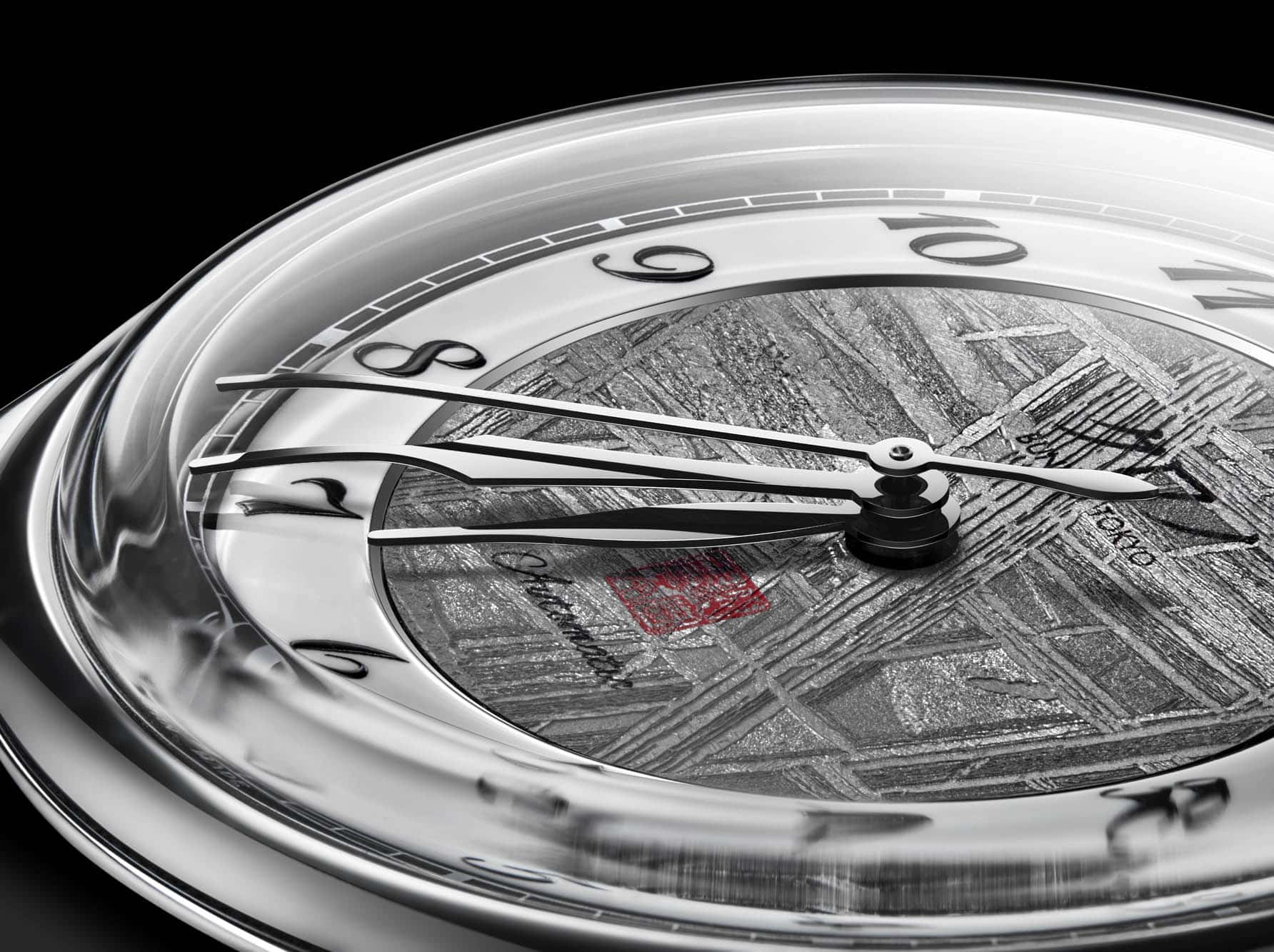
Kurono Tokyo has opened 2026 with its first-ever meteorite dial watch, a noteworthy development for a brand that has largely stayed within lacquer, metal, and traditional dial materials. It is also a first for founder Hajime Asaoka, who has spoken openly about wanting to work with meteorite for years but struggled to find an approach that made sense within Kurono’s constraints.

I’ve never owned a meteorite dial watch, and I’ve generally viewed the category with some skepticism. Too often, meteorite feels like the feature rather than part of a coherent design. That hesitation makes Asaoka’s solution here more interesting than most, because the technical problem he set out to solve is a real one.

Meteorite is fragile and difficult to machine, which made Kurono’s signature domed dial architecture either impractical or prohibitively expensive if executed as a single curved slab. The Inseki avoids that issue entirely by using a two-piece “bullseye” dial construction. A flat meteorite disc sits at the center, surrounded by a white lacquered outer ring with a sloped profile that preserves the brand’s cylindrical, domed visual language. The two sections are separated by a polished metal ring, with a gray and white railroad minute track printed outside the lacquered ring.

The meteorite itself comes from the Muonionalusta fall, estimated at around 4.5 billion years old and commonly used in watchmaking for its stable Widmanstätten pattern. Each meteorite disc was personally inspected by Asaoka, with attention paid to the clarity and structure of the crystalline pattern. His red seal appears on each dial as a visible marker of that involvement. Personal inspection at this level helps explain both the restrained execution and the limited production.
The outer lacquered ring also carries Asaoka’s design fingerprint. The black Arabic numerals are rendered in a custom calligraphic typeface drawn by Asaoka himself, offering a contemporary interpretation of classic Breguet-style numerals without leaning into overt vintage pastiche. Kurono’s familiar hand-bent, high-polished steel hands complete the dial, keeping the palette firmly monochromatic. The overall effect reads more like a controlled gray tuxedo dial than a showcase of raw material, which is not something I usually associate with meteorite watches at this price point.

Outside the dial, the Inseki remains firmly within Kurono’s established framework. The stainless steel case measures 37mm in diameter and 11.5mm thick, with approximately 4.5mm accounted for by the highly domed sapphire crystal. Inside is the Miyota Caliber 90S5 automatic movement, water resistance is rated to 30 meters, and the watch is delivered on a black calf leather strap.
Production is described as “very limited,” with no specific quantity disclosed. Given Asaoka’s hands-on inspection of each meteorite dial, output is likely constrained by process rather than marketing. The retail price is set at $1,850, though U.S. buyers should factor in an additional 15 percent tariff applied to Japanese goods, pushing the effective cost north of $2,000 before local taxes.

I’ve long viewed meteorite dials as more gimmick than substance, especially once prices climb. At this level, and with this kind of disciplined execution, the Inseki at least gives me pause in a way most meteorite releases do not. Sales are scheduled to begin on Kurono’s website at 9 a.m. EST on January 15.

Co-Founder & Senior Editor
Michael Peñate is an American writer, photographer, and podcaster based in Seattle, Washington. His work typically focuses on the passage of time and the tools we use to connect with that very journey. From aviation to music and travel, his interests span a multitude of disciplines that often intersect with the world of watches – and the obsessive culture behind collecting them.
The definition of what’s called an “affordable” brand these days has changed. What part of an $1,850 to above $2,000 uncomplicated, 3 handed watch, with a Miyota movement, with or without a slice of meteorite taking part in the dial, is deemed as “affordable”? I understand that the watch industry overall, swiss, german, and now japanese, is broken. And that there’s no incentive to fix it, either by the brands themselves or for the most part, from the outside, as there are a lot who profit from the broken system, but with lower level offerings now hitching themselves to the continuing exponential and unabated avaricious pricing of brands, especially the big box brands, to call some of them “affordable” appears more a play on words and a propaganda showing rather than reality. Unless of course, you’re one of the upper echelon of the wealthy, which is where this has gone and continues to go. It’s left the field of enthusiasts and become the playground of the rich. It used to be a field where the appreciation of craft and science and art could be enjoyed and admired on a daily basis and all one needed to do was look down on their wrist, which is a different aesthetic than those who are looking for more jewelry to show off. I used to love the hobby. Not so much anymore. Disappointing. Even though it’s hopeless, I still find myself perusing, although more from the outside now.