
Microbrand watches tend to sneak up on you. One minute you’re browsing for something safe: maybe one of the usual best watches under 1000, and the next you’re deep into a rabbit hole of brands you’ve never heard of, each doing something a little differently. Over time, we’ve realized the ones that stick aren’t always the most polished or widely known. They’re the ones that feel intentional on the wrist. That “it” factor is hard to define, but you know it when a watch keeps finding its way back onto your wrist without you overthinking it.

We’ve been reviewing microbrand watches for nearly a decade now, but more importantly, we’ve lived with them in the gaps between reviews. We’ve worn pieces through long workdays, timed the bezel action on divers, and spent more time than we’d like to admit adjusting bracelets and straps to get things right. Along the way, we’ve figured out which ones actually hold up, which ones just photograph well, and which become some of the best value watches you can own. This list pulls from that experience: watches that bring something extra to the table for collectors who care more about feel, design, and everyday use than logos.
Nodus Sector Deep

| Price: | $599 |
| Water Resistance: | 500m |
| Case Dimensions: | 38mm (diameter) x 47mm (lug-to-lug) x 13.6mm (thickness) |
| Lug Width: | 20mm |
| Movement: | Seiko NH35 (Mechanical Movement) |
The Nodus Sector Deep ended up being one of those microbrand watches that quietly earns its place the more time you spend with it. On paper, it leans heavily into function, but in practice, it’s the small, thoughtful details that give it that “it” factor. The dial is a good place to start. The white PVD frames around the indices catch enough light to keep things visually interesting without turning flashy. The lume-filled centers taper out toward the cardinal points, creating a subtle domed effect when you’re looking straight at it. It’s a small design choice, but it adds depth without getting in the way of legibility. In low light, BGW9 Super-LumiNova held up well in our testing, staying readable through the night without fading too quickly.
What really pulls you in, though, is how the watch wears. The 38mm case sits low and balanced, which isn’t something we take lightly given what this watch is built to handle. Even after a full day on the wrist, it never felt top-heavy or awkward, especially on smaller wrists. The left-side crown seemed like a novelty at first, but it turned out to be one of the more practical features. It stays out of the way and doesn’t dig into your wrist during extended wear (though the asymmetry might not be for everyone). The matte DLC bezel adds a bit of grip without reflecting light, and the dual-scale layout proved quite useful when timing something while keeping track of a second time zone.
Inside, the Seiko NH35 is regulated in-house by Nodus, and our samples hovered around +/- 10 seconds per day, which felt reassuring right out of the box. The 41-hour power reserve also fits easily into a regular rotation.
The bracelet is where things start to feel very well-thought-out. Screw links made sizing straightforward, and the taper from 20mm to 18mm kept the clasp from feeling too bulky. The NodeX system allowed for quick micro-adjustments during the day, which came in handy when wrist size fluctuated with heat or activity. That said, when fully extended, some of the clasp hardware becomes visible, which slightly disrupts the otherwise clean look. Still, this is a watch that prioritizes comfort and usability over symmetry or polish, and that trade-off is exactly what gives it character.
Pros:
- Low-profile case that stays balanced and comfortable throughout the day
- Left-side crown improves wearability by avoiding wrist bite.
- NodeX clasp system allows easy, on-the-fly micro-adjustments.
- Dual-scale matte DLC bezel offers practical, glare-free timing.
- Thoughtful dial design with strong BGW9 lume performance
Cons:
- Exposed clasp hardware, when fully extended, interrupts the clean look.
- The asymmetrical layout may not appeal if you prefer traditional case symmetry.
Baltic MR01

| Price: | $635 |
| Water Resistance: | 30m |
| Case Dimensions: | 36mm (diameter) x 44mm (lug-to-lug) x 9.9mm (thickness) |
| Lug Width: | 20mm |
| Movement: | Hangzhou 5000a automatic |
The Baltic MR01 doesn’t try to win you over with versatility or modern sport cues. Instead, it leans fully into classic dress-watch sensibilities, and somehow makes that feel fresh again. That’s where its “it” factor comes from. It’s a watch that feels intentional in a way many microbrands don’t. You notice it in the dial first. The fine sand-textured silver surface gives it a soft depth that changes subtly throughout the day, while the offset guilloché small-seconds subdial adds the right amount of structure to keep things from feeling flat. The polished Breguet numerals draw your eye in repeatedly, especially in lower light, where they seem to glow rather than reflect. It’s not a loud design, but it rewards attention.
On the wrist, the proportions make the biggest impression. Our review team found that the 36mm case and sub-10mm thickness keep things slim and easy to live with, mostly during long stretches of wear. It sits close to the wrist without feeling delicate, and the combination of fully polished surfaces with a brushed mid-case adds enough contrast to keep it from looking too formal. The domed Hesalite crystal introduces a gentle distortion near the edges, softening the dial and reinforcing the watch’s focus on texture rather than crisp, modern sharpness. It’s a detail that feels subtle at first but becomes part of the overall experience the longer you wear it.
Flipping the watch over, the Hangzhou 5000a movement is visible through the display caseback. It’s one of those choices that might divide collectors, but in practice, the finishing: polished bridges, perlage, and gold-tone engraving feels more considered than expected at this price point. In daily use, the 42-hour power reserve proved easy to manage, and the movement stayed consistent enough not to draw attention to itself.
That said, there are a few trade-offs worth keeping in mind. The Hesalite crystal is more prone to scratches than sapphire, and the 3 ATM water resistance makes it clear this isn’t a watch meant for unpredictable conditions. Still, whether on leather or the optional beads-of-rice bracelet, the MR01 settles into a rhythm that feels natural if you value proportion, texture, and restraint over outright versatility.
Pros:
- The slim 36mm case and sub-10mm thickness wear comfortably over long periods.
- The sand-textured dial and Breguet numerals create depth without clutter.
- Domed Hesalite crystal adds warmth and a softer visual presentation.
- Display caseback reveals a well-finished automatic movement.
Cons:
- Hesalite crystal scratches more easily than sapphire.
- Limited 3 ATM water resistance restricts everyday durability.
- The Hangzhou movement may not appeal to collectors who prefer more familiar calibers.
Baltic Hermétique Tourer

| Price: | $650 |
| Water Resistance: | 150m |
| Case Dimensions: | 37mm (diameter) x 46mm (lug-to-lug) x 10.8mm (thickness) |
| Lug Width: | 20mm |
| Movement: | Miyota 9039 Automatic |
The Baltic Hermétique Tourer didn’t immediately stand out to us, but it’s the kind of microbrand piece that grows on you the longer you wear it. It leans into the practicality of a field watch, but there’s enough refinement in the design that it doesn’t feel locked into one setting. That balance is where its “it” factor shows up. The dial keeps things simple and highly legible, with large indices filled with C3 X1 Super-LumiNova and syringe-style hands that are easy to track at a glance. In low light, the lume holds a steady green glow, which came in handy during late evenings when a quick check of the time needed to be effortless. A polished ring around the dial adds a bit of contrast, and the range of color options (green, beige, blue, and brown) gives it flexibility without overcomplicating the design.
On the wrist, the proportions are what really pull everything together. The 37mm case, 46mm lug-to-lug, and roughly 10.8mm thickness keep it compact and easy to wear for long stretches. It sits close without feeling cramped, and the fully brushed case keeps the overall look understated, while a thin polished bezel adds enough brightness to keep it from feeling flat. The boxed double-domed sapphire crystal adds a bit of vintage character, though we did notice reflections creeping in at certain angles due to the minimal anti-reflective coating. The crown sits nearly flush with the case, which helps maintain a clean profile, but it does make manual winding a bit less convenient. Even so, with 150 meters of water resistance, it feels more capable than its restrained design might suggest.
Inside, the Miyota 9039 keeps things predictable in a good way. It’s a familiar, reliable movement that doesn’t try to do too much, and in daily use, it stays consistent without drawing attention to itself. Baltic offers multiple strap options, from beads-of-rice and flat-link bracelets to a tropic-style rubber strap. All of them use quick-release spring bars, making it easy to change things up depending on the day. The bracelets themselves are comfortable and offer plenty of micro-adjustment, though the clasps feel a bit more basic than the rest of the watch. Still, this is a piece that focuses on usability and balance over flash, and that’s what makes it stick. For a deeper dive into our testing insights, read our detailed review.
Pros:
- Compact, well-balanced 37mm case wears comfortably over long periods.
- Clean, highly legible dial with strong C3 X1 lume performance
- Boxed sapphire crystal adds character and a subtle vintage feel.
- Multiple strap options with quick-release make daily swaps easy.
Cons:
- The flush crown design makes manual winding a bit awkward.
- Minimal anti-reflective coating leads to occasional reflections.
- Bracelet clasps feel simpler compared to the rest of the watch.
Baltic Aquascape
| Price: | $650 – $750 |
| Water Resistance: | 200m |
| Case Dimensions: | 39mm (diameter) x 47mm (lug-to-lug) x 12mm (thickness) |
| Lug Width: | 20mm |
| Movement: | Miyota 9039 (Mechanical Movement) |
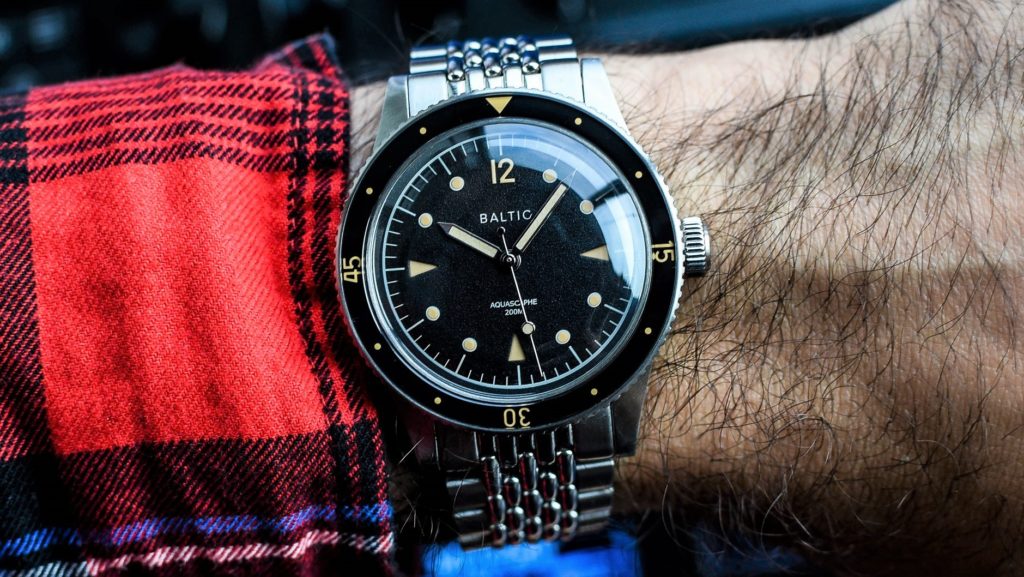
The Baltic Aquascaphe has a way of sticking around in a collection without ever demanding attention. It’s not trying to reinvent anything, but the way it pulls together proportions, finishing, and dial design gives it that “it” factor you only notice after living with it for a while.
The dial does a lot of the heavy lifting here. The hybrid sandwich construction reveals a fully lumed layer beneath the cut-out indices, which adds depth without cluttering the layout. In low light, that design translates into a smooth, even glow that’s easy to read at a glance. The gilt accents are handled with restraint—they bring warmth without tipping into faux-vintage territory, and they pair naturally with the sapphire bezel insert. Depending on the light, the matte dial shifts enough to keep things from feeling flat over long stretches of wear. The pencil-style hands are cleanly shaped, proportioned well, and remain easy to follow at a glance, while the lollipop second hand extends neatly out to the chapter ring. With minimal text on the dial, everything comes together in a way that feels deliberate and well-balanced.
On the wrist, the Aquascaphe feels more refined than its dimensions might suggest. The case sits just over 12mm thick, which made it easy to wear under a sleeve, and the 47mm lug-to-lug kept it planted without overhang. There’s a reassuring weight to it, but nothing that ever felt cumbersome during daily use. The mostly brushed surfaces helped hide small signs of wear, which we appreciated after a few weeks of regular rotation. The crown has a subtle texture that makes gripping and adjusting it easier than expected, especially when unscrewing it. Paired with the double-domed sapphire and 200 meters of water resistance, it’s the watch you end up wearing without second-guessing where you’re headed that day.
The bracelet adds to that easygoing experience. The beads-of-rice design conforms naturally to the wrist, and the taper keeps it from feeling bulky at the clasp. Over a full day, it remained comfortable without creating pressure points, and the mix of polished beads with brushed outer links struck a nice visual balance. Quick-release spring bars made switching to the Tropic-style rubber strap straightforward, further leaning into the watch’s vintage character. Inside, the Miyota 9039 keeps things simple and reliable. The two-position crown avoids unnecessary steps, and during our review, it ran smoothly at 28,800 vph with a consistent beat and a practical 42-hour power reserve.
Pros:
- The hybrid sandwich dial adds depth and delivers strong, even lume in low light.
- Slim case profile wears comfortably and slips easily under sleeves.
- The beads-of-rice bracelet is flexible, well-tapered, and easy to wear all day.
- Gilt accents feel warm and restrained rather than overdone.
- Reliable Miyota 9039 movement keeps things simple and consistent.
Cons:
- Brushed case finish lacks contrast if you prefer more polished surfaces.
- No date function may feel limiting for everyday use.
Formex Field Automatic

| Price: | $795 (nylon strap) $945 (leather strap and deployant clasp) |
| Water Resistance: | 150m |
| Case Dimensions: | 41mm (diameter) x 47mm (lug-to-lug) x 10.6mm (thickness) |
| Lug Width: | 20mm |
| Movement: | Sellita SW200-1 Automatic |
The first thing we noticed about the Formex Field Automatic was how little it got in the way. Not in a boring sense, but in that rare, “just works” way where nothing feels overbuilt or underthought. The lightweight Grade 2 titanium case plays a big role in that. It keeps the watch easy to wear over long stretches, sitting flat and staying out of the way, whether you’re at a desk or moving through a more active day. Over time, the hardened surface held up well, resisting the light scuffs and fingerprints that usually show up quickly on bead-blasted finishes. With a sapphire crystal and 150 meters of water resistance, it felt natural to treat it as a watch you don’t have to doubt, regardless of what the day looks like.
The dial brings in a bit more personality once you spend time with it. Formex uses stamped numerals that look a little unconventional up close, but from a normal viewing distance, they settle into something easy to read and visually distinct. The stepped outer edge adds a subtle sense of depth without crowding the layout. Lume coverage is generous across the hands and markers using Old Radium Super-LumiNova. It’s not the brightest we’ve tested, but it stayed readable well into the evening. We spent most of our time with the charcoal dial, though the lineup offers a range of colors depending on how expressive you want things to feel. The syringe-style hands generally work well, though the sage green variant may fall short on contrast for some.
What ultimately makes a difference day to day is the strap system. The one-piece nylon strap felt secure and breathable when worn outdoors, and the tool-free spring bars made switching things up quick and straightforward. The optional leather strap pushes things further, combining soft leather with Formex’s carbon composite clasp. The lighter feel and fine adjustment made it noticeably more comfortable, and it’s the configuration we found ourselves going back to most often. Inside, the Sellita SW200-1 keeps things simple. It ran consistently during our time with it and stayed out of the way, which is what you’d hope for in a watch like this.
Pros:
- Lightweight titanium case stays comfortable and unobtrusive throughout the day.
- Unique stamped dial design adds character without sacrificing legibility.
- Carbon composite clasp offers excellent comfort and easy adjustment.
- Versatile strap system with quick, tool-free changes
- Reliable SW200-1 movement with consistent performance
Cons:
- Lume is solid but not the brightest in its category.
- The sage green dial option may lack contrast for some wearers.
Nodus Contrail GMT

| Price: | $825 |
| Water Resistance: | 200m |
| Case Dimensions: | 40.5mm (diameter) x 46.6mm (lug-to-lug) x 11.8mm (thickness) |
| Lug Width: | 20mm |
| Movement: | Miyota 9075 |
The Nodus Contrail GMT is one of those watches where everything clicks the moment you start interacting with it. Not just visually, but mechanically too. It feels like Nodus finally pulled together all the small improvements we’ve seen across earlier models into something more complete. The case sits at 40.5mm, but the real story is the thickness. At 11.8mm, it wears much slimmer than most watches using the Miyota 9075. On the wrist, it stays close and balanced, helped by the 46.6mm lug-to-lug and those twisted lugs that soften the overall footprint. It has a bit of heft, but it never felt bulky during our time reviewing it. The alternating brushed and polished finishes add enough contrast to keep it interesting without turning it flashy. The sapphire bezel insert and box crystal catch light in a way that gives the watch more presence than you’d expect from the specs alone.
Where the “it” factor shows up is in how usable everything feels. The bi-directional 24-hour bezel has a smooth 48-click action that makes quick adjustments easy without feeling loose. Tracking across multiple time zones turned out to be more intuitive than expected. Between the bezel, the internal 24-hour scale, and the main handset, reading three zones felt natural after a short adjustment period. The handset itself is bold and easy to distinguish, and the BGW9 lume is applied generously across markers, bezel numerals, and even the GMT hand. In low light, everything stayed readable without having to hunt for angles.
The Laguna dial adds another layer of personality. It carries a subtle sandy tone that shifts depending on light, paired with a roulette date wheel that ties the whole look together. Dial text is minimal, which keeps things from feeling crowded, though the internal 24-hour numerals could stand to be a bit larger if you’re checking them quickly. The bracelet and clasp setup reinforce that everyday usability. The H-link bracelet feels straightforward but solid, tapering from 20mm to 16mm. Some of us would have preferred a slightly sharper taper, but it never felt awkward in use. Sizing was simple thanks to screw links, and the NodeX clasp made it easy to fine-tune the fit throughout the day. It’s a bit chunky, but the convenience of on-the-fly adjustment outweighs that. The screw-down crown deserves a mention as well. It’s large, well-textured, and easy to operate, which made setting the watch and jumping the local hour hand feel smooth and controlled.
Inside, the Miyota 9075 “flyer” GMT movement does what you’d want here. Jumping the local hour hand feels precise rather than clunky, and during our time with it, accuracy stayed consistent. The roughly 42-hour power reserve fits naturally into a regular rotation. At this point, it’s hard to argue against this movement for an affordable GMT. It works. Add in 200 meters of water resistance and a solid overall build, and this becomes a watch you don’t have to think twice about wearing in different situations. It’s not perfect, but it’s one of the more complete packages we’ve handled from Nodus.
Pros:
- The slim profile makes it wear close and balanced.
- Smooth bi-directional bezel and intuitive multi-time-zone tracking
- Strong BGW9 lume across dial, bezel, and GMT hand
- NodeX clasp allows quick, easy micro-adjustments.
- Well-executed crown and flyer GMT function feels precise in use.
Cons:
- Internal 24-hour scale numerals could be larger to improve readability.
- Bracelet taper feels a bit conservative for some preferences.
- The clasp adds a slight amount of bulk compared to the rest of the watch.
Nodus x Raven TrailTrekker

| Price: | $875 |
| Water Resistance: | 200m |
| Case Dimensions: | 39.5mm (diameter) x 46.6mm (lug-to-lug) x 11.8mm (thickness) |
| Lug Width: | 20mm |
| Movement: | Miyota 9075 |
The Nodus x Raven TrailTrekker feels like a watch that knows what it wants to be. There’s no attempt to soften its edges or broaden its appeal. That clarity is what gives it its “it” factor. The 39.5mm case, finished in a muted grey DLC, immediately sets the tone. It avoids the overly dark, almost glossy look that black coatings can fall into. On the wrist, it comes across as purposeful and low-profile, with no polished surfaces to distract from its tool-first approach. The proportions keep it wearable across a range of wrist sizes, and with 200 meters of water resistance, a sapphire crystal, and a deeply knurled screw-down crown, it felt like a watch we could wear without hesitation on more active days.
The bezel is where things really start to click. The sand-colored Cerakote finish has a texture that stands out right away, and paired with the high-contrast 24-hour scale, it gives the watch a distinctly utilitarian feel. It almost feels like something issued rather than designed for a display case. In practice, tracking a second time zone was straightforward, and the fixed scale paired well with the flyer-style GMT movement. The dial continues that same approach. It carries the same sand tone and texture, matched with gunmetal hands and applied indices that keep everything cohesive. The yellow GMT hand adds a bit of contrast, and while it may not be for everyone, it makes quick time zone checks easier. The layout stays balanced, with the date moved to 6 o’clock and co-branding kept subtle enough not to interfere with legibility.
While reviewing the watch, comfort turned out better than expected for something that looks this rugged. The flat-link bracelet sits close to the wrist and tapers from 20mm down to 16mm, which helps reduce bulk at the clasp. It feels solid without becoming heavy, and we found ourselves sticking with it over the included nylon strap. The NodeX clasp is a highlight here. The on-the-fly adjustment became part of the daily routine, especially when wrist size shifted with temperature. It offers about 10mm of adjustment across multiple positions, and once you get used to it, it’s hard to go back to a standard clasp.
Inside, the Miyota 9075 flyer GMT movement ties everything together. Jumping the local hour hand felt smooth and precise, and during our review process, accuracy stayed within a few seconds of our reference time. The ability to adjust the hour hand independently also made date changes more intuitive when traveling. It’s still a relatively new movement, so we’re watching long-term performance, but early impressions have been strong. The engraved caseback adds a final touch, with a caravan motif that ties into the watch’s theme of travel and resilience without feeling overdone.
Pros:
- DLC case and Cerakote bezel create a cohesive, rugged tool-watch aesthetic.
- The flyer GMT movement makes time zone tracking simple and practical.
- Strong bracelet taper and NodeX clasp improve daily comfort and fit.
- Clean, legible dial despite dual branding and added GMT functionality
- Screw-down crown and 200m water resistance support real-world use.
Cons:
- The yellow GMT hand may not appeal if you prefer a more subdued look.
- Lume is solid but not especially bright compared to top performers.
Farer World Timer Roché II

| Price: | $1,695 (leather strap) $1,865 (stainless steel bracelet) |
| Water Resistance: | 100m |
| Case Dimensions: | 39mm (diameter) x 45mm (lug-to-lug) x 11mm (thickness) |
| Lug Width: | 20mm |
| Movement: | Sellita SW330-1 Elaboré |
The Farer World Timer Roché II stands out because it doesn’t feel like a complication-first watch. It feels like something you can actually live with day to day, and the world-time function happens to be part of the experience. That’s a big part of its “it” factor. The dial pulls you in right away. The midnight-blue surface carries a textured pattern that plays nicely with light, making the rotating 24-city ring easier to follow than expected. There’s a lot going on, but it stays readable. The lume is generous across the hands, markers, and inner bezel, which, at first, feels a bit dramatic but proved useful during late nights and early travel days. The updated alpha hands are sharp and easy to track, and the raised markers add depth without overcrowding the layout.
What keeps it from feeling like a novelty is how it wears. The 39mm case hits a comfortable middle ground and sits flat across a range of wrist sizes. During our extended time with it, whether at a desk, out for errands, or moving through an airport, it stayed balanced and didn’t feel bulky under a sleeve. The 100 meters of water resistance adds a level of reassurance you don’t always get with more complicated designs, letting you treat it like a regular watch rather than something you need to handle with care. The rotating 24-hour disc turned out more intuitive than we expected, making it easy to check a second time zone without overthinking it.
The movement and strap round things out, reinforcing its usability. The modified Sellita SW330 ran steadily during testing, and the extended 50-hour power reserve gave us a bit more flexibility when rotating watches throughout the week. The St. Venere leather strap felt comfortable from the start and held securely, even on smaller wrists, and the quick-release setup made switching to the bracelet option straightforward if you wanted a bit more heft. It’s not the most minimal design, and the inner bezel takes a moment to get used to. Still, once you settle into it, the Roché II becomes less about the complication and more about how naturally it fits into daily wear.
Pros:
- Textured blue dial keeps the city ring legible while adding visual depth.
- Strong lume across hands, markers, and inner bezel improves low-light usability.
- Modified SW330 movement delivers stable performance with a useful 50-hour reserve.
- Comfortable leather strap with easy quick-release changes
Cons:
- Price sits higher than many comparable microbrand options.
- Inner bezel layout takes a bit of time to learn.
- The dial may feel busy if you prefer a more minimal look.
Serica 5303-2

| Price: | $1,720 – $1,950 |
| Water Resistance: | 300m |
| Case Dimensions: | 39mm (diameter) x 46mm (lug-to-lug) x 12.2mm (thickness) |
| Lug Width: | 20mm |
| Movement: | Soprod Newton (current model has Soprod M100) |
The Serica 5303-2 feels less like a reinterpretation and more like something that could have existed decades ago. That’s where its “it” factor comes from. It fully commits to its design rather than trying to modernize it. The 39mm case, 46mm lug-to-lug, and 12.2mm thickness land in a very wearable range. On the wrist, it sits balanced and never feels bulky, even over long days. The proportions between the bezel, mid-case, and caseback help mask the height, so it wears slimmer than expected. It’s easy to forget it’s there until you catch a detail that pulls you back in.
The dial is where things get more interesting. It uses a geometric layout that feels familiar but is executed in a different way. Everything is pad-printed, which gives it a slightly rugged texture rather than a glossy finish. The markers sit closer to the center and are framed to tie them into the minute track, keeping the layout cohesive. The metallic silver dial often reads as flat white, creating a strong contrast with the bezel and leaning into a retro-futuristic look. There’s almost no branding, but it doesn’t feel like anything is missing. The lume is excellent. It stays readable in low light without effort.
The bezel adds real utility. The black ceramic outer ring handles dive timing, while the inner steel 12-hour scale lets you track a second time zone. In practice, that flexibility proved more useful than expected. The 120-click action feels solid with no play. Case finishing balances brushed surfaces with polished chamfers along the lugs, and the transitions are crisp. The large 8mm crown is easy to grip and operate, even without guards, which adds to the vintage feel without hurting usability.
The mesh bracelet is where opinions may split. The integrated design looks great, but it isn’t the most practical. Parts of the clasp can feel sharp, and there’s no safety mechanism if it catches on something. The upside is versatility. With a 20mm lug width, it works well on almost any strap. Inside, earlier models, including this one, used the Soprod Newton, which had occasional quirks with crown engagement and hacking. In our personal experience, those showed up briefly but didn’t affect daily use. Over time, the movement proved reliable, and newer models with the Soprod M100 address those concerns while keeping similar performance.
Pros:
- Balanced proportions that wear slimmer than the specs suggest
- Distinctive dial with strong legibility and excellent lume
- Dual-scale bezel adds practical everyday flexibility.
- Crisp case finishing with thoughtful vintage-inspired details
Cons:
- The mesh bracelet can feel less practical and slightly sharp at the clasp.
- Earlier movement versions had minor crown and hacking quirks.
- Hand finishing feels slightly less refined than the rest of the watch.
Monta Atlas

| Price: | $1950 |
| Water Resistance: | 150m |
| Case Dimensions: | 38.5mm (diameter) x 47mm (lug-to-lug) x 10.2mm (thickness) |
| Lug Width: | 20mm |
| Movement: | MONTA Caliber M-23 (Mechanical) |
The Monta Atlas doesn’t rely on bold design or standout complications to get your attention. What gives it that “it” factor is how quickly it settles into everyday wear without friction. From the moment it’s on the wrist, the proportions feel dialed in. The 38.5mm case hits a comfortable middle ground, especially for those of us who usually hesitate around larger sizes, and the thickness of just over 10mm keeps it sitting low and balanced throughout the day. Whether we wore it during work hours, while traveling, or running errands, it stayed out of the way in the best sense: never bulky, never attention-seeking.
The dial follows that same restrained approach. It manages to display a second time zone alongside local time without feeling crowded or overly styled. Everything remains clean and symmetrical, and during our time with it, the extra time zone proved pretty useful for tracking work or family in another region. At the same time, it doesn’t dominate the dial when you don’t need it. The Atlas avoids the exaggerated design cues that sometimes come with travel-focused watches, which makes it easier to live with day to day.
Where the watch stands apart is in the finishing and overall build. The mix of brushed and polished surfaces is handled cleanly, giving it a level of refinement that becomes more apparent the more you handle it. The case includes a screw-down crown and 150 meters of water resistance, which meant we didn’t have to think twice about wearing it through bad weather, travel days, or even the occasional swim. It feels durable without crossing into overbuilt territory.
The bracelet and clasp are worth calling out on their own. The bracelet articulates smoothly across the wrist, and the clasp closes with a precise, secure feel that you notice every time you put it on. Inside, the MONTA Caliber M-23, based on the Sellita SW330, is regulated in-house, and our testing showed consistent accuracy of -5 to +5 seconds per day. That level of consistency added confidence over longer stretches of wear. The only element that felt a tad out of place was the exhibition caseback. While it offers a view of the movement, the visual payoff doesn’t quite match the rest of the watch.
Pros:
- Well-balanced 38.5mm case with a slim profile that wears comfortably all day.
- Clean dial layout keeps the second time zone readable without clutter.
- Regulated movement delivers consistent accuracy in daily use.
- High-quality bracelet and clasp with smooth articulation and a secure feel
- 150 meters of water resistance supports real-world versatility.
Cons:
- The second time zone function may feel unnecessary if you rarely use it.
- Exhibition caseback doesn’t offer much visual reward.
Monta Skyquest GMT

| Price: | $2,435 |
| Water Resistance: | 300m |
| Case Dimensions: | 40.7mm (diameter) x 47.4mm (lug-to-lug) x 11.8mm (thickness) |
| Lug Width: | 20mm |
| Movement: | Monta Caliber M-23 (Sellita SW330-2 base) |
The Monta Skyquest GMT doesn’t try to stand out in obvious ways, which is why it sticks. Its “it” factor comes from how composed everything feels once it’s on the wrist. The proportions land in a place that works across a wide range of wrist sizes, and despite the specs, it wears more compact than expected. A lot of that comes down to how the dial and 24-hour bezel are balanced. The larger bezel markings draw your eye outward, which makes the watch feel calmer and less crowded during everyday wear.
The GMT functionality is integrated in a way that feels natural rather than forced. Tracking a second time zone is straightforward thanks to the clear bezel and uncluttered dial layout. In daily use, the bezel itself proved easy to handle: the grip is solid, and the action is firm and predictable, even with cold hands or gloves. The dial leans into clarity, with applied markers and well-sized hands that make quick time checks easy. During our hands-on review, BGW9 Swiss Super-LumiNova provided strong visibility in low light, holding up well through the evening without fading too quickly. Some of the earlier design quirks have been refined away, which results in a cleaner look, though longtime fans might miss some of that character.
Where the Skyquest starts to separate itself is in the build quality. The bracelet feels thoughtfully engineered, with screw links and a milled clasp that closes with a precise, secure click. The tool-free micro-adjustment system proved more useful than expected, especially on long days when wrist size fluctuates. It’s one of those features that becomes part of your routine rather than something you forget is there. Comfort remained consistent throughout extended wear, making it easy to keep in rotation.
Inside, Monta’s Caliber M-23, based on the Sellita SW330, keeps things predictable. During our time with it, accuracy stayed consistent, and the roughly 55-hour power reserve gave us some flexibility when rotating watches. Servicing down the line should also be straightforward thanks to the familiar movement architecture. It’s not trying to reinvent anything mechanically, but everything works together in a way that feels considered and reliable.
Pros:
- Case proportions wear smaller and more balanced than expected.
- Firm, easy-to-grip bezel makes tracking a second time zone simple.
- Clean dial layout improves legibility in everyday use.
- High-quality bracelet with practical tool-free micro-adjustment
- Reliable GMT movement with a useful 55-hour power reserve
Cons:
- Cleaner redesign removes some of the original character.
- The screw-down crown could be slightly larger to make handling easier.
- Pricing puts it up against more established competitors.
Atelier Wen Perception

| Price: | $3,200 – $3,600 |
| Water Resistance: | 100m |
| Case Dimensions: | 40mm (diameter) x 47mm (lug-to-lug) x 9.4mm (thickness) |
| Lug Width: | Integrated bracelet, starts 22mm at the case, tapering down to about 18mm at the clasp |
| Movement: | Dandong SL1588 Automatic |
The Atelier Wen Perception stands out because it doesn’t borrow from the usual playbook. There’s no reliance on vintage cues or familiar Swiss design language. Instead, it presents something that feels distinct right away. That clear sense of identity is what gives it its “it” factor. The dial is where that comes through most strongly. The hand-guilloché patterns draw from traditional Chinese architectural motifs, creating a layered surface that feels detailed but not overwhelming. On the blue version we spent time with, the dial shifted constantly depending on the light: muted and metallic indoors, then noticeably more vibrant outdoors. Even with that complexity, it remained easy to read, which kept it grounded as a daily watch rather than something to admire.
The case and finishing reinforce that impression. Made from 904L steel, the watch feels more refined than its modest footprint might suggest. The 40mm case, at 9.4mm thick, made it comfortable over long stretches, and the alternating brushed and polished surfaces, along with sharp chamfers on the bezel and bracelet, added depth that became more apparent in natural light. The engraved stone lion on the caseback felt like a thoughtful detail rather than decoration for its own sake. At the same time, practical features like a screw-down crown and 100 meters of water resistance meant it didn’t need to be treated delicately.
The bracelet slightly shifts the wearing experience. Once sized, the effective lug-to-lug measures closer to 52mm, which you’ll notice if you’re sensitive to wrist coverage. Even so, the articulation stays smooth and comfortable throughout the day. And, as mentioned in our dedicated review, the toolless micro-adjust clasp turned out to be one of the more useful features, making it easy to fine-tune the fit as your wrist changes with temperature.
Inside, the modified Dandong SL1588 automatic movement ran about +10 seconds per day during our hands-on review and offered a power reserve of around 40 hours. It doesn’t hack, which will make some heads turn at this level, but winding and setting remained smooth enough in daily use.
Pros:
- 904L steel case with refined finishing that feels above its price point
- Hand-guilloché dial brings depth and a distinct design identity.
- Toolless micro-adjust clasp makes daily fit adjustments easy.
Cons:
- The bracelet increases the effective lug-to-lug, which may feel large on some wrists.
- Movement lacks hacking seconds.
Please let us know your thoughts on these picks in the comments below! Also, if there if there is a watch that you feel should be included, please share that as well. We’ll do our best to get it in for a hands-on review and potential inclusion here in this list.

Co-Founder and Senior Editor
Kaz has been collecting watches since 2015, but he’s been fascinated by product design, the Collector’s psychology, and brand marketing his whole life. While sharing the same strong fondness for all things horologically-affordable as Mike (his TBWS partner in crime), Kaz’s collection niche is also focused on vintage Soviet watches as well as watches that feature a unique, but well-designed quirk or visual hook.