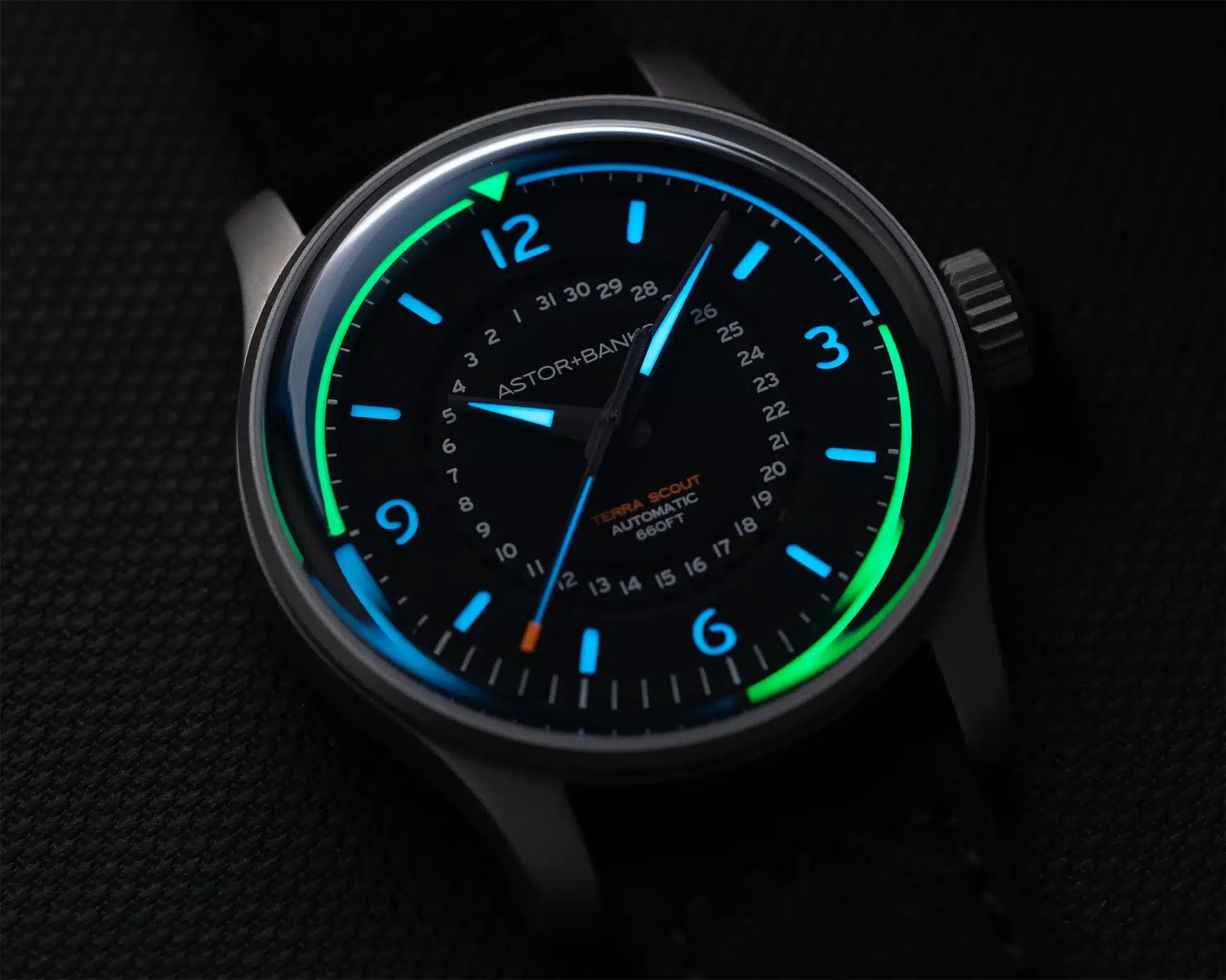
Astor and Banks has introduced a new automatic field watch called the Terra Scout, expanding its catalog with a design that steps away from traditional military aesthetics while staying within the functional expectations of the category. Priced under $1,000 and offered across four references at launch, the Terra Scout arrives as a new chapter for a brand that has refined its design language over the past few years.

I’ve generally enjoyed what Astor and Banks has been doing for a while now. We reviewed one of their divers a few years back, and even then there was a clear sense that the brand was more interested in thoughtful design decisions than in chasing trends or leaning too hard on vintage formulas.
Field watches tend to operate within a fairly defined visual framework, which makes meaningful deviation difficult without sacrificing legibility or purpose. The Terra Scout works within that constraint by reworking familiar elements instead of defaulting to expected ones. There are no syringe hands or printed military time scales. Instead, Astor and Banks uses blunted dauphine hands with partially lumed inlays, paired with a rotating date indicator that takes the place of the inner 24-hour track commonly associated with the genre.
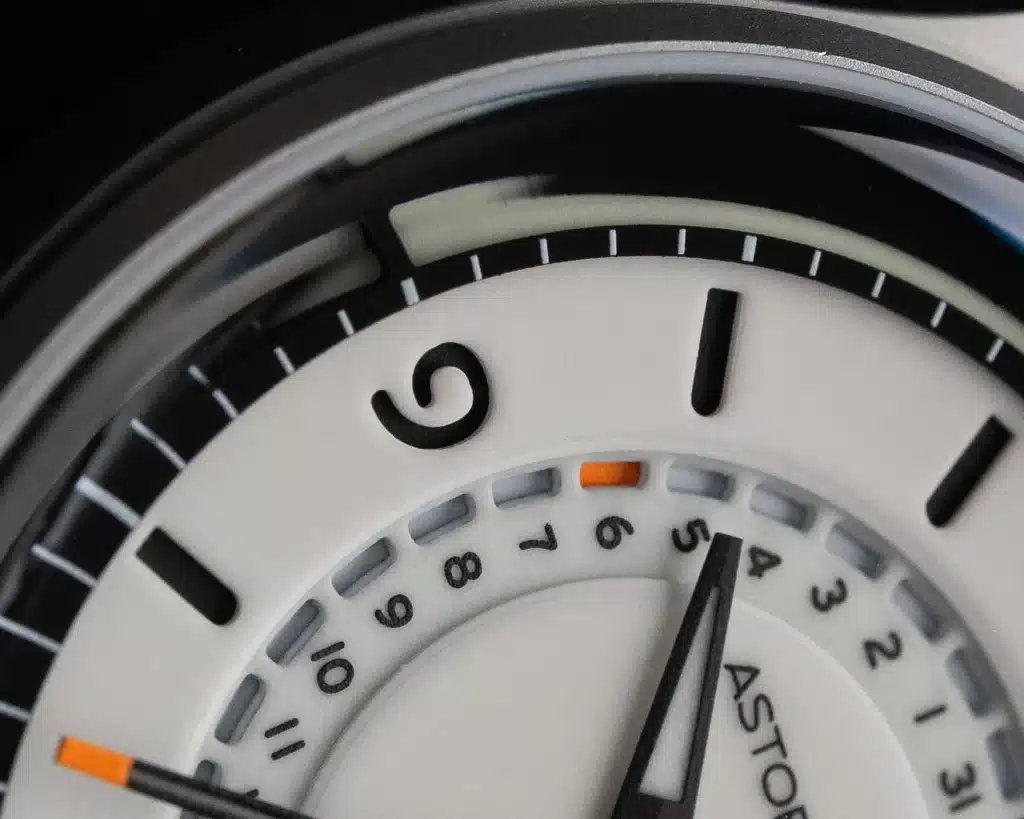
The dial architecture is where most of the differentiation happens. A hybrid sandwich-and-sector construction introduces depth while keeping the overall palette restrained and matte. The upper layer features a central sector and an hour track with cut-out markers, combining bullet-style indices with stencil numerals at the cardinal points. Beneath that, a lower plate carries a dash-style seconds track along the outer perimeter, adding contrast and structure without clutter.
Rather than isolating the date in a window, the Terra Scout integrates it into the dial layout. The date track sits recessed between the central sector and the hour track, with a white date wheel underneath and a rotating orange dash acting as the indicator. It reads as part of the dial system rather than an interruption, which feels very much in line with the brand’s recent design approach.

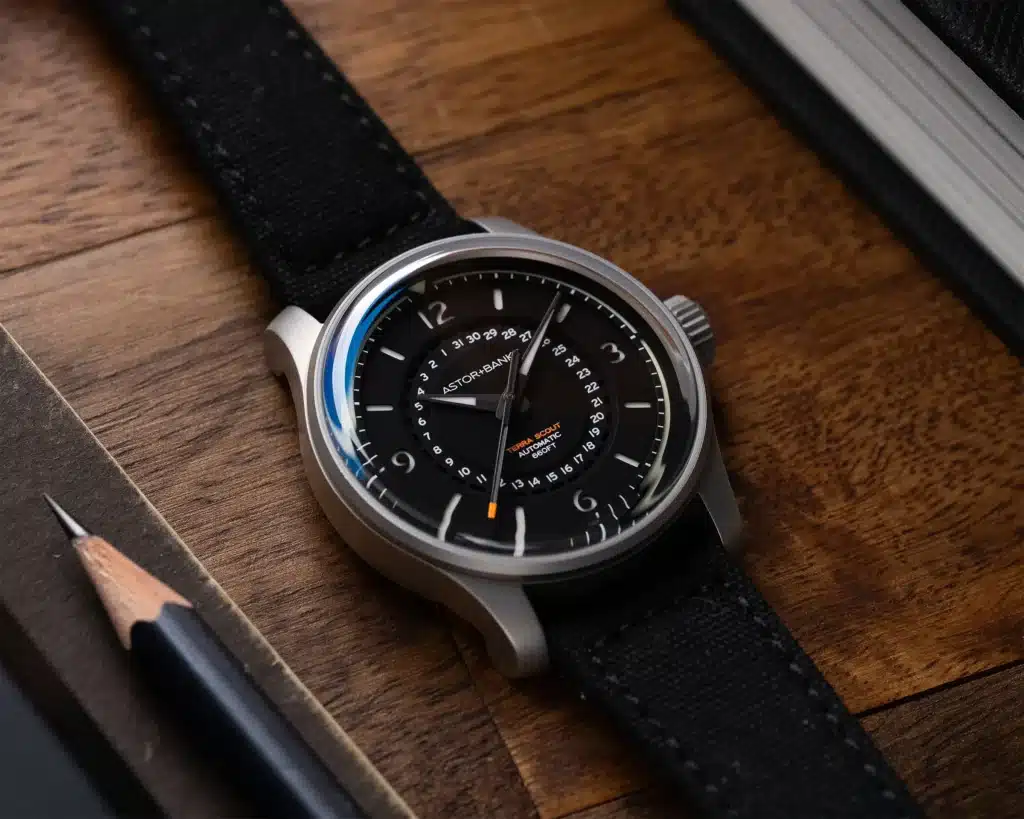
The Terra Scout launches in four 38.5mm references. Two are housed in sandblasted steel cases with either a black or white dial. Two additional versions use coated steel cases, again offered in black or white dial configurations. The seconds hand treatment varies across the lineup. The sandblasted steel models use matte black seconds hands with a neon orange tip, while the coated case references feature fully neon orange seconds hands.
Between the options, the white dial paired with the khaki Cerakote-coated case stands out to me the most. The contrast feels intentional rather than decorative, and the color combination works well with the layered dial construction. It also happens to be the only limited edition in the debut collection, dubbed Desert Sand and capped at 100 units. That reference ships on the same black strap setup as the black dial versions.
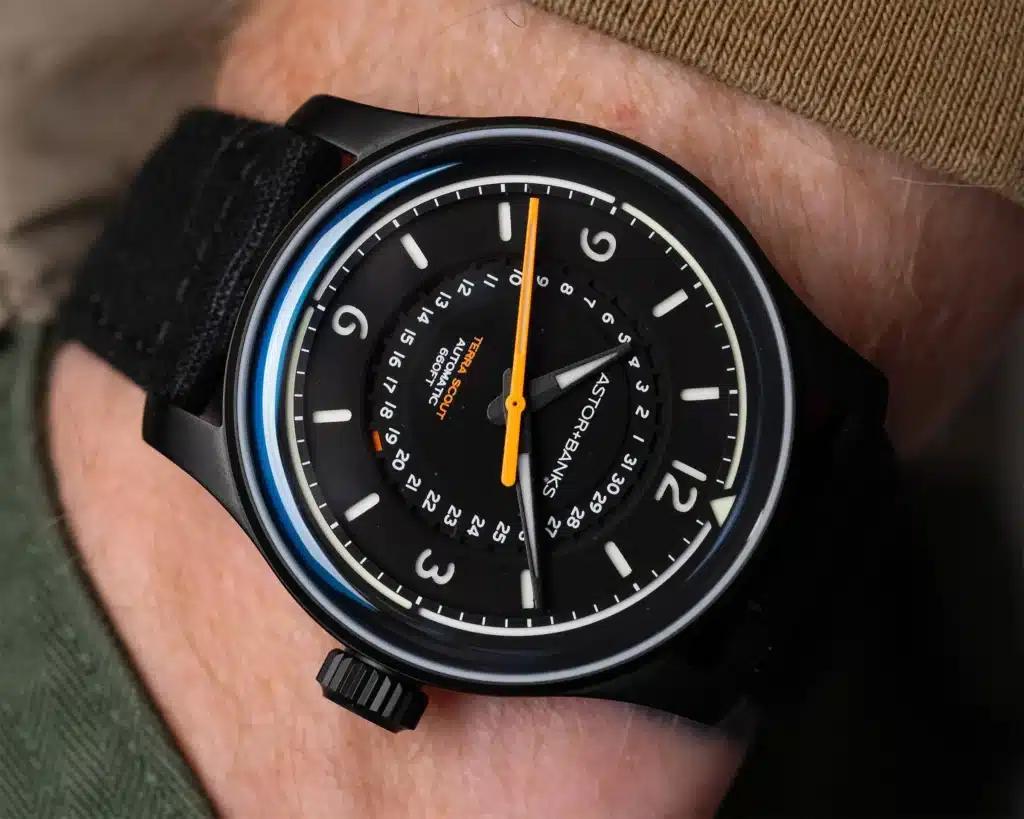
The black dials keep things more restrained, with white detailing throughout and “Terra Scout” printed in orange beneath the hands. The white dials introduce additional contrast through a black outer seconds track, which adds visual separation while preserving the same overall layout.
All black dial references are supplied with a black canvas strap and an additional FKM rubber strap, both secured with a pin buckle. One of the coated case options is finished in matte black DLC and paired with a solid orange seconds hand, creating a cohesive, monochromatic look that leans toward a more industrial design language.
Lume plays a central role in the Terra Scout’s identity. Astor and Banks uses Super-LumiNova to create an alternating blue and green luminous ring around the outer edge of the dial, topped by a green triangle at 12 o’clock. On black dials, the hour track glows blue. On white dials, the entire dial surface is lumed, allowing the raised hour track to stand out while keeping the date track visible in low light. All hands glow blue, including the fully orange seconds hands.
Each reference is fitted with a box-shaped sapphire crystal with an internal anti-reflective coating. Power comes from the La Joux-Perret G100 automatic movement, fitted with a customized date wheel. The movement operates at 4Hz, offers a 68 hour power reserve, and is regulated by Astor and Banks to an accuracy of plus or minus eight seconds per day.

The Terra Scout is available now directly from the brand. Three of the four references are offered at a temporary launch price of $875, reduced from $995. The limited edition Desert Sand Cerakote model is priced at $975 during the debut period, down from $1,195, with delivery estimated for March.
Taken as a whole, the Terra Scout feels like a confident step forward rather than a category experiment. I’ve liked the direction Astor and Banks has been heading in for a while, and this release reinforces that impression. More than anything, it makes me curious to see where the brand chooses to go next.

Co-Founder & Senior Editor
Michael Peñate is an American writer, photographer, and podcaster based in Seattle, Washington. His work typically focuses on the passage of time and the tools we use to connect with that very journey. From aviation to music and travel, his interests span a multitude of disciplines that often intersect with the world of watches – and the obsessive culture behind collecting them.