
This one caught my eye pretty quickly yesterday. Hamilton and Air Zermatt have been working together since 2011, and the latest watch celebrating that relationship takes a slightly different approach to the familiar pilot’s watch formula. The new Khaki Pilot GMT Air Zermatt combines a forged-carbon case, automatic GMT movement, and internal rotating city ring. It’s also priced at the higher end of what I’d typically expect from Hamilton’s aviation collection.

Air Zermatt operates helicopter rescue missions in the Swiss Alps, and Hamilton has produced several watches tied to the organization over the years. Some of those earlier collaborations featured fairly elaborate dial layouts. This latest release feels a little more restrained, at least from the front. I think that’s a welcome change, especially when there’s already quite a bit of information to accommodate on a GMT watch.

The 42mm case is made from forged carbon, giving it an irregular black-and-gray pattern that’s noticeably different from the steel cases we’re accustomed to seeing from Hamilton. I like the material choice here. Carbon composites have an established relationship with aviation, and the marbled appearance works reasonably well with the watch’s black dial and red accents. It’s also an uncommon material for Hamilton, which gives this release some additional interest. For me, though, the dial is the main attraction.
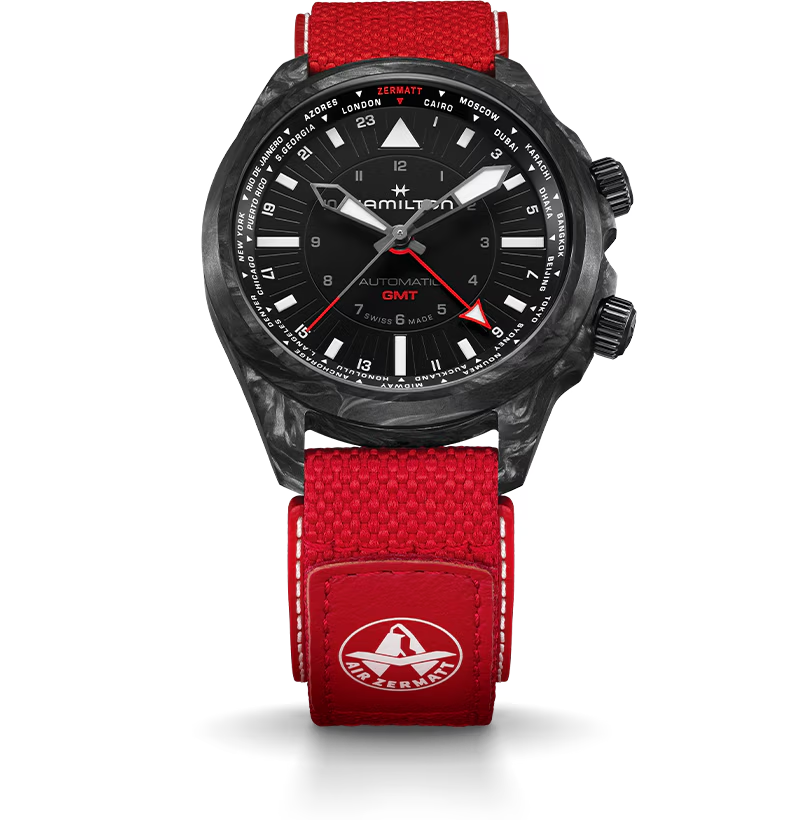
Hamilton has incorporated a 24-hour GMT scale alongside an internal rotating bezel printed with international city names. Zermatt appears in red, matching the GMT hand, seconds-hand tip, and several smaller dial details. The city ring is adjusted using a separate crown at 2 o’clock, while the primary crown sits at 4 o’clock.
I think the combination works visually, although there’s certainly plenty to take in. The skeletonized hands, large pilot-style triangle at 12, and multiple hour scales all compete for space. Still, the layout appears reasonably organized in the supplied images. I’m particularly interested in how easily the GMT information can be read once the watch is actually on the wrist.

Inside is Hamilton’s H-14 automatic movement, which offers an 80-hour power reserve and an independently adjustable local hour hand. That’s a useful arrangement for travel, since the local time can be changed without having to reset the reference time. The watch also features a sapphire crystal, 100 meters of water resistance, and an exhibition caseback carrying the Air Zermatt logo.
Hamilton includes two straps: a red textile option with a Velcro closure and a black leather alternative. Personally, I’d probably gravitate toward the leather. The red strap certainly reinforces the Air Zermatt connection, although the carbon case and dial already provide enough visual interest for my taste.

Then there’s the price. At $1,725, this is an expensive Hamilton, and I suspect that will give some collectors pause. In my opinion, the forged-carbon construction, GMT movement, and rotating city ring help explain the asking price. Whether those features justify it will depend heavily on how much someone appreciates this particular combination.

My take is that Hamilton has done a decent job giving the Air Zermatt collaboration its own identity. The aviation connection feels appropriate, and the GMT functionality gives the design a practical purpose. I’d still want to see the case in person and spend some time navigating the city ring before drawing stronger conclusions. For now, that’s the part of this release I’m most curious about.

Co-Founder & Senior Editor
Michael Peñate is an American writer, photographer, and podcaster based in Seattle, Washington. His work typically focuses on the passage of time and the tools we use to connect with that very journey. From aviation to music and travel, his interests span a multitude of disciplines that often intersect with the world of watches – and the obsessive culture behind collecting them.