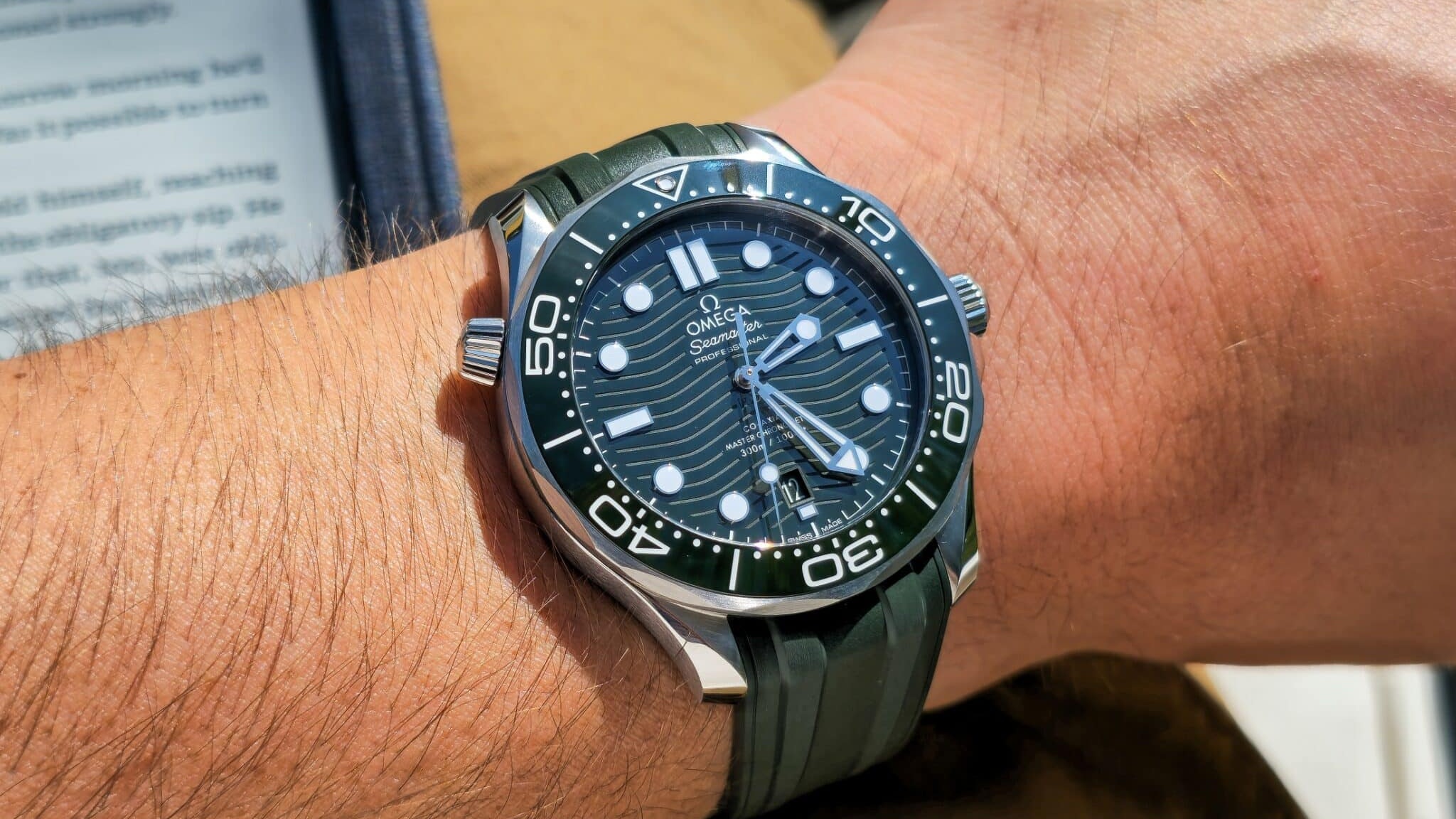
There’s something interesting about finding a $270 Timex with a wave-patterned dial sitting across from an Omega Seamaster Diver 300M that costs more than $6,000. The similarities are immediately apparent, but these are two very different watches once we look beyond the familiar diving aesthetic. Omega offers an exceptionally finished Swiss automatic with a ceramic dial, a METAS-certified movement, and decades of recognizable design behind it. Timex approaches the category with a battery-powered quartz movement, substantial water resistance, and a surprisingly impressive collection of materials for the money. Neither watch needs to apologize for its approach, but the price difference raises an obvious question. How much of the Seamaster experience can Timex realistically deliver at a fraction of the cost?
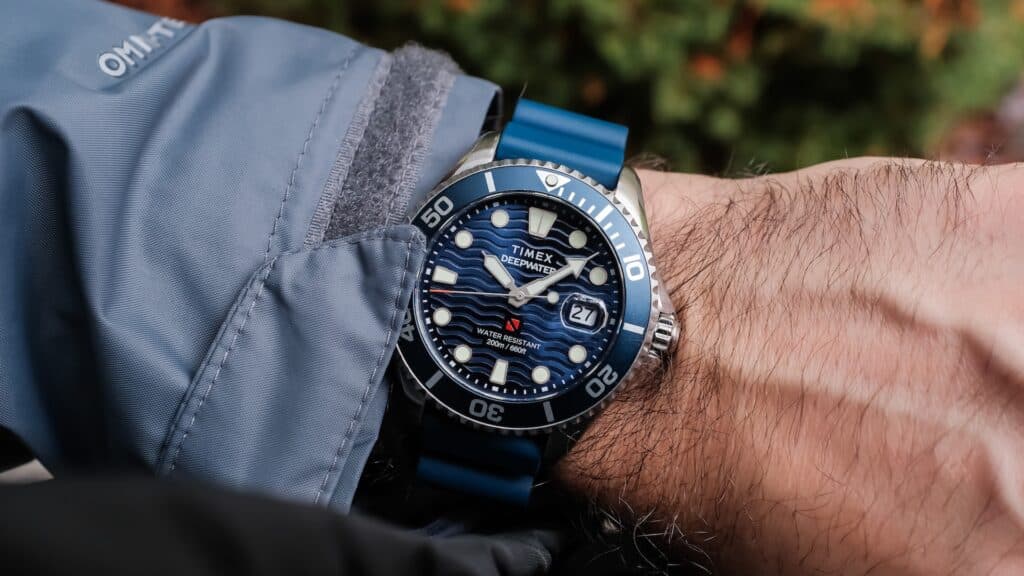
We’ve reviewed both watches hands-on, and the experiences left us with some unexpected observations. The green Omega Seamaster impressed us with its case finishing, crystal clarity, and remarkably comfortable proportions, although its bezel operation wasn’t nearly as satisfying as we’d hoped. The Timex Deepwater Meridian 200 proved more substantial and better executed than we expected from an affordable quartz diver, with particularly convincing crown and bezel action. Drawing on our Omega Seamaster Diver 300M review and Timex Deepwater Meridian 200 review, we’re comparing the details that matter most when wearing these watches and considering whether Omega’s additional refinement justifies such an enormous difference in price.
Overview and Identity
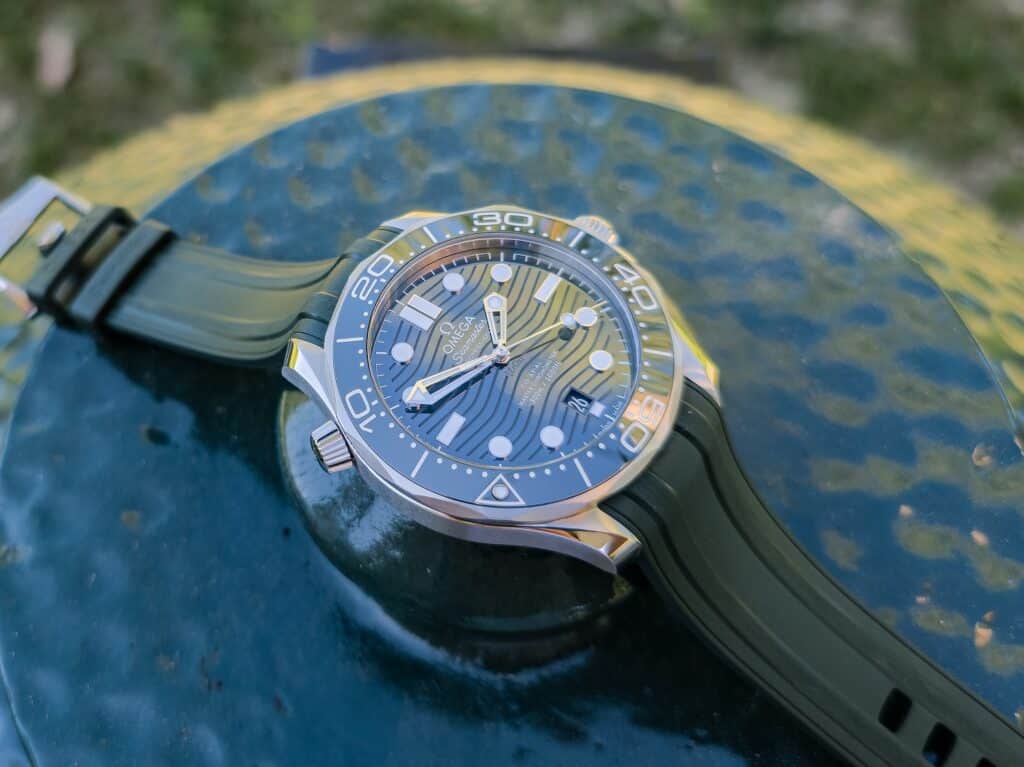
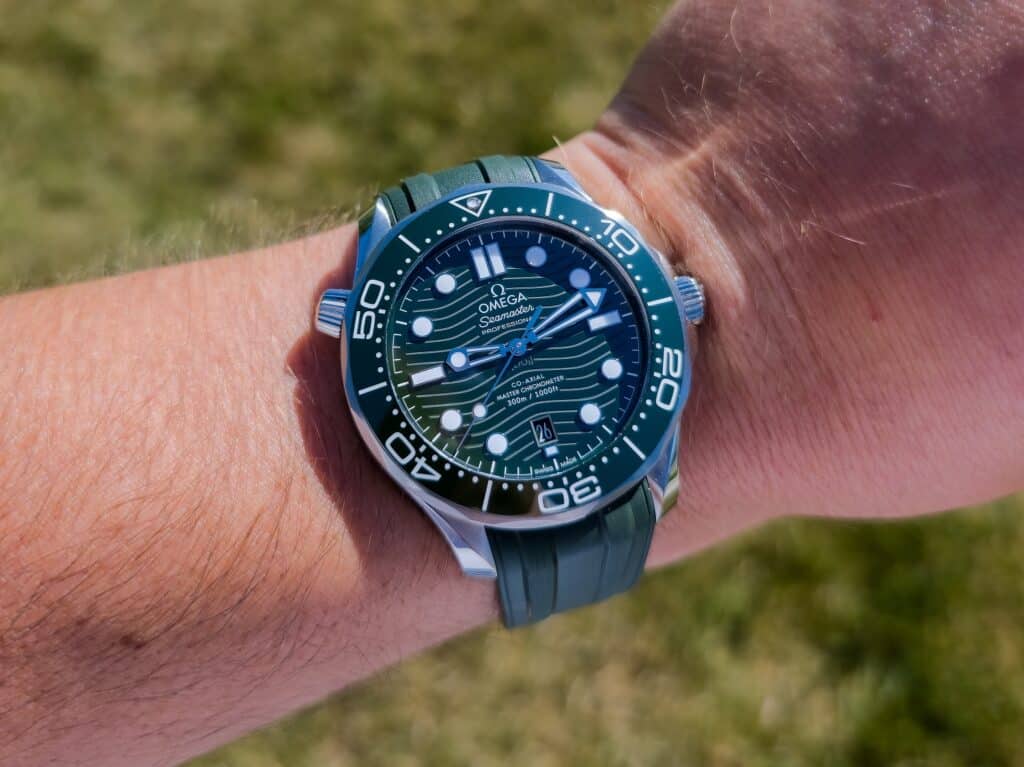
Few modern dive watches have developed an identity as recognizable as the Omega Seamaster Diver 300M. The collection has evolved through numerous generations, with its association with James Bond helping introduce the design to audiences well beyond traditional watch enthusiasts. Our reviewed green-dial model belongs to the modern generation powered by the Co-Axial Master Chronometer Caliber 8800, combining the familiar scalloped bezel, skeletonized hands, helium escape valve, and wave-patterned dial with contemporary materials and movement engineering. There’s no mistaking it for a conventional Submariner-inspired diver, and we appreciate that Omega has maintained those distinctive characteristics. The Seamaster occupies an interesting position in the market, offering much of the refinement associated with considerably more expensive watches while retaining a personality that feels entirely its own.
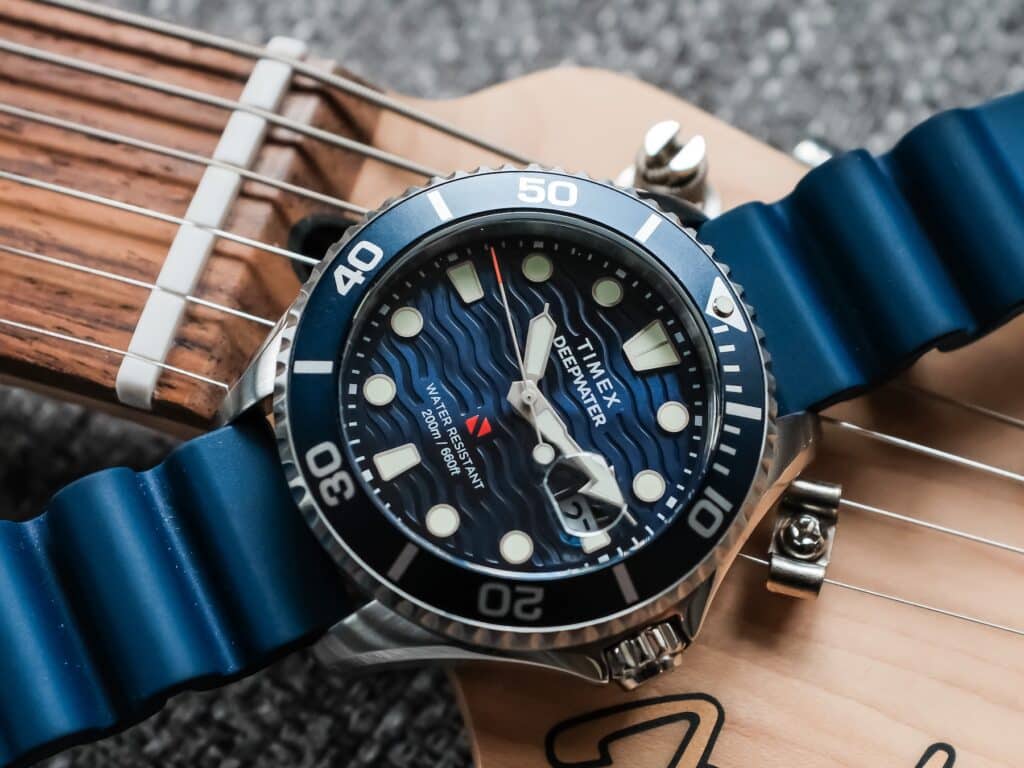
Timex arrived at the Deepwater Meridian 200 from a very different direction. Introduced as part of the brand’s more serious Deepwater collection, the TW2W81500 represents a departure from the casual everyday watches and heritage-inspired reissues many collectors associate with Timex. Its 44mm stainless steel case, sapphire crystal, screw-down crown, and 200-meter water-resistance rating signal a more ambitious approach to the affordable dive-watch category. The blue wave-patterned dial also gives the watch a recognizable connection to established designs, including the Seamaster, without feeling like a direct reproduction. We were initially uncertain how convincing the package would be, particularly given the low price. After spending time with it, however, the Meridian felt like a deliberate attempt to produce a capable modern diver rather than another inexpensive watch borrowing a familiar aesthetic.
Dial and Straps/Bracelets
The green ceramic dial is one of the strongest arguments for the Omega Seamaster, and photographs don’t quite capture how much character it has in person. Its laser-engraved wave pattern creates actual depth in the polished surface, with recessed channels contrasting against the glossy surrounding material. The shade of green also changes considerably depending on the lighting, moving from an almost military olive to a much brighter, more tropical color. We particularly appreciated that Omega matched the date disc to the dial rather than using a contrasting white window that would interrupt the composition. The skeletonized hands are another distinctive element, although their reduced luminous surface introduces a modest legibility compromise against the larger hour markers. Even with that criticism, the overall execution is exceptionally good. This is the sort of dial that rewards close inspection without losing the recognizable identity of the Seamaster.

Our reviewed Seamaster came on the matching green rubber strap, and we’d personally favor this configuration over the standard steel bracelet. We’ve never been particularly enthusiastic about Omega’s untapered Seamaster bracelet, which can feel heavier than its quality necessarily demands. The rubber alternative allows the case to take center stage while making the watch considerably more comfortable. Its surface finishing is unusually thoughtful, with subtle longitudinal brushing along the raised center sections and a well-executed stainless steel tang buckle. The material is soft and supple, although we’ve experienced modern FKM straps with a little more flexibility. We also found the adjustment holes spaced slightly farther apart than we’d prefer. Those are fairly minor criticisms, particularly when the finished package looks this cohesive. The green strap complements the ceramic dial beautifully and emphasizes the watch’s more polished interpretation of a modern diver.
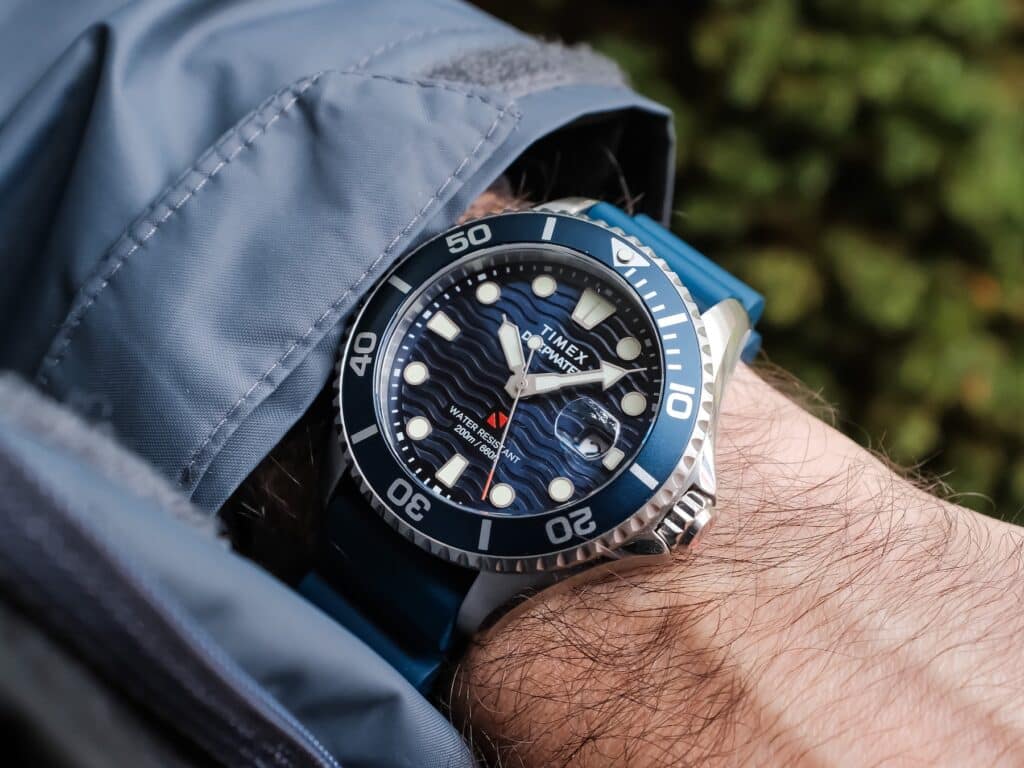
At a glance, the Timex Deepwater Meridian 200’s blue dial offers a familiar arrangement of applied markers, a wave pattern, and contrasting hands. Look a little closer, however, and there’s more personality than the price suggests. The sunburst finish introduces a range of blue tones, while the sculpted wave design adds visual interest without competing with the time display. White dial text and a small red diver’s flag provide additional contrast, giving the watch enough color variation to avoid looking flat. The date window sits at three o’clock beneath a magnifier, a feature that isn’t universally popular but proved reasonably well integrated during our review. We also appreciated the balance between the applied markers and the broader handset. The Omega’s ceramic dial is undoubtedly more sophisticated, but Timex has managed to deliver a convincing version of the wave-dial aesthetic without making the result feel excessively derivative.
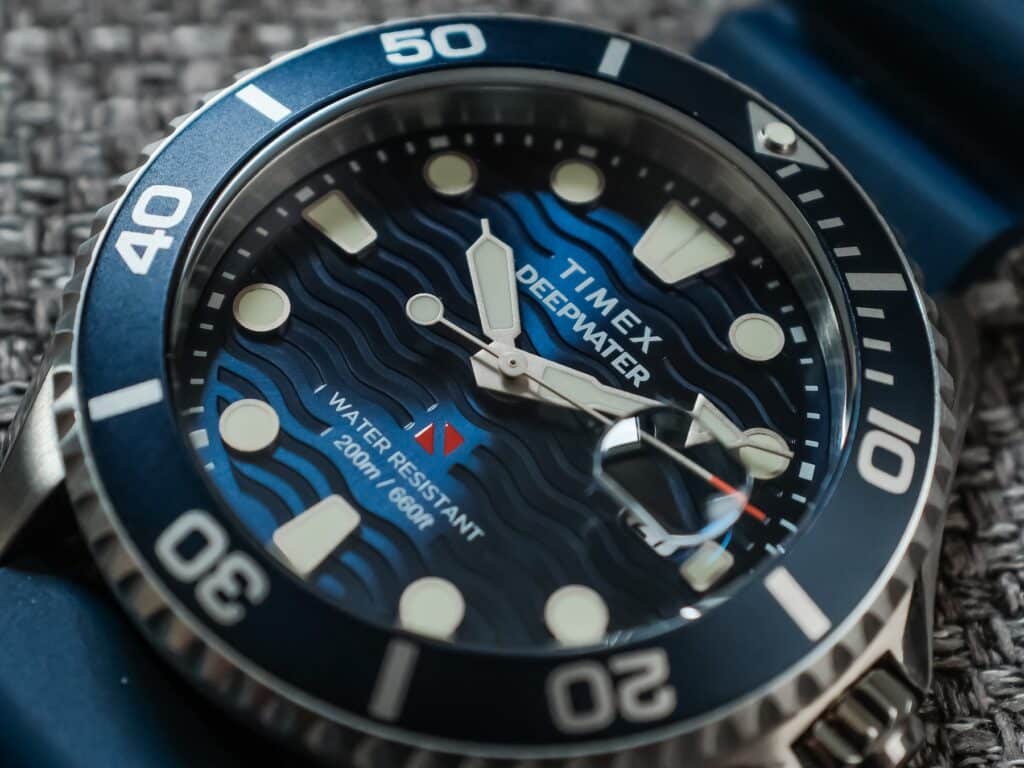
A blue synthetic rubber strap completes the Meridian’s substantial tool-watch appearance. The material feels soft and flexible, with perforations that help reduce the sense of having a large, solid band wrapped around the wrist. Quick-release spring bars also make changes straightforward for anyone who prefers a different arrangement. Unlike the Omega, whose strap finishing is almost decorative in its attention to detail, the Timex focuses on straightforward comfort and durability. That approach suits the watch’s personality, particularly because the 44mm case already provides plenty of visual presence. We found the overall wearing setup comfortable during our time with the Meridian, despite the watch being larger than many of the divers we’d ordinarily gravitate toward. There’s nothing especially elaborate about the strap, but it works with the case instead of making a substantial watch feel unnecessarily cumbersome.
Build Quality & Technical Approach
The differences become more interesting once we move beyond dial design. Omega concentrates on precision mechanical engineering, elaborate finishing, and materials that justify its place among premium Swiss dive watches. Timex delivers a more conventional quartz movement alongside the sort of practical construction we’d expect from a serious everyday diver. Both offer sapphire crystals, screw-down crowns, and substantial water resistance, but the details reveal different priorities. This is where we can begin separating features that genuinely change the wearing experience from those that primarily appeal to us as watch enthusiasts.
Movements
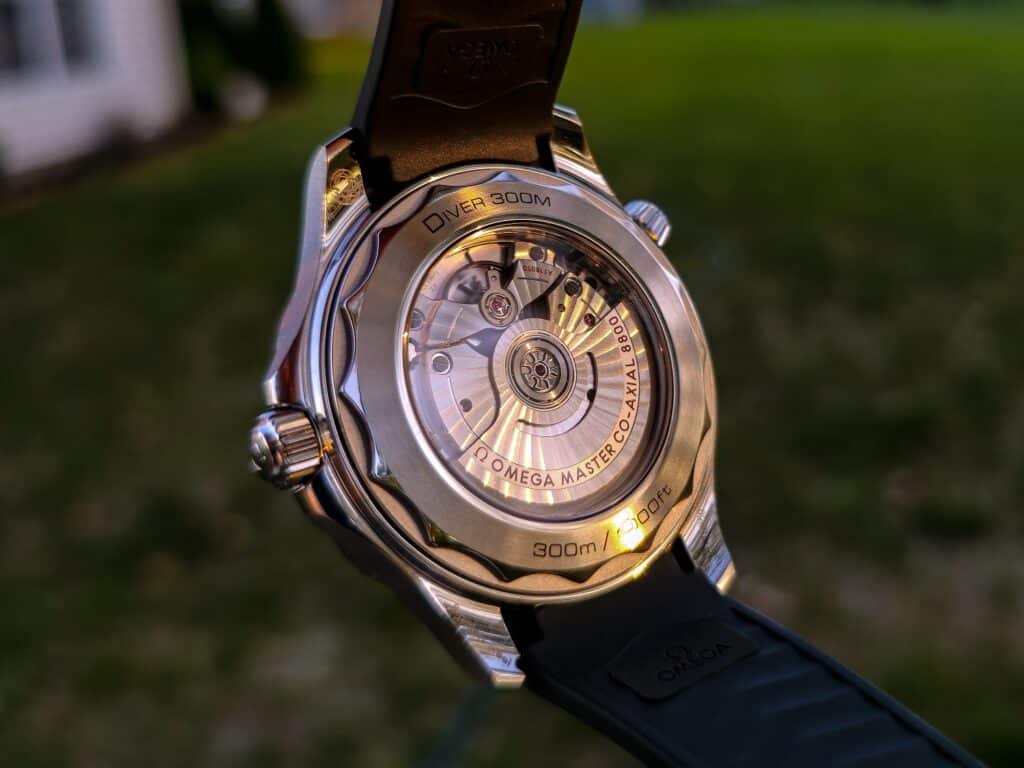
Omega’s Caliber 8800 is among the more compelling reasons to consider the Seamaster Diver 300M. The automatic movement offers 55 hours of power reserve, operates at an unusual 25,200 vibrations per hour, and uses the Co-Axial escapement originally developed by George Daniels. Its METAS Master Chronometer certification covers more than basic accuracy, including performance under magnetic exposure and other operating conditions. The movement is rated to withstand magnetic fields up to 15,000 gauss, an impressive specification even if most owners will never knowingly expose their watches to anything approaching that level. During our original review, the example we handled was running within approximately +1 second per day. Winding was exceptionally smooth, and the view through the sapphire exhibition caseback provided another reason to appreciate the engineering. This is a genuinely sophisticated mechanical movement, not simply an expensive way of accomplishing something quartz already does.
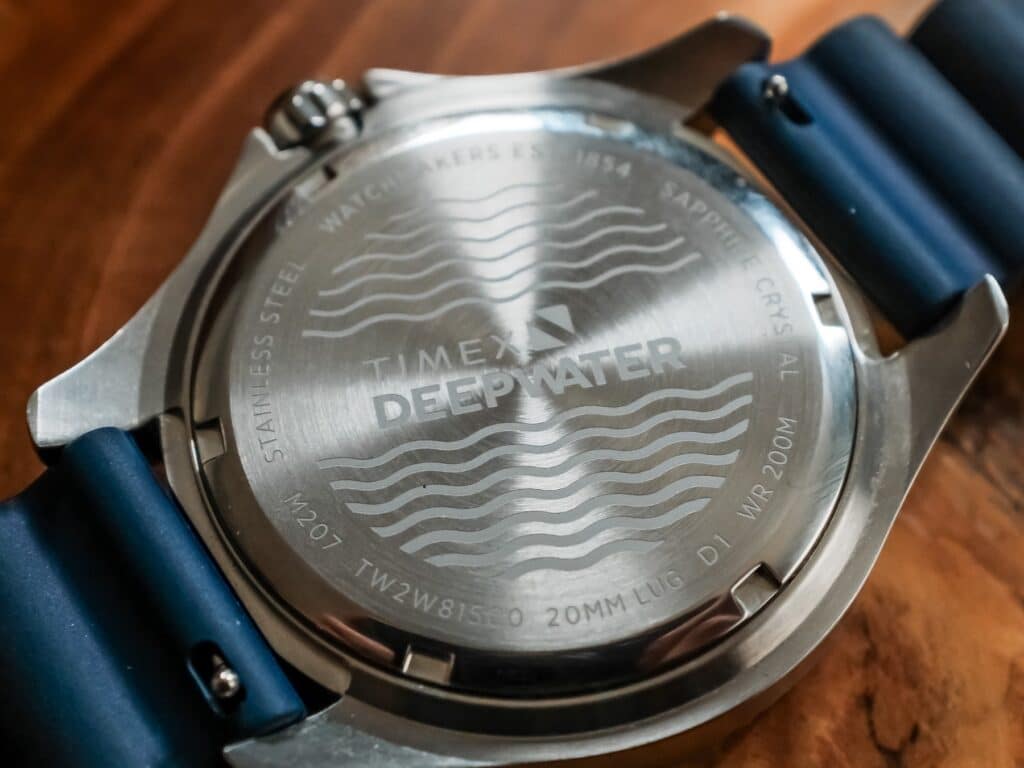
The Timex Deepwater Meridian 200 uses the Seiko Epson VX42E quartz movement, which offers hacking seconds, a quick-set date, and an estimated battery life of approximately three years. It’s a relatively straightforward caliber, but that simplicity is a natural fit for a watch intended to handle regular use without much attention. Setting the time and date was uncomplicated during our review, and the crown felt stable throughout the process. We appreciated the absence of unnecessary complexity, particularly because a watch in this category benefits from being ready whenever we need it. A solar movement would have been an appealing addition, but conventional battery-powered quartz isn’t a meaningful drawback at the asking price. The Meridian doesn’t provide the mechanical interaction or movement finishing found in the Seamaster. It also doesn’t demand that we pay several thousand dollars for those qualities.
Comparing these movements is where the relationship between price and practical value becomes complicated. There’s no question that Omega’s Caliber 8800 is the more sophisticated piece of watchmaking, and its certification, anti-magnetic resistance, and finishing deserve recognition. We enjoy that kind of engineering, particularly when it produces the accuracy and satisfying winding experience we observed. But Timex makes an equally reasonable argument for a conventional quartz diver. Its movement requires little attention, should maintain reliable everyday timekeeping, and allows the rest of the budget to support useful construction features. Neither approach invalidates the other. The Seamaster offers an experience that mechanical-watch enthusiasts can genuinely appreciate, while the Meridian focuses on making the watch as uncomplicated as possible. What matters is whether we consider the movement itself an important part of the reason we’re buying a watch.
Case Construction, Finishing & Wearability
One of the biggest surprises from our original Seamaster review was how comfortably the 42mm case wore despite its approximately 13.9mm thickness and 49.9mm lug-to-lug length. Those numbers suggested a fairly substantial watch, particularly for someone accustomed to smaller divers. Once on the wrist, however, the proportions felt considerably more manageable. Omega’s twisted lyre lugs play a major role in that experience, curving naturally around the wrist while helping visually disguise some of the case width. The green rubber strap also contributes to the comfortable fit, keeping the watch secure without adding the additional weight of a steel bracelet. We found the overall combination remarkably easy to wear, especially considering the Seamaster’s considerable diving credentials and the complexity of its automatic movement.
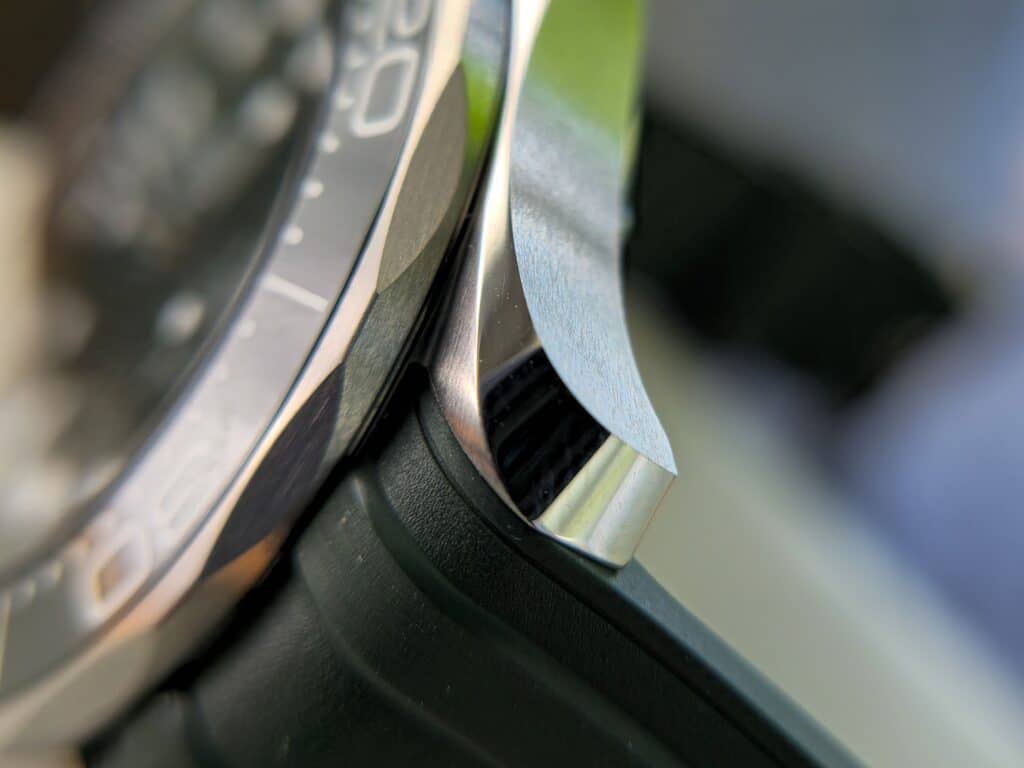
Finishing is where Omega begins to distinguish itself most convincingly. The upper surfaces of the lugs are beautifully polished, transitioning into narrow polished bevels and finely brushed sections that add depth without making the case appear excessively decorative. We were particularly impressed by how consistently those different treatments came together. The sapphire exhibition caseback provides another opportunity to appreciate the construction, with an attractive surrounding design and a clear view of the movement. The screw-down crown also deserves mention, although its relatively small size makes it less pleasant to unscrew than the actual winding action would suggest. There’s also the helium escape valve at ten o’clock, a distinctive Seamaster characteristic we’ve always appreciated even if some enthusiasts consider it unnecessary. These details make the case feel thoughtfully executed rather than simply expensive.
A 44mm diameter and approximately 50.5mm lug-to-lug measurement make the Timex Deepwater Meridian 200 the larger watch on paper. During our hands-on review, however, the case proved more comfortable than those dimensions initially suggested. We measured its thickness at approximately 12.5mm, somewhat different from the manufacturer’s published figure, and the relatively flat caseback helped it sit naturally against the wrist. The long lugs also curve downward, preventing the watch from feeling like a broad slab of metal perched on top of the hand. It’s undeniably a substantial diver, with the sort of presence that reminded us of much more expensive professional tool watches. But that bulk feels deliberate rather than poorly managed. Timex has produced a large watch that understands how to distribute its dimensions comfortably.
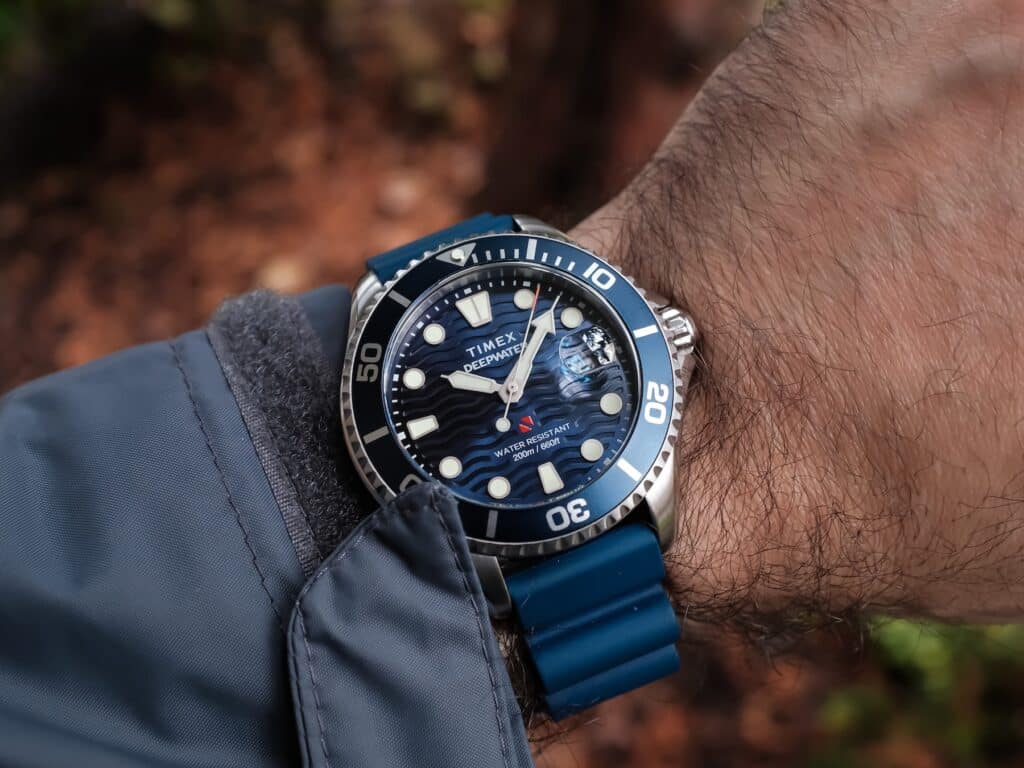
There’s also more attention to construction than we expected at this price. The stainless steel case combines brushed and polished surfaces, creating enough variation to keep the design interesting without attempting to imitate the Seamaster’s elaborate finishing. We were especially impressed by the screw-down crown, which engaged smoothly and offered reassuring resistance through its operation. Nothing about the action felt loose or carelessly assembled. The crown guards also reinforce the substantial appearance without becoming an obvious obstacle during adjustment. Of course, the transitions and decorative details aren’t executed to Omega’s standard, nor should we expect them to be. What impressed us was that the Meridian didn’t feel like an inexpensive watch relying entirely on its specifications. Its overall construction communicates a seriousness that’s unusual at this price.
Crystals and Bezels
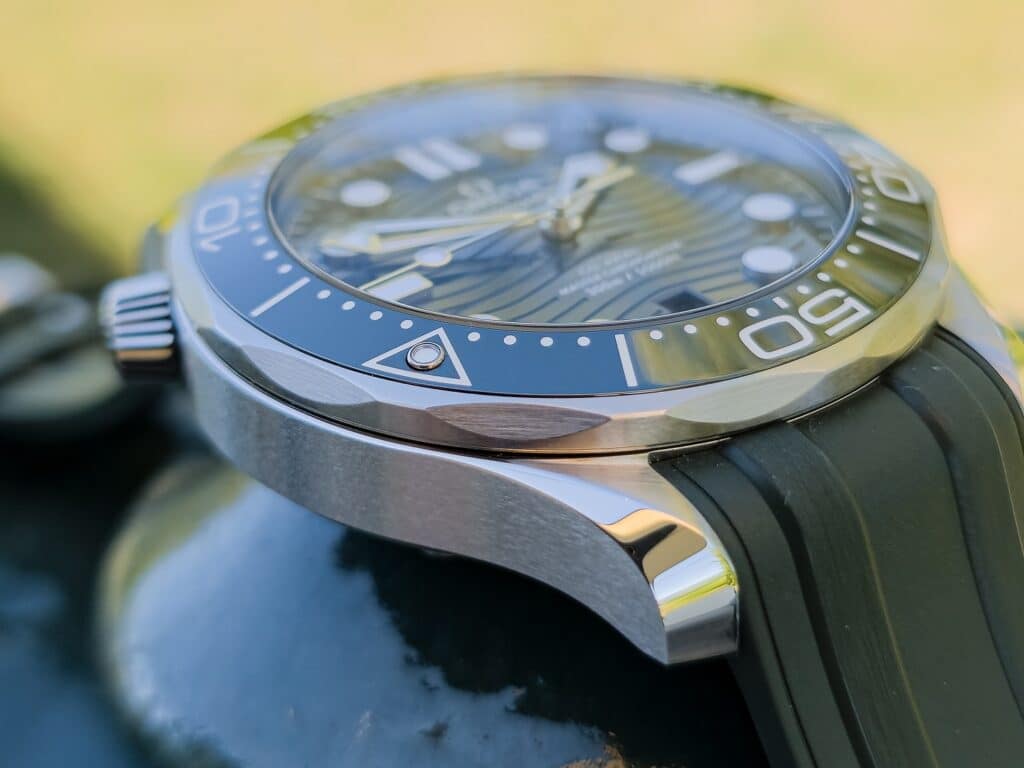
The Seamaster’s sapphire crystal was one of our favorite details during the original review. Omega’s extensive anti-reflective treatment makes the crystal almost disappear under many lighting conditions, allowing the ceramic dial and its intricate wave pattern to take center stage. We do have some reservations about the potential for fine scratches to develop in externally applied coatings, but the clarity itself was exceptional. The ceramic bezel insert is equally impressive visually, with a glossy green finish that complements the dial and scalloped outer edges that have become inseparable from the Seamaster’s appearance. Unfortunately, the actual bezel operation was considerably less satisfying. Its 60-click mechanism felt crisp and aligned correctly, but the tactile action lacked the refinement we expected from a watch at this price. The scalloped edges were also difficult to grip, particularly when imagining operation with wet hands. It looks fantastic. We just wish it worked with the same confidence it inspires visually.
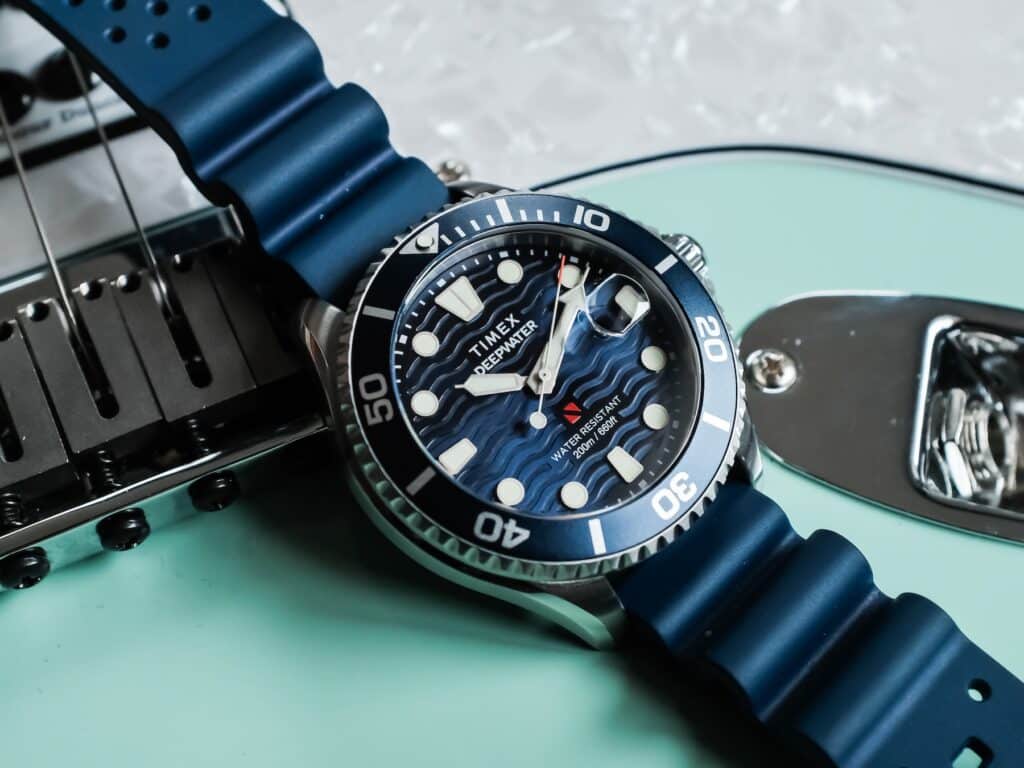
Timex makes a surprisingly strong counterargument with its sapphire crystal and 120-click unidirectional bezel. The crystal includes an anti-reflective coating and date magnifier, providing a useful combination of features at a price where mineral glass remains common. We appreciated the clarity of the display and found that the magnifier introduced relatively little distortion. More surprising was the bezel. Its aluminum insert lacks Omega’s ceramic construction, but the rotation felt tight, clean, and deliberate, without noticeable play or hollow clicking. The pronounced gripping surface also made the bezel straightforward to manipulate. Despite its ceramic insert and superior finishing, the Omega’s bezel was less satisfying to operate than the Timex’s. That’s a surprising result given the enormous price difference, and a reminder that more expensive materials don’t always deliver a better hands-on experience.
Water Resistance & Lume
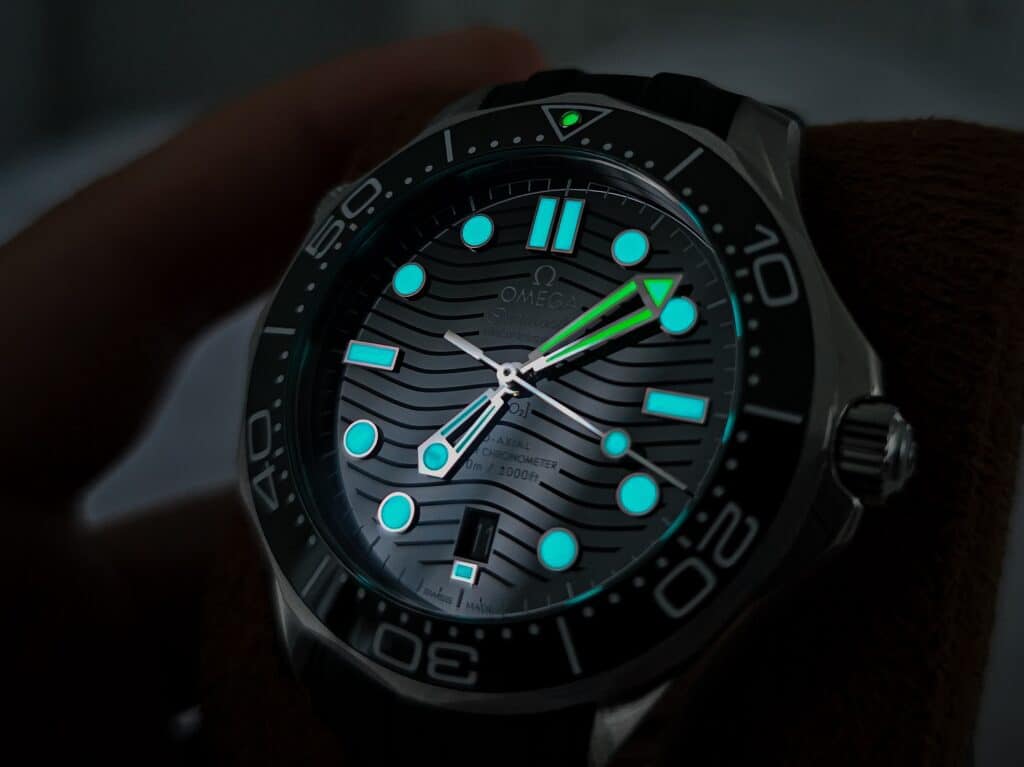
Three hundred meters of water resistance gives the Seamaster a considerable specification advantage over the Timex, although the practical importance of that difference depends on how the watch will be used. Omega combines its rating with a screw-down crown, screw-down caseback, and a helium escape valve designed for specialized saturation-diving conditions. The luminous treatment also takes a distinctive approach, with blue illumination across most of the dial and green illumination on the minute hand and bezel pip. We appreciated how easily those different colors helped distinguish the elapsed-time display. The brightness and longevity were less impressive than we’d hoped, however, particularly compared with some more affordable Japanese divers we’ve encountered. It’s a clever and attractive arrangement, but not necessarily the strongest example of pure tool-watch functionality.
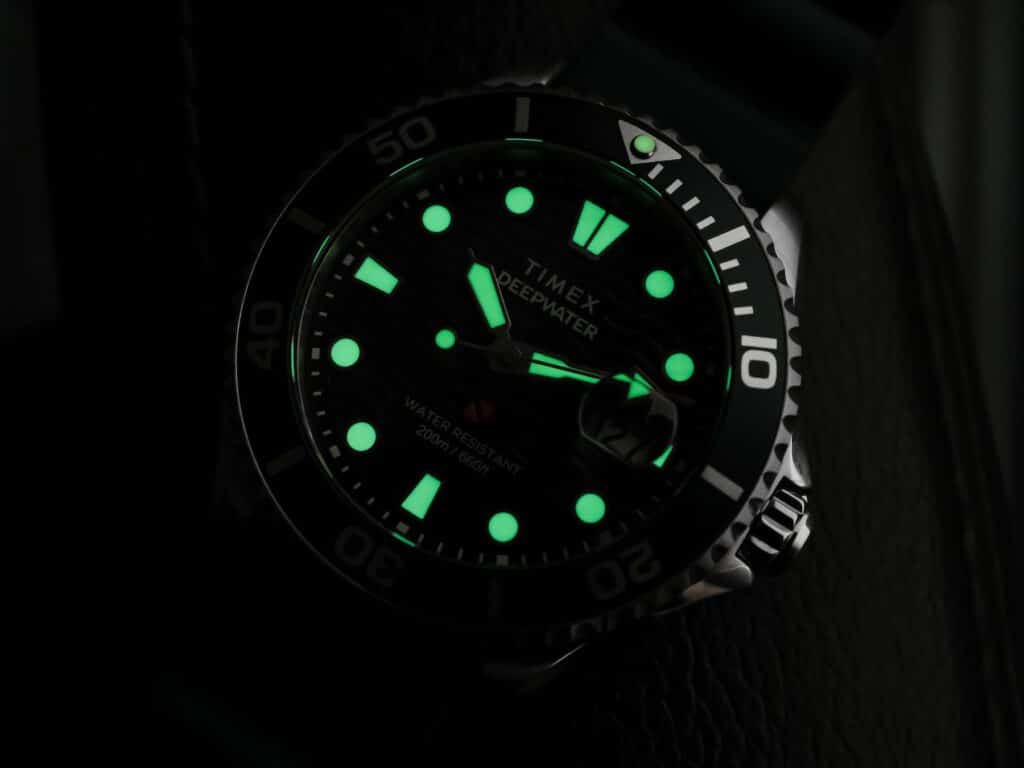
The Deepwater Meridian 200 carries a 200-meter water-resistance rating supported by its screw-down crown and caseback. That provides a substantial level of protection for everyday wear and recreational diving without requiring the specialized construction found on the Omega. Timex also uses Super-LumiNova across the hands and hour markers, producing a bright display that remained useful in low-light conditions during our review. The red and blue accents disappear into the background once the lume becomes the primary means of reading the time, leaving a straightforward arrangement that’s easy to understand. We wouldn’t claim that the Timex outperforms Omega through a controlled luminous-duration comparison, but the original hands-on impressions were encouraging. Combined with its solid bezel action and practical dial layout, the Meridian makes a credible case as an affordable diver intended for regular use rather than simply looking the part.
Cost Considerations
The green Omega Seamaster Diver 300M on rubber currently carries a U.S. retail price of approximately $6,300. That’s a substantial investment, even within the premium Swiss dive-watch category, and it places the Seamaster well beyond what most buyers need to spend for a capable everyday diver. There are tangible reasons for the price, particularly the Co-Axial Master Chronometer movement, ceramic dial and bezel, elaborate case finishing, and extensive anti-magnetic engineering. We were especially impressed by how beautifully the different surfaces came together and how comfortable the watch felt despite its substantial dimensions. Those aren’t superficial qualities. They’re part of what makes the Seamaster feel like a carefully designed and executed piece of watchmaking rather than simply a more expensive version of an ordinary tool watch.
Still, spending this much money creates expectations that become difficult to ignore when something falls short. We loved the Seamaster’s crystal, appreciated its movement, and found its green dial exceptionally attractive. But the bezel operation never felt as satisfying as the surrounding construction suggested it should. The grip was also less reassuring than we’d prefer on a serious dive watch. We can accept that the Seamaster leans toward the more polished side of the category, particularly because that character is a major part of its appeal. What becomes harder to justify is a basic functional component that doesn’t deliver the same level of tactile refinement found elsewhere on the watch. At this price, we expect the practical details to be as convincing as the decorative ones.
Timex currently lists the blue Deepwater Meridian 200 TW2W81500 for $270, putting it in an entirely different financial category. That price buys a sapphire crystal, 200-meter water resistance, an effective screw-down crown, a comfortable rubber strap, and a remarkably well-executed rotating bezel. We wouldn’t expect the same movement sophistication or case finishing as the Seamaster, but those differences don’t automatically diminish what Timex has accomplished. We were particularly impressed by how substantial the watch felt without becoming uncomfortable, as well as the lack of obvious shortcuts in its crown and bezel operation. For someone looking for a serious everyday diver without a significant financial commitment, this is a remarkably convincing collection of features.
The compromises are comparatively straightforward. Its Seiko Epson quartz movement won’t provide the fascination of an automatic caliber, while the aluminum bezel insert and less elaborate case finishing reflect the affordable price. The 44mm diameter also makes it a relatively large watch, even if the proportions were comfortable during our review. And while the blue wave-patterned dial has plenty of character, it doesn’t deliver the same visual depth or refined detailing as Omega’s green ceramic alternative. None of those limitations surprised us. What did surprise us was how little the Meridian felt like a watch that had been built down to a price. Its overall construction was more confident than we’d anticipated, and the relatively modest cost made those sensible compromises easier to accept.
At current retail prices, the difference between these watches is approximately $6,031, with the Omega costing more than 23 times as much as the Timex. That’s an enormous premium for two watches that share the same fundamental purpose. The Seamaster absolutely offers qualities the Meridian cannot reproduce, particularly in movement engineering, finishing, and the overall sophistication of its design. We appreciate those distinctions, and there are good reasons someone might be willing to pay for them. But the Timex makes it difficult to argue that expensive materials and mechanical complexity always translate into better everyday functionality. Both watches accomplish the basic tasks expected of a dive watch. The more interesting question is whether we personally value everything the Omega adds enough to justify the additional expense.
Final Thoughts: Omega Seamaster vs Timex Deepwater Meridian 200
The Omega Seamaster Diver 300M remains one of the most compelling premium dive watches we’ve reviewed. Its green ceramic dial is genuinely beautiful, the twisted-lug case finishing is exceptional, and the Caliber 8800 offers the kind of sophisticated engineering we enjoy exploring as watch enthusiasts. We were also surprised by how naturally the substantial case wore on the wrist. That combination makes the Seamaster a watch we’d be excited to add to a collection, particularly for someone who appreciates distinctive design and the experience of owning a finely executed mechanical instrument. Our frustrations with the bezel remain, and we’d still prefer a more practical gripping surface, but there’s no denying how much Omega gets right. This is a watch that feels special for reasons extending well beyond the name on its dial.
The Timex Deepwater Meridian 200 impressed us for almost the opposite reasons. We weren’t expecting a $270 quartz diver to deliver such convincing crown operation, bezel action, and overall case construction. Its sapphire crystal, comfortable proportions, and attractive blue wave-patterned dial also make it easy to appreciate without constantly thinking about the price. We especially like that Timex hasn’t tried to disguise what the watch is. The quartz movement is straightforward, the case is substantial, and the design leans toward practical functionality rather than pretending to offer the same experience as an expensive Swiss automatic. It’s a watch we could imagine reaching for regularly, particularly when we want something capable that doesn’t demand much attention.
What makes the comparison interesting is that the price difference doesn’t always correspond to the parts of the watches we enjoyed using most. Omega unquestionably offers the better movement, more elaborate finishing, and more sophisticated overall construction. Those observations don’t make the Meridian a direct substitute for the Seamaster, nor do they suggest the two watches belong in the same category of finishing or mechanical engineering. They do remind us that paying substantially more doesn’t guarantee that every individual component will feel better in practice.
For overall value, we’d choose the Timex Deepwater Meridian 200. It provides much of the functionality we’d expect from a capable dive watch, along with several material and construction choices that make its low price particularly impressive. The Omega Seamaster is still the watch we’d choose for its mechanical sophistication, exceptional finishing, and distinctive design, provided the additional expense fits comfortably within the budget. But we’re not convinced that spending more than $6,000 is necessary to enjoy a genuinely satisfying diver. The Seamaster gives us plenty to admire as collectors. The Meridian shows how far a thoughtfully executed affordable watch can go without asking us to spend anywhere near that much.

Co-Founder and Senior Editor
Kaz has been collecting watches since 2015, but he’s been fascinated by product design, the Collector’s psychology, and brand marketing his whole life. While sharing the same strong fondness for all things horologically-affordable as Mike (his TBWS partner in crime), Kaz’s collection niche is also focused on vintage Soviet watches as well as watches that feature a unique, but well-designed quirk or visual hook.