The Tudor Black Bay GMT and Christopher Ward C63 Sealander GMT sit far enough apart in price that we can’t treat this as a simple spec comparison. We need to ask whether the Tudor gives us enough extra on the wrist to justify spending substantially more, or whether the C63 gets us close enough to the experience that the savings make more sense elsewhere in the collection. After all, both watches are meant for enthusiasts who care about how a watch feels, wears, and fits into a collection.
We’ve been wearing, testing, and scrutinizing watches hands-on at TBWS for more than a decade, and that experience has made us less inclined to hand the victory to the watch with the bigger name or the longer spec sheet. We’ve also learned that what matters after weeks on the wrist can be very different from what catches our attention when we first encounter a watch. That’s especially true here: one carries the expectations that come with a major luxury name, while the other takes a more restrained route and puts its own priorities forward. So we’ll get past the obvious brand hierarchy and work out which one makes more sense when it’s our money, our wrist, and our collection on the line.
Overview and Identity
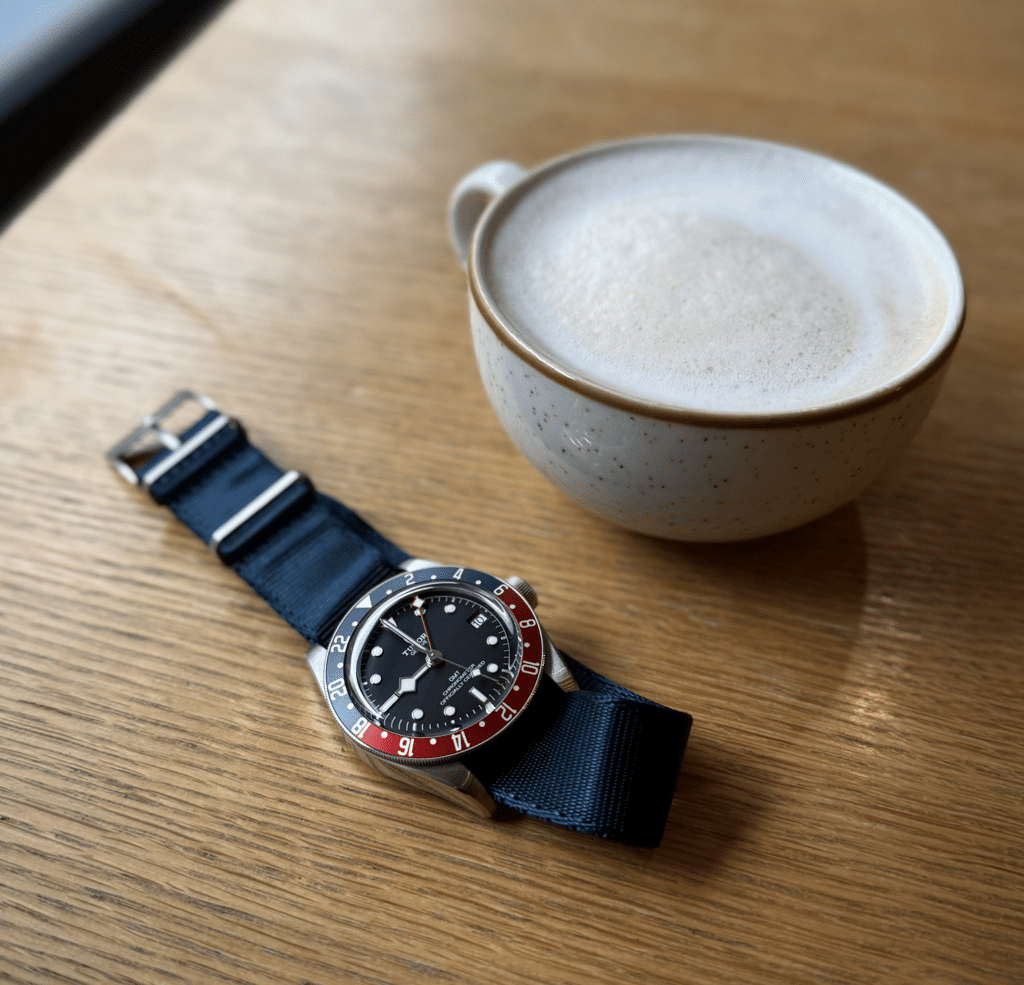
The Tudor Black Bay GMT has an identity that pulled us in before we even had one on the wrist. In our hands-on review, the vintage-inspired Black Bay aesthetic immediately brought to mind the Rolex Explorer II and GMT-Master, which made the watch feel tied to the kind of travel we like to imagine watches can represent. Even sitting in a Nashville coffee shop, the GMT managed to inject some of that sense of adventure into an otherwise ordinary day. That emotional pull is a big part of why the Tudor works for us. It doesn’t need to be traveling to make us think about traveling.
The Christopher Ward C63 Sealander GMT lands differently. After spending time reviewing the updated C63, we found that Christopher Ward had moved considerably closer to the straightforward GMT sports watch we’d wanted to see from the brand. Some changes are obvious, while others only made sense after wearing the watch, which is where the update proved more convincing than it might have at first glance. The result feels more cohesive without trying to make a spectacle of the redesign.
Dial and Bracelets: Tudor Character vs Christopher Ward Restraint
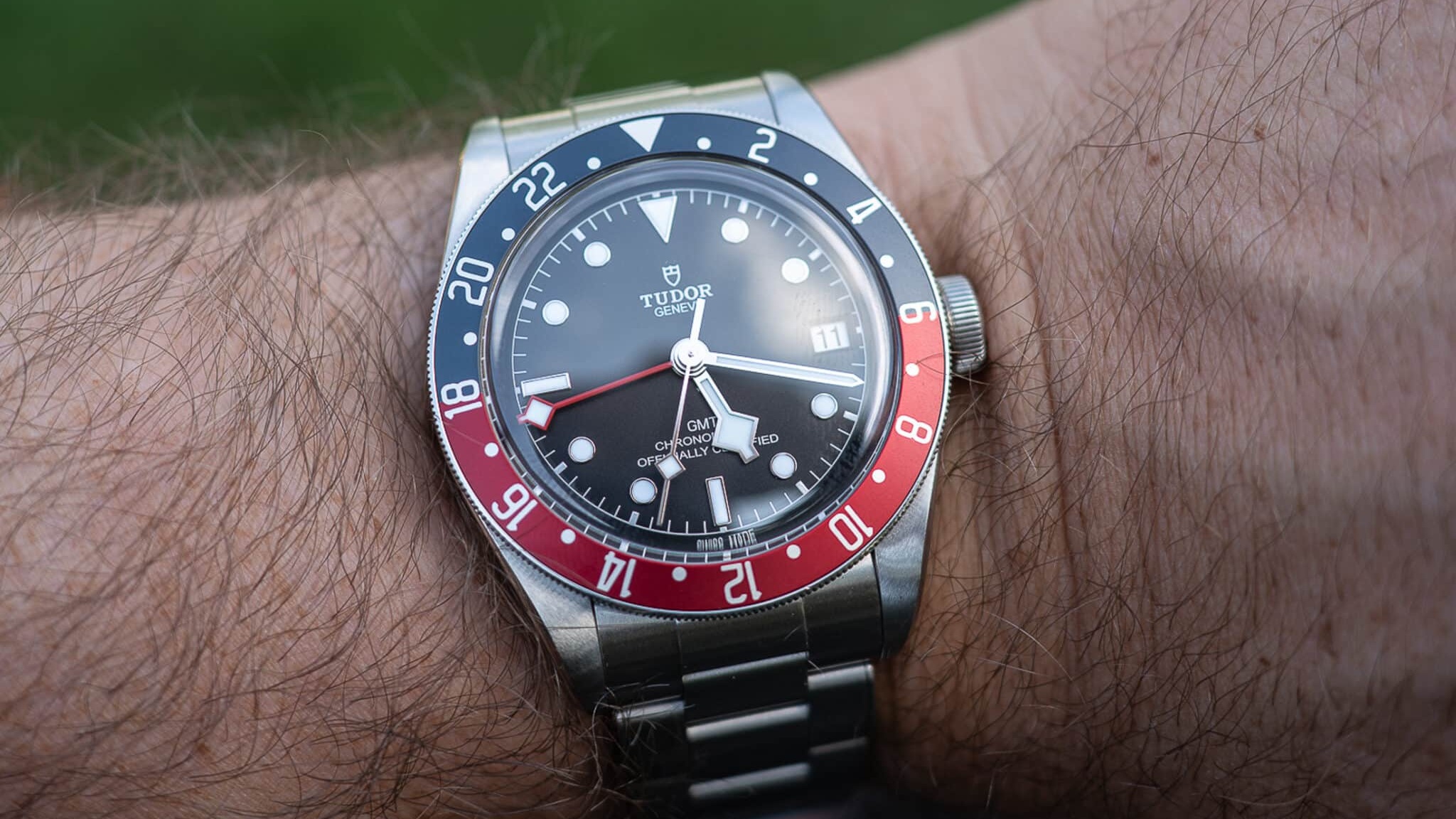
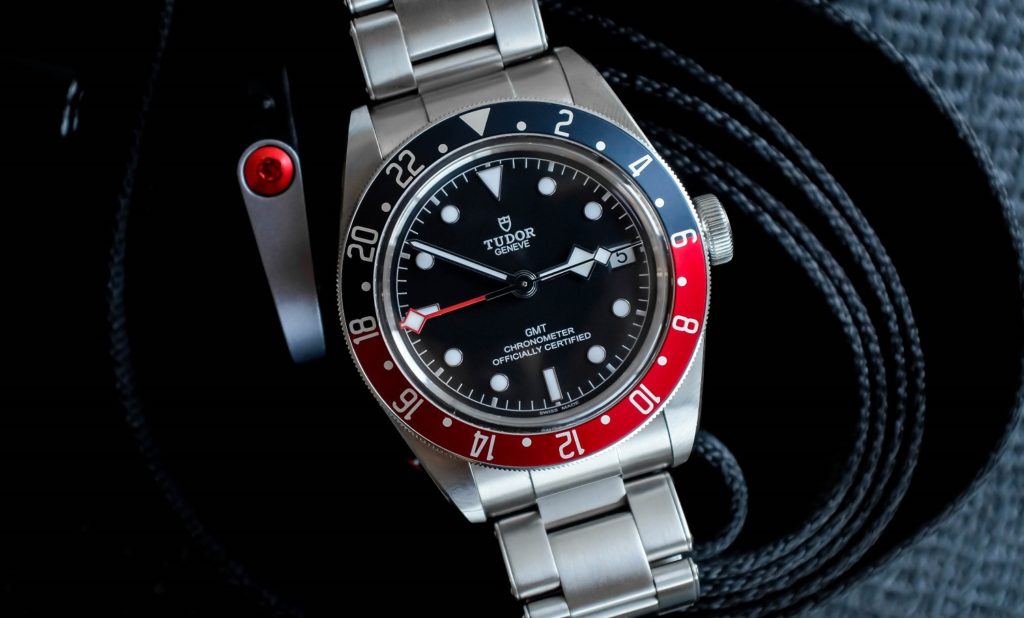
The Tudor Black Bay GMT keeps its “blizzard” dial disciplined, which gives the red GMT hand plenty of room to misbehave. The matte black surface, snowflake hands, polished dot hour markers, longer rectangular markers at 9 and 6, and oversized triangle at noon make for a layout that’s easy to take in without needing to decode it. Then there’s that red GMT hand, matched to the burgundy half of the bezel and extending slightly beyond the minute track. We love that touch because it makes the 24-hour hand feel like something we’re meant to use, not decorative furniture. The white date wheel at 3 o’clock is the one bit we’d change; matching it to the dial would have tied things together better, but it’s hardly a deal breaker.
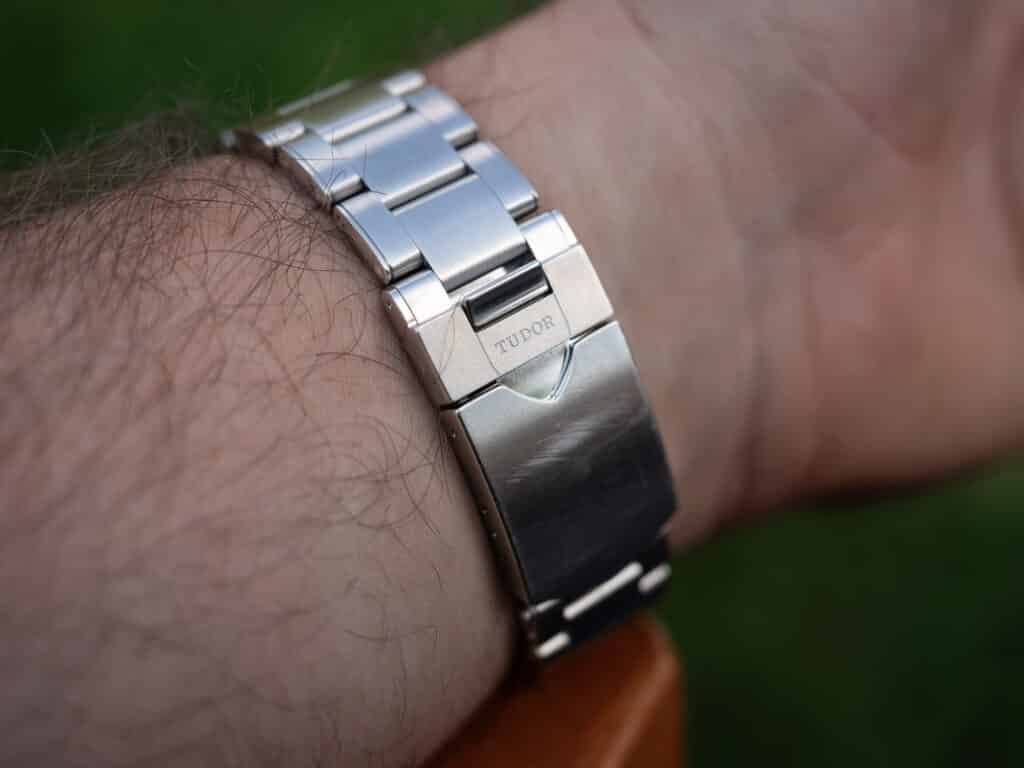
Then we get to the bracelet, which is one of those things Tudor gets right to an almost irritating degree. Putting it on in the morning and closing the clasp has that oddly satisfying “well, today has its act together” feeling. It articulates well and wears comfortably, and while the lack of half-links makes getting the fit exactly right more annoying than it should be, aftermarket solutions take some of the pain away. We’ve also worn the Black Bay GMT on a Toxic NATO, and that change does a nice job of stripping away some of the luxury-watch fussiness. On fabric, it feels more like the tool watch hiding underneath all that polished steel.
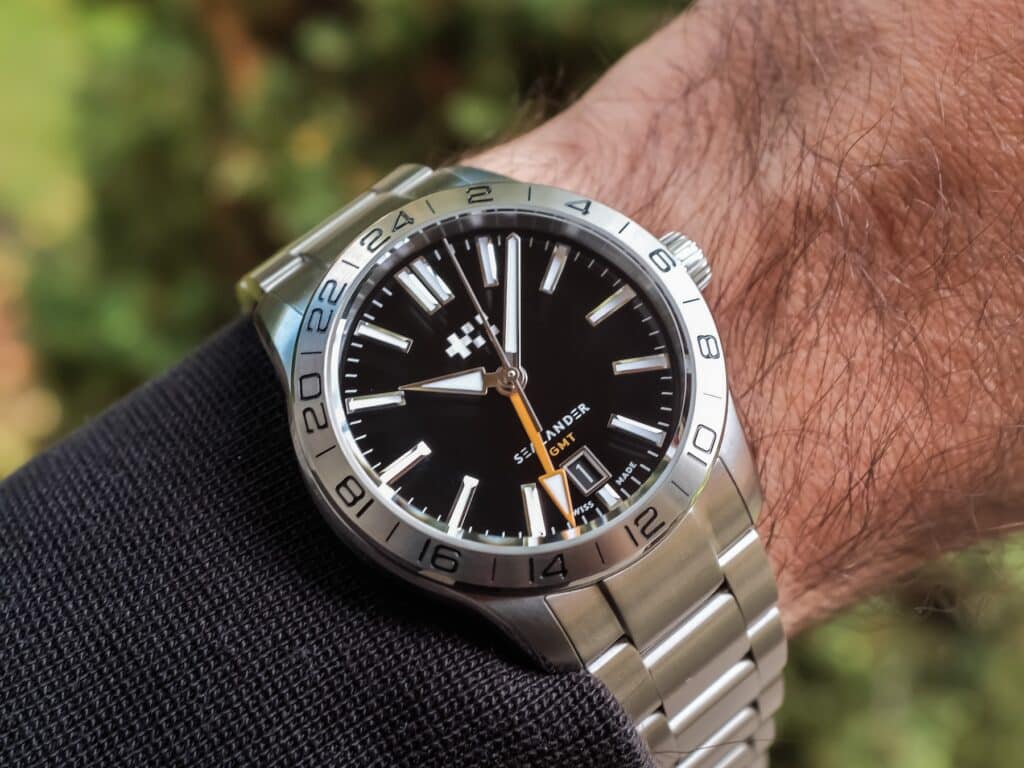
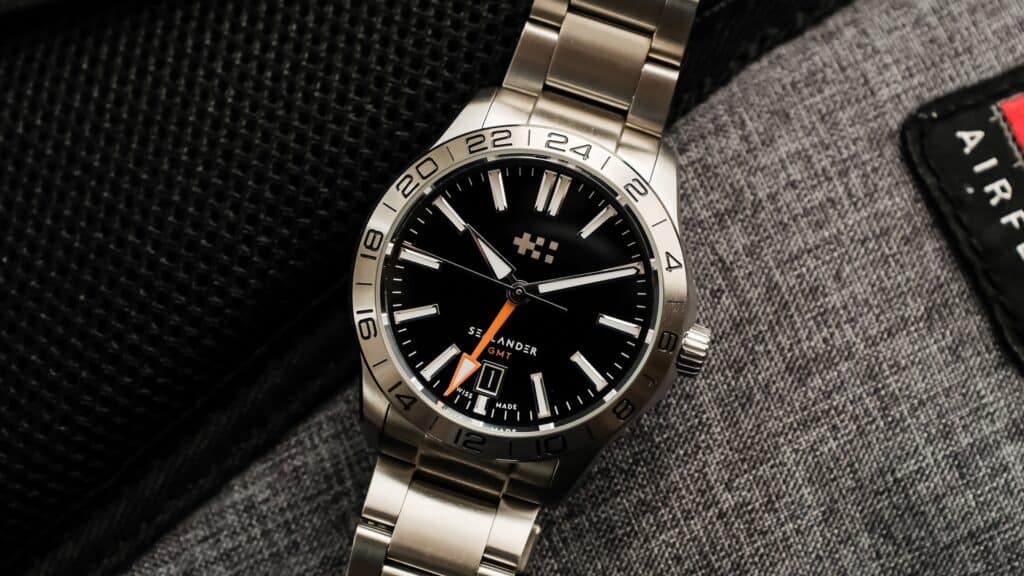
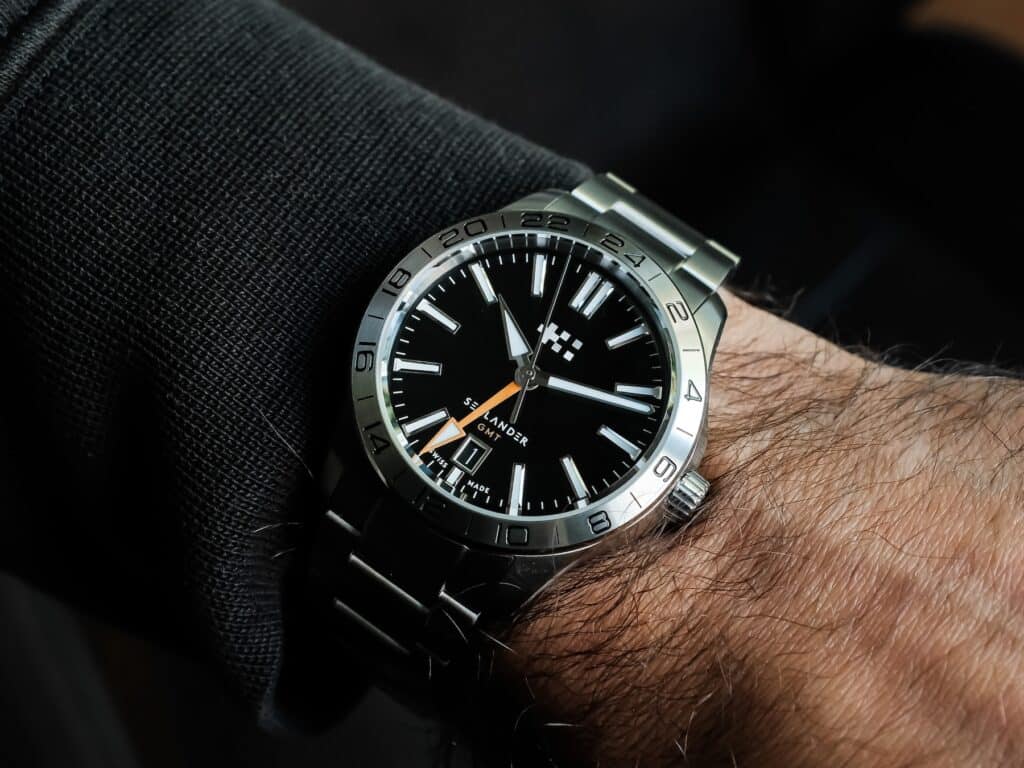
The Christopher Ward C63 Sealander GMT takes a quieter approach, particularly in the black lacquer version we reviewed. It offers plenty of contrast and pairs with almost anything, though after living with it, we found ourselves wishing for a brighter dial option. The design can take it. Christopher Ward also cleaned up the hands and revised the applied markers, while removing the Trident counterweight from the second hand. None of that sounds earth-shattering, but together it makes the dial feel less busy. The fully painted GMT hand is the change we noticed most. Against the black dial, it stands out immediately, giving the GMT function a visual presence that previous versions lacked.
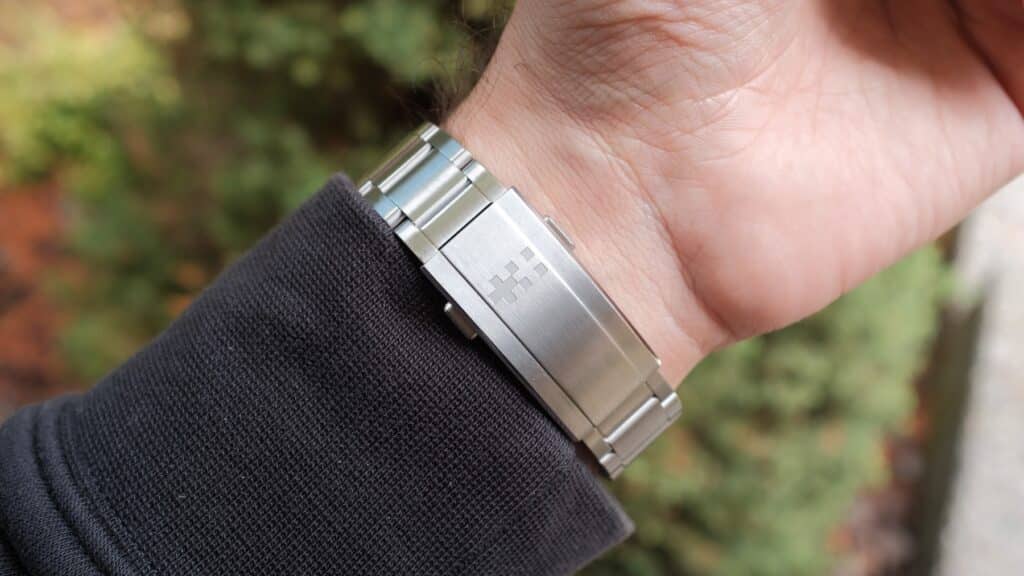
The Bader bracelet is where the C63 starts making its case in less glamorous but more useful ways. Once sized, it articulated nicely around the wrist and tapered well, keeping the watch balanced rather than making us feel like we’d strapped a small piece of kitchen equipment to our arm. The ratcheting micro-adjustment is truly useful during everyday wear, and Christopher Ward’s iLink system makes initial sizing less of a wrestling match. Clever, yes. A major reason to buy the watch on its own? Not for us. The comfort and articulation matter far more once the novelty of showing someone the adjustment system wears off.
That difference in execution is noticeable, but this is also where we have to start asking how much we’re willing to pay for refinement. The Tudor feels more special on the wrist, while the C63 gets surprisingly close on everyday comfort and usability without asking us to spend several thousand dollars more.
Build Quality & Technical Approach
This is where the two GMTs start showing their personalities under the hood. The Tudor and Christopher Ward may serve the same basic purpose, but our time with them revealed different priorities in how they do the job. Movement behavior, case execution, and the practical side of operating the GMT matter more here than another round of compliments about how either watch looks. These details tend to stay with us long after the honeymoon period—and sometimes remind us why we bought the watch in the first place.
Movements:
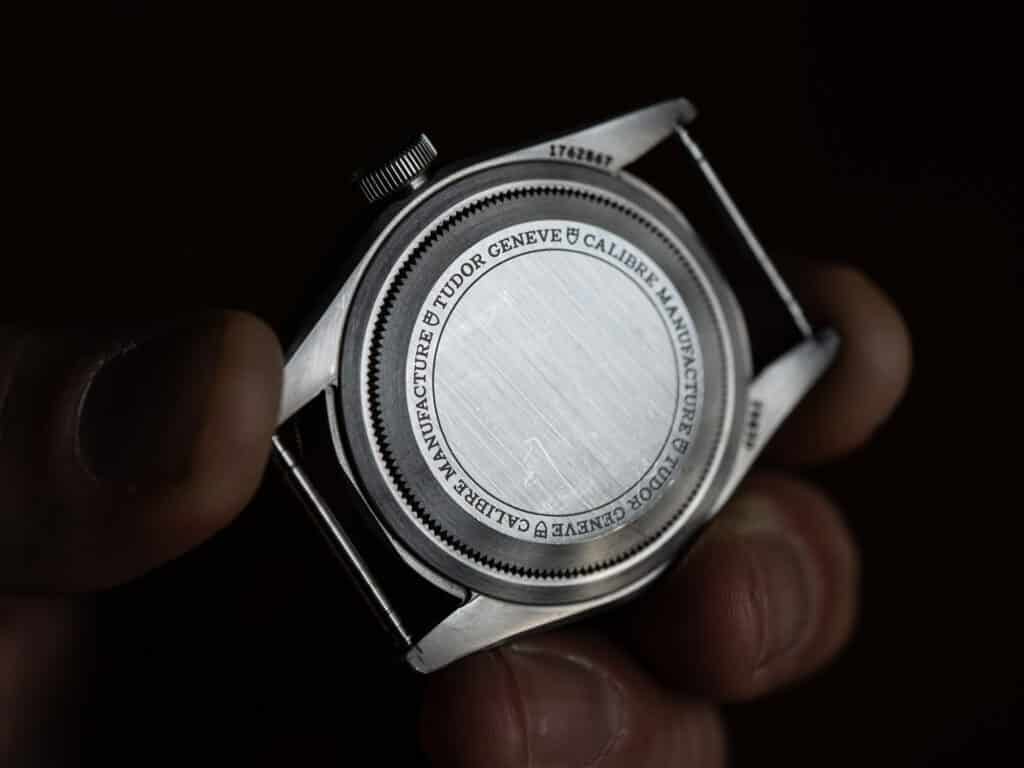
The Tudor Black Bay GMT uses Tudor’s Caliber MT5652, and we like it less for the numbers on the movement card than for how it works in practice. This is a flyer GMT, so the first crown position lets us jump the local hour hand independently while keeping the GMT hand on its chosen time zone. For travel, that is the useful bit: set the GMT hand first, then adjust the local hour when we land without disturbing the reference time. The movement runs at 28,800 bph, has 70 hours of power reserve, and our review sample was running around +4 seconds per day. That’s well within COSC and, more importantly, close enough that we weren’t checking our phone every five minutes to see whether the watch had betrayed us.
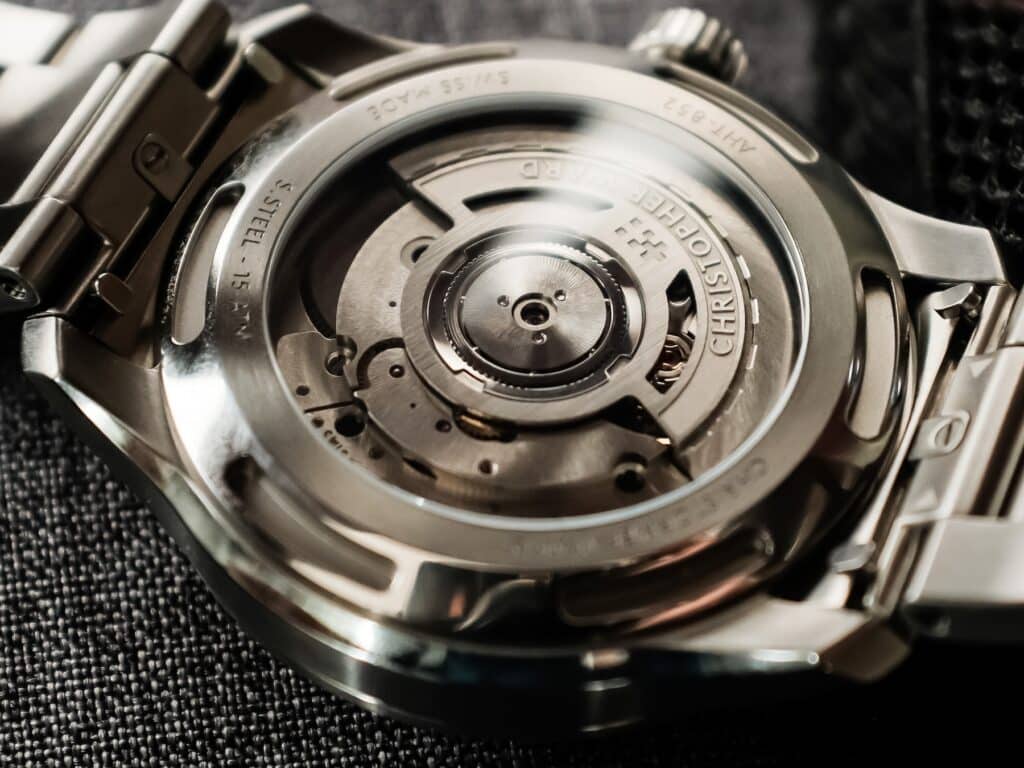
The Christopher Ward C63 Sealander GMT uses the Sellita SW330-2 and takes the caller-GMT route instead. You can adjust the GMT hand independently, not the local hour, so changing time zones means more of a full-time-setting exercise. That sounds like the sort of thing we should be complaining about loudly, except it never became a problem during our time with it. We tend to keep the second time zone set and leave it alone, so the SW330-2 suited how we actually use a GMT. It has a 56-hour power reserve, runs at the same 28,800 bph beat rate, and Christopher Ward rates it at -5/+12 seconds per day. The skeletonized rotor also gives the display caseback a little more to look at without pretending the movement is the star of the show.
The flyer GMT is the Tudor’s clearest functional advantage, especially if we’re regularly crossing time zones. But for the way we actually use a GMT, it isn’t enough on its own to justify the price difference. The Tudor movement is better suited to frequent travel; the C63 simply gives us most of the everyday usefulness for substantially less money.
Case Construction, Finishing & Wearability:
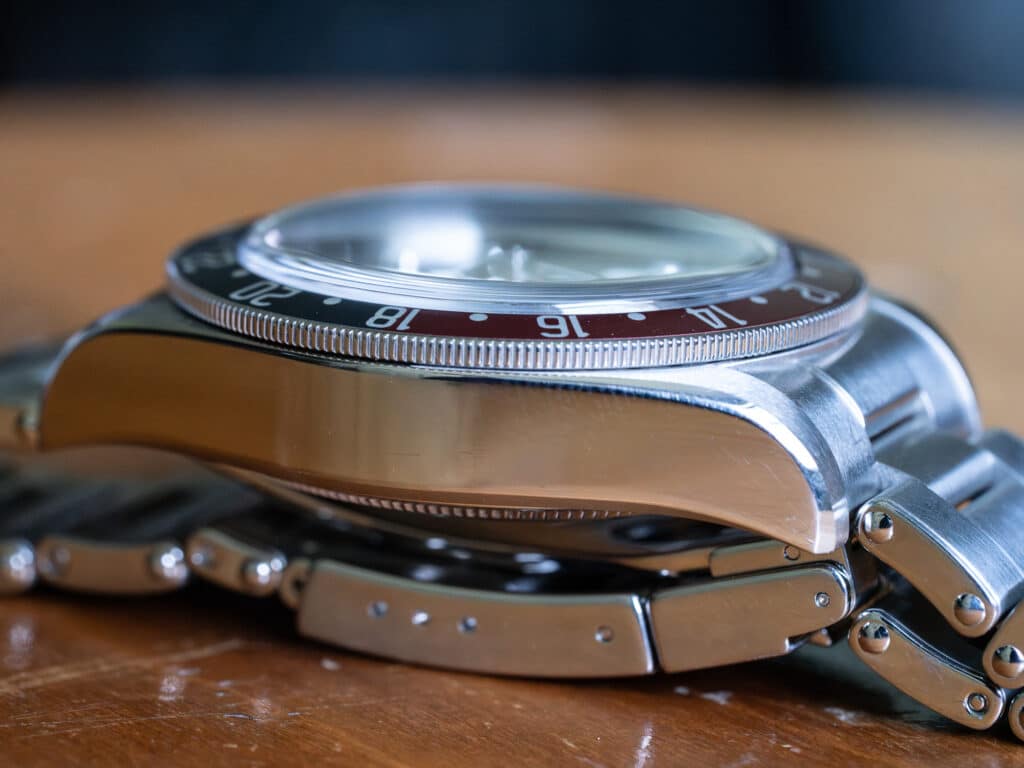
The Tudor Black Bay GMT doesn’t pretend to be a small watch. At 41mm across, 50mm lug-to-lug, and 14.7mm thick, there’s plenty of steel, but the case cleverly keeps it from feeling completely unruly. On our 7.5-inch wrist, the dramatically downturned lugs were doing most of the diplomatic work. They pull the case toward the wrist instead of leaving it perched on top, which is why the watch wears more comfortably than its dimensions imply. The finishing also has more going on than a first glance lets on: the top surfaces are brushed, the slab sides are polished, and a tiny bevel runs along the sides of the case. That last detail sounds like watch-nerd trivia until you wear it; as the wrist moves, it gives the case a little visual breathing room. On wrists under 7 inches, though, we’d expect the 50mm lug-to-lug to stand out more.
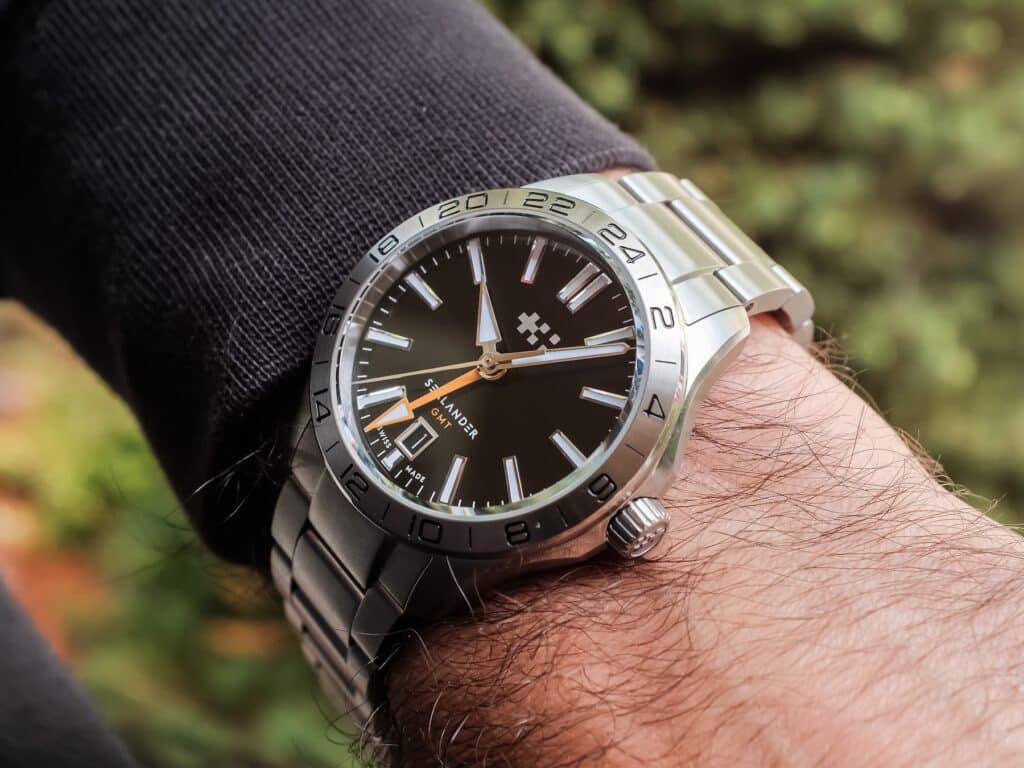
The Christopher Ward C63 Sealander GMT is much easier to forget once it’s on the wrist, and we mean that as a compliment. The 39mm version we reviewed measures 45mm lug-to-lug and 11.3mm thick, but the useful part isn’t the arithmetic. It’s how little bulk there is to deal with. After spending time with the 36mm, 39mm, and 42mm options on our radar, the 39mm made the most sense because the proportions felt settled, not just available in three sizes for the sake of it. Christopher Ward’s revised Light-catcher case also got slimmer and picked up a new conical crown with guards. We wouldn’t call those changes dramatic on their own, but together they keep the watch close to the wrist and out of the way. The Tudor announces itself a little more; the C63 is happier getting on with the day without demanding a roll call.
Crystals and Bezels:
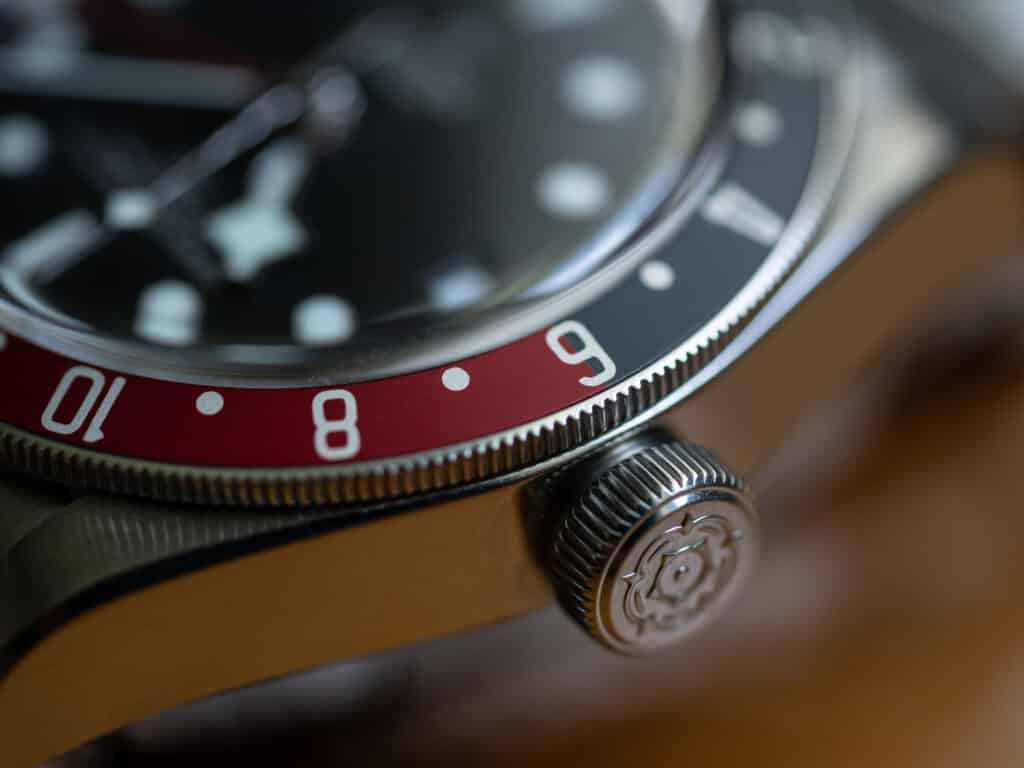
The Tudor Black Bay GMT uses a domed, boxed sapphire crystal, and it does a lot of the aesthetic heavy lifting. That raised profile reinforces the vintage-inspired character and makes the watch feel more like the sort of GMT we were drawn to in the first place. It also adds to the overall thickness, which is worth keeping in mind when you’re admiring the crystal from three different angles and wondering why the watch suddenly needs its own zip code. Underneath it sits a bidirectional bezel with a burgundy-and-deep-blue anodized aluminum insert. The color split indicates day and night. However, we’ll admit that particular piece of visual shorthand took us a minute (apparently not all of us received the GMT-bezel instruction manual at birth).
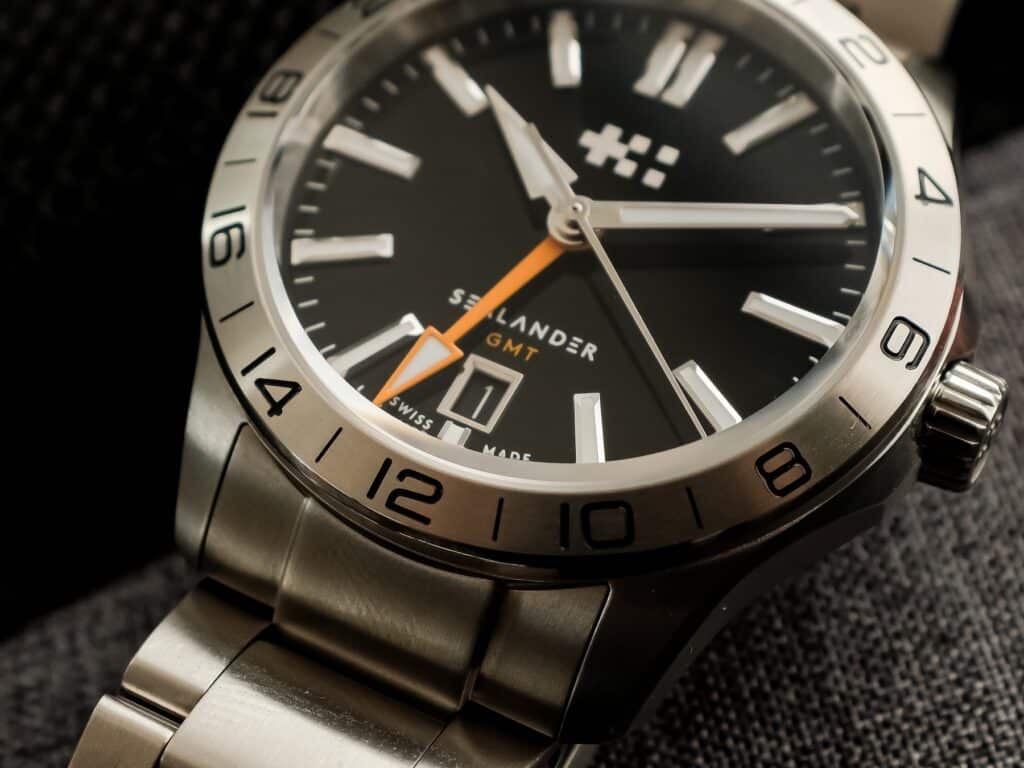
The CW C63 Sealander GMT also uses sapphire, and throughout our testing period, the crystal never made us feel like we needed to handle the watch too carefully. That fits the C63’s everyday personality well. The bigger change is the fixed stainless steel bezel. Christopher Ward re-proportioned it with a larger footprint and shallower angle. While the difference is subtle in person, it helps the bezel sit more naturally with the case and dial. We like that approach because it improves overall balance without making the bezel the first thing you notice. It’s a quieter solution, but the C63 is better for it.
Water Resistance & Lume:
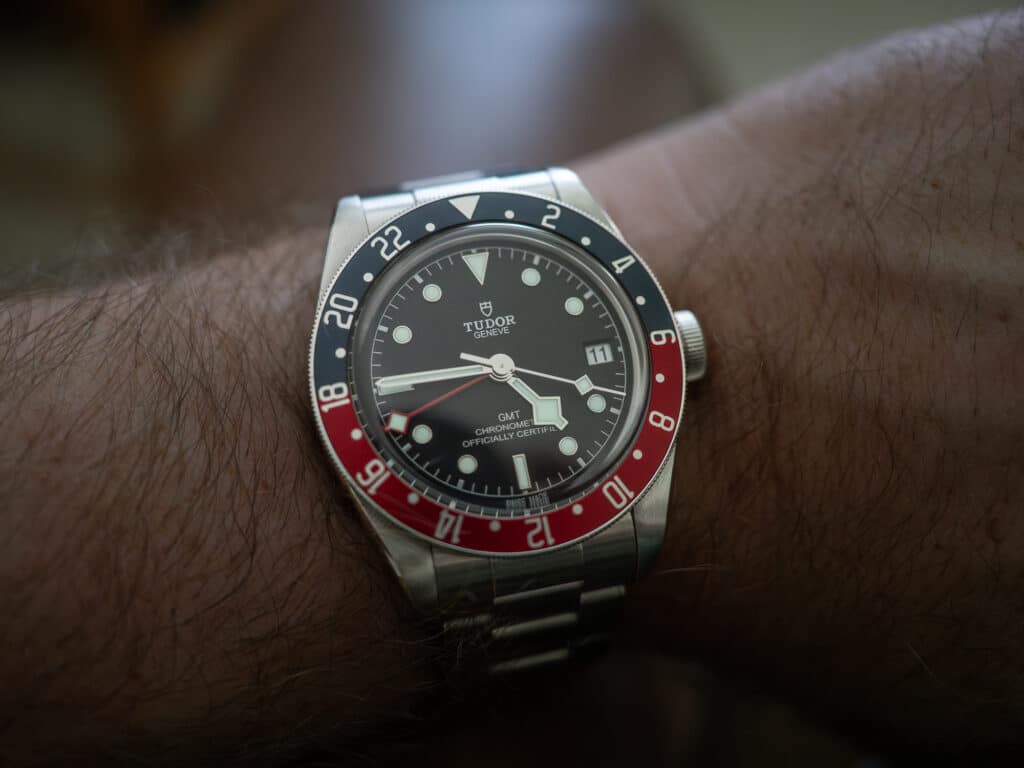
The Tudor Black Bay GMT gives us 200 meters of water resistance, which is comfortably beyond the “please keep your watch away from the swimming pool” category. That suits the watch’s broad travel-watch personality because we don’t have to overthink bad weather or time spent around water. The lume backs that up nicely. All the hour markers are filled with white lume, while the polished hands carry a generous amount of Super-LumiNova. Once the light disappears, the important information stays easy to find—no flashlight audition required.
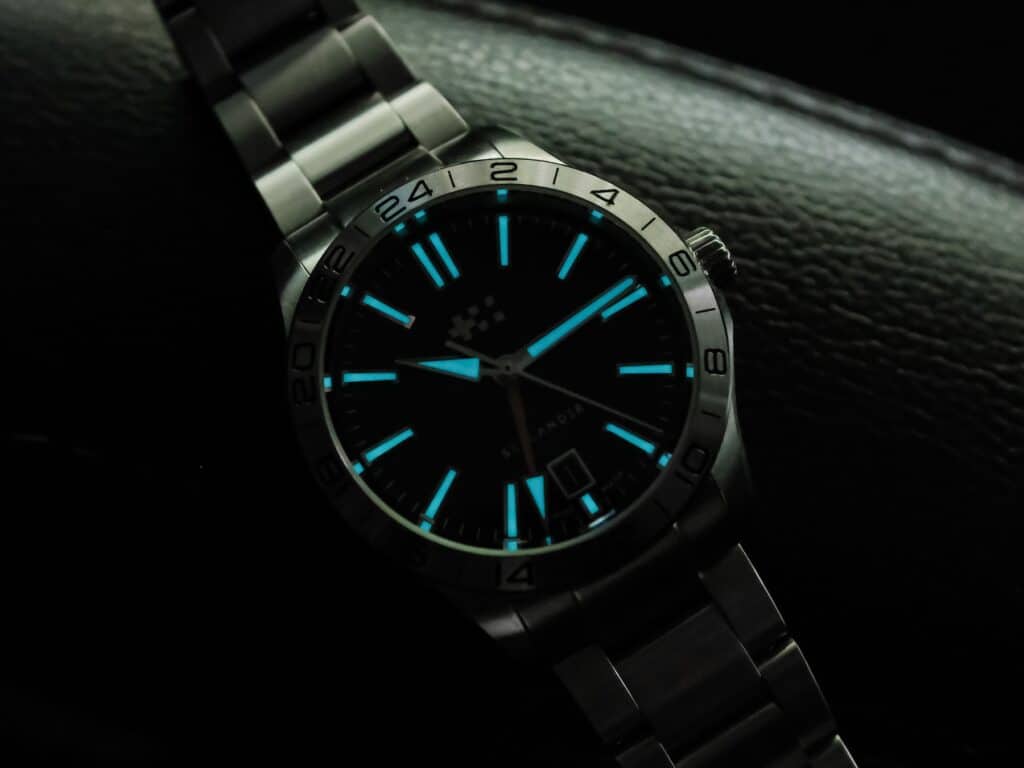
The Christopher Ward C63 Sealander GMT gets 150m of water resistance and a screw-down crown, and those are exactly the specs we want in an everyday sports watch. They’re boring until they save us from thinking about them, which is sort of the point. The diamond-polished, tapered indexes are filled with lume for low-light legibility, giving the C63 enough nighttime readability without cluttering up the cleaner dial. It doesn’t make a production out of being water-ready or lume-heavy; it simply removes a couple more reasons to baby the watch.
Taken together, the Tudor does give us more: a flyer GMT movement, greater water resistance, stronger wrist presence, and a level of finishing that feels more distinctly luxurious. What it doesn’t give us is a correspondingly dramatic improvement in how useful or enjoyable the watch is day to day. That’s where the price gap becomes difficult to ignore.
Cost Considerations
The Tudor Black Bay GMT lives in the part of the GMT market where the calculator starts getting involved. New examples are around $5,000-$5,300, while used pieces can sometimes dip below $3,500 if we’re willing to do some digging. That matters because cheaper flyer-GMT movements now exist, meaning the Tudor doesn’t have a monopoly on the useful part of the package. We think the difference shows up more in the watch’s overall quality and care than in some magical GMT functionality, and that’s a distinction worth being honest about. At new-watch money, the premium is substantial. On the used market, the equation gets a lot more interesting.
The Christopher Ward C63 Sealander GMT is easier to justify without opening a spreadsheet and staring at it for twenty minutes. The 39mm version costs $1,620 on the Bader bracelet, and we’d take it at that price based on how well the whole package came together during our time with it. Christopher Ward fixed enough of the details that had held back earlier versions, and the cumulative effect was pretty convincing. It doesn’t ask us to pay for a prestigious name and then explain why the watch is worth it afterward. For an enthusiast who wants a well-resolved GMT and would rather keep the rest of the budget available for another watch, that’s a pretty compelling proposition.
Final Thoughts: Is the Tudor Black Bay GMT Worth the Premium
After putting the Tudor Black Bay GMT and Christopher Ward C63 Sealander GMT through the same lens, we’d spend our money on the C63. Not because it manages to impersonate the Tudor for less, but because it doesn’t need to. It stands on its own, and that makes the decision easier once we stop treating the Tudor name as the automatic answer. For someone building a collection around enjoyment rather than status, the C63 leaves us with the feeling that we bought the watch itself, not the story attached to it.
That distinction matters more than it might at first. The Tudor makes more sense when being part of the Tudor world is itself part of the appeal. There’s nothing wrong with that; watches are emotional objects, and sometimes that connection is exactly what we’re paying for. But we wouldn’t buy the Tudor expecting its extra cost to show up as a dramatic difference in basic GMT usefulness. For an enthusiast who wants a GMT to wear regularly without constantly wondering whether the premium was justified, the Christopher Ward is easier to recommend.
So our verdict is straightforward: choose the Christopher Ward C63 Sealander GMT. The Tudor earns its premium when the brand, design language, and ownership experience are themselves part of the attraction. For everyone else, the C63 is the more convincing choice.

Co-Founder and Senior Editor
Kaz has been collecting watches since 2015, but he’s been fascinated by product design, the Collector’s psychology, and brand marketing his whole life. While sharing the same strong fondness for all things horologically-affordable as Mike (his TBWS partner in crime), Kaz’s collection niche is also focused on vintage Soviet watches as well as watches that feature a unique, but well-designed quirk or visual hook.