
Rolex surprised us with the Perpetual Padellone, a new annual calendar and moonphase watch in the Perpetual 1908 family. And judging by some of the early reactions I’ve seen online, Rolex has already managed to piss a few people off. I think it looks fantastic.
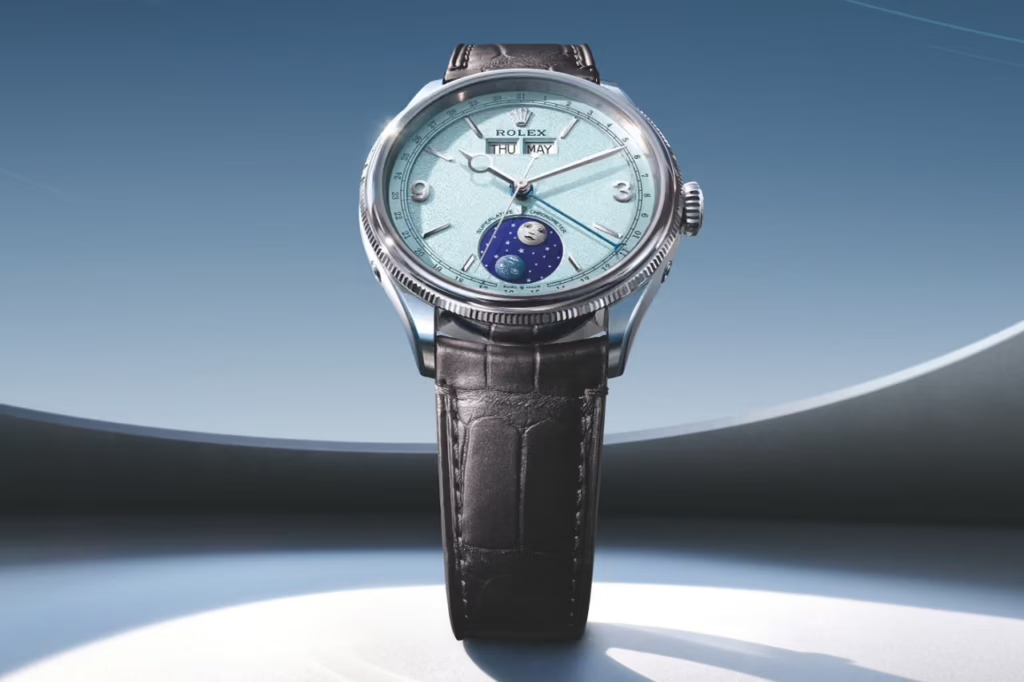
That was pretty much my reaction the second I saw it, before I knew much about the movement or started reading what everyone else thought. The moon faces are weird. The Arabic 3 and 9 are huge. There’s a lot happening on the dial. Somehow, when I look at the whole thing, it works. I’m not particularly interested in defending every individual design decision, either. To me, the strange combination of those elements is exactly what gives this watch some personality.
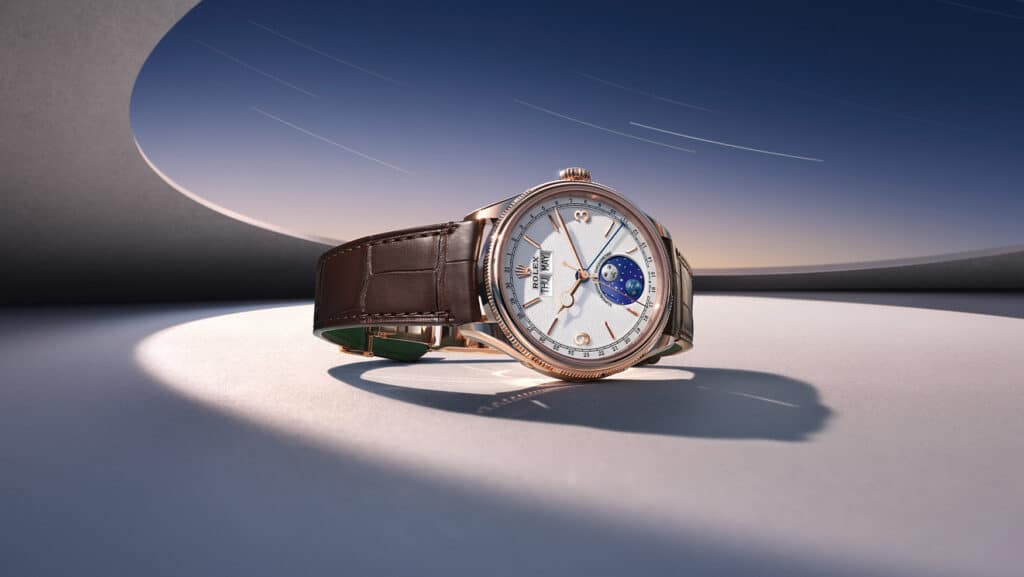
The Padellone name comes from the vintage Rolex ref. 8171, a complete calendar from the 1950s that collectors nicknamed after the Italian word for “frying pan.” Hilarious. Rolex has now officially adopted that nickname for this new watch. The modern version uses an annual calendar, so it automatically accounts for 30- and 31-day months and only needs a date correction once a year, at the end of February. The movement is where this release gets considerably nerdier.

Rolex developed the new automatic Calibre 7190 for the Rolex Perpetual Padellone, pairing its 5Hz Dynapulse escapement with a new annual calendar mechanism called Haplos. At midnight, the day, date, and month indications all jump instantaneously. You can also see the movement through the sapphire caseback, including Geneva-striped bridges and an 18K gold rotor. My take is that the Calibre 7190 gives me another reason to care about a watch I already liked on sight. There’s some legitimately interesting engineering here, especially from a company that tends to make relatively incremental changes to established models.

Still, I keep coming back to that face. The 39mm case surrounds a grained dial with day and month windows near 12, a pointer date around the perimeter, and the moonphase at 6. Rolex uses blue enamel for the moonphase disc, while the two moons themselves are meteorite appliqués. And yes, they have little faces. I love them.

Others very much do not. One reaction we came across simply read, “Wow, I hate it.” Another zeroed in on the same detail I like: “Sorry but those faces are not doing it for me at all…” I get it. The Padellone is a strange-looking Rolex. The oversized Arabic numerals compete for space with the calendar, and the upper half of the dial gets busy quickly. In my opinion, cleaning all of that up would also remove a lot of what attracted me in the first place.

Then we get to the uncomfortable part: price. The Everose model on leather starts at $59,000, with the platinum version coming in at $66,200. My favorite is the $72,800 Everose model on the seven-link Settimo bracelet. That is an enormous amount of money.

At those prices, comparisons with complicated watches from Jaeger-LeCoultre, Patek Philippe, Vacheron Constantin, A. Lange & Söhne, and others are inevitable. I think that’s completely fair, and I’m not prepared to argue that the Padellone represents some screaming value proposition based on photos and a spec sheet. I still seriously love the thing.

We haven’t handled one (and probably never will), so questions about the finishing, proportions, and how this fairly busy design comes across in person will have to wait. For now, I’m left with a Rolex that immediately grabbed me because it looks a little strange. In my opinion, Rolex could use more of that.

Co-Founder & Senior Editor
Michael Peñate is an American writer, photographer, and podcaster based in Seattle, Washington. His work typically focuses on the passage of time and the tools we use to connect with that very journey. From aviation to music and travel, his interests span a multitude of disciplines that often intersect with the world of watches – and the obsessive culture behind collecting them.