A chronograph can be the watch that makes us excited to check the time, or the watch we stop wearing once the novelty wears off. We’ve had both happen. The complication itself isn’t usually what decides it; it’s whether the whole thing makes sense once it becomes part of normal life. Some have turned timing something mundane into a reason to enjoy the watch more, while others have made us question why we were giving ourselves another function we rarely used. That distinction matters under $750, where a chronograph can be inexpensive enough to tempt an impulse purchase without being cheap enough to shrug off when it disappoints. After spending time with the options we’ve reviewed, we wanted to narrow the field to the ones that gave us a reason to keep wearing them. That’s what this list sets out to do.
Years of hands-on watch writing has given us plenty of opportunities to change our minds about what we thought we wanted. We’ve sold watches we expected to keep, returned to watches we thought we had outgrown, and found unexpected favorites in places that looked unremarkable at first. Accuracy has mattered more with some watches than others; so has learning how intuitive a complication feels after you’ve stopped thinking about how it works. Even wear over time tells us something a first impression can’t, particularly when scratches, fading finishes, or small annoyances start changing how a watch feels in the collection. Those experiences carry more weight here than a feature checklist. The result is a group of watches we’d genuinely consider keeping, along with the compromises we think are worth making—and the ones we don’t.
Dan Henry 1964 Gran Turismo
| Price: | $300 (Check Current Price) |
| Water Resistance: | 50m |
| Case Dimensions: | 39mm (diameter) x 44.7mm (lug-to-lug) x 12.9mm (thickness) |
| Lug Width: | 19mm |
| Movement: | Seiko VK63 mechanical-quartz |
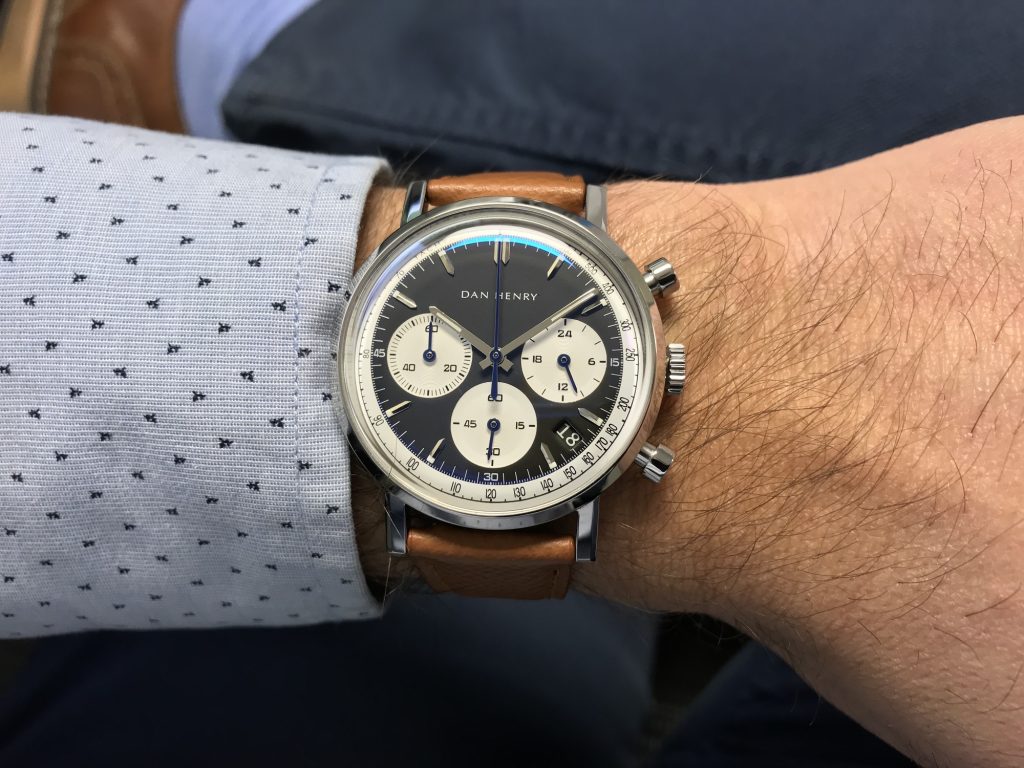
Chronographs can get visually busy fast, and the Dan Henry 1964 Gran Turismo takes the opposite approach without becoming boring. At 39mm, the case has enough presence to feel sporty but stays compact on the wrist, especially with those long lugs curving down around wrists from roughly 5.5 to 7 inches. The smooth bezel also helps it wear smaller than you might expect, while keeping the tachymeter tucked inside the dial instead of turning the bezel into another place to cram numbers. The result is a relaxed vintage racing look. For a chronograph under $750, that restraint is part of what makes the 1964 so easy to live with.
The lineup offers more flexibility than the restrained design suggests. Dan Henry offers four dial colors, plus date and no-date versions, and the evil panda configuration we wore and tested hands-on gets the 3-6-9 layout right without letting the date become visual clutter. The color-matched date wheel mostly stays in the background, while the blue hands add some welcome contrast. They’re chemically blued rather than heat blued, so they don’t have quite the same depth or changing character in the light. That’s a forgivable shortcut at this price, especially when the overall dial is this cohesive. We’d take the personality over another supposedly premium detail that exists mainly to pad the brochure.
Underneath, the VK63 meca-quartz movement makes the 1964 easy to own while preserving some of the tactile fun we want from a chronograph. The pushers have a crisp mechanical snap when starting and resetting, so timing something mundane can become enjoyable (which is pretty much the chronograph’s entire excuse for existing).
The beads-of-rice bracelet is comfortable for long stretches and gives the watch convincing vintage texture, while the included leather strap makes it a little more polished. Switching between them is less convenient without quick-release hardware, though. For us, that leaves the 1964 in a sweet spot: plenty of character, sensible proportions, easy ownership, and just enough quirks to remind us we bought a watch rather than a spreadsheet.
Pros
- The VK63 meca-quartz gives the pushers a satisfying mechanical feel without complicating ownership.
- The 39mm case and curved lugs work quite well on smaller and medium-sized wrists.
- The internal tachymeter keeps the racing aesthetic from becoming dial-and-bezel overload.
- The beads-of-rice bracelet is comfortable and adds the right amount of vintage texture.
Cons
- Bracelet swaps are more fiddly than normal without quick-release hardware.
- The chemically blued hands look good but don’t have the richer visual depth of heat bluing.
- The smooth bezel and compact proportions may feel smaller than expected for anyone wanting a more substantial racing chronograph.
Undone Watches Urban Chronograph
| Price: | $265 – $400 (Check Current Price) |
| Water Resistance: | 30m |
| Case Dimensions: | 40mm (diameter) x 47.6mm (lug-to-lug) x 12.7mm (thickness) |
| Lug Width: | 20mm |
| Movement: | Hattori VK61A |
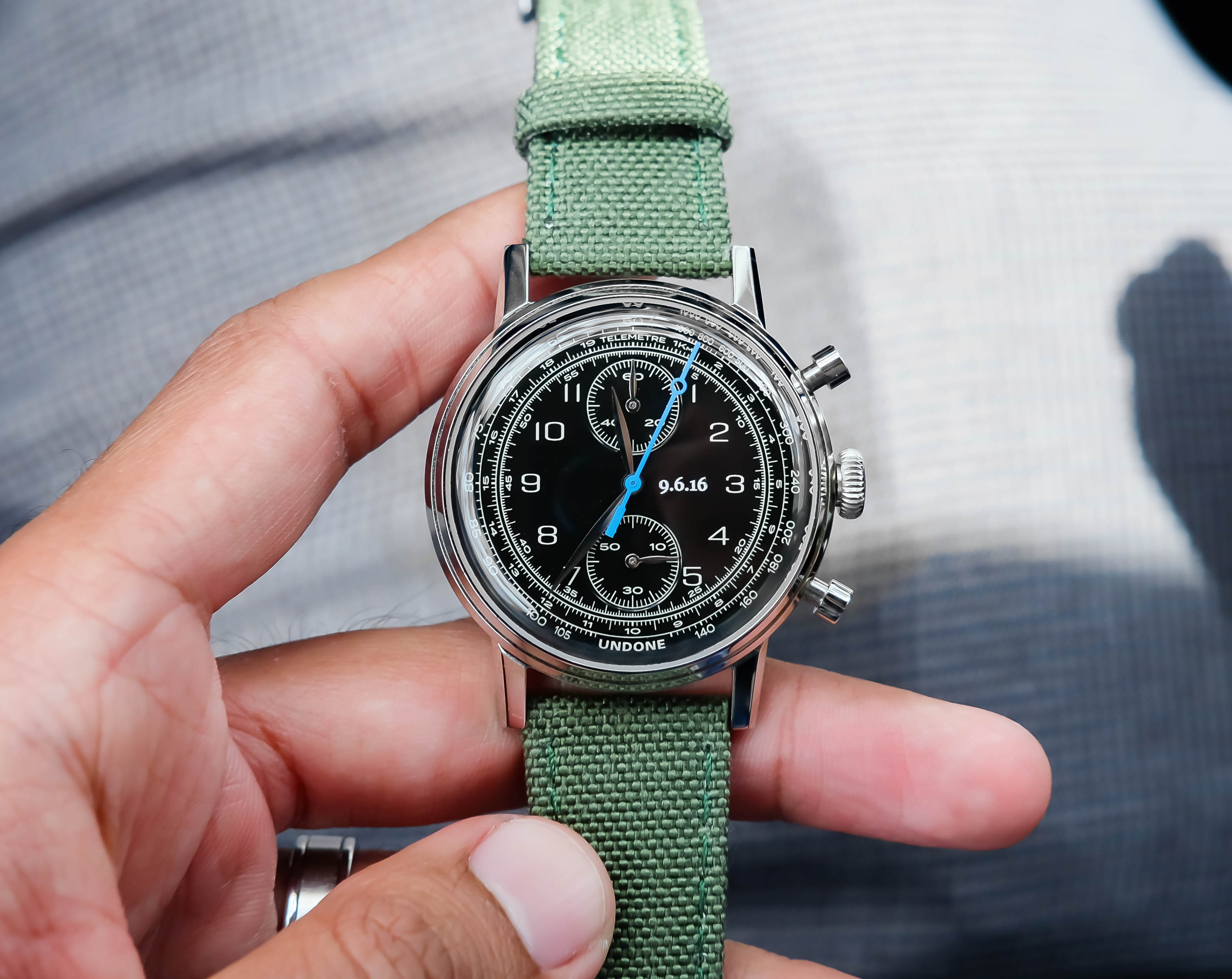
The Undone Urban Chronograph takes a different route to making a chronograph feel personal under $750. We spent as much time choosing the watch as we did wearing it, which is the whole point of Undone’s customization approach. Starting with the Navi layout, we could change the hands, add the TBWS founding date to the dial, and even put our logo on the exhibition caseback. Once it arrived, though, the customization stopped being the novelty, and the watch had to stand on its own. Fortunately, the 40mm case and roughly 47mm lug-to-lug give it a compact vintage-chronograph feel, with sharply angled lugs that slope down toward the wrist. The round profile, smooth fixed bezel, and domed hardened mineral crystal reinforce that old-school shape, while the mix of brushed case surfaces and polished bezel and caseback keeps it from feeling like a vintage replica.
The pushers are one of those details that make more sense once you hold the watch. They protrude cleanly from the otherwise rounded case and give us something satisfying to interact with without looking over-engineered. The same restraint carries into the dial presets, which are generally well balanced even before customization. Our silver leaf hands caught the light nicely thanks to their beveled surfaces, adding some movement to the display, although that same effect can hurt legibility in certain lighting. The custom chronograph second hand uses a matte finish that contrasts neatly with the polished hands, and the custom-printed “9.6.16” date on the dial looked properly considered rather than slapped on as an afterthought. The exhibition caseback customization held up through hot, humid wear, with the printed design showing no signs of peeling or fading.
The Hattori VK61A meca-quartz movement is arguably the easiest part of the watch to appreciate. Its quartz base keeps ownership simple, with roughly three years of battery life and a stated accuracy of around 20 seconds per month, while the mechanical chronograph action gives the pushers that crisp click and snap-back we want from the complication. The 20mm quick-change straps also make the watch easy to tailor after the initial design process. Our green Cordura option found a useful middle ground, neither too bulky nor too flimsy, with a canvas upper, leather underside, slight taper, and enough structure to hold the watch securely. That strap should show normal wear without falling apart prematurely.
For collectors who enjoy having a hand in the creative process and want a chronograph that feels genuinely their own, the Urban is unusually engaging. However, the brand itself becomes less important once the watch is personalized. That is arguably part of the appeal. For a closer look at the customization, meca-quartz action, and what we thought after living with it, read our full hands-on review.
Pros
- Customization lets you alter key dial, hand, and caseback details instead of simply choosing from fixed brand configurations.
- 40mm case and approximately 47mm lug-to-lug give the watch an easy-to-wear vintage chronograph footprint.
- The VK61A meca-quartz combines roughly three years of battery life with satisfying mechanical chronograph action.
- 20mm quick-change Cordura strap balances canvas texture with a comfortable leather underside.
- Custom caseback printing held up well through hot and humid wear without obvious fading or peeling.
Cons
- The beveled silver hands can become difficult to read in certain lighting.
- The hardened mineral crystal is less reassuring for long-term scratch resistance than sapphire.
- The polished bezel and caseback can show wear more readily than the brushed case body.
- Buyers who prefer a fixed, traditional brand identity may find the customization-first approach less meaningful once the personalization wears off.
Dan Henry 1972 Alarm Chrono

| Price: | $370 (Check Current Price) |
| Water Resistance: | 50m |
| Case Dimensions: | 41mm (diameter) x 45.5mm (lug-to-lug) x 12.7mm (thickness) |
| Lug Width: | 20mm |
| Movement: | Miyota OS80 quartz |
The Dan Henry 1972 Alarm Chrono earns its place under $750 by doing something most affordable chronographs don’t: giving us a complication we might actually use without turning the watch into another generic stopwatch. The alarm is the real personality here. Set it, switch it on, and the watch gives you its old-school triple-beep when the appointed time arrives. After getting used to seeing GMTs and pointer dates everywhere, having a watch tell us when it’s time to stop staring at our phones is satisfying. The 41mm case also wears much smaller than the diameter implies because there are barely any lugs to add length. At 45.5mm lug-to-lug, it sits neatly against the wrist, while the bead-blasted matte-silver finish gives the case a soft, satin character we rarely see at this price.
The dial is busy, but it’s busy with purpose. Eight hands, three subdials, the alarm indicator, tachymeter, and date window all share limited real estate, yet the black dial and white main hands make basic timekeeping surprisingly quick. The tachymeter sits on the chapter ring rather than the bezel, allowing larger numerals that are easier to pick out. We also liked the sandwich construction, with recessed lumed markers and subdial crosshairs adding depth that photographs don’t really convey. The 12-9-6 register arrangement still isn’t our favorite, and the small date at 3 o’clock gets surrounded by enough printing to make it harder to read at a glance. The blue chronograph second hand also feels slightly cooler than the rest of the design, although it works with the silver case.
The Miyota OS80 is a straightforward quartz workhorse, but it suits the 1972’s slightly eccentric mission. There’s no running second hand, so anyone irritated by the constant quartz tick gets a welcome break. The chronograph, 1/10-second counter, minute and 12-hour functions, alarm, and date are more involved than on a basic chrono, though, and there’s no paper manual in the box. Once we figured everything out, the alarm became the feature we actually kept using. The bracelet is another pleasant surprise. Its unusual 24mm first link flows neatly into the lugless case before tapering to 18mm at the clasp, and the clasp itself feels reassuringly solid. It also wore comfortably on a 6.75-inch wrist. The catch is sizing: Dan Henry uses pins instead of screws, and ours were stubborn enough to make the process an exercise in patience.
For collectors building an affordable collection, the 1972 makes sense when a conventional chronograph feels a little too predictable. It can play the driver or flyer role without simply adding another familiar timing complication to the box. The biggest problem is internal competition, since the Dan Henry 1963 and 1964 offer cleaner, more immediately approachable takes on the chronograph format. The 1972 earns its spot by being the oddball, especially for someone who wants useful complications and a watch with enough personality to start a conversation. For the full breakdown of its wear, controls, and alarm function, check our in-depth review.
Pros
- Practical alarm complication gives the watch a function beyond the usual chronograph and GMT fare.
- 41mm case with an unusually short 45.5mm lug-to-lug wears more compactly than expected.
- The bead-blasted matte-silver finish adds distinctive texture without relying on excessive polishing.
- Sandwich dial construction, large chapter-ring tachymeter numerals, and high-contrast hands keep a complicated display quite usable.
- The comfortable bracelet has a substantial clasp and tapers from an unusual 24mm first link to 18mm at the clasp.
Cons
- The small date window can get lost among the surrounding dial text.
- The 12-9-6 subdial layout is less balanced to our eye than a conventional 3-6-9 arrangement.
- Bracelet sizing is frustrating because the pins are quite stubborn.
- More complicated controls are harder to learn without the digital instruction manual.
- The alarm and extra functionality can be unnecessary for collectors who simply want a straightforward chronograph.
Citizen Navihawk

| Price: | $595 (Check Current Price) |
| Water Resistance: | 200m |
| Case Dimensions: | 40mm (diameter) x 44.3mm (lug-to-lug) x 13.4mm (thickness) |
| Lug Width: | 20mm |
| Movement: | Eco-Drive caliber B620 |
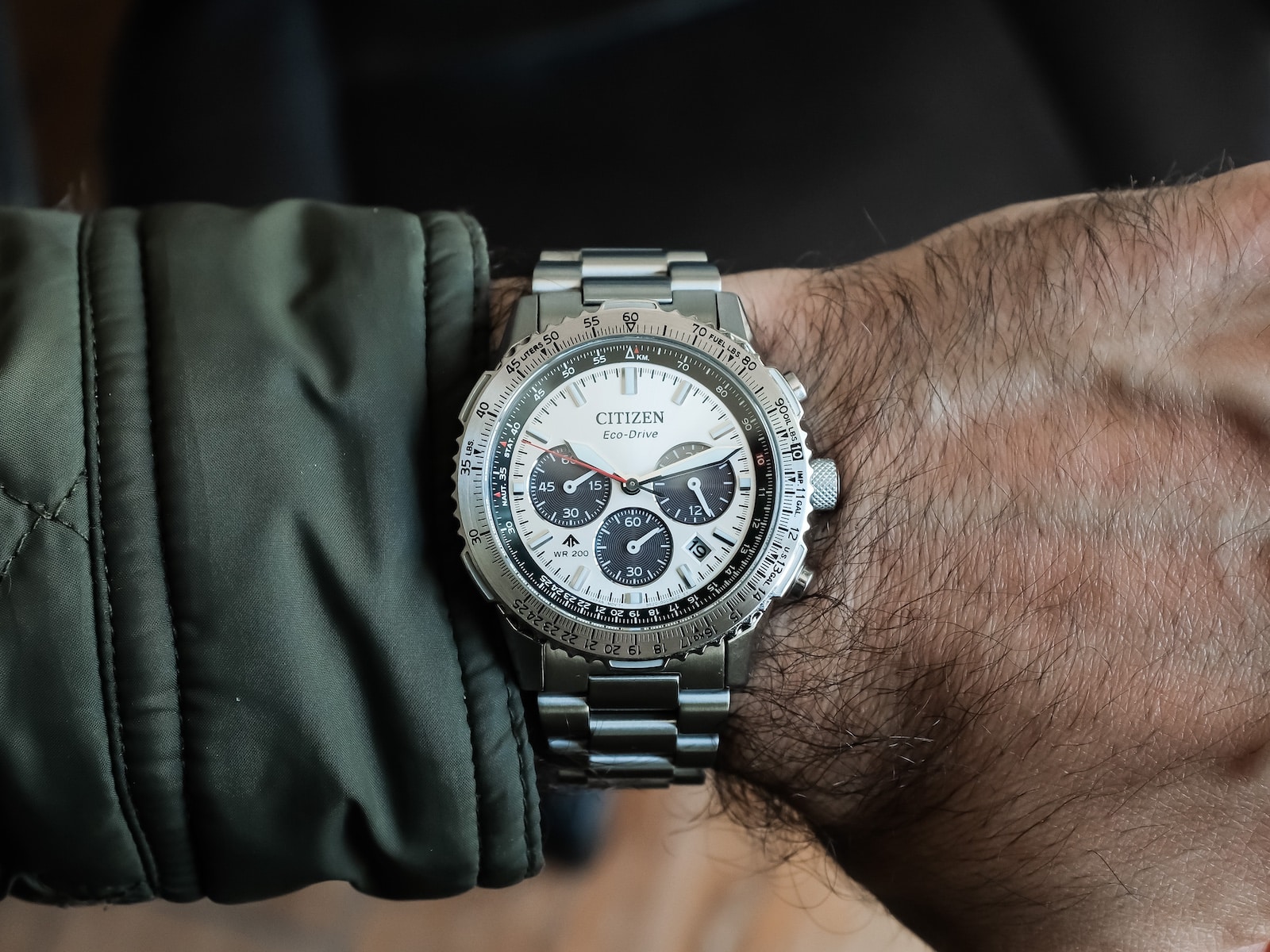
The Navihawk 40 is the kind of chronograph that makes us question how much information we actually want on a watch—and then makes us use most of it anyway. At 40mm with a 44.3mm lug-to-lug, it avoids the oversized feel we associate with older Navihawk designs, so the slide rule, 24-hour display, and chronograph don’t turn the wrist into an aviation instrument panel. We wore it for a week expecting to move on to something simpler, but we kept finding reasons to leave it on.
The case helps: broad brushing gives it the expected tool-watch attitude, while polished accents and the coin-edge bezel add enough definition to keep the smaller format from feeling neutered. Sapphire and 200m water resistance also make this an easy watch to throw into the day without much babysitting. The deeply recessed date is the one feature that made us work harder than necessary.
Citizen’s trick is to make the busy dial less busy the longer we wear it. The three textured black subdials give the silver-white sunburst dial some visual landmarks, while the restrained red accents help guide our eyes through the information. The white subdial hands also remain distinct from the main handset, which matters when we’re checking something quickly rather than admiring the dial from six inches away. Even the slide rule eventually becomes background furniture. That’s a meaningful achievement on a watch with this much going on. The bracelet had a similar effect on us. We assumed it would be the first thing to go, but its secure clasp and comfortable fit kept it on the watch. An on-the-fly adjustment would make that easier to fine-tune, but we didn’t find ourselves reaching for a strap just to escape it.
Then there’s the Eco-Drive B620, which turns a watch this complicated into something very easy to own. Citizen rates it around ±15 seconds per month with approximately six months of runtime from a full charge, but the bigger win is never having to think much about the movement. That made the chronograph function something we actually used—timing coffee, workouts, cooking, parking, and other deeply glamorous activities. We did notice some vertical bezel play on our sample, though it never caused a practical problem.
For this list, that combination is hard to dismiss: the Navihawk gives us a pile of information and plenty of personality while remaining an honest daily wearer. The catch is equally clear. Anyone looking specifically for the tactile ritual and mechanical charm of a traditional chronograph will probably find the Eco-Drive experience a little too sensible. For a closer look at how all that complexity works together on the wrist, see our full hands-on review.
Pros
- 40mm dimensions and 44.3mm lug-to-lug make the watch surprisingly wearable despite its dense feature set.
- Eco-Drive B620 offers low-maintenance ownership with strong rated accuracy and roughly six months of runtime.
- The layered dial design becomes intuitive quickly, with textured subdials and red accents helping separate the information.
- The combination of a sapphire crystal and 200m water resistance makes it easy to treat as a genuine daily watch.
- The bracelet is secure, comfortable, and better integrated than we initially expected.
Cons
- No on-the-fly bracelet adjustment limits fine-tuning during the day.
- Our review sample had some noticeable vertical bezel play.
- The recessed date display is awkward to read, particularly from an angle.
- The Eco-Drive approach won’t satisfy buyers specifically looking for the feel and ritual of a mechanical chronograph.
Vaer R1
| Price: | $539 (Check Current Price) |
| Water Resistance: | 100m |
| Case Dimensions: | 38mm (diameter) x 46mm (lug-to-lug) x 12.6mm (thickness) |
| Lug Width: | 20mm |
| Movement: | Seiko VK-63 meca-quartz |
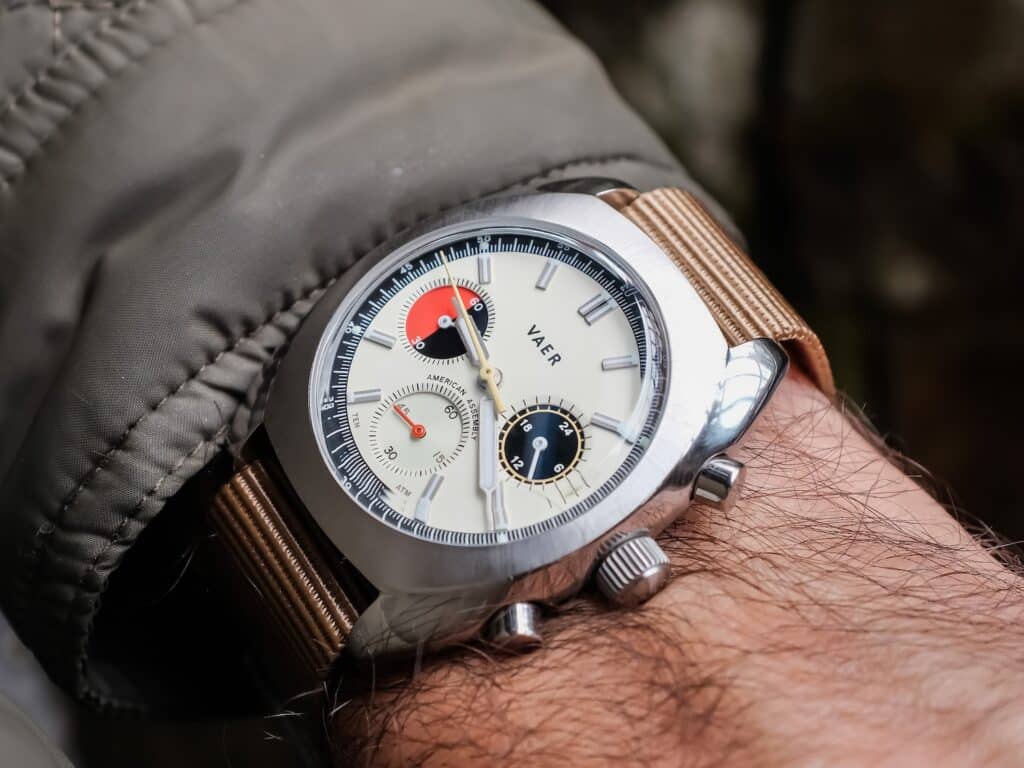
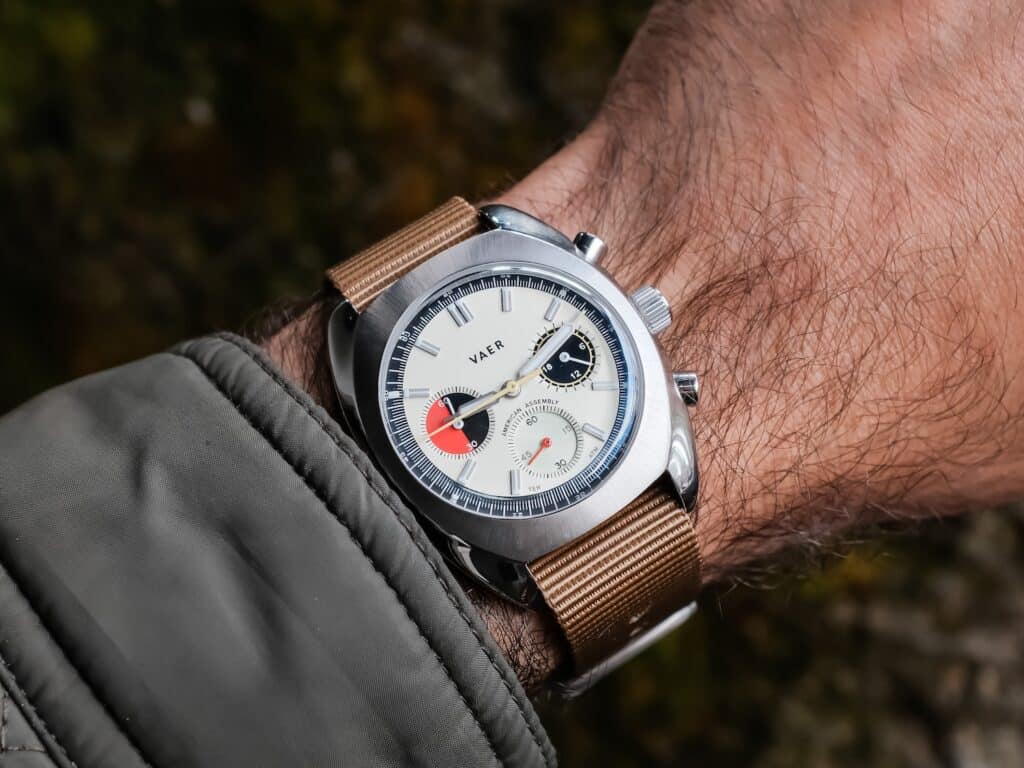
The Vaer R1 makes a convincing case for the chronograph as a break from dive-watch duty without giving up the parts of dive-watch ownership we’ve come to appreciate. At 38mm with a 46mm lug-to-lug, it has a vintage-sized presence that feels compact without becoming dainty. There’s no rotating bezel here, but the screw-down crown, 100 meters of water resistance, and domed sapphire crystal still give it enough everyday toughness that we never felt the need to treat it like a delicate weekend guest. That matters for a sub-$750 chronograph. We could wear the R1 with the same casual disregard we’d bring to a tool watch, rather than mentally switching into “careful, expensive thing” mode every time we put it on.
The meca-quartz setup reinforces that easygoing character. Accuracy is dependable, maintenance stays uncomplicated, and the pushers have the crisp mechanical snap that makes the chronograph worth fiddling with even when we have no important timing to do. The dial also deserves credit for finding personality without tipping into costume territory. Its cream base and orange-and-yellow accents give the R1 a distinctly vintage flavor, but after extended wear, it never felt like we had dressed for a theme party. The polished edges on the hands can disappear into the dial in some lighting, so legibility isn’t flawless, but it rarely stopped us from wearing the watch naturally.
Strap choice changes the feel more than we expected. The NATO sits flatter and feels more comfortable over long stretches, while the bracelet adds heft for anyone who prefers a more substantial presence. The rubber option was the least convincing of the three and never felt as cohesive as the NATO. Lume is another weak point; coming from a dive watch background, we noticed how quickly it faded. Still, neither issue outweighed the basic pleasure of wearing the R1.
Overall, it occupies a useful place under $750 for collectors who want a chronograph with genuine tool-watch manners, especially those coming from divers and unwilling to start babying their watch. We got into the R1’s strengths and quirks in much more detail in our full hands-on review, including how it wears and handles day-to-day.
Pros
- The vintage-leaning 38mm case stays compact while retaining enough presence for daily wear.
- Screw-down crown, domed sapphire, and 100m water resistance make it easy to wear without much fuss.
- Meca-quartz movement keeps ownership simple while giving the pushers a satisfyingly mechanical feel.
- The NATO strap wears flatter and more naturally than the rubber option.
Cons
- Polished hand edges can disappear against the dial in certain lighting.
- The rubber strap feels less cohesive than the NATO or bracelet.
- Lume fades faster than we’d expect from a watch with strong tool-watch intentions.
- The 46mm lug-to-lug gives the watch a longer footprint than its 38mm diameter suggests.
Gavox The Roads Chronograph
| Price: | $550 (Check Current Price) |
| Water Resistance: | 100m |
| Case Dimensions: | 41mm (diameter) x 51mm (lug-to-lug) x 12mm (thickness) |
| Lug Width: | 20mm |
| Movement: | Ronda 5130D quartz chronograph |
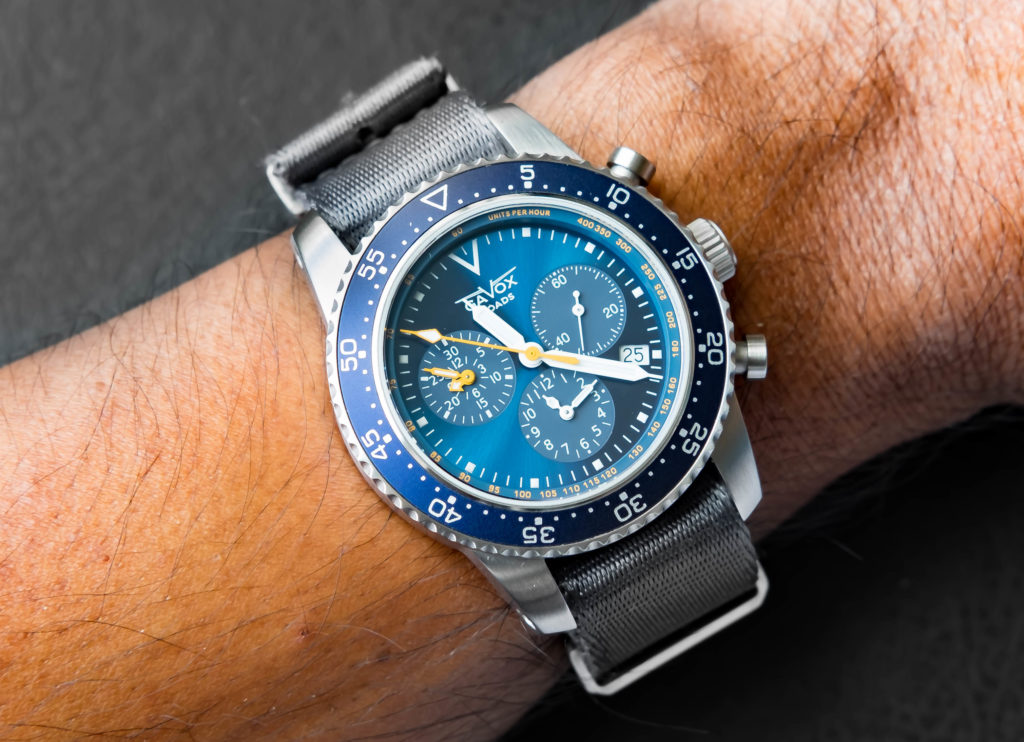
The Gavox Roads is refreshingly unapologetic about what it wants to be. It isn’t trying to disguise its functionality behind a minimalist dial or dress up as a vintage racer. The 41mm case and 51mm lug span give it a substantial footprint, but the sharply dropping lugs keep that footprint under control, pulling the watch down against the wrist instead of letting it perch awkwardly above it. We noticed the weight, too. There’s a lot of steel here, although the fully brushed, matte finish makes that heft feel purposeful rather than cumbersome. The 120-click rotating bezel extends just beyond the case and gives us enough purchase to turn it without becoming the visual centerpiece. For a chronograph under $750, it feels like something designed to be used rather than fussed over.
The Ronda 5130D is where the Roads earns much of its practical appeal. Beyond the usual chronograph duties, it offers a long-running totalizer that tracks up to 12 hours in 30-minute increments, plus an alarm and the dependable quartz accuracy we want in a tool watch. On an actual road trip, those features stop looking excessive—you can use the chronograph for driving shifts or keep track of time between stops without reaching for your phone.
As noted in our dedicated review, the dial is busy, but we found it quick to parse. The various markers, tracks, and subdials have enough separation to keep them from collapsing into visual soup. At the same time, the illuminated Gavox V and perimeter squares provide useful orientation in the dark. The bezel itself remains unlumed, which is a drawback when visibility gets poor.
The bracelet turned out to be one of the better parts of the package. Its all-brushed finish matches the case, the links feel more substantial than expected, and the lack of taper spreads the weight evenly so the watch stays planted through the day. Sizing can be a little frustrating because the micro-adjustments feel stiff. At the same time, the included leather strap never sat as naturally on our wrist, even though the vents underneath help with breathability. The screw-down crown and 100m water resistance add useful reassurance when a road trip turns into a stop somewhere near the water. Overall, the Roads makes sense for someone who wants a chronograph where the added functions actually earn their space, and who doesn’t mind a larger, heavier watch in return for that capability.
Pros
- The sharply angled lugs make the 51mm footprint more manageable than the dimensions suggest.
- Ronda 5130D adds a useful alarm and 12-hour totalizer alongside the chronograph.
- Fully brushed, non-tapering bracelet feels solid and spreads the watch’s weight evenly.
- Vents underneath the leather strap improve breathability.
- Busy dial remains easy to navigate, with thoughtful lume placement helping after dark.
Cons
- The leather strap feels less comfortable and natural than the bracelet.
- The unlumed bezel limits the watch when visibility is poor.
- Bracelet micro-adjustments can be stubborn when sizing the watch.
Bulova Marine Star
| Price: | $695 (Check Current Price) |
| Water Resistance: | 200m |
| Case Dimensions: | 45mm (diameter) x 51.5mm (lug-to-lug) x 15mm (thickness) |
| Lug Width: | 22mm |
| Movement: | Miyota 6S20 Quartz |
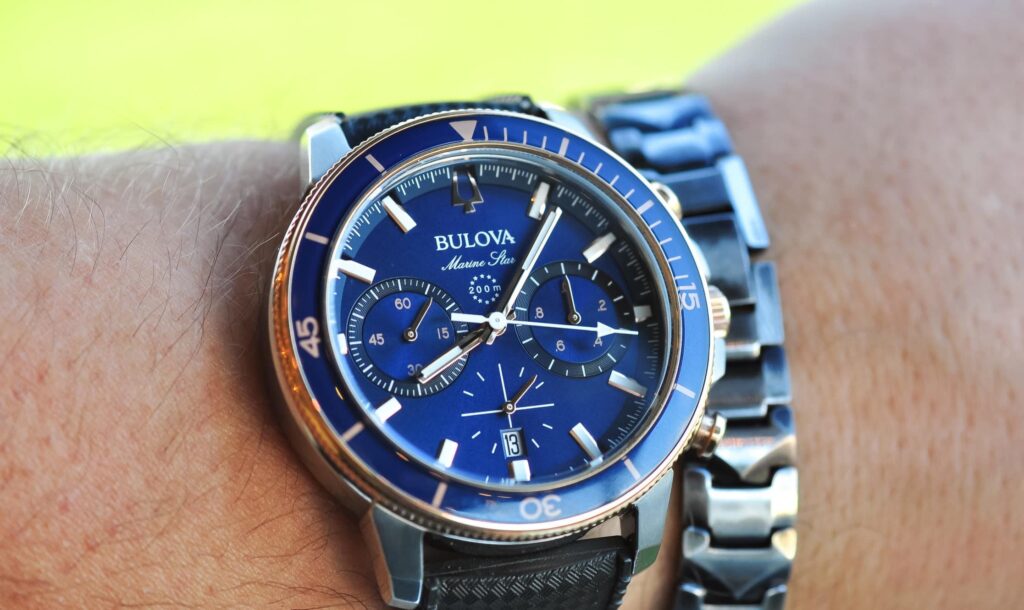
The Bulova Marine Star Chronograph is a little strange for this list because it gets so much right, then reminds us why Bulova can still feel like a mall-watch brand. At 45mm wide and 15mm thick, it is a substantial watch, and the side-by-side comparison with the Lunar Pilot made that size impossible to ignore. Yet the blue dial, gold accents, and classic round case give it a handsome presence once it’s on the wrist. The coin-edge bezel frames an acrylic insert with a nice dimensional quality, while the mix of brushed and polished surfaces gives the case some welcome definition. Unfortunately, the coarse brushing on the sides looks like someone attacked it with sandpaper and called it a day. Still, the 200m water resistance, screw-down crown, and 120-click bezel are a meaningful upgrade over the 100m rating found on other recent Marine Stars, and the bezel turns with very little play.
The dial is where this Marine Star makes its strongest argument under $750. The navy-blue sunburst surface has enough depth to reward closer inspection without getting lost beneath the chronograph hardware. Applied, lume-painted indices sit inside a beveled chapter ring, making the dial appear more compact than the case actually is. We particularly liked the crosshair running-seconds register, while the white chronograph second hand does a much better job of staying visible against the dark blue than some of the more decorative choices we’ve seen at this price. The gold hour and minute hands also have black center stripes and white lume. The layout is busy, but reading the time is straightforward. The date at 6 o’clock is useful, although the date wheel can look cheap and sometimes sits slightly off-center.
The quartz movement brings the familiar Miyota-style experience we’ve seen elsewhere in this price range. Accuracy is around ±20 seconds per month; the chronograph seconds hand sweeps at four ticks per second, and pressing the pushers produces the satisfying click and snap-back we want from an affordable chrono. The 1/20-second counter whirls rapidly for the first 30 seconds, but since the movement doesn’t give us meaningful precision at that level, the function feels more like visual theater than something we’d rely on. This would have been an ideal place for Bulova’s higher-frequency UHF chronograph technology.
The bracelet is another clear weak spot. Despite solid links and a dive extension, it feels tinny and cheap, and the stamped clasp does nothing to rescue it. We’d happily put it on a tropic strap instead, which gives the watch a more relaxed character and hides some of the bracelet’s shortcomings.
That leaves the Marine Star as an appealing near-miss. It may be one of the best-looking watches to carry the Marine Star name in years, and its 200m water resistance makes the dive-watch side of its personality more than decoration. But the oversized case, disappointing bracelet, rough side brushing, and slightly cheap date wheel keep it from feeling as polished as its strongest competitors under $750. For someone who wants a big chronograph with a dressier blue-and-gold look and genuine water resistance, it has plenty going for it. For a collector chasing the most refined ownership experience in this price bracket, we’d keep looking. For our full hands-on take, read our review.
Pros
- 200m water resistance and a screw-down crown give the Marine Star more genuine everyday water capability than most of its siblings.
- Acrylic bezel insert adds convincing vintage-diver depth to the otherwise modern case.
- Navy sunburst dial, crosshair subdial, and applied lume-filled markers create a cohesive display.
- Chronograph pushers have a satisfying click, while the central second hand sweeps at four ticks per second.
- The 120-click bezel operates smoothly with minimal play.
Cons
- Coarse side brushing looks noticeably less refined than the rest of the case.
- The bracelet feels tinny despite its solid links, with a bland stamped clasp.
- The 1/20-second counter adds visual motion without offering especially useful precision.
- The date wheel can look inexpensive and sit slightly off-center.
Bulova Lunar Pilot
| Price: | $550 – $750 (Check Current Price) |
| Water Resistance: | 50m |
| Case Dimensions: | 45mm (diameter) x 52mm (lug-to-lug) x 13.5mm (thickness) |
| Lug Width: | 20mm |
| Movement: | 262 kHz Quartz |
The Lunar Pilot earns its spot under $750 because its appeal doesn’t depend on pretending quartz is something it isn’t. Bulova has a genuine Apollo 15 connection here, and we like that the watch wears that history without turning into a souvenir with a stopwatch attached.
The high-frequency quartz movement is part of the point, too. It’s rated to around 10 seconds per year, while the chronograph second hand moves with a smooth sweep that gives the watch some of the visual theater we usually associate with mechanical chronographs. We found that combination quite satisfying in use: excellent accuracy without winding, setting, or servicing a mechanical chronograph every few years. For collectors who enjoy the story behind a watch as much as the mechanics inside it, that gives the Lunar Pilot an angle most watches in this price range can’t fake.
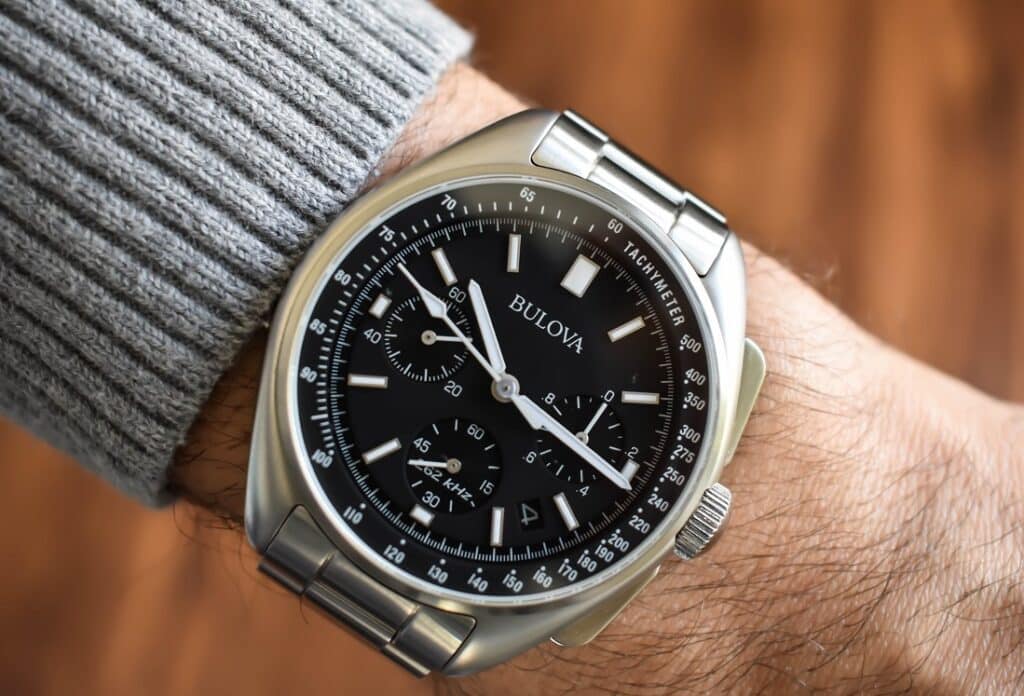
The catch is sitting squarely on the wrist. At 45mm, the 316L stainless steel case is big, full stop. That size does give the dial room to breathe, though, and the 1/10-second counter, running seconds, and minute totalizer stay easy to read rather than becoming a cramped collection of little circles. The date at 4:30 stays reasonably discreet, and the signed crown and pushers add welcome character. The bracelet also deserves more credit than it initially gets because its integration with the case keeps the watch feeling more balanced than the diameter indicates. While testing it hands-on, we preferred it to a strap, which made the Lunar Pilot feel even bigger. Look closely, and the case and bracelet finishing aren’t perfectly matched, either.
This isn’t the chronograph we’d choose for someone hunting for a compact, do-anything daily wearer, and the modest water resistance reinforces that limitation. But that’s not really the Lunar Pilot’s job. It’s for the collector who wants a substantial watch, appreciates an authentic space-era connection, and would rather have exceptional quartz accuracy than spend every morning negotiating with a mechanical movement. The size will eliminate it for plenty of wrists, and the bracelet is almost essential to keeping it in check. For the right wearer, though, something is refreshing about a watch that doesn’t need to borrow mechanical romance or pretend to be understated to earn its wrist time.
Pros
- High-frequency quartz accuracy of around 10 seconds per year is easy to live with.
- Smooth-sweeping chronograph second hand adds tactile and visual charm uncommon among quartz chronographs.
- The generous dial keeps the three chronograph registers legible rather than cramming them together.
- The integrated bracelet does a good job of controlling the presence of the 45mm case.
- Genuine Apollo 15 history gives it a collector story that isn’t manufactured for the marketing copy.
Cons
- The 45mm case is simply too large for many wrists.
- Strap wear makes the already substantial case feel even more cumbersome.
- The case and bracelet don’t quite share the same finishing character up close.
We’ve kept this list to chronographs we’ve actually reviewed and handled, because there’s not much value in recommending a watch we’ve only met through a press photo. If you think we’ve overlooked a worthy chronograph under $750, let us know in the comments. We’re always happy to add another watch to the review queue and put some real wrist time behind the recommendation.

Co-Founder and Senior Editor
Kaz has been collecting watches since 2015, but he’s been fascinated by product design, the Collector’s psychology, and brand marketing his whole life. While sharing the same strong fondness for all things horologically-affordable as Mike (his TBWS partner in crime), Kaz’s collection niche is also focused on vintage Soviet watches as well as watches that feature a unique, but well-designed quirk or visual hook.