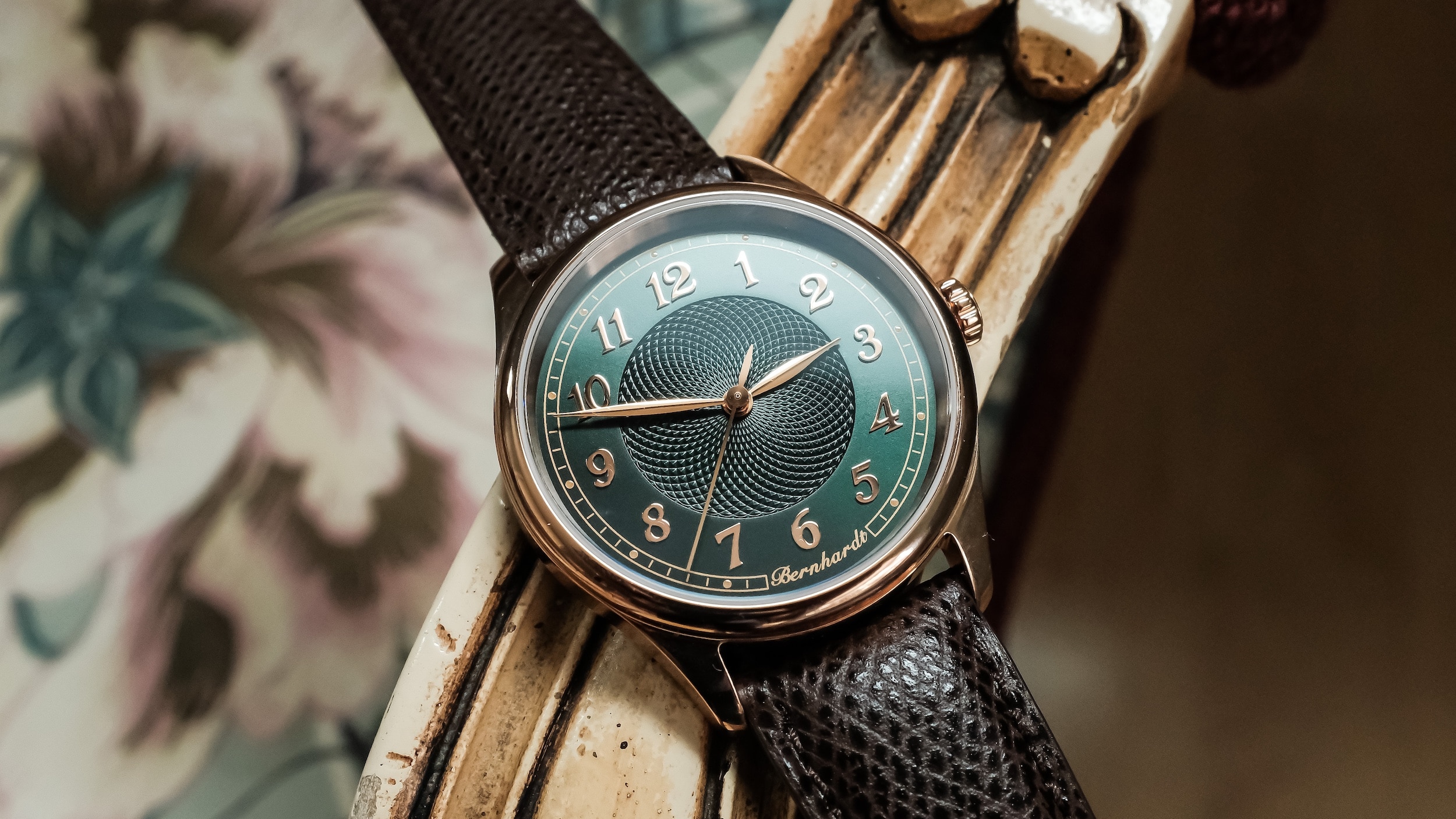
Here we go again. I’m spending time with a rose gold-coated, dressier watch, which is pretty far outside my usual collecting habits. Still, I’ve found that I learn a lot about my tastes whenever I force myself into these little explorations. In this case, I’m glad I did. For as long as I can remember, I’ve associated Bernhardt with the Binnacle Diver. So when the brand reached out to share something with TBWS, I was surprised to see the Captain, a newer, dressier offering that comes in at under $1,000.
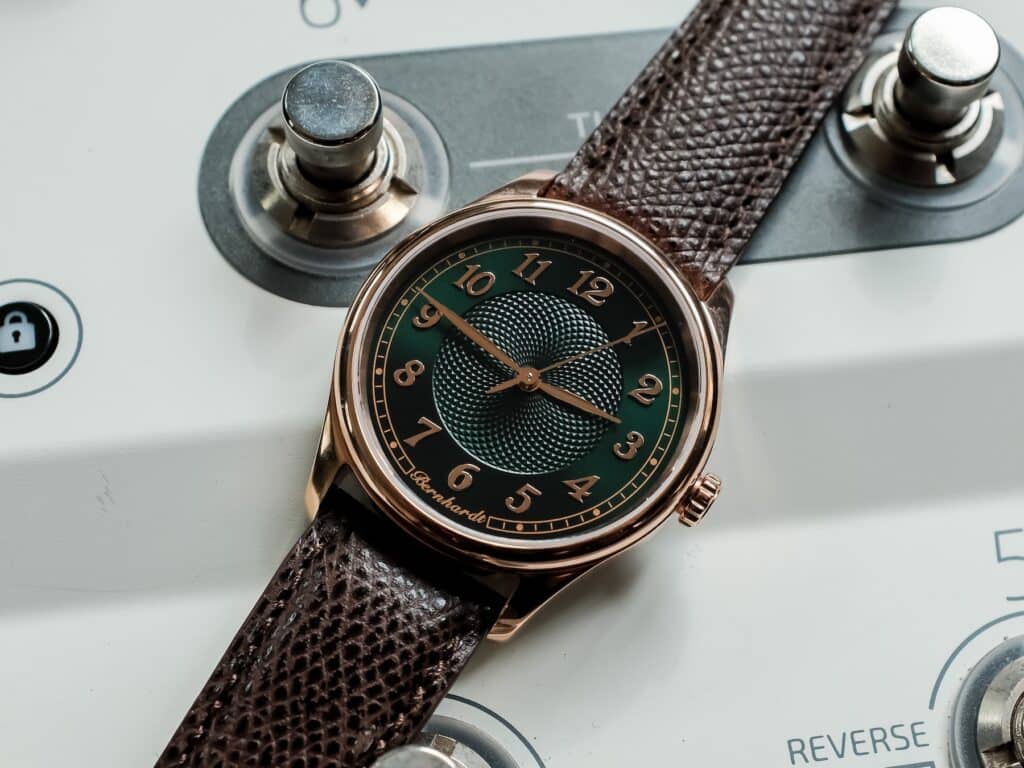
And apparently I have a thing for green dials paired with gold case tones. I felt it with the Mido Commander Datoday I reviewed here, and I’m feeling it again here with the Captain’s Cypress green guilloché dial and rose gold PVD treatment. There’s something about that combination that keeps getting me. So, once again outside my comfort zone, I spent some time with the Bernhardt Captain.
The Cypress Dial
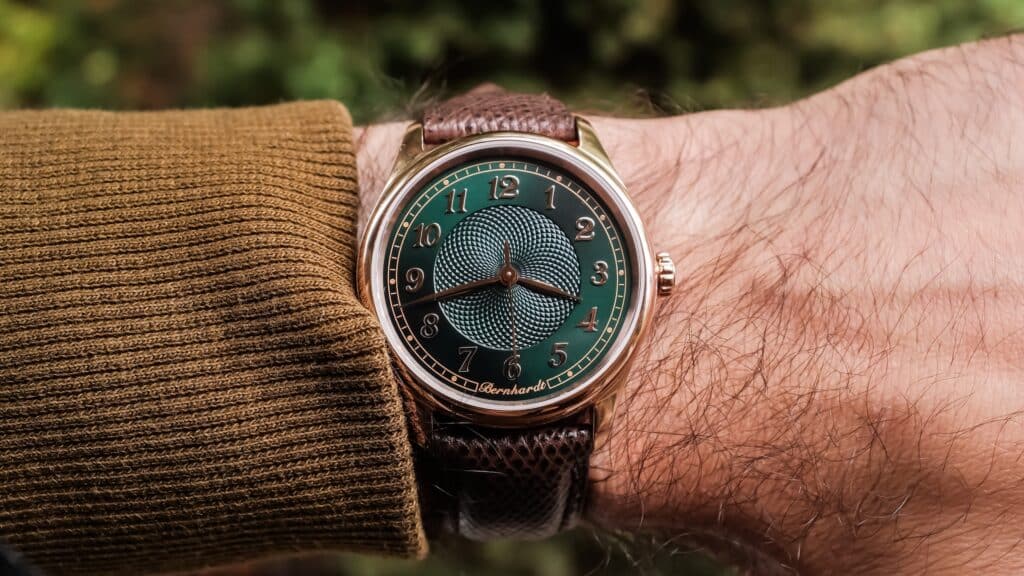
After wearing the Captain for the last few weeks, I’ve started thinking of it as an everyday watch for someone who doesn’t necessarily want an everyday sports watch. More surprising for me was how naturally it worked its way into my normal rotation. I expected the dressier styling and rose gold treatment to require some adjustment, and there was some of that early on. After a while, I stopped thinking about either of those things and simply started wearing it.
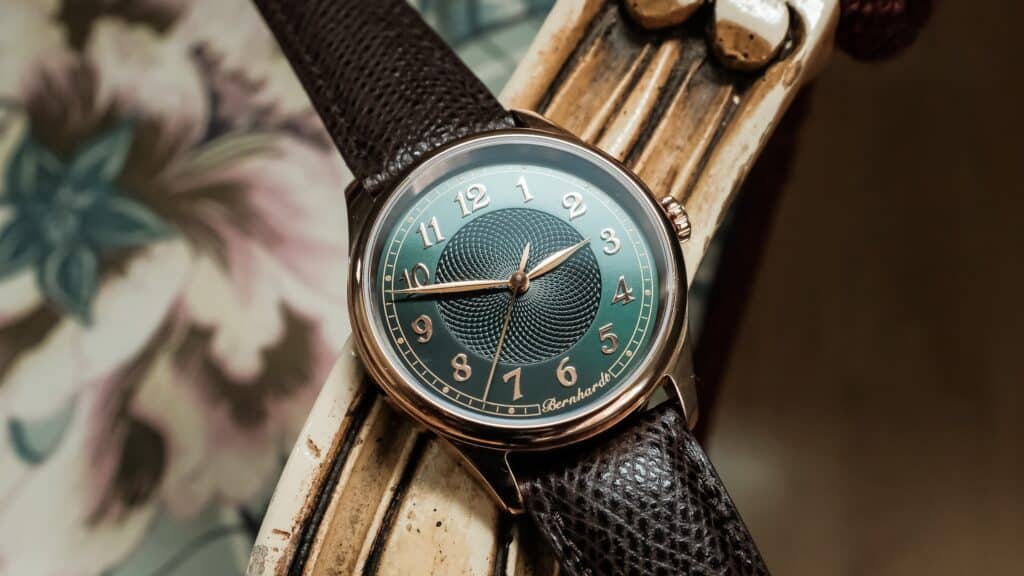
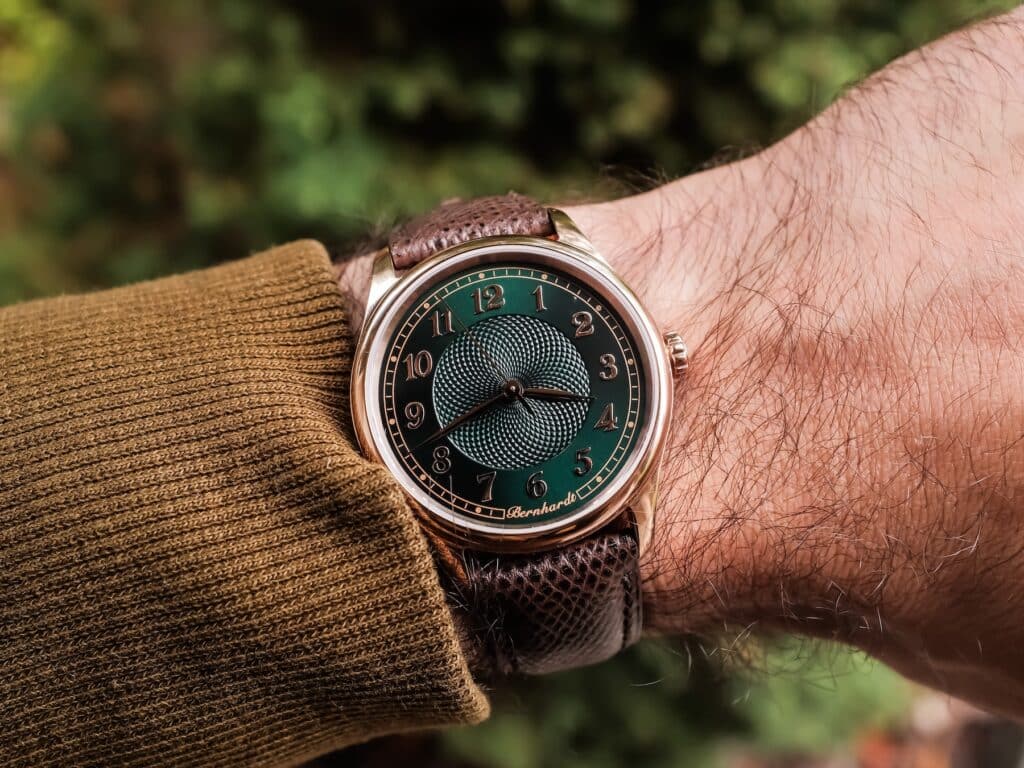
A lot of my enjoyment came back to the dial, and I suspect this is where most people will figure out whether the Captain works for them. Bernhardt launched three versions, with this Cypress green sitting alongside the blue Cove and silver Fog variants. Of those three, the Cypress is the one that immediately made sense to me because of that green and rose gold combination.
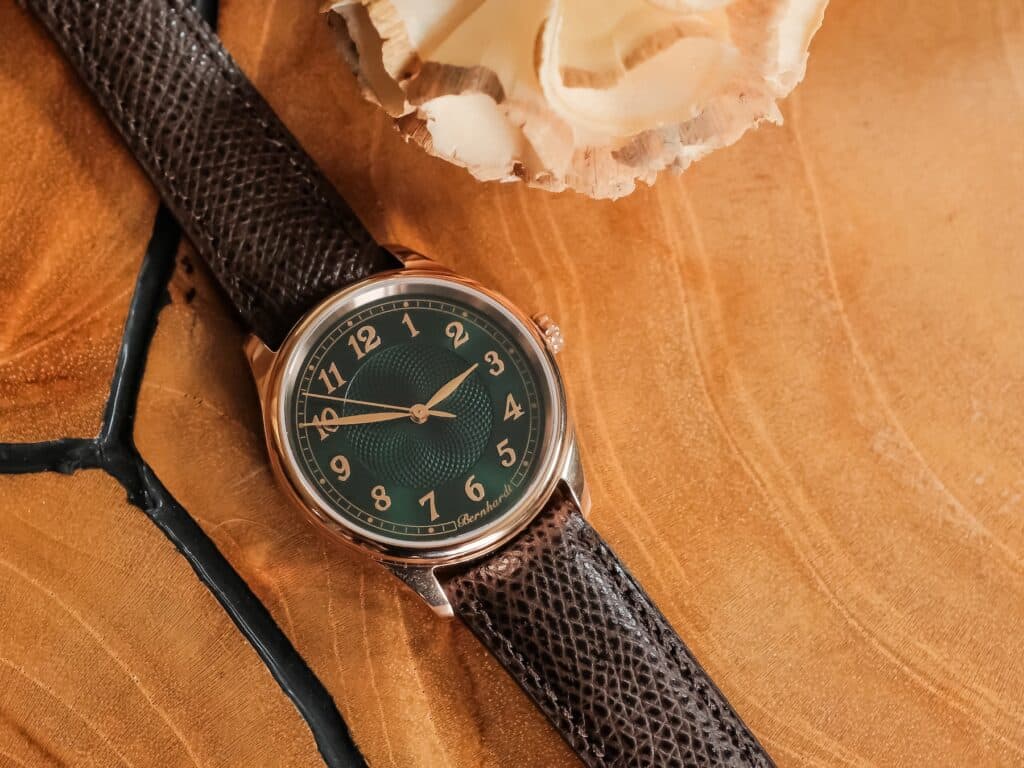
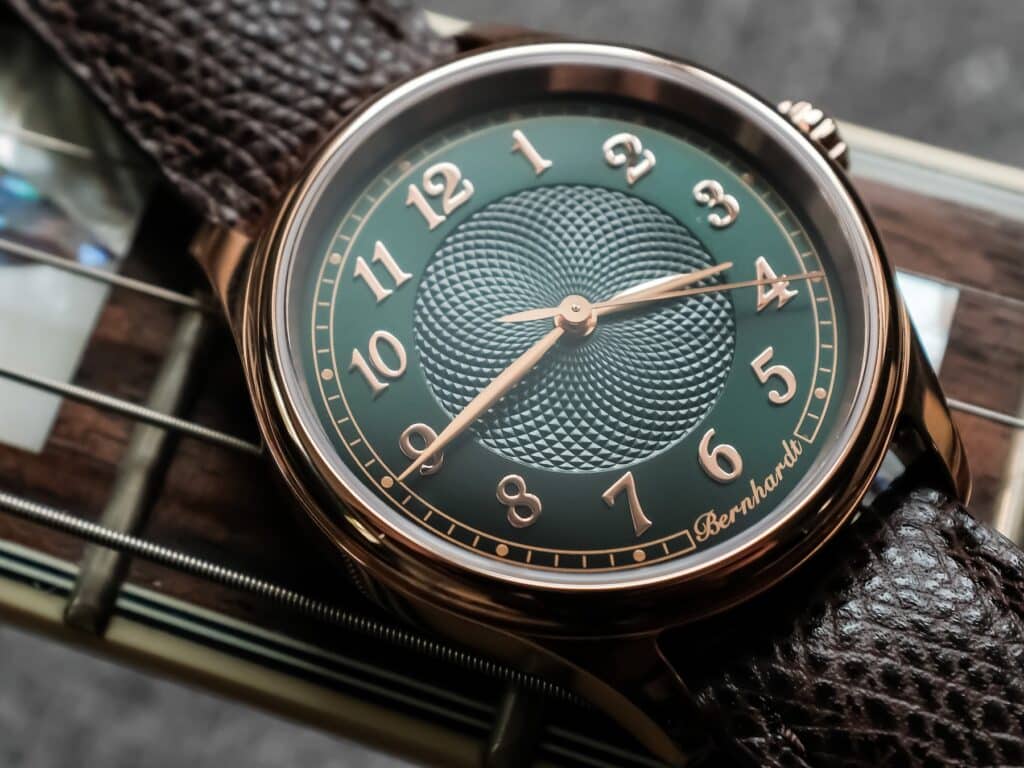
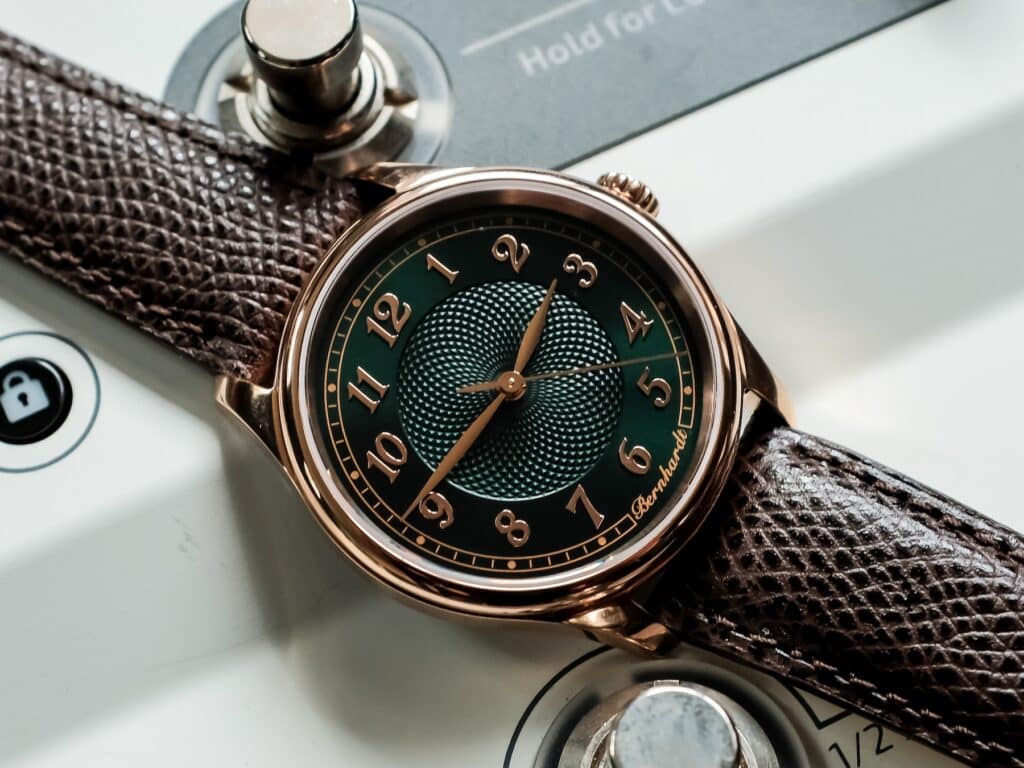
The overall layout is fairly traditional, with most of the visual interest concentrated toward the center. A stamped guilloché pattern radiates outward before meeting a satin-finished ring carrying polished, applied Breguet-style numerals. Those numerals ended up being one of my favorite details on the entire watch. They have enough height to give the dial real depth, and the polished surfaces catch light against the more subdued background without becoming difficult to read.
The long, thin rose gold hands help with legibility, as does the railroad minute track running around the perimeter. Five-minute intervals are clearly marked, which adds a practical element to a watch that otherwise leans heavily into traditional dress-watch styling. I still consider the Captain a dress watch, although after living with it I’m less interested in treating that classification as a restriction. I wore it casually plenty of times, and that ended up being one of the more useful discoveries of the review.
There’s no lume, so nighttime legibility is essentially out of the equation. That never bothered me much given how I used the Captain, although it’s one of the practical compromises that comes with the design. The 50 meters of water resistance also gives me enough confidence for normal daily wear without tempting me to forget what kind of watch I have on.
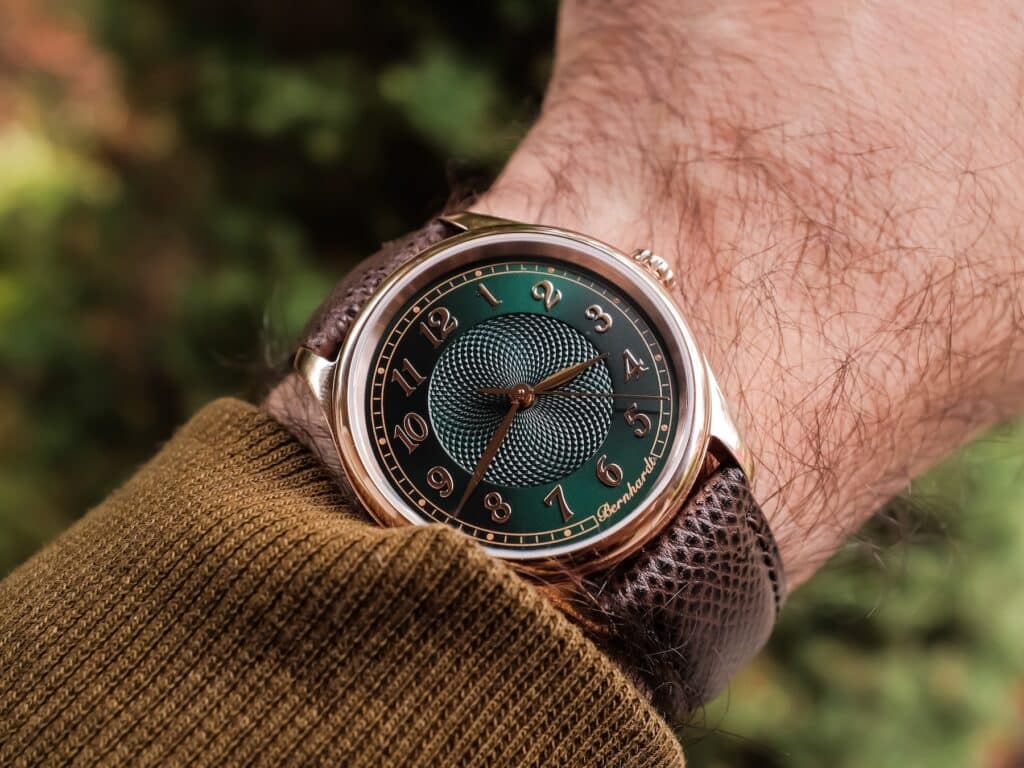
I also appreciate how restrained Bernhardt was with the dial text. The cursive Bernhardt wordmark sits below six o’clock, leaving the upper half largely uninterrupted. Between the applied numerals, guilloché, hands, and warm case treatment, there’s already plenty for my eyes to move between. More text would have worked against one of the Captain’s strongest features.
Case and Wearing Experience
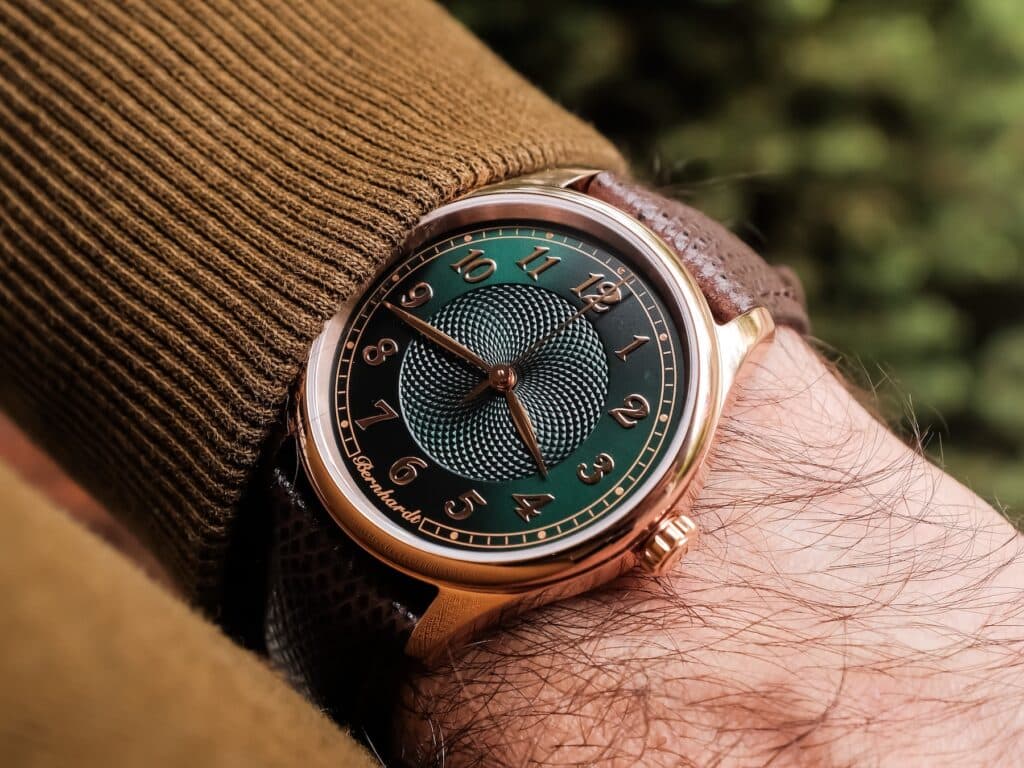
The Captain measures 38mm across, 45mm lug to lug, and 9.55mm thick. On my 6.75-inch wrist, those dimensions hit a comfortable middle ground for this style of watch. The case has enough presence that I never found it overly delicate, while the short lug-to-lug and sub-10mm thickness allow it to sit close to the wrist.
The polished case is titanium nitride coated steel with rose gold PVD, and Bernhardt carries that polished treatment across the exterior. Going into the review, I assumed the rose gold would be one of the bigger barriers for me. It wasn’t. After a couple of weeks, I became considerably more comfortable with it, especially paired with the Cypress dial.
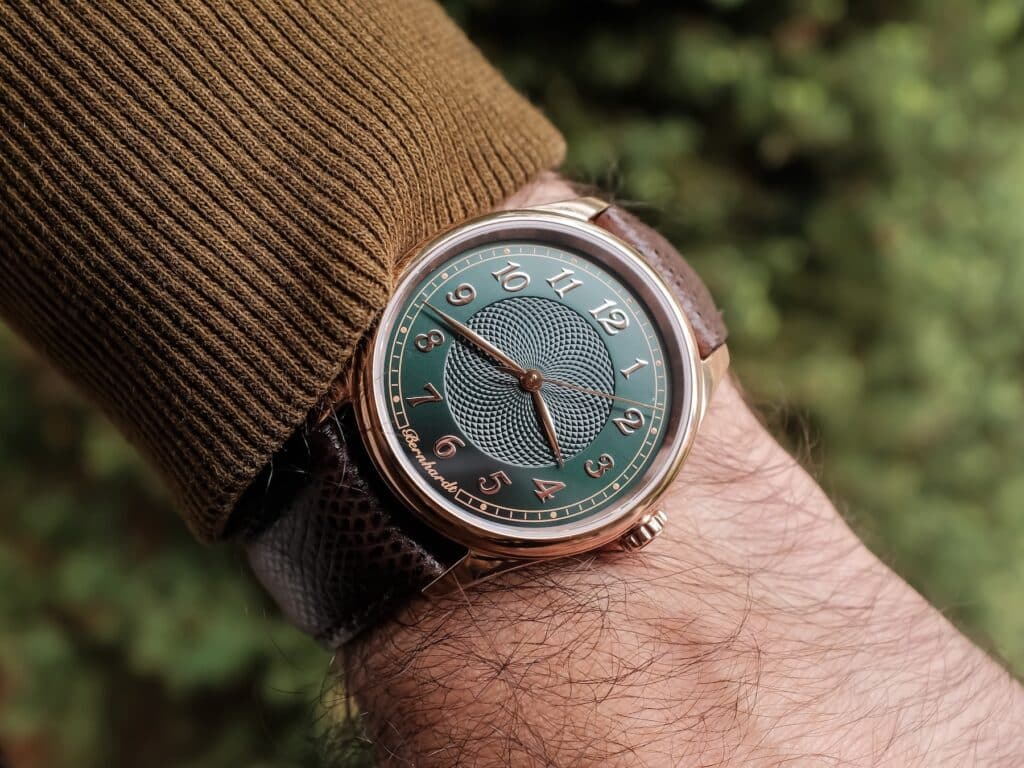
I think the full polish is a bigger consideration for me than the color itself. It matches the energy of the dial and gives the Captain a distinctly dressy presence, although it also limits some of the versatility I usually look for. I tend to live around brushed steel sports watches, so an entirely polished rose gold-tone case still fills a very different corner of that kind of collection.
The case architecture itself is fairly straightforward. There’s a curved polished bezel and a simple knurled push/pull crown at three o’clock, with the bezel meeting the midcase in a way that gives the Captain a slightly slab-sided appearance from certain angles. I noticed it more when handling the watch than when wearing it. At 9.55mm thick, there simply isn’t enough vertical mass for that profile to become a serious problem.
Movement and Daily Use
Inside is the Miyota 9039 automatic movement. What matters most to me here is how well it suits the physical design of the Captain. The movement is relatively thin, which helps Bernhardt keep the entire watch below 10mm while still giving me the convenience of a modern automatic.
The 9039 also hand-winds through the crown. Its roughly 42-hour power reserve means the Captain will stop if I leave it aside for a couple of days, which happened during my time with it. Coming back to it is simple enough. I wind it, set the time, and go.
I didn’t find myself thinking much about the movement beyond that, which suits my experience with the Captain. The 9039 has become familiar to me, and here it provides the basic reliability and dimensions the design needs without becoming part of the visual pitch.
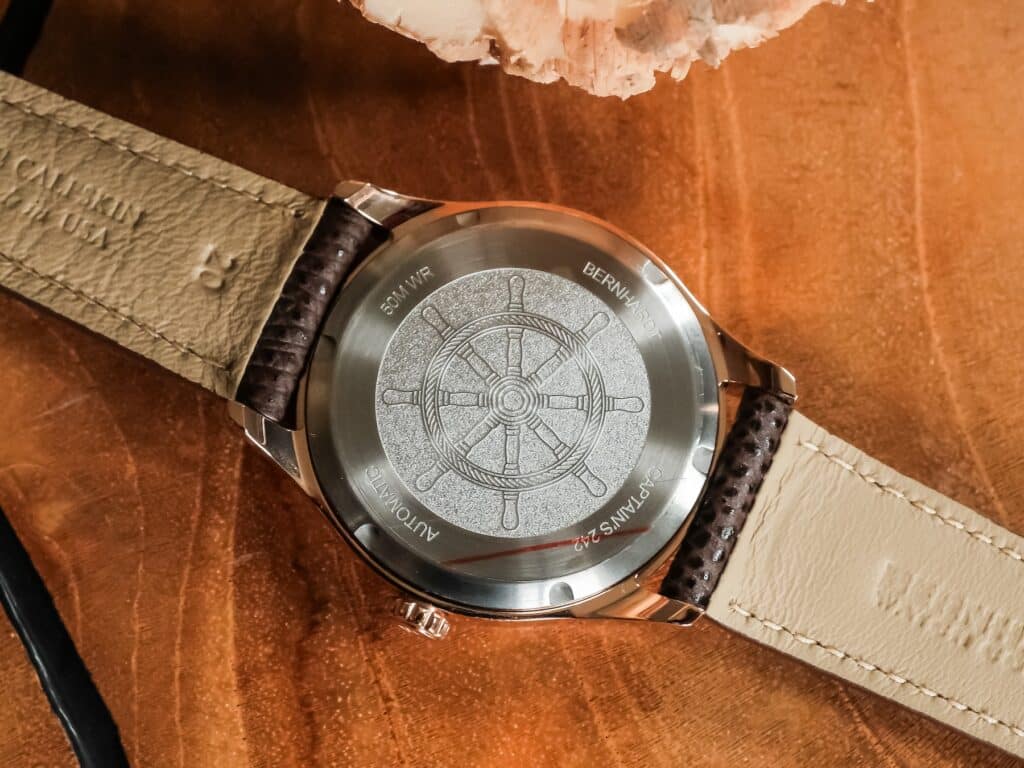
Bernhardt covers it with a solid caseback engraved with a ship’s wheel. I’m also completely fine with the closed caseback. I don’t find the 9039 particularly interesting to look at, and I’d rather keep the Captain at 9.55mm than add thickness for an exhibition window I’d rarely look through.
The push/pull crown and 50 meters of water resistance establish reasonable limits for how I’d use it. I wouldn’t approach the Captain with the same indifference around water that I would one of my divers. For ordinary wear, though, I never felt like I needed to baby it.
Strap and Collection Fit
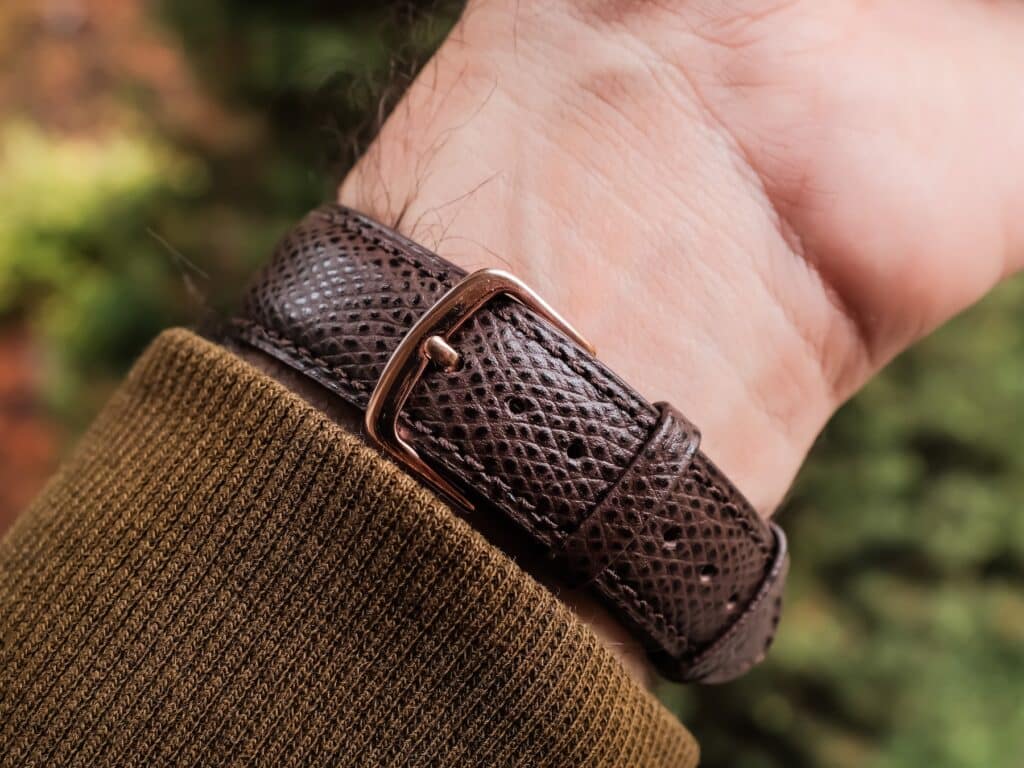
My review sample came on a textured brown leather strap with a 20mm lug width. The strap was comfortable during my time with the watch, and brown works naturally with the green dial and rose gold case. I could easily see black leather pulling the Captain further toward traditional dress-watch territory.
I’d probably head in the opposite direction. A Perlon would be one of my first experiments because I think taking a little formality away from the case would make the Captain even easier to wear the way I naturally dress. The standard 20mm lug width makes that kind of experimentation simple, which matters to me more than having a single perfect factory pairing.
That also reflects the role the Captain ended up filling during these few weeks. I reached for it when I wanted a change of pace. It gave me a break from the divers and sportier watches I usually gravitate toward without making me feel uncomfortable or overly dressed up.
At $749, the Captain lands in a part of the market where I still expect the details to hold up once the initial attraction fades. Here, the sapphire crystal, applied numerals, textured dial, compact dimensions, and Miyota 9039 make sense together. The underlying case design is fairly generic, and the all-polished treatment narrows its versatility for me. Neither issue disappeared during the review.
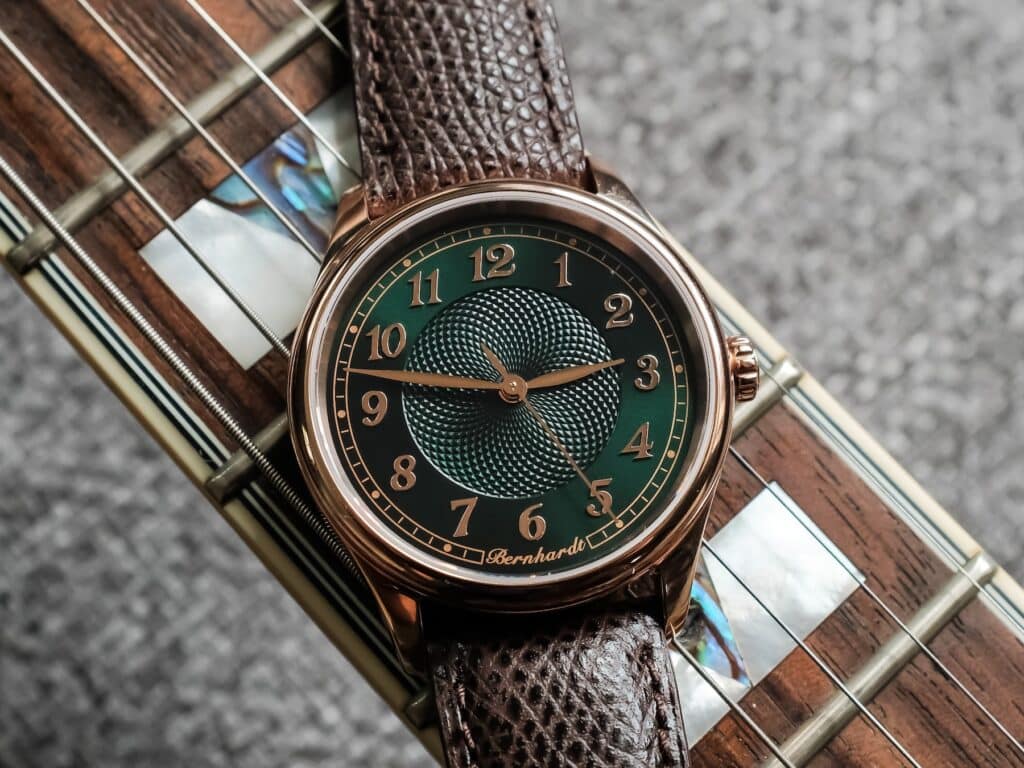
Still, the dial kept pulling me back. The guilloché and applied Breguet-style numerals were the details that gave the Captain some staying power during my time with it. Once the novelty of wearing rose gold had faded, I was still catching those numerals in different light and paying attention to how the patterned center changed around them.
Wrapping things Up
I started this review expecting to learn something by forcing myself outside my usual collecting habits, and that’s basically what happened. I’m considerably more comfortable wearing rose gold than I was before, and I’ve realized that a dressier watch can fit into my regular rotation without requiring much adjustment.
I also know myself well enough to recognize what would probably happen over six months instead of a few weeks. The divers and casual sports watches would start taking over again. The Captain would gradually become more of an occasional change of pace, and I suspect I’d eventually question whether that was enough to justify its place in my collection.
I don’t see that as a failure of the Captain. If anything, spending time with it clarified the difference between appreciating a watch and building my collection around it. The Captain gave me a reason to reconsider a style I normally overlook, and the Cypress dial reminded me that my attraction to green and gold apparently has some staying power.

Co-Founder & Senior Editor
Michael Peñate is an American writer, photographer, and podcaster based in Seattle, Washington. His work typically focuses on the passage of time and the tools we use to connect with that very journey. From aviation to music and travel, his interests span a multitude of disciplines that often intersect with the world of watches – and the obsessive culture behind collecting them.