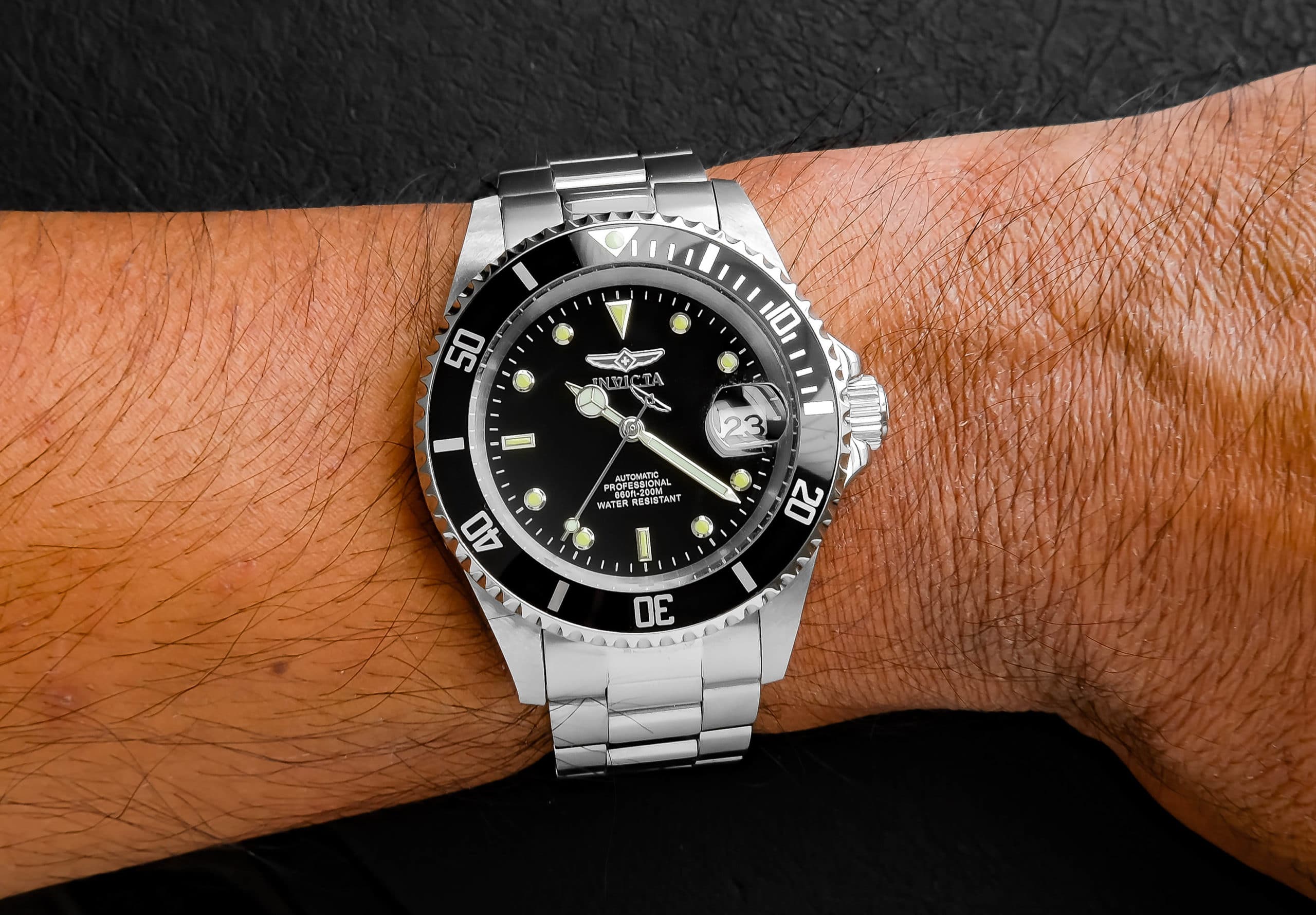
Cheap dive watches are dangerously easy to justify. We’ve all done the mental math: a Casio Duro here, an Invicta Pro Diver there, maybe an Orient Mako II because it feels like the sensible next step, and suddenly the “affordable watches” corner of the box is less a collection and more a small aquatic support group. None of those watches is necessarily bad. In fact, our own hands-on reviews show why they keep pulling people in. But this article tries to answer the question that comes up after the fifth cheap diver arrives: are we still buying watches worth the money, or are we just buying the same feeling over and over?
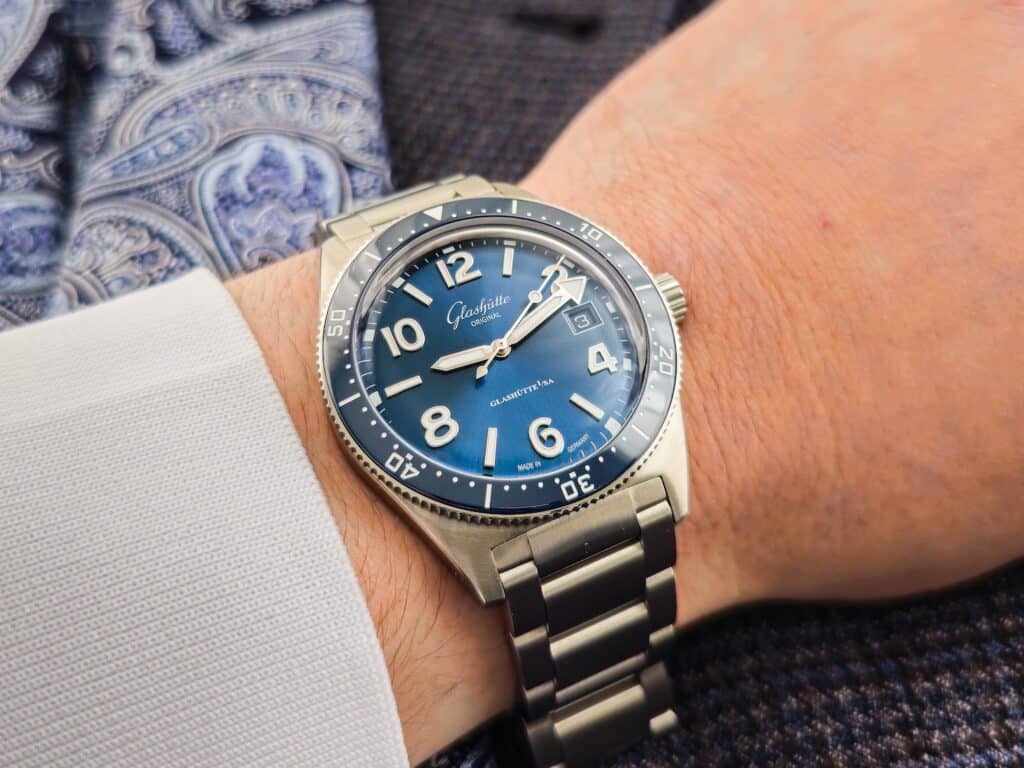
That said, we’re not here to shame affordable collecting. That would be stupid, and also deeply hypocritical. TBWS has spent close to a decade living in the space of best watches under 1000, microbrand watches, oddball divers, and “why is this better than it has any right to be?” discoveries. What we’ve also learned is that sometimes the smarter move is not to buy another cheap diver. Sometimes it’s pausing long enough to figure out what all those affordable purchases were trying to teach you: the size you actually wear, the bezel feel you care about, the dial language you keep coming back to, and the point where “value” starts to mean intentionally owning fewer watches that do more for you.
Invicta Pro Diver 8926OB
| Price: | $60 – $80 |
| Water Resistance: | 200m |
| Case Dimensions: | 40mm (diameter) x 48mm (lug-to-lug) x 14mm (thickness) |
| Lug Width: | 20mm |
| Movement: | NH35A (Mechanical) |
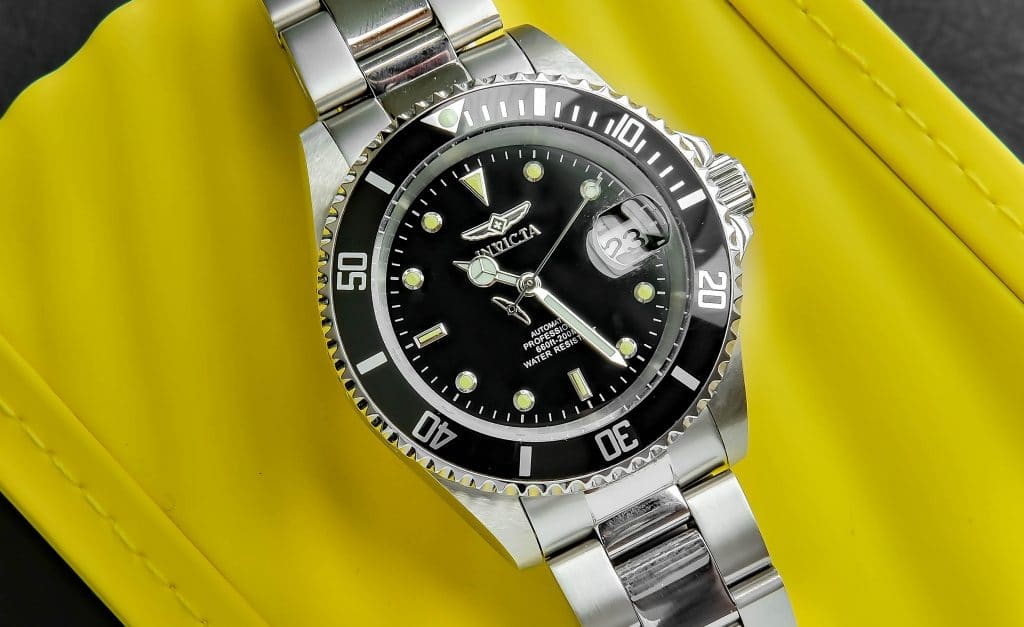
The Invicta Pro Diver 8926OB is an easy place to get stuck if you’re trying to collect your way toward satisfaction one cheap dive watch at a time. Once you get past the baggage around the Invicta name, the actual wearing experience is more competent than the price prepares you for. The 40mm Sub-style case is familiar to the point of being almost background noise, but the proportions work. It sits flat, the lug-to-lug length avoids that awkward overhanging feeling, and there’s no long “maybe this will grow on me” phase. From the first wear during testing, it felt settled and comfortable, which is why people keep recommending it as an affordable mechanical diver.
The NH35A movement gives it another point in its favor. It winds smoothly, keeps stable time in normal use, and doesn’t make ownership feel fragile or complicated. The crown is large enough to grip easily, so manual winding isn’t a fingertip wrestling match, and as long as the crown is secured, rain, swimming, and the usual accidental soaks don’t feel like a problem. That said, this is where the intentional-collecting conversation starts. A cheap automatic diver that works this well can feel like proof that you don’t need to spend more.
The day-to-day details are better than expected, with a few obvious reminders of the price. The aluminum bezel has firm, confident clicks with only slight play between positions, making it useful for timing coffee, laundry, parking meters, or whatever “dive timing” looks like in your life. The dial also does more than it has to, with applied markers and hands that catch light well during the day. After dark, the illusion breaks a bit. The lume is uneven and fades quickly, with the hands holding on longer than the markers. It works if you need a glance, but it’s not the watch we’d grab if low-light readability mattered for more than a few minutes.
The bracelet is probably the most pleasant surprise. It starts at 20mm and tapers to around 18mm at the clasp, helping the watch stay balanced throughout the day. The hollow end links are there if you’re paying attention, but the bracelet as a whole avoids the sharp, unfinished feel that often makes entry-level bracelets unpleasant. Articulation is smooth, edges are clean, and the clasp includes useful micro-adjustments, though the flip lock is stiff and shows wear sooner than we’d like. Add in the mineral crystal’s limited scratch resistance and the large Invicta branding on the case side, and the 8926OB becomes a perfect example of the cheap diver dilemma: very much wearable, mechanically dependable, and still full of small compromises that may eventually push you toward buying fewer watches with fewer excuses.
Pros:
- The 40mm case wears comfortably right away, with proportions that sit flat and feel natural.
- The bracelet has decent finishing, smooth articulation, and a comfortable taper.
- The NH35A movement is dependable, easy to wind, and straightforward to maintain.
- The bezel action feels firmer and more useful than expected for the price.
Cons:
- Lume is uneven and fades quickly, especially on the markers.
- The clasp’s flip lock is stiff and can wear more quickly than ideal.
- The mineral crystal is more vulnerable to scratches than sapphire.
- The large Invicta branding on the case side will not work for everyone.
Casio Duro
| Price: | $85 |
| Water Resistance: | 200m |
| Case Dimensions: | 44.2mm (diameter) x 48.5mm (lug-to-lug) x 12.1mm (thickness) |
| Lug Width: | 22mm |
| Movement: | Casio 2784 Quartz |
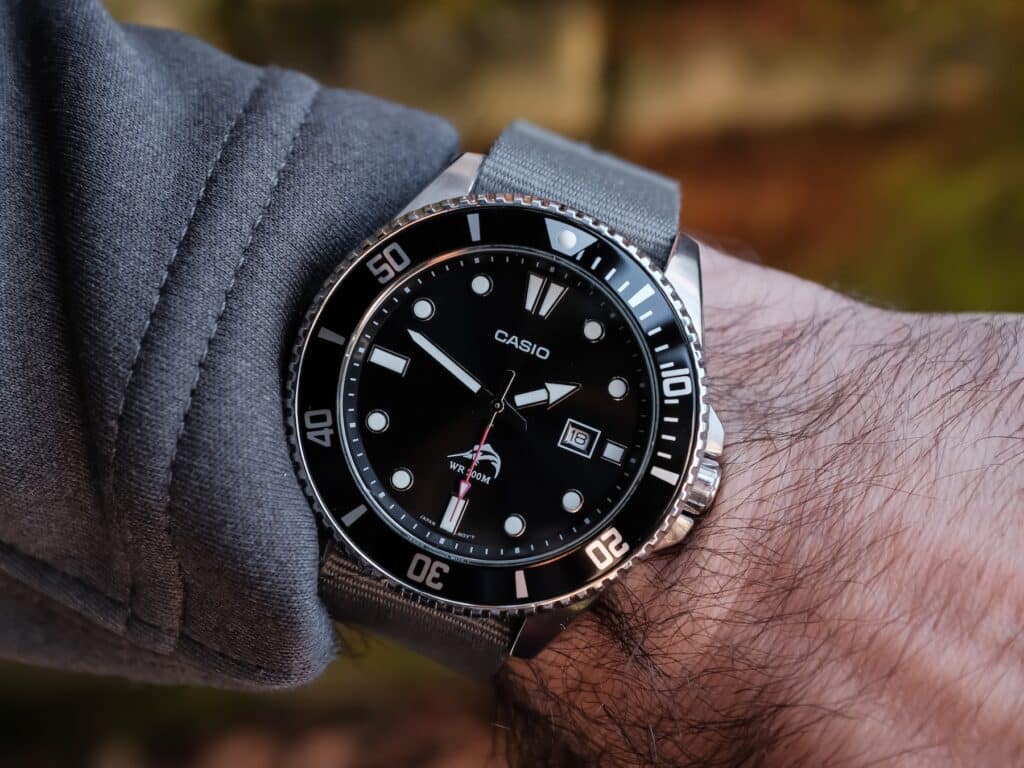
The Casio Duro is exactly how the cheap dive watch spiral starts, and we mean that with some affection. It does not beg for attention, it does not pretend to be rare, and it does not introduce many of the annoying problems that can make low-cost watches feel low-cost. The 200m water resistance, screw-down crown, and solid caseback give it enough credibility around water that you don’t have to baby it, while the aluminum bezel rotates with a controlled, deliberate feel instead of the loose, rattly action that sometimes shows up in this price range. That’s the trap: when a watch this inexpensive behaves this competently, it becomes easy to justify buying another cheap diver, then another, instead of asking what you’re actually trying to add to the box.
The quartz movement is a big reason the Duro sticks around. It hacks, has a quick-set date, and, in our hands-on experience, stays around ±20 seconds per month, which changes how you interact with it. You can leave it on the dresser for a few days, pick it back up, and not immediately fall into the winding-and-setting ritual. There’s no mechanical romance here, but there is a lot of practical usefulness. However, for someone who already owns three similar budget divers, it may also be a sign that convenience alone is no longer a good enough reason to keep buying variations of the same idea.
On the wrist, the Duro is more specific than its price suggests. At 44mm, it has real presence, and smaller wrists may find it oversized even though the shorter lug-to-lug span and downward-curving lugs help it sit more securely than the number suggests. If you’re comfortable with the general footprint of something like a Seiko Turtle, the Duro won’t feel completely foreign, but it still wears like a large watch. The finishing is simple in a way that works: brushed surfaces across the top, polished case sides, and a small bevel that breaks things up without pretending to be fancy. The 22mm lug width also makes it easy to move between rubber, nylon, and bracelets, which is useful, though it can also feed the “maybe one more strap will make this feel new again” phase of ownership.
The dial keeps the same practical energy. Minimal text, a clean layout, reflective arrow-shaped hands, applied markers, and a framed date at three make it easy to read at a glance. The flat mineral crystal is part of the value equation, but it also serves as a reminder that this is still a budget-friendly dive watch. The lume covers enough real estate to be useful at first, but it fades sooner than we’d like if you’re relying on it deep into the night. That’s why the Duro makes sense as a first affordable diver or a beater with actual water-ready chops, but less sense as the tenth cheap diver in a drawer.
Pros:
- The clean dial, reflective hands, and framed date make everyday legibility strong.
- The 22mm lugs make strap swaps simple across rubber, nylon, and bracelets.
- The 200m water resistance and screw-down crown make it useful around water.
- The bezel action feels controlled and avoids the loose feel common in cheaper divers.
- The quartz movement is accurate, low-maintenance, and easy to live with.
Cons:
- The mineral crystal is more vulnerable to scratches than sapphire.
- The lume starts strong enough but fades sooner than we’d like in longer low-light use.
- The 44mm case can feel too large, especially on smaller wrists.
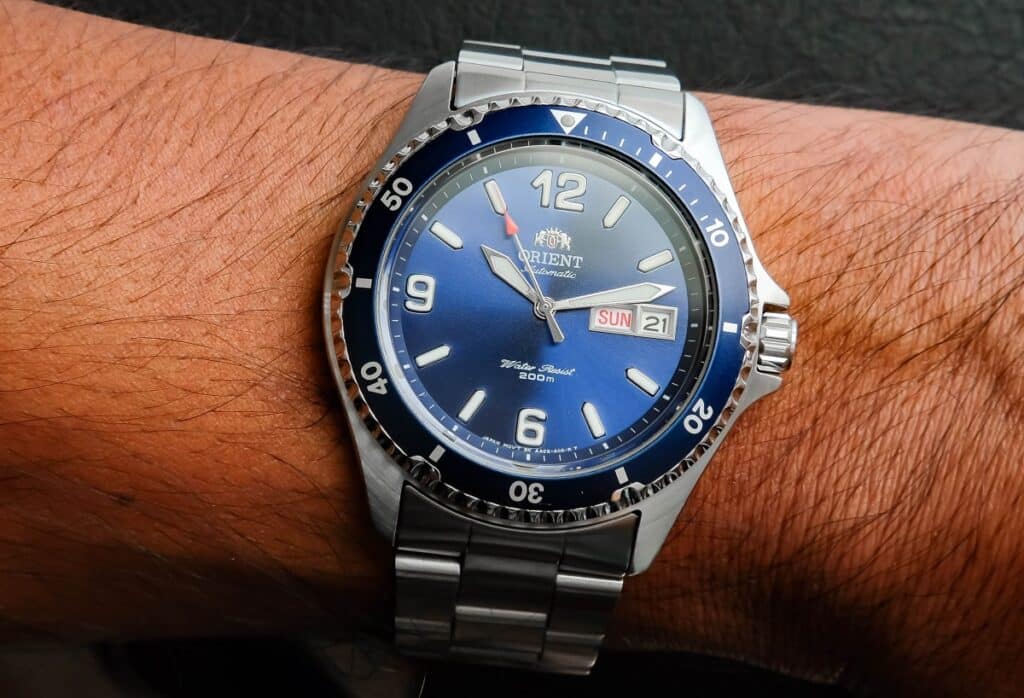
Orient Mako II
| Price: | $160 – $220 |
| Water Resistance: | 200m |
| Case Dimensions: | 41.5mm (diameter) x 47mm (lug-to-lug) x 13mm (thickness) |
| Lug Width: | 22mm |
| Movement: | Orient Caliber F6922 (Mechanical Movement) |
The Orient Mako II feels less like an impulse buy and more like a proper mainstream stepping stone: balanced, usable, and familiar enough to wear without thinking about it. The F6922 in-house movement helps with that impression because hacking and hand-winding make the watch easier to live with after it has been sitting for a few days. You can set it cleanly, wind it manually, and get moving without the awkward shake-it-awake routine that older entry-level automatics sometimes required. That kind of usability is why the Mako II has made sense for so many early collections.
The case is probably the strongest argument for keeping it around. At 41.5mm, it avoids the oversized feel that turns some dive watches into wrist furniture, and the compact lug-to-lug helps it fit more wrist sizes than the case diameter alone suggests. It sits flat, stays planted, and does not feel top-heavy during a full day of wear. The finishing also feels more cohesive than flashy: brushed lugs, polished case sides, and a case-to-bracelet transition that looks like someone paid attention. The end links follow the case lines naturally, giving the watch a more complete feel than many affordable divers that treat the bracelet as a separate problem.
Based on our personal testing experience, the dial gives the Mako II enough personality without compromising legibility. The sunburst finish adds movement in changing light, while the applied indices remain easy to read at a glance. Smaller details help the whole thing feel considered: the framed day-date window complements the polished accents on the hands, and the red-tipped second hand adds contrast without turning the dial into a toy. The lume is usable, but not very long-lasting, which matters if you’re expecting the watch to behave like a serious low-light tool. It does the job for quick checks, but it is not a prime reason to buy the watch.
The bezel and bracelet show both sides of the Mako II’s value. The 120-click bezel feels firm and controlled once you get a grip on it, but the sloped edge makes grip less intuitive than chunkier, more aggressively cut bezels. The bracelet feels secure on the wrist, and the clasp holds up well through normal daily wear, but the hollow end links are noticeable when the watch is off the wrist. The mineral crystal fits the same pattern: perfectly functional, but more vulnerable to scratches than sapphire. That’s why the Mako II works best as a watch that teaches you what you care about before you consolidate. If it makes you realize you like compact proportions, a day-date layout, and a restrained diver design, the smarter next move may be buying a better watch that builds on those preferences instead of adding another affordable variation.
Pros:
- The 41.5mm case wears comfortably and works across a wide range of wrist sizes.
- The 120-click bezel feels firm and controlled once engaged.
- The compact lug-to-lug helps the watch sit flat without feeling top-heavy.
- The sunburst dial and applied markers add depth while maintaining readability.
- The in-house F6922 movement adds hacking and hand-winding for easier everyday use.
Cons:
- Lume is usable, but it does not last as long as stronger dive-watch options.
- The hollow end links are noticeable when handling the watch off the wrist.
- The sloped bezel edge can be awkward to grip.
- The mineral crystal is more prone to scratches than sapphire.
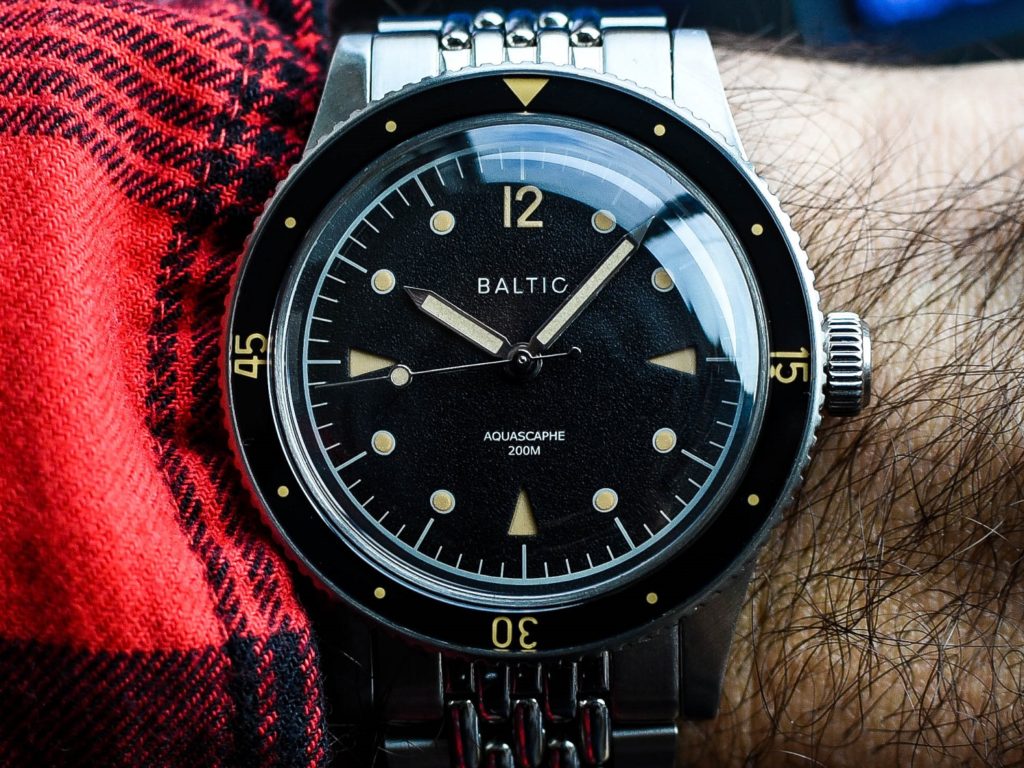
Baltic Aquascaphe
| Price: | $650 – $750 |
| Water Resistance: | 200m |
| Case Dimensions: | 39mm (diameter) x 47mm (lug-to-lug) x 12mm (thickness) |
| Lug Width: | 20mm |
| Movement: | Miyota 9039 (Mechanical Movement) |
The Baltic Aquascaphe is the kind of watch that makes the “fewer, better” argument feel less abstract. It is still approachable compared to luxury divers, but it moves beyond the cheap-diver loop in a way that feels meaningful on the wrist. The case sits a little over 12mm thick, so it wears easily under a sleeve, and the 47mm lug-to-lug keeps it planted without feeling stretched out. There is enough weight to remind you it is a proper steel dive watch, but it never crosses into cumbersome. After regular wear, the mostly brushed case also does a decent job of hiding small marks, though that same brushed-heavy finish may feel a little plain if you prefer stronger contrast from polished surfaces.
As noted by our review team, the dial is where the Aquascaphe starts to separate itself from the usual affordable rotating filler. Baltic uses a hybrid sandwich construction, with cut-out indices exposing a fully lumed layer underneath. That gives the dial real depth in daylight and a smooth, even glow when the lights drop. The matte surface shifts subtly with angle, so it avoids feeling flat after the initial excitement wears off. Gilt accents add warmth without turning the watch into a costume piece, and the sapphire bezel insert fits that same restrained vintage mood. The pencil-style hands are clean and properly sized, the lollipop second hand reaches neatly toward the chapter ring, and the minimal dial text helps everything breathe.
On the bracelet, the Aquascaphe becomes even easier to understand as an enthusiast-level upgrade rather than another cheap diver with nicer photos. The beads-of-rice bracelet conforms naturally to the wrist, tapers well at the clasp, and stays comfortable all day without creating pressure points. The polished center beads and brushed outer links add enough visual texture without making the watch feel fussy. Baltic also uses quick-release spring bars, so moving over to the Tropic-style rubber strap is simple and lends the watch a slightly more casual, vintage-leaning feel. That strap flexibility matters because it lets the Aquascaphe shift moods without needing to be replaced by yet another watch.
Inside, the Miyota 9039 keeps the ownership experience straightforward. It runs at 28,800 vph, stayed smooth and consistent during our in-depth review, and offers a practical 42-hour power reserve. The two-position crown keeps interaction simple because there is no date to set, which some people will love and others will find limiting for daily wear. That is the real trade-off here. The Aquascaphe is not trying to be the most feature-packed diver in the box. It works better as the sensible option you buy when the Casio, Invicta, and Orient starter pieces have already taught you what you like.
Pros:
- The hybrid sandwich dial adds depth without cluttering the layout.
- Fully lumed indices deliver a strong, even glow in low light.
- The beads-of-rice bracelet is flexible, well-tapered, and comfortable all day.
- Gilt accents add warmth without feeling overdone.
- Quick-release spring bars make strap changes simple.
Cons:
- The no-date layout keeps the dial clean but may feel less practical for everyday use.
- The mostly brushed case finish may feel too subdued if you prefer more polished contrasts.
Sinn T50
| Price: | $4,400 |
| Water Resistance: | 500m |
| Case Dimensions: | 41mm (diameter) x 47mm (lug-to-lug) x 12mm (thickness) |
| Lug Width: | 20mm |
| Movement: | Sellita SW 300-1 |
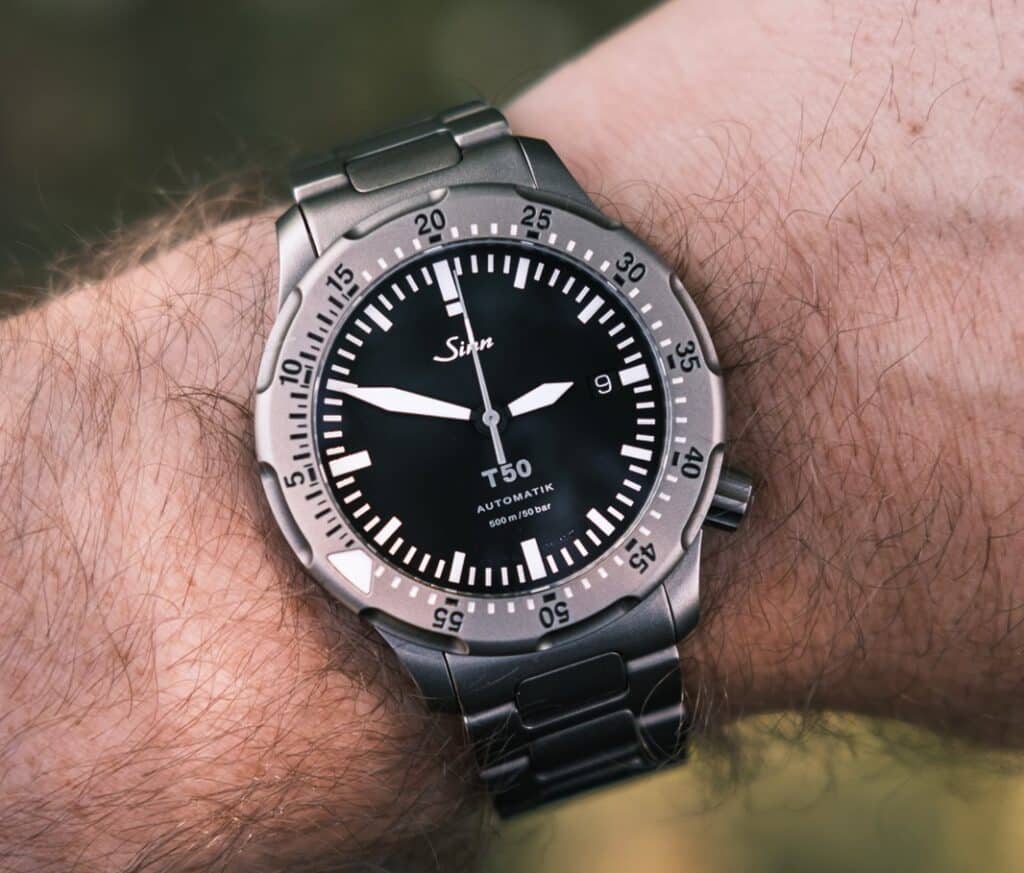
The Sinn T50 is where the “stop buying another cheap diver” advice starts to feel less like restraint and more like relief. It does not chase seriousness through bulk, polished drama, or the usual look-at-me premium-diver nonsense. Instead, it earns its place by wearing almost invisibly well. At around 95 grams and proportioned around a 7-inch wrist, it feels quite light the first time it goes on, but that lightness becomes the point. It stays planted, sits low, and doesn’t need constant midday adjustment, whether you’re working at a desk, riding a bike, or running errands. That is a very different kind of satisfaction than buying another affordable diver because the dial color looked good in a photo.
The matte titanium case gives the T50 its tool-watch personality without making it feel cold or unfinished. Reflections stay muted, small knocks feel less emotionally expensive, and the overall effect suits Sinn’s whole “built for use, not applause” thing. The 4 o’clock crown is one of those practical details that matter more after a few full days of wear. It remains easy to operate, but it does not dig into the wrist when your hand bends. The captive bezel system also feels more useful than gimmicky in practice. Having to press the bezel down before turning it sounds fussy until the watch takes a knock and the timing scale stays where you left it. The tegimented bezel adds to that quiet confidence, resisting scratches better than standard titanium during regular wear.
The dial keeps the same disciplined approach. The black-and-white layout, sword hands, tidy markers, and low-key date window make the watch easy to read without turning the dial into a billboard. It is clean, immediate, and legible across the kind of conditions where a real tool diver should make life easier. The lume on the second hand is useful because it lets you confirm the watch is running in the dark, though the patch itself is small enough that it takes a moment to pick out compared to larger lume plots. Inside, the SW300 performed extremely well in our testing, running around +2 to -3 seconds per day. The trade-off is the 42-hour power reserve. If your collection already has a few watches in rotation, leaving the T50 alone for a day or so may mean coming back to a stopped watch.
The bracelet is the one area where Sinn’s otherwise deliberate engineering gets a little uneven. The H-link design suits the titanium case visually and feels comfortable on the wrist, but the diver extension did not inspire the same confidence as the rest of the watch. It could release with a light pull, which is not what you want from something meant to feel overbuilt. We ended up removing it and switching to a normal spring bar setup. Thankfully, drilled lugs make that painless, and the T50 also wears well on rubber or NATO if you want the simplest version of the experience. As a purposeful, endgame-ish German tool-watch upgrade, the T50 works because it does not ask you to keep chasing small fixes through more cheap divers.
Pros:
- The low, planted case makes it easy to wear at a desk, on a bike, or during daily errands.
- Drilled lugs make strap changes simple.
- The matte titanium finish reduces reflections and reinforces the utilitarian feel.
- Titanium construction keeps the watch very light and comfortable over long wear.
- The captive bezel system helps prevent accidental bezel movement in real use.
Cons:
- The 42-hour power reserve can feel limiting if you rotate through several watches.
- Servicing is less straightforward because it requires going through Sinn directly.
- The diver extension can release too easily, which weakens confidence in the bracelet.
- The lume patch on the seconds hand is small and takes a moment to spot in the dark.
Glashütte Original SeaQ
| Price: | $10,200 |
| Water Resistance: | 200m |
| Case Dimensions: | 39.5mm (diameter) x 47.5mm (lug-to-lug) x 12.5mm (thickness) |
| Lug Width: | 20mm |
| Movement: | SeaQ Caliber 39-11 Automatic |
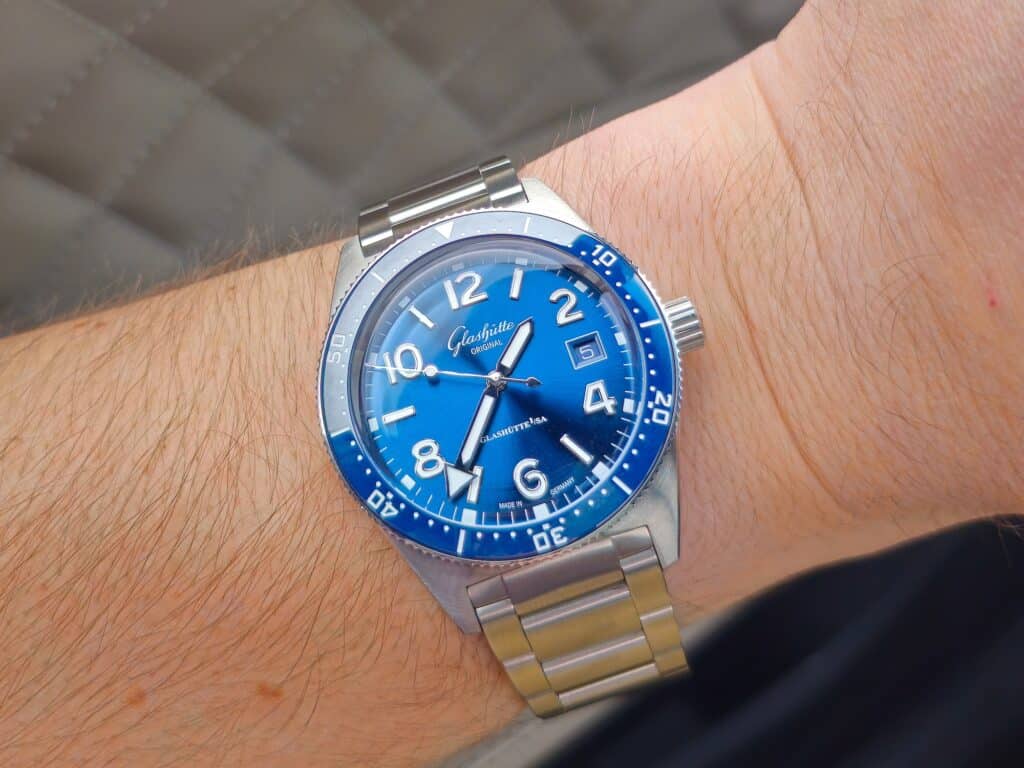
The Glashütte Original SeaQ is the contrarian premium consolidation move for someone who has already worked through the cheap diver phase and does not want the obvious answer. It starts to make sense after actual wrist time, when the small interactions keep feeling better than expected. The unidirectional bezel is a good example: firm, deliberate, and precise, with none of the vague play that can make a dive watch feel cheaper than it is. The screw-down crown has that same measured resistance, giving the watch a more intentional feel every time you set it. This is the kind of detail that can make five cheaper divers feel a little redundant.
The case finishing also helps explain why the SeaQ works as a “buy fewer, buy better” watch without turning into a safe, predictable flex piece. The brushed surfaces are placed where wear is more likely to happen, which keeps the watch feeling practical, while the polished accents along the edges add enough refinement to remind you this is not merely a tool with a luxury logo attached. It behaves like something you can wear often, but it also has enough finishing nuance to keep rewarding closer looks. That balance matters if you’re trying to replace a drawer full of affordable divers with one watch that still feels satisfying after the novelty wears off.
The dial is where the SeaQ kept pulling us back during our review. In brighter light, the sunburst surface opens up, revealing more movement; indoors, it settles into deeper, inkier tones, making the watch feel calmer and more restrained. The domed sapphire adds curvature and visual movement without making the dial harder to read. Clean Arabic numerals and restrained text keep the layout open, so even with the changing dial surface, the watch never feels busy. The bracelet adds another everyday advantage: the brushed 20mm links feel smooth and natural on the wrist, and the compact, tool-free, quick-adjust clasp is useful as your wrist changes size throughout the day. The only weak spot is the bracelet-to-case transition, which does not look quite as seamless as the rest of the execution.
Inside, the Caliber 39-11 brings more refinement than the closed caseback lets on, with beveled edges, polished screws, a swan-neck regulator, and a skeletonized rotor. In our testing period, it ran consistently, though the roughly 40-hour power reserve feels short for a watch at this level. The price also puts the SeaQ in serious company, so this is not the go-to upgrade for everyone. But as a premium consolidation choice, it makes sense for the enthusiast who has learned what they want from cheaper divers and now wants one watch with real dial depth, satisfying controls, useful bracelet adjustment, and enough personality to avoid feeling like the default pick.
Pros:
- The dial has strong tonal depth and stays engaging across different lighting conditions.
- The compact, tool-free, quick-adjust clasp is quite useful for daily wear.
- The domed sapphire adds visual movement without hurting readability.
- The bezel action feels precise, firm, and confidence-inspiring.
- The screw-down crown has reassuring resistance during use.
Cons:
- The roughly 40-hour power reserve feels short for this price tier.
- The bracelet-to-case transition is not as cohesive as the rest of the watch.
- The closed caseback hides much of the movement finishing.
That’s where we’ll leave this one, at least for now. The issue was never affordability; it was mistaking another low-risk purchase for progress. A good diver should clarify your taste over time, not blur it under a pile of similar bezels, dials, and compromises. So before the next checkout-button lapse in judgment, look at what keeps earning wrist time and what keeps getting politely ignored. And if there’s some other dive watch that helped you collect with more intent instead of more volume, share it in the comments. We’ll see if it’s something we can coordinate for a review.

Co-Founder and Senior Editor
Kaz has been collecting watches since 2015, but he’s been fascinated by product design, the Collector’s psychology, and brand marketing his whole life. While sharing the same strong fondness for all things horologically-affordable as Mike (his TBWS partner in crime), Kaz’s collection niche is also focused on vintage Soviet watches as well as watches that feature a unique, but well-designed quirk or visual hook.
I loved this article. I like the spread of watches and prices. I think we could throw a longines, tag, and maybe compare them to what most would consider the Pinnacle of dive watches, a rolex sub. But a great article that I think helps people with different affordability capabilities to help decide if it’s something worth spending on or saving for better quality.
Appreciate that. Longines and Tag would both fit well in a future version of this. The goal is always to give people useful reference points at different price levels, so it’s good to hear that came through. Thanks for reading.
I own the Invicta watch. I am very pleased with the watch. I purchased it at a discount outlet. The only thing I did is put a Jubilee band on it. Some people can mistake it for a Rolex.
Hey John. If you’re enjoying it, that’s what counts. A jubilee bracelet swap can really change how a watch presents itself. Glad it’s working for you 🙂
Interesting article, but there’s a giant jump from the Baltic’s reasonable $650 to the Sinn’s $4400. Personally, my Citizen Fugu is a perfect dive watch – has all the necessary “specs”, well built, and affordable at $450 – better than the first two options. And as someone who’s not subscribed to the under 40mm watch trend, I like the size. In fact, skipping right over that crucial $1k-3k is too bad, since I personally believe that’s where the best combination of value/luxury meets. Beyond that, the price continues to climb with more fine tuned difference that to my eye at least gets harder to justify. I don’t even use the bezels on my dive watches, lol. If I really need to time something in 2026, I’m not grabbing an analog watch (likely my Garmin).
Hey Andrew – the gap between $650 and $4,400 is a legitimate criticism and that mid-range is exactly where a lot of interesting stuff is happening. The Fugu is a solid example of a watch that nails the fundamentals without overthinking it. And the Garmin point is honest in a way the dive watch community doesn’t always want to hear. Appreciate the thoughtful feedback.
The upgrade path doesn’t actually solve the problem your article diagnoses. If “the same feeling over and over” is the issue, a $10,200 SeaQ delivers that feeling once and then quietly joins the rotation in exactly the way the Invicta did. The problem isn’t the price tier. It’s the buying.
It’s about what the dopamine hit is doing for us — and why a review-driven business model has every incentive to keep readers climbing the ladder instead of asking the question. That’s a harder piece to write, and a more interesting one. Consider that one instead.
PS — I still like watch reviews.
Hey Keb – that’s an interesting challenge, and I don’t think you’re wrong. The dopamine cycle doesn’t care how many zeroes are on the price tag. We’ve touched on that before I think, but you’re right that a piece focused squarely on it would be more honest and probably more useful. I’ll keep that in the back of my mind. Appreciate you reading.
I concur. Dopamine watch buying control article please.
My cycle is barely under control…. :-/
Haha that’s a topic worth exploring.
Watches and cars are the two stupidest things to spend your money on. The Invictas look great, you can wear them forever. I have Invitas for over 20 years. No problems. Whe they break, you throw them out. No thousand $$$service charges. I can afford any car or any watch. Rather spend it on good food and wine. Please don’t tell me about the investment factor. All you do is trade ins.
Hey James. If that approach works for you, that’s all that matters. There’s no wrong way to enjoy watches, and Invicta’s longevity at that price point is hard to knock. We just tend to focus on pieces where the design, build, and story give you something more to talk about. Thanks for reading.