Affordable luxury is a funny corner of this hobby. A lot of us started where one of our Tudor contributors did: agonizing over the cost of an SKX, living happily with affordable divers, and telling ourselves that anything beyond that was probably excessive anyway. Then the ceiling moves. You spend enough time around watches, and sooner or later, pieces like the Seamaster, Black Bay, Marinemaster, Doxa, or Oris Aquis stop feeling like fantasy objects and start feeling like the next serious step. That’s the lane this list is trying to sort out. Our take on the best affordable luxury dive watches under $5,000 is not about bargain shopping, and it’s definitely not about five-figure chest-thumping. It’s about the models that sit in that tempting middle ground.

We think that perspective holds up because our archive isn’t built on one afternoon with a press sample. It’s built on watches that changed our minds once they were actually on our wrists, models we kept thinking about after sending back review pieces, and pieces we bought with our own money and lived with well past the honeymoon phase. In our archive alone, that includes an Oris Aquis that landed differently in our hands than in the announcement photos, a Sinn shaped by earlier pre-release experience, a Doxa revisited after eight years of ownership, and other reviewed models we’re going to look back on here. That’s the kind of background we want behind a list like this, especially for readers trying to move from accessible watches into something more aspirational without losing the grounded, anti-nonsense mindset that got them into the hobby in the first place.
Mido Ocean Star
| Price: | $1040 |
| Water Resistance: | 200m |
| Case Dimensions: | 42.5mm (diameter) x 42.5mm (lug-to-lug) x 11.75mm (thickness) |
| Lug Width: | 22mm |
| Movement: | Caliber 80 |
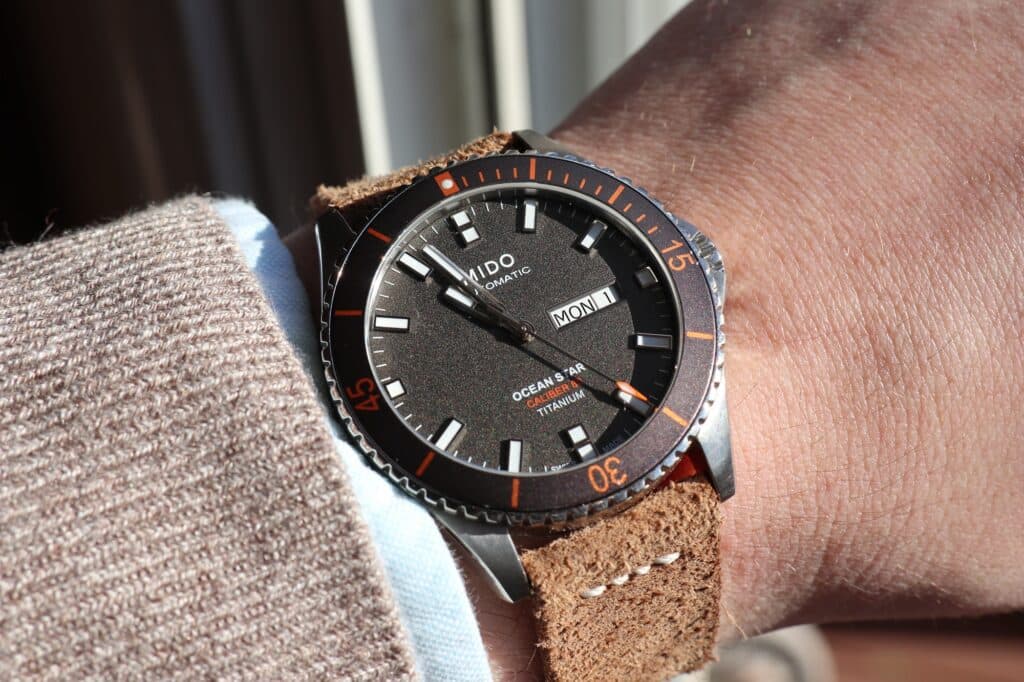
The Mido Ocean Star is easy to underestimate at first, which is part of its appeal. It does not come out of the box trying to out-flex anything in this price range. Instead, it earns its place through the kind of details we tend to notice after a few full days of wear. The fully brushed titanium case measures 42.5mm across and about 11.75mm thick, and that slimmer profile matters. For a modern dive watch, it sits quite flat. More importantly, the titanium build keeps the weight down in a way you feel during normal life, not just during a quick wrist shot. Through commuting, desk time, and errands, it never turned into a top-heavy nuisance. The case is subtly contoured, and the sloped bezel follows those lines nicely, while a polished chamfer at the edge adds a little contrast without making it feel shiny for its own sake.
The dial is where the Ocean Star begins to show greater depth. Its anthracite-textured surface shifts with the light, sometimes reflecting it softly and sometimes swallowing it up altogether. It’s paired with a double anti-reflective sapphire crystal, which keeps glare at bay and makes the watch easy to read outdoors or under harsh office lighting. During our hands-on review, we also appreciated that Mido did not phone in the dial layout. The shortened marker at nine balances the trimmed marker at three next to the day-date window, which keeps the whole thing from looking a bit off. At night, the pencil hands are filled with BGW9 Super-LumiNova and glow in a cool blue-green tone, while the orange-accented second hand, with its luminous tip, remains easy to follow all the way to the dial edge.
Underneath all of that is Mido’s Caliber 80, built on ETA 2824 bones but stretched to an 80-hour power reserve, making this an easy watch to rotate in and out without resetting it every other day. The bracelet deserves real credit, too. Titanium keeps it light, but the curved links, the shaping underneath, and the 22mm-to-19mm taper help it wrap the wrist better than plenty of chunkier divers in this broader under-$5,000 conversation. The ratcheting clasp also makes small adjustments to the fit painless during the day.
That said, it’s not perfect. The screw-down crown can be stubborn to start, sometimes to the point where a fingernail helps, and the lugs could stand to curve down more for smaller wrists. Strap options also feel a bit narrower than usual because the dial and case color combination pushes the watch toward a more specific look. Still, this is the kind of top-end affordable Swiss diver that undercuts pricier luxury options by being thoughtful where it counts, not loud where it doesn’t.
Pros
- The titanium case and bracelet keep it very comfortable over long stretches of wear.
- The Caliber 80 gives you a very usable 80-hour power reserve.
- The textured anthracite dial, strong lume, and double AR crystal make everyday legibility one of its best traits.
- The bracelet taper and ratcheting clasp make on-the-fly comfort adjustments easy.
Cons
- The crown can be quite stubborn to unscrew.
- The lug shape is not as accommodating as it could be on smaller wrists.
- The case-and-dial color combo limits how freely it can be paired with different straps.
Doxa Sub 300 Aqua Lung
| Price: | $2,190 |
| Water Resistance: | 300m |
| Case Dimensions: | 42.5mm (diameter) x 45mm (lug-to-lug) x 12mm (thickness) |
| Lug Width: | 20mm |
| Movement: | COSC ETA-2824 |
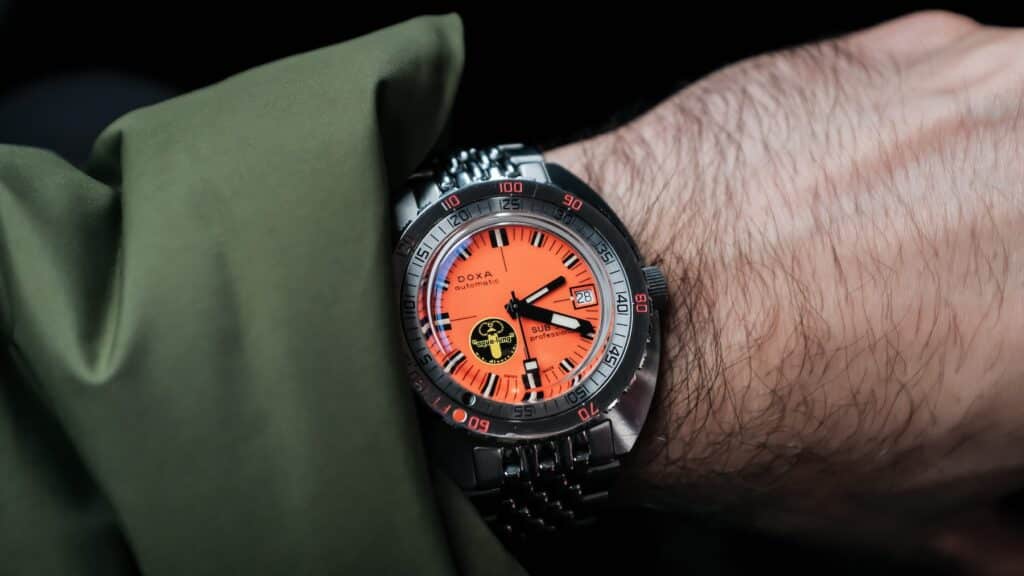
As an iconic skin-diver heritage option in this under-$5,000 conversation, the Doxa Sub 300 Aqua Lung brings a lot more personality than the usual safe luxury diver picks. The 42.5mm cushion case sounds larger than it feels, mostly because the shape is broad, low, and nicely curved into the bracelet rather than tall or clumsy. On the wrist, it settles in with that planted, secure feel we tend to appreciate on trips or long days out. Whether that means commuting, hiking, swimming, or disappearing for a weekend, it stays put without wobbling around or feeling too heavy.
What keeps the watch from feeling like a nostalgia act is how well the details still work. The bezel has the kind of firm, confidence-building action we want from a serious diver, with no backplay and enough grip to turn easily, whether your hands are wet, dry, or a little numb from the cold. The dual-scale no-decompression bezel is part of the charm, too. Most of us are not taking it anywhere near its limits, but with 300m of water resistance, it still feels purposeful rather than decorative. Over time, the steel picks up wear in a way that softens the watch’s appearance rather than ruining it, which suits its whole personality.
Then there is the dial, which does not hide in a sleeve. That signature orange is bold, and because the dial itself measures only about 25.5mm across inside the larger case, the color feels even more concentrated under the bubble crystal. Yes, that crystal introduces some distortion, but legibility stays strong thanks to the chunky indices, broad blocky hands, and a minute hand that reaches where it should. The lume is practical like the rest of the watch. It builds gradually, stays even, and works well in low light without trying to put on a show. One of the more charming quirks is the Aqua Lung logo, which sits slightly off-center. On a cleaner, more polished diver, that might feel like a mistake. Here, it fits. The Sub 300 is not trying to be sterile or perfectly resolved. It is bold, a little disruptive, and more memorable because of it.
The beads-of-rice bracelet follows the same logic. It looks heavier in photos than it feels in use, hugs the wrist well, and closes with a simple clasp that includes a dive extension and micro-adjustment holes. Inside, the COSC-certified ETA 2824 has proven to be what we want here: reliable, steady, and pleasantly boring in the best sense. After years of travel and daily wear, it continues to do its job without drama. That is a big part of why this Doxa belongs here. To dive deeper into our insights from personal testing, check out our detailed review.
Pros
- The cushion case wears smaller than the numbers suggest and feels secure without becoming cumbersome.
- The bezel action is firm, grippy, and easy to use in real conditions, including wet or cold hands.
- The orange dial remains legible despite the bubble crystal, thanks to the oversized hands and chunky markers.
- The lume is consistent and useful in low light without feeling overdone.
- The beads-of-rice bracelet is more comfortable and balanced than its appearance suggests.
- The COSC-certified ETA 2824 has held up as a dependable everyday movement over the years.
Cons
- The bubble crystal can distort the dial at certain angles, which will not be for everyone.
- The off-center Aqua Lung logo may bug anyone who wants perfect symmetry.
- The bracelet taper is slightly uneven, so it may not feel as polished as some buyers expect at this price point.
Oris Aquis New York Harbor II
| Price: | $3,000 |
| Water Resistance: | 300m |
| Case Dimensions: | 43.5mm (diameter) x 51mm (lug-to-lug) x 13mm (thickness) |
| Lug Width: | 23mm |
| Movement: | Caliber 733 (based on the Sellita SW200-1) |
The Oris Aquis New York Harbor II feels like the kind of dive watch you buy when you are ready to spend real money but still want something with a little personality. At around $3,000, it sits in a crowded part of the Swiss dive-watch market, which makes the details matter more. This one is tied to the Billion Oyster Project, with part of the proceeds supporting oyster restoration in New York Harbor, and that gives the collaboration more weight than the usual limited-edition backstory. Oris capped it at 2,000 pieces, which fits the brand’s habit of using the Aquis platform to try slightly more experimental ideas.
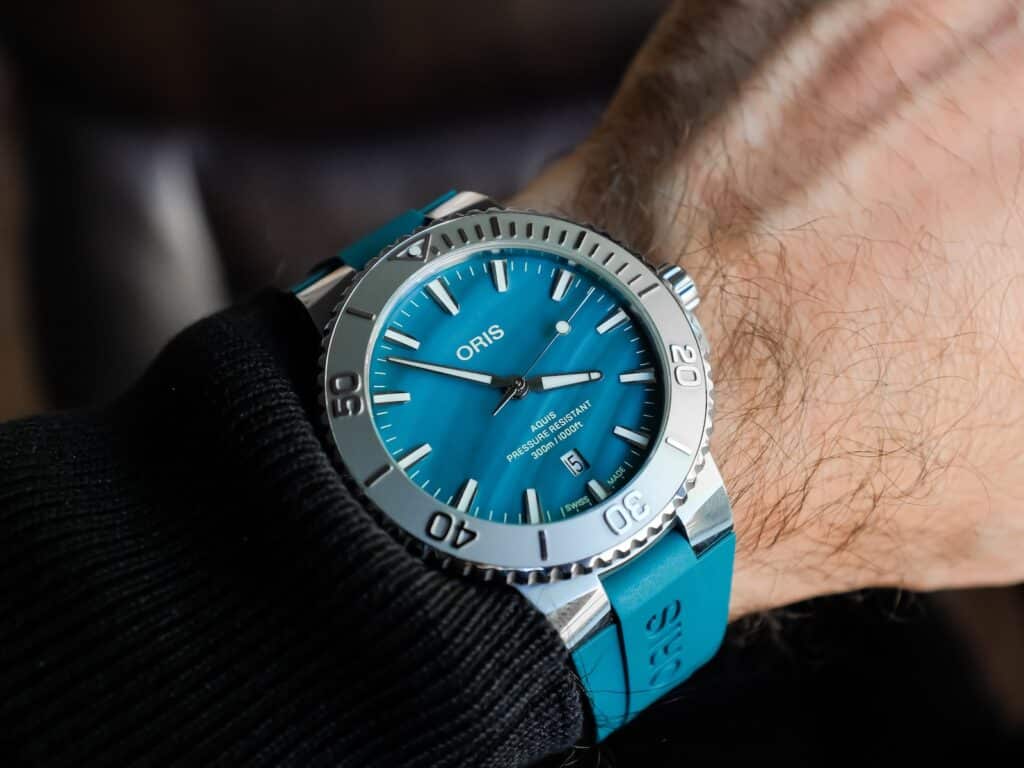
The dial is the main reason this one stands out. The aqua-green mother-of-pearl has an oyster-shell effect that sounds like marketing until you see it in person. In brighter light, different shades of green move across the surface. In lower light, it calms down and starts looking more muted, almost stone-like. We kept coming back to that because it gives the watch range without turning it into a novelty, and somehow legibility never really suffers.
On paper, the case looks like a lot. It measures 43.5mm across, a touch over 13mm thick, and roughly 51mm lug-to-lug. On a 6.75-inch wrist, though, it wears smaller than those numbers would suggest. The curved lugs and integrated strap setup pull the case down, keeping it from feeling flat or overextended. Most of the case is brushed, which keeps the watch grounded, while the polished edges catch enough light to stop it from feeling dull. The stainless steel bezel insert also helps. It looks a little more industrial and less polished than ceramic, which suits the watch better than we expected. More importantly, the bezel action is firm, precise, and clicky. The domed sapphire crystal has internal AR coating, so reflections stay under control without the usual worry about scratching the exterior coating. Crown action is smooth, and the engraved caseback with oyster-themed details makes the whole collaboration feel thought through rather than slapped together.
The aqua green rubber strap ended up making a lot of sense here. We are not usually eager to defend deployable rubber straps, but once this one was properly sized, it wore comfortably and securely for a full day. We honestly preferred it to adding a bracelet, mostly because the case already brings enough presence on its own. The watch is rated to 300 meters, which most owners will never challenge, but it does reinforce the idea that there is a real diver beneath the expressive dial.
Inside is the Caliber 733, based on the Sellita SW200-1. It gives you automatic winding, hacking seconds, a date, and a power reserve of about 41 hours. That reserve is fine if this is in regular rotation, though if you own several watches and leave it untouched for a couple of days, you will need to reset it. Accuracy landed right where we expected, with no drama. That is probably the right outcome here. It works because it takes a proven, comfortable dive-watch platform and pushes it in a more expressive direction. For someone moving up from safer, more conventional divers, this feels like a modern independent Swiss luxury-sport diver with enough personality to stand apart from the usual choices.
Pros
- The mother-of-pearl dial looks different and shifts beautifully with changing light.
- Brushed surfaces and polished edges strike a nice balance between tool-watch restraint and luxury presence.
- The stainless steel bezel insert gives it a slightly rawer, more industrial feel than ceramic alternatives.
- The rubber strap is very comfortable once sized and suits the watch better than a bracelet probably would.
- The Billion Oyster Project collaboration has real substance.
Cons
- The 43.5mm case still leans larger than what some of us would naturally reach for.
- The 41-hour power reserve is merely adequate if you rotate through several watches.
- The dial makes the watch feel more situational than a plain black diver.
Seiko Marinemaster
| Price: | $3,100 |
| Water Resistance: | 300m |
| Case Dimensions: | 44mm (diameter) x 50.5mm (lug-to-lug) x 15.4mm (thickness) |
| Lug Width: | 20mm |
| Movement: | Seiko 8L35 (Automatic Movement) |
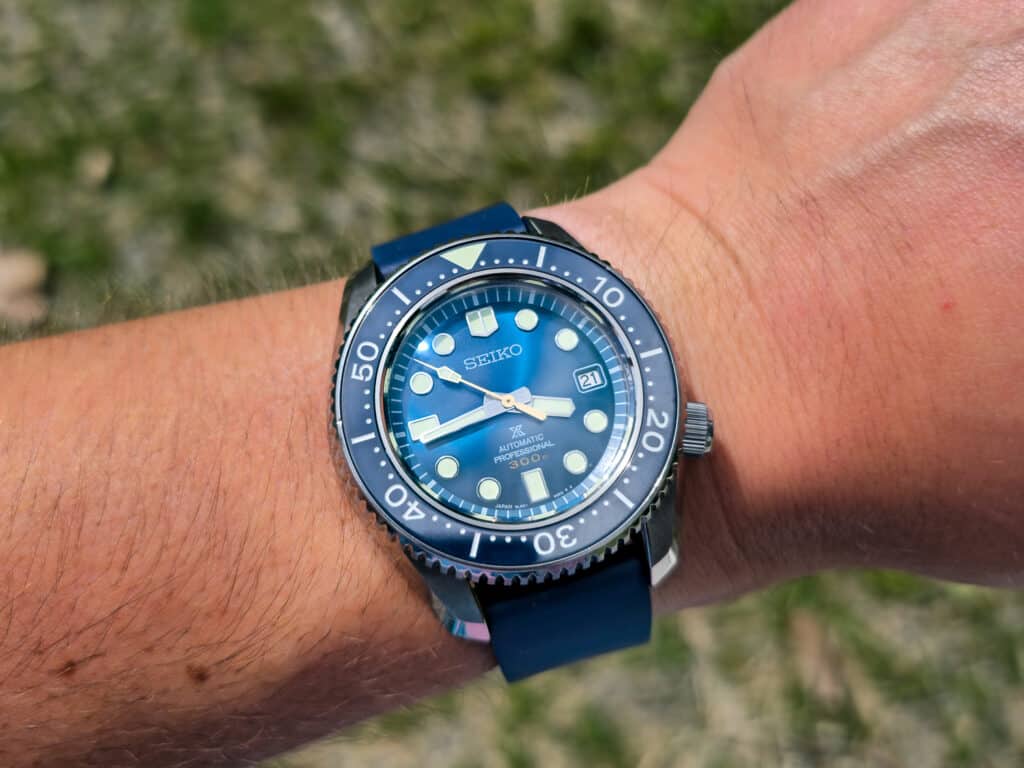
The Marinemaster 300 is not interested in pretending to be smaller, lighter, or more polite than it is. At roughly 44mm and close to 200 grams on the bracelet, this thing packs real mass, and you feel it right away. It is not the kind of diver you forget about after ten minutes. For larger wrists, though, that heft can be part of the appeal. It has the kind of physical presence that fills out the wrist in a satisfying way, even if it takes a little time to adjust to. In a list like this, that is part of what makes it compelling as a luxury-adjacent Japanese enthusiast option. It does not chase the same kind of refinement as a Swiss luxury diver, but it delivers a premium sense of seriousness.
What makes the watch more interesting is that it wears better than the specs suggest. The monocoque case gives it that dense, one-piece solidity, but the sculpted case sides do a lot to keep the watch from feeling as wide as the raw numbers imply. Polished flanks catch the light and visually trim down the profile, while the comparatively compact dial keeps the whole thing from reading like a giant slab of steel. On the wrist, the footprint lands closer to something like a modern Submariner than you might expect. The smooth caseback helps, too, since it sits evenly rather than wobbling. The trade-off is long-term servicing, because the movement has to be accessed through the front of the case rather than through a traditional caseback.
The bezel is another part of the watch that leaves an impression quickly. It sits high, offers plenty of grip, and stays easy to operate even with gloves. The action is not sharp or crisp in the familiar Swiss way. Instead, it has a smoother, more fluid resistance that feels controlled rather than clicky. The dial is what pulls you back in. On the blue version, especially, the color shifts well across different lighting conditions and holds its tone better than many sunburst dials do. The framed date and restrained gold accents add some personality, but not so much that the watch tips into flash. Lume is also on another level. It charges fast, glows hard, and stays legible through the night, which matters more than people admit until they actually rely on it.
Inside, the 8L35 feels like a proper step above Seiko’s more familiar mid-tier movements. In our extended hands-on review, it stayed within +/- 4 seconds per day, which is better than the official rating might suggest. It comes across as stable and dependable, and that consistency adds up over time. The weak point is the bracelet. It is heavy, the links are long, articulation is not very graceful, and the male end links stretch the effective lug-to-lug farther than they need to. That combination makes the watch wear bigger and clumsier on the bracelet than the head itself deserves. We found it much easier to enjoy on rubber or NATO, where the whole watch loosened up and started making more sense.
Pros
- The sculpted monocoque case wears smaller than the dimensions suggest.
- Lume performance is excellent and stays visible all night.
- The 8L35 delivers strong real-world accuracy and feels meaningfully above Seiko’s lower-tier calibers.
- The bezel is tall, grippy, and easy to control in use.
- The one-piece case construction gives the watch a durable, solid feel.
Cons
- Male end links increase the wrist presence more than necessary.
- Limited articulation and long links hurt overall comfort.
- The stock bracelet is very heavy and not especially refined for the money.
- Servicing is less straightforward because the movement is front-loaded.
Tudor 79220N Heritage Black Bay
| Price: | $3,400 – $3,750 |
| Water Resistance: | 200m |
| Case Dimensions: | 41mm (diameter) x 50.3mm (lug-to-lug) x 12.7mm (thickness) |
| Lug Width: | 22mm |
| Movement: | ETA 2824 |
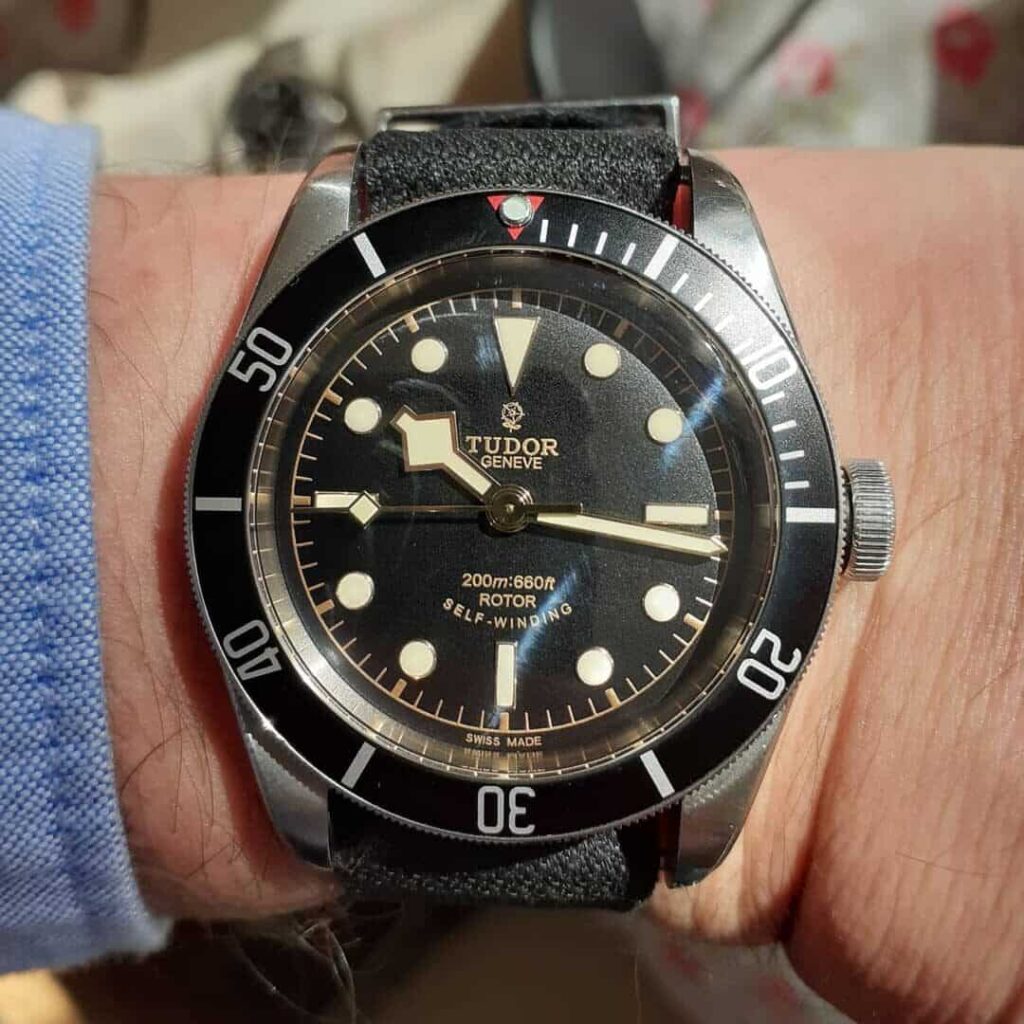
The Tudor 79220N Heritage Black Bay feels like the watch Tudor made when it stopped pretending collectors did not care about the old stuff. As mentioned in our hands-on comparison, it pulls together several vintage Submariner cues and drops them into the early Black Bay format, still feeling unusually complete. The gilt details, smiley dial, rose logo, and red triangle give it that 1950s-diver warmth without making it feel like a costume piece. For us, that is the whole draw. This is the watch you check far more often than necessary because the dial keeps pulling your eyes back in. It also proved very easy to live with.
On the bracelet, it felt robust but never too heavy. Once we started rotating through the bracelet, leather, and the included black fabric strap, it became obvious why early Black Bays developed such a following. We went a little overboard with strap changes, to the point that the lugs still show some scars from all that experimentation, which tells you something about how wearable and adaptable this case really is.
It is not a small watch, and Tudor did not try to hide that. At roughly 12.7mm thick, the case has that slab-sided profile critics love to point out. On paper, that sounds like a deal-breaker. On a 175mm wrist, though, it sits with enough balance that the thickness matters less in daily wear than it does in side-profile photos. The sapphire crystal and muted aluminum bezel insert help here, too. You get durability and scratch resistance where it counts, but the watch still keeps the softer, less flashy look that suits its vintage-leaning design.
The ETA 2824 inside is another reason this watch works so well in the affordable luxury lane. It is not the most advanced thing Tudor has used, and newer Black Bays clearly beat it on power reserve, anti-magnetism, and clasp design. The old three-hole clasp with a spring bar tool feels dated next to Tudor’s later T-fit system, especially if your wrist swells through the day. Still, the movement is dependable, easy to trust long-term, and in keeping with the watch’s character.
Pros
- Vintage Tudor design cues, such as the gilt accents, rose logo, smiley dial, and red triangle, feel cohesive rather than forced.
- Wears solid without crossing into heavy territory.
- Sapphire crystal and subdued aluminum bezel strike a smart balance between durability and period-correct charm.
- ETA 2824 is proven, reliable, and easy to live with over the long haul.
- Bracelet, leather, and fabric strap options make it versatile for different seasons and moods.
Cons
- The case is tall and visibly slab-sided, so it will not disappear under a cuff.
- The clasp feels dated compared with Tudor’s later T-fit setup and is less convenient for quick adjustment.
- Newer Black Bays outperform it on specs like power reserve and anti-magnetism.
- Buyers chasing pure technical value may find the emotional appeal stronger than the feature set.
Sinn T50
| Price: | $4,400 |
| Water Resistance: | 500m |
| Case Dimensions: | 41mm (diameter) x 47mm (lug-to-lug) x 12mm (thickness) |
| Lug Width: | 20mm |
| Movement: | Sellita SW 300-1 |
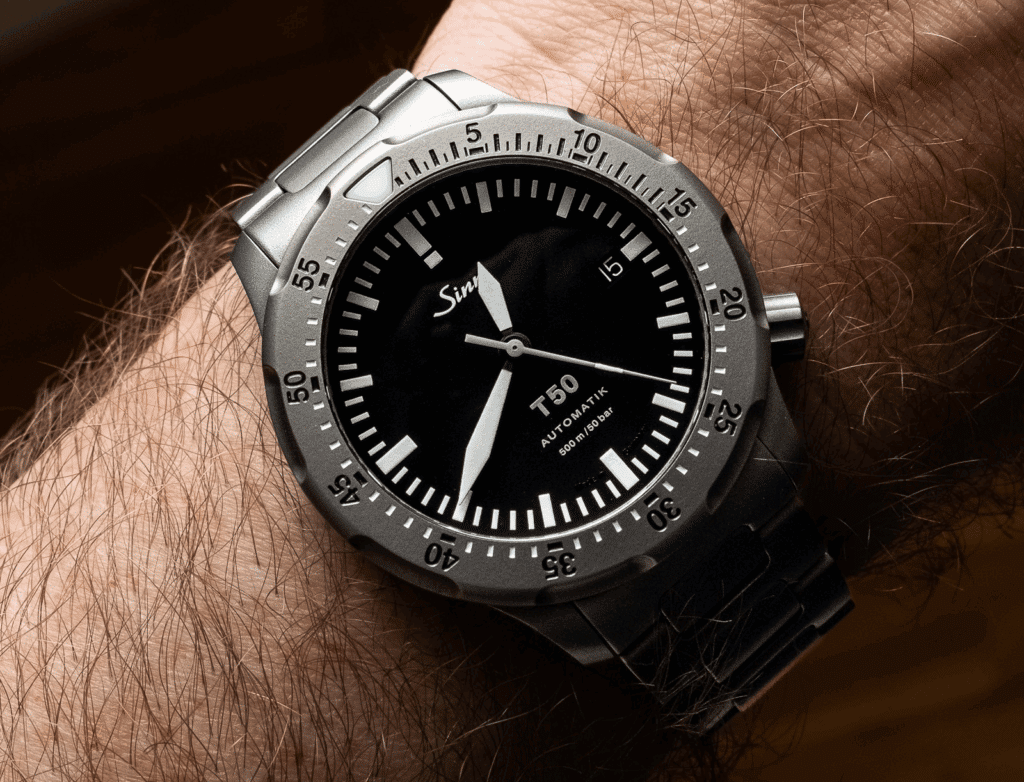
The Sinn T50 is what happens when a premium dive watch is engineered with restraint instead of swagger. In this under-$5,000 group, that matters. A lot of luxury-adjacent divers still equate seriousness with weight, thickness, or a case that constantly reminds you it is there. The T50 goes the other direction. Its presence comes from how it wraps around the wrist, not from bulk, and at roughly 95 grams, it’s sized for a 7-inch wrist and feels almost suspiciously light the first time you put it on. That lightness turns out to be one of its best qualities. It stays planted, sits low, and rarely needs a mid-day adjustment. At a desk, on a bike, or just moving through errands, it behaves like a watch built to stay out of your way while still feeling substantial enough to justify the price.
A lot of that experience comes down to the matte titanium case. It keeps reflections down and gives the watch a properly utilitarian feel, which suits Sinn better than any polished flourish would. The 4 o’clock crown is another detail that pays off in real wear. It stays easy to reach, but it does not dig into the wrist when your hand is bent or moving around. The captive bezel system is even more telling. You have to press it down before turning it, which sounds like a niche feature until you bang the watch against something and realize the bezel hasn’t shifted. That is the kind of execution engineering that earns its keep quietly.
Sinn also thought through durability well. The tegimented bezel holds up better against scratching than standard titanium, and that showed during regular wear. On the dial side, the black-and-white layout keeps things clean and immediate. Sword hands, tidy markers, and a date window that does not shout for attention all help the watch stay legible in a wide range of conditions. The lume on the second hand helps confirm that the watch is running in the dark. That said, its small size means it takes an extra second to notice compared to larger lume plots.
Inside, the SW300 kept excellent time during our testing period, landing around +2 to -3 seconds per day, which is better than plenty of watches in this bracket can manage. The compromise is the 42-hour power reserve. If you rotate watches and leave this untouched for a day or so, there is a decent chance you will come back to it stopped. That is not a fatal flaw, but it is worth knowing if your collection already has a few watches fighting for wrist time. The bracelet is also a mixed bag. The H-link design is comfortable and visually appropriate for the case, but the diver extension inspired less confidence than we wanted. It could release with a light pull, which is not ideal on a watch meant to feel overbuilt everywhere else. We ended up removing it and switching to a normal spring bar setup. Thankfully, the drilled lugs make that easy, and the T50 also works well on rubber or NATO if you want the simplest experience.
That all adds up to a German premium tool diver that feels thoughtfully engineered where it counts, even if a couple of ownership details keep it from being perfect.
Pros
- Titanium construction keeps the watch very light and comfortable over long stretches of wear.
- The captive bezel system prevents accidental movement and feels useful in practice.
- Tegimented bezel treatment improves scratch resistance over standard titanium.
- The dial layout is clean, clear, and easy to read at a glance.
- Drilled lugs make strap changes simple, and the watch wears well on both rubber and NATO straps.
Cons
- The 42-hour power reserve is a little limiting if you rotate between several watches.
- The diver extension can release too easily, which undermines confidence in the bracelet.
- The lume patch on the seconds hand is small and takes a moment to spot in the dark.
- Servicing is less straightforward since it requires going through Sinn directly.
Panerai PAM00777 Luminor Marina
| Price: | $3,700 – $5,000 |
| Water Resistance: | 100m |
| Case Dimensions: | 44mm (diameter) x 15mm (thickness) |
| Lug Width: | 24mm |
| Movement: | In-house, manual-winding P.6000 |
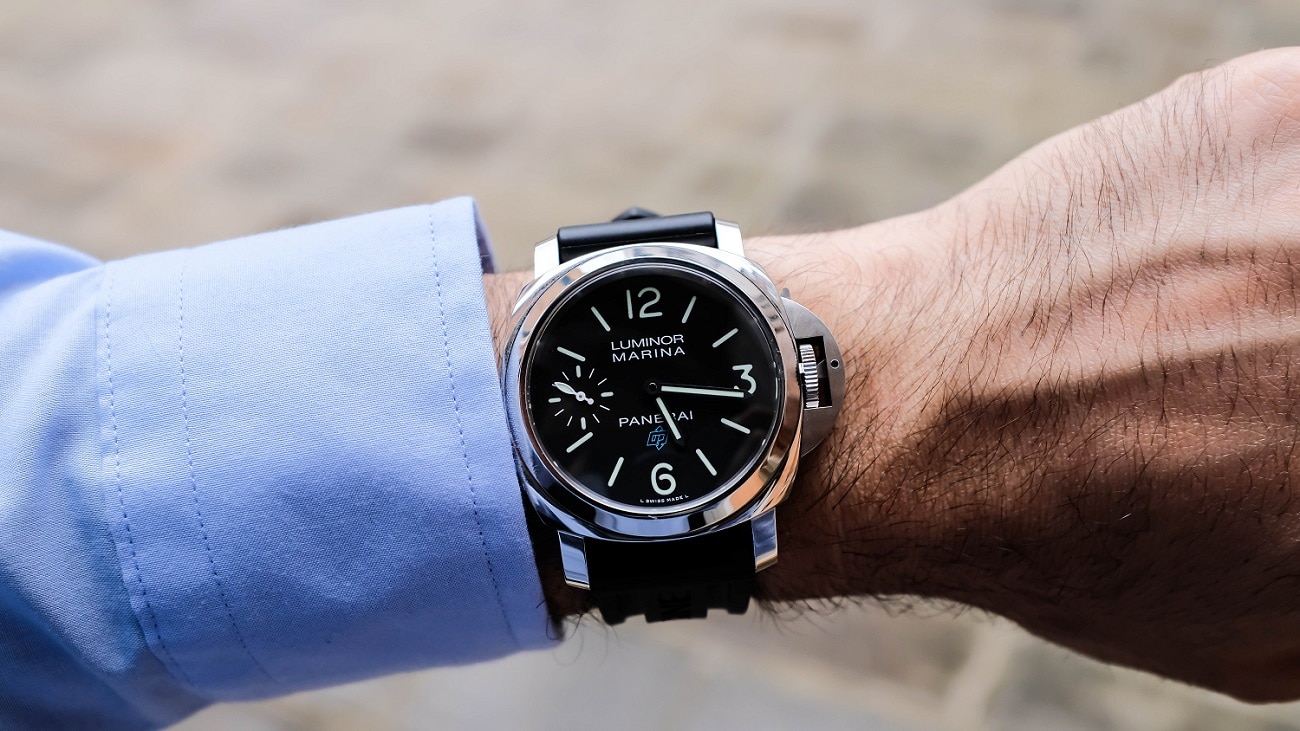
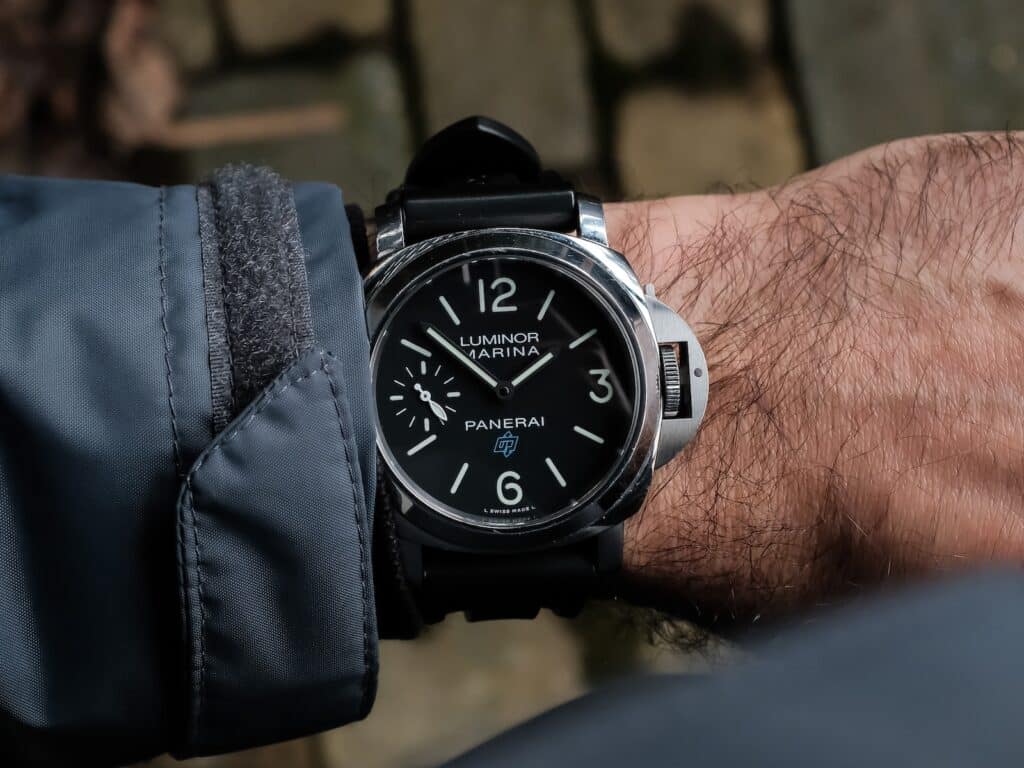
The Panerai PAM00777 is probably the clearest example on this list of what we mean by affordable luxury once you stop insisting on buying new. On the pre-owned market, this is one of the Panerai references that can still slip in under our ceiling, which is why we would approach it used in the first place. On the wrist, it does not try to disguise itself. At 44mm, the case wears with real presence, and after enough time with it, that stops feeling like a sizing issue and becomes the point. You notice it. You feel it. For the kind of buyer who wants a luxury diver that does not blend into the background, that is part of the appeal. The polished case also gives it more visual punch than the matte, toolish divers in this bracket, though that finish will pick up scratches from regular wear and make them visible sooner.
A lot of the charm comes from the things you interact with every day. The signature crown guard is not a mere branding bolted onto the side. The lever action feels precise, and opening it to wind or set the watch becomes a satisfying part of ownership over time. The dial follows the same straightforward approach. Large printed numerals and indices make it easy to read at a glance, and the running seconds at 9 keep the layout from feeling sterile. The longer we wore it during our review, the more small details stood out, especially the blue logo at 6 o’clock, which adds a little contrast and keeps the dial from looking too bare. It is a simple watch visually, but not a dull one. That simplicity is part of why it works so well in daily use.
Inside, the manual-wind P.6000 keeps the experience grounded. The three-day power reserve gives you enough flexibility to rotate it during the week without constantly resetting it, and the hacking seconds are there if you care about setting it precisely. In actual ownership, that kind of usability matters more than movement decoration you never see behind a solid caseback anyway.
The standard 24mm Panerai rubber strap also suits the watch better than many stock rubber straps suit their watches. It is broad and substantial, and it takes a little time to break in, but once it does, it becomes one of the more natural pairings for a case this large. The only caveat is that the 24mm width limits strap variety a bit, and this model does not offer the same level of water resistance some buyers may expect from a more traditional no-nonsense dive watch. Even so, if your idea of an under-$5,000 luxury diver includes personality, interaction, and a case shape that feels unmistakable, the PAM00777 makes a strong argument.
Pros
- The crown guard adds a very satisfying daily interaction, not just a recognizable silhouette.
- Large numerals and indices keep the dial highly legible in everyday conditions.
- The manual-wind P.6000 is straightforward, reliable, and backed by a useful three-day power reserve.
- The stock rubber strap fits the watch’s scale and character better than expected once broken in.
Cons
- The polished case shows scratches easily, so regular wear leaves visible marks.
- At 44mm, it wears with full-sized Panerai presence and will not suit anyone looking for subtlety.
- The 24mm strap width narrows your strap options.
- Water resistance is not as confidence-inspiring as some more traditional dive-focused alternatives in this price range.
Think we left out a worthy contender? We only include watches we’ve reviewed hands-on, so if there’s a piece you think deserved a spot here, drop it in the comments, and we’ll see if we can get one in for review for future consideration in this piece.

Co-Founder and Senior Editor
Kaz has been collecting watches since 2015, but he’s been fascinated by product design, the Collector’s psychology, and brand marketing his whole life. While sharing the same strong fondness for all things horologically-affordable as Mike (his TBWS partner in crime), Kaz’s collection niche is also focused on vintage Soviet watches as well as watches that feature a unique, but well-designed quirk or visual hook.
i wouldn’t buy any of them…not good looking enought to spend 3-5k on them imho
Hi, Pat:
Thank you for checking out the piece and sharing your feedback. I completely understand that what does or doesn’t work visually for a watch can be subjective. That said, I’d love to hear which alternatives you think would be stronger fits. It would be interesting to see whether there are any brands or models we should reach out to for hands-on reviews in future updates to the piece.
Best,
-Kaz
Why are the Concord Mariners never mentioned
Hi, John:
This is a brand that we’re actually unfamiliar with. We’ll check them out and see if we can potentially coordinate a hands-on review.
Thank you,
-Kaz
Squale makes great dive watches…
Hi, S. Ortiz:
Agreed! We don’t have any Squale models on this list because we actually haven’t reviewed one a long time. We only try to feature watches here that we’ve conducted recent hands-on reviews with. The great news is that we’re currently in the process of conducting a Squale review now so depending on how that goes, we may include it in a future update.
Best,
-Kaz