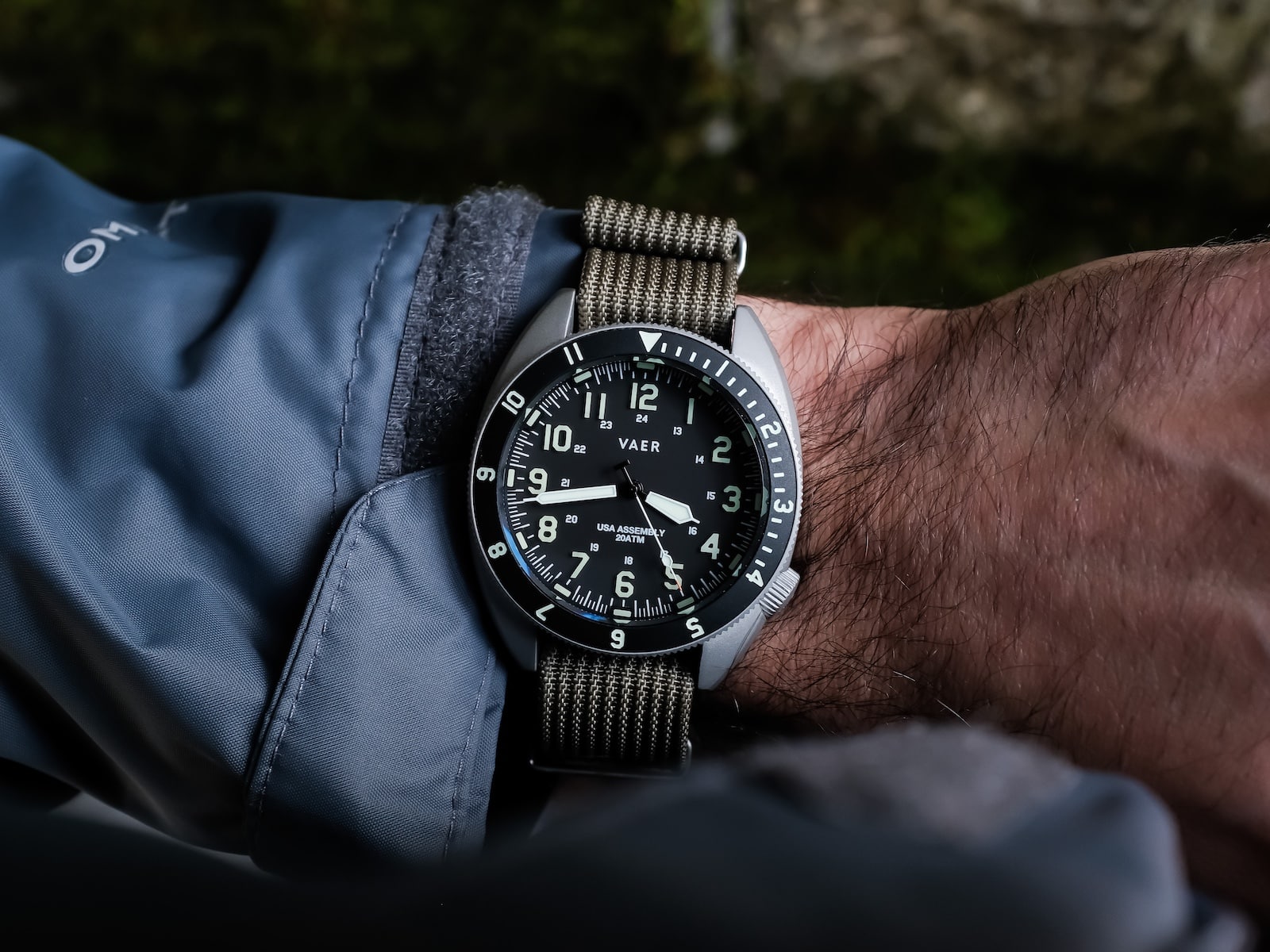
I’ve always liked watching newer brands settle into their own rhythm after they’ve been around for a few years. There’s a point where the early experimentation gives way to something more deliberate, and you start to see what the brand actually wants to be. Vaer feels like it’s at that stage now. Whether you’re fully on board with the approach or not, it has carved out a recognizable lane built around value-focused watches rooted in familiar, functional designs. When the Vaer C4 Tactical Field Solar came across my radar, it immediately hit a few of my personal pressure points.
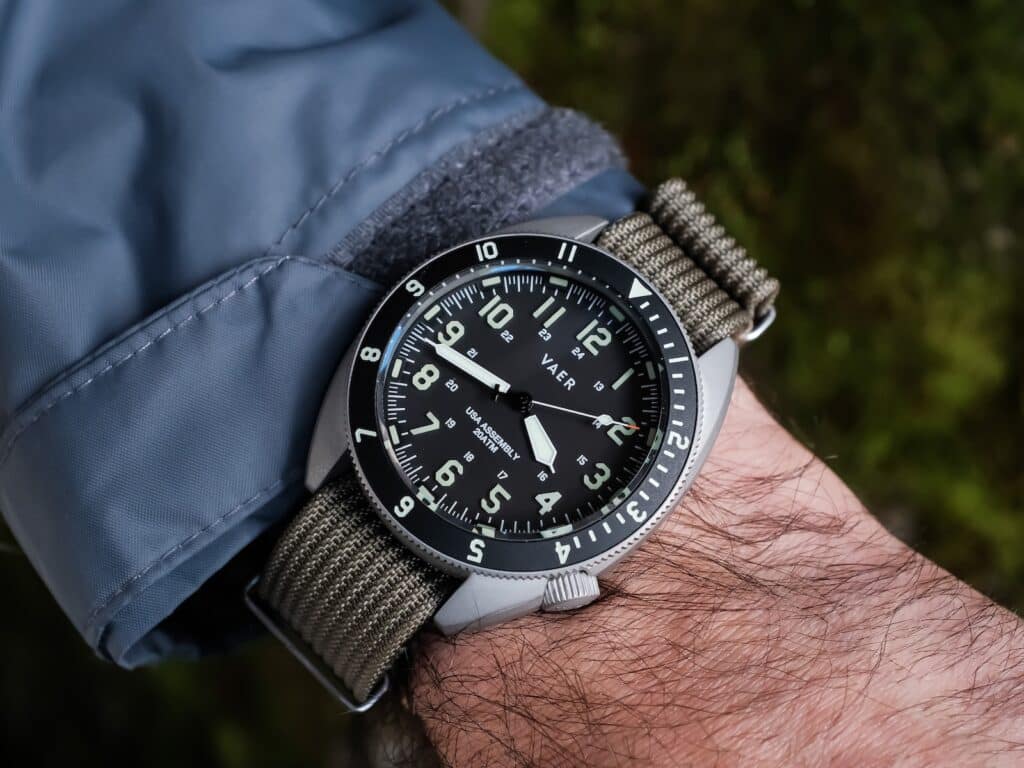
At first glance, this one looked like Vaer’s field watch formula pushed in a slightly more purposeful direction, with hints of old Seiko references and even a trace of Benrus Type II influence in the overall vibe. That combination alone made me want to spend some real time with it and see how it held up beyond the initial impression.
I’ve said for a while that Vaer tends to offer a solid entry point for newer collectors. A lot of the catalog focuses on delivering approachable versions of familiar watch archetypes that might otherwise feel out of reach. That philosophy aligns naturally with how I think about this hobby. With the Vaer C4 Tactical Field Solar, though, it feels like the brand is stretching a bit and leaning into something with more personality. Let’s take a look at what this watch brings to the table.
Case Design and Overall Capability
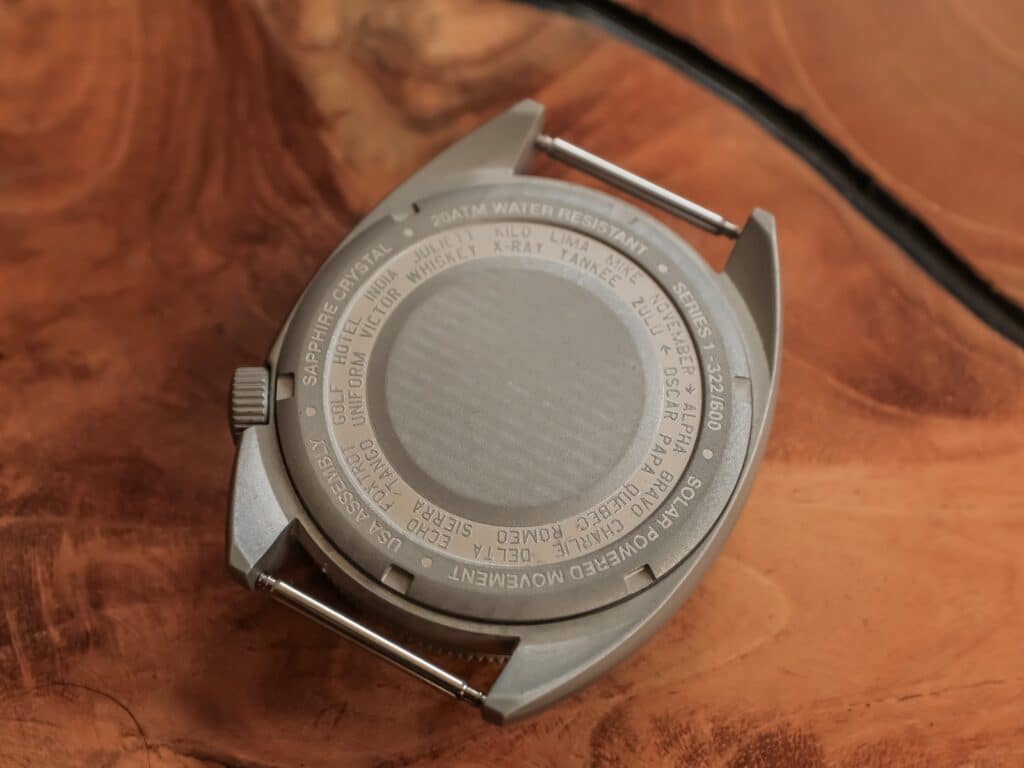
The first thing that stood out to me in person was the case. This is not a recycled off-the-shelf design. It’s a 41.5mm stainless steel case that feels purpose-built for this model, and in the bead blasted configuration I tested, it leans fully into that utilitarian military vibe. There’s also a full DLC option for anyone who wants to take the tactical aesthetic even further.
The shape carries a hint of that late 1960s and early 1970s Seiko vibe, particularly the softer curvature you’d associate with something like a 6105-8000. However, the lines are distinct enough that it stands on its own, especially when paired with the rotating bezel and stark dial layout.
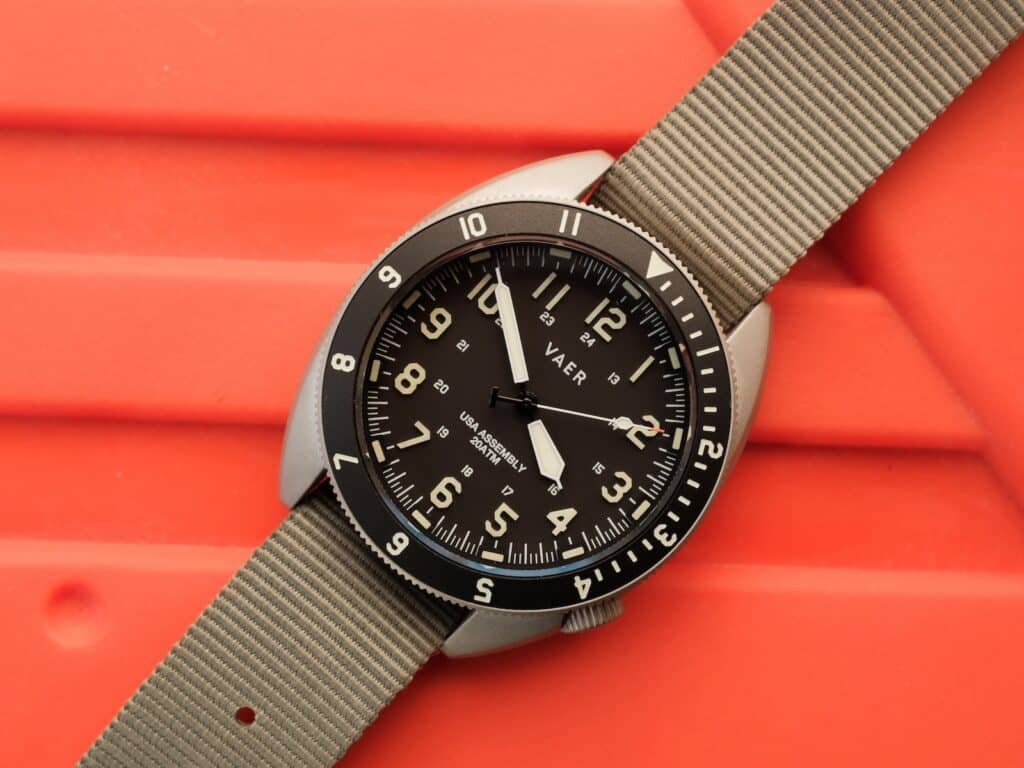
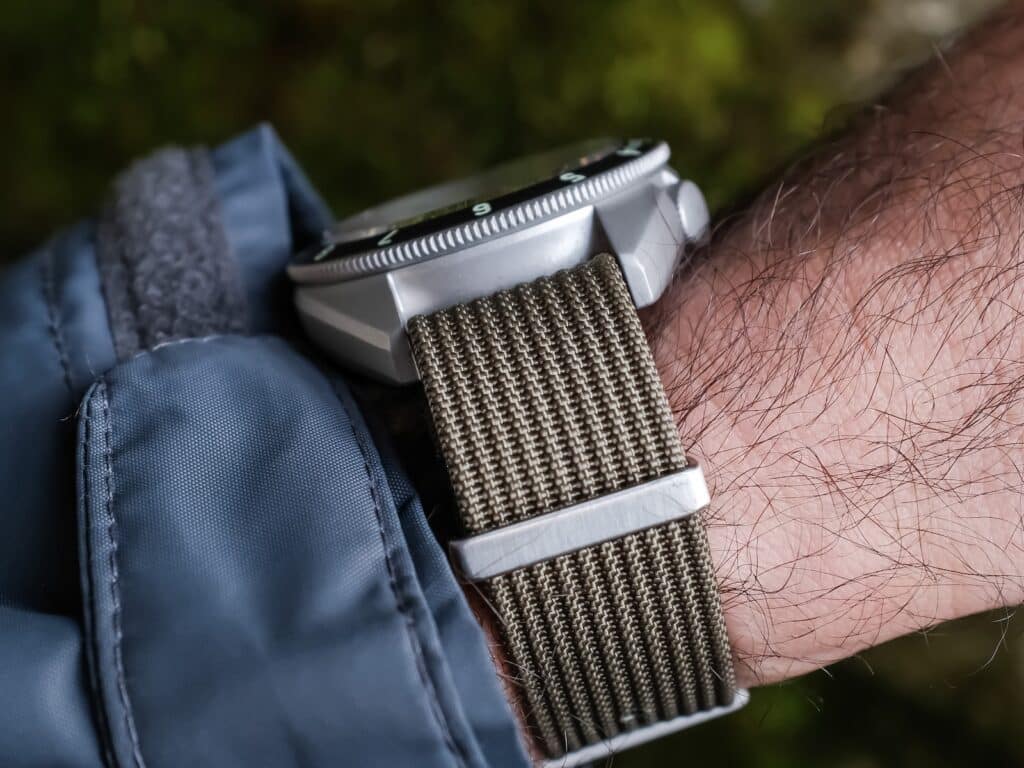
At 12.8mm thick including the bezel, it comes in slimmer than I expected. On paper that doesn’t scream thin, but the mid-case profile is relatively trim, and on the wrist it wears flatter than the numbers suggest. With 200 meters of water resistance, a screw-down crown, and a screw-down case back, this crosses over from field watch territory into something that could easily handle proper dive duty. You could reasonably call it a tactical diver and not feel like you were stretching the definition. The crown sits at 4 o’clock, which helps tuck it out of the way. I found it easy to unscrew and set, and it threaded back down without any gritty resistance. It’s a small detail, but it contributes to that overall sense of confidence.
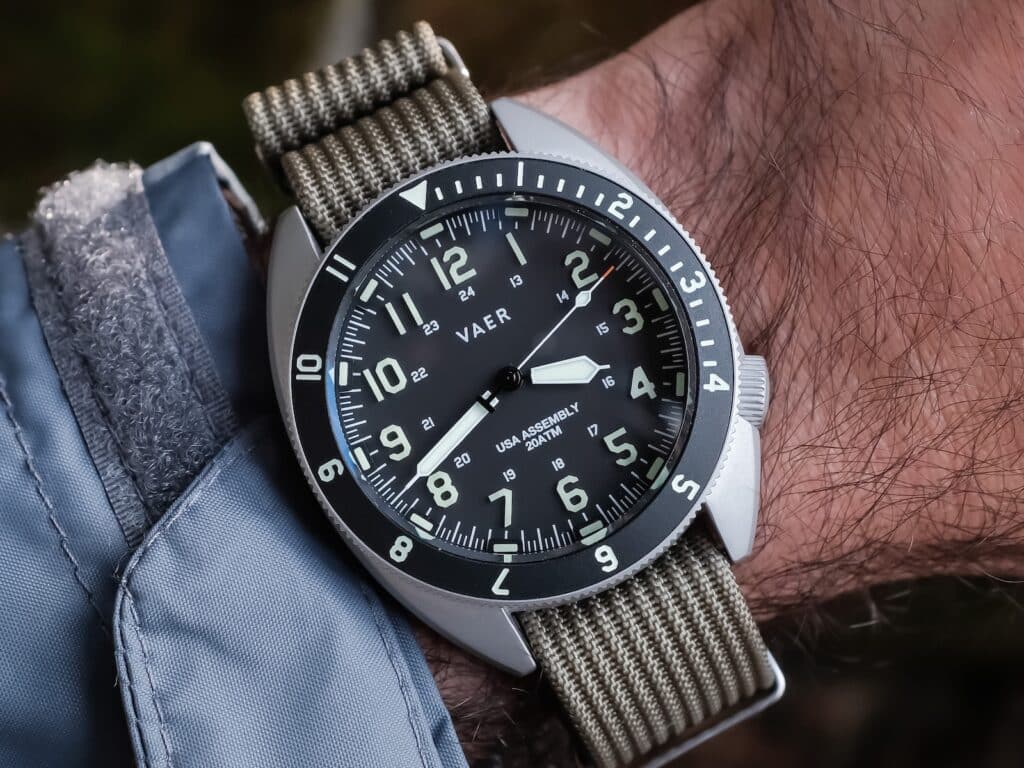
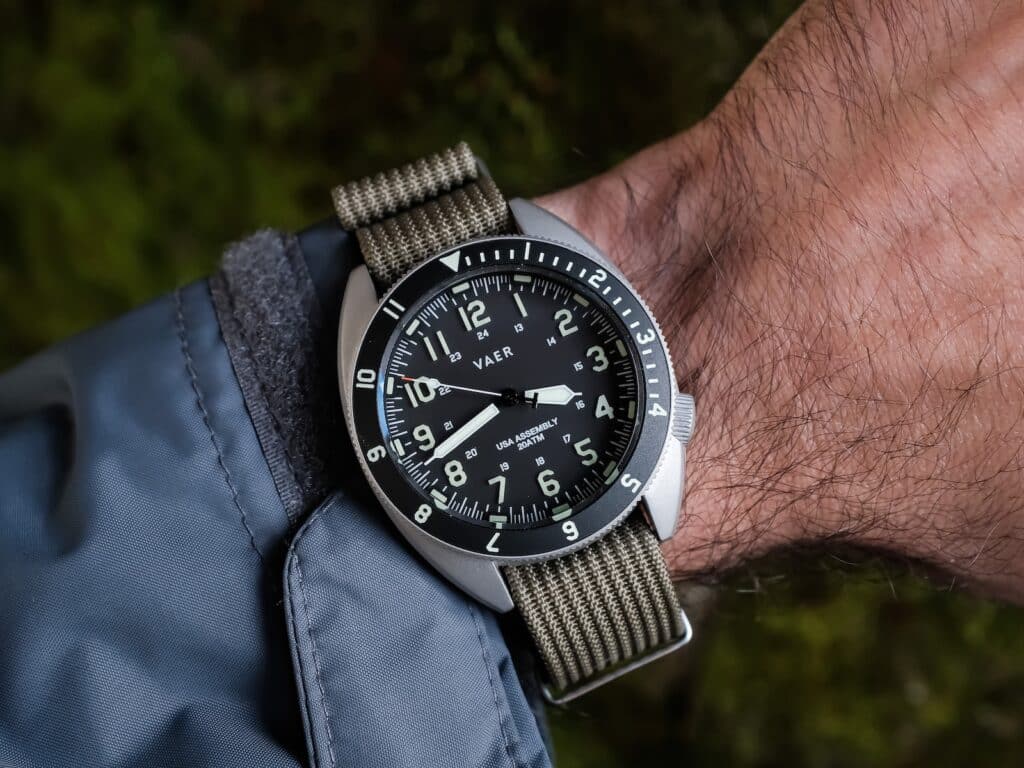
The bezel is another interesting choice. It’s a 120-click unidirectional setup with a coin-edge grip that’s easy to manipulate, even with damp fingers. The insert is actually steel with a DLC treatment rather than aluminum, which gives it a slightly more durable feel. It’s marked to 20 minutes, yet Vaer positions it as a 12-hour bezel, so in practice you can use it as a short-duration timing tool or track a second time zone if you want. I love a good “poor man’s GMT” set-up.
Dial and Lume Execution
The dial sticks to matte black across both case variations, which makes sense given the overall direction. There’s no sunburst, no gloss, and no unnecessary flourish. Large syringe-style hands and oversized Arabic numerals dominate the layout. Each hour marker also carries a smaller 24-hour track beneath it, reinforcing that military influence. Up close, the numerals reveal themselves to be three-dimensional lume blocks rather than printed or simply filled markers. The same approach carries over to the rectangular minute markers. It adds depth without feeling flashy, and more importantly, it enhances legibility in a way that feels intentional rather than decorative.
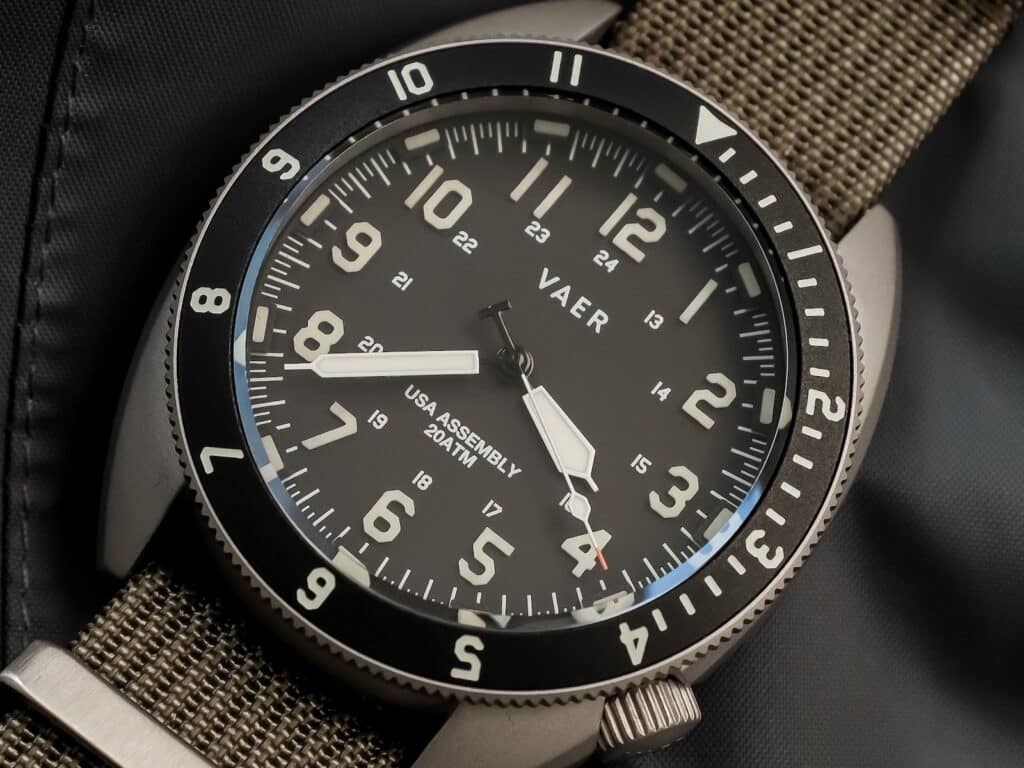
Over the dial sits a sapphire crystal with a beveled edge, which gives a subtle sense of refinement you don’t always find at this price point. It catches light in a way that adds dimension without undermining the watch’s tool-first personality.
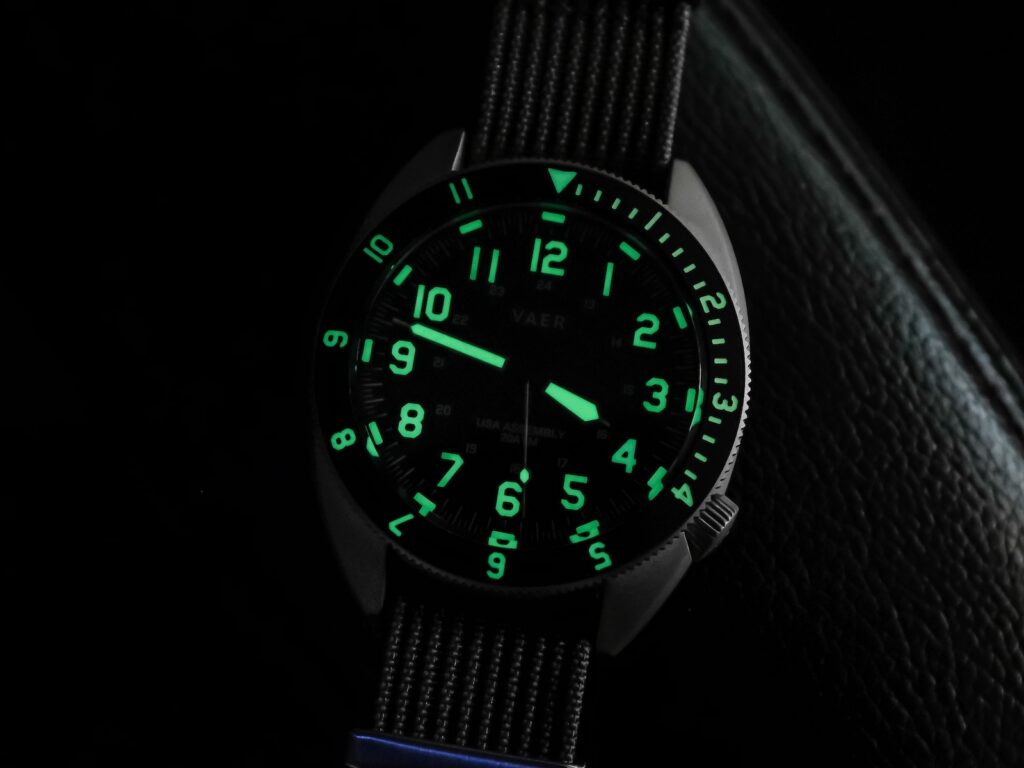
Then there’s the lume performance. I’ve handled a number of Vaer models at this point, and this Vaer C4 Tactical Field Solar is easily the strongest luminous display I’ve seen from the brand. The glow is intense after even brief exposure to light, and more importantly, it holds. I was consistently able to read it several hours into the night without strain. For a watch positioned under $500, that’s impressive and genuinely useful rather than just spec-sheet bragging.
Solar Movement and Daily Use
Vaer opted for a Japanese-made Epson VS-42 solar movement here, and I think that decision aligns with what this watch is trying to be. With roughly six hours of light providing up to six months of charge, I think it fits well into a rotating collection. It’s nice knowing I could set it down for weeks, pick it back up, and it would still be ready to go. That matters to me more these days than the novelty of winding or resetting an automatic that hasn’t been worn in a while.
There’s also a practical argument for solar in a watch that leans this heavily into hard-use territory. We’ve covered this in great detail here before. You don’t have to think about battery swaps every couple of years, and you’re not relying on a mechanical movement that could be more sensitive to shock if you actually use the watch as intended.
That said, I did notice that the seconds hand doesn’t align perfectly with every marker. It’s not wildly off, and it’s a common quirk in this segment, but once you see it, you can’t completely unsee it. For me, it’s a minor frustration rather than a fatal flaw. This isn’t a huge issue for me but I know it drives some collectors off the wall.
On the Wrist
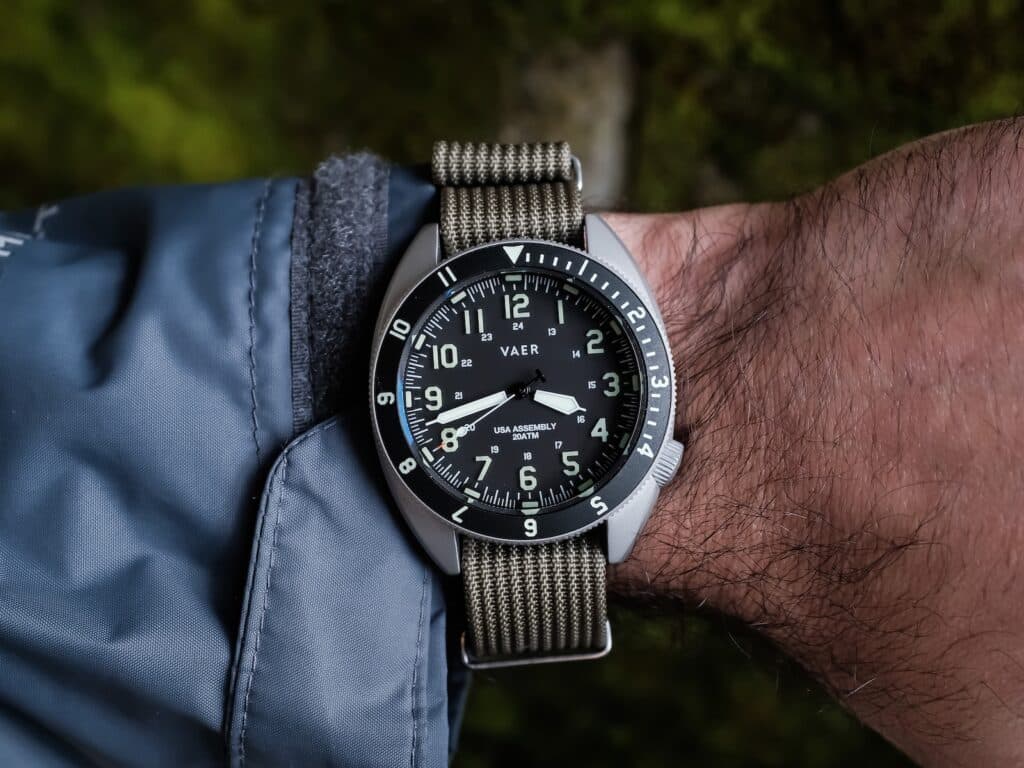
At 41.5mm, this lands in what I consider a comfortable modern sweet spot. On my 6.75-inch wrist, the proportions feel balanced, helped by a relatively compact lug-to-lug measurement that keeps it from overhanging. The dial opening remains generous, so legibility stays high without the watch feeling oversized.
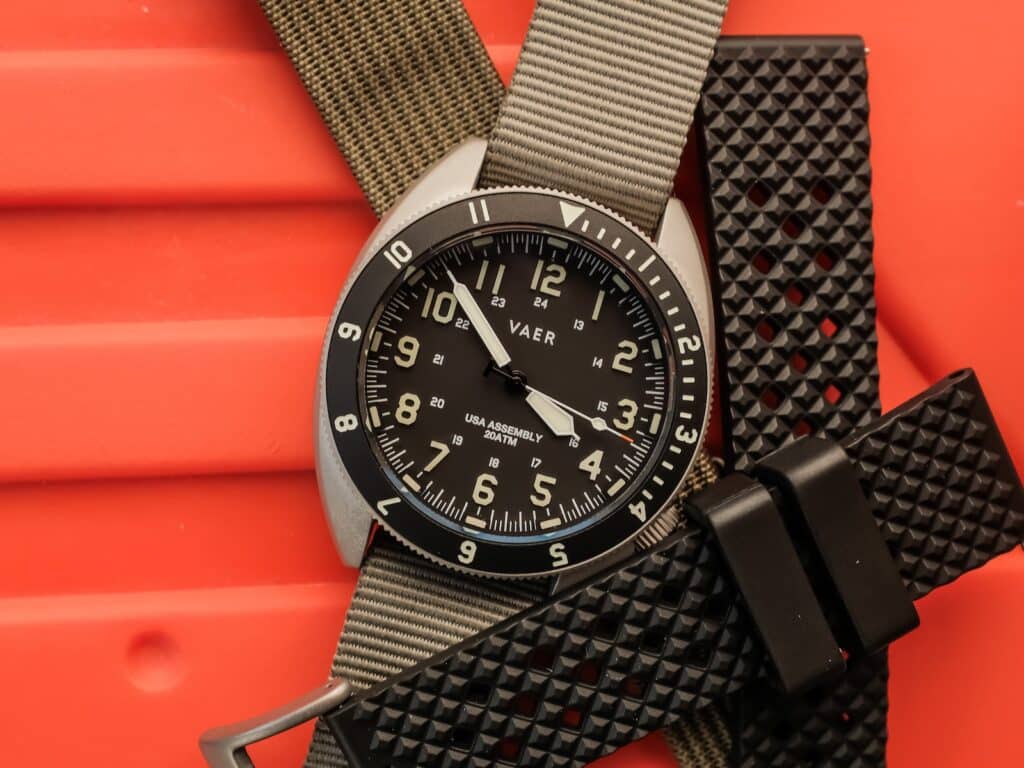
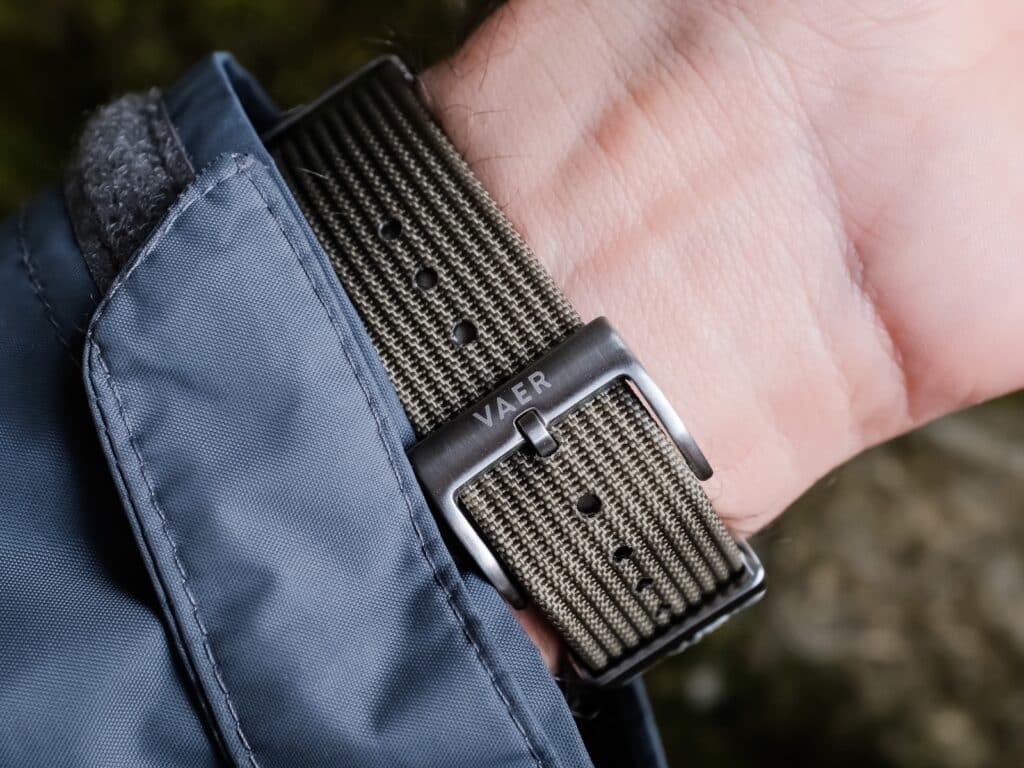
Vaer includes a black waffle-textured FKM strap as the standard option, along with your choice of a second strap. I spent most of my time with the waffle FKM and an olive single-pass nylon. Both work, but I found myself gravitating toward the FKM for daily wear. It feels substantial without being stiff, and the texture complements the tactical aesthetic better than the more common tropic-style rubber straps.
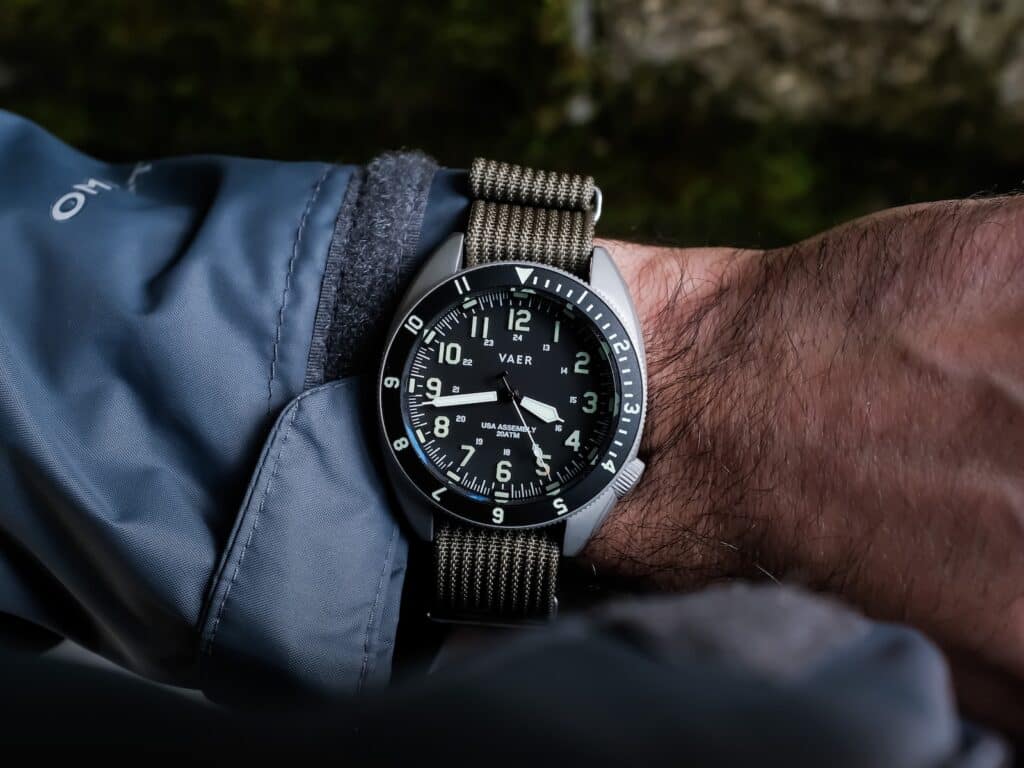
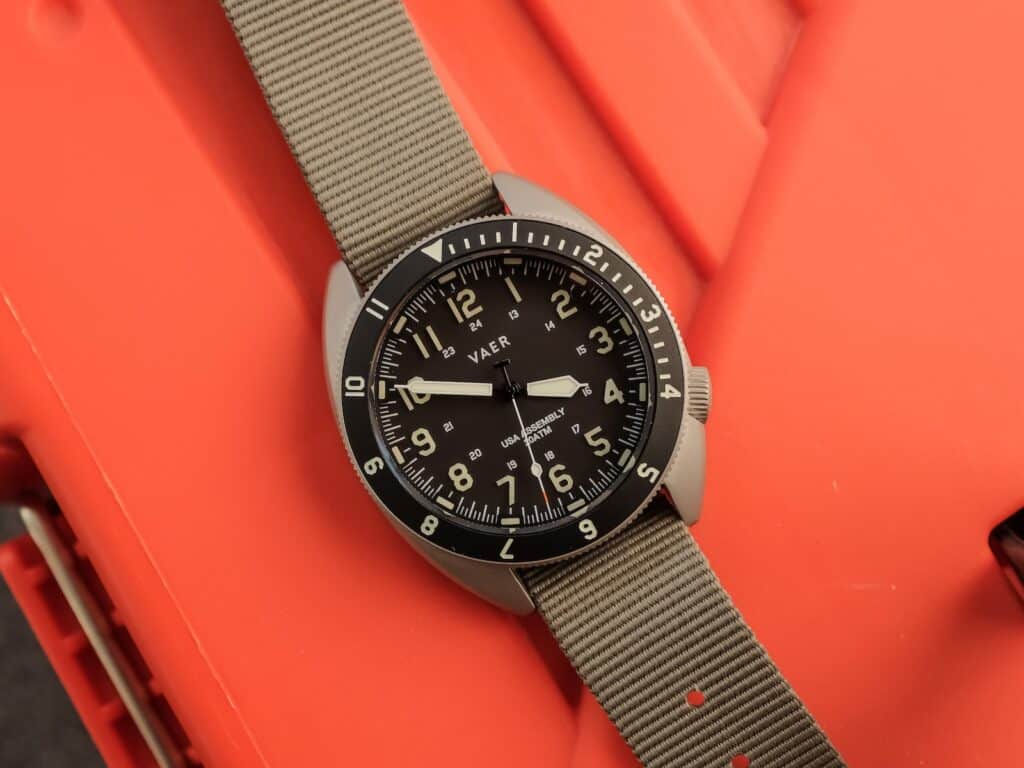
And then, of course, I had to try it on an admiralty grey strap from CWC. That combination just works. It leans fully into the military lineage that inspired this design in the first place, and for me, it might be the most satisfying pairing.
Coming back to where I started, this feels like Vaer stepping into a slightly more defined identity. It still delivers the accessibility the brand is known for, but it does so with a stronger point of view. For me, that’s encouraging. It shows growth without abandoning the core philosophy that drew me to pay attention in the first place.

Co-Founder & Senior Editor
Michael Peñate is an American writer, photographer, and podcaster based in Seattle, Washington. His work typically focuses on the passage of time and the tools we use to connect with that very journey. From aviation to music and travel, his interests span a multitude of disciplines that often intersect with the world of watches – and the obsessive culture behind collecting them.
Great looking watch, that strap is an excellent color. Don’t like it when the second hand doesn’t hit the mark.
Yep – I think both of the included strap options were great options. But it’s always nice to get these on something familiar like the CWC NATO I mentioned. Good package all around.
Great description. I own this very watch. It has been my daily driver for a few months now. This is a true, tactical grab and go piece. The day/night legibility and rugged good looks are what attracted me in the first place. A lot of watch for under $500.
They got the 24 hr military numbers wrong. Should be “00” for 24 hr scale underneath the 12 on the dial, not 24.
MIL-PRF-46374G states:
“Concentric with and adjacent to the numerals 1 through 12, in a smaller font, shall be the Arabic numerals 13 through 24. The 13 shall be adjacent to the 1 o’clock; the 14 shall be adjacent to the 2 o’clock; and continuing until the 24 is adjacent to the 12 o’clock.”
I’m also a big fan of Vaer. I was a bit miffed this series came out after I got a Marathon SSNAV with the same functionality and style, but with a wonky case. Could have saved some money on the Vaer, and I love the style of the Tactical’s numbers, the proportions, and the handset. But I also love a wonky case. I’m sure the automatic date version Vaer is adding to the series this year will be a hit.
Hey Ash – the Marathon has its own charm, wonky case and all. Sometimes character beats refinement. Interesting that Vaer is adding an automatic date version. That could open the series up to a wider audience. Thanks for the heads up.