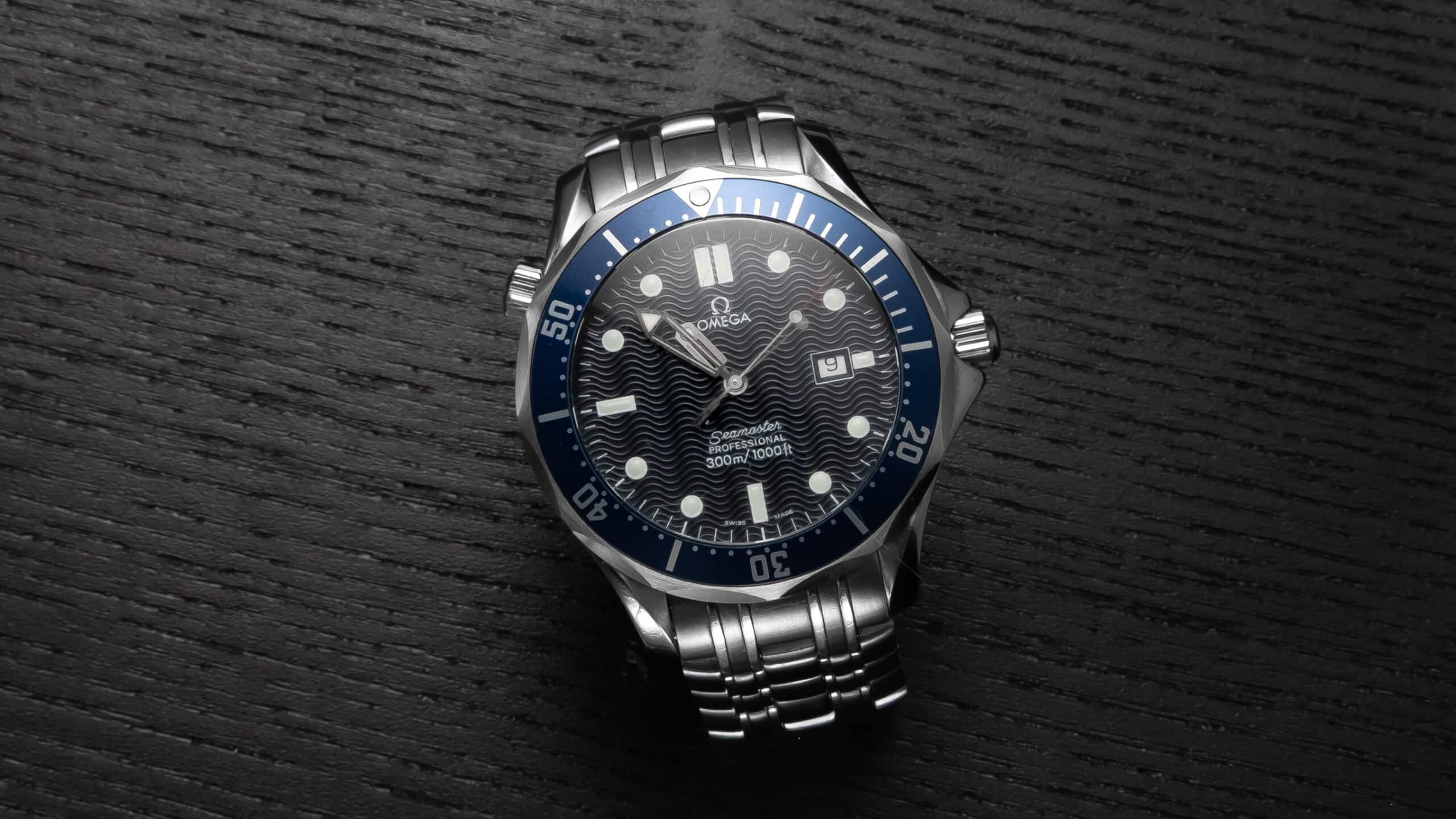
For a long time, the Omega Seamaster was more a symbol than an object to me. It was a shorthand for coolness that first registered in my brain when I saw it flash across the screen in GoldenEye. It wasn’t until years later, once I’d started collecting, that I recognized that early moment of recognition for what it was: the seed of interest. Now, after years of actual wear, that initial spark has evolved into something more grounded. This isn’t a watch I just admire for its history or movie pedigree. It’s one I’ve lived with, worn often, and come to understand on its own terms.
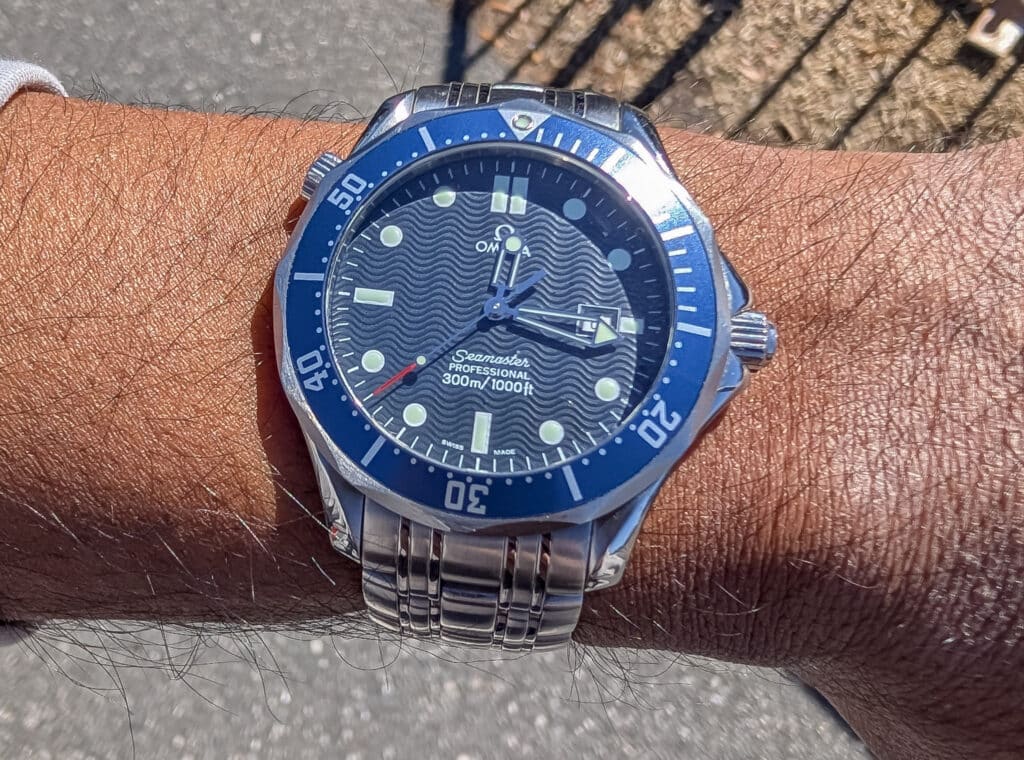
What’s always made me smile, though, is that this is the “Bond watch” no one seems to bring up. It’s the one I saw on Pierce Brosnan’s wrist as 007, the one that caught my attention before I even knew what Omega was. But unlike the mechanical version also offered by the brand that get all the spotlight, this one flies under the radar. There’s no pressure to revere it or treat it like an icon. I get to enjoy the design, the nostalgia, and the cultural halo without it ever feeling precious or performative. When I wear it, I don’t feel like I’m cosplaying a movie character. I just feel like I’m wearing a solid, well-designed diver that happens to have a little cinematic history riding along. That mix of function and fun is part of why I keep coming back to it.
The version I own is the ref. 2541.80.00 41mm quartz Seamaster Professional, with a 47.5mm lug-to-lug span, 11mm thickness, and 20mm lug width. It’s powered by the Omega Caliber 1438 quartz movement and rated to 300 meters of water resistance. The crystal is sapphire, and the case is stainless steel. Current secondhand pricing hovers between $2,000 – $3,500 based on condition. On paper, this watch would typically be a bit outside my comfort zone—I generally prefer watches under 40mm. But the slim profile, thanks to the quartz movement, completely shifts the wearing experience. It wears flatter, lighter, and more comfortably than the automatic Seamaster counterparts.
Case, Bezel Issues, and Wearing Experience
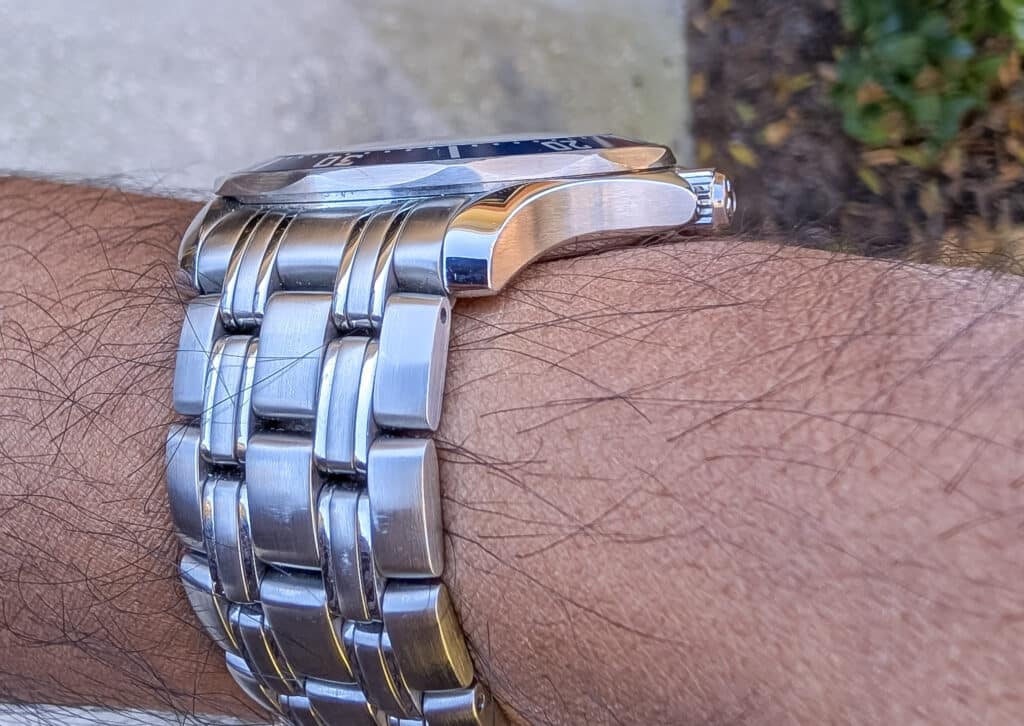
In many ways, the case represents a rare equilibrium that few watches achieve: it appears sturdy, yet not heavy-handed; capable, yet unpretentious. Its low profile helps it hug the wrist, particularly if, like me, you have a flatter wrist shape. However, the 47.5mm lug-to-lug does stretch out a bit, so those with rounder wrists might find it less forgiving. The caseback is a highlight with the design of the hippocampus logo sharply executed, and the construction as a whole feels premium.
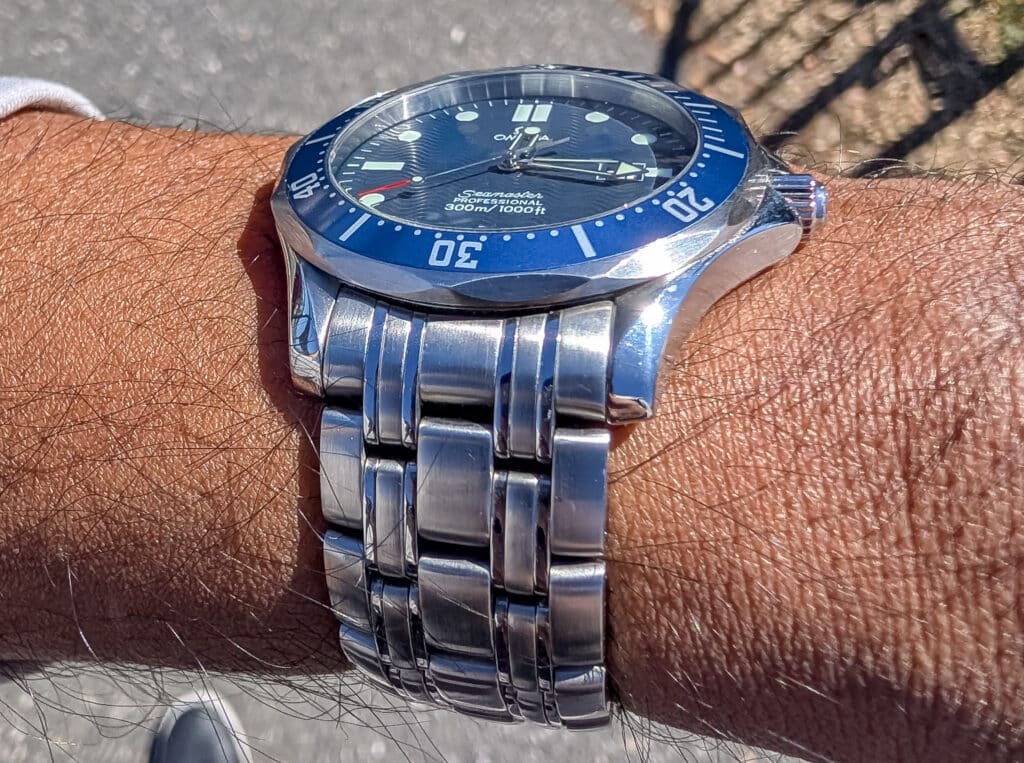
The bezel is where some quirks start to emerge. Alignment is usually good, but not foolproof, and the action itself lacks some tactile satisfaction. The grip, particularly, is a weak point. The low-set, angled facets make it tricky to grab, especially in warm weather when hands aren’t always dry. The crown is well-sized and tucked neatly, though the crown guards may be a bit tight for larger fingers. Fortunately, this being a quartz piece, I rarely need to use it.
Classic 90s Seamaster Dial
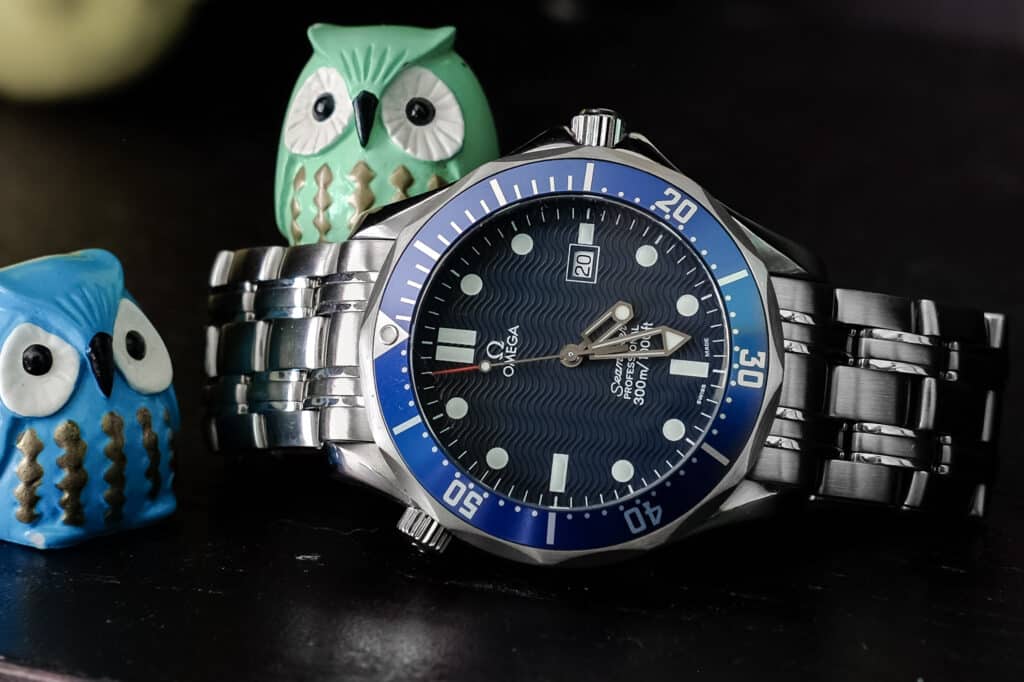
The dial features the earlier generation wave pattern, which is not as deeply etched as more recent models, but all the more charming for it. The grey tone is muted, offering a neutral canvas that lets the applied markers and skeleton hands breathe. Surprisingly, legibility isn’t compromised; those hands, which I once worried might feel too airy, are actually quite readable.
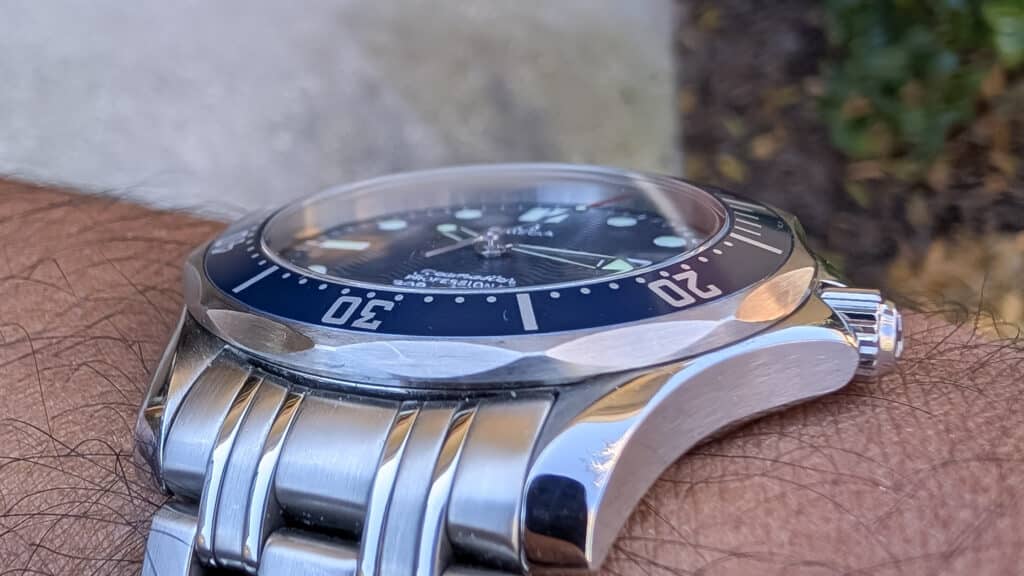
The red-tipped seconds hand is a perfect visual accent, noticeable but not intrusive. There’s a subtle dome to the crystal that introduces mild distortion at off angles, giving a nod to vintage dive watch aesthetics. That said, you do need to view the watch more or less head-on to read the time accurately.
Beautiful Bracelet, Big Headache
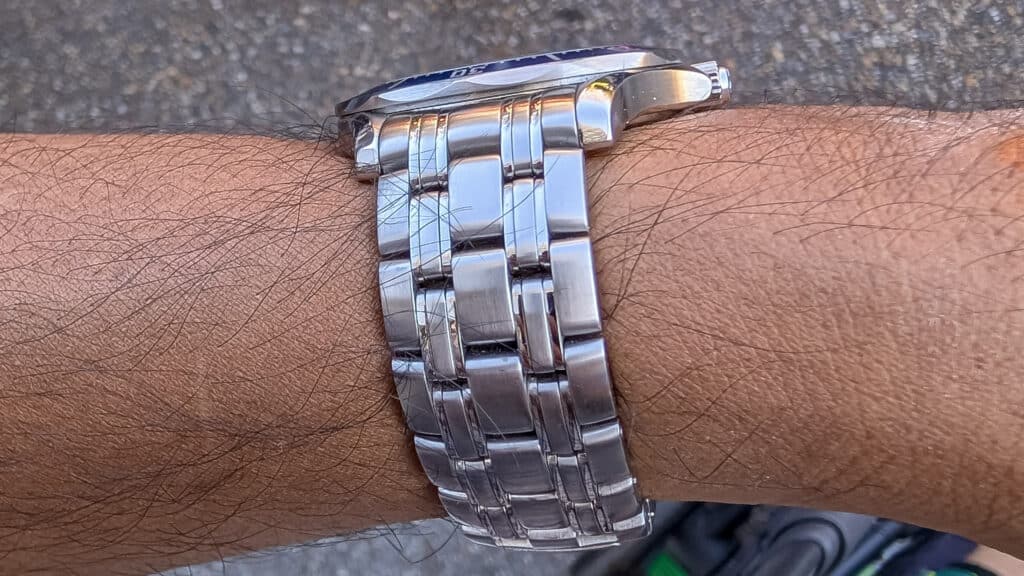
Out of the box, the classic Seamaster bracelet is both a blessing and a curse. It looks excellent, with alternating brushed and polished elements that reflect Omega’s design sensibilities of the time. The ergonomic fit is excellent on my 6.75inch wrist, but sizing is a nightmare. The collar-and-pin system is overly complex, and though it lends confidence once set, the process of getting there is frustrating. I tried a NATO strap once and while it photographed well, it never felt right.
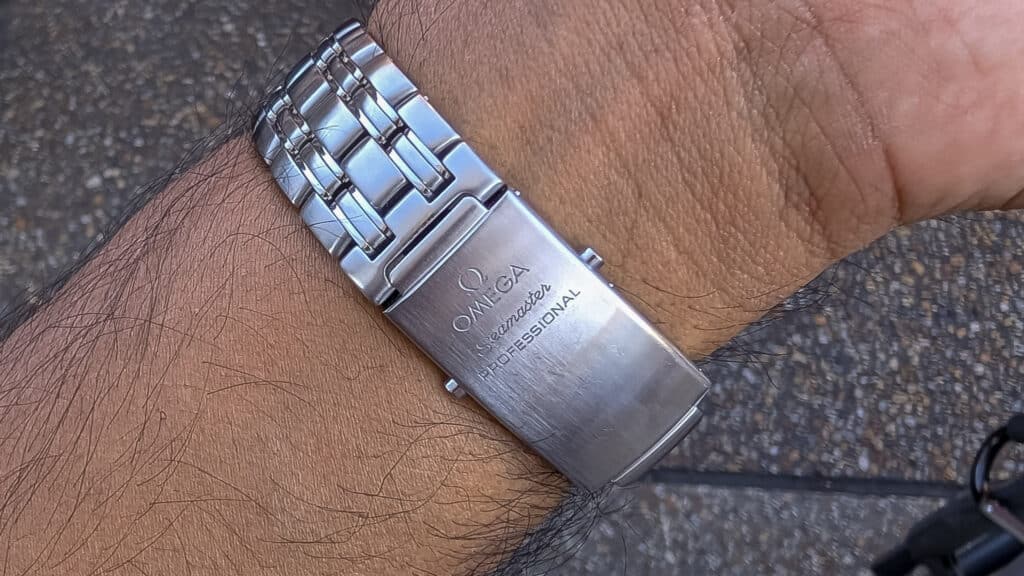
This watch belongs on its bracelet. I’ve also found that there is a quirk with the diver’s extension occasionally coming undone, possibly due to user error (I do tend to wear my watches snug), but it’s worth noting. I’ve even had that clasp replaced by Omega and this still occurs.
Chronometer-Certified Quartz Movement
The Caliber 1438 movement has been nothing short of stellar. As a certified chronometer-grade quartz, it keeps time better than any mechanical piece I own. It did require a service recently, which meant a trip back to Omega in Switzerland and a few weeks without the watch, but everything came back operating flawlessly. Some purists may scoff at quartz, especially in a brand known for co-axial mechanical innovations, but from a practicality and performance standpoint, I find quartz more appealing for daily wear.
Final Thoughts
I’ve noticed a real split among collectors when it comes to the quartz Seamasters. Some people get it immediately while others dismiss it almost out of reflex. There’s this idea that if a case design has an automatic sibling, the quartz version must somehow be the lesser one, like it’s filling space in the catalog rather than holding its own. That’s never how this watch felt to me. If anything, I’ve come to appreciate how the quartz model reframes the entire design: lighter, flatter, and less finicky. It’s not pretending to be mechanical, and there’s a kind of integrity in that. I never have to baby it, wind it, or worry about power reserve. For the way I actually wear watches it ends up being one of the most reliable things in the box.
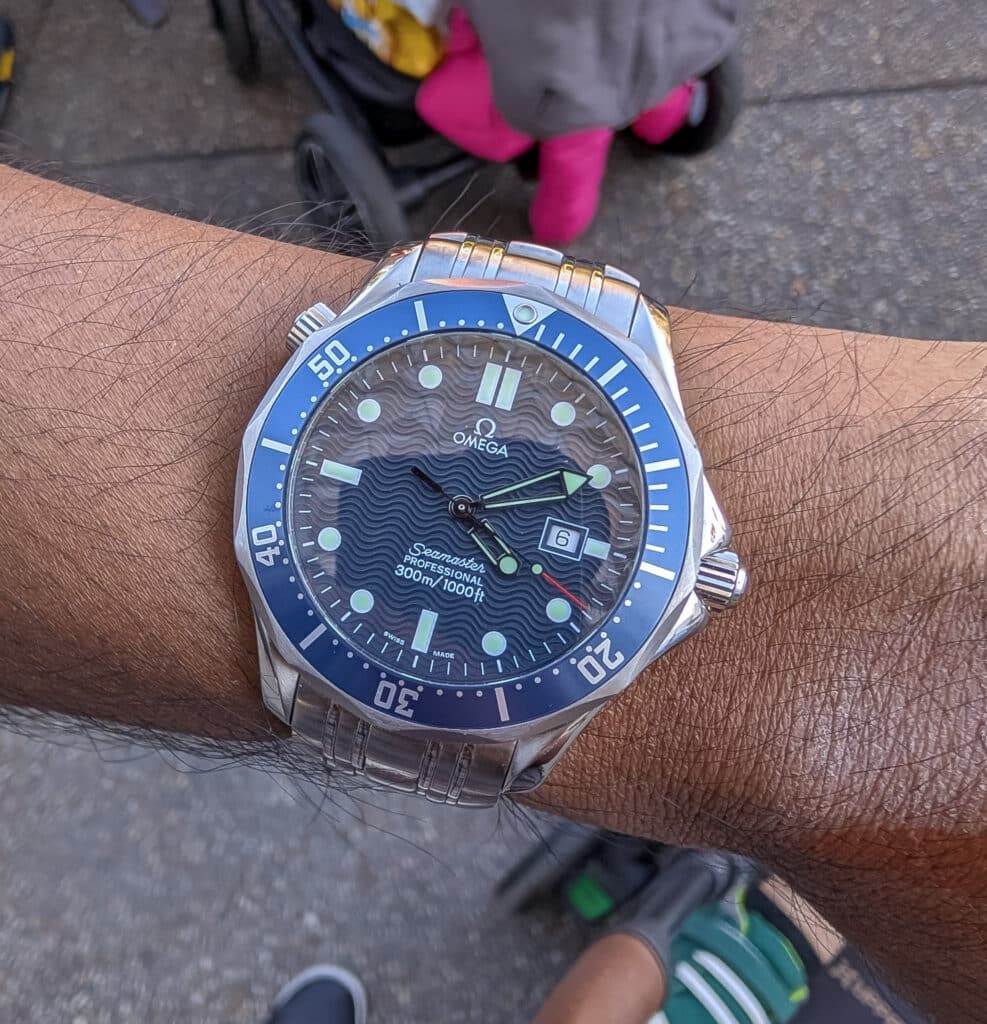
After several years, my view of this Seamaster has only solidified. It’s not flawless. The quirks (bezel grip, sizing struggles, the diver’s extension) might turn some off. But for me, those imperfections fade in the context of what this watch delivers: reliability, nostalgia, and a tactile wearing experience that remains compelling. It doesn’t beg for attention, yet it rewards it. It’s the kind of watch that reveals its strengths over time, rather than shouting them up front. It won’t be leaving my collection. Some watches ask to be babied; this one invites you to live with it. And that, more than anything, has earned its place on my wrist.

Co-Founder and Senior Editor
Kaz has been collecting watches since 2015, but he’s been fascinated by product design, the Collector’s psychology, and brand marketing his whole life. While sharing the same strong fondness for all things horologically-affordable as Mike (his TBWS partner in crime), Kaz’s collection niche is also focused on vintage Soviet watches as well as watches that feature a unique, but well-designed quirk or visual hook.
The whole point of wearing a watch these days is that you are wearing a mini mechanical miracle on your wrist that can and does take a beating but still keeps on beating. I get that some people just wear watches for looks (people that wear quartz watches) but calling a mechanical watch “finicky” is dismal is the poorest way possible. If you like something that fine but why you like it can be both parts mystery and nostalgia which it seems it is in this case. Is it a good looking watch? Yes it is, is it worth buying over the mechanical version, no and it never will be. If your are strapped for cash and want to look like you can afford more than you can this is an obvious choice. I cannot think of a single reason to buy the quartz over the mechanical. I would rather not buy at all.
Hi, Subrosa:
I completely understand the perspective on mechanical watches that you’re sharing. I think when people say things like mechanical watches are finnicky or they require more maintenance than quartz, I think what they’re really speaking to is lifestyle. A lot of people don’t want to wind a watch every time they pick it up and they don’t necessarily want to buy a watch winder. Similarly, there are some mechanical movements that are prone to issues or require more servicing than people are willing to commit to. We don’t feel like there is any issue with quartz and mechanical versions of watches existing since I think its less about budget for people and more about what kind of wearing experience they want.
Thank you for checking out our piece and sharing your thoughts.
Best,
-Kaz
I had purchased my 2541.80 in June of 2001. When I walked into the PX the quartz model was $987 while the mechanical was $1150. My choice was not about price, but how I was going to use it. At the time quartz was king and mechanical watches were unreliable novelties of a previous era. I wanted accuracy for mission timing, shock resistance and water resistance. I also wanted the watch I first saw in Goldeneye. But not being to afford the mechanical was not one of them. The movement still ticks on after 5 battery replacements. It’s had every seal replaced and the gear train has been serviced. An upgraded quartz crystal and PCB was installed a decade ago but the movement base, plates jewels and gears are original. It has survived two wars, diving excursions and many bangs on door jambs and car lifts. It is not the lesser but for a practical sense is the actual better of the two.
Hi, Douglas:
Really appreciate you sharing that context and your own personal experience with the 2541. That kind of firsthand experience adds a lot more value to this conversation than the usual collector hindsight and really drives home the idea I was trying to capture. Quartz is in no way a compromise and that sometimes it should actually be the preferred option.
Thank you,
-Kaz
I have the same model watch, but in does not have a red second hand, don’t know why. Had it since 1996, worn everyday, everywhere, indestructible. Every 3 years or so when the battery expires I get it replaced and fully serviced by UK independent service company; expensive but worth it. Looks a bit battered now, never had the outside refurbished. I love it!
Hi, Roger:
That’s interesting – if it is indeed the 2541 then perhaps the red has faded to white. I’ve heard of that happening before, but maybe it was also replaced during on of the services? It’s hard to say really. But I’m glad you love the watch. For me its a core part of my collection and I’m always excited when I wear it.
Best,
-Kaz
The lug-to-lug of the 2541 is not 50mm. That’s what you get on the current gen chunky SMPs from 2018.
Hi, Mike:
Thank you so much for spotting this error on my part. I’ve gone ahead and fixed the lug to lug measurement.
Very much appreciated!
Best,
-Kaz
I enjoyed the article but wanted to point out the vast majority of 2541.80 watches use the Omega 1538 movement, not 1438. The 1438 was phased out in 1994. As the 2541.80 was produced from 1993 to 2006, nearly all have the 1538. If your watch has the 1438 it’s had the dial replaced as yours has Superluminova lume and not tritium–which was phased out in 1997-98.
Good catch, and thanks for the detailed breakdown. We’ll get that updated. The lume and dial detail is a sharp observation too. Thanks for keeping us accurate.